
Sugar-Free Ice Cream Market Size and Share
Market Overview
| Study Period | 2022 - 2032 |
|---|---|
| Market Size (2027) | USD 9.10 Billion |
| Market Size (2032) | USD 13.40 Billion |
| Growth Rate (2027 - 2032) | 8.05 % |
| Fastest Growing Market | Asia-Pacific |
| Largest Market | North America |
| Market Concentration | Low |
Major Players *Disclaimer: Major Players sorted in no particular order Image © Mordor Intelligence. Reuse requires attribution under CC BY 4.0. | |
Sugar-Free Ice Cream Market Analysis by Mordor Intelligence
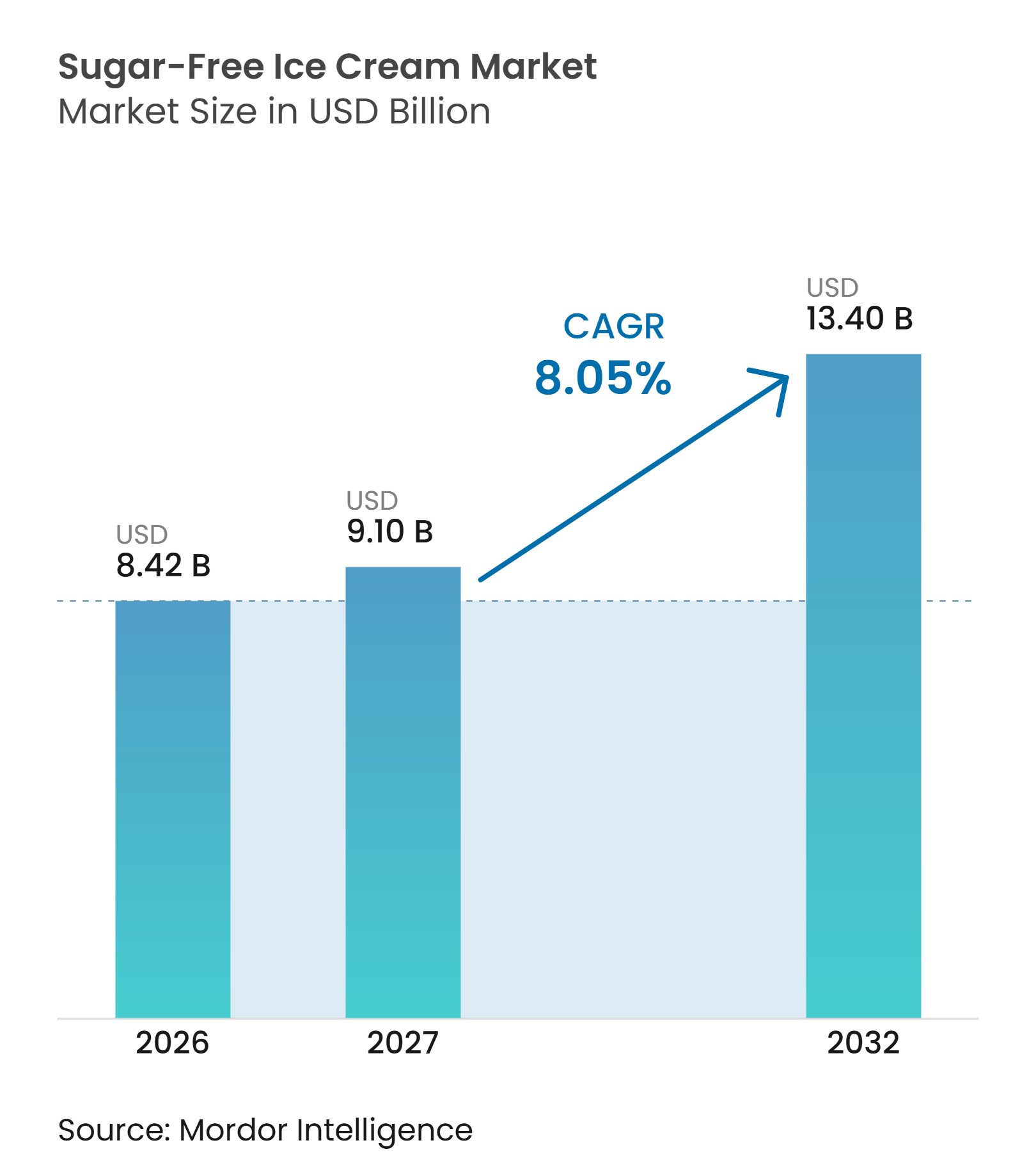
The sugar-free ice cream market size is expected to grow from USD 8.42 billion in 2026 to USD 9.10 billion in 2027 and is forecast to reach USD 13.40 billion by 2032 at an 8.05% CAGR over 2027-2032. The sugar-free ice cream market is benefiting from growing health awareness and increasing consumer interest in healthier dessert alternatives that deliver familiar taste and texture. Rising demand for reduced-sugar food options is encouraging manufacturers to expand their product offerings and improve flavor, creaminess, and ingredient quality. Wider retail availability and the growth of digital sales channels are making these products more accessible to consumers. Established manufacturers leverage their distribution networks, while emerging brands strengthen market presence through product innovation and direct-to-consumer channels.
Key Report Takeaways
• By product type, tubs held 43.21% of the sugar-free ice cream market share in 2026, while bars and sticks are forecast to expand at a CAGR of 8.63% through 2032.
• By flavor, vanilla accounted for 32.11% of the sugar-free ice cream market size in 2026, while chocolate is forecast to expand at a CAGR of 9.22% through 2032.
• By distribution channel, off-trade held 75.55% of the sugar-free ice cream market share in 2026, while on-trade is projected to expand at a CAGR of 10.41% through 2032.
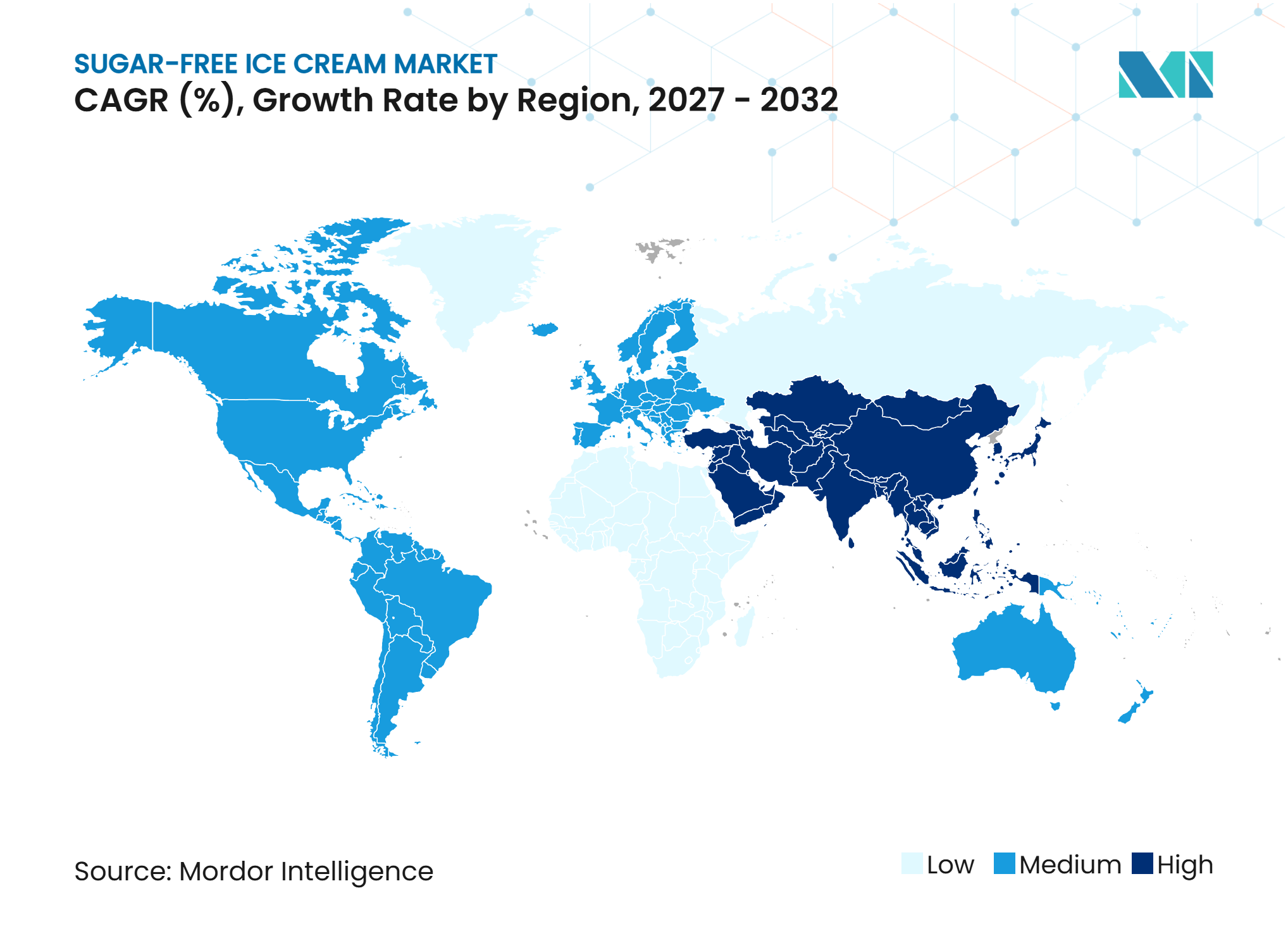
• By geography, North America held 35.18% of the sugar-free ice cream market size in 2026, while Asia-Pacific is forecast to expand at a CAGR of 9.61% through 2032.
Note: Market numbers in this report are based on Mordor Intelligence's proprietary estimation framework, which combines nine months of actuals with Q4 projections for base year 2026.
Market Trends and Insights
Drivers Impact Analysis of Sugar-Free Ice Cream Market*
| Driver | (~) % Impact on CAGR Forecast | Geographic Relevance | Impact Timeline |
|---|---|---|---|
| Rising diabetes and obesity management needs | +1.8% | Global, with high intensity in North America, South Asia, and Southeast Asia | Long term (≥ 4 years) |
| Growing preference for low-sugar and reduced-sugar diets | +1.5% | Global, strongest in North America, Western Europe, and urban Asia-Pacific | Medium term (2-4 years) |
| Expansion of better-for-you frozen dessert innovation | +1.1% | Global, with highest intensity in North America and Western Europe | Medium term (2-4 years) |
| Growing demand for portion-controlled and convenient formats | +0.8% | Global, with highest uptake in North America, Japan, and South Korea | Short term (≤ 2 years) |
| Increasing demand for clean-label and low-sugar frozen desserts | +0.9% | North America and Europe, with spillover to core Asia-Pacific markets | Medium term (2-4 years) |
| Rising consumer awareness of sugar reduction and alternative sweeteners | +0.7% | Global, accelerating in urban Asia-Pacific and Middle East and Africa markets | Long term (≥ 4 years) |
| Source: Mordor Intelligence | |||
Rising Diabetes and Obesity Management Needs
The increasing prevalence of obesity is encouraging consumers to adopt healthier dietary habits and pay closer attention to sugar intake. For instance, in 2025, according to the World Obesity Federation, the global adult population living with obesity is projected to reach 1.13 billion by 2030 [1]. This growing health burden is strengthening interest in dessert alternatives that align with weight-management and sugar-conscious eating preferences. For instance, in March 2026, The House of Ice Cream Works introduced its Zero Sugar Added range, using stevia and monk fruit to deliver sweetness while retaining a creamy texture. Such developments are expanding healthier frozen dessert offerings and making them more appealing to consumers seeking to balance dietary preferences with indulgence.
Growing Preference for Low-Sugar and Reduced-Sugar Diets
Growing consumer preference for healthier eating habits is encouraging greater attention to sugar content and nutritional composition when purchasing food products. For instance, in 2025, according to the International Food Information Council, 75% of Americans were trying to limit or avoid sugar, with 63% of these consumers specifically targeting added sugars. Additionally, 25% of consumers trying to manage sugar intake reported purchasing sugar-free products when available [2]. This preference is encouraging ice cream manufacturers to expand their reduced-sugar offerings while retaining familiar flavors and indulgent characteristics. For instance, in February 2025, NIC (Walko Food Company Pvt. Ltd.) introduced a No Added Sugar ice cream range, featuring five flavors, including Alphonso Mango and Tender Coconut.
Expansion of Better-for-You Frozen Dessert Innovation
Rising consumer interest in nutritionally enhanced desserts is encouraging manufacturers to develop frozen products that combine indulgent flavors with improved nutritional attributes. For instance, in July 2026, according to the National Frozen & Refrigerated Foods Association, 49% of consumers expressed interest in high-protein frozen treats, highlighting opportunities for innovation in functional frozen desserts [3]. Manufacturers are responding through product development involving protein enrichment and reduced-sugar formulations. For instance, in April 2025, Two Spoons Creamery launched its high-protein ice cream range, offering 30 grams of protein per container with zero added sugar. Available in four flavors, the range uses allulose as an alternative sweetener while incorporating traditional dessert mix-ins.
Growing Demand for Portion-Controlled and Convenient Formats
Increasing demand for convenient dessert options is prompting consumers to seek sugar-free ice cream in formats that enable easier portion control and greater flexibility in consumption. Individually packaged cups, bars, sticks, and single-serve tubs allow consumers to enjoy desserts in controlled quantities while managing their sugar intake and maintaining their dietary preferences. These formats are particularly suitable for busy lifestyles, offering easy storage, portability, and convenient consumption at home, at work, and while traveling. Manufacturers are responding by expanding their product portfolios with smaller pack sizes, individually wrapped portions, and ready-to-eat formats. Greater availability of these convenient options is improving product accessibility, supporting a wider range of consumption occasions, and strengthening the appeal of sugar-free ice cream among health-conscious consumers.
Restraints Impact Analysis of Sugar-Free Ice Cream Market*
| Restraint | (~) % Impact on CAGR Forecast | Geographic Relevance | Impact Timeline |
|---|---|---|---|
| Technical challenges in replacing sugar's functional properties | -1.2% | Global, most acute in emerging markets with limited research and development access | Long term (≥ 4 years) |
| Sweetener-related aftertaste and gastrointestinal tolerance | -1.0% | Global, with strongest resistance in Western Europe and mature North American markets | Medium term (2-4 years) |
| Consumer preference for traditional indulgent ice cream experiences | -0.8% | Global, strongest in Southern Europe, parts of South America, and rural Asia-Pacific | Long term (≥ 4 years) |
| Higher formulation and specialty ingredient costs | -0.7% | Global, with the greatest effect in price-sensitive Asia-Pacific and South American markets | Medium term (2-4 years) |
| Source: Mordor Intelligence | |||
Technical Challenges in Replacing Sugar's Functional Properties
Replacing sugar in ice cream formulations presents technical challenges because sugar contributes to more than sweetness, influencing texture, creaminess, freezing behavior, and overall product stability. Removing or reducing sugar can affect the balance of solids and water, potentially resulting in harder textures, larger ice crystals, reduced smoothness, and changes in melting characteristics. Manufacturers must carefully select and balance alternative sweeteners, bulking agents, and stabilizers to maintain the sensory and physical properties expected from conventional ice cream. Achieving the right sweetness profile while preserving creaminess, scoopability, and product stability can increase formulation complexity and development costs.
Sweetener-Related Aftertaste and Gastrointestinal Tolerance
The use of alternative sweeteners in sugar-free ice cream can pose challenges for taste perception and consumer tolerance. Certain high-intensity sweeteners may produce bitter, metallic, or lingering aftertastes that affect the overall flavor profile and reduce consumer acceptance. Sugar alcohols and some other sweetening ingredients may also cause digestive discomfort, including bloating, gas, or laxative effects when consumed in larger quantities. These effects can influence repeat purchases, particularly among consumers who are sensitive to specific sweeteners. Manufacturers must therefore balance sweetness intensity, flavor quality, and ingredient tolerance while selecting suitable sweetener combinations. Maintaining a pleasant taste and comfortable consumption experience without compromising the sugar-free formulation remains a key product-development challenge.
*Our forecasts treat driver/restraint impacts as directional, not additive. The impact forecasts reflect baseline growth, mix effects, and variable interactions.
Sugar-Free Ice Cream Market Segment Analysis
By Product Type:
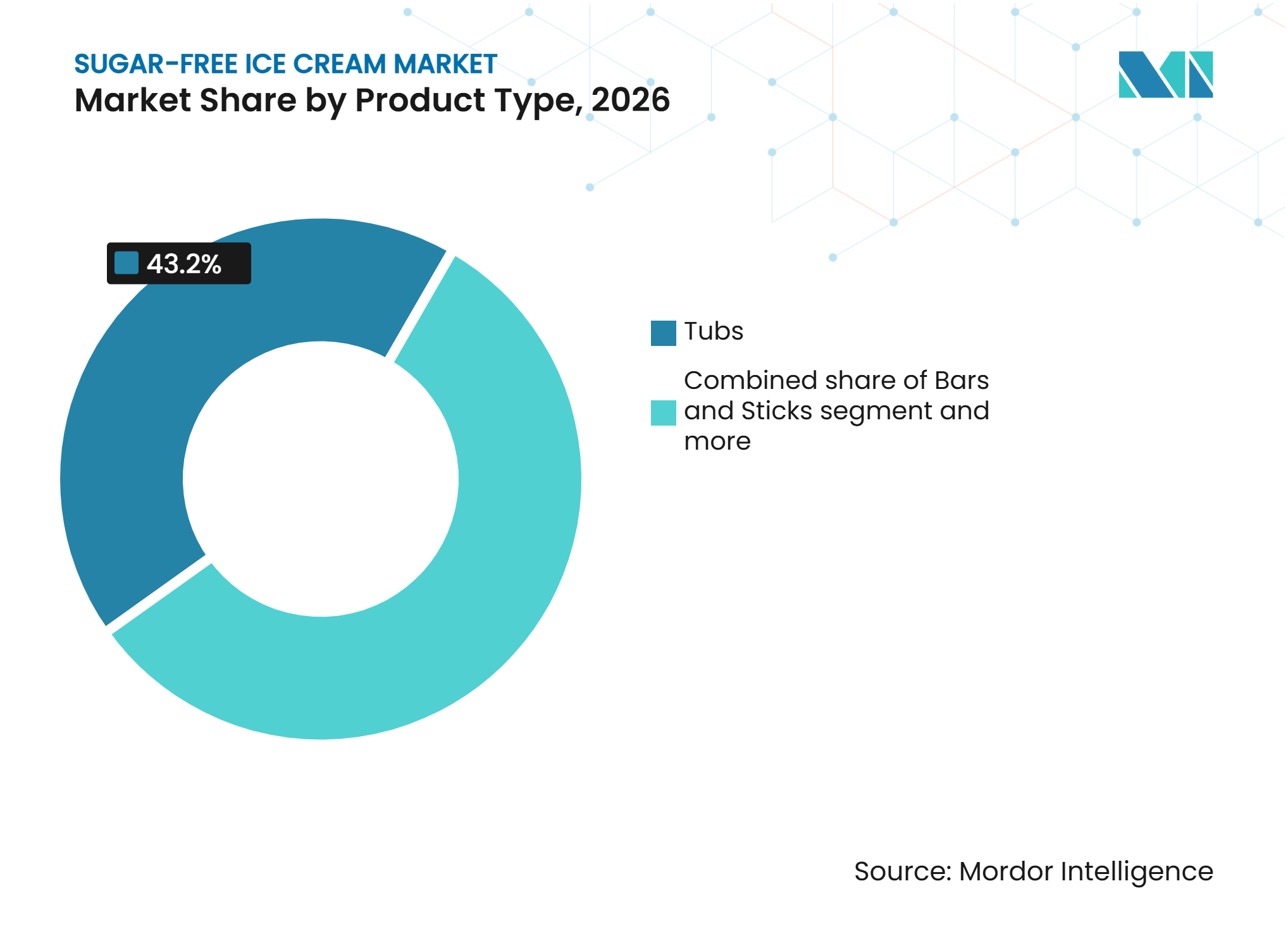
Single-Serve Formats Gain Share from Traditional TubsTubs held 43.21% of the sugar-free ice cream market share in 2026, reflecting the category’s roots in household take-home consumption. Tubs maintain a strong position in the sugar-free ice cream market due to their suitability for household consumption and planned grocery shopping. Their availability across supermarket and hypermarket freezer sections provides consumers with convenient access to familiar frozen dessert formats. Tubs also allow manufacturers to offer a wider variety of flavors and premium product options, encouraging consumers to explore sugar-free alternatives within established consumption occasions. Larger pack sizes provide multiple servings, making them suitable for families and shared consumption while offering greater value per serving. Retailers can further improve product visibility through dedicated better-for-you and sugar-free freezer sections.
Bars and sticks are forecast to expand at a CAGR of 8.63% through 2032. The growth of bars and sticks in the sugar-free ice cream market is supported by increasing demand for convenient, portable, and portion-controlled dessert options. Their individual serving format allows consumers to manage their consumption more easily while enjoying sugar-free treats without having to scoop or store larger quantities after opening. These products are well suited to on-the-go consumption, including workplace breaks, travel, and quick snacks, broadening consumption beyond traditional at-home dessert occasions. Their compact packaging also supports distribution through convenience stores, supermarkets, and online delivery platforms. Manufacturers can differentiate these formats through flavor variety, coatings, inclusions, and innovative textures, making them appealing to consumers seeking both convenience and indulgence.



By Flavor:
Vanilla’s Familiarity Supports Trial While Chocolate Gains MomentumVanilla held 32.11% of the sugar-free ice cream market share in 2026. Vanilla holds a leading position in the sugar-free ice cream market due to its widespread consumer familiarity and broad appeal across different age groups and taste preferences. Its simple, recognizable flavor makes it an accessible choice for consumers trying sugar-free ice cream for the first time, allowing them to evaluate the product's sweetness, creaminess, and overall quality without encountering unfamiliar flavor combinations. Vanilla also offers versatility across product formats, including tubs, bars, sticks, and sandwiches, making it suitable for both household consumption and foodservice applications. Its compatibility with toppings, sauces, and other inclusions enables manufacturers to introduce product variations while retaining a familiar flavor base.
Chocolate is forecast to expand at a CAGR of 9.22% through 2032. Chocolate is experiencing strong growth in the sugar-free ice cream market as consumers increasingly seek indulgent dessert options that offer reduced-sugar formulations without compromising on taste. Its rich flavor profile and versatility allow manufacturers to develop a wide range of products featuring chocolate coatings, chips, swirls, and layered inclusions. These applications help enhance flavor depth and texture while improving the overall sensory appeal of sugar-free ice cream. Chocolate also provides opportunities for premium product positioning through combinations with nuts, caramel, coffee, and other complementary ingredients. Improvements in alternative sweetener blends are further supporting manufacturers in achieving a more balanced sweetness profile and developing richer flavor experiences.
By Distribution Channel:
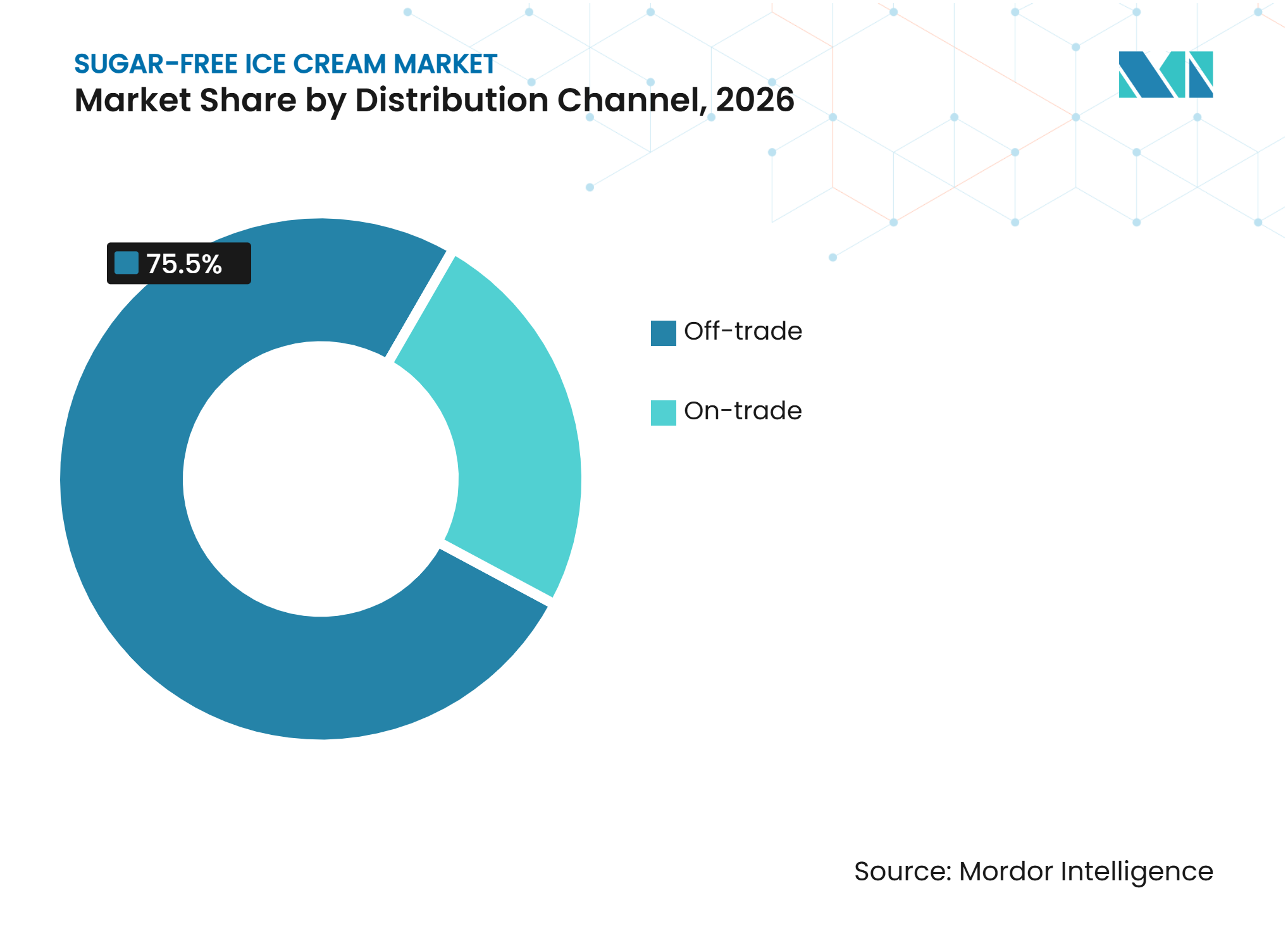
Off-Trade Anchors Volume While On-Trade Builds DiscoveryOff-trade held 75.55% of the sugar-free ice cream market share in 2026. Supermarkets and hypermarkets maintain a leading position in the sugar-free ice cream market due to their extensive retail networks, established cold-chain infrastructure, and ability to offer a wide range of frozen desserts. These outlets support planned household purchases by offering multiple pack sizes, flavors, and brands within dedicated freezer sections. Greater visibility of better-for-you and reduced-sugar products also helps consumers compare nutritional information, ingredients, and prices before purchasing. Their established presence and broad product assortment make them important channels for reaching health-conscious consumers and encouraging trial purchases.
On-trade is forecast to expand at a CAGR of 10.41% through 2032. Foodservice outlets, including restaurants, cafés, hotels, and other hospitality operators, are creating additional opportunities for sugar-free ice cream as alternative dessert options become more widely available. These establishments can incorporate sugar-free varieties into their menus to cater to consumers who monitor their sugar intake while still seeking indulgent dessert experiences. They also provide opportunities for product discovery, allowing consumers to experience different flavors and formulations before purchasing packaged products through retail channels. Specialist health-food stores and other alternative retail outlets further support market development by improving access to niche brands and catering to specific dietary preferences.

Geography Analysis
North America
North America accounted for 35.18% of the sugar-free ice cream market in 2026. North America holds a leading position in the sugar-free ice cream market due to its mature frozen food retail infrastructure, established ice cream consumption patterns, and growing consumer interest in healthier dessert alternatives. Rising awareness of obesity, diabetes, and dietary sugar intake is encouraging consumers to consider products that align with sugar-conscious eating habits. The region benefits from extensive supermarket and hypermarket networks, well-developed cold-chain distribution, and strong brand presence, enabling manufacturers to make sugar-free ice cream available across multiple product formats. Consumers' familiarity with nutritional labeling and better-for-you product claims also supports product discovery and purchasing decisions.
Asia-Pacific
Asia-Pacific is forecast to expand at a CAGR of 9.61% through 2032. Asia-Pacific is witnessing strong growth in the sugar-free ice cream market, supported by increasing health awareness, rising disposable incomes, and growing consumer interest in healthier indulgent food options. Expanding urban populations and changing dietary preferences are encouraging demand for frozen desserts that offer familiar flavors with reduced or no added sugar. Countries such as India, Japan, South Korea, and China are creating opportunities through the expansion of modern retail, quick-commerce platforms, and digital distribution channels. The growing presence of domestic and international manufacturers is further strengthening product availability, with companies focusing on alternative sweeteners, innovative flavors, and premium formulations.
Europe, South America, and Middle East and Africa
Europe's sugar-free ice cream market is supported by growing consumer awareness of healthier eating habits, clean-label preferences, and increasing demand for lower-sugar dessert alternatives. Established frozen-food retail networks and strong consumer interest in premium products create favorable opportunities for manufacturers to expand their offerings. In South America, rising health awareness, urbanization, and evolving dietary preferences are supporting demand for sugar-free desserts, particularly in major urban markets. Improving cold-chain infrastructure and expanding retail availability are further creating opportunities for market penetration. In the Middle East and Africa, rising awareness of sugar consumption, growing interest in alternative dessert options, and the expansion of modern retail channels are driving market growth.
Competitive Landscape
Market Concentration
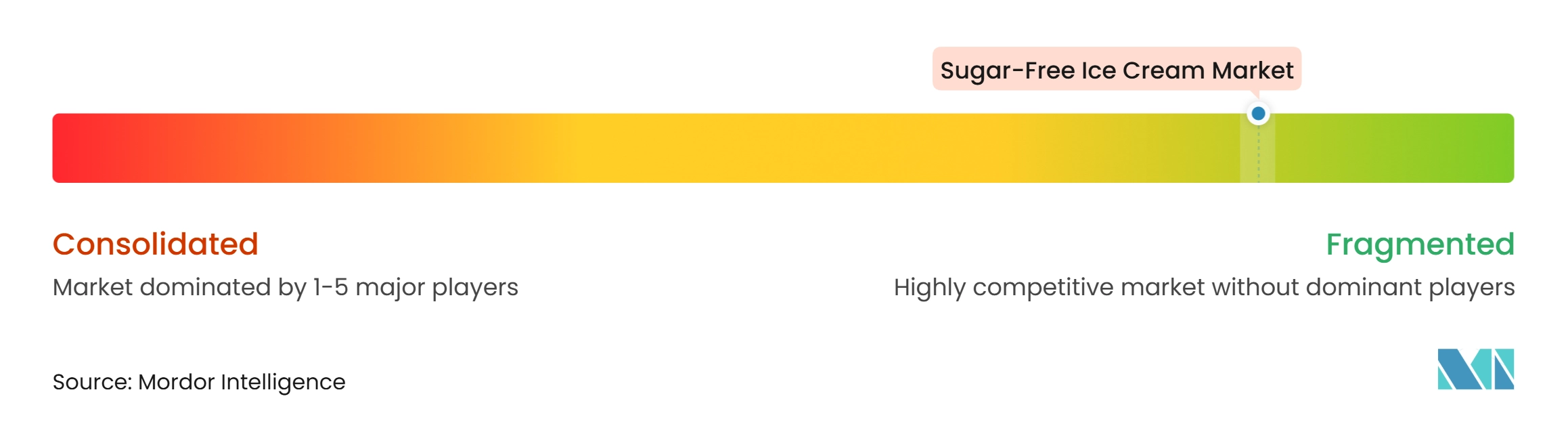
The sugar-free ice cream market is fragmented, with competition from established multinational manufacturers and specialized emerging brands. Large companies benefit from established manufacturing capabilities, extensive distribution networks, strong retail relationships, and recognized ice cream brands. Their existing product portfolios allow them to introduce sugar-free and reduced-sugar alternatives while leveraging consumer trust and market reach. This provides an advantage in expanding product availability across supermarkets, hypermarkets, and other retail channels.
Specialist brands compete through focused product positioning, alternative sweetener formulations, premium ingredients, and differentiated flavors. Their ability to maintain taste, texture, and product quality is important for building consumer loyalty and encouraging repeat purchases. Emerging companies are also strengthening their market presence through product innovation, geographic expansion, and digital distribution channels. Their specialized offerings help address consumer preferences that may not be fully served by conventional ice cream portfolios.
Ingredient innovation and formulation capabilities are becoming increasingly important competitive factors. Manufacturers are focusing on alternative sweetener combinations and improved formulations to address challenges related to sweetness, texture, and overall product quality. Competition is also influenced by pricing, retail accessibility, and the ability to serve different consumer preferences across regional markets. Overall, companies that combine consistent sensory quality, product differentiation, and effective distribution are better positioned to strengthen their market presence.
Sugar-Free Ice Cream Industry Leaders
-
Rebel Creamery, LLC
-
Heritage Foods Limited (Get-A-Way)
-
Unilever PLC (Breyers)
-
Froneri International Limited (Edy's / Dreyer's)
-
Hiland Dairy Foods Company, LLC (Hiland Dairy)
- *Disclaimer: Major Players sorted in no particular order
Sugar-Free Ice Cream Market Companies Covered in this Report
- Rebel Creamery, LLC
- Heritage Foods Limited (Get-A-Way)
- Unilever PLC (Breyers)
- Froneri International Limited (Edy's / Dreyer's)
- Hiland Dairy Foods Company, LLC (Hiland Dairy)
- Richman's Ice Cream Company
- Innodelice Ltd. (Papafilipou)
- Vadilal Industries Limited
- Bluemount Premium Dairy LLP (Alps Premium Ice Cream)
- Walko Food Company Pvt. Ltd. (NIC)
- Go Zero Foods Pvt. Ltd. (Go Zero)
- NOTO Foods Pvt. Ltd. (NOTO)
- Minus Thirty
- Devyani Food Industries Ltd. (Cream Bell)
- The Brooklyn Creamery
- Denada Co. (Denada)
- Keto Pint
- Inspire Brands, Inc. (Baskin-Robbins)
- Hershey Creamery Company
- Aroma Ice Creams (LEAN Ice Cream)
Recent Industry Developments in Sugar-Free Ice Cream Market
- July 2026: The Brooklyn Creamery launched its Protein Ice Cream Bars in India, combining protein enrichment with an indulgent dessert format. Each bar contains 10g of protein and zero added sugar, with Triple Chocolate and Vanilla Caramel Crunch flavors.
- May 2026: Valsoia expanded its Bontà e Salute ice cream portfolio with a sugar-free cone and a dual-flavor hazelnut-and-pistachio tub. The cone combined plant-based ice cream with chocolate swirls, wafer, and hazelnut toppings and contained no added sugar.
- March 2026: Blue Bell introduced its Blue Bell PRO frozen dairy dessert range, featuring Vanilla, Chocolate, Strawberry, Coffee, and Salted Caramel. The products contain zero added sugar and offer 33–35g of protein per pint, expanding the company's portfolio of nutritionally enhanced frozen desserts.
Global Sugar-Free Ice Cream Market Report Scope
The sugar-free ice cream market includes frozen desserts formulated without sugar, using alternative sweeteners to provide sweetness while maintaining taste and texture. The market is segmented by Product Type (Tubs, Bars and Sticks, Sandwiches, and Other Product Types), Flavor (Vanilla, Chocolate, Strawberry, and Other Flavors), Distribution Channel (On-Trade and Off-Trade), and Geography (North America, Europe, Asia-Pacific, South America, and the Middle East and Africa). The Off-Trade segment is further divided into Supermarkets and Hypermarkets, Convenience Stores, Specialist Retailers, Online Retail, and Other Distribution Channels. Market forecasts are provided in terms of value (USD).
Segmentation Overview
| Tubs |
| Bars and Sticks |
| Sandwiches |
| Other Product Types |
| Vanilla |
| Chocolate |
| Strawberry |
| Other Flavors |
| On-trade | |
| Off-trade | Supermarkets and Hypermarkets |
| Convenience Stores | |
| Specialist Retailers | |
| Online Retail | |
| Other Distribution Channels |
| North America | United States |
| Canada | |
| Mexico | |
| Rest of North America | |
| Europe | United Kingdom |
| Germany | |
| France | |
| Italy | |
| Spain | |
| Netherlands | |
| Poland | |
| Belgium | |
| Sweden | |
| Rest of Europe | |
| Asia-Pacific | China |
| Japan | |
| India | |
| Australia | |
| Indonesia | |
| South Korea | |
| Thailand | |
| Singapore | |
| Rest of Asia-Pacific | |
| South America | Brazil |
| Argentina | |
| Colombia | |
| Chile | |
| Peru | |
| Rest of South America | |
| Middle East and Africa | South Africa |
| Saudi Arabia | |
| United Arab Emirates | |
| Nigeria | |
| Egypt | |
| Morocco | |
| Turkey | |
| Rest of Middle East and Africa |
| By Product Type | Tubs | |
| Bars and Sticks | ||
| Sandwiches | ||
| Other Product Types | ||
| By Flavor | Vanilla | |
| Chocolate | ||
| Strawberry | ||
| Other Flavors | ||
| By Distribution Channel | On-trade | |
| Off-trade | Supermarkets and Hypermarkets | |
| Convenience Stores | ||
| Specialist Retailers | ||
| Online Retail | ||
| Other Distribution Channels | ||
| By Geography | North America | United States |
| Canada | ||
| Mexico | ||
| Rest of North America | ||
| Europe | United Kingdom | |
| Germany | ||
| France | ||
| Italy | ||
| Spain | ||
| Netherlands | ||
| Poland | ||
| Belgium | ||
| Sweden | ||
| Rest of Europe | ||
| Asia-Pacific | China | |
| Japan | ||
| India | ||
| Australia | ||
| Indonesia | ||
| South Korea | ||
| Thailand | ||
| Singapore | ||
| Rest of Asia-Pacific | ||
| South America | Brazil | |
| Argentina | ||
| Colombia | ||
| Chile | ||
| Peru | ||
| Rest of South America | ||
| Middle East and Africa | South Africa | |
| Saudi Arabia | ||
| United Arab Emirates | ||
| Nigeria | ||
| Egypt | ||
| Morocco | ||
| Turkey | ||
| Rest of Middle East and Africa | ||
Key Questions Answered in the Report
What is the market size of sugar-free ice cream?
The sugar-free ice cream market is estimated to reach USD 8.42 billion in 2026 and USD 9.10 billion in 2027. The market is projected to grow to USD 13.40 billion by 2032, registering a CAGR of 8.05% during 2027-2032.
Which sugar-free ice cream format is growing fastest?
Bars and sticks are forecast to expand at a CAGR of 8.63% through 2032, supported by convenient and portion-controlled consumption.
Which flavor leads sugar-free ice cream sales?
Vanilla leads with a 32.11% of the sugar-free ice cream market share in 2026.
Which region is expected to grow fastest?
Asia-Pacific is forecast to expand at a CAGR of 9.61% through 2032, aided by urban direct-to-consumer brands and premium product demand.