
Market Overview
| Study Period | 2021 - 2031 |
|---|---|
| Market Size (2026) | USD 9.07 Billion |
| Market Size (2031) | USD 17.97 Billion |
| Growth Rate (2026 - 2031) | 14.66 % |
| Fastest Growing Market | North America |
| Largest Market | Europe |
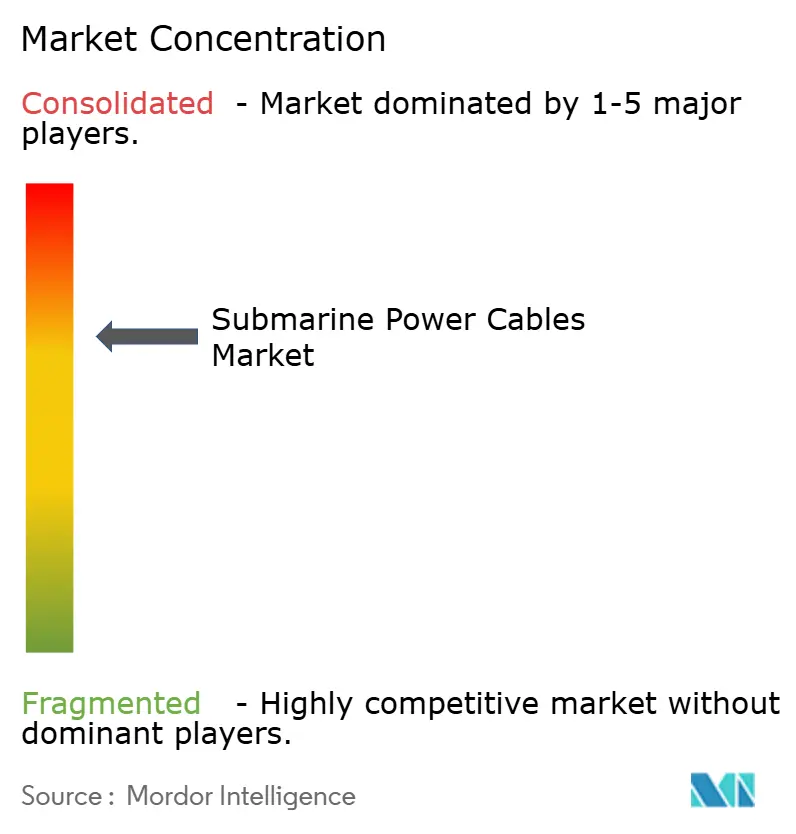
| Market Concentration | Medium |
Major Players *Disclaimer: Major Players sorted in no particular order Image © Mordor Intelligence. Reuse requires attribution under CC BY 4.0. | |
Submarine Power Cables Market Analysis by Mordor Intelligence
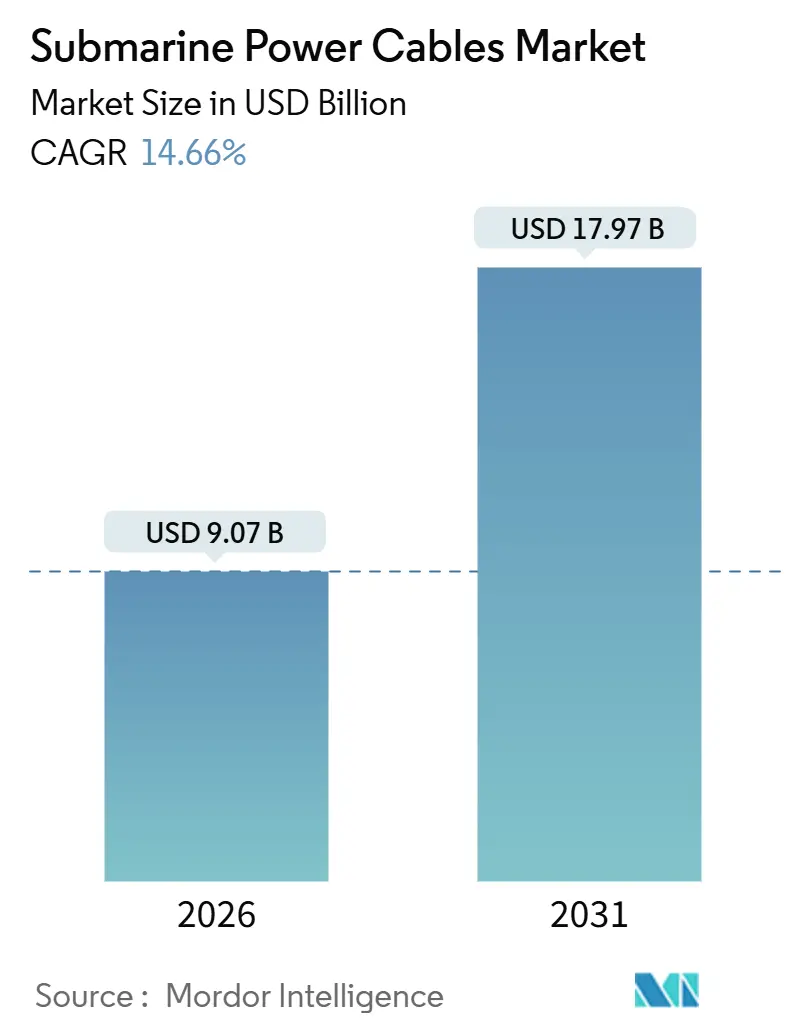
The Submarine Power Cables Market size is estimated at USD 9.07 billion in 2026, and is expected to reach USD 17.97 billion by 2031, at a CAGR of 14.66% during the forecast period (2026-2031).
The surge reflects unrelenting offshore-wind build-outs, the mainstreaming of 525 kV XLPE HVDC links, and a wave of government-backed interconnector projects that balance renewable generation across national grids. A robust project pipeline in Europe, aggressive capacity targets in the United States, and steady policy support in Asia-Pacific keep capital commitments high, while manufacturing expansions in high-voltage extrusion give suppliers room to scale. Turbine ratings above 15 megawatts, floating-foundation pilots, and dynamic-cable innovations reshape technical specifications, nudging developers toward longer export runs and higher conductor cross-sections. Input-price volatility, especially in copper, and a shortage of repair vessels continue to pressure margins, but cost-plus contracts and aluminum-conductor adoption soften the blow. Competitive intensity remains elevated as incumbents integrate vertically, deploy next-generation laying vessels, and race to secure long-lead copper and XLPE feedstocks.
Key Report Takeaways
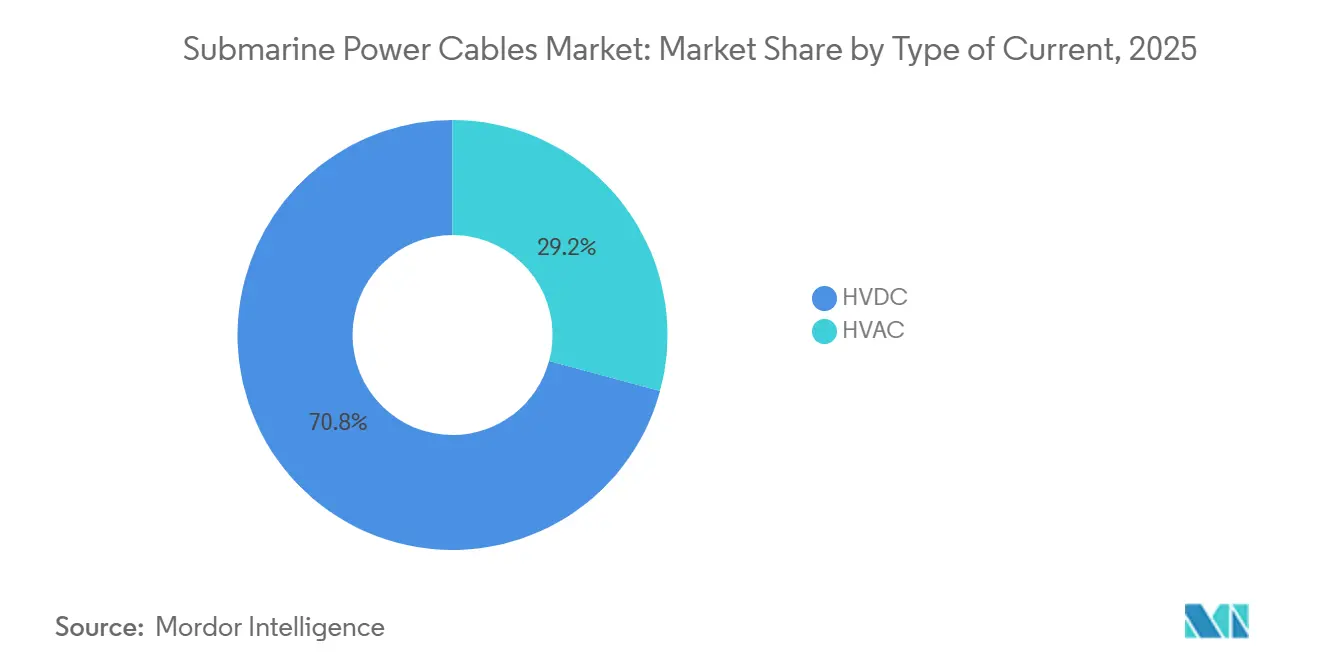
- By type of current, HVDC held 70.8% of revenue in 2025 and is expanding at a 15.1% CAGR through 2031, underscoring its dominance in long-haul, high-capacity links.
- By voltage class, the 66-220 kV segment led with 58.5% revenue share in 2025, while the above-220 kV class is forecast to register the fastest 16.9% CAGR to 2031.
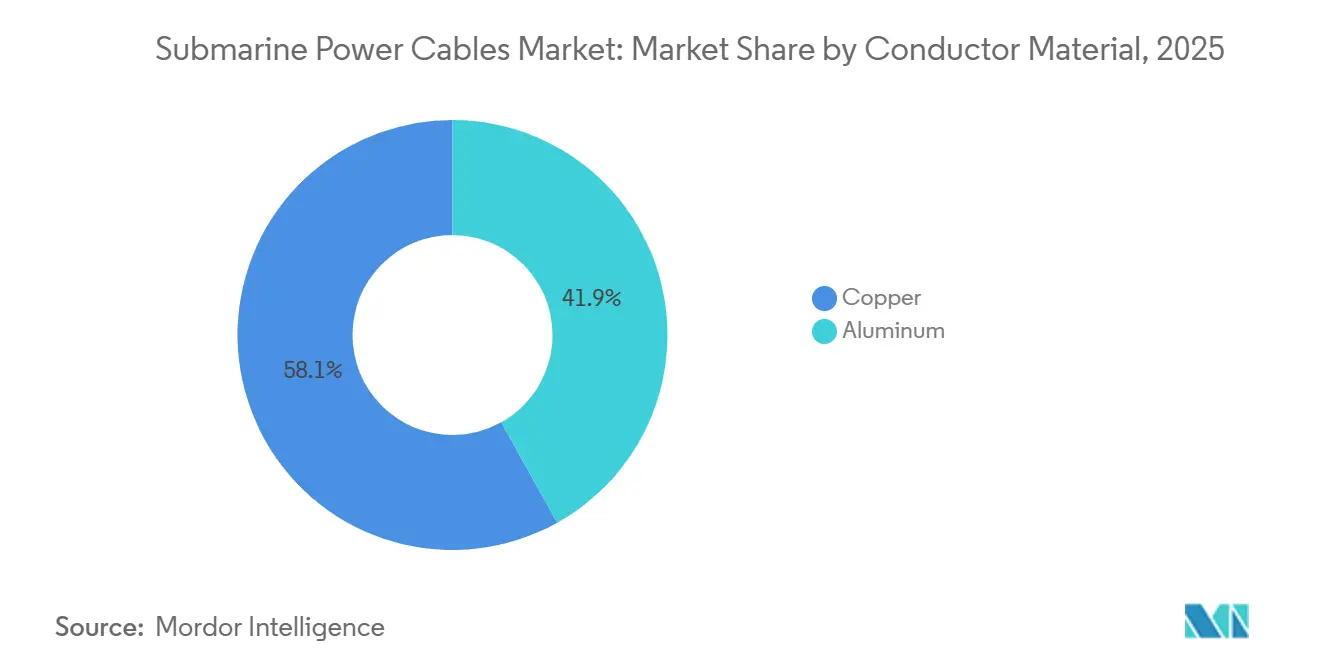
- By conductor material, copper commanded 58.1% of 2025 revenue, whereas aluminum is poised for the highest 16.5% CAGR on cost and weight advantages.
- By core type, single-core designs accounted for 64.7% of 2025 installations; multi-core variants are projected to rise at a 16.2% CAGR as developers seek trench-count reductions.
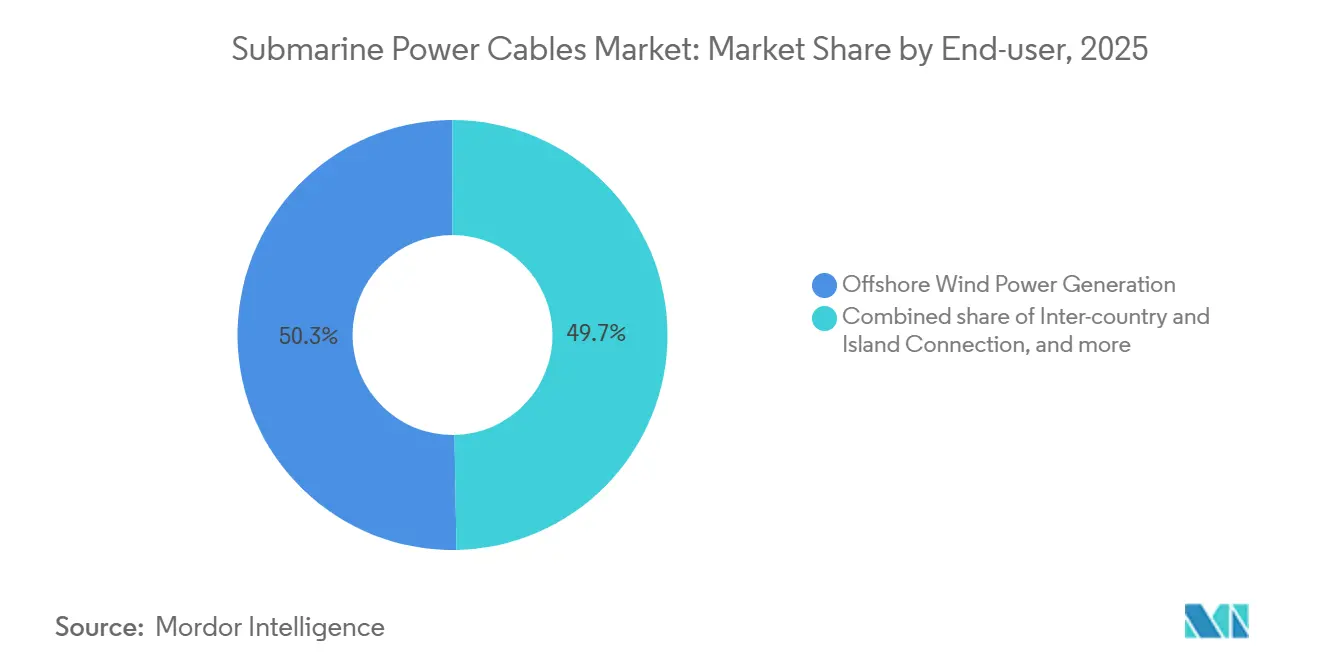
- By end-user, offshore wind generation captured 50.3% of 2025 demand; inter-country and island interconnectors lead growth at 15.7% CAGR on energy-security mandates.
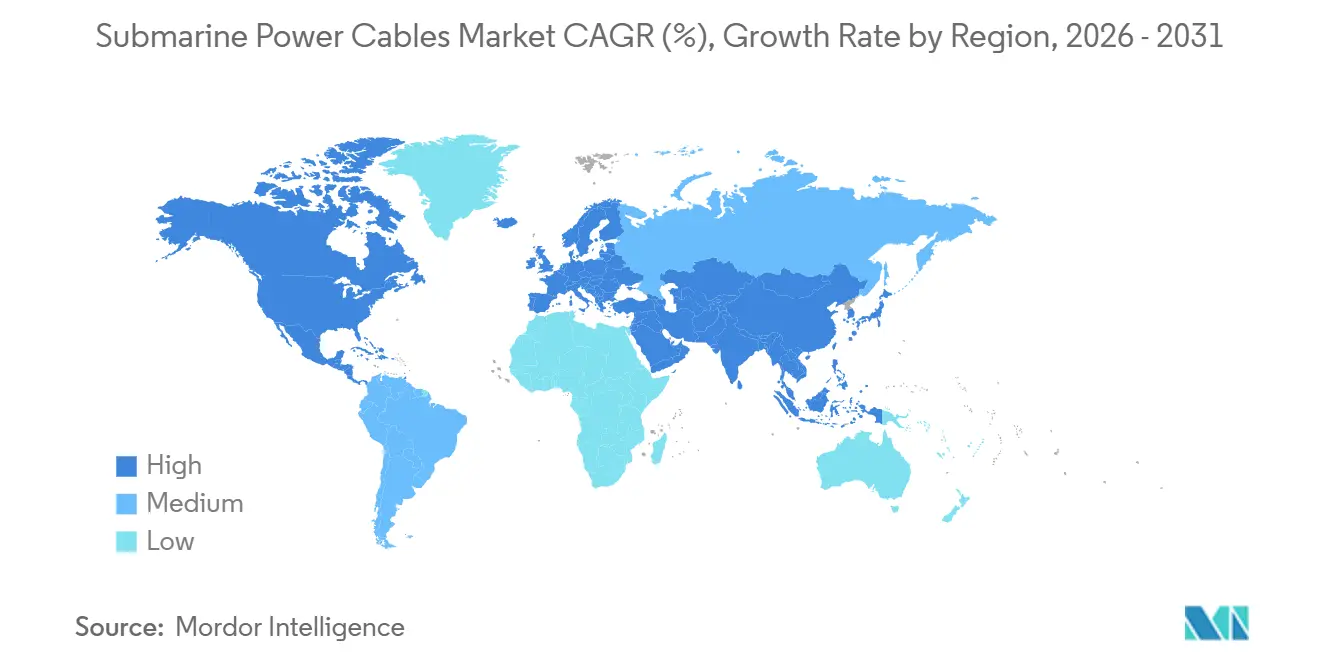
- By geography, Europe retained 55.6% of global revenue in 2025, while North America is expected to log a 17.3% CAGR driven by U.S. lease auctions.
- Prysmian, Nexans, and NKT collectively held 60% of 2025 global capacity, reflecting significant submarine power cable market share concentration at the top of the value chain.
Note: Market size and forecast figures in this report are generated using Mordor Intelligence’s proprietary estimation framework, updated with the latest available data and insights as of January 2026.
Market Trends and Insights
Drivers Impact Analysis of Submarine Power Cables Market*
| Driver | (~) % Impact on CAGR Forecast | Geographic Relevance | Impact Timeline |
|---|---|---|---|
| Surging offshore-wind project pipeline | 3.80% | Europe, North America, Asia-Pacific | Medium term (2-4 years) |
| Rapid adoption of 525 kV XLPE HVDC technology | 2.90% | Global, early focus in Europe & China | Long term (≥ 4 years) |
| Cross-border “green interconnector” initiatives | 2.40% | Europe, ASEAN, East Asia | Medium term (2-4 years) |
| Decarbonization of oil & gas platforms via power-from-shore | 1.70% | North Sea, Middle East | Long term (≥ 4 years) |
| CapEx reductions from next-gen cable-laying vessels | 1.50% | Global | Short term (≤ 2 years) |
| Marine-proven smart-cable health-monitoring systems | 1.20% | Global | Medium term (2-4 years) |
| Source: Mordor Intelligence | |||
Surging Offshore-Wind Project Pipeline
Global offshore-wind additions hit 10.8 GW in 2025 and are on track to average 15 GW annually through 2030, keeping the submarine power cable market firmly supplied with new tenders.[1] Each added gigawatt translates into more than 200 km of export and array cables, cementing baseline demand even before onshore grid upgrades are considered. China’s Jiangsu and Guangdong provinces alone commissioned 4.2 GW in 2025, relying heavily on domestic 220 kV XLPE lines that proved capable in 40 m depths. The United Kingdom’s latest Celtic Sea awards promise dynamic cable uptake as floating foundations move into 70 m waters. Japan’s designation of five promotion zones in 2025 further lifts the regional outlook, calling for fiber-optic-equipped dynamic cables that track strain in real time.[2] These trends keep the submarine power cable market on a trajectory where capacity expansions at extrusion plants struggle to keep pace with order intake.
Rapid Adoption of 525 kV XLPE HVDC Technology
Shifting from 320 kV to 525 kV reduces link losses by 35% on runs past 200 km, enabling 2 GW through a single bipole and cutting seabed corridor counts by half. Landmark contracts, TenneT’s 2 GW DolWin5 grid link and NKT’s Bornholm Energy Island supply, underline buyer confidence in extruded XLPE insulation. IEC 62067-A2, published in 2024, standardizes qualification, compressing permitting timelines and opening multi-region bidding.[3] Cost curves flatten as more suppliers certify 525 kV capability, though lead times still hover near 36 months because only five factories worldwide can produce the diameter and purity demanded. The result is a glide path where the submarine power cable market increasingly prices projects on a cost-plus basis linked to copper indices, pushing risk back to offtakers.
Cross-Border “Green Interconnector” Initiatives
Seventeen Projects of Common Interest, backed by EUR 800 million in Connecting Europe Facility grants, prove that Brussels sees cables as low-carbon arteries.[4] Operational showpieces like the 765 km, 400 kV Viking Link validate both technical feasibility and economic worth by injecting Danish wind into the U.K. grid during lull periods. Beyond Europe, ASEAN’s Sarawak-West Kalimantan link and a revived Korea-Japan feasibility study show other regions lifting templates directly from the European playbook. Supplier order books swell accordingly: Nexans won EUR 1.9 billion for the Crete-Attica HVDC line in 2025, and LS Cable secured 150 km for Malaysia-Indonesia hydro exports the same year. With grid inertia a mounting concern, HVDC interconnectors acquire a dual role in energy trade and frequency balancing.
Decarbonization of Oil & Gas Platforms via Power-from-Shore
Emissions from offshore installations made Norway’s regulators require electrification assessments for all new fields, a move mirrored by the U.K.’s North Sea Transition Authority. Equinor’s Johan Sverdrup Phase 2 now pulls 100 MW over 200 km HVAC lines, trimming annual CO₂ by 1.2 million t and OPEX by USD 40 million. Saudi Aramco, ADNOC, and others followed, awarding multi-hundred-million-dollar HVDC packages to bring solar-derived electrons offshore. Power-from-shore, therefore, shifts the submarine power cable market into oil provinces that previously favored satellite gas turbines, diversifying demand beyond pure renewables.
Restraints Impact Analysis of Submarine Power Cables Market*
| Restraint | (~) % Impact on CAGR Forecast | Geographic Relevance | Impact Timeline |
|---|---|---|---|
| Subsea repair-vessel bottlenecks & soaring day-rates | -1.80% | Global, acute in North Sea & U.S. East Coast | Short term (≤ 2 years) |
| Copper-price volatility impacting project budgets | -1.40% | Global | Short term (≤ 2 years) |
| Permitting delays for ultra-long HVDC corridors | -0.90% | Europe, North America | Medium term (2-4 years) |
| Seabed UXO risk in legacy war zones | -0.70% | North Sea, Baltic, East China Sea | Medium term (2-4 years) |
| Source: Mordor Intelligence | |||
Subsea Repair-Vessel Bottlenecks & Soaring Day-Rates
Only 12 vessels worldwide can handle 525 kV systems, utilization tops 85%, and day-rates leapt from USD 180,000 in 2023 to USD 290,000 in 2025. Ørsted’s Walney Extension faced a six-week delay that cost USD 18 million in lost revenue, highlighting how vessel scarcity feeds insurer premium hikes. A backlog of 14 projects in early 2025 stretched average wait times to 35 days in the North Sea. While Prysmian’s plan to convert a retired pipe-layer adds capacity by 2027, certification and crew training push relief at least 18 months away. Until the fleet expands, downtime risk dampens the submarine power cable market’s otherwise strong growth trajectory.
Copper-Price Volatility Impacting Project Budgets
Copper fluctuated between USD 8,200 and USD 10,400 per tonne in 2025, forcing suppliers to invoke escalation clauses that added up to 12% on fixed-price contracts. Nexans absorbed EUR 120 million in unrecovered costs on legacy deals and migrated to cost-plus bids with monthly indexation. Developers increasingly specify aluminum conductors, trading a 15% size penalty for 75% material savings. The International Copper Association forecasts cable demand at 450 kt per year by 2030, deepening competition with EV batteries. Price swings, therefore, inject budgeting uncertainty that can stall final investment decisions.
*Our forecasts treat driver/restraint impacts as directional, not additive. The impact forecasts reflect baseline growth, mix effects, and variable interactions.
Submarine Power Cables Market Segment Analysis
By Type of Current:
HVDC Widens Its LeadThe submarine power cable market size for HVDC installations reached USD 5.7 billion in 2025 and is on pace for a 15.1% CAGR, reflecting rising average export lengths and asynchronous-grid tie-ins. HVDC’s 70.8% 2025 share stems from its sub-3% round-trip losses on links above 100 km and its ability to move bulk power without reactive-compensation hardware. HVAC retains relevance inside wind arrays where runs rarely exceed 30 km, but cost parity tips to HVDC once converter-platform costs fall below USD 110 million per 500 MW.
Looking ahead, voltage-source converter adoption gives HVDC black-start capability, enabling offshore clusters to support grid inertia markets. Suppliers report that 70% of open tenders now mandate 525 kV rating, signalling that HVDC’s design envelope will keep stretching. These dynamics confirm HVDC as the defining growth engine for the submarine power cable market.

By Voltage Class:
Ultra-High Voltage Takes OffThe 66-220 kV band led 2025 volumes with 58.5% yet above-220 kV systems grow fastest at 16.9% CAGR as 2 GW export blocks head 135 km or more to shore. DolWin5 illustrates the economics, trimming line losses to 1.8% and removing interim platforms. Up to 66 kV retains niches in tidal arrays and island links but lacks the ampacity required for gigawatt-scale exports, especially as turbine nameplates exceed 15 MW.
Factory expansions underscore the pivot: Prysmian’s Arco Felice adds a second 525 kV extrusion line by 2027, and NKT’s vertical tower in Karlskrona hits zero-void insulation at 525 kV. IEC’s harmonized qualification accelerates multi-region permitting, ensuring ultra-high voltage remains the submarine power cable market’s fastest lane.
By Conductor Material:
Aluminum Scales Commercial AcceptanceCopper’s 58.1% share holds for deep-water reliability, yet aluminum posts 16.5% CAGR amid persistent price gaps. Nexans’ AluPower achieves 95% conductivity of copper at half the weight, shaving USD 8 million in vessel charters on a 100 km install. LS Cable’s Shinan project cut trenching time by 20% thanks to lighter pull forces, demonstrating field acceptance. Copper price spikes compel developers to dual-spec aluminum, locking in upside if markets tighten. Consequently, aluminum’s role expands from cost hedge to mainstream alternative, especially in Asia-Pacific’s shorter, shallower routes.
By Core Type:
Installation Strategy Drives ChoiceSingle-core cables, 64.7% of 2025 volume, remain the preferred HVDC architecture because each pole operates independently, facilitating parallel lay spreads that compress schedules by four months on a 2 GW link. Multi-core growth at 16.2% stems from HVAC arrays bundling three phases to slash seabed passes. Hornsea 3’s 66 kV three-core scheme cut vessel mobilizations by two-thirds, saving GBP 22 million. Single-core retains higher ampacity and superior thermal dissipation, but multi-core innovations such as helical armor and dynamic-fatigue designs open floating-wind applications, supporting a demand mix that keeps both formats integral to the submarine power cable market.
By End-User:
Interconnectors Accelerate on Energy-Security GoalsOffshore wind still dominated 2025 with a 50.3% share, yet inter-country and island links pace growth at a 15.7% CAGR. EU funding for Projects of Common Interest and Greece’s Crete-Attica link showcase policy backing that turns cables into geopolitical assets. Oil & gas power-from-shore supply sits at 8%, but electrification mandates in Norway and the Middle East elevate long-dated backlog visibility. Emerging marine renewables like tidal add niche volume, ensuring end-user diversification remains a hallmark of the submarine power cable market.
Geography Analysis
Europe Submarine Power Cables Market
Europe’s 55.6% share in 2025 reflects the North Sea pipeline and the EU’s mandate to double cross-border transfer capacity by 2030. Dogger Bank and Bornholm Energy Island typify massive cluster developments that bundle multiple wind farms into shared HVDC hubs, yielding economies of scale and reinforcing the region’s submarine power cable market leadership. Germany’s TenneT accelerated contract awards worth EUR 2.8 billion through 2025, spurring suppliers to expand extrusion lines despite 36-month delivery queues.
North America Submarine Power Cables Market
North America is set for a 17.3% CAGR through 2031 as federal lease auctions unleash 30 GW of targeted builds. Vineyard Wind proved bankability, and Empire Wind’s 340 km HVDC spec confirms long-haul trends. Canada’s 5 GW Atlantic target adds fresh load, with green-hydrogen export ambitions tying into cable demand. Supply-chain localization requirements push European OEMs to establish U.S. production, creating a twin-shore manufacturing footprint.
APAC Submarine Power Cables Market
Asia-Pacific seized 28% revenue in 2025 with China’s 4.2 GW additions and Japan’s floating-wind zones demanding dynamic, fiber-optic-equipped lines. Taiwan’s Formosa 3 will push 525 kV HVDC 180 km in typhoon-prone waters, validating design robustness for extreme weather. South Korea’s aluminum-conductor preference underscores regional cost focus, while a proposed Korea-Japan HVDC link could usher in the area’s first multi-gigawatt interconnector.
Regulatory Landscape
Regulation for submarine power cables is increasingly shaped by offshore wind build-out and interconnector security, spanning technical standards, seabed permitting, and cross-border approvals. In the United States, export and inter-array cable routing and installation on the Outer Continental Shelf commonly fall under the BOEM framework (30 CFR 585) as part of Construction and Operations Plan review, alongside multi-agency consultation and requirements such as cable-crossing agreements and environmental conditions. Industry guidance is also tightening around design and installation practices for offshore wind, including ANSI/ACP OCRP-5-2024, which developers and contractors use as a reference point to align engineering, testing, and installation approaches.
Security-focused oversight is also widening, influencing project documentation and expectations around ownership disclosure for critical subsea infrastructure. In June 2026, the FCC adopted a revised submarine cable licensing regime that extended oversight to gaps around Submarine Line Terminal Equipment (SLTE) ownership and operation, indicating tighter scrutiny for subsea cable systems that touch US jurisdiction. In Europe, discussions have shifted from fragmented national treatment toward more coordinated protection of subsea infrastructure after the European Commission Recommendation in 2024 and the EU Action Plan in 2025, adding further risk-management and reporting requirements for cross-border links.
Competitive Landscape
Submarine power cable market competition centers on five qualified 525 kV XLPE suppliers. Prysmian’s full control of the Leonardo da Vinci vessel locks in end-to-end execution, matching manufacturing with logistics capacity. Nexans counters with a Halden-plant expansion and patented distributed acoustic sensing, creating service-based revenue on top of cable sales. NKT leverages Victoria’s DP-3 capability for deep-water installs in the U.S. Outer Continental Shelf, bundling EPC scope to win Hornsea 4. Asian challengers, Sumitomo Electric, LS Cable, and Hengtong, deploy price discounts and local vessel builds to penetrate regional tenders, particularly in China and Taiwan.
Technology differentiation now lies in digital-monitoring integration and alloy innovation rather than pure voltage rating, a sign of maturing HVDC specifications. Smaller players like JDR and TFKable exploit tidal-array and island projects where agility trumps scale, carving defensible niches. Supply-chain stress persists around XLPE resin, armor wire, and copper rod, with leading firms securing long-term offtake contracts to buffer volatility and protect market share.
Submarine Power Cables Industry Leaders
-
Prysmian Group
-
NKT A/S
-
Nexans SA
-
Sumitomo Electric Industries Limited
- *Disclaimer: Major Players sorted in no particular order
Submarine Power Cables Market Companies Covered in this Report
- Prysmian Group
- Nexans SA
- NKT A/S
- Sumitomo Electric Industries Ltd.
- LS Cable & System Ltd.
- ABB Ltd.
- Hitachi Energy
- Furukawa Electric Co. Ltd.
- Hengtong Group
- ZTT International Ltd.
- TFKable Group
- KEI Industries Ltd.
- General Cable Corporation
- JDR Cable Systems
- Alcatel Submarine Networks
- Orient Cable (Ningbo Orient Wires & Cables)
- TE SubCom
- Brugg Kabel AG
- Southwire Company LLC
- Fujikura Ltd.
Market Opportunities and Future Outlook
High-capacity interconnectors and grid reinforcements create opportunities for suppliers that can deliver 525 kV HVDC systems with shorter lead times and integrated installation scope. UK transmission programs illustrate the scale: SSEN Transmission and National Grid advanced Eastern Green Link projects in 2026, and NKT disclosed a contract for the 525 kV HVDC cable system for Eastern Green Link 3, reinforcing demand for ultra-high-voltage export and interconnector corridors. Active execution on major cross-border links, including NeuConnect (Prysmian completing subsea cabling in UK waters in March 2026) and the Celtic Interconnector (first cable pull-in on the French side reported in April 2026), also points to buyer preference for vendors that can manage manufacturing slots, marine logistics, and commissioning support.
Intercontinental and multi-jurisdiction links broaden demand beyond traditional North Sea and Baltic routes, shifting attention toward permitting-heavy, security-sensitive corridors where bankability depends on proven EPC delivery. Prysmian receiving notice to proceed in June 2026 for the ELMED interconnector between Italy and Tunisia highlights how submarine cables are extending into new strategic energy-trade corridors and why robust HVDC export designs are in demand. Floating offshore wind pilots further lift requirements for dynamic cable capabilities (fatigue performance, bend stiffeners, and monitoring integration), favoring suppliers that can pair high-voltage extrusion with validated dynamic-cable designs and in-field health-monitoring services.
Recent Industry Developments in Submarine Power Cables Market
- July 2026: Sumitomo Electric and the Van Oord consortium signed a framework agreement with SSEN Transmission covering HVDC cable projects, including the Shetland 2 link. The agreement strengthens long-term pipeline visibility for a key European transmission buildout and supports capacity planning across manufacturing and installation resources.
- January 2026: NKT signed contracts with SSEN Transmission for the Western Isles and Spittal to Peterhead subsea cable projects. The awards broaden SSEN Transmissions HVDC reinforcement program and align NKT with high-voltage submarine cable deployment in the UK.
- December 2025: Sumitomo Electric secured a contract with National Grid Electricity Transmission for the Sea Link HVDC project, a roughly 140 km connection between Kent and Suffolk in the United Kingdom. The win adds to the supplier backlog tied to UK grid reinforcement and highlights the role of long-distance HVDC links in relieving onshore transmission constraints.
Submarine Power Cables Market Report Scope and Research Methodology
Market Definition and Coverage
This market covers revenue earned from submarine power cables that transmit electricity under water, including the cable and related project delivery services tied to that cable, from engineering through installation and then maintenance.
Scope exclusions: Fiber optic communication cables and purely onshore power cable work are not counted in this market sizing.
Segments Covered in This Report
- By Type of Current
- HVDC
- HVAC
- By Voltage Class
- Up to 66 kV
- 66 to 220 kV
- Above 220 kV
- By Conductor Material
- Copper
- Aluminum
- By Core Type
- Single-core
- Multi-core
- By End-User
- Offshore Wind Power Generation
- Inter-country and Island Connection
- Offshore Oil and Gas Platforms
- Others (Marine Renewables including Wave, Tidal)
- Geography
- North America
- United States
- Canada
- Mexico
- Europe
- Germany
- United Kingdom
- France
- Sweden
- Norway
- Denmark
- Netherlands
- Rest of Europe
- Asia-Pacific
- China
- India
- Japan
- South Korea
- ASEAN Countries
- Australia and New Zealand
- Rest of Asia-Pacific
- South America
- Brazil
- Argentina
- Colombia
- Rest of South America
- Middle East and Africa
- Saudi Arabia
- United Arab Emirates
- South Africa
- Egypt
- Rest of Middle East and Africa
- North America
Data Sources, Market Sizing, and Validation
Desk Research
Desk work started by aligning basic demand signals with project activity, so we did not treat this as a simple capacity story. Public sources such as the International Energy Agency, the International Renewable Energy Agency, and government energy and grid agencies were used to understand offshore wind build plans, interconnector priorities, and permitting timelines.
We also referred to sources such as national statistics offices and customs and trade portals for insulated wire and cable, plus standards and technical publications (including IEC guidance) to keep voltage classes and definitions consistent. Company annual reports, investor presentations, and reputable industry press were then used to build a clean view of active projects, delivery timing, and backlog commentary. Where required, paid subscriptions for company financials and intelligence, a patent database, and an import-export shipment level database were used to cross-check participation and technology direction. These examples are illustrative only, and many other public and paid sources were also used for collection, validation, and clarification.
Primary Interviews and Surveys
Primary discussions were run with a mix of cable suppliers, installation and service contractors, utilities and grid operators, and offshore project developers to validate what is actually awarded versus what is only announced. Inputs were also used to confirm typical project lengths, voltage mix, lead times, and how pricing changes with copper and insulation costs across APAC, EMEA, and the Americas.
Distribution of primary research fieldwork respondents
| Company type | Respondent position | Region |
|---|---|---|
| Top tier: 34% | CXOs: 19% | APAC: 38% |
| Mid tier: 47% | Functional/Unit leaders: 31% | EMEA: 37% |
| Smaller Players: 19% | Managers: 50% | Americas: 25% |
Market-Sizing & Forecasting
Sizing was built using a top-down approach where announced and awarded subsea transmission and export cable projects are translated into a yearly revenue pool using realistic timing, scope, and pricing. For each project cluster, revenue is shaped by variables such as route length (km), voltage band (up to 66 kV, 66 to 220 kV, and above 220 kV), current type (HVAC versus HVDC), conductor choice (copper versus aluminum), and installation window constraints driven by weather and vessel availability.
Those totals were then checked using selective bottom-up approximations, where sampled contract values and price per km ranges were combined with an estimated volume of delivered cable and installation activity, and then adjusted when the checks did not align. When project details were incomplete, gaps were handled by using peer-project analogs in the same region and voltage class, followed by primary validation so the assumed length and delivery phasing stayed realistic.
For forecasting, scenario analysis was used because outcomes depend on award slippage, permitting, and grid-connection readiness more than smooth historical growth. Scenarios were tied to leading indicators such as offshore wind capacity additions, interconnector tender pipelines, and major grid investment plans, and then shaped with expert views on lead times and pricing progression.
Data Validation & Update Cycle
Model outputs were tested against independent signals like offshore wind commissioning schedules, public tender awards, and trade patterns for insulated power conductors, and then reviewed for outliers by geography and voltage class. If a region showed a sudden jump or drop, the assumptions were revisited and, where needed, respondents were re-contacted to confirm whether the change was timing, scope, or pricing driven.
Before sign-off, the full file goes through multi-step internal checks so calculation logic, unit conversions, and currency timing are consistent. The report is refreshed annually, and interim updates are triggered when material events occur, such as large interconnector awards, major permitting changes, or sharp moves in key input costs. Right before delivery, a final pass is completed so clients receive the most current view available.
Mordor Intelligence's Submarine Power Cables Market Size Versus Other Published Estimates
Published numbers for submarine power cables often do not match because the market can be counted from different angles, and each angle pulls the total in a different direction. Differences usually come from what activities are included, which year is treated as the starting point, and how project timing is converted into yearly revenue.
The main gap comes from whether estimates include only power transmission submarine cables and related delivery work, or whether they also fold in adjacent cable categories and a wider set of offshore electrical equipment. Mordor Intelligence treats the market as revenue tied to submarine power cable supply and associated project services, and then ties the yearly size to awarded and active project timing rather than assuming all planned capacity turns into revenue on schedule.
Benchmark comparison
| Source | Market Size | Gaps in Research Methodology |
|---|---|---|
| Mordor Intelligence | USD 9.07 B (2026) | |
| Global Consultancy A | USD 11.28 B (2024) | The published page shows overlapping market-size figures and a different base year, which can indicate broader scope choices or mixed inclusions across voltage and application sets. With limited clarity on what is excluded, adjacent subsea electrical items can be implicitly counted, which lifts the total versus a cable-and-delivery-only view. |
| Industry Research Desk B | USD 17.80 B (2025) | This estimate emphasizes manufacturing and sale revenue, and it can move higher when pricing per km assumptions are applied uniformly across regions or when project backlogs are converted to revenue faster than actual installation windows allow. Differences in how HVDC interconnectors and offshore wind export links are phased by year also materially change the reported size. |
Across the three figures, the spread is mainly explained by scope and timing choices, not by a disagreement that demand exists. When the model is anchored to project award status, installation cadence, and voltage mix, the resulting market value becomes easier to trace back to clear inputs and repeatable steps.
Key Questions Answered in the Report
What is the current value of the submarine power cable market?
The market was valued at USD 9.07 billion in 2026 and is on course for USD 17.97 billion by 2031, reflecting a 14.66% CAGR.
Which technology leads growth in submarine cables?
HVDC systems dominate, capturing 70.8% of 2025 revenue and advancing at a 15.1% CAGR thanks to efficiency over long distances.
Why are 525 kV XLPE cables important?
They cut transmission losses by 35%, move 2 GW per bipole, and reduce the number of seabed corridors, lowering project CapEx.
How is copper price volatility affecting projects?
Fluctuating copper prices added up to 12% to some 2025 contracts, accelerating the shift toward aluminum conductor alternatives.
What region is growing fastest for new submarine cables?
North America is projected to post a 17.3% CAGR through 2031, driven by aggressive U.S. offshore-wind lease auctions.
Which companies control most capacity?
Prysmian, Nexans, and NKT together hold about 60% of manufacturing capacity, illustrating moderate concentration at the top.