
Struvite and Vivianite Fertilizers Market Size and Share
Market Overview
| Study Period | 2021 - 2031 |
|---|---|
| Market Size (2026) | USD 0.75 Billion |
| Market Size (2031) | USD 1.08 Billion |
| Growth Rate (2026 - 2031) | 7.57 % |
| Fastest Growing Market | Asia-Pacific |
| Largest Market | Europe |
| Market Concentration | High |
Major Players *Disclaimer: Major Players sorted in no particular order Image © Mordor Intelligence. Reuse requires attribution under CC BY 4.0. | |
Struvite and Vivianite Fertilizers Market Analysis by Mordor Intelligence
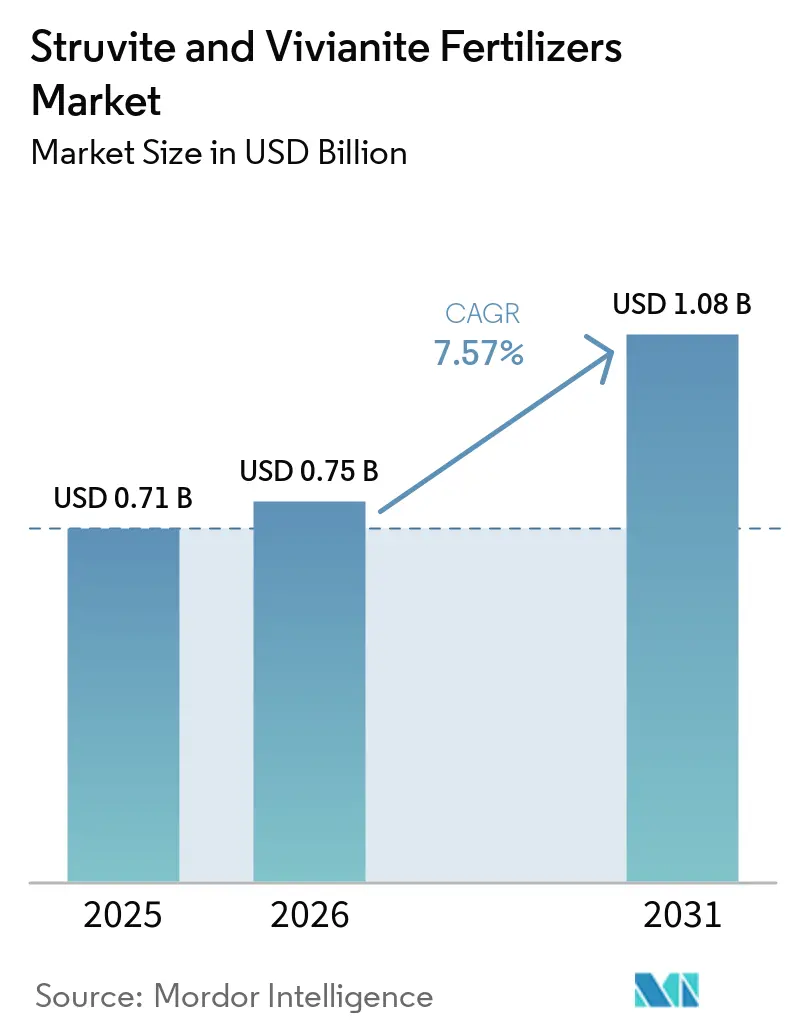
The struvite and vivianite fertilizers market size is estimated to expand from USD 0.71 billion in 2025 and USD 0.75 billion in 2026, to reach USD 1.08 billion by 2031, growing at a CAGR of 7.57% from 2026 to 2031. The struvite and vivianite fertilizers market is advancing as phosphorus recovery rules become more enforceable, especially in municipal wastewater systems in Europe, where the revised Urban Wastewater Treatment Directive took effect on January 1, 2025[1]Source: European Commission, “New Rules for Urban Wastewater Management Set to Enter into Force,” European Commission, europa.eu. The same directive projected annual economic benefits of USD 7.56 billion for the European Union by 2040, thereby supporting long-term plant investment and reducing offtake uncertainty for operators entering the Struvite and vivianite fertilizer market. The commercial case is also strengthening as utilities, technology licensors, and fertilizer producers align around recovered phosphorus, while organic certification and product recognition help expand the buyer base for the Struvite and vivianite fertilizers market. At the same time, regulatory fragmentation across regions continues to raise compliance costs and slow cross-border product launches, keeping execution risk visible even as demand conditions improve in the Struvite and vivianite fertilizer markets.
Key Report Takeaways
By product type, struvite held 97.5% of the struvite and vivianite fertilizers market size in 2025, while vivianite is forecast to grow at a CAGR of 11.2% between 2026 and 2031.
By form, solid products accounted for 95.2% of the struvite and vivianite fertilizers market share in 2025, while liquid formats are forecast to grow at a CAGR of 10.4% between 2026 and 2031.
By source, wastewater treatment plants held 54.1% of the struvite and vivianite fertilizers market size in 2025, while anaerobic digestion and biosolids streams are forecast to grow at a CAGR of 10.1% between 2026 and 2031.
By application, field crops captured 38.5% of the struvite and vivianite fertilizers market size in 2025, while horticultural crops are forecast to grow at a CAGR of 8.1% between 2026 and 2031.
By geography, Europe accounted for 38.2% of the struvite and vivianite fertilizers market size in 2025, while Asia-Pacific is forecast to grow at a CAGR of 9.8% between 2026 and 2031.
Note: Market size and forecast figures in this report are generated using Mordor Intelligence’s proprietary estimation framework, updated with the latest available data and insights as of January 2026.
Global Struvite and Vivianite Fertilizers Market Trends and Insights
Drivers Impact Analysis*
| Driver | (~) % Impact on CAGR Forecast | Geographic Relevance | Impact Timeline |
|---|---|---|---|
| Rising Phosphorus Recovery Mandates in Wastewater Infrastructure | +2.00% | Global, strongest in Europe and North America | Short term (≤ 2 years) |
| Premium Slow-Release Fertilizer Adoption in High-Value Crops | +1.30% | North America, Europe, and Asia-Pacific | Medium term (2-4 years) |
| Circular Economy Procurement by Municipal Utilities and Food Processors | +1.40% | Europe and North America | Medium term (2-4 years) |
| Struvite Commercial Acceptance Through CE Mark and Organic Certification | +1.00% | Europe and North America | Short term (≤ 2 years) |
| Vivianite Recovery Economics Through Magnetic Separation | +0.70% | Europe and Asia-Pacific | Long term (≥ 4 years) |
| Downstream Use in Specialty and High-Value Crop Markets | +0.60% | United States, Brazil, India, and China | Medium term (2-4 years) |
| Source: Mordor Intelligence | |||
Rising Phosphorus Recovery Mandates in Wastewater Infrastructure
Binding legislative timelines remain the clearest growth engine for the struvite and vivianite fertilizers market in 2026. The revised Urban Wastewater Treatment Directive took effect on January 1, 2025, and requires the European Commission to define a combined minimum rate for phosphorus reuse and recycling by January 2028[2]Source: European Sustainable Phosphorus Platform, “ESPP Proposals on Minimum Reuse and Recycling Rate for Phosphorus from Urban Wastewater,” European Sustainable Phosphorus Platform, phosphorusplatform.eu. The directive now covers agglomerations of 1,000 or more inhabitants, bringing many smaller municipalities into compliance and expanding the project pipeline for the Struvite and vivianite fertilizer market. Germany has already set a firm national direction by requiring large wastewater treatment plants to recover phosphorus from 2029 onward, and this has begun to shift feasibility studies toward engineering and planning decisions. The European Critical Raw Materials Act adds another layer of support because phosphate is explicitly listed, thereby strengthening political accountability for national recovery plans. This policy structure reduces uncertainty for operators, lenders, and fertilizer buyers, and gives the Struvite and vivianite fertilizer market a clearer path from wastewater compliance to commercial nutrient recovery.
Circular Economy Procurement by Municipal Utilities and Food Processors
Procurement behavior is shifting from waste handling to resource recovery, and that change is helping the struvite and vivianite fertilizers market secure more dependable offtake structures. Municipal utilities in Belgium, the Netherlands, and Scandinavia are increasingly linking nutrient recovery to biosolids and wastewater contracts, which gives producers more stable supply volumes over multi-year periods. Food and beverage processors also support this shift by seeking lower-impact nutrient sourcing for contract growers, opening a second commercial channel beyond compliance-driven demand. Veolia Environnement S.A. positioned its struvia platform to benefit from this trend, and its Lille pilot demonstrated phosphorus recovery rates of up to 75%, supporting practical procurement use cases in 2025. When utilities and processors commit to recovered nutrient pathways, project bankability improves because the revenue side becomes easier to forecast. This helps shorten commercial timelines for new operators and strengthens the transition of the Struvite and vivianite fertilizers market from pilot activity to repeatable supply contracts.
Premium Slow-Release Fertilizer Adoption in High-Value Crops
Premium crop systems are providing the struvite and vivianite fertilizer market with an attractive pool of demand because nutrient efficiency matters more in high-value harvests. Struvite releases phosphorus in a crop-demand-driven pattern, making it useful for growers seeking better nutrient timing and lower leaching losses. In June 2026, Ostara Nutrient Recovery Technologies Inc. introduced a higher-analysis CG P2X formulation that delivers more than 2 times the plant-available nitrogen, phosphorus, and magnesium of conventional phosphate fertilizers, and the company stated that application rates can be 40% lower than monoammonium phosphate, diammonium phosphate, and triple superphosphate[3]Source: Ostara, “Ostara Advances CG P2X with New, Higher-Analysis Formula Delivering More Than 2X the Plant-Available Nutrients,” June 8, 2026, Ostara.com. In April 2024, Crystal Green Pearl became the first pure struvite crop nutrition source to receive organic registration across Germany, Spain, Denmark, Austria, and the Netherlands, which opened a premium sales channel tied to certified organic production. That combination of agronomic value and certification support gives specialty growers a clearer reason to pay for recovered phosphorus products. As more growers prioritize traceable inputs and controlled nutrient release, premium crop adoption should remain an important growth layer for the Struvite and vivianite fertilizers market.
Struvite Commercial Acceptance Through CE Mark and Organic Certification
Commercial acceptance matters because it reduces adoption friction across the struvite and vivianite fertilizers market. In Europe, struvite benefits from recognition under the CMC12 framework, which gives producers a clearer route to market than many other recovered phosphorus products. NuReSys NV, part of Green Tile BV, has continued to operate controlled struvite crystallization systems with an active CMC12 pathway for its Biostru product, which supports continued blending and off-take expansion. Organic registration has added another layer of confidence because certified channels require stronger documentation and product consistency. When recovered fertilizer meets both compliance and premium-channel requirements, distributors and growers face fewer doubts about its use, labeling, and provenance. This lowers commercialization barriers for the Struvite and vivianite fertilizers market and supports a shift from trial-based demand to repeat purchases across established agricultural systems.
Restraints Impact Analysis*
| Restraint | (~) % Impact on CAGR Forecast | Geographic Relevance | Impact Timeline |
|---|---|---|---|
| Limited Farmer Awareness of Recovered Mineral Fertilizers | -1.00% | India, Brazil, France, and United States | Short term (≤ 2 years) |
| Uneven Product Standardization Across Jurisdictions | -1.20% | Europe, United States, Japan, and Canada | Medium term (2-4 years) |
| High Site-Specific Capital Expenditure and Qualification Cycles | -1.30% | United States, Germany, Australia, and Saudi Arabia | Medium term (2-4 years) |
| Supply Fragmentation Across Diverse Feedstock Streams | -0.80% | Global, most acute in Asia-Pacific and Latin America | Long term (≥ 4 years) |
| Source: Mordor Intelligence | |||
Limited Farmer Awareness of Recovered Mineral Fertilizers
Farmer awareness remains a real constraint because the Struvite and vivianite fertilizer market still relies on products that differ from familiar phosphate inputs in both origin and performance. Growers often need evidence on nutrient release, crop response, handling, and certification before they shift from established fertilizer programs to recovered mineral products. The fact that organic registration and product reformulation are emphasized so strongly in company communications shows that buyer education remains central to commercial conversion. This issue is more visible in price-sensitive farming systems, where growers may hesitate to pay a premium unless yield response or policy support is clearly demonstrated. It also slows distributor adoption because channel partners need a simpler sales story before they can promote new products at scale. As a result, commercial growth in the struvite and vivianite fertilizer market can lag behind technical readiness while awareness, training, and field-level confidence are still developing.
Uneven Product Standardization Across Jurisdictions
Regulatory fragmentation continues to raise costs and delay cross-border expansion in the Struvite and vivianite fertilizers market. The United States follows a different regulatory path linked to biosolids and state fertilizer registration, while Japan uses its own agricultural and recycling framework rather than the European Union classification route. No harmonized international standard exists yet for recovered mineral phosphorus fertilizers, leaving producers with multiple approval tracks rather than a single scalable process. The European Commission will not specify the delegated minimum phosphorus recycling rate until early 2028, so some interpretive uncertainty will remain in the near term. This can extend commercial launch timelines by many months and makes multi-region sales more difficult than the underlying agronomic case would suggest.
*Our forecasts treat driver/restraint impacts as directional, not additive. The impact forecasts reflect baseline growth, mix effects, and variable interactions.
Segment Analysis
By Product Type: Struvite Anchors Revenue as Vivianite Scales
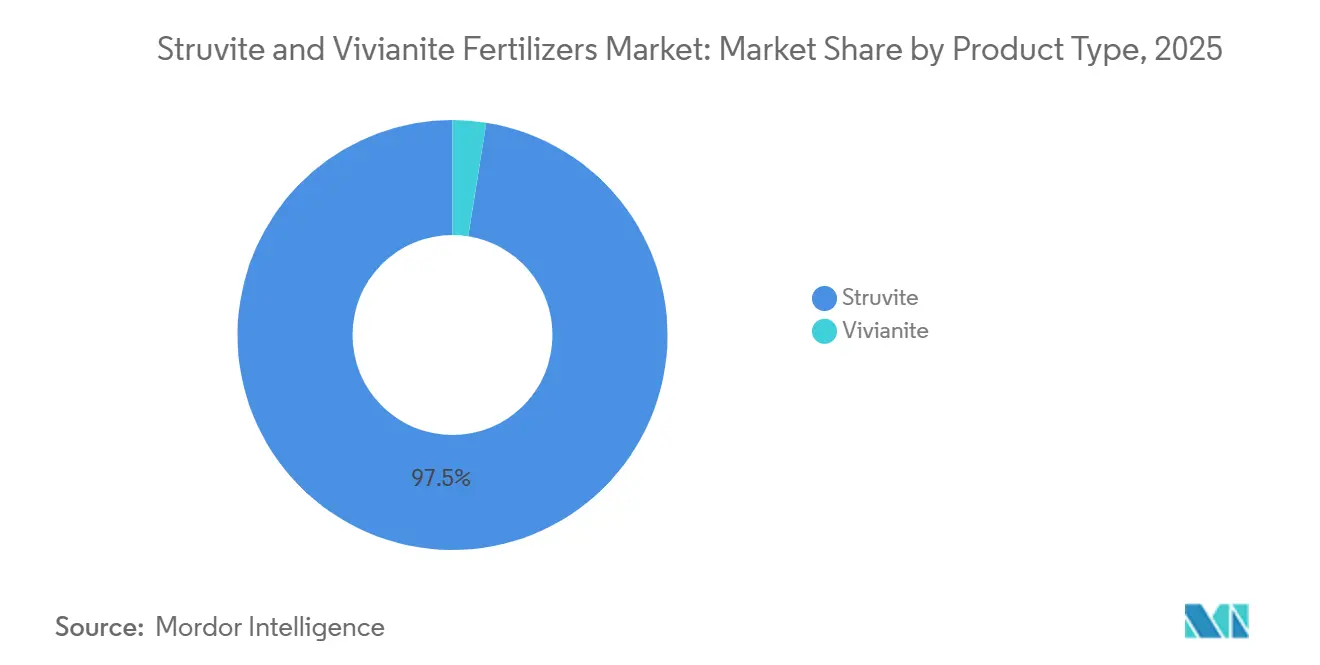
Struvite represented 97.5% of the struvite and vivianite fertilizers market size in 2025, which reflects its longer commercial history, broader field validation, and clearer regulatory status in Europe. Vivianite remained the smaller product category because it is still earlier in commercial development and lacks the same level of product recognition across fertilizer systems. Struvite also benefits from a stronger record in crop nutrition and blending compatibility, which keeps it ahead in present revenue contribution across the Struvite and vivianite fertilizers market.
Vivianite is anticipated to grow at an 11.2% CAGR through 2031, making it the fastest-growing product type in the market. Pilot magnetic separation has already shown recovery above 80% from digested sludge, and industrial wastewater trials reported phosphorus recovery of 93.54% under optimized conditions[4]Source: W.K. Wijdeveld, G. Sudintas, Philipp Kuntke, Leon Korving, and Mark C.M. van Loosdrecht, “Robust Magnetic Vivianite Recovery from Digested Sewage Sludge,” Water Research, doi.org. Struvite should continue to expand as well because its agronomic value, organic certification base, and commercial positioning remain stronger today. The result is a market where struvite supports near-term revenue while vivianite strengthens future growth potential.



By Form: Solid Products Lead as Liquid and Fine-Particle Formats Gain Ground
Solid products accounted for 95.2% of revenue in 2025, maintaining their dominant position in the global struvite and vivianite fertilizers market due to their compatibility with conventional fertilizer blending, storage, transportation, and field application systems. Most commercially available struvite fertilizers are offered as granules or pellets, supporting their widespread adoption across row crops, horticulture, turf, and specialty agriculture. Liquid products accounted for a much smaller share, with adoption primarily limited to specialized nutrient management programs and research-driven applications in which recovered phosphorus is incorporated into liquid formulations.
The liquid segment is estimated to advance at a 10.4% CAGR through 2031, driven by increasing adoption of fertigation and precision irrigation systems, along with ongoing research to improve the integration of recovered phosphorus into liquid nutrient solutions. However, solid fertilizers are expected to retain their market leadership throughout the forecast period, as most commercial struvite and emerging vivianite products are manufactured and marketed in granular or pelletized forms, offering superior handling, storage stability, and slow-release nutrient performance.
By Source: Wastewater Treatment Plants Lead, Anaerobic Digestion Routes Enable Vivianite
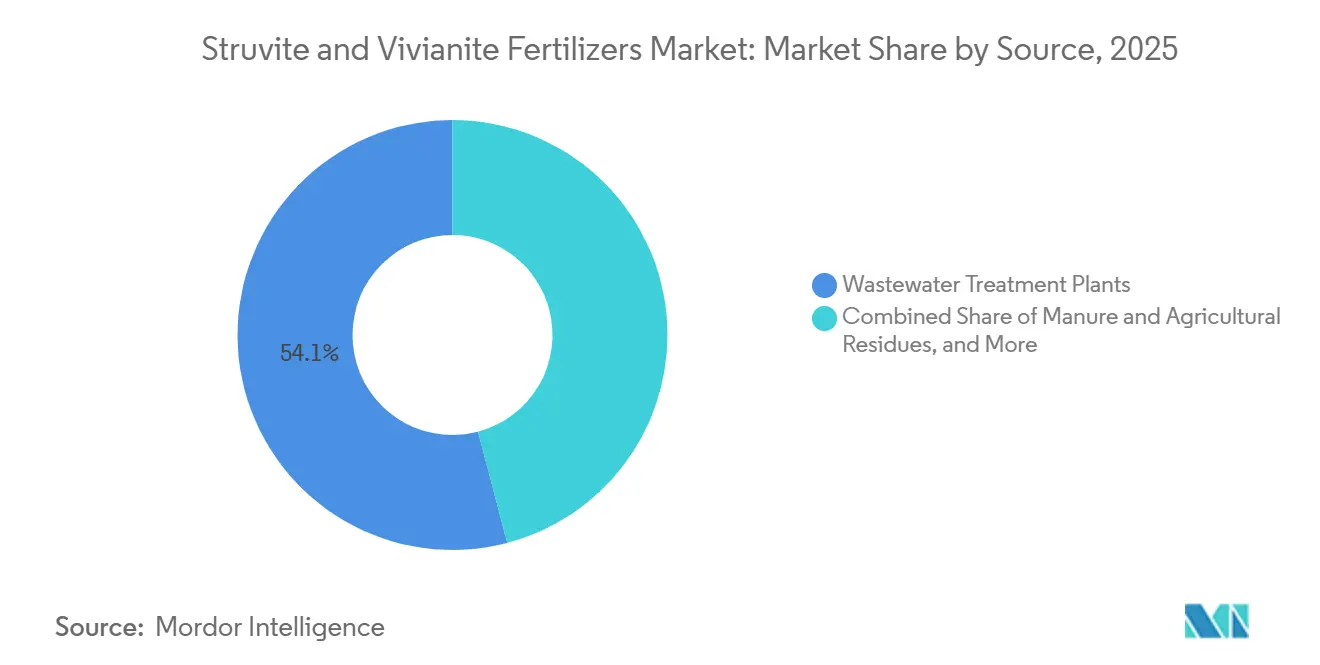
Wastewater treatment plants held 54.1% of the struvite and vivianite fertilizers market share in 2025, making them the dominant source because centrate and sidestream flows offer more consistent recovery conditions. Anaerobic digestion and biosolids streams emerged as increasingly important sources, while manure and agricultural residues remained a smaller but viable feedstock pool. Full-scale wastewater systems can achieve phosphorus recovery rates of 80% to 95%, and operators also benefit from lower scaling pressure in digesters and related equipment.
Anaerobic digestion and biosolids streams are projected to grow at a 10.1% CAGR through 2031, the fastest pace among source categories in the struvite and vivianite fertilizers market. Their importance comes from the reducing conditions that support vivianite formation, which gives this source a stronger link to the emerging vivianite supply base. Manure and agricultural residues should also continue to be developed, although compositional variability still complicates scaling compared with municipal wastewater systems. This leaves wastewater plants as the most stable source today, while digestion-linked streams shape a larger share of the future growth path.
By Application: Field Crops Anchor Volume as Horticultural Segment Builds Premium Value
Field crops captured 38.5% of demand in 2025, which kept them as the largest application area in the Struvite and vivianite fertilizers market because they absorb the greatest nutrient volumes. Horticultural crops followed as a smaller but increasingly valuable channel, while turf and ornamental applications remained a stable niche with clearer runoff and liability benefits. In field crop systems, slow-release phosphorus suits long growing cycles and helps reduce fixation losses in soils where conventional soluble phosphate performs less efficiently.
Horticultural crops are estimated to grow at a CAGR of 8.1% between 2026 and 2031, supported by premium economics and a stronger willingness to pay for certified recovered inputs. Organic registration across 5 European countries improves access to produce growers who need documented nutrient provenance before changing input programs. Turf and ornamental demand should remain steady because low heavy-metal concerns and reduced runoff risk align with municipal and managed-landscape requirements. The application mix is therefore separating into volume-led field use and value-led horticultural adoption over the forecast period.
Geography Analysis
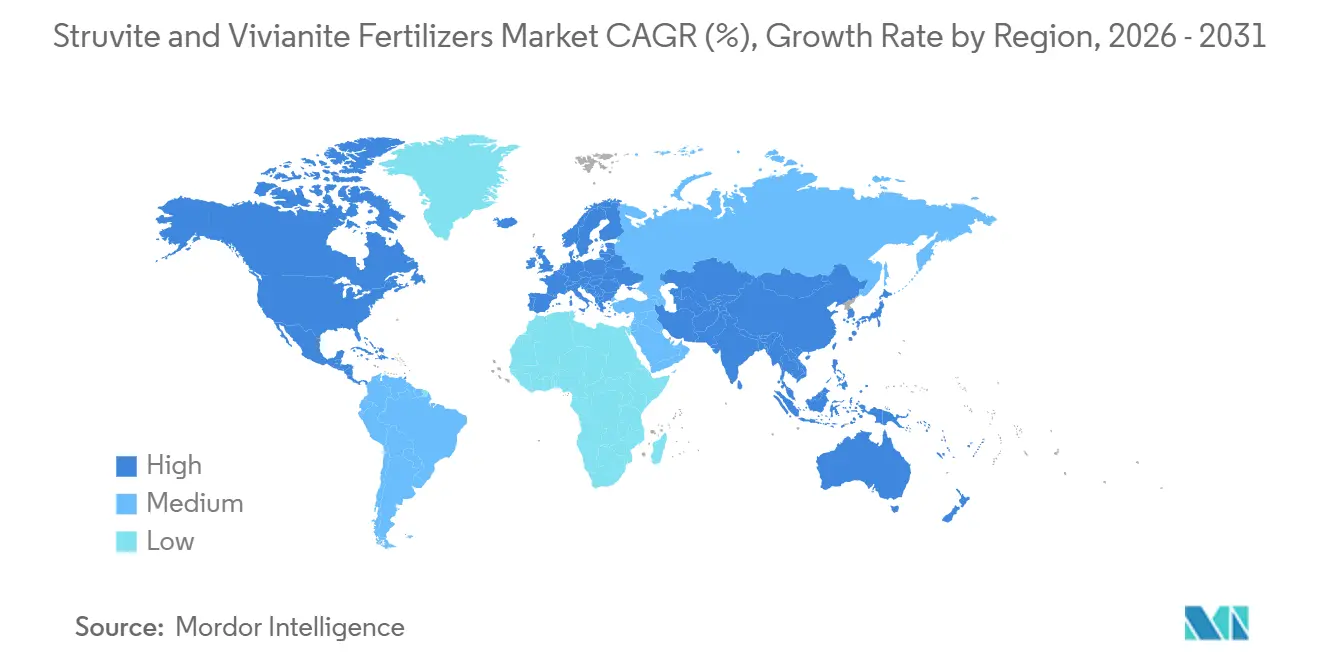
Europe held 38.2% of the global struvite and vivianite fertilizers market in 2025, making it the leading regional market, supported by more advanced wastewater infrastructure, phosphorus-recovery capabilities, and regulatory frameworks. The Netherlands, Germany, Denmark, and France have emerged as key production hubs, with established experience in struvite recovery. For example, REMONDIS SE & Co. KG operates a commercial phosphorus-recovery facility in Hamburg and is developing additional TetraPhos projects in Germany and the Netherlands. With regulatory requirements, established certification pathways, and strong links between recovery facilities and municipal utilities, Europe is expected to maintain its leading position in the market.
Asia-Pacific is anticipated to grow at a 9.8% CAGR through 2031, which makes it the fastest-growing region in the struvite and vivianite fertilizers market. China offers the largest near-term volume base because municipal treatment coverage and livestock-related nutrient streams are both extensive. Japan and South Korea remain important for vivianite development because their phosphorus recycling frameworks helped move pilot work closer to commercial practice. India is also becoming more relevant to the struvite fertilizer market as wastewater treatment and nutrient-recovery initiatives gain importance, creating a longer-term basis for domestic phosphorus recovery. The country’s large agricultural sector and growing need for efficient phosphorus management provide potential demand for recovered-phosphorus fertilizers such as struvite, particularly as circular-economy approaches to wastewater and nutrient management develop.
North America remains the one of the largest regional positions in the struvite and vivianite fertilizers market, with the United States as the main demand center. South America, led by Brazil and Argentina, has strong agricultural demand potential but more limited wastewater infrastructure outside major urban areas. The Middle East and Africa remain early-stage markets for struvite and vivianite fertilizers, with growing investment in wastewater treatment and water reuse creating a foundation for phosphorus recovery. However, limited commercial-scale recovery capacity and developing regulatory and certification frameworks continue to constrain market development. Near-term opportunities will therefore depend on wastewater infrastructure expansion, successful recovery projects, product approval pathways, and the economics of producing recovered-phosphorus fertilizers.

Competitive Landscape
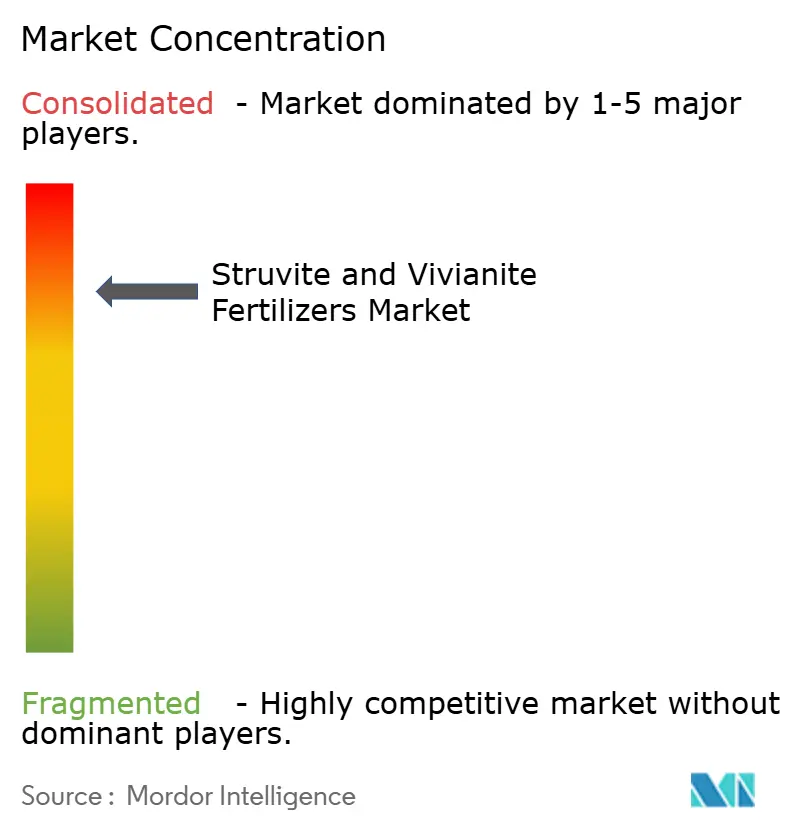
The Struvite and vivianite fertilizers market remains concentrated, with leadership still centered on technology specialists who built early positions in reactors, certification, and distribution in 2025. Ostara Nutrient Recovery Technologies Inc., NuReSys NV (Green Tile BV), Veolia Environnement S.A., and Phosmag Group hold clear first-mover advantages through operating experience and installed recovery systems. Their strategies differ by business model, as some focus on licensing and branded fertilizer sales, while others integrate phosphorus recovery into broader wastewater and biosolids service contracts. Phosmag Group’s base of more than 200 installations gives it a stronger modular position among municipal customers seeking proven repeatability. CNP Technology Water and Biosolids Corporation and similar firms remain more relevant in the mid-sized utility tier, where project needs differ from large, bespoke installations.
Strategic moves in 2025 and 2026 indicate that competition is widening across the Struvite and vivianite fertilizer markets. In June 2026, Ostara Nutrient Recovery Technologies Inc. introduced a higher-analysis CG P2X formulation, which strengthened its product performance case in mainstream agronomy. Glatt Ingenieurtechnik GmbH and Seraplant GmbH pushed the phos4green granulation system further, which addresses a downstream bottleneck by converting variable recovered streams into standardized granules.
Established fertilizer producers are also entering the space more directly, which is changing the competitive shape of the struvite and vivianite fertilizers market. ICL Group Ltd. positioned Puraloop as a fertilizer made from 100% recycled sewage sludge ash resources, which signals downstream entry from a major nutrient supplier. NuReSys NV continues to expand the commercial relevance of controlled struvite crystallization through its Biostru pathway and operating base in municipal and industrial treatment systems. The main open space remains in the mid-market utility segment, where neither large custom plants nor small packaged units fully solve the cost and qualification challenge today.
Struvite and Vivianite Fertilizers Industry Leaders
Ostara Nutrient Recovery Technologies Inc.
ICL Group Ltd.
NuReSys NV (Green Tile BV)
The Andersons, Inc.
Phosmag Group
- *Disclaimer: Major Players sorted in no particular order

Recent Industry Developments
- June 2026: Ostara Nutrient Recovery Technologies Inc. announced a significant advancement in its CG P2X fertilizer with a new, higher-analysis formulation (9-42-0 plus 9 Mg), delivering more than 2x the plant-available nitrogen, phosphorus, and magnesium compared with conventional phosphate fertilizers and enabling 40% lower application rates.
- March 2026: ICL Group Ltd. opened a new specialty fertilizer production facility in Maharashtra, India. The facility aligns with the Government of India's Make in India initiative and positions ICL Group Ltd. as a resilient supplier of specialty crop nutrition inputs, including recovered-phosphorus-adjacent products like Puraloop, to a high-growth market.
- January 2025: The European Commission brought the European Union Urban Wastewater Treatment Directive 2024/3019 into force, extending phosphorus recovery mandates to agglomerations of 1,000 or more inhabitants and projecting USD 7.56 billion in annual economic benefits for the European Union by 2040. The directive tasks the European Commission with specifying minimum phosphorus recycling rates by January 2028.


Global Struvite and Vivianite Fertilizers Market Report Scope
The struvite and vivianite fertilizers market comprises recovered phosphorus-based fertilizers produced from wastewater and organic residues for sustainable, slow-release plant nutrition. The struvite and vivianite fertilizers market is segmented by product type (struvite and vivianite), by form (solid and liquid), by source (wastewater treatment plants, anaerobic digestion and biosolids streams, and manure and agricultural residues), by application (field crops, horticultural crops, and turf and ornamental), and by geography (North America, Europe, Asia-Pacific, South America, Middle East, and Africa). The market forecasts are provided in terms of value (USD).
| Struvite |
| Vivianite |
| Solid |
| Liquid |
| Wastewater Treatment Plants |
| Anaerobic Digestion and Biosolids Streams |
| Manure and Agricultural Residues |
| Field Crops |
| Horticultural Crops |
| Turf and Ornamental |
| North America | United States |
| Canada | |
| Mexico | |
| Rest of North America | |
| Europe | France |
| Germany | |
| Italy | |
| Netherlands | |
| Russia | |
| Spain | |
| Ukraine | |
| United Kingdom | |
| Rest of Europe | |
| Asia-Pacific | China |
| India | |
| Japan | |
| Australia | |
| Indonesia | |
| Thailand | |
| Vietnam | |
| Philippines | |
| Rest of Asia-Pacific | |
| South America | Argentina |
| Brazil | |
| Rest of South America | |
| Middle East | Turkey |
| Saudi Arabia | |
| Rest of Middle East | |
| Africa | Nigeria |
| South Africa | |
| Rest of Africa |
| By Product Type | Struvite | |
| Vivianite | ||
| By Form | Solid | |
| Liquid | ||
| By Source | Wastewater Treatment Plants | |
| Anaerobic Digestion and Biosolids Streams | ||
| Manure and Agricultural Residues | ||
| By Application | Field Crops | |
| Horticultural Crops | ||
| Turf and Ornamental | ||
| By Geography | North America | United States |
| Canada | ||
| Mexico | ||
| Rest of North America | ||
| Europe | France | |
| Germany | ||
| Italy | ||
| Netherlands | ||
| Russia | ||
| Spain | ||
| Ukraine | ||
| United Kingdom | ||
| Rest of Europe | ||
| Asia-Pacific | China | |
| India | ||
| Japan | ||
| Australia | ||
| Indonesia | ||
| Thailand | ||
| Vietnam | ||
| Philippines | ||
| Rest of Asia-Pacific | ||
| South America | Argentina | |
| Brazil | ||
| Rest of South America | ||
| Middle East | Turkey | |
| Saudi Arabia | ||
| Rest of Middle East | ||
| Africa | Nigeria | |
| South Africa | ||
| Rest of Africa | ||


Key Questions Answered in the Report
What is the current size of the struvite and vivianite fertilizers space?
The struvite and vivianite fertilizers market size is estimated at USD 0.71 billion in 2025.
Which product type leads revenue today?
Struvite leads with 97.5% of 2025 revenue because it has a longer commercial record and clearer product recognition.
Which source stream contributes the most supply?
Wastewater treatment plants lead with 54.1% of supply in 2025 because their recovery conditions are more consistent than other feedstocks.
Which region is expanding the fastest?
Asia-Pacific is the fastest-growing region with a 9.8% CAGR through 2031, supported by wastewater investment and rising specialty fertilizer demand.
Page last updated on:


 Your data is secure and never sold or shared.


