
Stiffleg Crane Market Size and Share
Market Overview
| Study Period | 2020 - 2032 |
|---|---|
| Market Size (2027) | USD 2.19 Billion |
| Market Size (2032) | USD 3.12 Billion |
| Growth Rate (2027 - 2032) | 7.31 % |
| Fastest Growing Market | Middle East and Africa |
| Largest Market | Asia-Pacific |
| Market Concentration | Medium |
Major Players *Disclaimer: Major Players sorted in no particular order Image © Mordor Intelligence. Reuse requires attribution under CC BY 4.0. | |
Stiffleg Crane Market Analysis by Mordor Intelligence
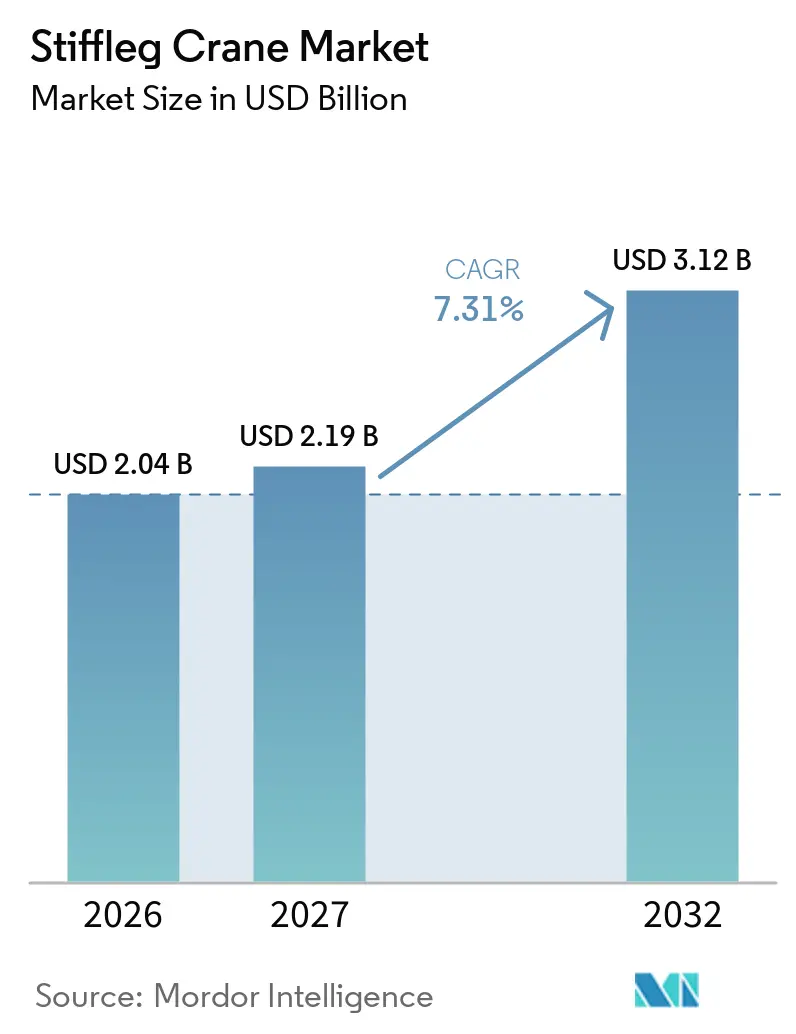
The stiffleg crane market size was valued at USD 2.04 billion in 2026 and is expected to grow from USD 2.19 billion in 2027 to USD 3.12 billion by 2032, at a CAGR of 7.31% during 2027-2032. The study covers stiffleg (stiff-leg) derricks and comparable fixed and barge-mounted derrick cranes used at shipyards, ports, and waterfront industrial sites. The stiffleg crane market is shaped by long-lived investments in shipyards, ports, and industrial waterfront facilities, where equipment selection is tied to civil works, electrical supply, operating layouts, safety rules, and the expected sequence of lifting work. Buyers generally make decisions well before construction starts because a fixed crane can affect the location of fabrication areas, access routes, berth operations, and the design of supporting electrical systems. Fixed installations remain central because established yards and terminals can justify permanent foundations when lifting work is frequent, predictable, and integrated with long-term asset plans. Electric drive adoption is also changing purchasing decisions as site operators prioritize grid connection, lower equipment maintenance, energy recovery, and compliance with site-level emissions requirements.
Key Report Takeaways
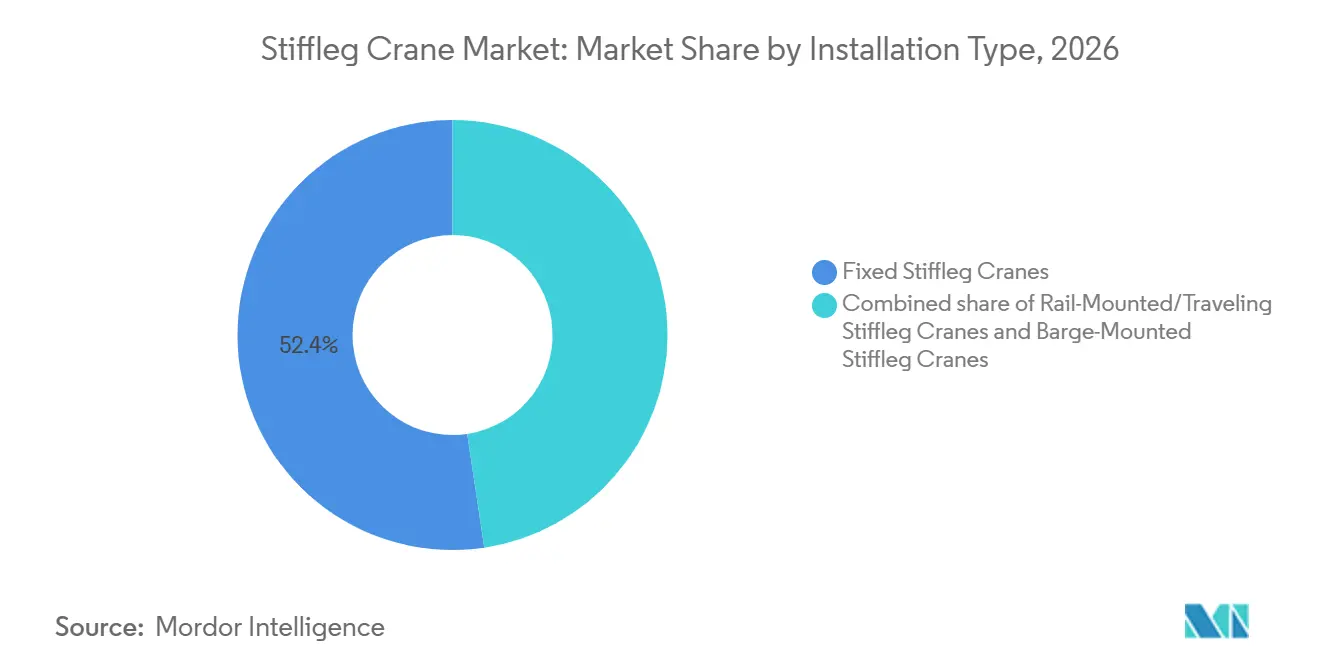
- By installation type, fixed stiffleg cranes held a 52.36% share in 2026, while barge-mounted stiffleg cranes are projected to grow at an 8.37% CAGR through 2032.
- By load capacity, 26 to 50 tons held a 34.27% share in 2026, while above 80 tons is projected to grow at an 8.26% CAGR through 2032.
- By drive type, electric held a 57.18% share in 2026, while hybrid is projected to grow at a 10.74% CAGR through 2032.
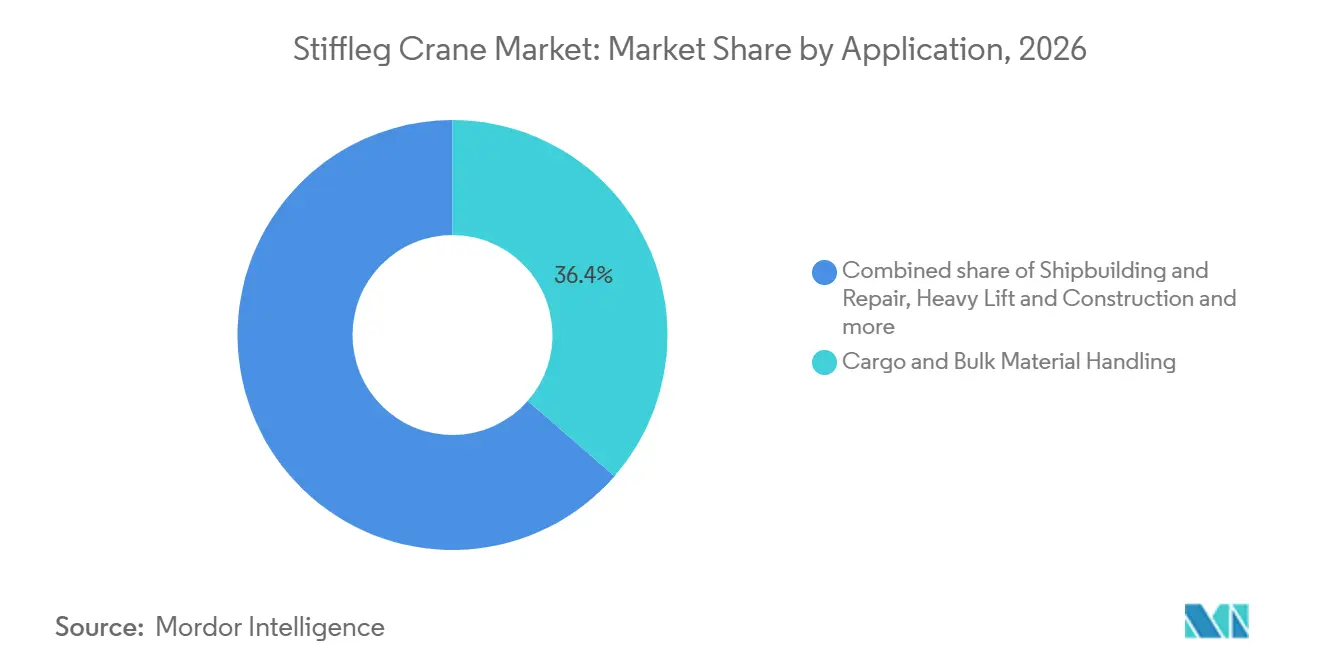
- By application, cargo and bulk material handling held a 36.42% share in 2026, while heavy lift and construction is projected to grow at an 8.13% CAGR through 2032.
- By end user, container and general cargo ports held a 33.27% share in 2026, while shipyards are projected to grow at an 8.42% CAGR through 2032.
- By geography, Asia-Pacific held a 49.63% share in 2026, while the Middle East and Africa is projected to grow at an 8.67% CAGR through 2032.
Note: Market numbers in this report are based on Mordor Intelligence's proprietary estimation framework, which combines nine months of actuals with Q4 projections for base year 2026.
Market Trends and Insights
Drivers Impact Analysis of Stiffleg Crane Market*
| Driver | (~) % Impact on CAGR Forecast | Geographic Relevance | Impact Timeline |
|---|---|---|---|
| Port and Shipyard Capital Expenditure Expansion | +2.1% | Global, with concentrated impact in Asia-Pacific, Middle East, and North America | Medium term (2–4 years) |
| Growth in Vessel Construction, Repair, and Heavy Fabrication | +1.8% | Asia-Pacific primary, Europe and North America secondary | Medium term (2–4 years) |
| Demand for High-Capacity Lifts in Bulk and Industrial Terminals | +1.4% | Global, with South America, Africa, and Southeast Asia showing early gains | Long term (≥ 4 years) |
| Electrification and Grid Availability at Fixed Lifting Sites | +0.9% | North America, Europe, and East Asia | Medium term (2–4 years) |
| Replacement of Aging Shipyard and Terminal Lifting Assets | +0.7% | North America and Europe, where legacy fleets are concentrated | Short term (≤ 2 years) |
| Digital Controls, Remote Monitoring, and Predictive Maintenance Adoption | +0.5% | Global, with early adoption in North America, Japan, and South Korea | Long term (≥ 4 years) |
| Source: Mordor Intelligence | |||
Port and Shipyard Capital Expenditure Expansion
Shipyard and port spending is creating a sustained pipeline for lifting equipment that can be integrated into permanent operating layouts and commissioned alongside broader infrastructure work. South Korean shipbuilders are expanding production facilities, while port operators are adding handling capacity, renewing equipment fleets, and improving the reliability of high-use waterfront assets. Those programs require lifting equipment to be planned alongside berth works, fabrication halls, utilities, access roads, safety zones, and material flows rather than purchased as an isolated item. Procurement therefore begins well before a crane is delivered, particularly where foundations, electrical connections, and detailed operating approvals are needed.
Growth in Vessel Construction, Repair, and Heavy Fabrication
Vessel construction and repair continue to support demand for controlled lifting systems at shipyards where production depends on repeated movement of blocks, machinery, and structural assemblies. China accounted for 74.4% of contracted gross tonnage in 2024 and held 63.7% of the global orderbook at the start of 2025, which supports the continued importance of Asian yard infrastructure[1]. Larger hull blocks and more complex fabrication work require repeatable movement across defined work areas, with clear load paths and minimal disruption to adjacent production activity. New yards also need lifting equipment as they enter commercial vessel construction and repair work, while established yards need to align equipment upgrades with active orderbooks.
Demand for High-Capacity Lifts in Bulk and Industrial Terminals
Bulk terminals and coastal industrial sites increasingly require lifts that exceed the practical range of older mid-capacity equipment and can be repeated within controlled site conditions. Offshore wind structures, LNG modules, and large fabricated assemblies require precise placement as well as lifting capacity because their construction sequences leave little room for changes in position or timing. Jiangsu Weihua Ocean Heavy Industry began lifting a 2,400-ton single-girder gantry crane into place at Wison New Energies' Qidong yard in May 2026, showing the scale of equipment used in offshore engineering work[2]. Similar fabrication requirements can create demand for stiffleg configurations where a fixed or semi-fixed arrangement matches the work sequence, site geometry, and required degree of control.
Electrification and Grid Availability at Fixed Lifting Sites
Grid-connected drive systems are becoming a standard consideration for fixed lifting sites because energy supply is now closely linked to maintenance planning, local emissions rules, and lifecycle operating costs. The shift toward electric drives across maritime equipment shows that more operators are treating electrification as a practical operating requirement rather than an optional feature. Operators value electric equipment because it can reduce routine engine maintenance, remove fuel-handling tasks, support emissions requirements, and provide more predictable operating conditions at ports and yards. Among fixed waterfront lifting equipment such as rubber-tired gantry cranes, Konecranes states that its E-Hybrid technology can limit peak power demand to 60 kW per crane, compared with up to 400 kW for traditional electric systems[3]. This option is relevant when a customer needs a staged path to full grid operation but must manage existing site power limits and avoid immediate large-scale substation investments.
Restraints Impact Analysis of Stiffleg Crane Market*
| Restraint | (~) % Impact on CAGR Forecast | Geographic Relevance | Impact Timeline |
|---|---|---|---|
| High Site-Preparation and Foundation Costs | -1.2% | Global, most severe in developing-economy ports and brownfield shipyards | Short term (≤ 2 years) |
| Long Engineering, Certification, and Delivery Cycles | -0.9% | Global, magnified in markets with import-control or local-content requirements | Medium term (2–4 years) |
| Limited Availability of Specialized Marine Heavy-Lift Engineering Talent | -0.6% | North America, Europe, and emerging maritime economies in the Middle East and Southeast Asia | Long term (≥ 4 years) |
| Project-Specific Design Complexity and Low Resale Liquidity | -0.4% | Global | Long term (≥ 4 years) |
| Source: Mordor Intelligence | |||
High Site-Preparation and Foundation Costs
Foundation work can be a decisive cost barrier for a fixed stiffleg crane installation because the crane structure depends on civil works that are specific to the site and the planned load chart. Each installation requires design that reflects soil conditions, waterfront constraints, ground clearance, embedded components, access for erection, and the anchor arrangement used to transfer lifting loads. Brownfield sites can present buried infrastructure, contamination, or soil conditions that only emerge during detailed engineering, demolition, or excavation work. These factors can force changes to the foundation plan after a project has been approved and can create coordination issues between crane suppliers, civil contractors, and the operator. The effect is most pronounced where capital discipline is tight and the buyer is comparing a permanent crane with mobile alternatives that require less initial site preparation.
Long Engineering, Certification, and Delivery Cycles
Custom equipment projects can take a long time to move from engineering to commissioning because each crane must be aligned with site geometry, operating procedures, safety controls, and required documentation. Classification review, structural fabrication, testing, transport, erection, and final acceptance are interdependent steps that cannot be compressed easily without adding execution risk. SOLAS Regulation II-1/3-13 introduced design, load-test, and documentation requirements for lifting appliances installed on ships from January 1, 2026. Site-specific requirements can also change during fabrication when customers update operating assumptions, compliance needs, or the arrangement of adjacent facilities. Limited marine heavy-lift engineering capability can prolong design reviews, especially in emerging maritime centers that are developing large new projects at the same time.
*Our forecasts treat driver/restraint impacts as directional, not additive. The impact forecasts reflect baseline growth, mix effects, and variable interactions.
Stiffleg Crane Market Segment Analysis
By Installation Type:
Fixed Installations Lead, Barge-Mounted Units AccelerateFixed stiffleg cranes accounted for 52.36% of the stiffleg crane market share in 2026. They fit established shipyards and heavy terminals where recurring lifts, known load paths, stable production volumes, and long operating lives justify major civil works and detailed pre-installation planning. The arrangement gives operators a stable lifting point for repetitive work across planned material flows, assembly areas, berth-side operations, and maintenance zones that must remain accessible during daily activity. It also suits sites where crane access, electrical supply, maintenance routes, safety zones, inspection procedures, and personnel movement can be integrated into the facility layout.
Barge-mounted stiffleg cranes are forecast to grow at an 8.37% CAGR through 2032. They address waterfront locations where permanent foundation work is technically impractical, commercially difficult, incompatible with active terminal operations, or unsuitable because the available ground cannot carry the required structural loads. Their value is strongest at constrained ports, island terminals, temporary project sites, and brownfield expansions where shore access cannot be interrupted for lengthy construction, excavation, or changes to existing utility systems.

By Load Capacity:
The Above-80-Ton Class Redefines Structural ScopeThe 26 to 50 tons category held 34.27% of the stiffleg crane market share in 2026. This range aligns with common ship-component lifts, terminal upgrade requirements, replacement programs, and general fabrication work where loads are substantial but remain within regular operating routines. It is well suited to facilities that need dependable lifting performance without the engineering complexity, wider clearance needs, additional foundation requirements, and specialized operating procedures associated with very large heavy-lift systems. The category also supports maintenance, fabrication, and general materials movement at industrial waterfront sites where operators value familiar workflows, accessible servicing, and a capacity suited to a broad mix of daily tasks.
Above 80 tons is projected to grow at an 8.26% CAGR through 2032. The segment reflects heavier vessel blocks, offshore energy components, and more integrated fabrication work that is increasingly undertaken within dedicated coastal facilities rather than at dispersed temporary locations. Larger loads require precise positioning, effective anti-sway controls, clear communication protocols, detailed operating procedures, and reliable coordination between the lifting team and the wider production schedule. This raises the importance of engineering expertise, structural planning, site access assessments, rigging plans, visibility across the work area, and careful coordination between crane suppliers, civil contractors, equipment installers, and site operators.
By Drive Type:
Electric Systems Dominant, Hybrid Class Captures Future GrowthElectric systems held 57.18% of the stiffleg crane market share in 2026. Their position reflects the availability of grid infrastructure at major ports and shipyards, where long operating hours can support investment in electrical connection, distribution equipment, and site-wide power management. Electric drives can simplify maintenance by reducing reliance on combustion engines, fuel systems, and exhaust-related components, as well as the servicing requirements that can complicate operations at busy waterfront facilities. They also help sites respond to tighter rules for quayside equipment emissions, meet internal energy objectives, and build a more predictable operating model for equipment that serves fixed production areas.
Hybrid systems are forecast to grow at a 10.74% CAGR through 2032. They give operators a practical option when a full electrical connection is not immediately available, when the timing of wider power upgrades remains uncertain, or when sites need to maintain operating flexibility during an infrastructure transition. Battery-supported and hybrid arrangements can reduce local emissions during lifting cycles while retaining operational continuity at sites with variable power supply or incomplete electrical infrastructure. This allows facilities to improve performance while planning larger electrical upgrades, evaluating the cost of new substations or cable systems, and avoiding an immediate commitment to full grid-primary operation.
By Application:
Bulk Handling Anchors Demand, Heavy Lift AcceleratesCargo and bulk material handling held 36.42% of the stiffleg crane market share in 2026. This application benefits from the large installed base of terminal infrastructure that requires dependable fixed lifting equipment for planned cargo movements, berth-side work, equipment replacement cycles, and the handling of materials within defined operating areas. Bulk facilities value equipment that can withstand repetitive operating cycles, exposed waterfront conditions, demanding maintenance schedules, and the practical need to keep essential operations available during service work. Modernization programs can include both replacement assets and capacity additions when operators expand berths, storage areas, material transfer systems, or supporting maintenance capability.
Heavy lift and construction is forecast to grow at an 8.13% CAGR through 2032. Offshore wind, LNG fabrication, and industrial installation projects are increasing the need for high-capacity precision lifts in locations where lift planning is central to the construction schedule and where access conditions can limit the use of mobile equipment. These projects often have limited tolerance for delays, placement errors, restricted access, or changes in the sequence of work once large modules are ready to move. Fixed crane systems can provide stable operations where large modules are moved repeatedly within a defined work area and placed at controlled positions during assembly or installation.
By End User:
Ports Lead in Volume, Shipyards Drive Fastest GrowthContainer and general cargo ports held a 33.27% share of the stiffleg crane market in 2026. Their leadership reflects decades of infrastructure investment in cargo handling, waterfront logistics, berth operations, and supporting maintenance facilities that operate over long asset lives. Terminals need equipment that supports predictable cargo flows, fits within established operating zones, accommodates vessel calls and storage activity, and can be maintained without causing extended disruption at berths or nearby transfer areas. Mining and bulk terminals also need durable, fixed lifting systems for high-cycle handling, planned maintenance, and equipment movement within industrial port environments.
Shipyards are projected to grow at an 8.42% CAGR through 2032. New-yard construction and capacity expansions are increasing the need for purpose-engineered lifting equipment that works with production halls, docks, block routes, safety controls, and the planned movement of material from one stage of construction to the next. Shipyards require cranes that fit building halls, docks, safety systems, and specific block-handling sequences, rather than standardized layouts alone, because the physical arrangement of the yard affects every lift.
Geography Analysis
Asia-Pacific held 49.63% of the stiffleg crane market share in 2026. China remains central to regional demand because its yards combine a large share of global vessel construction with a deep domestic network of steel fabricators, equipment makers, engineering firms, and port operators. China held 63.7% of the global orderbook at the start of 2025. That production base sustains recurring demand for equipment used in block assembly, repair, berth work, and the movement of fabricated structures between defined areas within a yard. South Korea adds demand through large shipyard infrastructure programs and high utilization at major facilities, while Japan, Singapore, Vietnam, and India contribute through repair activity, terminal development, and electrified handling projects.
North America and Europe operate in a medium-growth range, although the sources of demand and procurement priorities differ. North American demand is supported by shipyard modernization, efforts to strengthen domestic vessel construction, and the need to address lifting constraints at naval and commercial facilities. These customers often require purpose-designed portal, gantry, and associated systems that can operate within existing sites with restricted space, older foundations, and strict safety procedures. European investment is more closely tied to port modernization, electrification, and replacement of aging assets, often with a strong focus on lifecycle support and operating efficiency. Established grid infrastructure and rigorous operating standards make electric drives, energy recovery systems, and digitally monitored equipment especially relevant in both regions.
Middle East and Africa is forecast to grow at an 8.67% CAGR through 2032. Saudi Arabia and the United Arab Emirates are supporting the region's expansion through maritime industrial development, shipyard investment, and port programs that require new lifting and handling capability. DP World added three semi-automated quay cranes, a form of fixed waterfront lifting equipment, at Jeddah Islamic Port in March 2026 as part of its modernization program. Ras Al-Khair, African port upgrades, and bulk export infrastructure add selective opportunities, although each project depends on local construction conditions, power availability, and access to specialized engineering support. South American coastal industrial projects add further selective opportunities.
Competitive Landscape
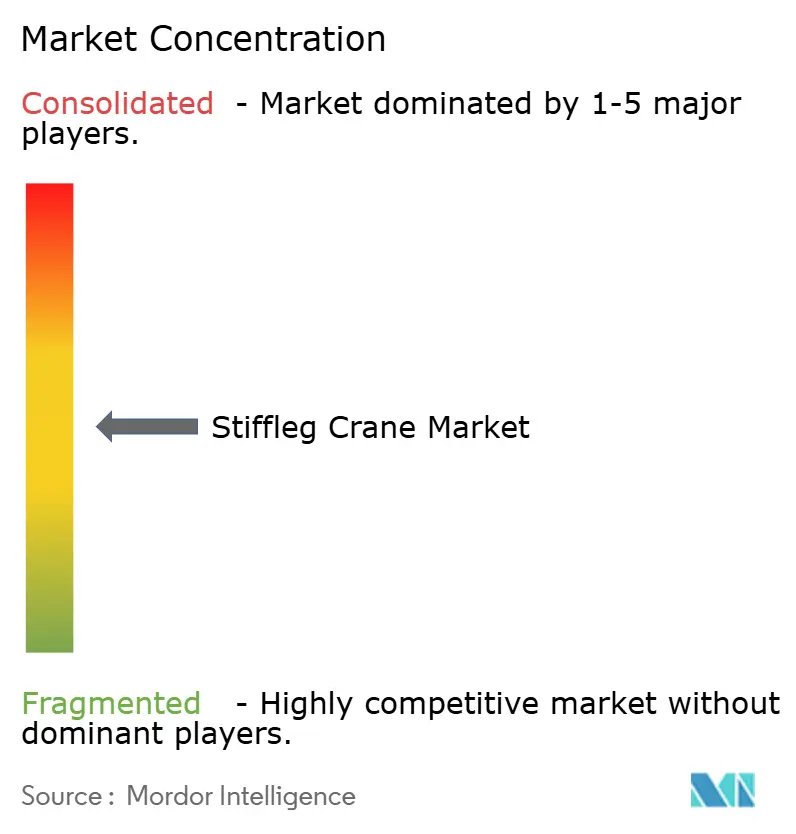
The competitive structure of the stiffleg crane market is moderately concentrated. Chinese original equipment manufacturers have a strong position in volume-oriented equipment and across Asian supply chains because their production networks combine steel fabrication, component sourcing, assembly, and large-project execution. ZPMC, Weihua, and XCMG compete through integrated fabrication, competitive delivery schedules, and experience in supplying equipment for large ports and heavy industrial facilities. European and North American suppliers are more visible in high-specification projects that require precision engineering, documented compliance processes, corrosion protection, and specialized service over the equipment life. This mix gives customers choices across standardized and custom equipment requirements, while making technical capability and delivery assurance more important than price alone for critical projects.
Konecranes and Liebherr compete in applications where operating precision, safety systems, classification requirements, and availability are decisive for the buyer. Konecranes completed a custom package of fixed lifting equipment such as overhead and Goliath cranes at BAE Systems' Govan shipbuilding hall in 2025, which supports closely coordinated crane operations. Weihua's 2,400-ton gantry crane installation at the Qidong yard in 2026 demonstrates the capability of Chinese manufacturers in large marine fabrication equipment. Suppliers are also using remote monitoring, preventative service, and predictive maintenance to strengthen customer relationships after delivery and to reduce the risk of avoidable downtime at operating sites. Updated compliance requirements further favor companies that can provide engineering, documentation, testing, and lifecycle support within a coordinated project scope.
Opportunities are present at both ends of the product range. The ultra-heavy end is supported by offshore wind mother ports, LNG module fabrication, and other projects that need carefully controlled lifts, extensive planning, and specialist technical support. Mid-capacity customers may favor standardized skid-mounted or barge-deployable systems that can be commissioned quickly at constrained facilities, especially where permanent civil works are difficult to justify. Electrification offers another route to differentiation where customers have strong grid access, emissions requirements, or a clear plan to improve energy performance across their equipment fleet.
Stiffleg Crane Industry Leaders
-
Liebherr Group
-
Konecranes Plc
-
Shanghai Zhenhua Heavy Industries Co., Ltd. (ZPMC)
-
Henan Weihua Heavy Machinery Co., Ltd.
-
Lampson International LLC
- *Disclaimer: Major Players sorted in no particular order
Stiffleg Crane Market Companies Covered in this Report
- Shanghai Zhenhua Heavy Industries Co., Ltd. (ZPMC)
- Henan Weihua Heavy Machinery Co., Ltd.
- Konecranes Plc
- Liebherr Group
- XCMG Group
- GH Cranes & Components
- Lampson International LLC
- The Manitowoc Company, Inc.
- Kobe Steel, Ltd.
- Tadano Ltd.
- Terex Corporation
- SANY Heavy Industry Co., Ltd.
- Zoomlion Heavy Industry Science & Technology Co., Ltd.
- Fushun Yongmao Construction Machinery Co., Ltd.
- Nucleon (Xinxiang) Crane Co., Ltd.
- PLM Cranes
- Somerset Engineering
- Thunder Cranes
- Shenyang Baoquan Group
- Palfinger AG
Recent Industry Developments in Stiffleg Crane Market
- May 2026: Konecranes received a USD 51.2 million order from the US Navy for a 175-ton portal jib crane for Portsmouth Naval Shipyard in Kittery, Maine.
- May 2026: Jiangsu Weihua Ocean Heavy Industry began lifting a 2,400-ton single-girder gantry crane into place at Wison New Energies' Qidong yard in China.
- April 2026: Konecranes agreed to supply Meyer Turku with a 50-ton single-boom shipyard crane with up to 75 m outreach for its outfitting quay, with installation planned for July 2027.
- March 2026: DP World added three ZPMC semi-automated quay cranes at Jeddah Islamic Port, raising the terminal's ship-to-shore crane fleet from 14 to 17.
Global Stiffleg Crane Market Report Scope
The stiffleg crane market is segmented by Installation Type, Load Capacity, Drive Type, Application, End User, and Geography. By Installation Type, the market is segmented into Fixed Stiffleg Cranes, Rail-Mounted/Traveling Stiffleg Cranes, and Barge-Mounted Stiffleg Cranes. By Load Capacity, the market is segmented into Up to 25 Tons, 26 to 50 Tons, 51 to 80 Tons, and Above 80 Tons. By Drive Type, the market is segmented into Diesel/Diesel-Hydraulic, Electric, and Hybrid. By Application, the market is segmented into Shipbuilding and Repair, Cargo and Bulk Material Handling, Heavy Lift and Construction, Equipment Maintenance and Installation, and Other Applications. By End User, the market is segmented into Shipyards, Container and General Cargo Ports, Mining and Bulk Terminals, Industrial Plants and Power Utilities, and Other End Users. By Geography, the market is segmented into North America (United States, Canada, and Rest of North America), Europe (United Kingdom, Germany, France, Italy, Spain, Belgium, Netherlands, Sweden, Poland, and Rest of Europe), Asia-Pacific (China, India, Japan, South Korea, Indonesia, Thailand, and Rest of Asia-Pacific), South America (Brazil, Argentina, Chile, Colombia, and Rest of South America), and Middle East and Africa (Saudi Arabia, United Arab Emirates, Turkey, Israel, South Africa, Egypt, Nigeria, and Rest of Middle East and Africa). The study covers stiffleg (stiff-leg) derricks and comparable fixed and barge-mounted derrick cranes used at shipyards, ports, and waterfront industrial sites. Market forecasts are provided in terms of Value (USD) and Volume (Units).
Segmentation Overview
| Fixed Stiffleg Cranes |
| Rail-Mounted/Traveling Stiffleg Cranes |
| Barge-Mounted Stiffleg Cranes |
| Up to 25 Tons |
| 26 to 50 Tons |
| 51 to 80 Tons |
| Above 80 Tons |
| Diesel/Diesel-Hydraulic |
| Electric |
| Hybrid |
| Shipbuilding and Repair |
| Cargo and Bulk Material Handling |
| Heavy Lift and Construction |
| Equipment Maintenance and Installation |
| Other Applications |
| Shipyards |
| Container and General Cargo Ports |
| Mining and Bulk Terminals |
| Industrial Plants and Power Utilities |
| Other End Users |
| North America | United States |
| Canada | |
| Rest of North America | |
| Europe | United Kingdom |
| Germany | |
| France | |
| Italy | |
| Spain | |
| Belgium | |
| Netherlands | |
| Sweden | |
| Poland | |
| Rest of Europe | |
| Asia-Pacific | China |
| India | |
| Japan | |
| South Korea | |
| Indonesia | |
| Thailand | |
| Rest of Asia-Pacific | |
| South America | Brazil |
| Argentina | |
| Chile | |
| Colombia | |
| Rest of South America | |
| Middle East and Africa | Saudi Arabia |
| United Arab Emirates | |
| Turkey | |
| Israel | |
| South Africa | |
| Egypt | |
| Nigeria | |
| Rest of Middle East and Africa |
| By Installation Type | Fixed Stiffleg Cranes | |
| Rail-Mounted/Traveling Stiffleg Cranes | ||
| Barge-Mounted Stiffleg Cranes | ||
| By Load Capacity | Up to 25 Tons | |
| 26 to 50 Tons | ||
| 51 to 80 Tons | ||
| Above 80 Tons | ||
| By Drive Type | Diesel/Diesel-Hydraulic | |
| Electric | ||
| Hybrid | ||
| By Application | Shipbuilding and Repair | |
| Cargo and Bulk Material Handling | ||
| Heavy Lift and Construction | ||
| Equipment Maintenance and Installation | ||
| Other Applications | ||
| By End User | Shipyards | |
| Container and General Cargo Ports | ||
| Mining and Bulk Terminals | ||
| Industrial Plants and Power Utilities | ||
| Other End Users | ||
| By Geography | North America | United States |
| Canada | ||
| Rest of North America | ||
| Europe | United Kingdom | |
| Germany | ||
| France | ||
| Italy | ||
| Spain | ||
| Belgium | ||
| Netherlands | ||
| Sweden | ||
| Poland | ||
| Rest of Europe | ||
| Asia-Pacific | China | |
| India | ||
| Japan | ||
| South Korea | ||
| Indonesia | ||
| Thailand | ||
| Rest of Asia-Pacific | ||
| South America | Brazil | |
| Argentina | ||
| Chile | ||
| Colombia | ||
| Rest of South America | ||
| Middle East and Africa | Saudi Arabia | |
| United Arab Emirates | ||
| Turkey | ||
| Israel | ||
| South Africa | ||
| Egypt | ||
| Nigeria | ||
| Rest of Middle East and Africa | ||
Key Questions Answered in the Report
What is the forecast value of the stiffleg crane market by 2032?
The stiffleg crane market is forecast to reach USD 3.12 billion by 2032, growing from USD 2.19 billion in 2027 at a 7.31% CAGR. The projection reflects continued investment in port, shipyard, and coastal industrial lifting infrastructure.
What is driving demand for stiffleg cranes?
Shipyard expansion, port modernization, heavy fabrication, and the shift toward electric drive systems are supporting demand. Procurement is also linked to major civil works and the need for reliable lifting equipment in fixed operating locations.
Which installation type leads stiffleg crane demand?
Fixed stiffleg cranes lead with a 52.36% share in 2026 because established yards and terminals can support permanent foundations. This configuration is particularly suited to sites with regular lifts and planned material movement.
Which drive technology is growing fastest for stiffleg cranes?
Hybrid systems are forecast to grow at a 10.74% CAGR through 2032, supported by sites that need a staged route to electrification. They can help customers improve emissions performance while managing grid limitations.