
Spiral Membrane Market Size and Share
Market Overview
| Study Period | 2020 - 2031 |
|---|---|
| Market Size (2026) | USD 8.3 Billion |
| Market Size (2031) | USD 14.28 Billion |
| Growth Rate (2026 - 2031) | 11.48 % |
| Fastest Growing Market | Asia Pacific |
| Largest Market | Asia Pacific |
| Market Concentration | High |
Major Players *Disclaimer: Major Players sorted in no particular order Image © Mordor Intelligence. Reuse requires attribution under CC BY 4.0. | |
Spiral Membrane Market Analysis by Mordor Intelligence
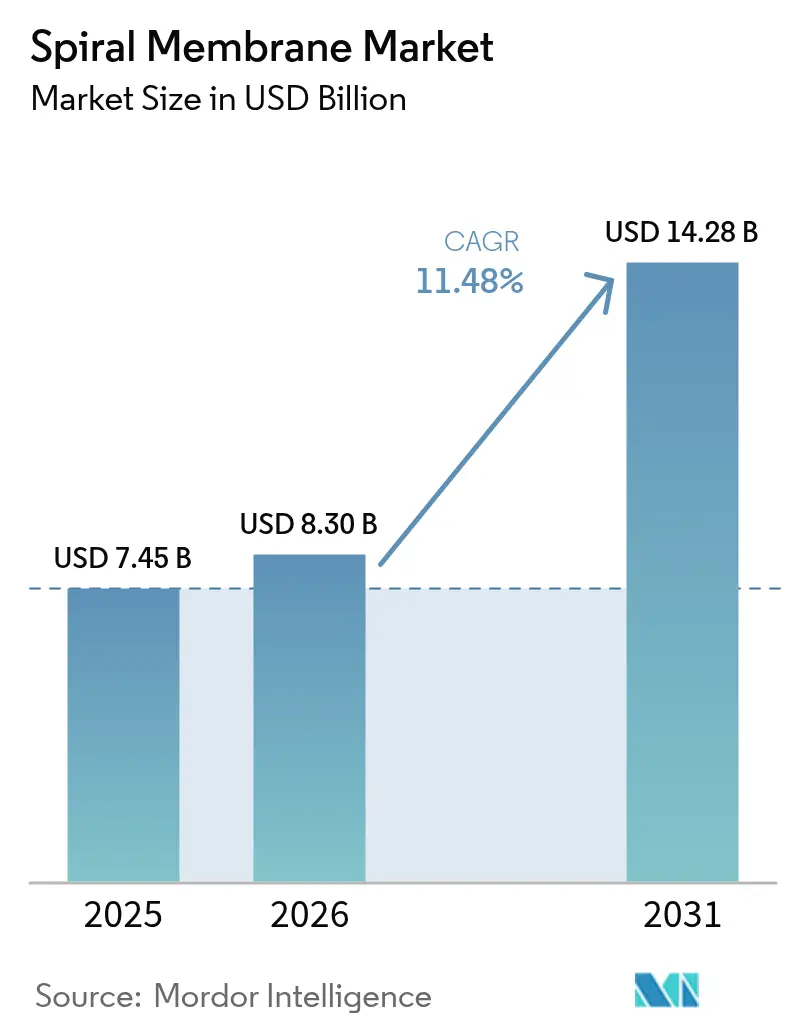
The Spiral Membrane Market size was valued at USD 7.45 billion in 2025 and estimated to grow from USD 8.3 billion in 2026 to reach USD 14.28 billion by 2031, at a CAGR of 11.48% during the forecast period (2026-2031). Strong growth rests on the technology’s ability to increase water-treatment capacity while satisfying tightening discharge standards. Buyers in industrial and municipal sectors gravitate toward spiral membranes because their high packing density lowers equipment footprints and capital costs. Polyamide thin-film composite (TFC) elements remain the mainstream choice for large-scale desalination, yet fluoropolymer designs are winning share in harsh-chemistry streams. Reverse osmosis (RO) installations drive the bulk of current demand, though ultrafiltration (UF) modules are scaling quickly as food and beverage processors intensify protein-recovery projects. Regionally, Asia Pacific dominates both usage and momentum: local regulations now compel factories, utilities, and lithium-brine operators to adopt advanced treatment for compliance. North America and Europe provide steady upgrade demand as operators replace aging equipment and pursue per- and polyfluoroalkyl substances (PFAS) abatement. Competitive dynamics remain moderately fragmented; multinational suppliers reinforce their positions through material science advances and targeted acquisitions that broaden service portfolios.
Key Report Takeaways
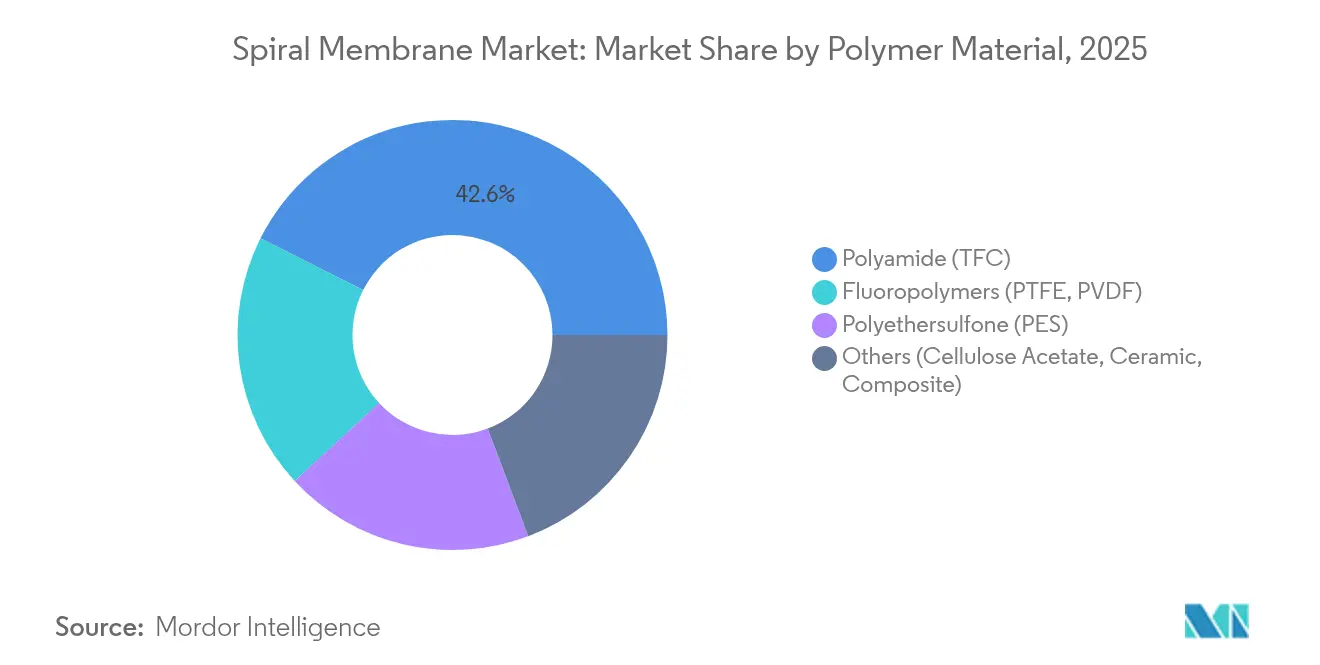
- By polymer material, polyamide TFC products captured 42.58% of the spiral membrane market share in 2025, while fluoropolymers are projected to post a 12.34% CAGR through 2031.
- By separation technique, reverse osmosis accounted for 46.88% of revenue in 2025; ultrafiltration is set to record the fastest 12.52% CAGR to 2031.
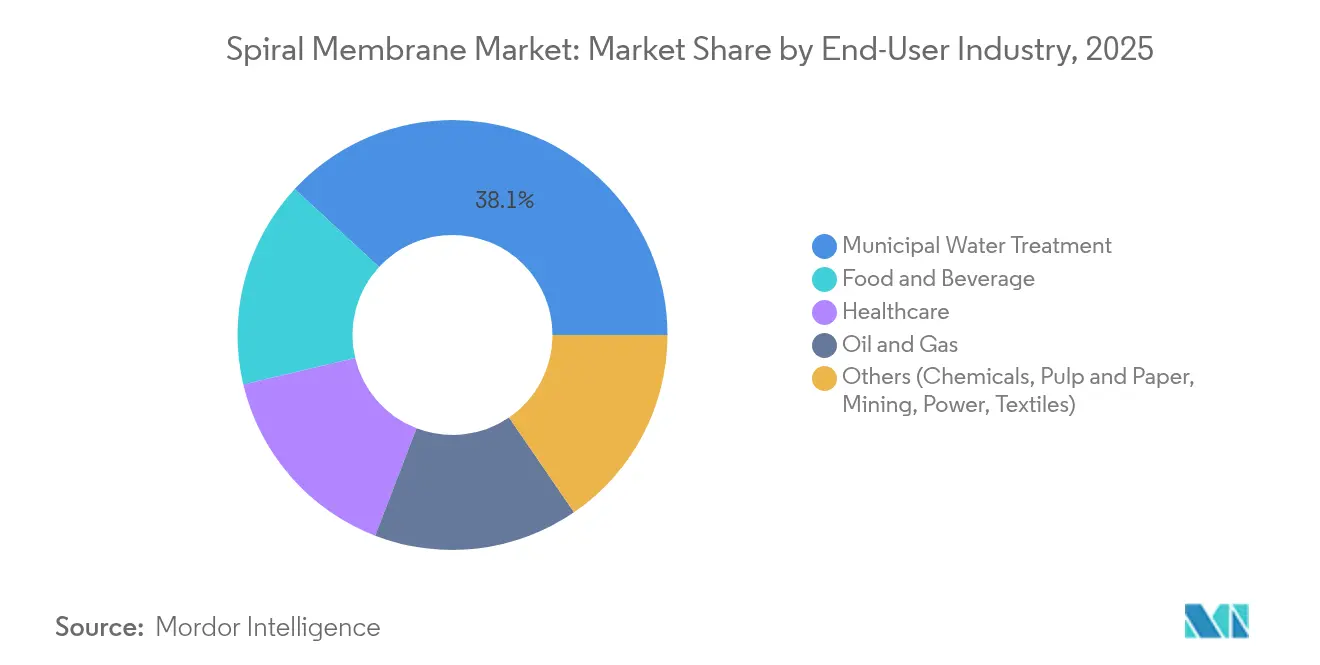
- By end-user industry, municipal water treatment held 38.12% of revenue in 2025; the food and beverage segment is forecast to advance at a 12.76% CAGR over the period.
- By geography, Asia Pacific commanded 33.74% of 2025 revenue and is projected to expand at a 12.63% CAGR, topping all other regions.
Note: Market size and forecast figures in this report are generated using Mordor Intelligence’s proprietary estimation framework, updated with the latest available data and insights as of 2026.
Market Trends and Insights
Drivers Impact Analysis of Spiral Membrane Market*
| Driver | (~) % Impact on CAGR Forecast | Geographic Relevance | Impact Timeline |
|---|---|---|---|
| Expanding food and beverage protein-fractionation needs | +2.8% | Global, with concentration in North America & EU dairy regions | Medium term (2-4 years) |
| Stricter industrial and municipal wastewater discharge norms | +3.2% | Global, led by APAC regulatory tightening | Short term (≤ 2 years) |
| Shift from hollow-fiber to high-flux spiral-wound modules | +1.9% | North America & EU industrial sectors | Medium term (2-4 years) |
| Adoption of hot-sanitizable spiral membranes in bioprocessing | +1.4% | North America & EU pharmaceutical hubs | Long term (≥ 4 years) |
| Lithium-brine concentration via spiral nanofiltration in battery supply chain | +2.4% | APAC core, spill-over to South America | Long term (≥ 4 years) |
| Source: Mordor Intelligence | |||
Expanding Food and Beverage Protein-Fractionation Needs
Dairy processors and juice bottlers are migrating from thermal concentration to membrane fractionation so they can produce value-added protein isolates that sell at 40-60% price premiums. Modern spiral-wound microfiltration lines separate whey proteins with 99% efficiency while preserving functional properties, allowing manufacturers to serve sports-nutrition, medical-nutrition, and infant-formula channels. Recent spacer redesigns lift cross-flow velocity, which suppresses fouling and stretches run times between cleanings. Plant managers also appreciate the smaller footprint; spiral modules pack two to three times more surface area than equivalent hollow-fiber units, lowering civil‐work costs.
Shift from Hollow-Fiber to High-Flux Spiral-Wound Modules
Industrial water operators notice that spiral-wound designs deliver up to three-fold higher packing density than hollow-fiber counterparts, enabling smaller skids and lower replacement costs. Cleaning protocols also improve: new feed-spacer geometries enhance turbulence, reducing chemical use. These benefits are decisive in viscous streams such as dairy, sugar, and gelatin, where hollow-fiber membranes foul rapidly.
Adoption of Hot-Sanitizable Spiral Membranes in Bioprocessing
Biopharmaceutical plants now specify hot-sanitizable spiral elements that tolerate 121 °C steam, eliminating harsh chemicals, simplifying validation, and cutting downtime. Growth in monoclonal-antibody and cell-therapy output accelerates uptake. Single-use system designers value the compact layout and the ability to maintain sterility throughout continuous manufacturing.
Stricter Industrial and Municipal Wastewater Discharge Norms
Policy changes such as the revised EU Urban Wastewater Treatment Directive and Asia Pacific zero-liquid-discharge mandates force utilities and factories to add advanced treatment lines capable of removing micropollutants, pharmaceuticals, and PFAS[1]European Commission, “Urban Wastewater Treatment Directive Revision,” wateronline.com . Municipalities retrofit conventional activated-sludge plants with membrane bioreactors that integrate spiral modules, cutting biosolid output by 90%. Textiles, chemicals, and pharmaceuticals now install multi-stage RO and nanofiltration trains to keep effluent within allowable limits, creating non-discretionary demand that shields the spiral membrane market from short-cycle economic swings.
Restraints Impact Analysis of Spiral Membrane Market*
| Restraint | (~) % Impact on CAGR Forecast | Geographic Relevance | Impact Timeline |
|---|---|---|---|
| Membrane fouling and cleaning-chemical costs | -2.1% | Global, particularly in high-fouling applications | Short term (≤ 2 years) |
| High energy/pressure demand for RO operations | -1.8% | Global, concentrated in energy-intensive regions | Medium term (2-4 years) |
| Volatile pricing of ultra-pure polyamide casting films | -1.3% | Global, with supply chain concentration in Asia Pacific | Short term (≤ 2 years) |
| Source: Mordor Intelligence | |||
Membrane Fouling and Cleaning-Chemical Costs
Across Dutch desalination plants, cleaning accounts for 24% of RO operating expenses. Biofouling shortens membrane life, especially in polyamide elements that cannot tolerate free chlorine. Developers are coating surfaces with zwitterionic polymers and leveraging pulsed-flow cleaning to cut chemical use in half. Until these tools mature, elevated cleaning and downtime costs will temper adoption in heavily bio-active streams.
High Energy/Pressure Demand for RO Operations
Producing 1 m³ of permeate from seawater still consumes 3-4 kWh of electricity on average. Energy can reach 50% of a plant’s operating bill, a barrier in regions with costly power. Although isobaric recovery devices reclaim up to 98% of hydraulic energy and ultra-high-permeability membranes raise flux by 25-30%, widespread deployment takes time. Capital outlays for 120-bar pumps and corrosion-resistant piping remain substantial.
*Our forecasts treat driver/restraint impacts as directional, not additive. The impact forecasts reflect baseline growth, mix effects, and variable interactions.
Spiral Membrane Market Segment Analysis
By Polymer Material:
Polyamide Dominance Faces Fluoropolymer ChallengePolyamide thin-film composites retained a 42.58% spiral membrane market share in 2025, propelled by decades of performance optimization in desalination where 99.5% salt rejection is routine. PES holds niche utility in bioprocessing because it withstands repeated steam cycles. Fluoropolymers such as PVDF and PTFE, though only a small slice today, are on track to grow 12.34% annually, capturing opportunities in lithium brine, semiconductor, and aggressive-solvent streams. These chemistries tolerate pH 0–14 and temperatures to 120 °C, features that justify premium pricing. Surface-activation techniques—plasma etching, UV grafting—now overcome their intrinsic hydrophobicity, pushing water flux toward polyamide territory.
The polyamide segment draws strength from mature supply chains and competitive pricing, but its chlorine sensitivity restricts reuse after fouling events, nudging operators toward fluoropolymer retrofits. Ceramic and composite designs populate extreme environments such as produced-water clean-up, where uptime outweighs capital intensity. They represent a small yet strategic fragment of the spiral membrane market size for specialty chemicals and mining services.



By Separation Technique:
RO Leadership Challenged by UF InnovationReverse osmosis sustained 46.88% revenue in 2025 on the back of global desalination and ultrapure-water applications. Plants achieve permeate with fewer than 10 ppm total dissolved solids, a spec unattainable by thermal distillation at comparable cost. UF lines, however, are accelerating at a 12.52% CAGR. Food, dairy, and biotech processors adopt UF for high-value protein concentration, cutting chemical steps out of flowsheets. Nanofiltration occupies the middle ground, excelling at selective divalent-ion removal for water softening or solvent-recycling tasks. Microfiltration still serves as RO pretreatment and beverage clarification, but its share grows slowly.
Advances in UF membrane chemistry upgrade fouling resistance and heightened flux, enabling single-pass recoveries above 90% for whey proteins. The spiral membrane market size for lithium extraction also leans on NF’s selective permeability, where sodium passes but magnesium and calcium remain, boosting lithium yield.
By End-User Industry:
Municipal Leadership Meets F&B InnovationMunicipal utilities represented 38.12% of 2025 revenue as governments funded infrastructure to meet tightening nutrient and micropollutant limits. Membrane bioreactor adoption in cities such as Beijing and Chennai expands 14.5% annually. Meanwhile, food and beverage processors form the fastest-growth cohort at 12.76% CAGR; spiral-wound modules concentrate proteins, sugars, and juices while meeting clean-label expectations. Healthcare manufacturers also increase spending, driven by single-use biologics production. Oil and gas operators embrace ceramic-lined spiral elements to recycle produced water and cut freshwater withdrawals by 98%.
Municipal segments concentrate on total cost of ownership, valuing elements that resist biofouling and reduce chemicals. Food and beverage buyers prioritize product purity and temperature control, favoring hot-sanitizable PES and fluoropolymer designs. The spiral membrane market size for mining and textiles remains smaller but grows steadily as zero-liquid-discharge rules spread.
Geography Analysis
APAC and Oceania Spiral Membrane Market
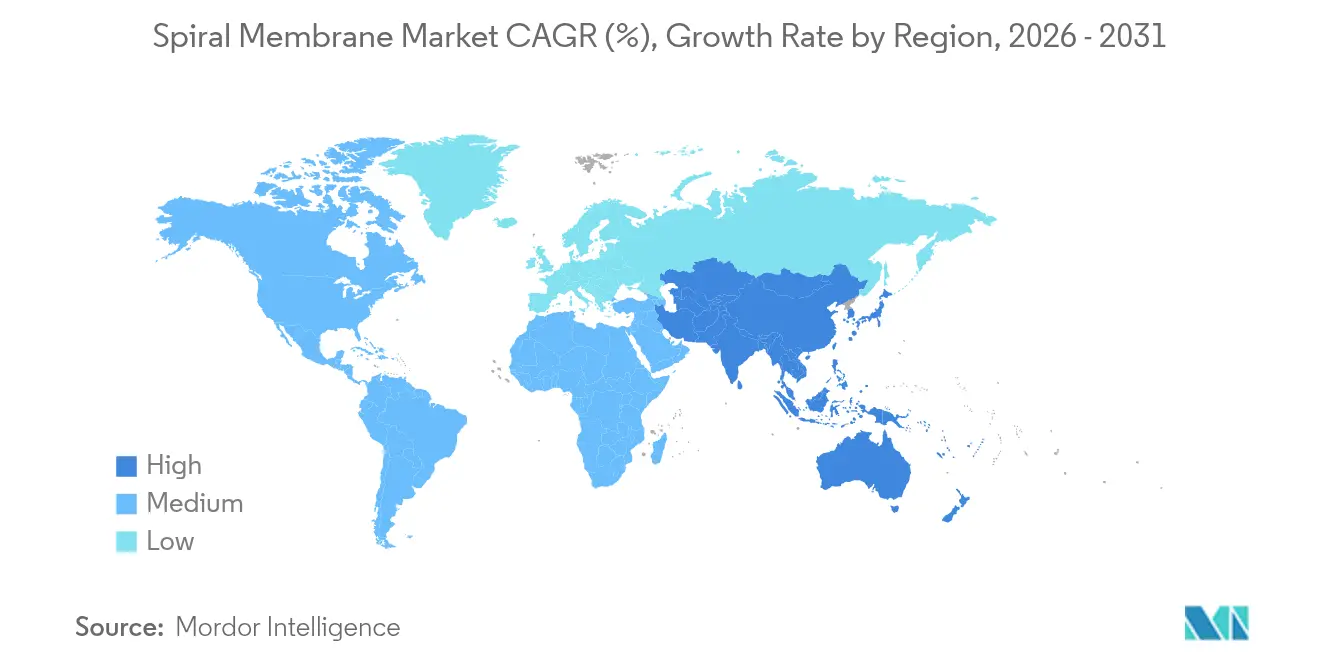
Asia Pacific commands the largest slice of spiral membrane market share at 33.74% in 2025, and its 12.63% CAGR through 2031 outpaces all other regions. Environmental enforcement now compels Chinese factories to install advanced membranes, while India funnels public funds into municipal upgrades under schemes such as the Jal Jeevan Mission. Semiconductor fabs in Taiwan, Japan, and South Korea require ultra-pure water below 5 ppt total organic carbon, pushing demand for high-selectivity RO and UF stacks. Australia leans on spiral-wound RO to secure potable water for cities facing protracted drought.
North America Spiral Membrane Market
North America is the second-largest consumer as the Infrastructure Investment and Jobs Act channels USD 55 billion into water-system modernization. Aging RO trains from the early-2000s are being swapped for high-permeability designs that cut energy 20-25%. Market activity centers on upgrading PFAS removal and industrial reuse. Mexico’s automotive corridor invests in zero-liquid-discharge, boosting local spiral membrane imports.
Europe Spiral Membrane Market
Europe maintains strict effluent norms under the Water Framework Directive, spurring retrofits across food, beverage, and pharmaceutical plants. Scandinavian utilities pilot PFAS-targeted nanofiltration, while southern states deploy seawater desalination to offset prolonged drought. Suppliers see healthy aftermarket sales as operators adhere to energy-efficiency and circular-economy targets.
LATAM and MEA Spiral Membrane Market
Latin American demand concentrates in mining hubs. Chile and Argentina fit spiral nanofiltration for lithium salars, extracting battery-grade feedstock while recycling brine. Brazil’s pulp-and-paper mills adopt RO for closed-loop bleaching circuits, trimming chemical oxygen demand discharges by 85%. The Middle East and North Africa emphasize megascale RO plants where state utilities explore energy-recovery devices to offset power constraints. Sub-Saharan Africa’s uptake remains low but climbs as multilateral lenders finance sewage-reuse projects in water-scarce cities.

Value Chain Analysis
Upstream inputs for spiral-wound elements focus on membrane polymers and supports (for example, polysulfone support layers, polyester backing fabric, polypropylene feed spacers) as well as casting and monomer chemistry used in thin-film composite production (such as m-phenylenediamine and trimesoyl chloride for interfacial polymerization). Midstream manufacturing typically proceeds through membrane casting and formation of the selective barrier layer, followed by element winding, assembly (including glue lines, permeate tubes, and end caps), and final testing before shipment. Production footprints are concentrated across the United States, Japan, and key European and Asian manufacturing bases (including Germany, the Netherlands, Denmark, Sweden, the UK, China, and South Korea). This tends to shape availability for high-purity RO/NF elements.
Downstream, demand is met through OEM skid integrators and packaged-system builders, regional distributors, and project-driven EPC channels for municipal and industrial installations. An aftermarket layer also plays a growing role, supplying replacement elements, cleaning chemicals, performance monitoring, and service. Logistics and consolidation hubs in Europe, including the Rotterdam-Antwerp corridor, Hamburg, and Felixstowe, support cross-border distribution. Lead times can stretch for specialized high-temperature elements, reported at 16-20 weeks, which elevates supplier qualification, stocking strategies, and regionalized assembly capacity for buyers managing uptime and compliance-driven replacement cycles.
Competitive Landscape
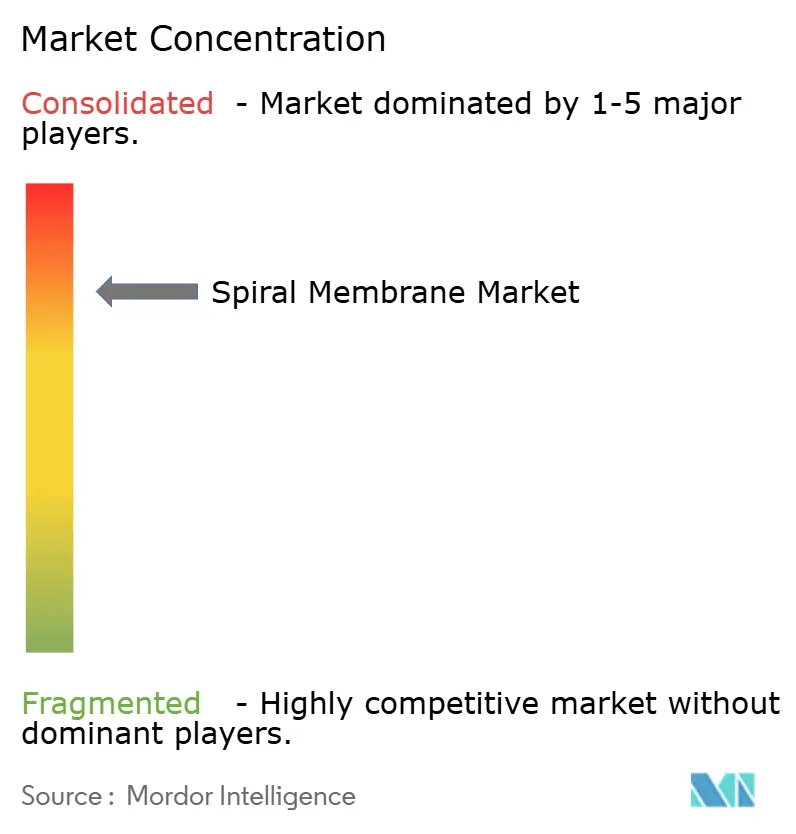
The spiral membrane market remains highly consolidated. DuPont retained its Water Solutions division in 2025, signaling long-term confidence after weighing a divestiture. Toray Industries expands integrated offerings by fusing RO, NF, and MBR modules under one digital monitoring platform. SUEZ consolidates aftermarket service networks after Veolia’s acquisition of Water Technologies and Solutions closed in 2025, pushing synergies in global procurement.
Thermo Fisher’s USD 4.1 billion purchase of Solventum’s purification unit strengthens vertically integrated bioprocessing systems aimed at hot-sanitizable spiral membranes. Niche players—NX Filtration, Aquaporin, and Keppel—commercialize biomimetic and 2D-material layers that promise double-digit flux gains. Start-ups concentrate on surface-anchored zwitterionic coatings that curb fouling without chlorine. Competitive intensity is highest in commodity water treatment where lifecycle costs dictate supplier selection; in contrast, pharmaceutical and lithium-extraction clients favor high-performance membranes, accepting premiums for specialized functionality.
Spiral Membrane Industry Leaders
SUEZ
DuPont
LG Chem
Hydranautics (Nitto)
Toray Industries Inc
- *Disclaimer: Major Players sorted in no particular order
Spiral Membrane Market Companies Covered in this Report
- Alfa Laval
- Asahi Kasei Corporation
- AXEON Water
- DuPont
- Hydranautics (Nitto)
- IDE Technologies
- Koch Separation Solutions
- Lanxess
- LG Chem
- MANN+HUMMEL
- Membranium (JSC RM Nanotech)
- Merck KgaA
- Pall Corporation
- Pentair PLC
- Synder Filtration, Inc
- SUEZ
- Toray Industries Inc
- Toyobo Co., Ltd
- Veolia
- Xylem
- ZwitterCo.

Market Opportunities and Future Outlook
Capacity additions and regionalization of spiral-wound manufacturing create near-term whitespace for shorter lead times and localized support, especially for industrial reuse and food and beverage processing. Kovalus Separation Solutions announced an investment of more than USD 20 million in a 140,000 sq-ft spiral membrane element assembly facility in Mexico, targeting a 50% increase in production capacity. This investment ties directly to North American demand for packaged systems and quicker replenishment of replacement elements. In the United States, Aqua Membranes announced a USD 6.6 million investment to build a 200,000 sq-ft manufacturing facility in Knoxville, Tennessee, scaling spiral-wound production using printed spacer technology. The move also points to spacer engineering as a lever to reduce fouling and improve energy efficiency.
Application-led product differentiation supports further opportunity in higher-value niches where standard polyamide RO faces durability and cleaning constraints. Developments such as full-size 8040 module capability (Active Membranes) and manufacturer roadmaps around ZLD/MLD and resource recovery shift procurement toward elements optimized for higher concentration regimes and lower specific energy. Meanwhile, municipal upgrades for drinking water and industrial compliance maintain a steady pipeline for NF/RO retrofits. At the same time, long lead times for specialized elements and volatility in high-purity polyamide-related inputs favor suppliers that can offer multi-region manufacturing footprints, along with validated cleaning and monitoring services, and portfolio breadth spanning RO, NF, and UF modules.
Recent Industry Developments in Spiral Membrane Market
- April 2026: DuPont expanded its FilmTec Fortilife portfolio with XC-Max UHP and XC220 reverse osmosis elements positioned for ZLD/MLD and resource recovery duty. The release targets higher salinity and tougher industrial operating windows, broadening spiral-wound applicability where thermal concentration and multiple-effect evaporation have been common endpoints.
- June 2025: DuPont launched the FilmTec Hypershell element for dairy processing, emphasizing higher productivity and improved energy efficiency for RO in food applications. This strengthens specialization in sanitary processing, where operators prioritize throughput, cleanability, and drop-in performance improvements over standard commodity elements.
- June 2024: Kovalus Separation Solutions announced an investment of more than USD 20 million in a 140,000 sq-ft spiral membrane element assembly facility in Mexico, targeting a 50% increase in production capacity. The expansion supports faster delivery and inventory positioning for North American OEMs and end users managing project schedules and replacement-element cycles.


Spiral Membrane Market Report Scope and Research Methodology
Market Definition and Coverage
This market tracks revenues from spiral-wound membrane elements and modules used to separate, concentrate, or purify liquids in municipal and industrial processes, where the membrane sheet is arranged in a spiral configuration. We size it in USD on a value basis across major end uses.
Scope exclusions: We exclude non-spiral configurations (such as hollow fiber, tubular, and plate and frame) and also exclude installation labor and plant civil works unless bundled with membrane supply.
Segments Covered in This Report
- By Polymer Material
- Polyamide (TFC)
- Polyethersulfone (PES)
- Fluoropolymers (PTFE, PVDF)
- Others (Cellulose Acetate, Ceramic, Composite)
- By Separation Technique
- Microfiltration (MF)
- Ultrafiltration (UF)
- Nanofiltration (NF)
- Reverse Osmosis (RO)
- By End-user Industry
- Municipal Water Treatment
- Food and Beverage
- Healthcare
- Oil and Gas
- Others (Chemicals, Pulp and Paper, Mining, Power, Textiles)
- By Geography
- Asia-Pacific
- China
- India
- Japan
- South Korea
- ASEAN
- Australia and New Zealand
- Rest of Asia-Pacific
- North America
- United States
- Canada
- Mexico
- Europe
- Germany
- United Kingdom
- France
- Italy
- Spain
- Russia
- Rest of Europe
- South America
- Brazil
- Argentina
- Rest of South America
- Middle East and Africa
- Saudi Arabia
- United Arab Emirates
- South Africa
- Rest of Middle East and Africa
- Asia-Pacific
Data Sources, Market Sizing, and Validation
Desk Research
Desk research was used to set the market structure and to build realistic ranges for volumes, pricing, and adoption by application. Public sources such as the US EPA, USGS, World Bank, and UN Comtrade helped anchor water stress signals, treatment investment direction, and trade movement for filtration-related components.
We also reviewed publicly available standards information (such as ASTM and ISO summaries), peer-reviewed membrane and separation journals, and association publications that track desalination and reuse activity. This was paired with company filings, investor presentations, and reputable press coverage to understand capacity additions and shifts in product mix, for example RO versus UF, by region. Where needed, paid subscriptions were used only for company financials and for shipment-level import and export screening to sanity-check directional trends. The sources listed here are illustrative, and additional public documents were also used for data collection, validation, and clarification.
Primary Interviews and Surveys
Primary discussions were run with membrane manufacturers, channel partners, EPC and OEM participants, and large end users that purchase membranes for municipal treatment, food and beverage, healthcare, and process industries. We used respondent input to verify where spiral elements are specified versus other module types, to test assumptions on replacement cycles, and to confirm how pricing moves with polymer and energy costs across major regions.
Distribution of primary research fieldwork respondents
| Company type | Respondent position | Region |
|---|---|---|
| Top tier: 33% | CXOs: 14% | APAC: 46% |
| Mid tier: 50% | Functional/Unit leaders: 35% | EMEA: 30% |
| Smaller Players: 17% | Managers: 51% | Americas: 24% |
Market-Sizing & Forecasting
The core sizing starts from a top-down build where municipal and industrial water treatment demand pools are reconstructed by region using installed capacity signals and project activity, then translated into spiral membrane consumption through penetration and replacement assumptions. To keep the totals grounded, we corroborate with selective bottom-up approximations, including sampled supplier revenue ranges, channel checks on shipment flow, and a simple ASP-times-volume view for key applications.
Inputs that matter in this market include reverse osmosis and ultrafiltration adoption by end use, average element replacement frequency in municipal and industrial plants, common element size mix linked to membrane area per element, plant utilization ranges, and price movement linked to polymer costs. When coverage is thin in smaller countries, we handle gaps by proxying from similar capacity build-outs and normalizing by industrial output and population served, then adjusting after expert feedback from interviews.
Forecasts were produced using scenario analysis supported by short variable-level projections, which were checked in interviews for realism. The forward view tracks expected desalination and water reuse project pipelines, tightening discharge norms, and gradual shifts in food and beverage and healthcare filtration demand, with conservative adjustments when tender pipelines appear delayed or funding looks uncertain.
Data Validation & Update Cycle
Outputs are cross-checked against independent indicators such as reported desalination capacity additions, wastewater investment direction, and observable price movement patterns for membrane elements. Where the model shows unusual jumps, assumptions are revisited, and follow-up outreach is triggered to re-check replacement rates, procurement cycles, and the split of spiral versus non-spiral modules.
Before sign-off, the work is reviewed in steps, starting with internal logic checks and then moving to variance checks by region, application, and implied pricing. Reports are refreshed annually, and interim updates are made when there are material events such as sudden policy changes, large project delays, or major capacity expansions. Right before delivery, we do a final pass so clients receive the latest updated view.
Mordor Intelligence's Spiral Membrane Market Size Versus Other Published Estimates
Published market sizes for spiral membranes often do not align, even when similar forecast windows are used, because each publisher defines included products and revenue types in its own way. Differences also appear when one estimate assumes faster replacement cycles or steeper ASP changes than what buyers report.
The main gap comes from whether non-spiral membrane formats and plant-level services are folded into the total, because Mordor Intelligence counts only spiral membrane product revenues and then stress-tests the RO versus UF mix and replacement timing through primary validation before locking the 2025 value.
Benchmark comparison
| Source | Market Size | Gaps in Research Methodology |
|---|---|---|
| Mordor Intelligence | USD 7.45 B (2025) | |
| Global Consultancy A | USD 9.26 B (2024) | Uses a different base year and may blend broader filtration module revenues and selected system-related services into the spiral membrane total, which can lift the starting value before growth is applied. |
| Industry Publisher B | USD 8.50 B (2024) | Appears to carry wider technology coverage across RO, UF, MF, and NF without clearly separating spiral-only revenues from adjacent membrane configurations, and 2024 currency timing can shift the reported USD value. |
Taken together, the spread is mostly explained by scope alignment and base-year selection rather than disagreement on demand direction. When inclusions are kept consistent and the key levers that move value, like replacement frequency and average pricing, are checked with market participants, the final number is easier to reproduce and update over time.


Key Questions Answered in the Report
What is the current Spiral Membrane Market size?
The spiral membrane market size reached USD 8.3 billion in 2026 and is forecast to hit USD 14.28 billion by 2031, reflecting an 11.48% CAGR.
Which polymer material holds the largest spiral membrane market share?
Polyamide thin-film composite membranes led with 42.58% market share in 2025 thanks to proven performance in desalination and industrial reuse.
Why is Asia Pacific growing fastest in the spiral membrane market?
Rapid industrialization, stricter effluent rules, and heavy investments in municipal water infrastructure drive Asia Pacific’s 12.63% CAGR.
How are spiral membranes applied in food and beverage processing?
Dairy and juice producers use spiral-wound microfiltration and ultrafiltration to recover proteins and clarify liquids while preserving flavor and nutrition, supporting a 12.76% CAGR in this segment.
Page last updated on:


 Your data is secure and never sold or shared.


