
Reverse Osmosis Membrane Market Size and Share
Market Overview
| Study Period | 2020 - 2031 |
|---|---|
| Market Size (2026) | USD 5.66 Billion |
| Market Size (2031) | USD 8.38 Billion |
| Growth Rate (2026 - 2031) | 8.18 % |
| Fastest Growing Market | Middle East and Africa |
| Largest Market | Asia Pacific |
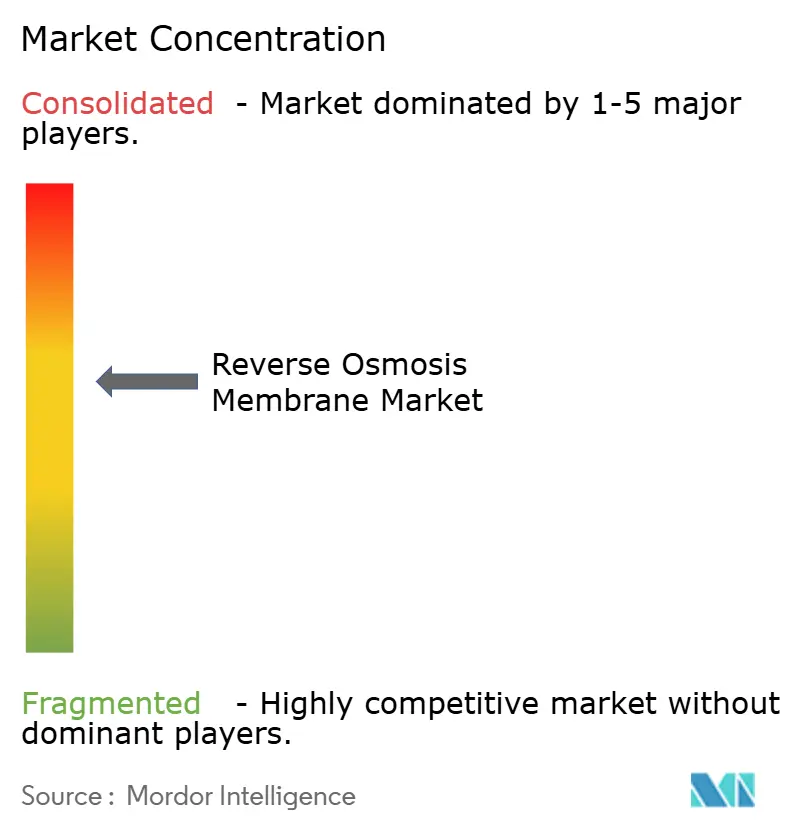
| Market Concentration | Medium |
Major Players *Disclaimer: Major Players sorted in no particular order Image © Mordor Intelligence. Reuse requires attribution under CC BY 4.0. | |
Reverse Osmosis Membrane Market Analysis by Mordor Intelligence
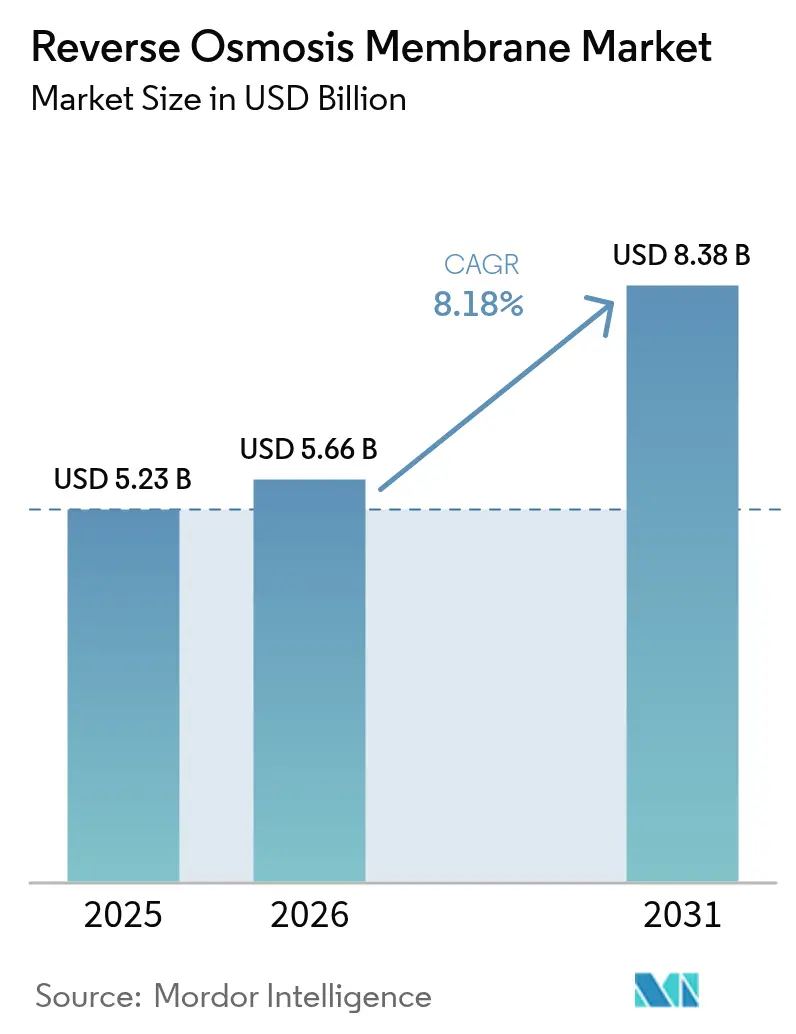
The Reverse Osmosis Membrane market size is expected to grow from USD 5.23 billion in 2025 to USD 5.66 billion in 2026 and is forecast to reach USD 8.38 billion by 2031 at 8.18% CAGR over 2026-2031. Water‐scarcity pressures, tightening discharge regulations, and membrane technology improvements collectively lift demand for thin-film composite (TFC) elements in industrial and municipal plants across all major regions. Regulatory agencies in the European Union, China, and the United States now cap priority contaminants such as PFAS and specific pharmaceutical actives at parts-per-trillion levels, prompting rapid upgrades of legacy treatment lines to thin-film modules that can consistently meet those limits. At the same time, hollow-fiber innovations improve fouling resistance and packing density, enabling compact systems for off-grid or space-restricted installations.
Key Report Takeaways
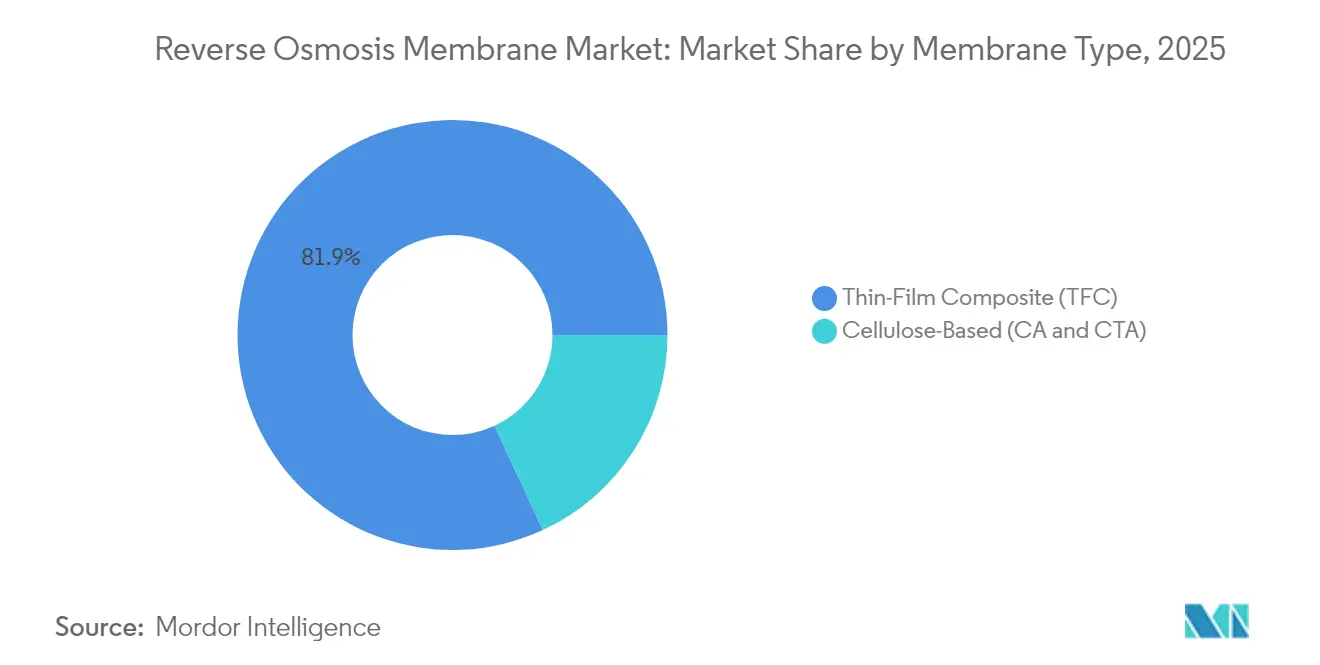
- By membrane type, thin-film composite elements captured 81.90% revenue share in 2025 while cellulose-based membranes posted the highest projected CAGR at 8.62% through 2031.
- By configuration, spiral-wound devices held 69.60% of the reverse osmosis membrane market share in 2025, whereas hollow-fiber modules are projected to expand at an 8.55% CAGR to 2031.
- By end-use industry, municipal and desalination utilities accounted for a 37.85% share of the reverse osmosis membrane market size in 2025 and healthcare and pharmaceuticals is advancing at a 8.92% CAGR through 2031.
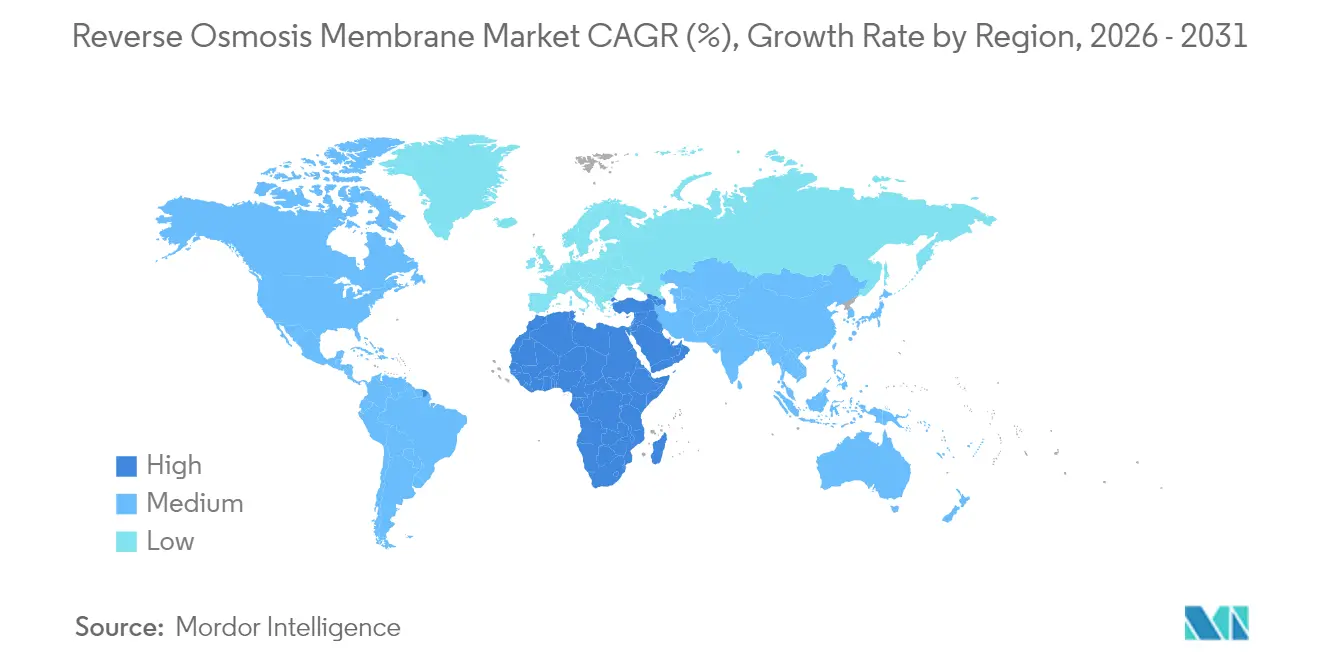
- By geography, Asia-Pacific led with 45.60% revenue share in 2025, while the Middle East and Africa region is forecast to expand at a 8.78% CAGR out to 2031.
Note: Market size and forecast figures in this report are generated using Mordor Intelligence’s proprietary estimation framework, updated with the latest available data and insights as of 2026.
Market Trends and Insights
Drivers Impact Analysis of Reverse Osmosis Membrane Market*
| Drivers | (~) % Impact on CAGR Forecast | Geographic Relevance | Impact Timeline |
|---|---|---|---|
| Increasing demand for pure and potable water | +2.1% | Global with APAC and MEA focus | Long term (≥ 4 years) |
| Expansion of seawater desalination capacity | +1.8% | Middle East and coastal APAC | Medium term (2-4 years) |
| Stricter industrial-effluent discharge norms | +1.2% | North America and EU; spreading to APAC | Short term (≤ 2 years) |
| Growth in residential POU/POE filtration units | +0.9% | North America, Europe, urban APAC | Medium term (2-4 years) |
| Low-pressure RO membranes enabling off-grid usage | +0.6% | Rural APAC, Sub-Saharan Africa, Latin America | Long term (≥ 4 years) |
| Source: Mordor Intelligence | |||
Increasing Demand for Pure and Potable Water
Climate change intensifies water stress for 40% of the global population, amplifying the appeal of membrane purification that can process brackish or contaminated supplies at scale[1]European Environment Agency, “Industrial Emissions Directive 2024 Amendments,” eea.europa.eu. Municipal utilities in India, Vietnam, and Nigeria now budget reverse osmosis upgrades into five-year capital plans because operating costs have fallen 25% since 2020 thanks to higher-flux TFC sheets. Urban growth compounds this pressure as megacities must secure new potable sources without increasing treatment footprints. Plasma-enhanced surface modification further cuts biofouling episodes, allowing longer run times between clean-in-place cycles. Declining module prices therefore align with public-sector objectives to achieve Sustainable Development Goal 6 targets by 2030.
Expansion of Seawater Desalination Capacity
Saudi Arabia’s NEOM utility alone will demand membranes equal to 15% of current annual global production, accelerating pre-order activity for high-flux, low-pressure sheets. Morocco’s Agadir expansion and Jordan’s Red Sea Project similarly tighten supply, prompting Asian producers in South Korea and China to plan line expansions by 2026. Scaling efficiencies at mega-plants now cut levelized water costs below USD 0.50 per cubic meter, reinforcing RO as the default technology for new capacity. These trends reinforce long-term demand visibility for reverse osmosis membrane market participants.
Stricter Industrial-Effluent Discharge Norms
The European Union slashed permitted pharmaceutical and chemical discharges by 30% in 2024, compelling upgrades that only membrane filtration can reliably meet[2]World Health Organization, “Global Water Security Report 2024,” who.int . China followed with textile and petrochemical thresholds that effectively mandate zero-liquid-discharge systems using multi-stage RO plus crystallizers. U.S. state regulators, meanwhile, target PFAS below four parts per trillion, a level unattainable with conventional adsorptive or biological schemes.
Growth in Residential POU/POE Filtration Units
Residential installations climbed 35% across North America and Europe in 2024 as consumers reacted to media coverage of PFAS, nitrates, and endocrine disruptors. Miniaturized thin-film modules now retail under USD 100 for point-of-use systems, while smart-home integration delivers real-time sensor alarms when rejection declines. Subscription-based filter-replacement models further improve affordability by spreading costs over three-year contracts. In Japan and South Korea, apartment developers install centralized point-of-entry systems to raise property value, widening the installed base for aftermarket membrane sales. Vendors leverage e-commerce channels to reach middle-income consumers in Indonesia and Mexico, delivering double-digit shipment growth since 2023.
Restraints Impact Analysis of Reverse Osmosis Membrane Market*
| Restraints | (~) % Impact on CAGR Forecast | Geographic Relevance | Impact Timeline |
|---|---|---|---|
| High acquisition and replacement cost of membranes | -1.4% | Global, particularly acute in developing markets | Short term (≤ 2 years) |
| Persistent fouling and scaling issues | -0.8% | Industrial applications globally, hot climate regions | Medium term (2-4 years) |
| Supply-chain risk for specialty polyamide feedstocks | -0.5% | Global, concentrated in Asia-Pacific manufacturing hubs | Short term (≤ 2 years) |
| Source: Mordor Intelligence | |||
High Acquisition and Replacement Cost of Membranes
Membrane elements often represent 35-45% of total operating expenditure, and price volatility in polyamide feedstocks can push unit costs to USD 300 per 8-inch spiral, deterring adoption in cost-sensitive markets. Smaller municipal operators in Southeast Asia sometimes extend element lifetimes beyond manufacturer guidelines, trading higher energy usage for lower near-term capital outlay. Financing institutions now request five-year replacement reserve accounts in project models, raising up-front cash requirements and elongating payback. Component reuse and recycling remain limited, though pilot programs in Spain and Singapore show promise for reclaiming polypropylene housings. Until secondary markets or recycling streams mature, replacement expense will curb installation growth among budget-constrained buyers.
Persistent Fouling and Scaling Issues
RO plants lose 15–25% flux annually from biofouling and mineral scaling, necessitating chemical cleans every 4–6 weeks that increase downtime and operating costs. Biofilm growth can occur within weeks when nutrient levels are elevated, particularly in food-processing effluents. Scaling from calcium carbonate or silica accelerates under high-recovery designs pursued for brine minimization, forcing operators to accept lower recoveries or install costly antiscalant dosing systems. Though surface-grafted zwitterionic coatings and graphene oxide interlayers show early success in lab trials, commercial proof of durability beyond three-year cycles remains limited. These operational headaches can cause some industrial users to defer RO adoption in favor of less efficient but better-understood treatment routes.
*Our forecasts treat driver/restraint impacts as directional, not additive. The impact forecasts reflect baseline growth, mix effects, and variable interactions.
Reverse Osmosis Membrane Market Segment Analysis
By Membrane Type:
Thin-Film Composite Dominance Drives InnovationThin-film composite sheets captured an 81.90% reverse osmosis membrane market share in 2025, benefitting from 99.5% salt rejection and broad chemical stability. Robust investment in automated coating lines now yields consistent roll-to-roll throughput above 10,000 m² per day, lowering costs while improving quality. Cellulose-based alternatives retain footholds in beverage and dairy clarification where biodegradability and chlorine tolerance matter more than rejection efficiency. Nonetheless, the performance gap widens each year as solvent-free interfacial polymerization creates ultra-thin barrier layers under 50 nm, reducing pump energy by 10–15%.
Across 2026–2031, TFC demand will rise at an 8.49% CAGR as desalination mega-plants specify higher-flux, low-pressure variants to hit sub-3 kWh/m³ energy targets. The reverse osmosis membrane market size for cellulose acetate products is set to shrink to less than USD 145 million by 2031 as regulation favors longer-life, lower-waste solutions. Sustainability narratives could revive interest in bio-derived membranes, yet recycling schemes for TFC elements are advancing faster, dulling that advantage. Suppliers now trial per- and polyfluoroalkyl-free synthesis routes to anticipate future environmental scrutiny without sacrificing performance.



By Configuration:
Spiral-Wound Leadership Faces Hollow-Fiber ChallengeSpiral-wound elements held 69.60% of the reverse osmosis membrane market size in 2025 thanks to well-established supply chains and straightforward retrofit compatibility. High-pressure vessels, cartridge housing standards, and cleaner logistics all favor the incumbent format. Yet hollow-fiber modules are projected to post an 8.55% CAGR, outpacing every other configuration through 2031.
Higher packing density lets hollow-fiber systems deliver the same permeate flow in housings 40% shorter, a decisive benefit where plant footprints command premium value, such as offshore oil platforms and dense urban districts. Backwash capability, absent in spiral elements, further extends operational uptime in particulate-rich waters and aligns with reduced chemical clean objectives. Manufacturing defects once plagued fiber integrity, but laser-monitored spinning lines now push burst pressures above 100 bar, clearing reliability hurdles. Investment in dedicated hollow-fiber plants by Japanese and Korean majors signals confidence that demand will scale fast enough to justify capacity expansions.
By End-use Industry:
Healthcare Precision Drives Fastest GrowthMunicipal and desalination utilities dominated in 2025, accounting for 37.85% of the reverse osmosis membrane market size as drought-stricken regions doubled down on long-life TFC investments. However, healthcare and pharmaceuticals will lead growth with a 8.92% CAGR out to 2031, fueled by rising biologics output in India and Brazil plus stricter USP water specifications.
Drug makers require multi-pass RO-EDI (electrodeionization) trains validated under Good Manufacturing Practice, elevating membrane performance and traceability demands. Suppliers differentiate on leachables profiles, endotoxin retention, and electronic batch-record platforms that streamline FDA audits. The reverse osmosis membrane market now attracts specialty polymer firms aiming to supply ultra-clean feedstocks, mitigating risk of extractable organics that could compromise drug purity. This premium niche delivers margins up to 25% higher than municipal tenders, incentivizing continuous research and development.

Geography Analysis
APAC Reverse Osmosis Membrane Market
Asia-Pacific accounted for 45.60% of reverse osmosis membrane market revenue in 2025 on the back of China’s zero-liquid-discharge drive and India’s Smart Cities rollouts. Chinese textile, electronics, and petrochemical facilities together consumed over 30% of global membrane output as of 2024. Domestic producers scale quickly in Jiangsu and Zhejiang provinces, shortening lead times and lowering landed cost versus imported sheets. India’s National Water Mission mandates 20% recycling by 2030, prompting state utilities to integrate RO as the backbone of new water reuse projects across Pune, Surat, and Chennai.
MEA Reverse Osmosis Membrane Market
Middle East and Africa will register the fastest regional growth at 8.78% CAGR through 2031, driven by USD 20 billion in desalination spending under Saudi Arabia’s Vision 2030 and multiple public–private partnerships in the UAE, Qatar, and Oman. African states such as Kenya and Ghana pilot solar-powered RO units for rural communities where grid ties are unavailable, signaling a decentralized trajectory distinct from Gulf mega-projects.
North America and Europe Reverse Osmosis Membrane Market
North America and Europe remain mature yet lucrative as replacement business and regulatory compliance underpin steady sales. The European Commission’s Industrial Emissions Directive now forces chemical producers to retrofit multi-barrier systems, often selecting hollow-fiber pre-filters followed by TFC spirals to hit discharge thresholds.

Value Chain Analysis
The reverse osmosis (RO) membrane value chain starts with upstream specialty chemicals and polymers used to build thin-film composite (TFC) structures, including monomers such as m-phenylenediamine (MPD) and trimesoyl chloride (TMC), solvents such as N-methyl-2-pyrrolidone (NMP), and porous support materials (commonly polysulfone-based supports with polyester or polypropylene backing). These inputs feed the core manufacturing step, interfacial polymerization on a porous support followed by element conversion (spiral-wound or other configurations), quality testing, and module assembly. Supply risk is concentrated in key intermediates, with TMC production heavily concentrated in China, where periodic environmental compliance actions in chemical hubs have tightened availability and contributed to price volatility for RO monomers and related feedstocks.
Midstream, large membrane producers differentiate through proprietary thin-film chemistries, automation of coating and conversion lines, and tighter process control to lift yields and consistency for municipal/desalination and industrial reuse applications. Downstream, elements move through OEM system integrators, EPCs, and distributors to end users (municipal and desalination utilities, industrial process water, power, food and beverage, and healthcare/pharma). In this layer, aftermarket replacement, clean-in-place compatibility, and performance guarantees create a recurring revenue stream. Trade measures and tariffs on imported modules and components have added landed-cost variability, which reinforces multi-sourcing, regional stocking, and localization strategies to protect project schedules and reduce logistics exposure.
Competitive Landscape
The reverse osmosis membrane industry exhibits moderate fragmentation. DuPont, Toray Industries, and LG Chem leverage proprietary thin-film chemistries, backward integration into polyamide, and fully automated coating lines that elevate yields above 98%. Competitive intensity has shifted toward fouling-mitigation innovations. Toray’s hydrophilic nanolayer extends clean-in-place intervals by 20%, while DuPont commercialized a chlorine-tolerant sheet targeting reuse schemes with variable pretreatment. Intellectual-property filings exceeded 200 in 2024, concentrated on surface-layer grafting and solvent-free interfacial polymerization methods that reduce greenhouse-gas intensity.
Reverse Osmosis Membrane Industry Leaders
TORAY INDUSTRIES, INC.
NITTO DENKO CORPORATION
LG Chem
Koch Membrane Systems, Inc
DuPont
- *Disclaimer: Major Players sorted in no particular order
Reverse Osmosis Membrane Market Companies Covered in this Report
- applied membranes, inc.
- Aquatech
- Axeon Water Technologies
- BNKO Environmental Techology (Shanghai) Co., Ltd
- DuPont
- GEA Group Aktiengesellschaft
- Koch Membrane Systems, Inc
- Lenntech B.V.
- LG Chem
- Membranium
- NITTO DENKO CORPORATION
- Pentair
- Permionics Membranes Private Limited
- Pure Aqua, Inc.
- Samco Technologies, Inc
- Scinor Water America, LLC
- Synder Filtration, Inc
- TORAY INDUSTRIES, INC.
- Toyobo.Co.Ltd
- Veolia Water Technologies

Market Opportunities and Future Outlook
Near-term whitespace is forming around localization of manufacturing and service footprints in high-build regions, as utilities and industrial buyers seek shorter lead times and supply assurance for both newbuild and replacement demand. Concrete investments highlight this shift, with Saudi Arabia inaugurating a large RO membrane manufacturing facility in Dammam in November 2025 (a joint venture between Abunayyan Holding and Toray Industries) and a stated capacity of 300,000 units per year. DuPont also signed an agreement in September 2025 to acquire Sinochem (Ningbo) RO Memtech to establish additional manufacturing presence in China. For suppliers, these actions create opportunities in qualified local-content procurement, faster retrofit cycles for municipal and desalination plants, and bundled supply-plus-support offerings tied to longer-term membrane replacement programs.
Technology-driven opportunity is concentrating in seawater desalination membranes that raise boron and salt rejection while improving chemical resistance, enabling system designers to simplify trains and reduce operating complexity. It is also appearing in industrial wastewater reuse membranes designed to handle more challenging feeds. Toray announced the TSW-K/M/V series for seawater desalination with an October 2026 release timeline, and it also announced the TLF-400ULD membrane targeted at industrial wastewater reuse and sewage treatment, pointing to vendor emphasis on higher-performance elements for reuse and compliance-driven upgrades. Additional whitespace is emerging in materials that address chlorine tolerance and durability limits of conventional polyamide, with developers pursuing non-polyamide approaches to broaden addressable use cases where pretreatment is variable and disinfectant exposure is frequent.
Recent Industry Developments in Reverse Osmosis Membrane Market
- June 2026: Toray Industries announced new reverse osmosis membrane element offerings, including the TSW-K/M/V series aimed at seawater desalination and the TLF-400ULD designed for industrial wastewater reuse and sewage treatment. The launch targets higher rejection and chemical resistance for desalination while broadening fit in reuse applications where feed variability and fouling pressure are higher. The update strengthens Toray’s positioning in both mega-desalination tenders and industrial retrofit projects that prioritize uptime and stable compliance performance.
- September 2025: DuPont signed an agreement to acquire Sinochem (Ningbo) RO Memtech Co., Ltd. to expand FILMTEC reverse osmosis membrane manufacturing into China. Establishing another manufacturing base inside a major demand center supports shorter lead times and improved supply continuity for municipal, industrial, and desalination projects. This move also reflects increased competitive emphasis on localized production to manage logistics risk and align with domestic procurement preferences.
- July 2024: LG Water Solutions secured a supply contract for more than 23,000 units of its SW 440 GR G2 seawater reverse osmosis membranes for the Ghubrah III Desalination Plant in Oman. The award anchors volume demand into a large desalination project and reinforces the role of long-term membrane supply agreements in winning utility-scale programs. It also elevates the strategic value of performance-proven SWRO product lines in Gulf-region project pipelines.


Reverse Osmosis Membrane Market Report Scope and Research Methodology
Market Definition and Coverage
This market covers the sales value of reverse osmosis membranes used to remove dissolved salts and contaminants in water treatment across municipal, industrial, and building level systems. We treat the market as membrane elements supplied into installed systems and replacement cycles, across major regions.
Scope exclusions: It does not count complete RO systems, pumps, housings, chemicals, or full EPC project revenues. Only the membrane product value is considered.
Segments Covered in This Report
- By Membrane Type
- Thin-Film Composite (TFC)
- Cellulose-Based (CA and CTA)
- By Configuration
- Spiral-Wound
- Hollow-Fiber
- Plate and Frame
- Tubular
- By End-use Industry
- Residential
- Commercial and Institutional
- Municipal and Desalination Utilities
- Industrial Process Water
- Power Generation
- Food and Beverage
- Healthcare and Pharmaceuticals
- By Geography
- Asia-Pacific
- China
- India
- Japan
- South Korea
- Rest of Asia-Pacific
- North America
- United States
- Canada
- Mexico
- Europe
- Germany
- United Kingdom
- France
- Italy
- Rest of Europe
- South America
- Brazil
- Argentina
- Rest of South America
- Middle-East and Africa
- Saudi Arabia
- South Africa
- Rest of Middle-East and Africa
- Asia-Pacific
Data Sources, Market Sizing, and Validation
Desk Research
Desk research starts with building a clean fact base on where RO membranes are used and what drives demand in each end setting. Public sources such as the US EPA, USGS water-use releases, FAO AQUASTAT, World Bank water and sanitation indicators, and IEA power sector data help us anchor demand signals that map to treatment capacity needs.
We also review company filings, investor presentations, reputable press coverage, and association or conference materials that discuss desalination additions, water reuse targets, and industrial water tightening. Where helpful, we use paid subscriptions focused on company financials and intelligence, patent databases, and shipment-level import and export data to cross-check pricing direction and trade flows for key membrane formats. These sources are not exhaustive, and many other public references were also used for data collection, validation, and clarification.
Primary Interviews and Surveys
Primary discussions are used to confirm how demand splits between new installations and replacements, and how price and life assumptions shift by feedwater quality and system design. We speak with membrane suppliers, channel partners, EPC and plant operators, and industrial water users across APAC, EMEA, and the Americas so the model reflects procurement patterns that show up during buying cycles, not only announced capacity plans.
Distribution of primary research fieldwork respondents
| Company type | Respondent position | Region |
|---|---|---|
| Top tier: 26% | CXOs: 13% | APAC: 51% |
| Mid tier: 58% | Functional/Unit leaders: 27% | EMEA: 30% |
| Smaller Players: 16% | Managers: 60% | Americas: 19% |
Market-Sizing & Forecasting
Our sizing uses a top-down build where water treatment demand pools are reconstructed from indicators like desalination capacity additions, municipal treatment and reuse projects, industrial water intake trends, and power and process water requirements. These are then translated into membrane area or element demand. To keep the result realistic, we also run selective bottom-up checks using sampled supplier revenues, channel checks on replacement rates, and typical ASP bands by module type (spiral-wound versus other formats) before final totals are set.
Key inputs that matter in this market include plant operating hours, feedwater salinity and fouling risk (which affects replacement frequency), recovery ratio targets, and the share of thin-film composite membranes versus cellulose-based products in different uses. Pricing is handled through a simple ASP progression tied to resin and film input cost direction, product mix, and regional tender behavior, and then normalized to consistent currency timing. For forecasting, scenario analysis is used around desalination build-out and wastewater reuse policy momentum. We stress-test scenarios with expert consensus from interviews so the growth path does not look overly optimistic. Where bottom-up signals are missing for smaller countries, we backfill using per-capita treated water benchmarks, and then adjust using local industrial intensity and project pipeline visibility.
Data Validation & Update Cycle
Results are triangulated by checking whether implied membrane volumes align with known capacity additions, replacement cycles, and trade flow direction. We also compare regional splits against independent signals such as project awards and utility spending patterns. Outliers are flagged and reviewed in steps, first at the assumption level and then at the output level, and we re-contact sources when variance cannot be explained by mix or timing.
The dataset and model are reviewed by multiple analysts before sign-off to catch calculation errors and inconsistent definitions early. The report is refreshed annually, and interim updates are made when major events occur, including large desalination awards, regulatory changes affecting reuse, or sharp raw material price shifts. Before final delivery, a last pass is completed to ensure clients receive the most current view available.
Mordor Intelligence's Reverse Osmosis Membrane Market Size Compared With Other Published Estimates
Published numbers for RO membrane market size often differ, even when the topic sounds identical, because the scope line can move between membranes, full RO systems, and broader water treatment equipment. Differences also show up when studies choose different base years, currency timing, and how they treat replacement demand versus only new plant additions.
The table shows a spread around the 2025 value, and in Mordor Intelligence's model the count is limited to membrane product revenues across end uses like municipal and desalination utilities, industrial process water, and residential applications. It does not bundle full system hardware or EPC project value into the same total.
Benchmark comparison
| Source | Market Size | Gaps in Research Methodology |
|---|---|---|
| Mordor Intelligence | USD 5.23 B (2025) | |
| Global Consultancy A | USD 4.77 B (2025) | Uses a narrower demand build that appears to lean more on new installations and a tighter end-use set, which can undercount replacement cycles in industrial and municipal plants. |
| Industry Research Group B | USD 4.19 B (2025) | Applies a different base-year framing and product-mix assumptions, and may treat certain membrane module formats and adjacent purification uses as out of scope, reducing the counted value. |
Taken together, the comparison points to scope and replacement-rate assumptions as the main drivers of variance, rather than simple math differences. By tying demand to water treatment capacity signals and then validating with real-world pricing and replacement behavior, we keep the estimate traceable to clear inputs that can be checked and updated.


Key Questions Answered in the Report
How large is the reverse osmosis membrane market in 2026?
The reverse osmosis membrane market size stands at USD 5.66 billion in 2026.
What is the forecast CAGR for reverse osmosis membranes to 2031?
Industry revenues are projected to grow at an 8.18% CAGR through 2031.
Which region represents the largest demand?
Asia-Pacific leads with 45.60% share due to industrial and municipal project pipelines.
Which end-use segment is expanding fastest?
Healthcare and pharmaceuticals is forecast to grow at 8.92% CAGR as USP water standards tighten.
What configuration is gaining ground against spiral-wound elements?
Hollow-fiber modules are projected to advance at an 8.55% CAGR through 2031.
What factor most constrains wider adoption?
High membrane replacement costs, representing up to 45% of operating expenses, remain the chief barrier.
Page last updated on:


 Your data is secure and never sold or shared.


