
Spain Grapes Harvesters Market Size and Share
Market Overview
| Study Period | 2021 - 2031 |
|---|---|
| Forecast Data Period | 2026 - 2031 |
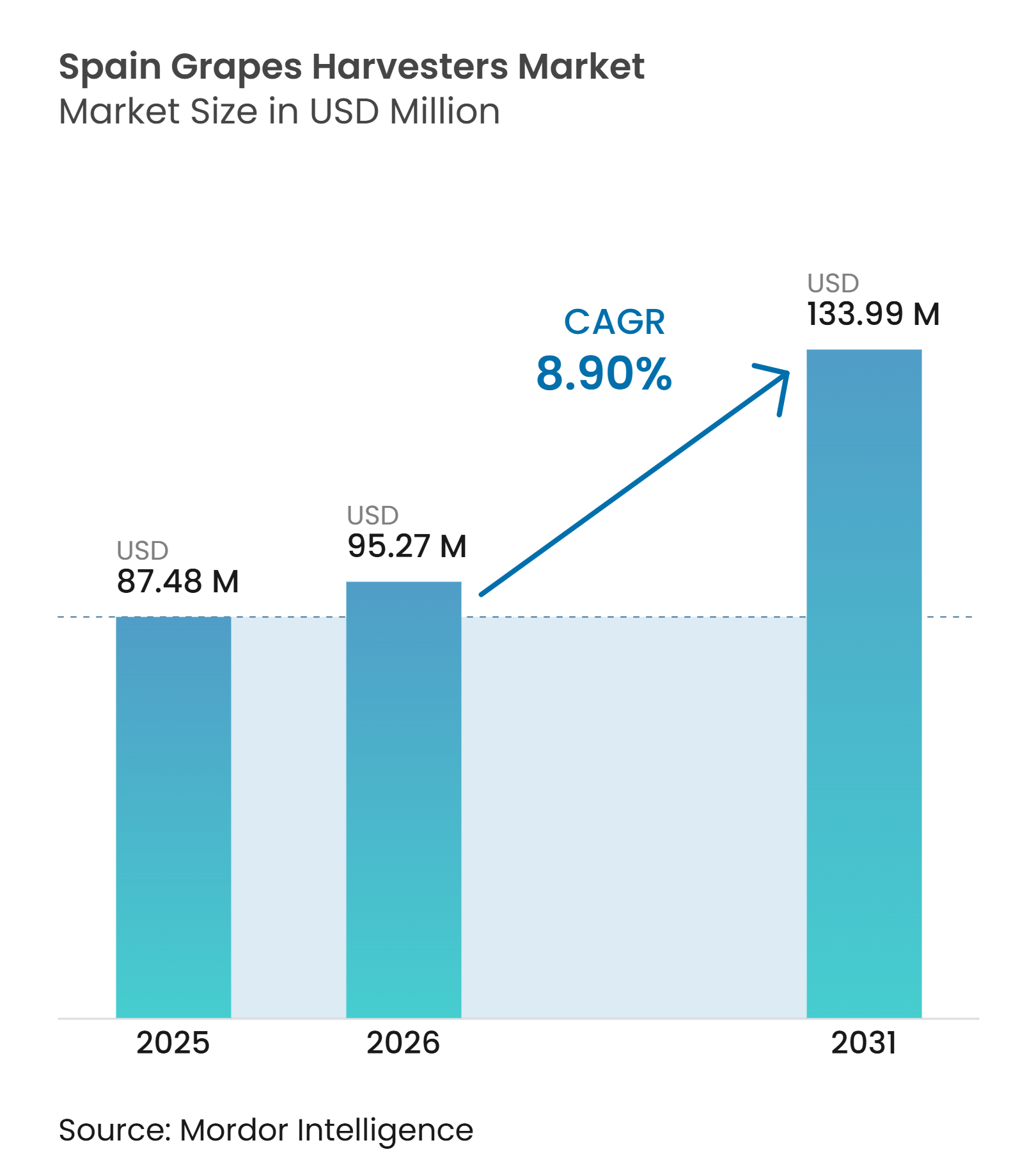
| Base Year Market Size (2025) | USD 87.48 Million |
| Market Size (2026) | USD 95.27 Million |
| Market Size (2031) | USD 133.99 Million |
| Growth Rate (2026 - 2031) | 8.90 % |
| Market Concentration | High |
Major Players *Disclaimer: Major Players sorted in no particular order Image © Mordor Intelligence. Reuse requires attribution under CC BY 4.0. | |
Spain Grapes Harvesters Market Analysis by Mordor Intelligence
The Spain grapes harvesters market size was valued at USD 87.48 million in 2025 and is estimated to grow from USD 95.27 million in 2026 to reach USD 133.99 million by 2031, at a CAGR of 8.90% during the forecast period (2026-2031). Labor shortages are making dependable harvest capacity more important for wineries and growers. Rising wages and the movement of seasonal workers to France have increased the cost of relying on manual crews during a short picking season. Investment in agricultural machinery and public funding for vineyard restructuring are supporting purchases by cooperatives and contractors. A declining vineyard area limits expansion potential based on planted acreage, so replacement demand and greater mechanization of existing vineyards will shape sales.[1] Suppliers are responding with narrow-row machines, connected systems, and equipment designed for cooperative fleets, while financing and terrain remain constraints on adoption.
Key Report Takeaways
- By harvester type, self-propelled harvesters held 48.5% of the Spain grapes harvesters market share in 2025, while tractor-mounted harvesters are forecast to grow at a CAGR of 11.8% from 2026 to 2031.
- By mode of operation, assisted and precision-guided equipment held 54.2% share of the Spain grapes harvesters market size in 2025, while autonomous and semi-autonomous equipment is forecast to grow at a CAGR of 13.2% from 2026 to 2031.
- By power source, diesel-powered equipment held 66.8% market share in 2025, while electric equipment is forecast to grow at a 14% CAGR from 2026 to 2031.
- By vineyard size, medium vineyards held 43.2% market share in 2025, while small vineyards are forecast to grow at a CAGR of 12.4% from 2026 to 2031.
- By application, wine-grape harvesting held 98.3% market share in 2025, while table-grape harvesting is forecast to grow at a CAGR of 10.8% from 2026 to 2031.
Note: Market size and forecast figures in this report are generated using Mordor Intelligence’s proprietary estimation framework, updated with the latest available data and insights as of January 2026.
Market Trends and Insights
Drivers Impact Analysis of Spain Grapes Harvesters Market*
| Driver | (~) % Impact on CAGR Forecast | Geographic Relevance | Impact Timeline |
|---|---|---|---|
| Vineyard labor scarcity and wage inflation | +2.0% | Global, with highest intensity in Spain, Castilla-La Mancha, La Rioja, Catalonia, and Andalusia | Short term (≤ 2 years) |
| Mechanization demand in large wine estates and cooperatives | +1.6% | Europe, with Spain and France as core locations, and spillover to South America | Medium term (2-4 years) |
| Precision viticulture data integration | +1.2% | Europe and North America | Medium term (2-4 years) |
| Spanish vineyard fragmentation driving shared equipment models | +1.0% | Spain, especially regions with fragmented appellations | Medium term (2-4 years) |
| Narrow row harvester adaptation for high density vineyards | +0.8% | Europe, Asia, and Western Asia | Long term (≥ 4 years) |
| Climate volatility response through faster harvest windows | +1.1% | Global, especially hotter inland areas of Spain, South America, and Western Asia | Short term (≤ 2 years) |
| Source: Mordor Intelligence | |||
Vineyard Labor Scarcity and Wage Inflation
Spain’s vineyard labor shortage has become a lasting factor in equipment planning. Agricultural wages reached EUR 61 (USD 66) per jornal in 2025, after a 4.7% increase from 2024. The French agricultural minimum wage stood at EUR 11.88 (USD 12.9) per hour, compared with the prevailing Spanish rate of EUR 9.08 (USD 9.8) per hour. This gap drew up to 15,000 seasonal workers to France during harvest periods. Mechanical harvesters give growers a way to maintain operations when experienced crews are unavailable.
Mechanization Demand in Large Wine Estates and Cooperatives
Large cooperatives are treating harvesters as shared operating assets rather than purchases for individual members. This approach is especially relevant in Castilla-La Mancha, which received EUR 32.12 million (USD 34.8 million) for restructuring under the 2026 allocation. Shared ownership can distribute machine use across many plots during the harvest period and reduce the financial burden on smaller members. Public support for winery and vineyard investment lowers the upfront risk of fleet renewal.[2] This buying model supports demand for the Spain grapes harvesters market.
Precision Viticulture Data Integration
Precision guidance is becoming increasingly important to the value proposition of grape harvesters for estates and cooperatives. Assisted systems can support steering, yield mapping, and canopy monitoring during harvest operations. A 2025 CSIC study found that a collaborative robotic fleet could reduce harvest labor costs by 22.5% in Spanish vineyard conditions, with a maximum yield-map variability error of 0.11 kg.[3]These results support the use of connected equipment where operators need both harvest capacity and field data. The Spain grapes harvesters market, therefore has room for machines that combine field performance with practical recordkeeping.
Spanish Vineyard Fragmentation Driving Shared-Equipment Models
Spain had 889,470 hectares of wine-grape vineyards in 2025, spread across many small holdings. Many growers cannot justify owning a self-propelled harvester for limited annual use. Contractor and cooperative fleets provide access to machines without requiring every grower to purchase one. These arrangements also favor equipment that can move efficiently between different parcel layouts and give contractors an important role in supplier sales and financing decisions. This pattern supports wider participation in the Spain grape harvesters market without relying on larger farm sizes.
Restraints Impact Analysis of Spain Grapes Harvesters Market*
| Restraint | (~) % Impact on CAGR Forecast | Geographic Relevance | Impact Timeline |
|---|---|---|---|
| High acquisition cost and financing exposure | -1.2% | Global, most acute for small and medium vineyards in Europe and South America | Medium term (2-4 years) |
| Harvest quality concerns for premium hand-picked grapes | -0.9% | Europe, especially premium wine regions in Spain, France, and Italy | Long term (≥ 4 years) |
| Terrain and parcel access constraints | -0.7% | Europe and Western Asia, including hilly Spanish appellations | Long term (≥ 4 years) |
| Shrinking vineyard area and uncertain replacement timing | -0.8% | Spain, with secondary relevance in Russia and Africa | Medium term (2-4 years) |
| Source: Mordor Intelligence | |||
High Acquisition Cost and Financing Exposure
Entry-level self-propelled harvesters cost USD 80,000, while advanced models can exceed USD 400,000. These prices are difficult for small vineyards to absorb through direct ownership. Long payback periods can delay purchasing decisions when bulk-wine prices are under pressure. Public co-financing, contractor fleets, and cooperative ownership reduce part of this burden. However, limited used-machine certification and service infrastructure can reduce residual values. Financing exposure remains a constraint for the Spain grape harvesters market.
Harvest Quality Concerns for Premium Hand-Picked Grapes
Premium grapes require careful handling, as berry condition can affect the final product. Mechanical systems are more readily accepted for bulk and mid-range wine categories. Producers of premium hand-picked grapes may remain cautious about machine use. This concern is more pronounced in regions where manual harvest practices support product positioning. Suppliers need to improve handling performance and cleaning systems to address these concerns. Quality expectations can therefore slow adoption in parts of the Spain grape harvesters market.
*Our forecasts treat driver/restraint impacts as directional, not additive. The impact forecasts reflect baseline growth, mix effects, and variable interactions.
Spain Grapes Harvesters Market Segment Analysis
By Harvester Type:
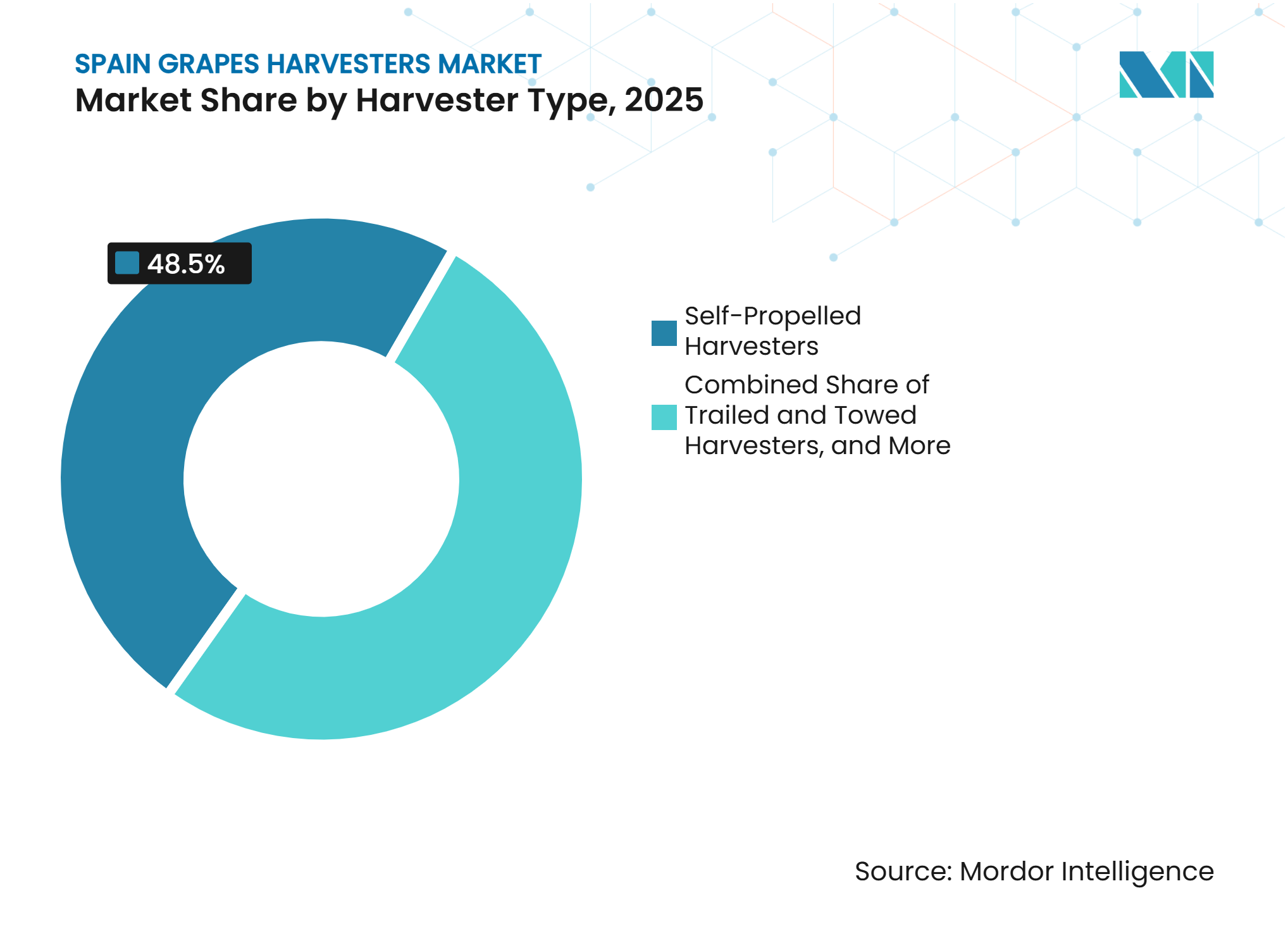
Self-Propelled Harvesters Led Sales While Tractor-Mounted Harvesters Grew FasterSelf-propelled harvesters held 48.5% of Spain grape harvesters market share in 2025. Large estates and cooperatives favor these machines for their high throughput and integrated design, which allow them to cover a large number of rows within a limited harvest window. Trailed and towed systems serve buyers that already own tractors and are relevant where capital budgets are smaller, and equipment is shared.
Tractor-mounted harvesters are forecast to grow at a CAGR of 11.8% from 2026 to 2031. These machines allow growers to use a single tractor across grape, olive, and cereal operations, which can improve the economic justification for purchasing these machines compared with dedicated self-propelled unit. Updated narrow-row equipment indicates that suppliers are adapting designs to Spanish plot geometry. Performance, fit, and service capability will remain important factors in buyer decisions. The Spain grape harvesters market is therefore likely to retain several equipment formats rather than converge on a single machine type.



By Mode of Operation:
Assisted Equipment Led the Installed Fleet While Autonomous Systems AdvancedAssisted and precision-guided equipment held 54.2% of Spain grape harvesters market share in 2025. GPS guidance, yield maps, and canopy sensors are established features on mid-range and advanced machines. Manual steering remains present in older cooperative fleets and towed equipment, though its role is declining as guidance features become more common. Growers value tools that help operators work consistently during a narrow harvest period. Precision systems also generate harvest records that can be used in vineyard management.
Autonomous and semi-autonomous systems are forecast to grow at a 13.2% CAGR through 2031. New Holland Agriculture previewed its R4 electric and hybrid vineyard robot models in February 2026. The HarvRESt project began live Spanish trials with an electric tractor and autonomous vineyard robot at Viñas del Vero in 2025. These efforts focus on vineyard work broadly, not only harvesting, and may reduce concerns about deploying supervised automation in commercial vineyards. Fleet turnover will still determine how quickly these systems become widespread.
By Power Source:
Diesel Held the Largest Position While Electric Power Source ExpandedDiesel-powered accounted for 66.8% of Spain grape harvesters market share in 2025. Their operating range and familiar maintenance requirements support this position, as does the existing fuel supply infrastructure in rural production areas. Hybrid machines offer an intermediate option for estates seeking lower fuel consumption and can support extended work hours without full dependence on battery charging. The installed diesel base will remain significant during the forecast period.
Electric power sources are forecast to grow at a CAGR of 14% from 2026 to 2031. EU regulations are increasing the focus on safety, emissions documentation, and digital reliability for agricultural equipment. The HarvRESt trial at Viñas del Vero included an electric tractor operating in a commercial vineyard setting. Structured estates may be better suited to charging requirements and shorter daily work cycles. Broader uptake will depend on operating range, charging access, and fleet economics. Electric adoption in the Spain grape harvesters market is likely to occur first among progressive estates and cooperatives.
Vineyard Size:
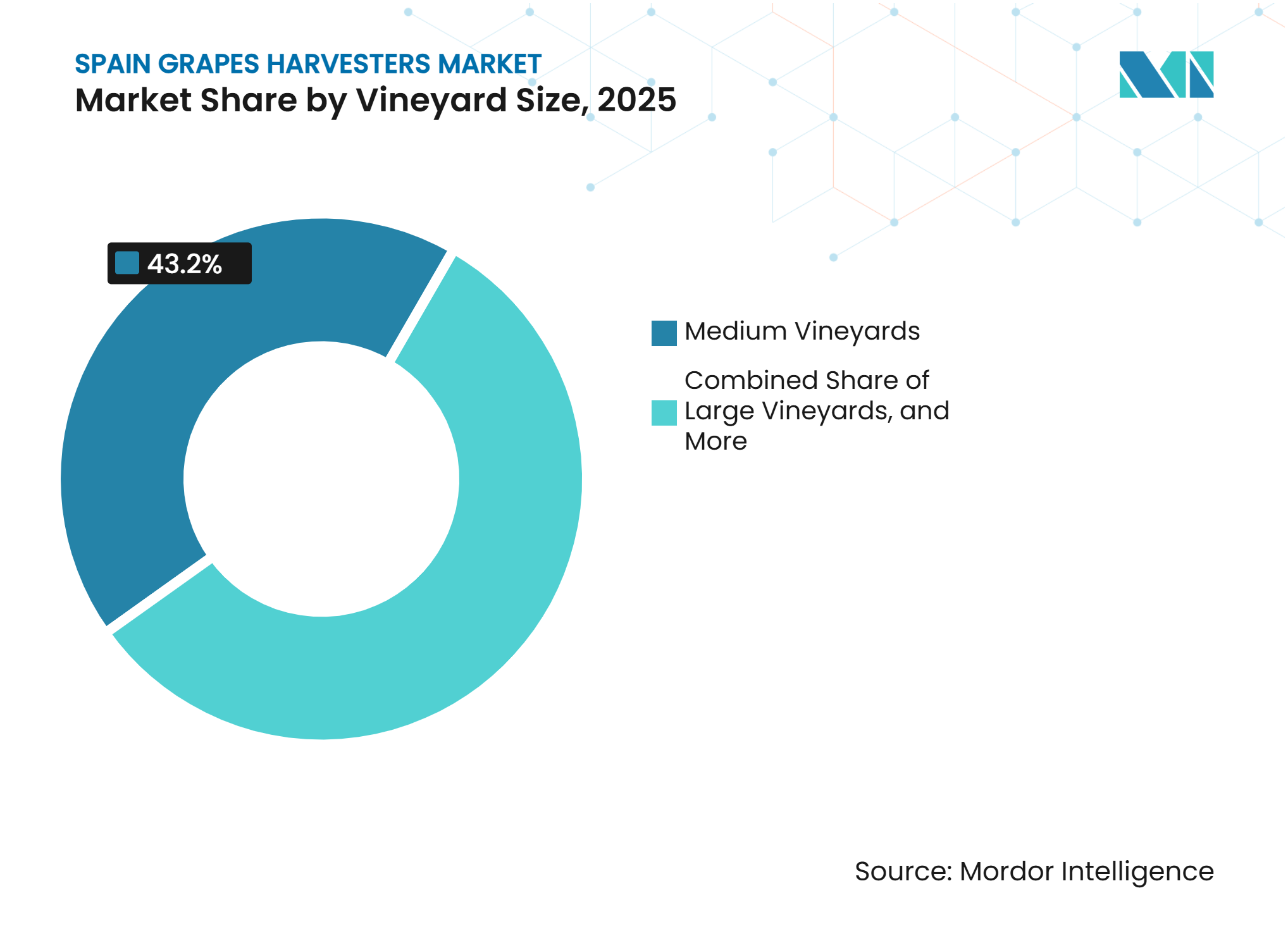
Medium Vineyards Held the Largest Position While Small Vineyards Grew FasterMedium vineyards held 43.2% of the Spain grape harvesters market in 2025. This group is large enough to benefit from machinery but may still depend on cooperative access. Large vineyards generally maintain established mechanized fleets, while medium operators can combine direct ownership with contracted capacity during peak demand. This makes them an important source of replacement purchases, and their buying decisions are closely linked to cooperative planning and available investment support.
Small vineyards are forecast to grow at a CAGR of 12.4% from 2026 to 2031, reflecting access through contractors and cooperatives rather than widespread direct ownership. The 2025 ISV round financed 340 operations across Spain’s autonomous communities, with Castilla y León receiving 69 operations and Castilla-La Mancha receiving 62 operations under this round. Smallholdings can gain machine access where vine rows are compatible and fleet schedules allow, supporting mechanization in fragmented areas.

By Application:
Wine Grapes Dominated Demand While Table Grapes Presented a Developing NicheWine-grape harvesting held a 98.3% of Spain grape harvesters market in 2025. Spain's large wine production base supports this concentration, and mechanical handling is more accepted in bulk and mid-range wine production. Other uses, including musts, industrial processing, and raisins, account for a limited share of demand. The installed machine base is therefore designed primarily around wine-grape vineyard practices, and this application will remain the primary source of equipment utilization.
Table-grape harvesting is forecast to grow at a CAGR of 10.8% from 2026 to 2031. This segment is concentrated in Murcia and Almería, where growers face pressure to improve labor efficiency. Fresh grapes require greater protection from berry loss, bruising, and leaf contamination, and existing shaking and catching systems do not always meet these handling requirements. The PREVID operational group is developing a quadruped robotic system for monitoring table-grape vineyards. Purpose-built gentle handling systems will be needed before mechanization can expand materially in this application.
Geography Analysis
Castilla-La Mancha and Castilla y León are among the key regions for mechanized grape harvesting in Spain, supported by their large vineyard areas, relatively extensive vineyard blocks, and strong wine-production base. These characteristics make the regions well-suited to self-propelled harvesting equipment, which can operate efficiently across large estates and vineyards operated by cooperatives. Mechanization in these regions is supported by increasing pressure on vineyard labor availability. Spain registered 112 new self-propelled grape harvesters in 2025, compared with 103 units in 2024, indicating a recovery in demand for harvesting machinery. The availability and cost of seasonal workers remain important considerations for vineyard operators, particularly when harvesting windows are short.
Premium wine regions such as La Rioja, Ribera del Duero, Penedès, and Rueda present a more mixed adoption environment. Mechanical harvesting is feasible in several vineyards in these regions, but adoption varies according to vineyard structure, grape quality requirements, and producer preferences. Premium producers may continue to use manual harvesting for selected wines or parcels where quality positioning and grape-selection requirements are prioritized. At the same time, labor shortages and increasingly compressed harvesting windows are encouraging some producers to consider greater mechanization. A 2025 ProWein Business Report indicated that 63% of Spanish wineries faced difficulties in assembling harvest teams, highlighting the growing labor challenge for the sector.
Emerging technology projects are creating new opportunities for mechanization in other Spanish wine regions. In Aragón's Somontano appellation, Viñas del Vero has participated in the Horizon Europe-funded HarvRESt project, which is investigating electric tractors and autonomous vineyard technologies under commercial conditions. The project is being coordinated by the CIRCE research center in Zaragoza and involves multiple international partners. In Murcia and Almería, where table-grape production is concentrated, the EU-funded PREVID operational group is developing machine-vision and robotic technologies for grape identification and selective harvesting applications.
Multi-crop vineyard operations could also support demand for versatile harvesting equipment. Extremadura and parts of Andalusia, where vineyards and super-intensive olive groves can be located within the same farming operations, present potential opportunities for multifunctional machinery. SDF Group's Grégoire GX 9 Mixta, launched in 2026, is designed for both grape and olive harvesting, potentially allowing multi-crop producers to spread equipment investment across different harvesting activities.
Competitive Landscape
Market Concentration
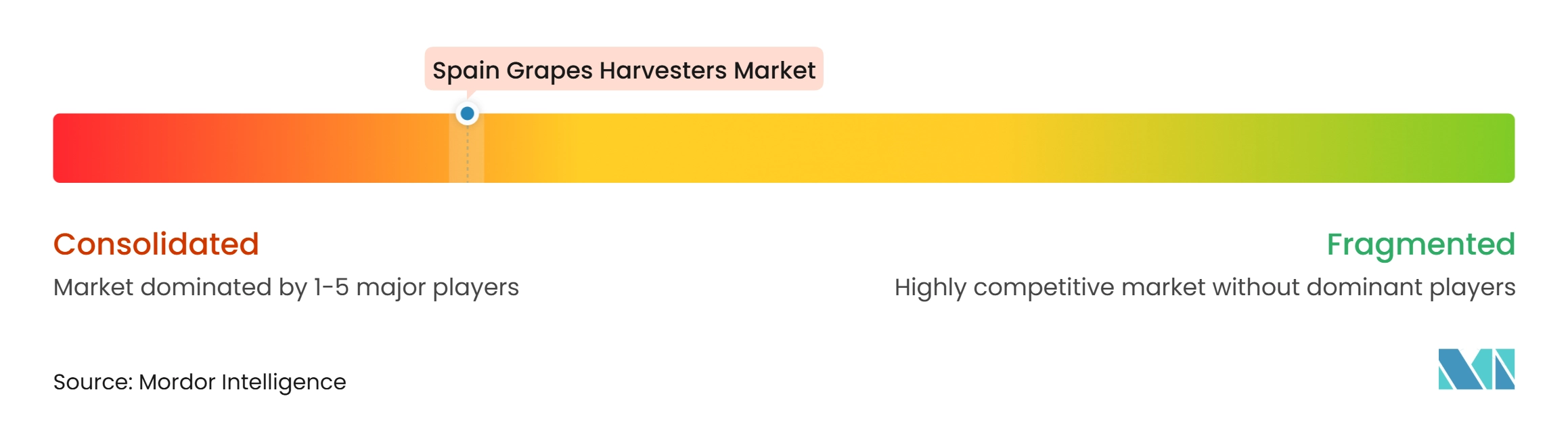
The Spain grapes harvesters market is consolidated, with a limited number of established international suppliers competing through differentiated product portfolios, vineyard adaptability, dealer and service networks, and harvesting technologies. New Holland Agriculture, PELLENC S.A.S., Grégoire S.A.S., ERO GmbH, and Oxbo International Corporation are among the key suppliers. New Holland Agriculture has a strong presence in grape-harvesting machinery through its Braud platform, while PELLENC S.A.S. is well established in vineyard equipment and Grégoire S.A.S. focuses on high-capacity harvesting solutions. ERO GmbH and Oxbo International Corporation offer specialized and multifunctional equipment. These suppliers differentiate themselves through product specialization, machinery fit, service support, and technological capabilities.
New Holland Agriculture launched the Braud 9.50L, 9.70L, and 9.70M self-propelled harvesters in November 2025. The company stated that its Vari-Control System supports automatic leveling at working speeds of up to 13 km/h. It also updated the Braud 9.80N narrow-row machine for the 2026 model year. These developments strengthen the company's offering for vineyards requiring high productivity, narrow-row compatibility, and improved machine control. Grégoire S.A.S. introduced the GX 9 Mixta in 2026 for vineyards and super-intensive olive groves, expanding its offering for operations requiring versatile harvesting equipment.
Competition is increasingly focused on machine adaptability, harvesting efficiency, operator assistance, connectivity, and precision-guidance capabilities. Suppliers are also differentiating their offerings through equipment designed for narrow-row vineyards, challenging terrain, and varied vineyard operating conditions. Dealer networks, after-sales service, equipment reliability, and access to specialized harvesting machinery remain important competitive factors in Spain's fragmented vineyard landscape. The increasing integration of connected technologies and harvesting data could further support supplier differentiation by enabling vineyard operators to monitor machine performance, harvesting conditions, and yield-related information.
Spain Grapes Harvesters Industry Leaders
-
New Holland Agriculture (CNH Industrial N.V.)
-
PELLENC S.A.S.
-
Grégoire S.A.S. (SDF Group)
-
ERO GmbH
-
Oxbo International Corporation (Ploeger Oxbo Group B.V.)
- *Disclaimer: Major Players sorted in no particular order
Spain Grapes Harvesters Market Companies Covered in this Report
- New Holland Agriculture (CNH Industrial N.V.)
- PELLENC S.A.S.
- Grégoire S.A.S. (SDF Group)
- ERO GmbH
- Oxbo International Corporation (Ploeger Oxbo Group B.V.)
- Alma S.R.L.
- CRF Costruzioni S.R.L.
- Bobard Frères
- Reese Group Ltd. (Nairn)
- Andreoli Engineering
- CH engineering GmbH
- I.ME.CA
- C.M.A. Carpenterie Metalliche Anaunia S.r.l. (Compact)
- SANIDAS
- Marthedal Enterprises Inc.
Recent Industry Developments in Spain Grapes Harvesters Market
- March 2026: SEVI reported that Spain registered 112 new self-propelled grape harvesters in 2025, compared with 103 units in 2024. The publication identified New Holland as the leading brand in self-propelled sales.
- July 2025: MAPA agreed to distribute EUR 195 million (USD 211.2 million) through the CAP Sectoral Wine Intervention for vineyard restructuring and processing infrastructure investments in 2026 and 2027. Castilla y León had 69 investment operations and Castilla-La Mancha had 62 operations.
- April 2025: Viñas del Vero activated the Horizon Europe HarvRESt project, which deployed an electric tractor and autonomous vineyard robot in Somontano.
Spain Grapes Harvesters Market Report Scope
Grape harvesters are agricultural machines designed for the mechanical harvesting of grapes from vineyards. They automate the harvesting process by removing grapes from vines and collecting them for further processing or handling.
The Spain Grapes Harvesters Market Report is Segmented by Harvester Type (Self-Propelled Harvesters, Trailed and Towed Harvesters, and Tractor-Mounted Harvesters), by Mode of Operation (Manual Steering and Operation, Assisted and Precision-Guided, Autonomous and Semi-Autonomous), by Power Source (Diesel-Powered, Hybrid, and Electric), by Vineyard Size (Small, Medium, and Large), and by Application (Wine-Grape Harvesting, Table-Grape Harvesting, and Others). The Market Forecasts are Provided in Terms of Value (USD).
Segmentation Overview
| Self-Propelled Harvesters |
| Trailed and Towed Harvesters |
| Tractor-Mounted Harvesters |
| Manual Steering and Operation |
| Assisted and Precision-Guided |
| Autonomous and Semi-Autonomous |
| Diesel-Powered |
| Hybrid |
| Electric |
| Small Vineyards |
| Medium Vineyards |
| Large Vineyards |
| Wine-Grape Harvesting |
| Table-Grape Harvesting |
| Other Applications |
| By Harvester Type | Self-Propelled Harvesters |
| Trailed and Towed Harvesters | |
| Tractor-Mounted Harvesters | |
| By Mode of Operation | Manual Steering and Operation |
| Assisted and Precision-Guided | |
| Autonomous and Semi-Autonomous | |
| By Power Source | Diesel-Powered |
| Hybrid | |
| Electric | |
| By Vineyard Size | Small Vineyards |
| Medium Vineyards | |
| Large Vineyards | |
| By Application | Wine-Grape Harvesting |
| Table-Grape Harvesting | |
| Other Applications |
Key Questions Answered in the Report
What was the Spain grape harvesters market size in 2026?
The Spain grapes harvesters market was valued at USD 95.27 million in 2026 and is forecast to reach USD 133.99 million by 2031. The market is forecast to grow at a CAGR of 8.90% from 2026 to 2031.
Which harvester type held the largest share in Spain?
Self-propelled harvesters led with a 48.5% share in 2025, while tractor-mounted harvesters are forecast to grow at a CAGR of 11.8% from 2026 to 2031. Tractor-mounted systems can suit growers that already use tractors for other farm work.
Which power source is growing fastest for grape harvesters in Spain?
Electric equipment is forecast to grow at a 14% CAGR from 2026 to 2031, although diesel held a 66.8% share in 2025. Adoption is forecast to begin in structured estates and cooperatives with suitable charging access.
What is driving vineyard mechanization in Spain?
Labor scarcity, wage inflation, shorter harvest windows, and cooperative fleet models are increasing demand for mechanical harvesting. Public funding for vineyard restructuring and eligible investments also reduces the cost barrier for participating wineries.
Why do small vineyards use shared harvester fleets?
Shared contractor and cooperative fleets give small vineyards machine access without the full cost of owning a self-propelled harvester. These models also allow machinery to be scheduled across fragmented holdings during the harvest period.