
South Korea Liquid Packaging Cartons Market Size and Share
Market Overview
| Study Period | 2021 - 2032 |
|---|---|
| Forecast Data Period | 2027 - 2032 |
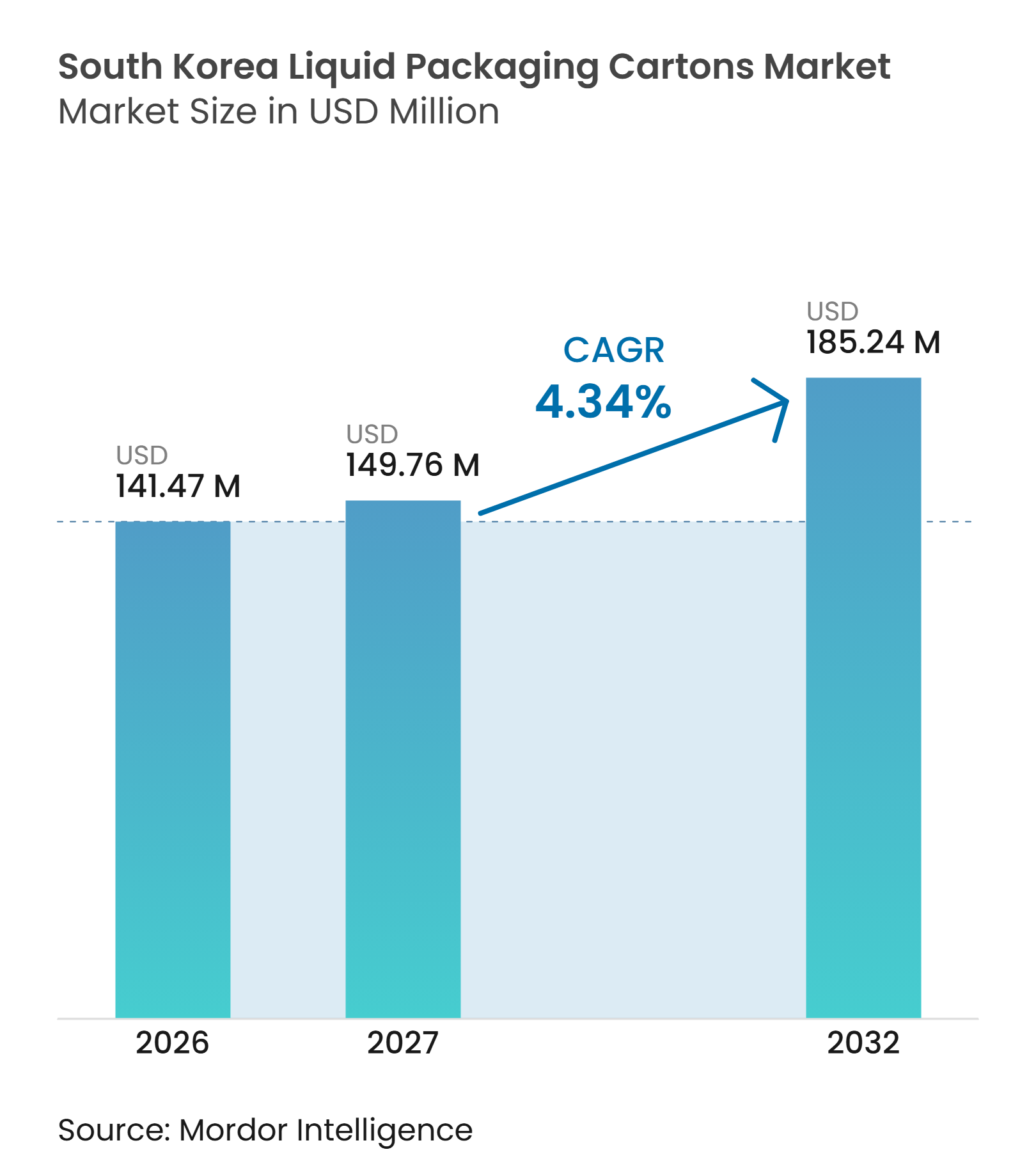
| Base Year Market Size (2026) | USD 141.47 Million |
| Market Size (2027) | USD 149.76 Million |
| Market Size (2032) | USD 185.24 Million |
| Growth Rate (2027 - 2032) | 4.34 % |
| Market Concentration | Medium |
Major Players *Disclaimer: Major Players sorted in no particular order Image © Mordor Intelligence. Reuse requires attribution under CC BY 4.0. | |
South Korea Liquid Packaging Cartons Market Analysis by Mordor Intelligence
The South Korea liquid packaging cartons market size was valued at USD 141.47 million in 2026 and estimated to grow from USD 149.76 million in 2027 to reach USD 185.24 million by 2032, at a CAGR of 4.34% during the forecast period (2027-2032). The South Korea liquid packaging cartons market is moving toward higher-value material specifications rather than relying only on volume growth. Demand is shifting toward shelf-stable beverages, functional drinks, and smaller packs that fit convenience retail purchasing. Recycling rules are changing the cost comparison between conventional aseptic cartons and formats designed for easier recovery. Suppliers with aluminum-free barriers, recyclable certification, and established filling-line relationships are better placed to support this transition. The South Korea liquid packaging cartons market also faces pressure from imported input costs, plastic packaging, and low recovery rates for conventional aseptic packs.
Key Report Takeaways
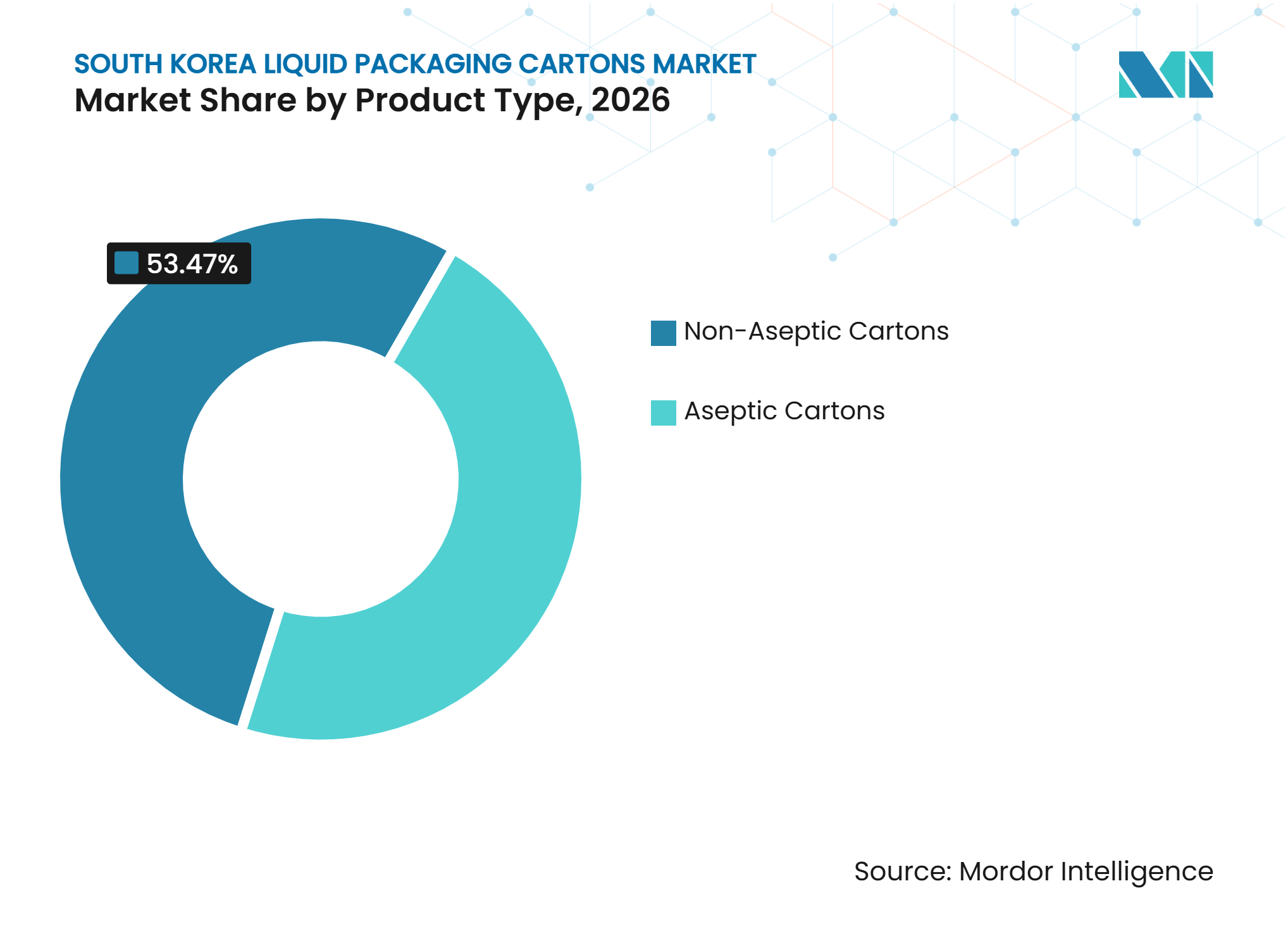
- By product type, non-aseptic cartons held 53.47% of the South Korea liquid packaging cartons market share in 2026, while aseptic cartons are projected to expand at a 5.12% CAGR through 2032.
- By application, milk accounted for 49.32% of the South Korea liquid packaging cartons market size in 2026, while plant-based beverages are expected to grow at a 5.07% CAGR through 2032.
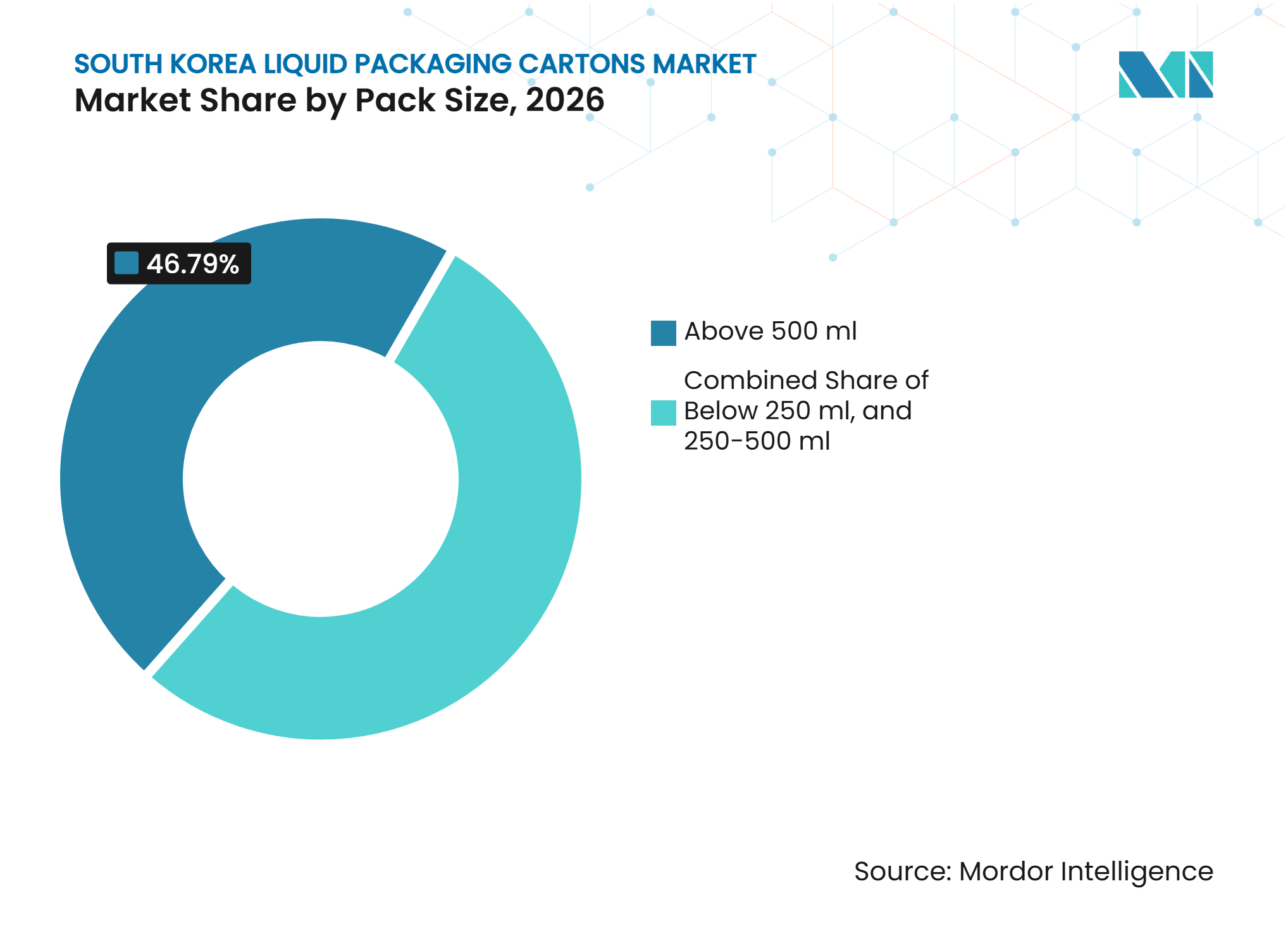
- By pack size, above 500 ml cartons held 46.79% of the market share in 2026, while the 250-500 ml category is projected to grow at a 5.14% CAGR through 2032.
Note: Market numbers in this report are based on Mordor Intelligence's proprietary estimation framework, which combines nine months of actuals with Q4 projections for base year 2026.
Market Trends and Insights
Drivers Impact Analysis of South Korea Liquid Packaging Cartons Market*
| Driver | (~) % Impact on CAGR Forecast | Geographic Relevance | Impact Timeline |
|---|---|---|---|
| Growth in Dairy and Plant-Based Beverage Applications | +1.2% | National, with leading intensity in Seoul Capital Region and Busan urban corridors | Medium term (2-4 years) |
| Expansion of Shelf-Stable and Ambient Distribution | +0.9% | National, amplified in secondary cities with limited cold chain coverage | Long term (≥ 4 years) |
| Paper-Based Barrier Innovation and Aluminum Reduction | +0.8% | National, anchored to major filler sites in Seoul Capital Region and Chungcheong zones | Medium term (2-4 years) |
| Sustainability-Led Substitution From Plastic Formats | +0.7% | National, with early adoption in hypermarkets and e-commerce hubs | Medium term (2-4 years) |
| Premium Small-Pack Demand From Convenience Retail | +0.4% | National, with highest intensity in Seoul metro and major urban corridors | Short term (≤ 2 years) |
| Retailer and Filler Adoption of Digitally Traceable Cartons | +0.2% | National | Long term (≥ 4 years) |
| Source: Mordor Intelligence | |||
Growth in Dairy and Plant-Based Beverage Applications
The South Korea liquid packaging cartons market is supported by a change in demand within dairy and beverage categories. Per capita white milk consumption fell to 22.9 kg in 2025, the lowest level in 40 years reported by the Korea Dairy Promotion Association.[1] This change raises the importance of premium dairy, soy, oat, almond, nutritional, and protein drinks for carton suppliers. Major dairy producers are expanding their presence in protein and plant-based drinks, which often need ambient protection and aseptic packaging.[2] Starbucks entered South Korea’s protein beverage category in June 2025, extending competition into branded foodservice channels. The South Korea liquid packaging cartons market can benefit when new beverage launches require packs that can be stored and sold without refrigeration.
Expansion of Shelf-Stable and Ambient Distribution
Ambient distribution is becoming more important because online grocery and quick-commerce operators can store room-temperature products without refrigeration costs. The South Korea liquid packaging cartons market can serve this need through aseptic formats used for UHT milk, plant-based beverages, protein drinks, and liquid food. This is not simply a response to weak cold-chain systems because South Korea has well-developed chilled distribution. Korea Package Co. signed a five-year exclusive agreement to import and sell Lamipak aseptic cartons in November 2026, showing a commercial opening for this format. Secondary cities, smaller population centers, and island channels can use shelf-stable products to reduce dependence on short-haul chilled replenishment. The same model can help micro-fulfillment sites hold ambient cartons alongside refrigerated products and improve inventory flexibility.
Paper-Based Barrier Innovation and Aluminum Reduction
Paper-based and aluminum-free barriers are changing the technical basis of competition in the South Korea liquid packaging cartons market. Tetra Pak extended its paper-based barrier packaging to high-speed lines in Asia in February 2026, including Maeil Dairies’ deployment on Tetra Pak A3/Speed equipment.[3] The reported line capability of up to 24,000 packages per hour allows major fillers to change materials without sacrificing industrial throughput. SIG’s Terra Alu-free and Full barrier cartons, introduced by Seoul Dairy Cooperative in October 2025, were the first aseptic cartons recognized as recyclable under Korean regulations. The two-material format uses FSC-certified paperboard and polymer, while SIG reports a potential carbon-footprint reduction of up to 61% when forest-based polymers are used. These options make recyclability a practical purchasing and compliance consideration for fillers.
Sustainability-Led Substitution From Plastic Formats
South Korea’s recycling rules are increasing attention on packaging materials and end-of-life outcomes. The Resource Recycling Act was amended effective August 7, 2025, allowing recovered paper cartons to be used in building materials and molded products. This broader set of uses can improve the value of collected carton fiber and support investment in collection infrastructure. A 10% recycled-content requirement for PET bottles, enacted in February 2025, also changed the cost context for plastic converters. Under the Extended Producer Responsibility framework, formats without a recyclable grade can face fee surcharges, and a planned review may extend fee obligations to full output volumes. The South Korea liquid packaging cartons market could gain where suppliers offer recyclable structures, though PET will retain advantages in transparency and familiar collection systems.
Restraints Impact Analysis of South Korea Liquid Packaging Cartons Market*
| Restraint | (~) % Impact on CAGR Forecast | Geographic Relevance | Impact Timeline |
|---|---|---|---|
| High Dependence on Imported Pulp and Barrier Inputs | -1.1% | National, affects all production sites given the absence of significant domestic virgin pulp capacity | Long term (≥ 4 years) |
| Competition From Lightweight PET and Flexible Packaging | -0.8% | National, with highest pressure in juice, protein drink, and functional beverage segments | Medium term (2-4 years) |
| Low Recovery Rates for Conventional Aseptic Cartons | -0.5% | National, collection infrastructure gap most acute outside Seoul Capital Region | Medium term (2-4 years) |
| Limited Domestic Aseptic-Filling Line Flexibility | -0.4% | National, concentrated at major filler sites in Seoul Capital Region and Chungcheong | Long term (≥ 4 years) |
| Source: Mordor Intelligence | |||
High Dependence on Imported Pulp and Barrier Inputs
The South Korea liquid packaging cartons market has a higher structural cost base because it relies on imported virgin bleached kraft pulp, barrier layers, and coatings. Exposure to imported inputs makes carton producers sensitive to global commodity prices and trade conditions. Domestic collection does not provide enough recovered fiber to offset this dependence. The national carton recycling rate declined from 19.9% in 2019 to 13% in 2023, according to government data reported by Kyunghyang Shinmun. Domestic recyclers imported recovered carton material from Japan to support plant utilization. A separate collection requirement due from January 1, 2027 aims to improve recovery, but imported pulp and barrier inputs will remain an important margin constraint.
Competition From Lightweight PET and Flexible Packaging
Lightweight PET bottles and flexible formats compete with cartons where unit cost, visibility, and portion flexibility guide purchasing. The South Korea liquid packaging cartons market is most exposed in juice, flavored beverages, protein drinks, and functional beverages. PET gives consumers a view of the product and benefits from established separate-collection systems. Flexible bag-in-box formats also compete in larger liquid volumes and industrial applications. Fresh dairy cartons remain supported by established chilled distribution and consumer familiarity with gable-top packs. Carton suppliers must make a clear case around shelf life, material design, filling efficiency, retail presentation, and collection performance.
*Our forecasts treat driver/restraint impacts as directional, not additive. The impact forecasts reflect baseline growth, mix effects, and variable interactions.
South Korea Liquid Packaging Cartons Market Segment Analysis
By Product Type:
Aseptic Adoption Reshapes Non-Aseptic LeadershipNon-aseptic cartons accounted for 53.47% of the South Korean liquid packaging carton market share in 2026. Their position rests on the established fresh milk network, school milk programs, and consumer preference for chilled products. Gable-top cartons have also benefited from their recyclable grade under South Korea’s packaging assessment system. This compliance position has historically differentiated them from conventional aseptic bricks. The South Korea liquid packaging cartons industry continues to rely on this segment for a large part of its base demand. Fresh dairy producers can use familiar chilled distribution and established pack formats without the higher technical requirements of aseptic systems.
Aseptic cartons are projected to expand at a 5.12% CAGR through 2032. Their growth is linked to plant-based beverages, protein drinks, UHT milk, and liquid foods that need room-temperature stability. The 2025 and 2026 launches of aluminum-free aseptic formats altered the recyclability options available to fillers. Seoul Dairy’s launch of a recyclable aseptic package and Maeil Dairies’ deployment of high-speed paper-barrier packaging show that upgraded structures can be used without a complete production-line replacement. The South Korea liquid packaging cartons industry is thus seeing a shift from a simple chilled versus ambient comparison toward a competition based on barrier performance and recyclability. Korea Package Co.’s supply agreement with Lamipak also points to new import competition in aseptic carton supply.


By Application:
Milk Remains Central While Plant-Based Beverages Lead GrowthMilk accounted for 49.32% of the South Korea liquid packaging cartons market size in 2026. This leading position reflects the use of cartons for fresh milk, school meal programs, and ambient UHT products. White milk consumption has fallen, so the segment’s future contribution will depend more on value-added products than on basic volume growth. Flavored dairy, premium nutrition products, and extended-shelf-life offerings can help maintain carton use within dairy. The established milk base still provides stable demand for non-aseptic gable-top cartons. It also provides a large installed customer base for suppliers that want to introduce recyclable material upgrades.
Plant-based beverages are expected to grow at a 5.07% CAGR through 2032, ahead of the overall South Korea liquid packaging cartons market. Soy, oat, and almond beverages need dependable barriers and often benefit from ambient distribution. The shift toward protein and functional drinks creates a related opportunity for aseptic packs. Major dairy companies have expanded into these categories as they respond to changing consumption patterns. Juice remains an important but difficult application because PET bottles offer transparency and a familiar collection route. Dairy products other than milk, energy drinks, and liquid foods provide smaller but additive uses for cartons, particularly when consumers value convenient storage and portion control.
By Pack Size:
Larger Formats Lead While Mid-Range Packs AccelerateAbove 500 ml cartons held 46.79% of the market share in 2026. Family dairy packs, bulk juice, and liquid food formats support this position through hypermarkets, online grocery, and foodservice channels. Larger formats offer a lower unit cost and suit household purchasing patterns. They also fit the recurring needs of institutional buyers. For the South Korea liquid packaging cartons market, this segment provides a stable volume base even when consumer demand moves toward smaller servings. Its performance will continue to depend on the strength of family-size dairy and grocery purchasing.
The 250-500 ml segment is projected to advance at a 5.14% CAGR through 2032. The increase in single-person households and convenience-led purchasing support single-serve and dual-serve package choices. Single-person households represented 42% of all households in 2025, according to the Ministry of the Interior and Safety. GS25, CU, and 7-Eleven Korea expanded smaller-portion assortments in 2025 and 2026, which supports formats used for protein drinks, coffee, and functional beverages. Below 250 ml cartons retain a role in school milk, single-serve coffee, and controlled portions, although they face a more mature demand base. The South Korea liquid packaging cartons market can use these formats to address convenience retail without replacing larger household packs.

Geography Analysis
Seoul Capital Region
The Seoul Capital Region is the leading center for premium carton specifications, advanced filling operations, and small-format retail demand. Maeil Dairies became the first producer globally to deploy Tetra Pak’s paper-based barrier technology on high-speed lines in February 2026. Seoul Dairy Cooperative had already introduced the first aseptic carton recognized as recyclable under Korean rules in October 2025. The South Korea liquid packaging cartons market benefits here from dense convenience retail and the concentration of quick-commerce services. These channels favor cartons for protein drinks, plant-based beverages, and specialty dairy products. Environmental labeling and FSC-certified material claims are likely to receive close attention from urban retailers and consumers. The region also gives suppliers a visible platform to test upgraded barrier materials before wider national rollout.
Busan and Gyeongnam Region
Busan and Gyeongnam combine a major consumer corridor with an important entry point for imported packaging materials and equipment. Busan’s port role affects the lead times and landed costs of virgin pulp, barrier coatings, and aseptic carton rolls. This connection matters as Chinese converters seek local distribution partners. Korea Package Co.’s exclusive agreement with Lamipak provides a direct example of this route to the South Korean market. Local dairy producers in Gyeongnam still rely mainly on non-aseptic gable-top cartons supported by short-haul chilled networks. National retail chains are gradually widening the presence of ambient plant-based products, which reduces the separation between this regional model and the Seoul model. The area’s aging population also supports demand for shelf-stable nutritional beverages and liquid foods designed for home storage.
Chungcheong, Honam, Gangwon, and Jeju
Chungcheong includes food and beverage processing clusters that supply carton-packed products to markets across the country. Honam and Gangwon cooperative dairies remain more dependent on non-aseptic cartons for local fresh milk distribution. These areas may not have enough scale to justify aseptic filling investments in every location. Jeju presents a different case because its geographic separation can favor ambient beverages in tourism, hotels, resorts, and convenience stores. The South Korea liquid packaging cartons market size for a region is not provided, but the operating conditions show why carton demand will vary by distribution channel. National quick-commerce growth can help ambient cartons reach inland and island locations through room-temperature fulfillment. The separate carton collection requirement from 2027 may also influence local packaging choices as collection systems expand. These mixed geographies are likely to maintain different growth paths for chilled and ambient cartons.
Competitive Landscape
Market Concentration
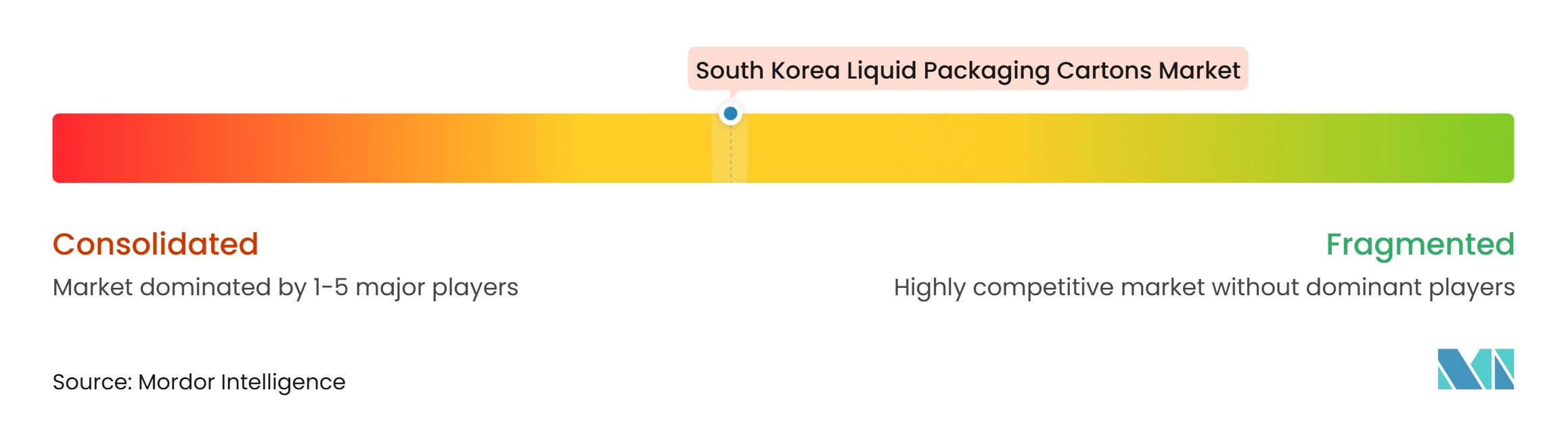
The South Korea liquid packaging cartons market is moderately concentrated in aseptic cartons and highly concentrated in pasteurized cartons. Global system suppliers have long-standing filling-line relationships that make supplier changes difficult for dairy and beverage producers. Tetra Pak and SIG have used South Korea for important material launches, supported by local regulatory pressure for better recyclability. Maeil Dairies deployed Tetra Pak’s paper-based barrier on high-speed A3/Speed lines in February 2026. Seoul Dairy Cooperative launched SIG Terra Alu-free and Full barrier aseptic cartons in October 2025. These moves give established suppliers a way to combine material innovation with installed-equipment relationships.
Regional Chinese converters are adding competitive pressure through local supply arrangements. Lamipak’s five-year exclusive agreement with Korea Package Co. opens a channel into a domestic filler base that has been centered on pasteurized cartons. Lamipak’s One Pack One Code traceability platform provides an additional point of differentiation for retailers and fillers that want better packaging-level information. Major food and beverage buyers also consider FSC certification and ISO compliance when assessing suppliers. Domestic companies such as Samryoong Co. and Hankuk Package Co. retain advantages in local proximity, customer familiarity, and knowledge of regulatory requirements. Imported firms must therefore compete through a meaningful price, supply, or material-specification advantage.
The South Korea liquid packaging cartons market has open opportunities in liquid foods and functional beverages, where aseptic filling capacity remains limited relative to demand potential. Suppliers that can deliver recyclable structures without slowing high-speed lines have a stronger position in these categories. Separate collection rules and producer responsibility reviews make material design increasingly important to competitive strategy. Competition will remain strongest around filling compatibility, barrier performance, and local distribution capability. No combined share for the leading suppliers is provided, so the available evidence supports a concentrated structure in pasteurized cartons and a moderately concentrated structure in aseptic cartons without assigning a company-level share. Individual supplier shares are therefore not stated.
South Korea Liquid Packaging Cartons Industry Leaders
-
Samryoong Co., Ltd.
-
Hankuk Package Co., Ltd.
-
Tetra Pak International SA
-
SIG Group AG
-
Elopak ASA
- *Disclaimer: Major Players sorted in no particular order
South Korea Liquid Packaging Cartons Market Companies Covered in this Report
- Tetra Pak International SA
- SIG Group AG
- Elopak ASA
- Greatview Aseptic Packaging Co. Ltd.
- Nippon Paper Industries Co., Ltd.
- UFlex Limited
- IPI Srl
- Lami Packaging (Kunshan) Co. Ltd.
- Italpack Srl
- Parksons Packaging Ltd.
- Shandong Bihai Packaging Materials Co. Ltd.
- Southern Packaging Group Ltd.
- Lamipak (SuZhou) Co., Ltd.
- Xiamen Hexing Packaging Group Co., Ltd.
- Adam Pack SA
- Samryoong Co., Ltd.
- Hankuk Package Co., Ltd.
Recent Industry Developments in South Korea Liquid Packaging Cartons Market
- November 2026: Korea Package Co., South Korea's market leader in pasteurized cartons, signed a five-year exclusive supply agreement with Lamipak (Kunshan, China), granting exclusive rights to import and sell Lamipak's aseptic carton products in South Korea. The deal strategically extends the company into the higher-growth aseptic carton market, estimated at over KRW 200 billion (USD 148 million) annually.
- September 2026: SIG Korea joined the Ministry of Climate, Energy and Environment's paper carton recycling improvement partnership on September 21, 2026, alongside Seoul Dairy Cooperative, Maeil Dairies, Hansol Paper, and recycling consortia, committing to recyclability-by-design principles and infrastructure support while expanding deployment of its aluminum-layer-free Terra Alu-free and Full barrier technology across its Korean customer base.
- April 2026: South Korea initiated a comprehensive legislative review of its producer responsibility recycling system, in force since 2003, to explore potential extension of fee obligations to full output volumes, as reported by Yonhap News Agency on April 3, 2026. The reform would directly affect liquid carton producers with EPR obligations and intensify incentives for recyclable packaging design.
- February 2026: Maeil Dairies became the first producer globally to deploy Tetra Pak's paper-based barrier technology on high-speed Tetra Pak A3/Speed filling lines, launching Tetra Brik Aseptic 200 Slim cartons for Maeil Soy Milk 99.9 with 87% renewable content and a 26% lower package carbon footprint verified by the Carbon Trust. The A3/Speed line delivers up to 24,000 packages per hour and can be retrofitted without significant capital outlay.
South Korea Liquid Packaging Cartons Market Report Scope
The South Korea Liquid Packaging Cartons Market encompasses the manufacturing and supply of paperboard-based packaging solutions designed for the safe storage, transportation, and distribution of liquid beverages and food products. These cartons provide product protection, extended shelf life, and convenient handling while supporting efficient packaging and distribution. The market includes packaging solutions designed to maintain product freshness, prevent contamination, and meet evolving food safety and sustainability requirements. Growing consumption of packaged beverages, increasing demand for convenient and shelf-stable products, and the shift toward recyclable packaging materials drive market growth across India.
The South Korea Liquid Packaging Cartons Market Report is Segmented by Product Type (Aseptic Cartons, and Non-Aseptic Cartons), Applications (Milk, Juices, Plant Based Beverages, Dairy Products Excluding Milk, Energy and Functional Drinks, Liquid Food, and Other Applications), and Pack Size (Below 250 ml, 250-500 ml, and Above 500 ml). The Market Forecasts are Provided in Terms of Value (USD).
Segmentation Overview
| Aseptic Cartons |
| Non-Aseptic Cartons |
| Milk |
| Juices |
| Plant Based Beverages |
| Dairy Products (Excluding Milk) |
| Energy and Functional Drinks |
| Liquid Food |
| Other Applications |
| Below 250 ml |
| 250-500 ml |
| Above 500 ml |
| By Product Type | Aseptic Cartons |
| Non-Aseptic Cartons | |
| By Applications | Milk |
| Juices | |
| Plant Based Beverages | |
| Dairy Products (Excluding Milk) | |
| Energy and Functional Drinks | |
| Liquid Food | |
| Other Applications | |
| By Pack Size | Below 250 ml |
| 250-500 ml | |
| Above 500 ml |
Key Questions Answered in the Report
What is the size of the South Korea liquid packaging cartons market?
The South Korea liquid packaging cartons market is estimated at USD 149.76 million in 2027 and is forecast to reach USD 185.24 million by 2032 at a 4.34% CAGR.
Which product type leads liquid packaging carton demand in South Korea?
Non-aseptic cartons lead with a 53.47% share in 2026, supported by fresh dairy distribution and chilled gable-top formats.
Which application is expected to grow fastest through 2032?
Plant-based beverages are expected to grow at a 5.07% CAGR, supported by ambient distribution needs and demand for soy, oat, and almond drinks.
Why are aseptic cartons gaining relevance in South Korea?
Aseptic cartons support shelf-stable beverages and liquid foods, while new paper-based and aluminum-free barriers can improve recyclability performance.
What pack size is projected to expand fastest?
The 250-500 ml category is projected to grow at a 5.14% CAGR through 2032 as convenience retail and single-person households favor smaller portions.
What factors limit carton adoption in South Korea?
Imported pulp and barrier inputs, low recovery rates for conventional aseptic cartons, and competition from PET and flexible formats remain key limits.