
South East Asia Luxury Tourism Market Size and Share
Market Overview
| Study Period | 2022 - 2032 |
|---|---|
| Forecast Data Period | 2027 - 2032 |
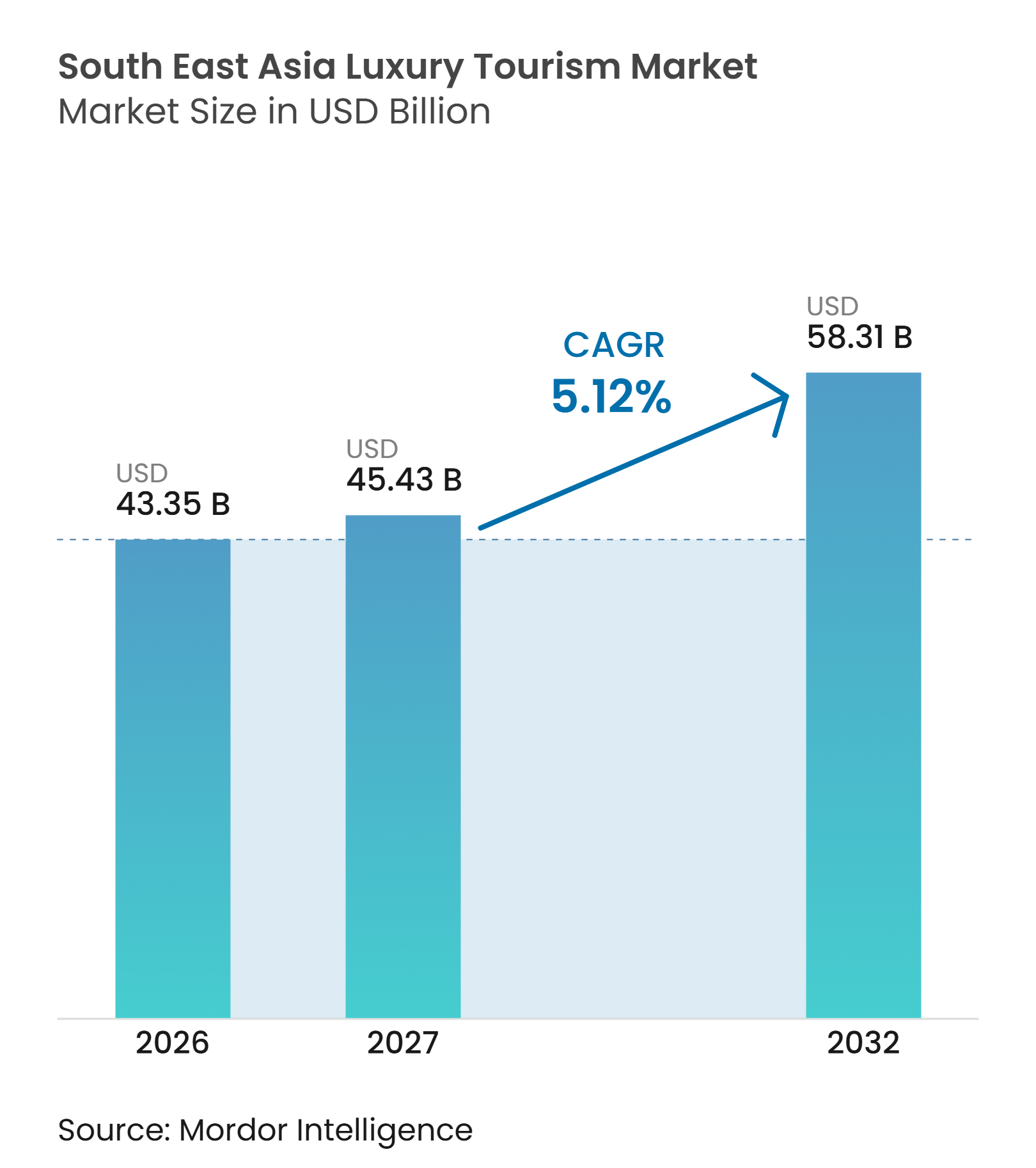
| Base Year Market Size (2026) | USD 43.35 Billion |
| Market Size (2027) | USD 45.43 Billion |
| Market Size (2032) | USD 58.31 Billion |
| Growth Rate (2027 - 2032) | 5.12 % |
| Market Concentration | Medium |
Major Players *Disclaimer: Major Players sorted in no particular order Image © Mordor Intelligence. Reuse requires attribution under CC BY 4.0. | |
South East Asia Luxury Tourism Market Analysis by Mordor Intelligence
The South East Asia luxury tourism market size was valued at USD 43.35 billion in 2026 and is estimated to grow from USD 45.43 billion in 2027 to reach USD 58.31 billion by 2032, at a CAGR of 5.12% during the forecast period (2027-2032). The South East Asia luxury tourism market is being shaped by a regional shift in tourism policy, in which governments are giving greater weight to visitor spending, trip quality, and premium experiences than to simple arrival-volume targets. Intra-regional movement continues to support demand because the Association of Southeast Asian Nations (ASEAN) is pushing to increase travel within the bloc from 38% in 2024 to 40% to 45% by 2030, helping premium operators rely less on volatile long-haul demand[1]. The South East Asia luxury tourism market also benefits from a traveler mix that books more frequent premium trips, wider use of direct digital channels, and a clear move toward wellness, privacy, and tailored stays among affluent travelers.
Key Report Takeaways
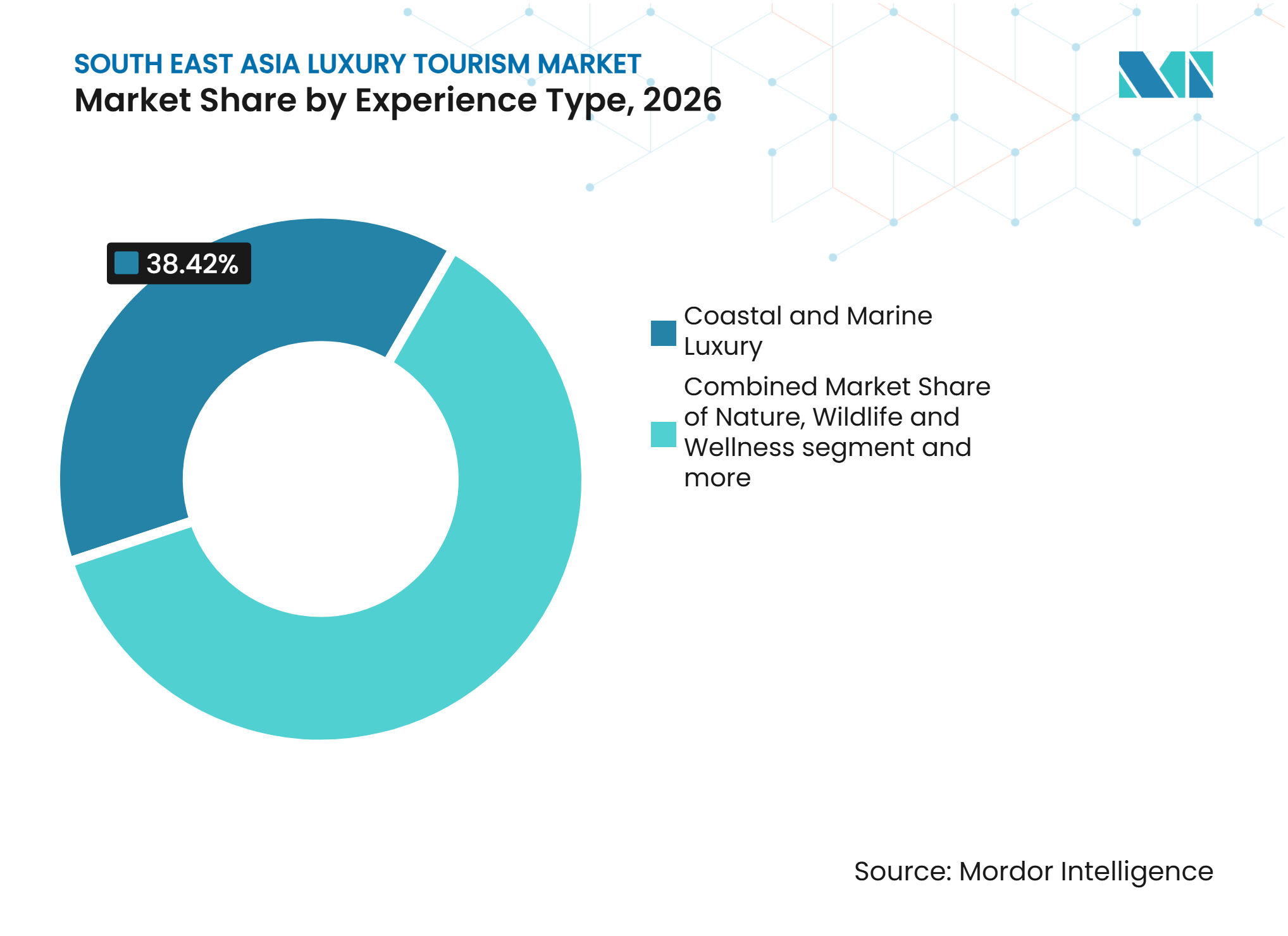
- By experience type, coastal & marine luxury accounted for 38.42% of the South East Asia luxury tourism market share in 2026, while nature, wildlife & wellness is projected to grow at a 6.35% CAGR through 2032.
- By accommodation type, branded grand luxury hotels and resorts accounted for 45.52% of the South East Asia luxury tourism market share in 2026, while Boutique Luxury Stays & Eco-Lodges are projected to grow at a 6.74% CAGR through 2032.
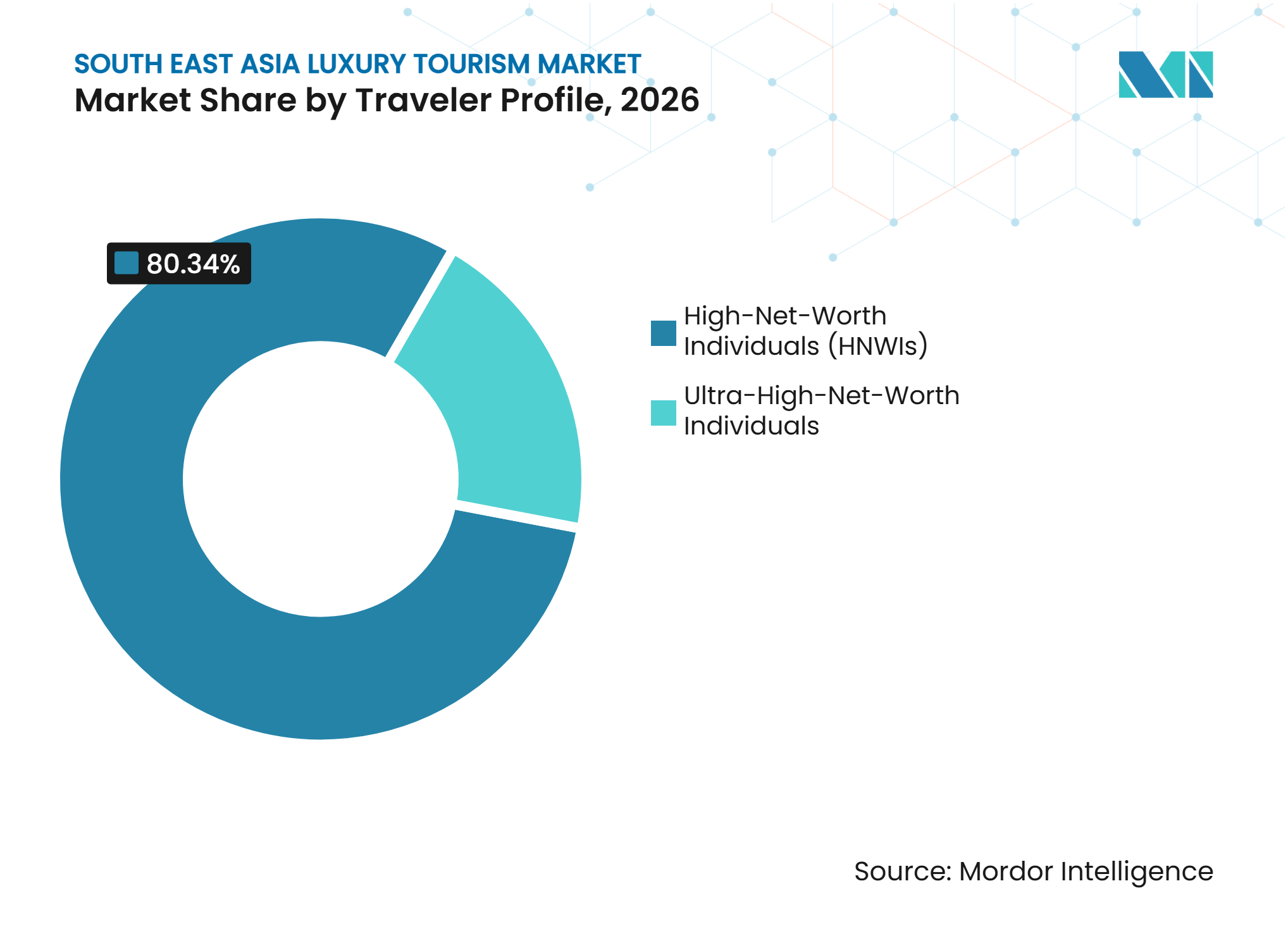
- By traveler profile, high-net-worth individuals (HNWIs) accounted for 80.34% of the South East Asia luxury tourism market share in 2026, while Ultra-High-Net-Worth Individuals (UHNWIs) are projected to grow at a 5.66% CAGR through 2032.
- By booking channel, luxury travel advisors and agencies accounted for 40.61% of the South East Asia luxury tourism market share in 2026, while Direct Brand Websites are projected to grow at a 5.98% CAGR through 2032.
- By geography, Thailand accounted for 28.95% of the South East Asia luxury tourism market share in 2026, while Vietnam is projected to grow at a 6.18% CAGR through 2032.
Note: Market numbers in this report are based on Mordor Intelligence's proprietary estimation framework, which combines nine months of actuals with Q4 projections for base year 2026.
Market Trends and Insights
Drivers Impact Analysis of South East Asia Luxury Tourism Market*
| Drivers | (~) % Impact on CAGR Forecast | Geographic Relevance | Impact Timeline |
|---|---|---|---|
| Rising Affluent Intra-Regional Travelers | +1.5% | ASEAN-wide, particularly Thailand, Singapore, and Vietnam | Short term (≤ 2 years) |
| Wellness-Led Premium Itineraries | +1.0% | Indonesia, Thailand, Vietnam, and secondary destinations | Medium term (2-4 years) |
| Air Connectivity Expansion Across ASEAN Hubs | +0.8% | Vietnam, Malaysia, Indonesia, and Cambodia | Short term (≤ 2 years) |
| Digital-First Luxury Booking Behavior | +0.7% | ASEAN-wide, strongest in Thailand, Singapore, and Vietnam | Short term (≤ 2 years) |
| Premiumization of Cultural and Nature-Based Trips | +0.5% | Vietnam, Indonesia, Cambodia, and Laos | Medium term (2-4 years) |
| Growing Preference for Brand-Backed Luxury Assurance | +0.4% | ASEAN-wide, with spillover to secondary destinations | Long term (≥ 4 years) |
| Source: Mordor Intelligence | |||
Rising Affluent Intra-Regional Travelers
The intra-ASEAN traveler segment has evolved from a supporting demand source into a core base for South East Asia luxury tourism. Deeper ASEAN integration, harmonized visa policies, and expanded regional air agreements provide a resilient foundation for the market. These developments enable operators to rely more on a mobile base of South East Asian travelers and reduce exposure to volatile long-haul demand. Affluent Asian travelers often take shorter, more frequent trips, helping luxury properties maintain steadier year-round bookings rather than relying on peak seasons. Google and Visa reported that the top 10% of South East Asia’s travel spenders take 5.3 leisure trips annually and spend substantially more than mass-market travelers on lodging, dining, and retail. This behavior supports higher-value hospitality formats and allows travelers to spread annual budgets across several luxury breaks instead of one extended vacation. It also supports secondary destinations that attract visitors through privacy, exclusivity, and curated local experiences rather than global brand recognition alone.
Wellness-Led Premium Itineraries
Wellness is emerging as a demand driver in South East Asia’s luxury tourism market, creating opportunities to increase trip value and spending per stay. The ASEAN medical and wellness tourism market was estimated at USD 51.5 billion in 2023, including a USD 37 billion wellness tourism segment; these are third-party estimates rather than official regional statistics. Thailand, Indonesia and Vietnam are positioned to benefit by combining hospitality with spa therapies, preventive health services and tailored wellness retreats. In 2026, Thailand’s Tourism Authority placed wellness at the center of its quality-led tourism strategy through “Healing is the New Luxury,” prioritizing high-value experiences over arrival growth alone[2]. This shift supports longer, experience-led stays and creates opportunities for resorts to differentiate through personalized programs, nature-based settings, and culturally rooted treatments. It may also help secondary destinations attract premium travelers, provided accessibility and service standards meet luxury expectations.
Air Connectivity Expansion Across ASEAN Hubs
Air connectivity remains a key growth driver in South East Asia’s luxury tourism market, as affluent travelers value efficient, reliable and comfortable transportation. The Asian Development Bank reported that air travel accounted for 74% of tourist arrivals in South East Asia in 2022, compared with 15% by land and 11% by sea. More recent ASEAN statistics show that the region received 127.2 million visitors in 2024, up from 102.0 million in 2023, although arrivals remained below the 2019 total of 143.7 million. This recovery strengthens the case for improving international and regional air links to established luxury hubs and emerging resort destinations. New routes can broaden access to premium accommodation and experiences, but their commercial impact depends on destination readiness, ground transport and the availability of high-quality hospitality infrastructure.
Digital-First Luxury Booking Behavior
Digital planning behavior is reshaping South East Asia’s luxury tourism market, as affluent travelers plan trips earlier and expect greater personalization. Google and Visa reported that digital travel spending in South East Asia increased by 13.3% in 2025, while average booking windows extended to 83 days, up from 46 days in 2024[3]. Longer planning cycles create opportunities to sell complex itineraries, premium bundled services and customized pre-arrival experiences. High-value travelers also contribute disproportionately to tourism revenue, with top-decile spenders generating 15 times the lodging revenue and 16 times the dining revenue of mass-market travelers. In response, hotel groups are strengthening direct digital channels and guest-data capabilities to personalize offers and encourage repeat bookings. Brands that combine seamless online planning with tailored, high-touch service can better attract affluent travelers while reducing dependence on third-party booking platforms.
Restraints Impact Analysis of South East Asia Luxury Tourism Market*
| Restraints | (~) % Impact on CAGR Forecast | Geographic Relevance | Impact Timeline |
|---|---|---|---|
| Airport Congestion and Inter-Island Connectivity Gaps | -0.5% | Indonesia, the Philippines, and Thailand | Medium term (2-4 years) |
| High Cost of Premium Hospitality Inputs | -0.7% | Singapore, Thailand, Vietnam, and Indonesia | Medium term (2-4 years) |
| Climate Exposure and Seasonal Disruption Risk | -0.4% | The Philippines, Vietnam, and Thailand | Long term (≥ 4 years) |
| Fragmented Service Quality Across Secondary Destinations | -0.3% | The Philippines, Cambodia, Myanmar, and emerging South East Asia markets | Medium term (2-4 years) |
| Source: Mordor Intelligence | |||
Airport Congestion and Inter-Island Connectivity Gaps
Access constraints continue to restrain the South East Asia luxury tourism market, as many itineraries depend on a limited number of major entry points. In island destinations, international travelers often arrive through a single primary airport, while transfers to secondary luxury locations rely on smaller airports or slower local connections. These limitations create friction for high-value travelers who expect seamless mobility, flexible schedules, and minimal transfer risk across multi-destination journeys. ASEAN's tourism plan identifies an Asian Development Bank tourism infrastructure pipeline through 2030, supported by significant planned investment. However, the market impact will depend on how much of this investment improves access beyond primary gateways. The South East Asia luxury tourism market is constrained by overall flight capacity and uneven last-mile connectivity to islands, nature areas, and secondary leisure hubs. Until these gaps narrow, some destinations will remain attractive but difficult to scale in practice.
High Cost of Premium Hospitality Inputs
The South East Asia luxury tourism market faces margin pressure as operating costs rise for luxury hospitality assets. Luxury hotels require large service teams, high-quality food, stringent maintenance, and amenity-rich facilities. Consequently, even modest cost inflation can affect profitability more quickly than in the midscale segment. These pressures are significant in Singapore, Thailand, Vietnam, and Indonesia, where branded luxury properties continue to expand. Operators must maintain service quality while exercising rate discipline. The challenge is structural rather than temporary because simplifying luxury experiences can weaken their core value proposition. Hotels can automate certain processes; however, room service, butler support, wellness programs, concierge services, and curated dining continue to rely heavily on skilled labor. As a result, the South East Asia luxury tourism market can continue to grow in revenue while operators face tighter operating margins than topline demand suggests.
*Our forecasts treat driver/restraint impacts as directional, not additive. The impact forecasts reflect baseline growth, mix effects, and variable interactions.
Traveler Behavior & Tourism Trends
South East Asia luxury tourism is shifting toward wellness, meaningful experiences, and personalization. A 2025 survey of 1,750 affluent Asia-Pacific travelers, including respondents from Singapore, Indonesia, and Thailand, found that 90% considered wellness important when booking travel, up from 80% in 2024. Additionally, 72% planned to increase luxury travel spending. These trends create opportunities for retreats, cultural immersion, and tailored family experiences.
Booking Behavior, Channel Preferences, and Travel Spending: Digital discovery and expert-led planning increasingly coexist. Skift’s 2025 survey found that more than 80% of Indian and Chinese travelers booked flights and hotels through mobile channels, while 74% of Indian travelers planned to use online travel agencies (OTAs) for hotel bookings. Singapore recorded tourism receipts of SGD 32.8 billion (USD 25.54 billion) in 2025, up 10% year on year, despite a 2.1% decline in the average length of stay to 3.48 days. Luxury travel providers should combine seamless digital booking with high-value experiences.
Tourism Performance Intelligence
South East Asia recorded approximately 144 million international visitor arrivals in 2025, up 13.4% year on year and above the 2019 total of 143.6 million. Performance varied across destinations: Malaysia recorded approximately 42.0 million arrivals (+11.2%), Vietnam 21.2 million (+20.4%), Singapore 16.9 million (+2.3%), and Thailand 32.97 million, down 7.23%. Malaysia’s total includes excursionists and is not directly comparable with overnight tourist arrivals. These trends highlight the need for luxury operators to diversify destination and source-market exposure rather than rely solely on headline arrival growth.
Length of stay and visitor spending provide additional indicators of market value. Singapore’s average stay fell 2.1% to 3.48 days in 2025, while tourism receipts rose 10% to SGD 32.755 billion (USD 25.50 billion). Indonesia recorded an average stay of 9.92 days. Visitors from Germany, France, and the Netherlands stayed an average of 17.45, 16.72, and 19.81 days, respectively. Although these figures cover all international visitors rather than luxury travelers, they support short-break packages in Singapore and longer resort, wellness, and multi-destination experiences in Indonesia.
South East Asia Luxury Tourism Market Segment Analysis
By Experience Type:
Coastal Dominance Holds as Nature and Wellness Redraw the PipelineCoastal & marine luxury accounted for 38.42% of South East Asia luxury tourism market in 2026, making it the largest experience category in the South East Asia luxury tourism market. The region’s island geography supports private beaches, overwater villas, marine recreation, and resort formats that command high prices. Recognition among long-haul and regional travelers supports established destinations such as Phuket, Koh Samui, and Bali. Nature, Wildlife & Wellness is projected to grow at a 6.35% CAGR through 2032, reflecting demand for privacy, lower-density settings, slower-paced travel, and wellness, ecology, and local healing programs.
The South East Asia luxury tourism market is expanding beyond coastal resorts to include varied landscapes and travel motivations. Heritage & Urban Luxury remains important, as historic districts, restored properties, and culturally rooted cities offer design, culinary access, and local identity. Other Specialty Experiences, including private charters, guided expeditions, and customized nature circuits, are gaining importance as ultra-affluent travelers spend more on privacy and exclusive access. The industry is expanding its offerings, encouraging travelers to extend trips and spend time traveling across multiple destinations.



By Accommodation Type:
Branded Hotels Lead While Boutique and Eco Formats Gain GroundBranded grand luxury hotels and resorts accounted for 45.52% of the South East Asia luxury tourism market in 2026, making them the largest accommodation format. They benefit from loyalty programs, distribution networks, and brand recognition among travelers seeking consistent experiences across multiple countries. They also capture more corporate travel, diplomatic travel, and high-end meeting demand than smaller independent formats. Supply remains favorable as global chains continue to invest in urban and resort developments across the market. Branded hotels reduce booking risk while offering diverse location options.
Boutique luxury stays and eco-lodges are the fastest-growing accommodation category, with a forecast CAGR of 6.74% through 2032. They appeal to guests seeking privacy, low room counts, environmental positioning, and location-specific design. Private villas and estates serve families, friend groups, and high-spending travelers seeking secluded spaces and bespoke services. Branded serviced apartments address longer-stay demand among travelers combining leisure, wellness, and business activities. Growth is shifting toward formats offering intimacy, flexibility, and local character.
By Traveler Profile:
HNWI Volume Supports Revenue While UHNWI Growth Lifts Premium IntensityHNWIs accounted for 80.34% of the South East Asia luxury tourism market in 2026, making the upper-affluent segment the primary revenue base rather than UHNWIs. The region offers high-end accommodation and services at trip costs often lower than those in mature Western destinations. Google and Visa data show that top-decile South East Asia travel spenders take 5.3 leisure trips annually and spend more than mass-market travelers on lodging, dining, and retail. This provides hotels and travel operators with repeat-customer and upselling opportunities across accommodation, wellness, dining, and local experiences.
UHNWIs are the fastest-growing traveler segment, with a projected CAGR of 5.66% during 2027-2032. They are more likely to book large villas, private transportation, residence-linked stays, and invitation-only experiences, increasing revenue per trip. Consequently, hotels are developing private arrival processes, member-style access, extended-stay luxury products, and resort-residence components. Even modest gains in UHNWI capture can improve property economics through higher rates, ancillary revenue, and long-stay spending.

By Booking Channel:
Advisor Trust Leads While Direct Digital Channels Gain FasterLuxury travel advisors and agencies accounted for 40.61% of the South East Asia luxury tourism market in 2026, representing the largest distribution channel. The regional travel landscape often involves multi-county trips, varied transportation, and specific property preferences requiring expert coordination. Advisors access limited inventory, resolve disruptions, and match clients with suitable resorts, villas, and itineraries. Their role strengthens as planning horizons extend. Google and Visa estimate booking windows in South East Asia at 83 days in 2025, compared with 46 days in 2024. Advisor-led sales provide risk reduction, time savings, and curated travel planning.
Direct brand websites are expected to be the fastest-growing distribution channel, with a 5.98% CAGR through 2032. Hotel brands encourage direct bookings through room upgrades, dining credits, loyalty benefits, and personalized pre-arrival communication. High-spending travelers generate substantial room and on-property revenue, increasing the value of direct customer relationships. Online travel agencies support visibility, discovery, and short-booking-window demand but remain less suitable for transactions requiring customization and detailed service coordination. The market is expected to retain a mixed distribution structure, with advisors handling complex sales and direct channels capturing a larger share of repeat high-value demand.
Geography Analysis
Thailand accounted for 28.95% of the South East Asia luxury tourism market in 2026, supported by its tourism ecosystem across Phuket, Koh Samui, Bangkok, and Chiang Mai. These destinations offer established accommodations, wellness infrastructure, and service capacity. The Tourism Authority of Thailand has adopted a quality-led strategy targeting THB 2.65 trillion (USD 0.084 trillion) in tourism revenue from 33 million arrivals in 2026. In the first five months of 2026, Thailand generated THB 679 billion (USD 21.56 billion) from 14 million international visitors. Singapore has a smaller physical scale but higher yields, reporting record tourism receipts of SGD 32.8 billion (USD 25.54 billion) in 2025 from 16.9 million visitors[4].
Vietnam is the fastest-growing country segment, with a forecast CAGR of 6.18% through 2032. The Vietnam National Administration of Tourism targets 25 million international visitors and approximately USD 42.7 billion in tourism revenue in 2026. Indonesia remains a core destination, with Bali supporting luxury demand and branded expansion potential. Malaysia is expanding its luxury hotel supply, including Waldorf Astoria Kuala Lumpur and Conrad Kuala Lumpur. The Philippines faces access and service consistency challenges. Cambodia, Laos, Myanmar, and Brunei can attract high-value travelers through low-density, culture-led, and nature-based offerings.
Tourism Infrastructure & Development Intelligence
Luxury hotel development is expanding across South East Asia’s urban gateways and resort destinations. As of year-end 2025, Vietnam had 248 hotel projects with 84,079 rooms in the Asia-Pacific pipeline, excluding China. Indonesia had 181 projects with 30,761 rooms, while Thailand had 167 projects with 43,067 rooms. Bangkok accounted for 68 projects and 16,641 rooms, while Phuket had 41 projects with 9,583 rooms. This concentration reflects growing investment in city and resort accommodation and increases the need for properties to differentiate through service, wellness offerings, and guest experiences.
In 2026, luxury hotel supply across Asia-Pacific grew 4% annually over the past decade and accounted for approximately 8% of total hotel supply. In Thailand, ultra-luxury room rates approached THB 15,000 (USD 476.29), compared with approximately THB 10,000 (USD 317.53) before the COVID-19 pandemic. New lifestyle, wellness, and culturally immersive properties are expanding the region’s luxury inventory beyond conventional five-star accommodations.
Competitive Landscape
Market Concentration
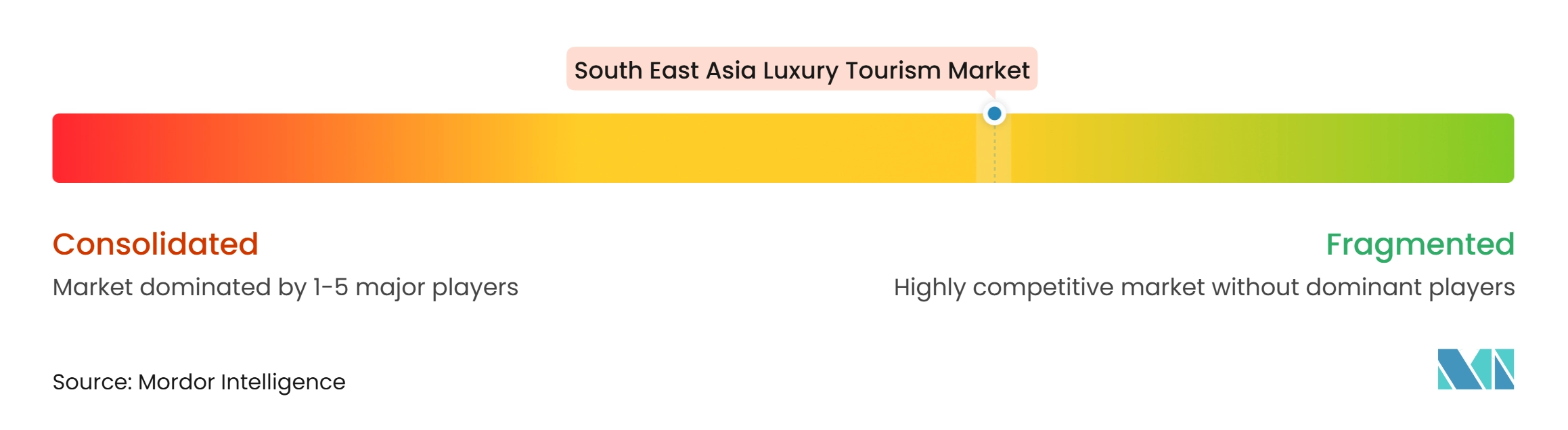
The South East Asia luxury tourism market is moderately concentrated, with global hotel groups and regional luxury brands driving competition. Marriott, Hilton, Accor, Hyatt, and IHG benefit from loyalty ecosystems, multi-country operating experience, and expansion capacity across gateway cities and resort destinations. Banyan Group, Dusit International, Centara Hotels and Resorts, Pan Pacific Hotels Group, Capella Hotel Group, Aman, and COMO Hotels and Resorts compete through local identity and low-density positioning. No single player dominates the market, although it is less fragmented than mass tourism lodging.
Competition is intensifying through expansion, product upgrades, and destination-specific strategies. Luxury hospitality development is expanding across South East Asia. Hilton announced 17 luxury and lifestyle properties across six countries in October 2025, adding nearly 4,000 rooms. Hyatt announced nearly 90 luxury and lifestyle properties across Asia-Pacific in July 2025, including Thailand, Malaysia, and Vietnam. Banyan Group reached 100 operating hotels and resorts by 2025-end, with FY2025 revenue rising 25% to SGD 477.4 million (USD 371.69 million), supported by branded-residence sales.
Competition is shifting beyond room growth toward direct customer relationships and product differentiation. Direct bookings enable personalized offers through guest data. Independent villas, eco-lodges, and residence-linked resorts serve privacy-focused demand. Ultra-luxury operators benefit from demand for seclusion, curated experiences, and limited availability. Strong players will combine trusted brands, direct customer relationships, and destination-linked experiences.
South East Asia Luxury Tourism Industry Leaders
-
Marriott International, Inc.
-
Hilton Worldwide Holdings Inc.
-
Accor S.A.
-
Hyatt Hotels Corporation
-
Four Seasons Hotels and Resorts
- *Disclaimer: Major Players sorted in no particular order
South East Asia Luxury Tourism Market Companies Covered in this Report
- Marriott International, Inc.
- Hilton Worldwide Holdings Inc.
- Accor S.A.
- Hyatt Hotels Corporation
- Four Seasons Hotels and Resorts
- InterContinental Hotels Group PLC
- Mandarin Oriental Hotel Group Limited
- Rosewood Hotel Group
- Banyan Group Ltd.
- The Ascott Limited
- Minor International Public Company Limited
- Shangri-La Asia Limited
- Kempinski Hotels S.A.
- Aman Group Sàrl
- Belmond Ltd.
- Centara Hotels and Resorts
- Dusit International
- Pan Pacific Hotels Group
- COMO Hotels and Resorts
- Capella Hotel Group
Recent Industry Developments in South East Asia Luxury Tourism Market
- April 2026: Club Med, a Fosun Tourism Group company, signed a Hotel Management Agreement with Thailand’s Central Group Capital for Club Med Exclusive Collection Koh Samui. The agreement marks the brand’s first ultra-luxury property in Thailand. The resort is expected to open in late 2028 and pursue Building Research Establishment Environmental Assessment Method (BREEAM) sustainable building certification.
- January 2026: Banyan Group surpassed 100 hotels and resorts in 2025, with FY2025 revenue rising 25% to SGD 477.4 million (USD 371.69 million), driven by branded residences and continued international expansion.
- October 2025: Hilton announced 17 luxury and lifestyle properties across six South East Asian countries, expected to add nearly 4,000 rooms. The pipeline included NoMad by Hilton Singapore, Waldorf Astoria Kuala Lumpur, Conrad Kuala Lumpur, NHAAN Resort & Spa Hoi An, and Tapestry Collection by Hilton.
- July 2025: Hyatt announced a near-90-property Asia-Pacific luxury pipeline over 5 years, including the regional debut of Thompson Hotels and expansion of Andaz, The Standard, and Park Hyatt. The announcement also included Park Hyatt Phu Quoc in Vietnam, scheduled to open in the first quarter of 2026 on 160 acres of beachfront land.
South East Asia Luxury Tourism Market Report Scope
The South East Asia luxury tourism market report analyzes luxury travel experiences, premium accommodation, high-net-worth and ultra-high-net-worth travelers, and booking channels across Singapore, Malaysia, Thailand, Indonesia, Vietnam, and the Philippines. The market is segmented by experience type, accommodation type, traveler profile, booking channel, and country, with separate market size and growth forecasts for each covered country. The study assesses drivers such as rising affluent intra-regional travel, wellness-led premium itineraries, expanding air connectivity across ASEAN hubs, digital-first luxury booking behavior, premiumization of cultural and nature-based trips, and demand for brand-backed luxury assurance. It also examines restraints including airport congestion, inter-island connectivity gaps, high premium hospitality input costs, climate exposure, seasonal disruptions, and inconsistent service quality across secondary destinations. The report evaluates luxury hospitality supply and room inventory, tourism arrivals, length of stay, traveler preferences, booking behavior, travel spending, and emerging demand patterns. It provides market size and growth forecasts by experience type, accommodation type, traveler profile, and booking channel for 2022-2032, including country-level breakdowns across the same segments. The study also covers value and supply chain dynamics, regulatory and technological developments, Porter’s Five Forces Analysis, market concentration, market shares, strategic moves, and profiles of major international hotel groups, luxury resort operators, boutique hospitality brands, and serviced-apartment providers. Opportunities in premium wellness retreats in secondary destinations and high-value multi-island luxury circuits are also assessed. Market estimates and forecasts are presented in value terms across the covered segments.
Segmentation Overview
Key Questions Answered in the Report
What is the projected value of South East Asia's luxury tourism by 2032?
The South East Asia luxury tourism market is forecast to reach USD 58.31 billion by 2032, rising from USD 43.35 billion in 2026 at a CAGR of 5.12%.
Which country leads luxury tourism demand in South East Asia?
Thailand led the region in 2026 with a 28.95% share, supported by its strong resort base, wellness positioning, and mature premium hospitality infrastructure.
Which traveler group contributes the most to premium tourism revenue in the region?
HNWIs accounted for 80.34% of the traveler profile in 2026, making them the main volume base for premium travel spending across the region.
Which segment is growing the fastest by experience type?
Nature, Wildlife & Wellness is the fastest-growing experience segment, with a projected CAGR of 6.35% through 2032.
Why are direct booking channels gaining importance in luxury travel?
Direct Brand Websites are expected to grow at a 5.98% CAGR because brands want stronger guest ownership, better personalization, and higher value from repeat affluent travelers.
What are the main risks affecting premium tourism growth in South East Asia?
Airport access gaps, high operating costs, climate-related disruption, and uneven service quality across secondary destinations remain the main restraints on future growth.