
South America Trace Detection Market Size and Share
Market Overview
| Study Period | 2020 - 2031 |
|---|---|
| Forecast Data Period | 2026 - 2031 |
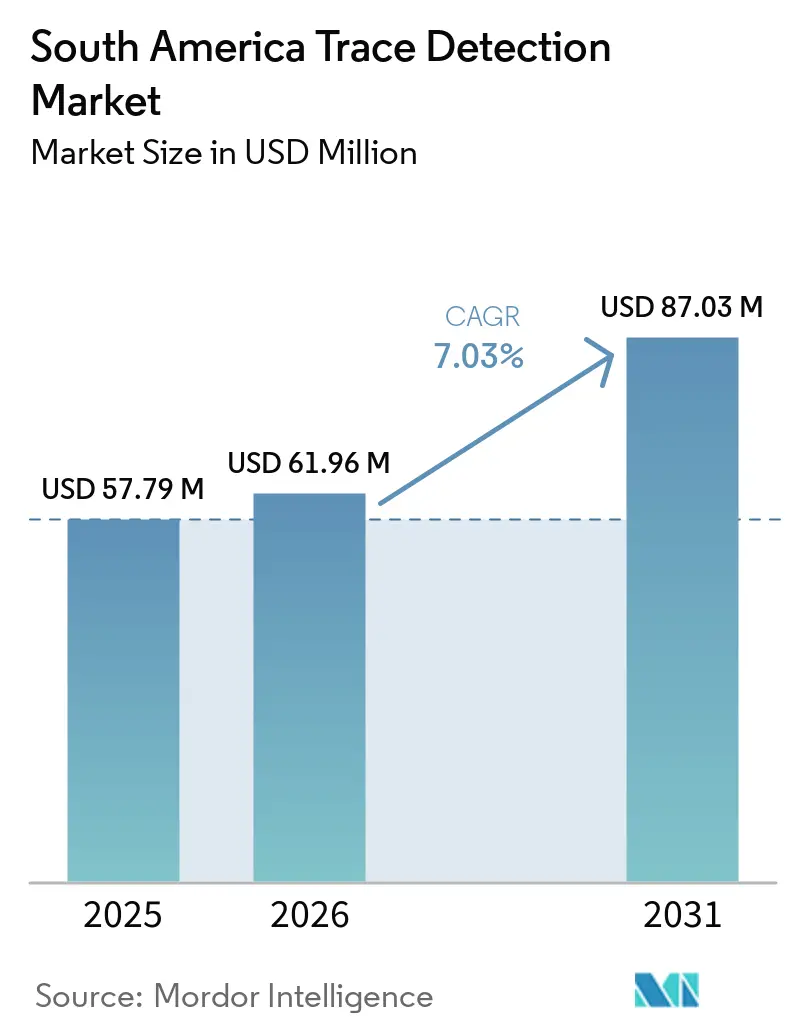
| Base Year Market Size (2025) | USD 57.79 Million |
| Market Size (2026) | USD 61.96 Million |
| Market Size (2031) | USD 87.03 Million |
| Growth Rate (2026 - 2031) | 7.03 % |
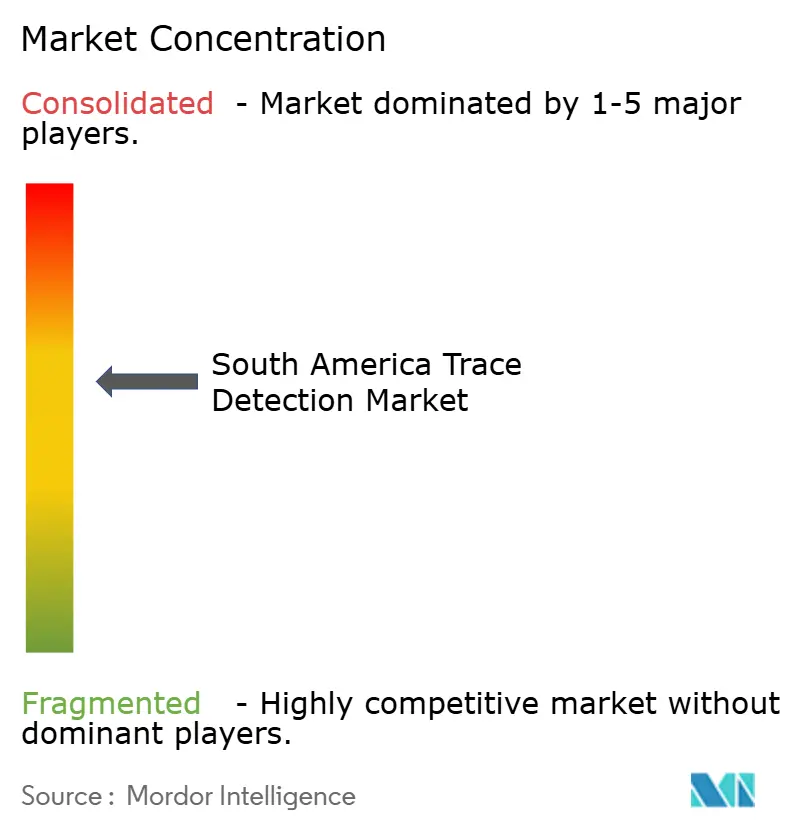
| Market Concentration | Medium |
Major Players *Disclaimer: Major Players sorted in no particular order Image © Mordor Intelligence. Reuse requires attribution under CC BY 4.0. | |
South America Trace Detection Market Analysis by Mordor Intelligence
The South America trace detection market size was USD 57.79 million in 2025 and is forecast to reach USD 87.03 million by 2031, advancing at a CAGR of 7.03% from 2026 to 2031. Demand is being shaped by airport screening upgrades, port expansion, and stronger counternarcotics operations across the region. Security agencies are placing more weight on detection capability at ports, borders, and airports as cocaine seizures and synthetic drug risks increase. Multilateral cooperation and bilateral equipment support can help projects move forward when domestic procurement budgets are under pressure. Suppliers that combine approved equipment, service support, and dependable consumables are better placed to secure long-term institutional contracts in the South America trace detection market.
Key Report Takeaways
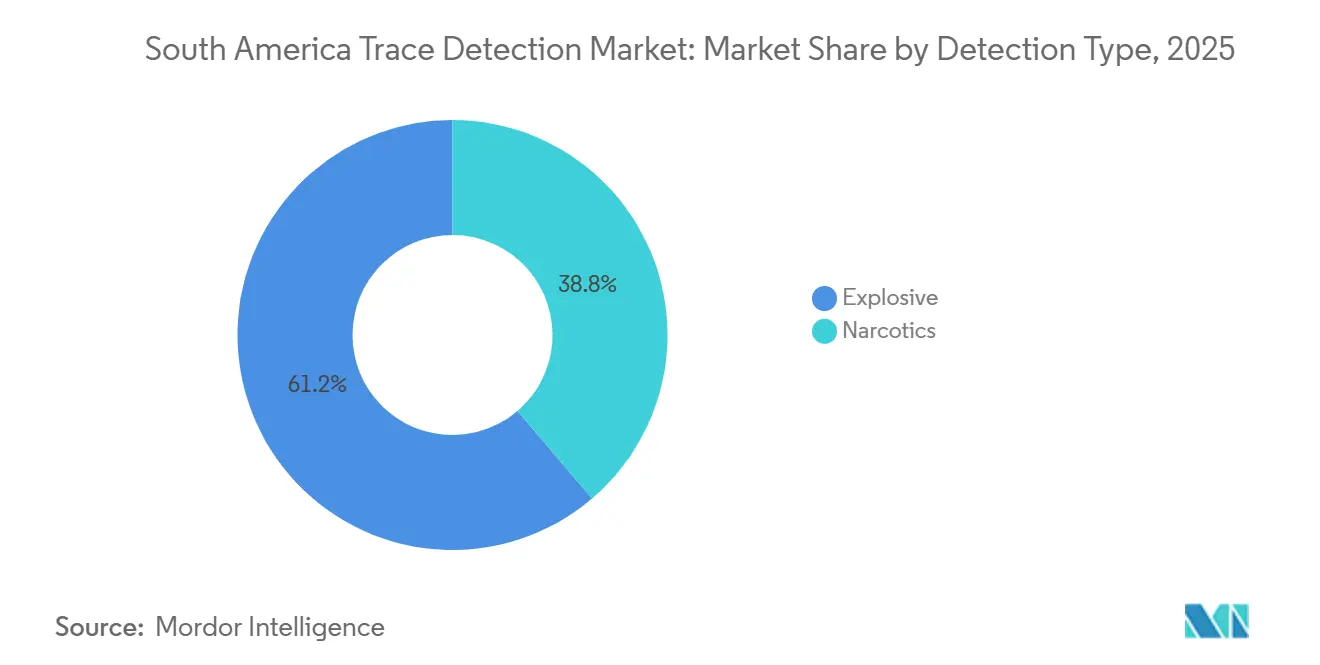
- By detection type, explosive detection held 61.24% of the South America trace detection market share in 2025, while narcotics detection is projected to expand at a 7.36% CAGR through 2031.
- By product, handheld trace detectors accounted for 50.66% of the regional total in 2025, while fixed systems are expected to expand at a 7.44% CAGR through 2031.
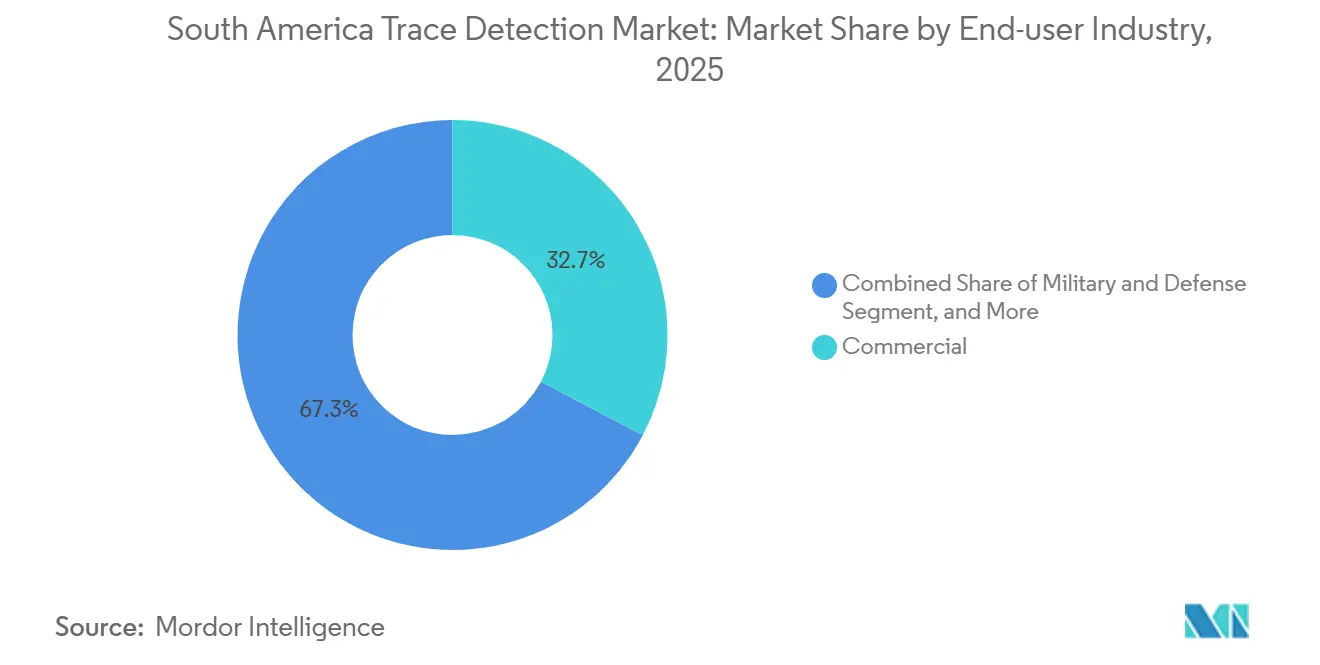
- By end-user industry, commercial operators held 32.73% of the South America trace detection market share in 2025 and are projected to expand at a 7.52% CAGR through 2031.
- By geography, Brazil accounted for 41.37% of the regional total in 2025, while Colombia is forecast to expand at a 7.48% CAGR through 2031.
Note: Market size and forecast figures in this report are generated using Mordor Intelligence’s proprietary estimation framework, updated with the latest available data and insights as of January 2026.
South America Trace Detection Market Trends and Insights
Drivers Impact Analysis*
| Driver | (~) % Impact on CAGR Forecast | Geographic Relevance | Impact Timeline |
|---|---|---|---|
| Airport and International Passenger Screening Expansion | +2.0% | Brazil, Colombia, Argentina, Chile | Short term (≤ 2 years) |
| Cocaine and Synthetic Narcotics Interdiction | +1.8% | Colombia, Brazil, Rest of South America | Short term (≤ 2 years) |
| Cargo, Customs, and Border Security Requirements | +1.2% | Brazil, Colombia, Chile | Medium term (2-4 years) |
| Port, Logistics Hub, and Cross-Border Trade Expansion | +0.8% | Colombia, Brazil, Chile | Medium term (2-4 years) |
| Mobile Interdiction Team Screening Demand | +0.5% | Brazil, Colombia, Rest of South America | Short term (≤ 2 years) |
| Threat-Library Adaptation for Emerging Substances | +0.4% | Brazil, Chile, Colombia | Long term (≥ 4 years) |
| Source: Mordor Intelligence | |||
Growth in Airport and International Passenger Screening
South American aviation capacity additions are increasing the number of checkpoints that require trace detection equipment. In January 2025, 6 explosive trace detectors, 3 body scanners, and 5 dual-view X-ray machines began operating at Viracopos International Airport in Campinas, Brazil, through a U.S. government donation.[1]Agência Nacional de Aviação Civil, “Novos Equipamentos Modernizam Procedimentos de Inspeção de Segurança,” Agência Nacional de Aviação Civil, gov.br The equipment deployment made the airport the first in South America to receive a donation of this scale for screening equipment. Jorge Chávez International Airport added 19 automated border-control gates in 2025 and planned terminal capacity for 40 million annual passengers. Airport additions create demand for equipment at passenger and baggage screening points under aviation security requirements. This makes airport capacity projects a useful near-term indicator for the South America trace detection market.
Intensifying Cocaine and Synthetic Narcotics Interdiction
Counternarcotics agencies now face a wider range of substances than bulk cocaine alone. A 2026 peer-reviewed study reported nitazene production infrastructure in Brazil from May 2025 and fentanyl analogs in ketamine and MDMA or Ecstasy samples in Colombia. These substances present a challenge for instruments that depend on threat libraries built for established compounds. INTERPOL’s Operation Orca XI ran from October to November 2025 across 20 countries, including Argentina, Bolivia, Brazil, Chile, Colombia, Ecuador, Peru, and Paraguay.[2]International Criminal Police Organization, “Over 3,300 Illegal Firearms, 56 Tonnes of Drugs Seized in Operation in the Americas,” INTERPOL, interpol.int The operation seized substantial quantities of drugs, including cocaine, cocaine base paste, methamphetamine, and marijuana. These conditions support demand in the South America trace detection market for devices that can assess multiple substances with greater specificity.
Stricter Cargo, Customs, and Border Security Requirements
Cargo controls are moving beyond selective inspection at major South American ports. Brazil’s updated cargo-scanning regulations led Rio Brasil Terminal to install a port scanner in October 2025. The installation placed the terminal among the first Brazilian facilities to meet the new standard. Colombia’s Decreto 1086 of October 2025 created a National Maritime Security System involving 17 national entities.[3]Colombia Government Dirección General Marítima, “Government Launches Maritime Security System to Stop Crime in the Country’s Ports,” Dirección General Marítima, solonoticias24.com The arrangement brings DIMAR, POLFA, DIAN, and other bodies into maritime security coordination. Such requirements create a more formal procurement path for detection equipment in the South America trace detection market.
Expansion of Ports, Logistics Hubs, and Cross-Border Trade
Port construction and expansion increase the number of cargo entry points that require security controls. Puerto de Santa Marta activated a multi-million-dollar Eagle container scanner and planned additional trace detection devices and a narcotics identification laboratory. Barranquilla introduced a non-intrusive inspection system that substantially reduced cargo inspection times. Faster primary inspection can make secondary trace screening more workable without adding long dwell times. In July 2026, FORPO transferred nationalized vessels to Colombia’s National Police Anti-Narcotics Directorate for operations at Urabá, Buenaventura, Barranquilla, Cartagena, and Santa Marta.[4]Fondo para la Rehabilitación, Inversión Social y Lucha Contra el Crimen Organizado, “FORPO Nacionaliza Embarcaciones para Fortalecer la Lucha Antidrogas,” FORPO, forpo.gov.co The expanded operational reach can raise demand for portable equipment at these locations. Port and logistics investment, therefore, supports the South America trace detection market over the medium term.
Restraints Impact Analysis*
| Restraint | (~) % Impact on CAGR Forecast | Geographic Relevance | Impact Timeline |
|---|---|---|---|
| Total Cost of Ownership and Consumable Dependence | -1.8% | Regional, most acute in Argentina and Rest of South America | Medium term (2-4 years) |
| Specialist Training and Calibration Infrastructure Limits | -0.9% | Brazil interior regions, Rest of South America | Long term (≥ 4 years) |
| Fragmented Procurement and Budget Release Cycles | -0.7% | Argentina, Chile, Colombia, Rest of South America | Short term (≤ 2 years) |
| Inconsistent Field Validation of New Psychoactive Substances | -0.5% | Brazil, Colombia, Chile | Long term (≥ 4 years) |
| Source: Mordor Intelligence | |||
High Total Cost of Ownership and Consumable Dependence
Operating a trace detection fleet involves more than the initial equipment purchase. Agencies must fund certified swabs, reagent cartridges, calibration services, and threat-library licenses during the equipment life cycle. These operating costs can exceed the original capital outlay within 3 to 5 years. Imported consumables priced in USD can create added pressure for agencies whose operating budgets are denominated in pesos or reais. Argentina’s currency-management challenges during 2024 and 2025 reduced purchasing power for imported security consumables without changing formal appropriations. Supply is also concentrated among 2 to 3 original equipment manufacturers for each platform, which limits price leverage at renewal and can slow expansion in the South America trace detection market.
Limited Specialist Training and Calibration Infrastructure
Trace detection equipment can perform poorly in field settings when users cannot interpret alarms or follow sampling procedures correctly. Operators need to manage false-positive readings and collect samples from vehicle surfaces, cargo packaging, and currency. South America has limited certified forensic chemistry trainers and accredited calibration laboratories outside Brazil’s major metropolitan areas. In July 2026, the UNODC Airport Communication Project brought together frontline officers from Southern Cone inter-agency units to align screening and intelligence-led targeting practices. The program indicates that operational procedures remain as important as equipment procurement. Agencies may delay purchases until they can maintain calibration capability, even as training later supports demand for more capable systems in the South America trace detection market.
*Our forecasts treat driver/restraint impacts as directional, not additive. The impact forecasts reflect baseline growth, mix effects, and variable interactions.
Segment Analysis
By Detection Type: Explosive Detection Retains Its Base as Narcotics Screening Expands
Explosive detection held 61.24% of the South America trace detection market share in 2025. The installed base reflects long-standing use at certified airports, where ion mobility spectrometry equipment has been widely used for military and commercial explosive screening and where international aviation security standards continue to guide baseline equipment requirements. ICAO Annex 17 requirements support baseline explosive screening at internationally certified airports and create recurring demand for replacement devices, approved swabs, certified consumables, and calibration support. Suppliers with established certifications, threat libraries, and service relationships can retain a strong position in replacement tenders, particularly where airport operators need proven systems that fit existing screening processes. Airport security requirements, therefore, continue to support this part of the South America trace detection market.
Narcotics detection is projected to expand at a 7.36% CAGR from 2026 to 2031, exceeding the overall regional rate. Colombia’s port modernization, Brazil’s synthetic opioid concerns, and reported fentanyl analogs are increasing the need for narcotics-capable instruments that can be deployed with existing explosive screening coverage. Dual-mode platforms can screen for explosives and narcotics through one system, allowing agencies to strengthen detection without operating separate single-purpose instruments at each screening point. Their use can be particularly important where library-dependent instruments do not reliably resolve compounds that have not yet been catalogued. This can increase revenue per unit even when tenders do not call for more individual devices in the South America trace detection market.


By Product: Fixed Systems Gain as Permanent Screening Locations Expand
Handheld detectors accounted for 50.66% of the South America trace detection market in 2025. Their leading position reflects their flexibility for mobile interdiction teams, patrol units, smaller border crossings, and other sites where permanent infrastructure is not practical or cannot be justified by traffic volumes. Portable or movable systems serve regional airports and medium-sized ports that prefer desk-mounted equipment which can be reassigned between screening lanes as operational needs change. These formats allow agencies to extend coverage while managing the dispersed geography of enforcement locations and varying volumes of passenger and cargo traffic. The South America trace detection market size for handheld devices remains tied to these field and border operations.
Fixed systems are expected to expand at a 7.44% CAGR from 2026 to 2031, the fastest rate among product categories. Major ports and aviation hubs are building permanent checkpoints where hardwired screening lanes can support sustained traffic volumes and where dedicated equipment can be integrated into wider checkpoint upgrades. The deployment of 6 explosive trace detectors at Viracopos Airport in January 2025 showed how bilateral security support can advance checkpoint upgrades outside domestic procurement cycles, using equipment comparable to systems deployed by the TSA across 440 U.S. airports. A 2025 scientific review described ambient ionization mass spectrometry advances that can provide higher throughput and require less sample preparation in fixed checkpoint applications. Fixed systems also create recurring requirements for maintenance, calibration, and certified consumables across the South America trace detection market.
By End-User Industry: Commercial Operators Lead Demand and Forecast Expansion
Commercial operators held 32.73% of the South America trace detection market share in 2025. This group includes commercial airports, airlines, logistics operators, and cargo handlers that are taking on screening duties previously managed mainly by public agencies, often within facilities that must sustain regular passenger and cargo flows. Regulators are asking more private facilities to support pre-clearance and checkpoint procedures, while operators must maintain security practices without disrupting passenger processing, cargo handling, or operating schedules. Aviation and cargo infrastructure activity supports demand among commercial users. This setting favors providers that can pair equipment with dependable maintenance, consumable supplies, and service arrangements for commercial facilities.
The commercial segment is projected to expand at a 7.52% CAGR from 2026 to 2031, the highest rate among end-user groups. Military and defense users retain meaningful demand through Brazil’s SISFRON program and Colombia’s counternarcotics operations, while law enforcement agencies are extending field screening to mobile checkpoints beyond airport perimeters and into transport corridors. Brazil’s defense monitoring program covers radar, communications, and detection infrastructure along its land border. Ports and border users are gaining momentum as cargo regulations and Colombia’s maritime security arrangements create formal equipment requirements, while public safety and other users benefit from sports venues, critical infrastructure protection, and urban transit security projects. These combined requirements broaden the customer base for the South America trace detection market.

Geography Analysis
Brazil accounted for 41.37% of the South America trace detection market share in 2025. Its leading position rests on the scale of its airport network, port throughput, and government security modernization programs. The SAD 3 and SAD 7 phases of SISFRON involved substantial investment and included radar, communications, and detection infrastructure across Brazil’s extensive land border. The Ministry of Ports and Airports and Federal Police established an integrated monitoring program at selected ports, with plans to expand coverage to additional strategic ports. Large, multi-year tenders favor suppliers with local service capacity that can support long equipment life cycles.
Argentina faced macroeconomic pressure and currency volatility during 2024 and 2025, which reduced purchasing power for imported instruments and consumables. Border security and customs requirements nevertheless sustain baseline demand in the South America trace detection market. Chile benefits from stable institutions and Pacific coast port expansion, with customs authorities extending cargo-screening capacity at Valparaíso and San Antonio under trade-facilitation programs. Argentina and Chile participated in Operation Orca XI, a 20-country operation that seized 56 tonnes of drugs across the Americas. Reported Tusi and ketamine use in Chile adds pressure to introduce narcotics capabilities beyond cocaine at existing screening locations.
Colombia is projected to expand at a 7.48% CAGR from 2026 to 2031, the fastest national rate in the South America trace detection market. The National Maritime Security System coordinates DIMAR, POLFA, DIAN, and other entities across key seaports. Colombia has conducted significant cocaine seizures, including a major haul at Buenaventura. Paraguay, Uruguay, Bolivia, Ecuador, and smaller economies generate demand through transit-route monitoring, where INTERPOL and UNODC support equipment and training at key locations.
Competitive Landscape
The South America trace detection market is moderately concentrated, with established multinational firms holding substantial revenue through long-cycle institutional contracts and service arrangements. Smiths Detection Group Ltd., OSI Systems Inc. through Rapiscan, and Leidos Holdings Inc. hold strong aviation security positions through proven ion mobility spectrometry platforms, certifications, integrated service agreements, and support networks. These capabilities matter to customers who operate distributed equipment estates across several countries. Leidos received a major long-term TSA Integrated Logistics Support contract in early 2025. The award reinforced its role in institutional screening program management and supported its international service position.
Bruker Corporation reported substantial orders from new contracts and framework agreements for explosives and chemical trace detection. The orders covered aviation customers in Scandinavia, Korea, and Saudi Arabia, along with chemical reconnaissance systems for a European defense ministry. Recently, 908 Devices expanded its MX908 handheld device with additional priority narcotics targets and introduced TIC Hunter mode for hazardous vapor detection. These developments support suppliers that can offer greater substance specificity with field portability. They also show why conventional systems may face more demanding technical requirements in future tenders.
The main opening lies in field identification of novel psychoactive substances that legacy single-mode equipment may not identify with confidence. 908 Devices and other multi-spectral suppliers combine ion mobility spectrometry with high-pressure mass spectrometry, FTIR, or Raman spectroscopy. Smiths Detection and 908 Devices formed an AVCAD partnership selected by the U.S. Department of Defense’s JPEO-CBRND for a next-generation chemical threat detector. The program entered a low-rate initial production phase and may influence South American procurement specifications. Suppliers that rely only on legacy dual-port systems face pressure when tenders require better coverage of novel substances.
South America Trace Detection Industry Leaders
Smiths Detection Group Ltd.
Leidos Holdings, Inc.
OSI Systems, Inc.
Bruker Corporation
Teledyne Technologies Incorporated
- *Disclaimer: Major Players sorted in no particular order

Recent Industry Developments
- July 2026: Chemring Group PLC's U.S. subsidiary, Chemring Sensors and Electronic Systems (CSES), received a sole-source USD 48.8 million full-rate production IDIQ contract for the Joint Biological Tactical Detection System (JBTDS) program, with an initial USD 36.3 million production order; the 3-year contract extends through June 2029 and positions CSES as the primary supplier for military biological threat detection, providing a technology and channel bridge into adjacent chemical and trace detection programs.
- June 2026: Teledyne FLIR Defense launched CheMSense Protect, the first commercially available chemical detection system using its Multi-Dimensional Mass Spectrometry (MDMS) technology, designed for continuous and autonomous air monitoring at fixed infrastructure; commercial deliveries began in Q3 2026.
- May 2026: Colombia launched the National Maritime Security System under Decreto 1086 of October 2025, establishing a 17-entity inter-agency committee led by DIMAR to coordinate maritime threat detection at the country's major seaports, directly creating mandated procurement timelines for trace and scanning detection equipment at Buenaventura, Barranquilla, Cartagena, Santa Marta, and Gulf of Urabá ports.
- February 2026: 908 Devices Inc. announced enhanced capabilities for its MX908 handheld mass spectrometry device, adding 5 new priority narcotics targets including emerging synthetic opioids and replacing the Hazard Survey mode with a dedicated TIC Hunter mission mode for hazardous vapor detection, directly extending the MX908's operational coverage to South America's evolving synthetic narcotics environment.


South America Trace Detection Market Report Scope
South America Trace Detection Market refers to the sale and deployment of systems that detect minute quantities of explosives, narcotics, chemical agents, and other hazardous substances on surfaces and objects, in cargo, and in air or liquid samples. It includes explosive trace detectors, narcotics trace detectors, handheld, portable, and fixed screening units based on ion mobility spectrometry, mass spectrometry, Raman, fluorescence, and related technologies.
The South America Trace Detection Market Report is Segmented by Detection Type (Explosive, and Narcotics), Product (Handheld, Portable/Movable, and Fixed), End-user Industry (Commercial, Military and Defense, Law Enforcement, Ports and Borders, Public Safety, and Other End-user Industries), and Geography (Brazil, Argentina, Chile, Colombia, and Rest of South America). The Market Forecasts are Provided in Terms of Value (USD).
| Explosive |
| Narcotics |
| Handheld |
| Portable/Movable |
| Fixed |
| Commercial |
| Military and Defense |
| Law Enforcement |
| Ports and Borders |
| Public Safety |
| Other End-user Industries |
| Brazil |
| Argentina |
| Chile |
| Colombia |
| Rest of South America |
| By Detection Type | Explosive |
| Narcotics | |
| By Product | Handheld |
| Portable/Movable | |
| Fixed | |
| By End-user Industry | Commercial |
| Military and Defense | |
| Law Enforcement | |
| Ports and Borders | |
| Public Safety | |
| Other End-user Industries | |
| By Geography | Brazil |
| Argentina | |
| Chile | |
| Colombia | |
| Rest of South America |


Key Questions Answered in the Report
What is the South America trace detection market size?
The South America trace detection market was USD 57.79 million in 2025 and is forecast to reach USD 87.03 million by 2031 at a 7.03% CAGR from 2026 to 2031.
Which detection type held the largest share in South America?
Explosive detection held 61.24% of the regional total in 2025, supported by airport security screening requirements.
Which product category is expected to expand fastest through 2031?
Fixed systems are projected to expand at a 7.44% CAGR as ports and aviation hubs build permanent screening points.
Which end-user group leads regional demand?
Commercial operators held 32.73% of the regional total in 2025 and are projected to expand at a 7.52% CAGR through 2031.
Which country has the largest regional position?
Brazil accounted for 41.37% of the regional total in 2025, supported by airport, port, and border-security programs.
Why is Colombia expected to expand faster than other countries?
Colombia is projected to expand at a 7.48% CAGR through 2031 because maritime security coordination, port investment, and counternarcotics operations are increasing equipment needs.
Page last updated on:





