
South America Scaffolding Rental Market Size and Share
Market Overview
| Study Period | 2021 - 2032 |
|---|---|
| Forecast Data Period | 2027 - 2032 |
| Base Year Market Size (2026) | USD 0.78 Billion |
| Market Size (2027) | USD 0.84 Billion |
| Market Size (2032) | USD 1.21 Billion |
| Growth Rate (2027 - 2032) | 7.67 % |
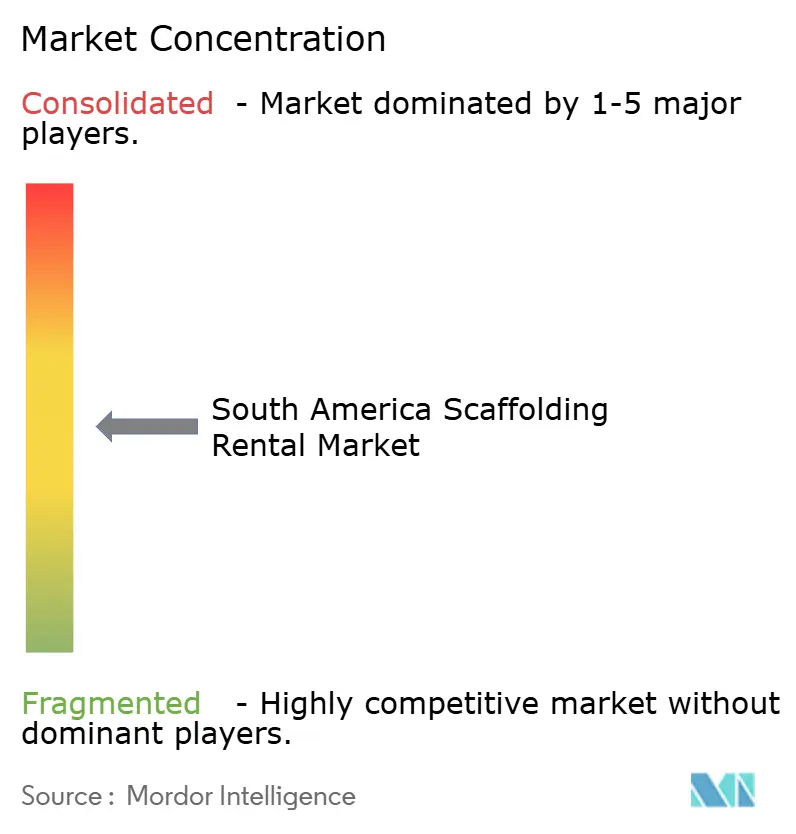
| Market Concentration | Medium |
Major Players *Disclaimer: Major Players sorted in no particular order Image © Mordor Intelligence. Reuse requires attribution under CC BY 4.0. | |
South America Scaffolding Rental Market Analysis by Mordor Intelligence
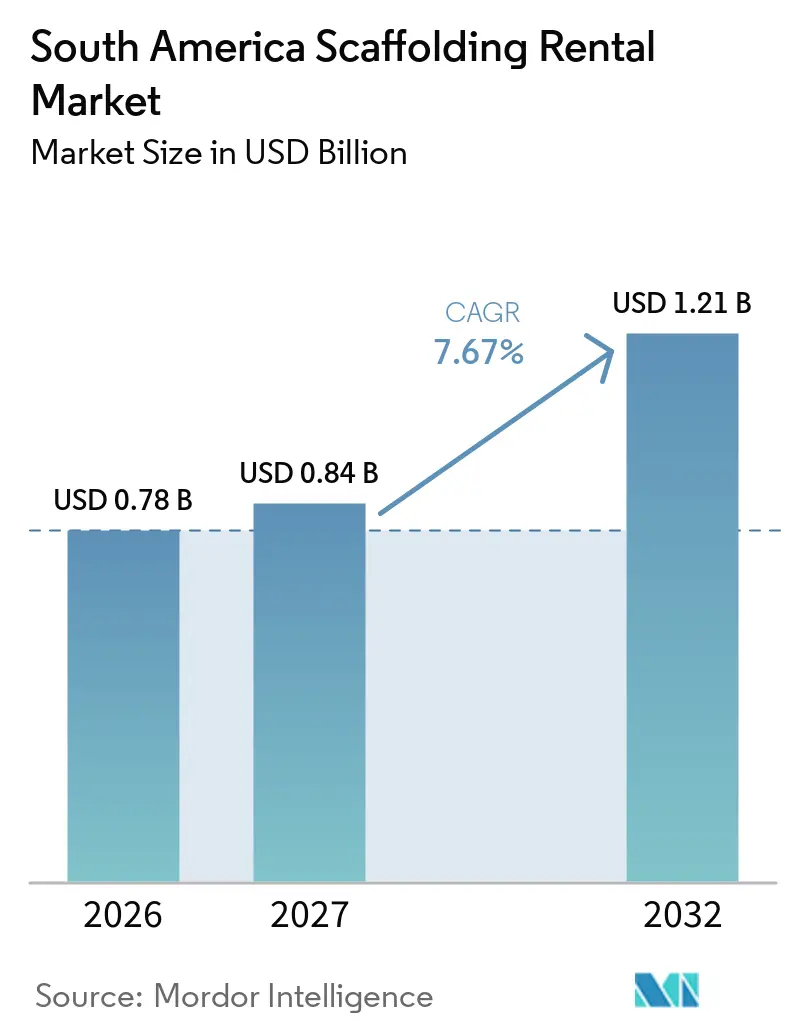
The South America Scaffolding Rental Market size is expected to grow from USD 0.78 billion in 2026 to USD 0.84 billion in 2027 and is forecast to reach USD 1.21 billion by 2032 at 7.67% CAGR over 2027-2032.
Infrastructure programs, refinery maintenance, mining construction, and recurring industrial work support demand across the region. Large project owners increasingly require engineered designs, inspection records, and documented access plans, which favor organized rental providers. This requirement makes rental income less dependent on new building projects because scaffolds are also used during installation, repair, and planned maintenance. Competition is becoming more concentrated among formal providers, although informal suppliers remain important in smaller residential and commercial projects.
Key Report Takeaways
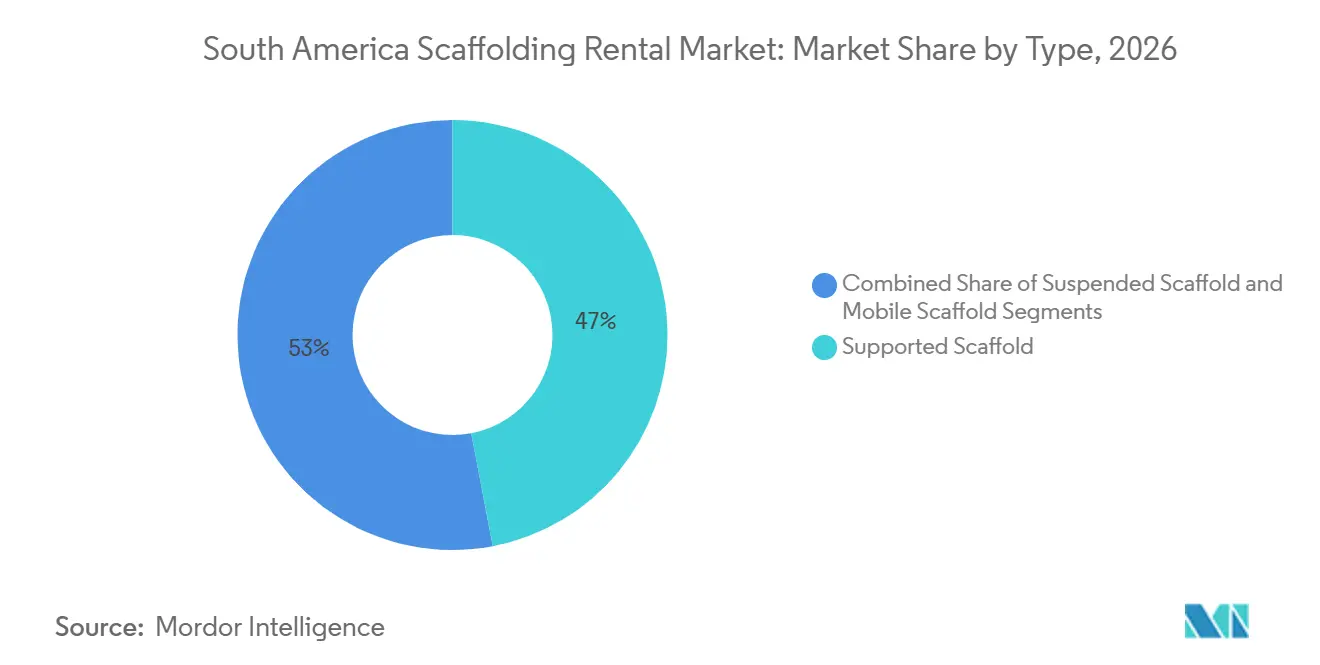
- By type, supported scaffold held 47.00% of the South America scaffolding rental market share in 2026, while suspended scaffold is forecast to grow at an 8.70% CAGR through 2032.
- By system, frame and H-frame held 33.00% of the South America scaffolding rental market share in 2026, while modular and Ringlock systems are forecast to grow at an 8.60% CAGR through 2032.
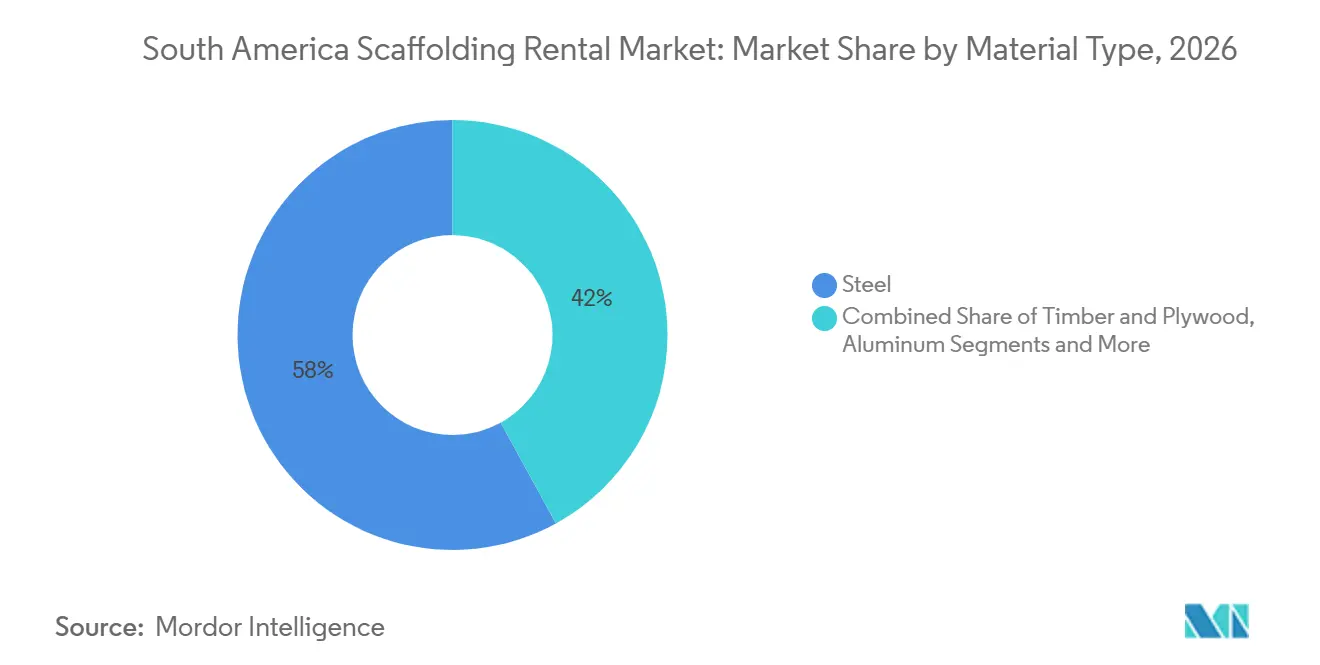
- By material type, steel held 58.00% of the South America scaffolding rental market size in 2026, while aluminum is forecast to grow at a 9.00% CAGR through 2032.
- By sector, infrastructure held 40.00% of the South America scaffolding rental market size in 2026 and is forecast to grow at a 9.10% CAGR through 2032.
- By geography, Brazil held 45.00% of the South America scaffolding rental market in 2026 and is forecast to grow at an 8.70% CAGR through 2032.
Note: Market numbers in this report are based on Mordor Intelligence's proprietary estimation framework, which combines nine months of actuals with Q4 projections for base year 2026.
Market Trends and Insights
Drivers Impact Analysis of South America Scaffolding Rental Market*
| Drivers | (~) % Impact on CAGR Forecast | Geographic Relevance | Impact Timeline |
|---|---|---|---|
| Urban Infrastructure Renewal and Vertical Construction | +2.0% | Brazil, Chile, Colombia, Peru | Medium term (2-4 years) |
| Oil and Gas Maintenance and Refinery Turnarounds | +1.5% | Brazil, Argentina, Colombia | Short term (≤ 2 years) |
| Mining and Energy Project Activity | +1.2% | Chile, Peru, Brazil | Long term (≥ 4 years) |
| Rental Preference Among Contractors and Small and Medium-Sized Enterprises | +1.0% | Brazil, Chile, Colombia | Medium term (2-4 years) |
| Consolidation of the Organized Rental Sector | +0.7% | Brazil, Chile | Long term (≥ 4 years) |
| Shift Toward Modular and Safer Access Systems | +0.6% | Brazil, Peru, Chile | Medium term (2-4 years) |
| Source: Mordor Intelligence | |||
Urban Infrastructure Renewal and Vertical Construction
Brazil’s highway concession pipeline supports a sustained flow of bridge, road, tunnel, and utility work that requires temporary access equipment across several construction stages[1]. The Santos-Guarujá tunnel project received USD 1.21 billion in investment in 2025 and will require access solutions through its construction and fit-out work[2]. In Colombia, the Fourth Generation, or 4G, road program had reached 93.3% execution by September 2026, supporting late-stage work on tunnel portals and viaducts. Scaffold use can continue through installation, finishing, and later repair work, which reduces idle time for rental fleets. Brazil’s Regulatory Standard 18, known as NR-18, requires engineered designs for multi-floor interconnected scaffold configurations, giving documented providers a stronger position on large work sites.
Oil and Gas Maintenance and Refinery Turnarounds
Planned refinery shutdowns create concentrated demand for scaffolds because access must be available before inspection, repair, and equipment replacement begin. Petrobras invested more than USD 351 million across shutdowns at its REVAP, Refap, and RPBC refineries during 2025, and its announcements identified scaffold assembly among the work categories involved. Tanks, boiler cavities, columns, and elevated process equipment often need modular systems with documented load capacity. This favors organized rental companies that can supply equipment, engineering support, and inspection records as one service. Maintenance activity in Colombia’s Llanos and Catatumbo basins, along with Argentina’s Vaca Muerta developments, broadens the demand base beyond new construction.
Mining and Energy Project Activity
Peru’s Ministry of Energy and Mines, or MINEM, listed 67 mining investment projects worth USD 64.1 billion in its 2025 portfolio[3]. MINEM also identified 12 projects expected to enter construction during 2025 and 2026, with a combined investment of USD 11.4 billion. The South America scaffolding rental market benefits when mine development needs access for crushers, processing plants, transmission systems, and maintenance platforms. At remote high-altitude sites, lower transport weight makes aluminum systems more attractive than conventional heavy materials. Southern Peru Copper received authorization to begin exploitation activities at Tía María in 2025, creating work across mine construction and related infrastructure.
Rental Preference Among Contractors and Small and Medium-Sized Enterprises
Contractors increasingly use rental packages that include equipment, design support, inspection records, and technical review. This structure can reduce the administrative burden on small and medium-sized enterprises, or SMEs, that would otherwise manage each requirement separately. NR-18 in Brazil strengthens this preference because larger projects must meet formal access and safety requirements. Long-term contracts also give rental providers better fleet planning and customers greater certainty over equipment availability. The South America scaffolding rental market is therefore moving toward more complete service packages rather than equipment-only transactions.
Restraints Impact Analysis of South America Scaffolding Rental Market*
| Restraints | (~) % Impact on CAGR Forecast | Geographic Relevance | Impact Timeline |
|---|---|---|---|
| Macroeconomic and Currency Volatility | -1.3% | Argentina, Brazil, Colombia | Short term (≤ 2 years) |
| High Equipment Financing Costs | -0.9% | Brazil, Argentina, Peru | Medium term (2-4 years) |
| Informal and Price-Sensitive Competition | -0.7% | Brazil, Colombia, Peru | Long term (≥ 4 years) |
| Skilled Labor Shortages Outside Major Hubs | -0.4% | All countries | Long term (≥ 4 years) |
| Source: Mordor Intelligence | |||
Macroeconomic and Currency Volatility
Macroeconomic uncertainty can delay construction starts and reduce demand for rental equipment, especially in projects dependent on public or local financing. Argentina’s construction activity index declined 2.8% year over year in April 2026, reflecting continuing pressure on the country’s construction environment. Currency movements can also raise the local cost of imported scaffold parts and equipment. Larger operators can better manage this exposure through broader purchasing networks and longer customer contracts. This situation can reduce short-term rental volumes while accelerating consolidation among formal providers.
High Equipment Financing Costs
High interest rates can limit fleet purchases and slow expansion into secondary cities where formal rental supply remains limited. The effect is strongest for local operators that rely on domestic borrowing to buy inventory. In Brazil, larger operators can use corporate funding structures to keep investing despite a higher cost of credit. Mills announced a debt issuance of up to USD 88 million in 2025, illustrating the financing capacity available to larger businesses. The resulting gap can allow well-funded suppliers to preserve equipment availability and win larger contracts.
*Our forecasts treat driver/restraint impacts as directional, not additive. The impact forecasts reflect baseline growth, mix effects, and variable interactions.
South America Scaffolding Rental Market Segment Analysis
By Type:
Supported Systems Retain the Broadest Demand BaseSupported scaffold held 47.00% of the segment in 2026 because it can be used across residential, commercial, civil, and industrial work. Its broad compatibility with steel and aluminum equipment allows rental fleets to use the same base inventory across many customer types. The system is especially useful where ground support is available, and access heights are moderate. Formal site requirements in Brazil also make supported systems attractive when contractors need documented assembly and inspection procedures. This position gives supported scaffold a stable role across the South America scaffolding rental industry.
Suspended scaffold is forecast to expand at an 8.70% CAGR through 2032. The system is suited to bridge undersides, cooling towers, elevated vessel exteriors, and other locations where ground-supported access is not practical. Its use rises when project owners need longer work windows and a controlled platform for crews and materials. The move toward engineered access solutions also supports suspended platforms on technically complex maintenance projects. Mobile scaffold continues to serve low-rise renovation work, although it faces pressure from providers that prioritize higher-value modular inventory.
Bridge rehabilitation, facade work, utility installation, and industrial repair each create different access conditions. Supported systems fit projects where crews can establish stable ground contact. Suspended platforms provide access below bridges and along elevated surfaces that cannot be reached from the ground. The choice also depends on the expected duration of the work and the materials that crews must move. Longer maintenance windows can justify a more engineered access arrangement. Rental providers can improve service by assessing access needs before they deliver equipment. This reduces changes during assembly and helps customers plan inspection and work sequences. Mobile units continue to have a role in short-duration renovation work, but they do not replace systems needed for more complex access tasks. A mixed fleet allows providers to align equipment with project risk, site geometry, and customer budgets. Providers also need dependable assembly crews when access requirements become more complex. Early planning can prevent equipment changes after work has started. That improves safety coordination and helps rental assets return to the next project on schedule. For rental firms, repeatable planning methods can support a more consistent service experience across varied construction and maintenance jobs. It can also support faster handovers between projects when demand is high.

By System:
Frame and H-Frame Maintain Volume While Modular Systems GrowFrame and H-frame systems captured 33.00% of the segment in 2026, supported by contractor familiarity and lower rental cost on residential and medium-sized commercial sites. The systems are widely available and can be installed efficiently for regular building layouts. Their installed base also encourages rental providers to keep significant inventory in service. This position helps frame systems to maintain relevance even as customers raise their safety and documentation requirements. For many standard projects, these systems remain the practical starting point for the South America scaffolding rental market.
Modular and Ringlock systems are forecast to grow at an 8.60% CAGR through 2032. Their connection design helps crews adapt platforms to irregular refinery geometry, bridges, and mine plants. The systems can also support detailed design documentation, which is valuable for compliance-intensive projects. Tube and coupler equipment retains a role where unusual layouts require flexibility, but its labor needs are higher. Scarcity of trained workers outside major industrial centers strengthens the appeal of modular systems that can be planned and assembled more consistently.
System selection depends on the shape of the work area, the required platform loading, and the amount of time available for installation. Contractors on simple buildings may prefer frame systems because crews know the equipment well. Refinery and mining customers may choose modular equipment because it can be configured around pipes, vessels, and uneven structures. Rental firms can keep both customer groups by maintaining a mixed fleet and offering engineering guidance before delivery. This approach also helps providers explain why a higher-specification system may reduce work delays on complex sites. Frame and H-frame equipment remains useful when a customer needs standard access at a predictable cost. Modular equipment becomes more useful when structures have uneven surfaces, tight spaces, or several levels of access. Ringlock connections can support consistent assembly across repeated work areas. Tube and coupler systems can still meet specialized requirements in irregular industrial layouts. Their greater labor needs can be a drawback when projects face skilled-worker constraints. Providers must also consider how much equipment will be reused after a project ends. Systems with interchangeable components can simplify fleet movement between contracts. Engineering support is valuable when contractors need clear loading information before work begins. These factors make system choice a service decision as well as an equipment decision. The right system can shorten installation time when the equipment and crew are matched to the job. It can also make load planning clearer for the contractor. This reinforces the value of technical support alongside basic equipment availability. Customers can benefit when equipment selection reflects the actual constraints of the work area rather than a standard fleet preference. This makes site review an important part of rental service delivery.
By Material Type:
Steel Leads Fleet Volume While Aluminum Gains in Remote ProjectsSteel held 58.00% of the segment in 2026, reflecting its cost efficiency and suitability for high-load refinery and civil applications. Large rental fleets also have substantial steel inventory, which supports continued use across Brazil and other regional markets. Steel remains appropriate for demanding access work where strength and established equipment availability matter most. Its wide installed base makes replacement and fleet management straightforward for many operators. These factors keep steel at the center of the South America scaffolding rental industry.
Aluminum is forecast to grow at a 9.00% CAGR through 2032, the highest rate among material types. Lighter components can reduce transport needs at high-altitude mine sites and remote infrastructure locations. Aluminum can also offer corrosion resistance in coastal industrial settings, where maintenance conditions are demanding. Timber and plywood use is declining where formal safety requirements favor metal systems, while plastic and fiberglass remain specialized options for electrical and corrosive settings. This material mix lets rental providers match scaffold selection to access conditions, transport limits, and the need for documented safety performance.
Material decisions are increasingly linked to the full cost of a project rather than only the daily rental rate. Steel remains suitable where high loading and established fleet availability are decisive. Aluminum can be more valuable where a project has long transport routes or repeated handling requirements. Providers also need to consider repair, storage, and replacement needs when updating their fleets. A balanced material offering gives customers more choice without requiring a provider to replace its steel inventory quickly. High-load refinery and civil work can continue to favor steel because it is widely available in existing rental fleets. Aluminum can be more appropriate where crews must transport equipment over long routes to remote mine or energy sites. Lower component weight can also simplify handling during installation and dismantling. Coastal industrial areas may place greater value on materials that perform well in corrosive conditions. Providers need to match material selection with the expected load, transport plan, and maintenance needs. Timber and plywood systems have a more limited role where formal safety practices favor metal alternatives. Plastic and fiberglass systems remain relevant in selected electrical and chemical environments. This varied material demand allows specialist suppliers to serve narrow technical needs. It also allows larger rental companies to use steel fleets while adding aluminum inventory for specific projects. Material availability can influence delivery time when several projects start at once. Rental firms that understand the customer’s transport plan can make better allocation decisions. This practical capability can be important on remote industrial and mining contracts. It also supports a clearer comparison between lower transport weight, expected loading conditions, and the frequency of equipment reuse. These factors can affect total project coordination beyond the daily rental charge.
By Sector:
Infrastructure Combines Scale with the Highest Growth RateInfrastructure held 40.00% of the segment in 2026, giving it the largest position among sectors. Road, rail, bridge, metro, sanitation, and tunnel work need access equipment during construction, finishing, inspection, and later maintenance. Brazil’s infrastructure program provides a multi-year pipeline for these activities across several asset categories. Colombia’s 4G road program also supports demand for scaffolds at complex civil structures as projects approach completion. This breadth makes infrastructure a key source of work for the South America scaffolding rental market.
Infrastructure is forecast to grow at a 9.10% CAGR through 2032, the highest rate among sectors. Industrial and logistics projects provide an additional source of demand through planned shutdowns, plant expansions, and warehouse work. Refinery maintenance is particularly important because schedules are set around operating needs rather than the broader building cycle. Residential construction provides baseline volume in secondary cities, while commercial activity benefits from office changes and data center development. Providers that can place equipment quickly near projects and support compliance requirements are better positioned to benefit from this sector mix.
The sector mix also reduces the risk that a slowdown in one customer group will determine overall equipment use. Civil contractors need access during several stages of a project, while maintenance teams need it when operating assets are taken offline. This creates different booking patterns and calls for flexible fleet planning. Suppliers can improve utilization by moving standard equipment between civil, industrial, and commercial jobs. The strongest operators will balance national account work with local projects that fill short gaps in demand. Infrastructure contracts often require access equipment through civil construction, finishing, and later inspection work. Industrial customers may require large volumes over a short planned shutdown period. Residential projects usually need smaller equipment packages but can support regular activity in secondary cities. Commercial renovation and logistics facilities provide another source of work when project schedules overlap. A provider that serves several sectors can move equipment from one job type to another. This helps reduce idle inventory and supports more stable fleet use. Long-term contracts can make equipment planning easier for both the customer and the rental company. Shorter contracts remain important where contractors need fast support for urgent repairs. The sector mix therefore favors suppliers that can manage both large planned projects and smaller recurring orders. This requires careful branch planning, transport coordination, and fleet visibility. Companies that maintain equipment close to active project areas can respond faster to schedule changes. Local service capacity can be as important as the size of the overall fleet. This is particularly relevant when project schedules change, and contractors need equipment or technical support with limited notice. Local preparation helps operators manage this requirement without disrupting other contracts.
Geography Analysis
Brazil
Brazil held 45.00% of the South America scaffolding rental market in 2026 and is forecast to grow at an 8.70% CAGR through 2032. The Novo PAC program committed USD 226 billion to infrastructure investment through 2026, covering work that includes bridges, metro systems, highways, and sanitation assets. Petrobras also invested more than USD 351 million across 3 refinery shutdowns in 2025, which shows the importance of industrial maintenance alongside civil construction. NR-18 and ABNT NBR 6494, a Brazilian scaffold standard, reinforce demand for documented equipment and formal oversight. This regulatory influence favors rental companies that can supply engineering support and inspection records while expanding logistics capacity beyond São Paulo and Rio de Janeiro.
Chile
Chile’s demand is led by industrial maintenance and mining activity, with copper smelting, sulfuric acid plants, and power infrastructure in Antofagasta and Atacama creating recurring planned-maintenance work. Scafom-Rux completed a 72-meter chimney tower access project at the Altonorte copper facility in 2026, using modular components, loading platforms, and an aluminum stair tower. This example shows why industrial clients need systems that can manage complex geometry and defined loading requirements. Digital planning and modular equipment can reduce material movements at remote mine sites, while residential activity in Santiago and Valparaíso, renewable projects, and data center construction add a wider but smaller layer of demand.
Rest of South America
Peru’s mining pipeline is a major source of scaffold demand, with MINEM listing USD 64.1 billion across 67 projects in 2025. Tía María received approval for exploitation activities in 2025, supporting demand for mine construction access and processing infrastructure. Colombia benefits from the final phases of the 4G program and from maintenance work in oil and gas areas. Argentina has a weaker broad construction setting, but Vaca Muerta and lithium projects create more resilient demand for industrial access equipment. Ecuador, Bolivia, and Paraguay contribute smaller volumes through urban residential and sanitation work, helping the regional mix reduce reliance on any one national construction cycle. This diversity also supports fleet planning across different customer schedules and operating conditions.
Competitive Landscape
The South America scaffolding rental market has a formal segment that serves compliance-intensive projects and an informal segment that supplies lower-cost residential and small commercial work. Formal providers compete through fleet availability, safety documentation, engineering support, and branch coverage. Informal suppliers compete mainly on price and remain relevant where project requirements are less demanding. This split gives organized companies a stronger position in refineries, mines, major infrastructure, and large building projects, while leaving local specialists room to compete on fast response and nearby inventory.
Loxam agreed in May 2026 to acquire a 50.3% controlling stake in Mills, a move that combines Loxam’s purchasing reach with Mills’ Brazilian network. The transaction indicates that large rental groups are increasing their commitment to the region. These moves can increase the ability of larger firms to serve customers that need several equipment categories and consistent service across locations. Regional companies can respond by focusing on technical support, shorter delivery times, and relationships with local contractors.
Technology and safety standards are becoming more important in competitive decisions. Providers can use modular equipment and digital design tools to plan access around complex industrial structures. Scafom-Rux’s 2026 project at Altonorte shows how specialized scaffold engineering can support work at industrial facilities. Petrobras maintenance programs also create opportunities for suppliers that can mobilize safely within strict shutdown schedules.
South America Scaffolding Rental Industry Leaders
-
Mills Locação, Serviços e Logística S.A. (Loxam Group)
-
Layher Holding GmbH & Co. KG
-
PERI SE
-
ULMA Construction
-
Altrad Group
- *Disclaimer: Major Players sorted in no particular order
South America Scaffolding Rental Market Companies Covered in this Report
- Mills Locação, Serviços e Logística S.A. (Loxam Group)
- Layher Holding GmbH & Co. KG
- PERI SE
- ULMA Construction
- Altrad Group
- BrandSafway
- Doka GmbH
- Scafom-rux
- Mecan Indústria de Equipamentos para Construção
- SH Brasil
- Sul Andaimes
- Andaimes Pirâmide
- Rohr S.A.
- Tecnoandaimes
- Unispan Chile
- Andamios Atlas (Mexico/LatAm)
- Fortequip Equipamentos Industriais
- Triunfo Andaimes
- Bilfinger SE
- Mills Scaffold (Benchmark Scaffolding)
Recent Industry Developments in South America Scaffolding Rental Market
- August 2026: Scafom-rux completes a RINGSCAFF chimney tower project at Altonorte in Chile. The 10-month project used 7,291 modular components, an aluminum stair tower, and 500-kilogram loading platforms.
- May 2026: Loxam SAS announces the acquisition of a 50.3% controlling stake in Mills Locação. Loxam and Mills’ controlling shareholders entered into a share purchase agreement for a controlling interest in the Brazilian equipment rental company.
- October 2025: Peru’s MINEM authorizes construction activity for the USD 1.8 billion Tía María copper mine. The project supports access needs for crusher installation, solvent extraction, and transmission-line construction.
South America Scaffolding Rental Market Report Scope
Segmentation Overview
| Supported Scaffold |
| Suspended Scaffold |
| Mobile Scaffold |
| Tube and Coupler |
| Cuplock |
| Modular and Ringlock |
| Frame and H-Frame |
| Timber and Plywood |
| Steel |
| Aluminum |
| Plastic and Fiberglass |
| Others |
| Residential |
| Commercial |
| Industrial and Logistics |
| Infrastructure |
| Brazil |
| Argentina |
| Chile |
| Peru |
| Colombia |
| Rest of South America |
| By Type | Supported Scaffold |
| Suspended Scaffold | |
| Mobile Scaffold | |
| By System | Tube and Coupler |
| Cuplock | |
| Modular and Ringlock | |
| Frame and H-Frame | |
| By Material Type | Timber and Plywood |
| Steel | |
| Aluminum | |
| Plastic and Fiberglass | |
| Others | |
| By Sector | Residential |
| Commercial | |
| Industrial and Logistics | |
| Infrastructure | |
| By Country | Brazil |
| Argentina | |
| Chile | |
| Peru | |
| Colombia | |
| Rest of South America |
Key Questions Answered in the Report
What is the expected growth rate for South America scaffolding rental?
The sector is forecast to grow at a 7.67% CAGR from 2027 to 2032, reaching USD 1.21 billion by 2032. Growth is supported by infrastructure work, refinery maintenance, mining construction, and recurring industrial access needs.
Which scaffold type has the largest share in South America?
Supported scaffold leads with 47.00% of the segment in 2026 because it serves residential, commercial, civil, and industrial work. It is widely used where ground support is possible, and contractors need standard access equipment.
Which material is growing fastest for scaffold rentals in South America?
Aluminum is forecast to grow at a 9.00% CAGR through 2032. Its lighter weight can reduce transport needs at remote high-altitude mining sites, while its corrosion resistance is useful in coastal industrial settings.
Why is infrastructure important for scaffold rental providers?
Infrastructure held 40.00% of the segment in 2026 and is forecast to grow at a 9.10% CAGR through 2032. Civil assets need temporary access through construction, finishing, inspection, and later maintenance, which supports repeat rental use.
Which country offers the largest scaffold rental opportunity in South America?
Brazil held 45.00% of regional revenue in 2026 and is forecast to grow at an 8.70% CAGR through 2032. Its infrastructure, refinery maintenance, mining, and residential work support a broader customer base than other countries in the region.
What factors are changing competition among scaffold rental companies?
Engineering documentation, safety compliance, modular systems, and Loxam’s agreement to acquire a controlling stake in Mills are increasing the importance of scale and technical service. Local providers can still compete through quick delivery, regional branch coverage, and customer relationships.