
South America Roads and Highways Infrastructure Construction Market Size and Share
Market Overview
| Study Period | 2020 - 2031 |
|---|---|
| Forecast Data Period | 2026 - 2031 |
| Base Year Market Size (2025) | USD 78.84 Billion |
| Market Size (2026) | USD 85.33 Billion |
| Market Size (2031) | USD 121.21 Billion |
| Growth Rate (2026 - 2031) | 7.27 % |
| Market Concentration | Low |
Major Players *Disclaimer: Major Players sorted in no particular order Image © Mordor Intelligence. Reuse requires attribution under CC BY 4.0. | |
South America Roads and Highways Infrastructure Construction Market Analysis by Mordor Intelligence
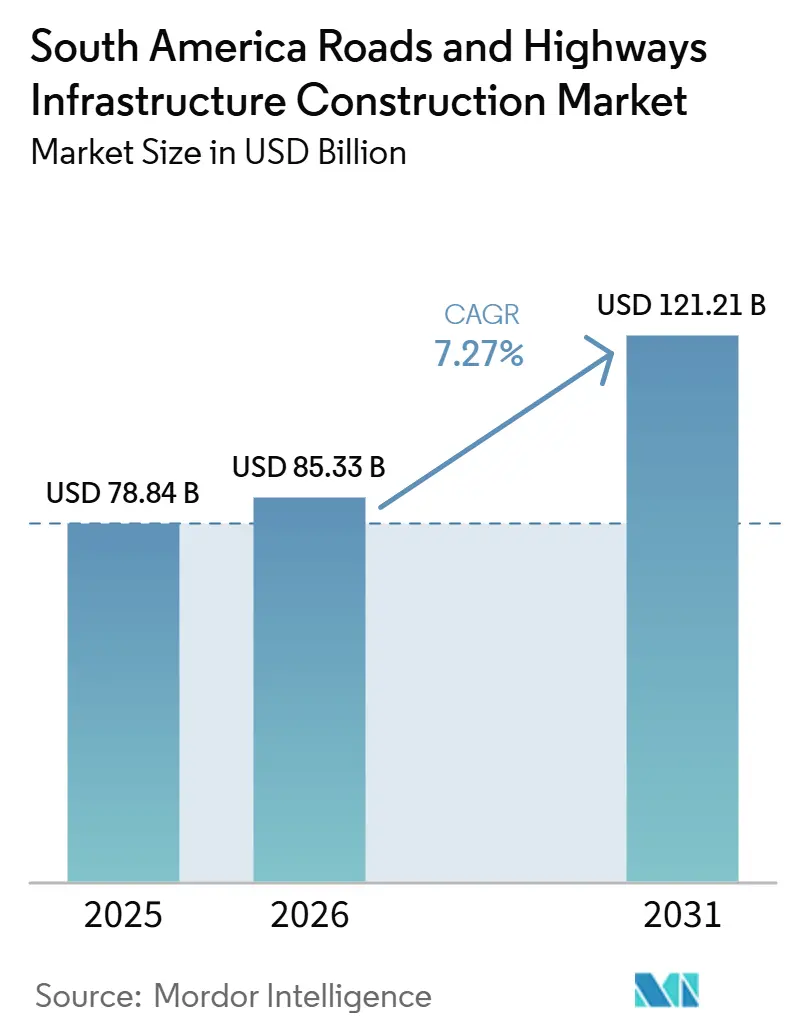
The South America Roads And Highways Infrastructure Construction Market size is expected to increase from USD 78.84 billion in 2025 to USD 85.33 billion in 2026 and reach USD 121.21 billion by 2031, growing at a CAGR of 7.27% over 2026-2031.
The South America roads and highways infrastructure construction market is expanding because freight movement across the region still depends heavily on roads, which keeps highway capacity and service quality tied to trade flows, domestic distribution, and commodity exports. A financing shift is also lifting the South America roads and highways infrastructure construction market, as governments increasingly rely on concession auctions and private capital to move forward with projects that had been delayed under direct public funding models. A large part of the existing network still operates below expected service standards, so replacement, widening, and rehabilitation needs are adding to new construction demand instead of competing with it. The South America roads and highways infrastructure construction market is also benefiting from corridor planning that links national projects to cross-border trade routes, which increases the value of connected highways, bypasses, and access roads. Digital design, project monitoring, and climate-resilient engineering standards are further raising project readiness and contract value, especially where new concession terms now include stronger technical and reporting requirements.
Key Report Takeaways
- By component, road construction accounted for 72.80% of the South America roads and highways infrastructure construction market share in 2025, while bridges/overpass are forecast to expand at an 8.20% CAGR through 2031.
- By construction type, new construction accounted for 69.70% of the South America roads and highways infrastructure construction market in 2025, while renovation is projected to grow at a 7.80% CAGR through 2031.
- By investment source, public investment accounted for 68.60% of the South America roads and highways infrastructure construction market in 2025, while public-private partnerships recorded the highest projected CAGR of 8.60% through 2031.
- By type, national highways accounted for 58.90% of the South America roads and highways infrastructure construction market share in 2025, while state roads are forecast to expand at a 7.60% CAGR through 2031.
- By country, Brazil accounted for 46.50% of the South America roads and highways infrastructure construction market size in 2025, while Colombia recorded the highest projected CAGR at 8.90% through 2031.
Note: Market size and forecast figures in this report are generated using Mordor Intelligence’s proprietary estimation framework, updated with the latest available data and insights as of January 2026.
South America Roads and Highways Infrastructure Construction Market Trends and Insights
Drivers Impact Analysis*
| Drivers | (~) % Impact on CAGR Forecast | Geographic Relevance | Impact Timeline |
|---|---|---|---|
| Highway Concession Auctions Accelerate Road Infrastructure Investment | +1.8% | Brazil, Argentina, Chile, Colombia | Short term (≤ 2 years) |
| Freight Corridor Expansion Strengthens Regional Logistics Networks | +1.5% | Brazil, Paraguay, Argentina, Chile | Medium term (2-4 years) |
| Multilateral Funding Improves Development of Strategic Transport Corridors | +1.2% | Paraguay, Bolivia, Ecuador, and the regional corridors | Medium term (2-4 years) |
| Climate-Resilient Road Standards Support Infrastructure Modernization | +0.9% | Brazil, Colombia, Peru, Chile | Medium term (2-4 years) |
| Deferred Road Rehabilitation Needs Increase Infrastructure Construction Activity | +0.7% | Argentina, Brazil, Colombia, Rest of South America | Short term (≤ 2 years) |
| Digital Permitting and Right-of-Way Tracking Enhance Project Delivery Efficiency | +0.4% | Brazil, Peru, Colombia | Long term (≥ 4 years) |
| Source: Mordor Intelligence | |||
Highway Concession Auctions Accelerate Road Infrastructure Investment
The South America roads and highways infrastructure construction market is receiving its strongest near-term support from concession auctions that convert policy decisions into funded construction commitments. Brazil's transport pipeline includes 14 federal highway concession contracts in 2026, covering 7,295 km and carrying projected investments above USD 57.4 billion across the wider four-year program[1]Brazil Ministry of Transport, “Highways 2026 - Concession Pipeline,” Portal Gov.br, gov.br. Argentina is also moving more than 9,000 km of national routes into its Red Federal de Concesiones program across 14 provinces with full private financing, and Stages I and II-A were already contracted by July 2026[2]Argentina Vialidad Nacional, “Red Federal de Concesiones,” Argentina.gob.ar, argentina.gob.ar. These awards matter because they do not stop at operations and maintenance; the contracts require widening, duplication, and other capital works that keep construction activity going long after the auctions close. The South America roads and highways infrastructure construction market, therefore, gains both immediate project starts and a longer stream of mandated follow-on works from the same concession cycle.
Freight Corridor Expansion Strengthens Regional Logistics Networks
The South America roads and highways infrastructure construction market is also being shaped by trade corridors intended to shorten routes to Pacific and Atlantic gateways. The Capricorn Bioceanic Corridor stretches 3,800 km across Brazil, Paraguay, Argentina, and Chile, and is supported by major regional and multilateral financing institutions through the South Connection framework[3]OECD Emerging Markets Forum, “The Capricorn Bioceanic Corridor in South America,” OECD, oecd.org. The Inter-American Development Bank also approved a USD 200 million loan for Paraguay's Route PY15 segment, which is expected to help facilitate USD 220 million in annual exports once completed. Mainline corridor work creates additional demand for port connectors, border approaches, logistics access roads, and provincial links that are often outside the headline project value. This keeps the South America roads and highways infrastructure construction market tied not only to national budgets, but also to regional logistics planning that extends construction demand across multiple asset classes.
Multilateral Funding Improves Development of Strategic Transport Corridors
The South America roads and highways infrastructure construction market is deepening as multilateral lenders now influence project selection, corridor design, and execution standards. South Connection was launched on March 28, 2025, with 11 South American governments and a structure centered on physical and digital connectivity, regional value chains, and regulatory modernization[4]Inter-American Development Bank, “IDB Launches South Connection Regional Program,” Inter-American Development Bank, iadb.org. The same framework includes cooperation to support risk-sharing and co-financing across border projects, helping move projects that would otherwise face funding gaps or sovereign risk limits. World Bank transport corridor lending across the region also supports all-weather connectivity and rehabilitation along strategic routes, which strengthens the quality and continuity of the future project pipeline. The South America roads and highways infrastructure construction market benefits from this funding, as it increasingly comes with stronger procurement rules, technical requirements, and performance conditions that raise the quality and value of contracted works.
Climate-Resilient Road Standards Support Infrastructure Modernization
Climate adaptation requirements are becoming a practical driver of contract value across the South America roads and highways infrastructure construction market. Brazil's Sectoral Plan for Transport, under the national climate adaptation plan for 2024-2035, integrates climate risk into transport planning, operations, maintenance, and investment decisions. Brazil's National Land Transport Agency, the Agência Nacional de Transportes Terrestres, also linked infrastructure debentures and concession revenue use to environmental, social, and governance compliance, allowing new revenues to support resilience investments. These standards raise the required spending on drainage, slopes, pavement durability, and protective structures, thereby increasing the value of each kilometer awarded rather than simply expanding the length. In the Andes, tunnel design studies also show that more than 35% of routes through difficult terrain can require major structures such as tunnels, viaducts, and retaining walls, reinforcing the link between resilience standards and higher engineering intensity.
Restraints Impact Analysis*
| Restraints | (~) % Impact on CAGR Forecast | Geographic Relevance | Impact Timeline |
|---|---|---|---|
| Fiscal Volatility and Budget Revisions Delay Infrastructure Investments | -1.4% | Argentina, Colombia, Rest of South America | Short term (≤ 2 years) |
| Toll Acceptance Challenges Limit Revenue Generation for Road Projects | -0.6% | Brazil, Colombia | Medium term (2-4 years) |
| Geotechnical Complexity Increases Construction Costs and Project Risks | -0.5% | Chile, Peru, Colombia, Bolivia | Long term (≥ 4 years) |
| Fragmented Permitting Across Subnational Authorities Delays Project Execution | -0.4% | Brazil, Argentina, Colombia | Medium term (2-4 years) |
| Source: Mordor Intelligence | |||
Fiscal Volatility and Budget Revisions Delay Infrastructure Investments
Fiscal instability remains the most visible constraint on the South America roads and highways infrastructure construction market, especially where public works still depend on direct state execution. Argentina's private concession model cannot cover the entire national network, particularly the large share of roads that are not commercially viable under tolling. This leaves a gap for maintenance and rehabilitation on routes that still need public support, even while the concession program moves ahead on stronger corridors. Colombia also experienced slower-than-target execution in its fifth-generation concession portfolio because financing strength alone did not eliminate licensing and implementation delays. The South America roads and highways infrastructure construction market, therefore, remains exposed whenever fiscal pressure, administrative disruption, or payment delays interrupt works that private operators cannot absorb.
Toll Acceptance Challenges Limit Revenue Generation for Road Projects
The South America roads and highways infrastructure construction market also faces risk from public resistance to free-flow tolling in active concession systems. Brazil's shift to electronic tolling resulted in more than 1.1 million non-payment violations on a single corridor, prompting the issue into legislative debate. That matters because modern concessions rely on predictable toll collection to support financing assumptions, debt coverage, and the pace of required capital works. If operators face weaker collection or political pressure to delay enforcement, lenders and bidders may become more cautious in new auctions. In the South America roads and highways infrastructure construction market, this can directly delay the timing of higher-value expansion works such as extra lanes, bridges, and tunnel packages that fall within concession obligations.
*Our forecasts treat driver/restraint impacts as directional, not additive. The impact forecasts reflect baseline growth, mix effects, and variable interactions.
Segment Analysis
By Component: Road Infrastructure Maintains Leadership While Bridges/Overpass Gains Momentum
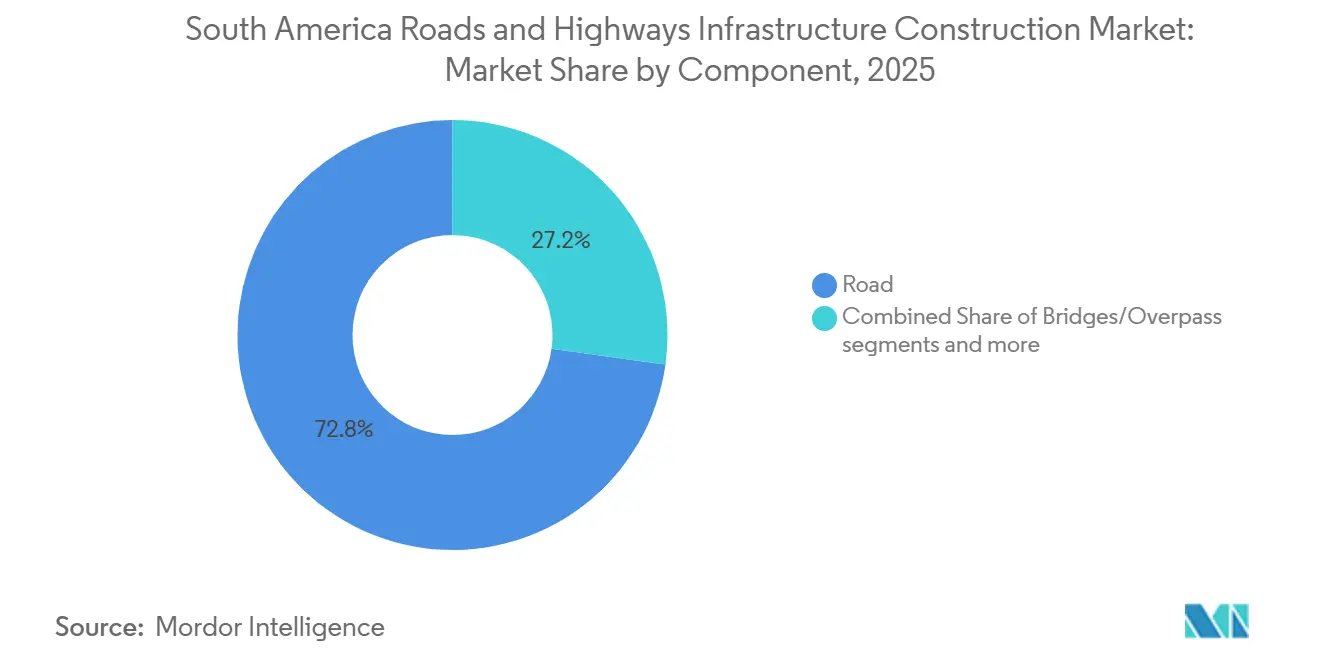
Road construction accounted for 72.80% of the South America roads and highways infrastructure construction market in 2025, confirming that surface transport remains the core of regional mobility and freight movement. This lead position reflects how most current concession pipelines are centered on widening, duplication, pavement improvement, and capacity upgrades along existing highway corridors. The South America roads and highways infrastructure construction market still relies on roads as the primary asset because highways carry the highest traffic volumes and connect directly to ports, cities, and agricultural zones. That keeps road packages larger in number and more broadly distributed than more specialized structures. At the same time, the strongest growth is shifting toward bridges and overpasses, which are forecast to rise at 8.20% CAGR through 2031.
That faster pace reflects a higher share of grade separations, river crossings, and access structures written into new corridor programs. The South America roads and highways infrastructure construction market is therefore not moving away from roads, but toward more engineering-intensive road systems that require structural additions at multiple points. This is especially visible in trade corridors where basic carriageway works alone cannot meet logistics goals. Support from the Bi-Oceanic Corridor in Paraguay shows how corridor investment can raise demand for structural works beyond standard road surfaces. Major corridor sections require bridge packages and other heavy civil elements to keep freight routes continuous across difficult terrain and water crossings. Tunnel activity remains smaller in share, but it has strategic weight in Colombia, Chile, and Peru, where alignment constraints make underground works necessary on selected sections. The supporting category, which includes drainage, retaining walls, and service facilities, also grows with overall contract volume because resilience standards increasingly require more than basic road surfacing.



By Construction Type: New Construction Leads While Renovation Builds Momentum
New construction accounted for 69.70% of the South America roads and highways infrastructure construction market in 2025, reflecting the continued importance of greenfield alignments, route extensions, and large-scale corridor duplication. Many of the highest-value projects in Brazil, Chile, and Colombia still focus on new capacity or major reconfiguration rather than limited repair. The South America roads and highways infrastructure construction market is benefiting from this, as new routes and expanded corridors remain central to concession economics and regional export planning. These projects also attract greater private participation because traffic growth and toll potential are easier to structure around expanded assets. Renovation is the fastest-growing construction type and is forecast to grow at a 7.80% CAGR through 2031.
That higher growth shows that maintenance neglect has moved beyond routine repair in several markets. Rehabilitation now includes resurfacing, base reconstruction, drainage correction, and structural renewal that can be large enough to resemble new-build packages. This makes renovation a more meaningful source of contract value than a simple maintenance line item. Delayed intervention can raise rehabilitation costs to 3 to 4 times the cost of preventive work. Brazil's SIGICOR monitoring system also strengthens renovation execution by requiring visible, trackable reporting on work progress under concession agreements. That is important in brownfield work, where scope disputes have historically slowed delivery and raised costs. The South American roads and highways infrastructure construction industry is therefore moving into a phase in which renovation plays a stronger contractual and financial role than before.
By Investment Source: Public Funding Holds Share While Public-Private Partnerships Set the Pace
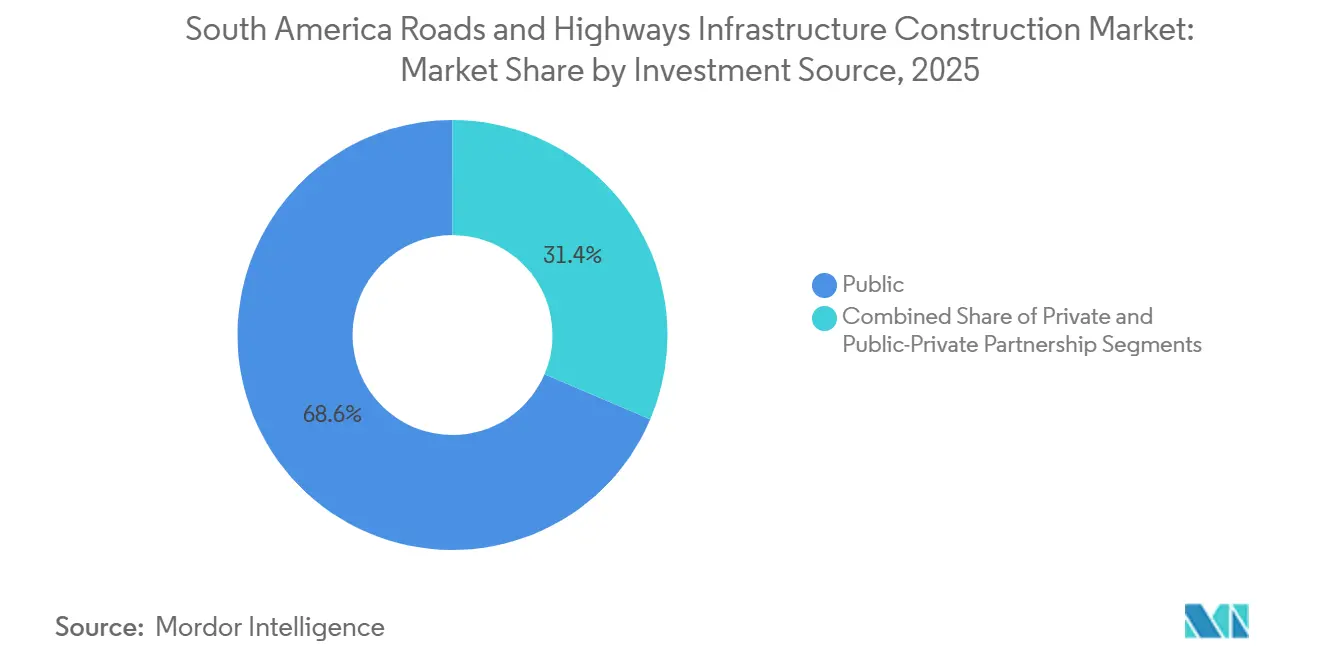
Public investment accounted for 68.60% of the South America roads and highways infrastructure construction market in 2025, indicating that the region still depends on state-led or publicly backed funding across broad parts of the network. Rural roads, secondary roads, and low-traffic assets often do not generate enough revenue to support a concession structure, so public capital remains necessary. The South America roads and highways infrastructure construction market still relies on ministries, development banks, and multilateral lenders to keep these areas active. This makes public funding the largest base of demand, even while private participation is rising in the most bankable corridors. Public-private partnerships are the fastest-growing investment source and are projected to expand at 8.60% CAGR through 2031.
That growth is supported by Brazil's federal auction pipeline, Chile's structured concessions program, and Colombia's fifth-generation model, all of which use private balance sheets to deliver long-duration transport assets. The market effect is strong because private capital not only provides funding, but also often locks in construction schedules and technical obligations more tightly than traditional public works. Brazil's transport ministry identified USD 57.4 billion in projected investment across the current concession push, which shows how central private participation has become to national highway delivery. Chile's 2025-2026 portfolio includes 15 projects worth USD 8.6 billion, which reinforces the depth of its concession pipeline. The Brazilian Development Bank also plans to approve USD 14.5 billion in equivalent highway project finance between 2026 and 2029, extending the private funding pipeline beyond the immediate auction calendar. Private-only funding remains limited and more selective, with activity concentrated in access roads linked to mining and agribusiness operations.
By Type: National Highways Dominate While State Networks Expand
National highways accounted for 58.90% of the South America roads and highways infrastructure construction market in 2025, reflecting the concentration of major concession value in federal freight corridors and cross-country routes. These roads attract the largest contracts because traffic volumes, toll potential, and national policy focus are strongest on trunk networks. The South America roads and highways infrastructure construction market has therefore centered much of its recent capital deployment on national assets in Brazil, Argentina, Colombia, and Chile. This also aligns with export logistics, since the main links between production zones, ports, and border crossings usually sit within national highway systems. State roads are the fastest-growing type and are forecast to rise at 7.60% CAGR through 2031.
That pace shows that subnational networks are becoming more important as governments push connectivity deeper into agricultural and industrial regions. State-level concessions in Brazil are adding a second layer of investment alongside the federal program, especially in São Paulo, Minas Gerais, and Paraná. These roads may be smaller than federal corridors, but they are critical feeders into larger freight systems. The South America roads and highways infrastructure construction market is benefiting from state projects that often target links between farm output areas and national trunk routes. That creates direct construction demand in widening, safety upgrades, pavement strengthening, and junction improvement. Local roads remain the smallest segment in individual contract value, but they still add significant aggregate volume where multilateral lenders support rural access and corridor feeder infrastructure. This matters because local and state links are often required to unlock the full value of headline national projects.
Geography Analysis
Brazil held 46.50% of the South America roads and highways infrastructure construction market share in 2025, and that lead reflects both network scale and the maturity of its concession framework. The country is also home to the region's busiest auction cycle, with 14 federal concession contracts in 2026 covering 7,295 km of highways under the transport ministry's pipeline. The South America roads and highways infrastructure construction market is particularly dependent on Brazil, as the country combines federal projects, state concession programs, and a deeper financing base than its regional peers. The Brazilian Development Bank's project-finance role continues to support this advantage, while climate adaptation planning is raising design expectations for drainage, slope stability, and pavement durability across future works.
Colombia is the fastest-growing geography in the South America roads and highways infrastructure construction market, with a forecast growth rate of 8.90% through 2031. Its fifth-generation concession cycle is now the main reason, as the portfolio brings a new set of road and multimodal projects after the fourth-generation program moved toward completion. The March 2026 El Estanquillo-Popayán award was the largest single road public-private partnership in the country's history, at USD 2.3 billion equivalent, and included 62.3 km of dual carriageway, 14 tunnels, and 125 bridges. Chile offers a different profile, as its value comes less from sheer size and more from a steady, disciplined concession pipeline totaling USD 8.6 billion across 15 projects in 2025-2026. Chile also awarded the Route 5 Río Bueno-Puerto Montt concession for USD 821 million in June 2026 and launched the Austral Route Plan, with USD 840 million equivalent for Route 7 over 2026-2030, keeping the South America roads and highways infrastructure construction market active well beyond the largest economies.
Argentina remains a high-need geography in the South America roads and highways infrastructure construction market, but its outlook is split between strong concession ambition and weaker public maintenance capacity. The Red Federal de Concesiones covers more than 9,000 km, and Stages I and II-A were contracted by July 2026, which confirms that the private model is now moving into execution. Still, large parts of the national network are not commercially viable under tolling, so the country remains exposed where public funding and administrative capacity are needed most. In the rest of the region, Paraguay stands out because of its role in the Bioceanic Corridor, which is attracting targeted transport investment. At the same time, Peru, Bolivia, Ecuador, and others continue to rely on multilateral support for corridor upgrades and rural access. This leaves the South America roads and highways infrastructure construction market with a geography pattern where Brazil anchors volume, Colombia leads growth, Chile sustains quality deal flow, and the rest of the region adds selective but strategically important corridor demand.
Competitive Landscape
The South America roads and highways infrastructure construction market remains fragmented, with competition distributed across international concession operators, global engineering, procurement, and construction (EPC) firms, Chinese state-owned enterprises, and domestic contractors. European groups such as Ferrovial SE, Sacyr, Acciona, OHLA, Webuild, and Mota-Engil participate in concession-led projects across Brazil, Colombia, and Chile, supported by financing capabilities, technical expertise, and long-term infrastructure experience. Chinese contractors, including China Harbor Engineering Company Limited, China Railway Construction Corporation, and China Communications Construction Company, compete in public tenders and technically complex infrastructure assignments, particularly where large-scale execution capabilities are required. Domestic Latin American contractors remain important participants due to local market knowledge, regulatory familiarity, and established relationships with public authorities. This combination creates a fragmented market structure in which competitive strength varies significantly by country, project type, and procurement model, rather than being controlled by a small group of regional leaders.
Strategic activity across 2025 and 2026 highlights how contractors are strengthening their positions through concession participation, technical capabilities, and long-term asset management models. VINCI Highways took over the Belo Horizonte-Cristalina highway concession in Brazil in 2025 under a 30-year contract, expanding its presence in long-duration transport infrastructure operations. In May 2026, the Mota-Engil Engenharia, OEC, and Galápagos consortium won the Rota dos Sertões concession in Brazil, demonstrating continued competition among regional and international operators for concession opportunities. In June 2026, Intervial Chile S.A. secured the Route 5 Río Bueno-Puerto Montt concession for USD 821 million, reinforcing the role of experienced operators in Chile’s highway development pipeline. These developments show that while concession projects attract established players, competition remains distributed across different countries and contract structures.
Digital delivery capabilities and operational expertise are becoming increasingly important differentiators in the South America roads and highways infrastructure construction market. Brazil’s Building Information Modeling (BIM) mandate for federal highway concessions and the SIGICOR monitoring platform are increasing expectations around design coordination, asset monitoring, and construction reporting. This trend benefits contractors with stronger digital workflows, project management capabilities, and lifecycle maintenance experience, particularly for renovation and concession-based projects. At the same time, smaller regional contractors such as Aenza, Besalco S.A., and Salfacorp S.A. continue to compete in local and specialized projects where execution experience and market relationships remain important. As a result, the South America roads and highways infrastructure construction market is expected to remain fragmented, with competitive advantage determined by local presence, technical specialization, financing capability, and the ability to deliver across diverse country-level infrastructure programs.
South America Roads and Highways Infrastructure Construction Industry Leaders
Ferrovial SE
China Harbour Engineering Company Limited (CHEC)
Acciona S.A.
VINCI Construction
Sacyr Ingeniería e Infraestructuras
- *Disclaimer: Major Players sorted in no particular order


Recent Industry Developments
- June 2026: Chile's Ministry of Public Works awarded the Route 5 Río Bueno-Puerto Montt highway concession to Intervial Chile S.A. for USD 821 million, covering a 129 km stretch of Southern Route 5 with third lanes, new interchanges, and 147 km of service roads. The project benefits more than 530,000 residents in southern Chile.
- May 2026: A consortium of Mota-Engil Engenharia, OEC through its investment vehicle, and Galápagos Capital won the USD 1.7 billion equivalent Rota dos Sertões highway concession in Brazil, a 502 km network in Bahia and Pernambuco states. The award marked OEC's return to the highway concessions market after years of judicial restriction.
- May 2026: Chile's president announced the Austral Route Plan, committing USD 840 million in public investment for Route 7 over 2026-2030, covering 244 km across 23 integrated projects in the Aysén region.


South America Roads and Highways Infrastructure Construction Market Report Scope
The South America Roads and Highways Infrastructure Construction Market Report is Segmented by Component (Road, Bridges/Overpass, Tunnels, and Others), Construction Type (New Construction and Renovation), Investment Source (Public, Private, and Public-Private Partnership), Type (National, State, and Local), and Geography (Brazil, Argentina, Colombia, and More). The Market Forecasts are Provided in Terms of Value (USD).
| Road |
| Bridges/Overpass |
| Tunnels |
| Others |
| New Construction |
| Renovation |
| Public |
| Private |
| Public-Private Partnership |
| National |
| State |
| Local |
| Brazil |
| Argentina |
| Colombia |
| Chile |
| Rest of South America |
| By Component | Road |
| Bridges/Overpass | |
| Tunnels | |
| Others | |
| By Construction Type | New Construction |
| Renovation | |
| By Investment Source | Public |
| Private | |
| Public-Private Partnership | |
| By Type | National |
| State | |
| Local | |
| By Country | Brazil |
| Argentina | |
| Colombia | |
| Chile | |
| Rest of South America |


Key Questions Answered in the Report
What is the 2026 outlook for road and highway construction in South America?
The sector is set to rise from USD 85.33 billion in 2026 to USD 121.21 billion by 2031 at a 7.27% CAGR, supported by concession auctions, corridor expansion, and rehabilitation demand.
Which segment leads by component in this sector?
Road construction led with a 72.8% share in 2025, as freight and passenger mobility still depend mainly on surface transport across the region.
Which investment model is growing the fastest?
Public-private partnerships are the fastest-growing investment source, with a 8.60% CAGR through 2031, led by active concession programs in Brazil, Chile, and Colombia.
Which country is the largest opportunity today?
Brazil is the largest country opportunity with 46.50% share in 2025, supported by the region's deepest concession pipeline and stronger project finance capacity.
Which country is expanding the fastest through 2031?
Colombia is the fastest-growing country with an 8.90% CAGR, driven by its fifth-generation concession program and large new corridor awards such as El Estanquillo-Popayán.
What are the main risks for developers and investors?
Fiscal pressure, toll-collection uncertainty, geotechnical complexity, and permitting delays can slow project execution or delay the timing of expansion works under concession contracts.
Page last updated on:





