
South America Plastic Pouch Packaging Market Size and Share
Market Overview
| Study Period | 2020 - 2031 |
|---|---|
| Forecast Data Period | 2026 - 2031 |
| Base Year Market Size (2025) | USD 1.98 Billion |
| Market Size (2026) | USD 2.08 Billion |
| Market Size (2031) | USD 2.57 Billion |
| Growth Rate (2026 - 2031) | 4.32 % |
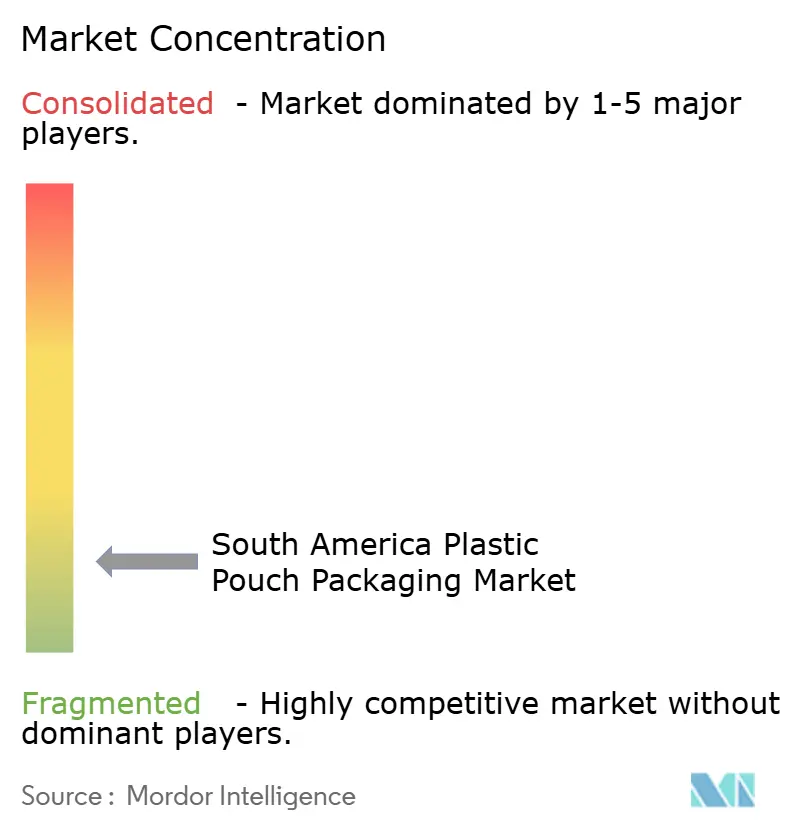
| Market Concentration | Low |
Major Players *Disclaimer: Major Players sorted in no particular order Image © Mordor Intelligence. Reuse requires attribution under CC BY 4.0. | |
South America Plastic Pouch Packaging Market Analysis by Mordor Intelligence
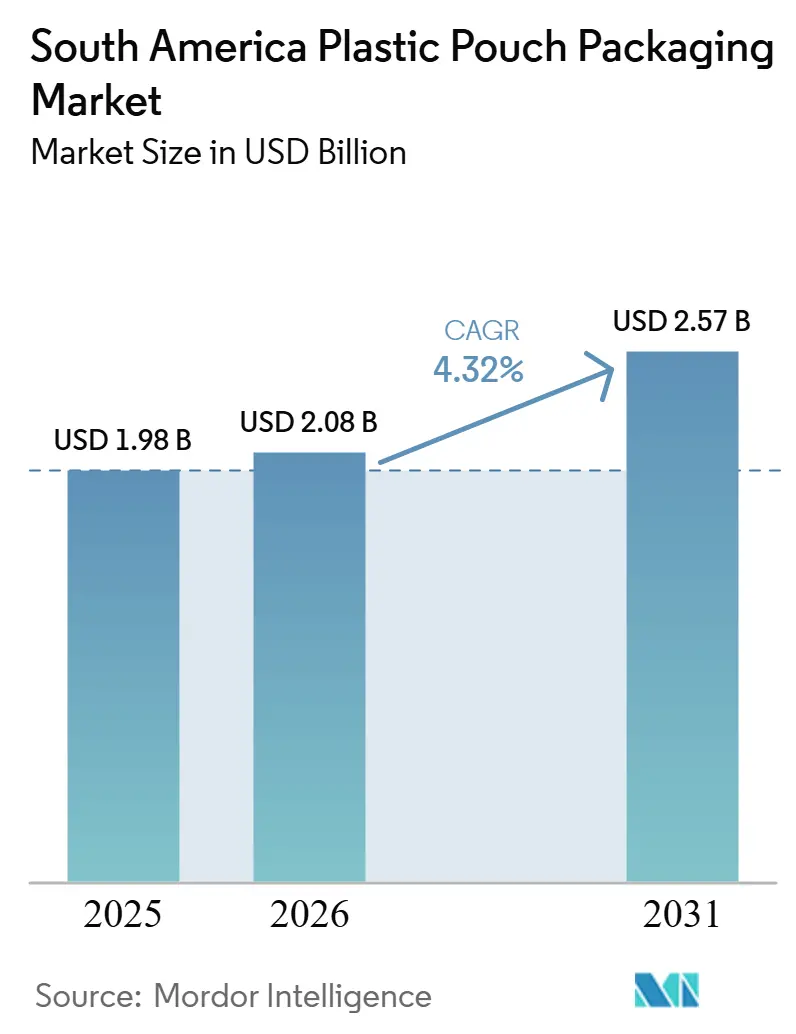
The South America plastic pouch packaging market size was valued at USD 1.98 billion in 2025 and estimated to grow from USD 2.08 billion in 2026 to reach USD 2.57 billion by 2031, at a CAGR of 4.32% during the forecast period (2026-2031). The South America plastic pouch packaging market is being supported by sustained urbanization above 84% across the region, rising packaged food consumption, and a steady shift away from rigid containers in food, agro-processing, and pharmaceutical uses. Brazil remains the operating center for the South America plastic pouch packaging market because its converter base, integrated petrochemical supply, and large-scale food retail activity continue to support steady flexible packaging demand. The regional revenue base also reflects strength in flexible packaging manufacturing, with Brazil's flexible plastic packaging industry reaching BRL 40.1 billion (USD 7.0 billion) in 2025, while agro-sector demand for flexible packaging increased 9.7% in the same year. That export-facing agro momentum gives the South America plastic pouch packaging market a buffer beyond domestic retail cycles, since soy, meat, and frozen goods shipments continue to require high-barrier pouch formats at scale. At the same time, new recycled-content rules and volatility in polyethylene sourcing are raising compliance and procurement costs, likely tightening margins for smaller converters and supporting further consolidation.
Key Report Takeaways
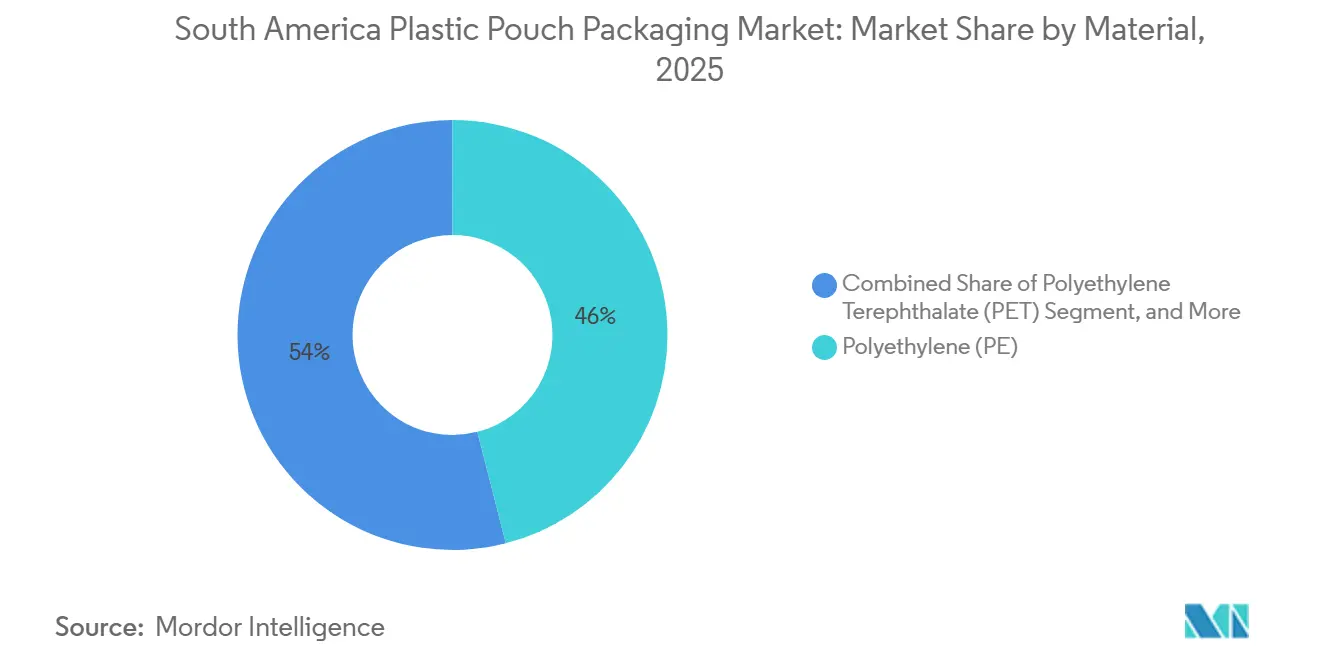
- By material, polyethylene accounted for 46.01% of the South America plastic pouch packaging market size in 2025.
- By product type, the South America plastic pouch packaging market for stand up pouches is projected to grow at a CAGR of 7.34% through 2031.
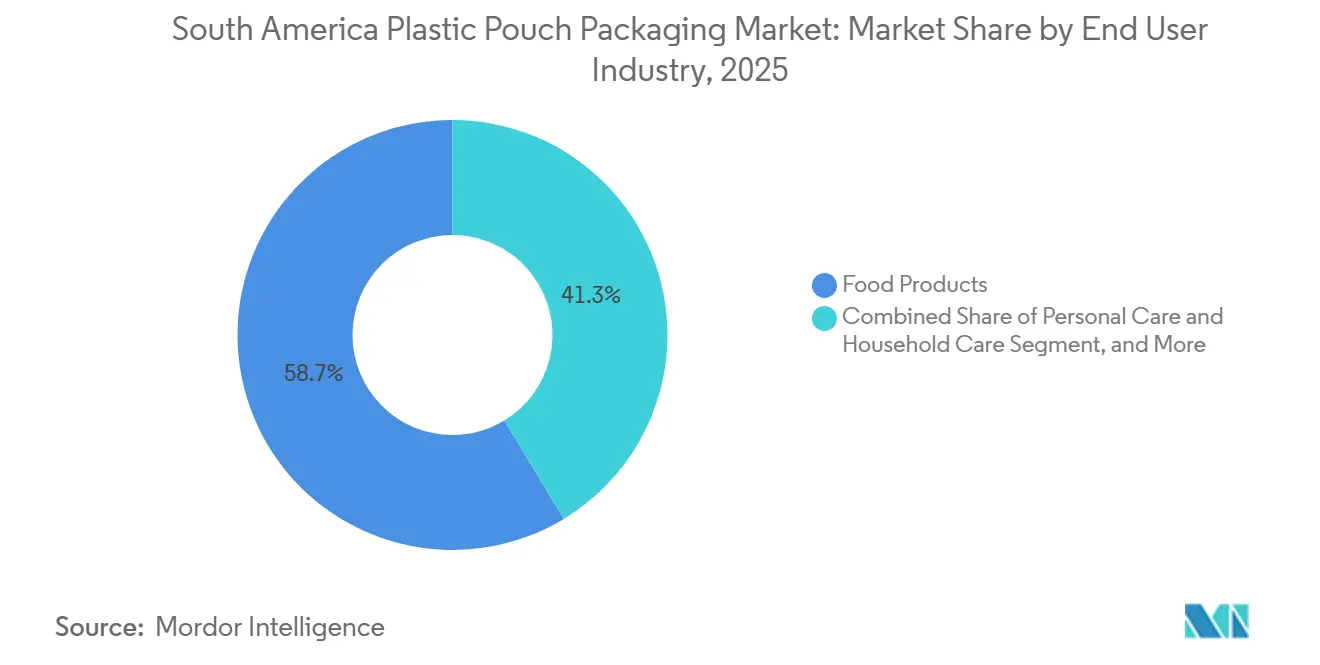
- By end user industry, food products accounted for 58.67% of the South America plastic pouch packaging market size in 2025.
- By geography, the South America plastic pouch packaging market for Colombia is projected to expand at a 5.16% CAGR through 2031.
Note: Market size and forecast figures in this report are generated using Mordor Intelligence’s proprietary estimation framework, updated with the latest available data and insights as of January 2026.
Market Trends and Insights
Drivers Impact Analysis of South America Plastic Pouch Packaging Market*
| Driver | (~) % Impact on CAGR Forecast | Geographic Relevance | Impact Timeline |
|---|---|---|---|
| Transition from Rigid Packaging to Flexible Plastic Pouch Solutions | +1.4% | Brazil, Argentina, Colombia | Short term (≤ 2 years) |
| Expansion of Organized Retail and Modern Trade Channels | +0.8% | Brazil, Colombia | Medium term (2-4 years) |
| Rising Adoption of Sustainable and Recyclable Pouch Packaging | +0.7% | Brazil, Colombia, Chile | Medium term (2-4 years) |
| Advancements In High-Barrier Films and Pouch Manufacturing Technologies | +0.5% | Brazil, Colombia | Long term (≥ 4 years) |
| Cost Optimization Through Lightweight and Material-Efficient Packaging | +0.3% | Global | Short term (≤ 2 years) |
| Expansion of Regional Manufacturing and Export-Oriented Industries | +0.2% | Brazil, Argentina, Colombia | Long term (≥ 4 years) |
| Source: Mordor Intelligence | |||
Transition from Rigid Packaging to Flexible Plastic Pouch Solutions
The South America plastic pouch packaging market continues to benefit from a broad shift away from glass jars, tin cans, and HDPE containers toward lighter pouch formats across dry snacks, sauces, dairy, and frozen proteins. Brazil's flexible plastic packaging industry processed 2.321 million tons in 2025, which shows how deeply flexible formats are embedded in mainstream packaging demand. LDPE and LLDPE grades accounted for 73% of that Brazilian volume in 2025, reinforcing the strong operating base for PE-led pouch conversion across food, agro-industrial, and consumer goods uses. Agro-sector demand for flexible packaging rose 9.7% in 2025 to 316,000 tons, which shows that export-linked food chains are using multilayer pouch formats for freshness protection and lower logistics costs. This demand pattern remains important because smaller and mid-sized food manufacturers can adopt pouch filling and conversion with lower capital requirements than rigid packaging systems, keeping converter order books active even when regional economic conditions weaken.
Expansion of Organized Retail and Modern Trade Channels
The South America plastic pouch packaging market is also being supported by the spread of supermarket, cash-and-carry, and modern trade formats across large urban centers and secondary cities. Organized retail expansion increases the share of packaged products on shelves, which directly raises demand for lightweight, resealable, and display-ready pouch formats. Cencosud allocated USD 600 million in capital expenditure for 2026, with 70% directed to store growth and greenfield development across South American markets.[1]Cencosud S.A., “Cencosud Provides FY2026 Guidance and Investment Plan,” Cencosud Investor Relations, cencosud.com That investment pace matters because a broader retail footprint strengthens procurement volumes for packaged foods, household products, and refill formats that rely heavily on flexible pouch packaging. It also favors converters that can respond to shorter product runs and more frequent packaging refresh cycles, especially as modern trade chains continue to expand product assortments.
Rising Adoption of Sustainable and Recyclable Pouch Packaging
The South America plastic pouch packaging market is shifting toward recyclable and recycled-content structures as producer responsibility rules and brand commitments begin to alter material specifications. Brazil's Federal Decree No. 12,688 took effect in January 2026 and requires 32% recovery of plastic packaging, together with a 22% minimum recycled-content threshold at the outset, with both obligations rising over time. These rules do not eliminate pouch demand, but they do redirect orders toward converters that can qualify mono-material or recycle-ready structures with credible compliance pathways. EVOH benefits from this change because ultra-thin barrier layers can be used in polyethylene-dominant recyclable designs without sacrificing oxygen protection performance. Kuraray highlighted this direction at Interpack 2026 through EVAL EVOH, which it positioned for PPWR-compliant recyclable packaging across food and pet food applications.
Advancements In High-Barrier Films and Pouch Manufacturing Technologies
High-barrier film development is expanding the range of applications the South America plastic pouch packaging market can serve, especially in sterile packaging, retort food, and cold-chain protein applications. Nine-layer co-extruded structures with EVOH barrier layers can reduce oxygen transmission rates to below 0.05 cm³/(m²·day), which supports longer shelf life and tighter food safety performance in meat and deli applications. Amcor installed the first Moda Vac rotary vacuum chamber sealing systems in Brazil in June 2026 at Barra Mansa Alimentos, replacing up to 9 conventional belt chamber machines across 3 production lines. That move shows how global suppliers are pairing advanced films with specialized equipment to secure premium protein-packaging volumes rather than competing only on commodity film supply. The same trend is evident in recycle-ready film investments across South America, where higher-barrier performance and better process control are becoming part of the competitive baseline for premium pouch applications.
Restraints Impact Analysis of South America Plastic Pouch Packaging Market*
| Restraint | (~) % Impact on CAGR Forecast | Geographic Relevance | Impact Timeline |
|---|---|---|---|
| Strengthening Plastic Packaging Regulations and Extended Producer Responsibility Policies | -0.4% | Brazil, Colombia, Chile, Argentina | Medium term (2-4 years) |
| Underdeveloped Collection and Recycling Infrastructure for Flexible Plastics | -0.3% | Brazil, Argentina, Rest of South America | Long term (≥ 4 years) |
| Volatility in Petrochemical Resin Prices and Raw Material Costs | -0.2% | Brazil, Argentina | Short term (≤ 2 years) |
| Rising Competition from Paper-Based and Alternative Sustainable Packaging Materials | -0.2% | Brazil, Colombia | Medium term (2-4 years) |
| Source: Mordor Intelligence | |||
Strengthening Plastic Packaging Regulations and Extended Producer Responsibility Policies
Regulatory tightening is one of the clearest near-term constraints on converter economics in the South America plastic pouch packaging market. Brazil's Decree No. 12,688 created immediate obligations on recovery and recycled content, and those rules raise qualification, sourcing, and reporting costs for converters that depend on multilayer structures. The pressure is strongest for laminates that combine PET, PA, and EVOH because these structures do not fit easily into current mechanical recycling systems used across much of the region. Compliance, therefore, favors larger suppliers that already have technical, certification, and customer support capabilities in place. The restraint is not simply about lower demand for plastic, but about a faster shift in orders toward converters that can meet regulatory requirements without disrupting food safety and performance standards.
Underdeveloped Collection and Recycling Infrastructure for Flexible Plastics
Infrastructure remains a major constraint because flexible packaging recovery in South America is still far behind the scale of pouch production. Brazil's flexible plastic packaging industry operated at 70.4% of installed capacity in 2025, yet recycled materials accounted for only 5% of total flexible packaging volume produced that year. This gap matters because adhesives, inks, and mixed polymer layers make flexible structures harder to sort and reprocess than many rigid packaging formats. Local supplies of post-consumer recycled polyethylene remain limited in both volume and consistency, which complicates compliance with recycled-content mandates for pouch converters. As a result, converters often face a choice between importing certified recycled resin and funding dedicated collection efforts, and both routes raise input costs and weaken price competitiveness.
*Our forecasts treat driver/restraint impacts as directional, not additive. The impact forecasts reflect baseline growth, mix effects, and variable interactions.
South America Plastic Pouch Packaging Market Segment Analysis
By Material:
Polyethylene Leads as EVOH Targets High-Barrier ApplicationsPolyethylene held 46.01% of the South America plastic pouch packaging market share in 2025 because it combines low processing costs with wide compatibility across blown-film and cast-extrusion lines used by regional converters. Its leadership is reinforced by domestic resin availability in Brazil and by its broad fit across food, agro-industrial, and consumer goods pouch formats. In Brazil, LDPE and LLDPE alone accounted for 73% of the flexible packaging volume produced in 2025, underscoring the PE family's centrality to everyday pouch conversion activity. Polypropylene holds an important secondary position because it is better suited to hot-fill and retort applications, while PET and PVC continue to serve selected transparent and thermoformed pouch uses.
EVOH is projected to expand at a 7.59% CAGR through 2031, and this segment of the South America plastic pouch packaging market is being driven by higher demand for barrier performance in food safety and pharmaceutical packaging. Food processors and pharmaceutical manufacturers are increasingly specifying co-extruded structures with EVOH layers because they extend shelf life and support stricter packaging requirements. Kuraray's EVAL EVOH, presented at Interpack 2026, was positioned for recyclable mono-material packaging designs that align with emerging compliance needs in high-performance pouch applications.[2]Kuraray Co., Ltd., “Interpack 2026: EVAL EVOH by Kuraray Can Help in Designing PPWR-Compliant, Recyclable Packaging,” Kuraray Europe GmbH, kuraray.eu Nine-layer PE/EVOH/PE structures can reduce OTR to below 0.05 cm³/(m²·day), helping meat processors extend shelf life from 7 to 21 days and reduce waste across the supply chain.



By Product Type:
Flat Pouches Anchor Volume as Stand Up Formats Drive PremiumizationFlat pouches accounted for 68.61% of demand in 2025, keeping them at the center of the South America plastic pouch packaging market because they offer low unit costs and fit easily into high-speed form-fill-seal operations. Their large installed base reflects broad use across dry foods, pet food, and agro-industrial applications where cost efficiency matters more than shelf display. The agro-sector also supported this format in 2025, as demand for flexible packaging in that segment rose 9.7% and extended the use of flat pouches beyond standard consumer food categories. Their dominance also reflects the reality that many smaller cities and interior retail markets still prioritize affordability and functional packaging over premium shelf presentation.
Stand up pouch is projected to post the fastest growth at a 7.34% CAGR through 2031 as brand owners move toward formats that improve shelf visibility, resealability, and e-commerce handling. Demand is strengthening across premium food, pet food, beverage, and pharmaceutical applications, where packaging formats now play a larger role in product positioning and logistics. This shift is especially relevant in pet food, as producers are moving from standard pillow-bag laminates to zipper-equipped stand-up formats that better align with global specification standards used by regional manufacturing partners. The format is also receiving targeted redesign investment through oriented polyethylene structures with thin EVOH layers, which helps improve barrier performance while moving closer to future recyclability requirements.
By End User Industry:
Food Products Lead by Volume as Medical and Pharmaceutical Accelerates Premium DemandFood products accounted for 58.67% of end-user demand in 2025 and remained the largest base for the South America plastic pouch packaging market, as candy, confectionery, dry foods, meat and poultry, frozen foods, and pet food all rely heavily on flexible formats. Brazil's agro-industrial sector played a major role in that volume base, with flexible packaging demand rising 9.7% in 2025 to 316,000 tons of off-take. Beverage applications are also expanding through spout pouches and liquid sachets in single-serve juice, dairy, and nutraceutical formats, especially where portability and pack-size control influence buying behavior. Personal care and household care remain meaningful secondary outlets because sachets and refill pouches continue to gain space in detergents, home cleaning, and hair care lines sold through organized trade.
The medical and pharmaceutical sector is projected to grow at a 6.57% CAGR through 2031, and this segment of the South America plastic pouch packaging market is rising as high-barrier, low-leachable films become increasingly important in regulated packaging formats. Drug-delivery sachets, intravenous bag over-pouches, diagnostic test kit laminates, and wound-care film pouches are all higher specification uses that require tighter process control than commodity food packaging. That requirement favors converters with clean-room infrastructure and access to certified resin grades, which narrows the field of suppliers that can serve the segment at scale. The result is a sharper divide between premium-margin regulated packaging and price-driven standard food pouch production.
Geography Analysis
Brazil Plastic Pouch Packaging Market
Brazil accounted for a 56.50% share of the South America plastic pouch packaging market in 2025 and remained the clear regional center of demand. Its position rests on converter infrastructure concentrated in São Paulo state and the Campinas-to-Curitiba industrial corridor, together with domestic PE availability and a large packaged food base. Brazil's flexible plastic packaging industry produced 2.321 million tons in 2025 across 3,888 converter companies, which shows the depth of installed capacity, even though the supplier base remains highly fragmented.[3]Associação Brasileira da Indústria de Embalagens Plásticas Flexíveis, “ABIEF Divulga Resultados de 2025,” ABIEF, abief.org.br The same industry operated at 70.4% capacity in 2025, indicating that scale exists, but profitability remains uneven across smaller players. Amcor's June 2026 installation of Moda Vac rotary vacuum sealing systems in Brazil also underlines why multinational capital continues to flow first into the country's premium protein and barrier packaging base.
Colombia Plastic Pouch Packaging Market
Colombia is projected to expand at a 5.16% CAGR through 2031, which makes it the fastest-growing country in the South America plastic pouch packaging market. Growth is being supported by expanding packaged food processing, nearshoring-related manufacturing interest, and a regulatory environment that is already pushing suppliers toward more compliant pouch structures. Colombia's packaging framework has been operational since 2021, so converters and brand owners are adapting earlier than several neighboring markets. That earlier compliance cycle can support demand for qualified recyclable and high-barrier formats, even when it raises operating complexity. The country therefore stands out less for sheer scale and more for the speed at which its packaging mix is moving toward technically upgraded applications.
Argentina and Broader South America Plastic Pouch Packaging Market
Argentina remains relevant because demand is concentrated in the Greater Buenos Aires food processing and retail corridor, where food-contact requirements continue to favor barrier-oriented structures. The country's operating environment in 2025 was difficult because peso devaluation weakened converter margins and delayed capital spending. Rest of South America, including Chile, Peru, Ecuador, Bolivia, Paraguay, and Uruguay, represents a growing secondary demand pool with country-by-country variation in regulation and converting capacity. Peru gained importance after Amcor installed an MDO line at its local facility in October 2025, which strengthened the Andean supply base for recycle-ready flexible films used across regional customer programs.
Competitive Landscape
The South America plastic pouch packaging market remains fragmented at the country level, but it is becoming more concentrated in premium and technically demanding applications. Brazil alone had 3,888 converter companies in 2025, and most of them operated standard blown-film and flexographic printing lines without advanced co-extrusion capability. That imbalance gives global suppliers an advantage because they can combine films, equipment, and technical support rather than competing only on price. Amcor's all-stock merger with Berry Global, completed in April 2025 at a combined transaction value of USD 24 billion, raised the scale threshold for the top tier and brought together broad capabilities across healthcare, food-service, and flexible packaging. The South America plastic pouch packaging market is therefore seeing a clearer separation between standard regional converters and large groups with the capital to lead on recyclable, high-barrier, and pharma-grade structures.
Competitive differentiation is increasingly shaped by process know-how and depth of qualifications. Patent activity in mono-material recyclable pouch structures and MDO orientation technology is concentrated among global players, and that matters because product approval cycles can be long in regulated and food-sensitive applications. Oben Group is also expanding capability rather than chasing only commodity volume, and its agreement for a new 12-meter BOPP line in Brazil targeting 94,000 metric tons of annual capacity adds regional scale in performance film supply.[4]Oben Group, “Brazil Expansion: Oben Group Signs Agreement for New 12-Meter BOPP Line with 94,000 Tons of Annual Capacity,” Oben Group, obengroup.com Amcor has reinforced this position through recycle-ready film investments in Peru and through advanced sealing system deployment in Brazil, which strengthens its premium protein and performance packaging presence across the region.
Regional players such as ZARAPLAST and Bolsafilm remain important, but the competitive center of gravity is shifting toward suppliers that can meet recyclability, barrier, and certification requirements together. ProAmpac's March 2026 rebranding of TC Transcontinental Packaging's South American operations to ProAmpac also shows that North American groups view the region as a strategic expansion platform. The white space is strongest in pharma-grade EVOH pouch converting, where clean-room capability, qualification discipline, and customer approval cycles create high switching costs. That is why the most durable margin opportunities in the South America plastic pouch packaging market are moving toward regulated and specification-heavy applications rather than conventional mass-volume pouch runs.
South America Plastic Pouch Packaging Industry Leaders
Amcor plc
ProAmpac Holdings, Inc.
Mondi plc
Constantia Flexibles Group GmbH
Huhtamäki Oyj
- *Disclaimer: Major Players sorted in no particular order
South America Plastic Pouch Packaging Market Companies Covered in this Report
- Amcor plc
- ZARAPLAST S.A.
- ProAmpac Holdings, Inc.
- Finpak Flexibles, S.A. de C.V.
- SIG Group AG
- Mondi plc
- Constantia Flexibles Group GmbH
- Guala Pack S.p.a.
- Huhtamäki Oyj
- Bolsafilm SA
- BOLSAS DELTA S.A. DE C.V

Recent Industry Developments in South America Plastic Pouch Packaging Market
- June 2026: Amcor plc installed the first Moda Vac rotary vacuum chamber sealing systems in Brazil at Barra Mansa Alimentos' Sertãozinho deboning facility, replacing up to nine conventional belt chamber machines across 3 production lines. The project supports Amcor's South America protein-packaging growth strategy and, upon completion of all 3 lines in 2026, will position Barra Mansa Alimentos to operate one of the most advanced rotary vacuum sealing systems in the region.
- May 2026: Kuraray presented EVAL EVOH at Interpack 2026, demonstrating its application in PPWR-compliant mono-material recyclable packaging structures. The showcase highlighted EVAL's role as an ultra-thin oxygen barrier layer in high-performance food and pet food pouches, directly relevant to Brazil's Decree No. 12,688/2025 recycled-content compliance pathway.
- March 2026: TC Transcontinental Packaging LATAM rebranded all South American and Central American operations under the ProAmpac name following ProAmpac Holdings' integration of TC Transcontinental's packaging business. ProAmpac LATAM now operates plants in Colombia and Panama, with acquired converter assets including Olefinas, Banaplast, Trilex, Supraplast, and Chemplast del Sur.
- October 2025: Oben Group signed an agreement for a new 12-meter BOPP line at its Brazilian facility, targeting 94,000 metric tons of annual production capacity. The expansion, building on Oben's prior integration of Terphane and Vitopel do Brasil, reinforces Brazil's position as the largest BOPP film production base in South America and extends the group's capacity across the Southern Cone.


South America Plastic Pouch Packaging Market Report Scope
The South America plastic pouch packaging market covers the production, distribution, and use of flexible plastic pouches for packaging applications across end-user industries such as food, beverages, personal care, healthcare, and household products in South America. The study analyzes market trends, growth drivers, restraints, competitive landscape, and key developments across major countries in the region.
The South America Plastic Pouch Packaging Market Report is Segmented by Material (Polyethylene (PE), Polypropylene (PP), Polyethylene Terephthalate (PET), Ethylene Vinyl Alcohol (EVOH), Polyvinyl Chloride (PVC), and Other Materials), Product Type (Flat Pouch and Stand Up Pouch), End User Industry (Food Products [Candy and Confectionery, Frozen Foods, Fresh Produce, Dairy Products, Dry Foods, Meat, Poultry, and Seafood, Pet Food, and Other Food Products], Beverage, Medical and Pharmaceutical, Personal Care and Household Care, and Other End User Industries), and Geography (Brazil, Argentina, Colombia, and Rest of South America). The Market Forecasts are Provided in Terms of Value (USD).
| Polyethylene (PE) |
| Polypropylene (PP) |
| Polyethylene Terephthalate (PET) |
| Ethylene Vinyl Alcohol (EVOH) |
| Polyvinyl Chloride (PVC) |
| Other Materials |
| Flat Pouch |
| Stand Up Pouch |
| Food Products | Candy and Confectionery |
| Frozen Foods | |
| Fresh Produce | |
| Dairy Products | |
| Dry Foods | |
| Meat, Poultry, and Seafood | |
| Pet Food | |
| Other Food Products | |
| Beverage | |
| Medical and Pharmaceutical | |
| Personal Care and Household Care | |
| Other End User Industries |
| Brazil |
| Argentina |
| Colombia |
| Rest of South America |
| By Material | Polyethylene (PE) | |
| Polypropylene (PP) | ||
| Polyethylene Terephthalate (PET) | ||
| Ethylene Vinyl Alcohol (EVOH) | ||
| Polyvinyl Chloride (PVC) | ||
| Other Materials | ||
| By Product Type | Flat Pouch | |
| Stand Up Pouch | ||
| By End User Industry | Food Products | Candy and Confectionery |
| Frozen Foods | ||
| Fresh Produce | ||
| Dairy Products | ||
| Dry Foods | ||
| Meat, Poultry, and Seafood | ||
| Pet Food | ||
| Other Food Products | ||
| Beverage | ||
| Medical and Pharmaceutical | ||
| Personal Care and Household Care | ||
| Other End User Industries | ||
| By Geography | Brazil | |
| Argentina | ||
| Colombia | ||
| Rest of South America | ||


Key Questions Answered in the Report
What is the current size and forecast for South America plastic pouch packaging?
The South America plastic pouch packaging market size was USD 1.98 billion in 2025, reached USD 2.08 billion in 2026, and is forecast to reach USD 2.57 billion by 2031 at a 4.32% CAGR.
Which country leads regional demand?
Brazil led regional demand with a 56.50% share in 2025, supported by its large converter base, domestic resin supply, and broad food processing footprint.
Which material category holds the largest share?
Polyethylene led materials with 46.01% share in 2025 because it remains cost efficient and widely compatible with regional film conversion lines.
Why are stand up pouches growing faster than flat formats?
Stand up pouch is projected to grow at a 7.34% CAGR because it offers better shelf presence, resealability, and e-commerce handling in premium food, pet food, beverage, and pharmaceutical uses.
Which end user segment is creating the strongest premium opportunity?
Medical and pharmaceutical is projected to grow at a 6.57% CAGR, and it offers higher-margin opportunities because converters need advanced barrier films, clean-room capability, and stronger qualification processes.
What is the main risk for suppliers over the next few years?
The main risk is the combination of tighter recycled-content and recovery rules with limited regional recycling infrastructure, which raises compliance costs and can pressure smaller converters more than larger players.
Page last updated on:





