
South America Pharmaceutical Blister Packaging Market Size and Share
Market Overview
| Study Period | 2020 - 2031 |
|---|---|
| Forecast Data Period | 2026 - 2031 |
| Base Year Market Size (2025) | USD 1.18 Billion |
| Market Size (2026) | USD 1.26 Billion |
| Market Size (2031) | USD 1.72 Billion |
| Growth Rate (2026 - 2031) | 6.42 % |
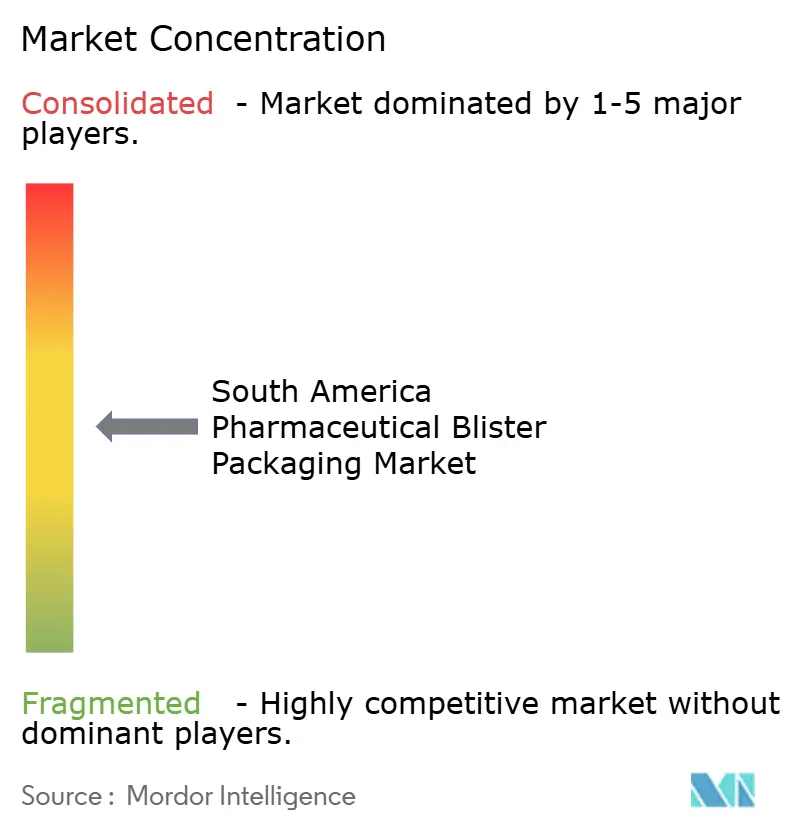
| Market Concentration | Medium |
Major Players *Disclaimer: Major Players sorted in no particular order Image © Mordor Intelligence. Reuse requires attribution under CC BY 4.0. | |
South America Pharmaceutical Blister Packaging Market Analysis by Mordor Intelligence
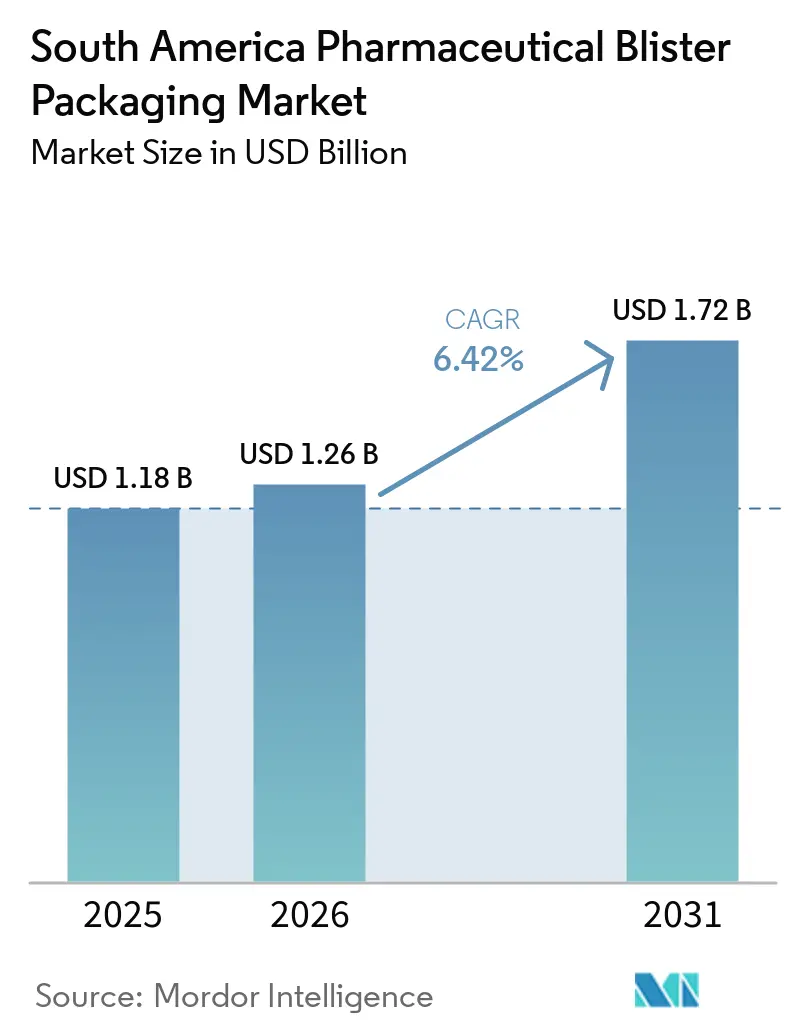
The South America pharmaceutical blister packaging market size was valued at USD 1.18 billion in 2025 and is estimated to expand from USD 1.26 billion in 2026 to reach USD 1.72 billion by 2031, at a CAGR of 6.42% during the forecast period (2026-2031). Rising generic-drug production is increasing demand for high-volume primary packaging across Brazil and Argentina. Serialization requirements are also directing investment toward packaging lines that can apply and verify unit-level codes. Chronic therapies support steady retail volumes because pharmacies and hospitals need individually dispensed medicine packs. Tropical storage conditions in much of the region raise the need for moisture protection, particularly for medicines with hygroscopic active ingredients. The South America pharmaceutical blister packaging market therefore favors suppliers that can combine barrier performance, reliable conversion capacity, and compliance-ready production processes. Their position also depends on whether they can serve large generic-drug programs while supporting specialized medicines that require higher moisture protection. This combination links material choice to the way medicines are produced, coded, transported, stored, dispensed, and used by patients. It also explains why established converters can retain business even when global materials suppliers introduce alternative film, foil, or laminate structures. Customers also need proven compatibility with their manufacturing equipment, approved product specifications, and established supply processes before making a change. Regional opportunities remain closely tied to practical qualification work, since pharmaceutical manufacturers need evidence that a package performs consistently before it can be adopted for a commercial product. Competitive strategies consequently center on technical documentation, manufacturing reliability, and customer support as much as on the basic cost of the packaging material The pattern also reflects the need to coordinate packaging-material availability with pharmaceutical production plans, quality release procedures, distribution needs, and the requirements of patients and pharmacy staff who handle medicines in different care settings.
Key Report Takeaways
- By product type, carded and face-seal blisters held 25.83% of the South America pharmaceutical blister packaging market share in 2025, while child-resistant and senior-friendly blisters are projected to expand at a 7.82% CAGR through 2031.
- By material, plastic films held 40.71% of the 2025 share, while paper and paperboard is expected to expand at a 7.51% CAGR through 2031.
- By technology, thermoforming accounted for 64.53% of the 2025 share, while cold forming is projected to expand at a 6.79% CAGR through 2031.
- By application, tablets accounted for 49.78% of the 2025 share, while oral thin films and lozenges are expected to expand at a 7.94% CAGR through 2031.
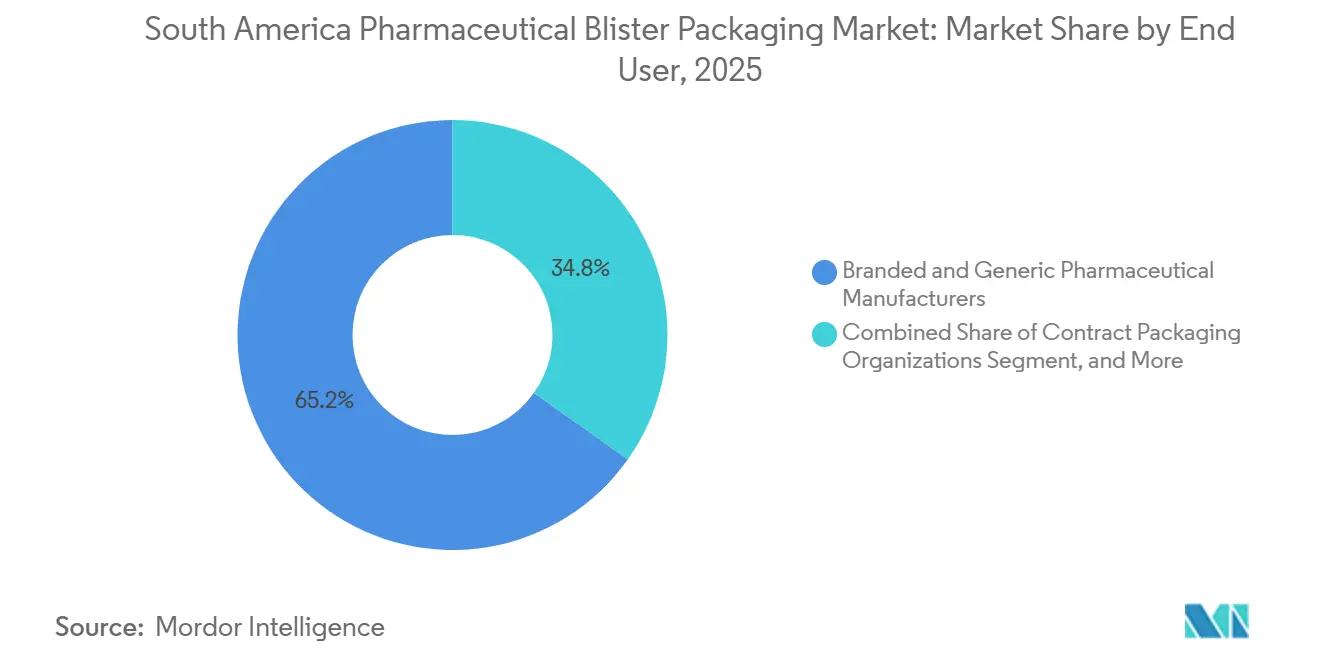
- By end user, branded and generic pharmaceutical manufacturers held 65.18% of the 2025 share, while contract development and manufacturing organizations are projected to expand at a 7.18% CAGR through 2031.
- By packaging format, push-through blisters held 36.72% of the 2025 share, while peelable blisters are expected to expand at a 7.45% CAGR through 2031.
- By geography, Brazil held 55.47% of the regional share in 2025, while Argentina is projected to expand at a 7.62% CAGR through 2031.
Note: Market size and forecast figures in this report are generated using Mordor Intelligence’s proprietary estimation framework, updated with the latest available data and insights as of January 2026.
Market Trends and Insights
Drivers Impact Analysis of South America Pharmaceutical Blister Packaging Market*
| Driver | (~) % Impact on CAGR Forecast | Geographic Relevance | Impact Timeline |
|---|---|---|---|
| Rising Unit-Dose and Adherence Packaging Demand | +1.6% | Global, with the highest concentration in Brazil and Argentina | Medium term (2-4 years) |
| Pharmaceutical Serialization and Traceability Requirements | +1.3% | Brazil, Argentina, and regulatory spillover to Colombia | Short term (≤ 2 years) |
| Expansion of Generic-Drug and Contract-Manufacturing Capacity | +1.1% | Brazil, especially São Paulo and Minas Gerais, and Argentina | Medium term (2-4 years) |
| High-Barrier Protection for Moisture-Sensitive Medicines | +0.9% | Tropical South America, including Brazil, Colombia, and Bolivia | Medium term (2-4 years) |
| Growth of Retail Pharmacy, Self-Medication, and Chronic-Therapy Volumes | +0.7% | Brazil, Argentina, Colombia, and Rest of South America | Long term (≥ 4 years) |
| Localized Production and Near-Shoring of Pharmaceutical Packaging | +0.5% | Brazil, Argentina, and Paraguay | Long term (≥ 4 years) |
| Source: Mordor Intelligence | |||
Rising Unit-Dose and Adherence Packaging Demand
Unit-dose blisters support medication safety, dispensing accuracy, and clearer records across the pharmaceutical supply chain. An aging population is expected to increase polypharmacy, which strengthens the need for packs that separate doses and make treatment schedules easier to follow.[1] Hospital pharmacy automation also favors consistent cavity dimensions that work with unit-dose dispensing systems. Once hospitals install cassette-based automation, changing to another primary format can require additional equipment spending and workflow changes. Argentina's Disposición 8277 requires individually identifiable, peelable unit-dose blisters for oral solid medicines supplied to hospitals. These requirements are shaping specifications in retail settings as pharmacies align institutional and community dispensing practices This matters because packaging decisions must fit established pharmaceutical quality procedures, production schedules, and distribution practices across the region.
Pharmaceutical Serialization and Traceability Requirements
Serialization is making compliant printing and verification capacity more important across the South America pharmaceutical blister packaging market. Argentina's Disposición 3294/2025 requires QR or Data Matrix codes on secondary pharmaceutical packaging.[2] The requirement applies to pharmaceutical specialties and supports patient access to product information. Packaging converters increasingly need validated code printing and vision inspection systems before they can serve regulated pharmaceutical customers. This capability can influence contract awards because a supplier without verified production records may not meet customer qualification requirements. The resulting investment cycle extends to generic manufacturers and contract producers that are upgrading lines for regulated supply arrangements The requirement also affects how manufacturers coordinate material qualification, line operation, product release, and pharmacy supply activities.
Expansion of Generic-Drug and Contract-Manufacturing Capacity
Generic-drug production remains a central demand source for blister materials because solid oral medicines are commonly supplied in individual doses. Brazil and Argentina together meet 35% of domestic pharmaceutical demand through locally manufactured products, supported by policies that encourage regional production. Eurofarma began operating its Montes Claros complex in October 2025, and the site produces more than 600 million solid-oral units annually. The facility was designed for modular expansion, giving packaging suppliers a sustained customer base rather than a short project-led demand increase. Contract producers are also building export-grade packaging capabilities as pharmaceutical companies use outsourced regional capacity. Suppliers that combine blister conversion with serialization readiness are better placed to participate in these programs Its practical effect depends on whether the supplier can meet the customer’s stated specification without disrupting routine production planning.
High-Barrier Protection for Moisture-Sensitive Medicines
Moisture-sensitive medicines require packaging that maintains protection through transport, warehousing, and pharmacy storage. Tropical conditions in Brazil, Colombia, and Bolivia increase the importance of high-barrier structures for these products. Cold-form aluminum configurations are used where conventional thermoformed PVC does not provide sufficient moisture protection. This need becomes more important as oncology, biosimilar, and other specialty medicine pipelines require careful stability management. Packaging suppliers must balance barrier performance with efficient use of aluminum and polymer layers. The South America pharmaceutical blister packaging market has an opportunity in validated high-barrier formats that suit regional storage conditions and established pharmaceutical production lines This consideration is especially relevant where medicine producers manage broad product portfolios with different protection and dispensing needs.
Restraints Impact Analysis of South America Pharmaceutical Blister Packaging Market*
| Restraint | (~) % Impact on CAGR Forecast | Geographic Relevance | Impact Timeline |
|---|---|---|---|
| Medical-Waste and Difficult-to-Recycle Multilayer Structures | -0.7% | Chile and Colombia, with emerging mandates in Brazil | Medium term (2-4 years) |
| PVC, Aluminum, Resin, and Currency Volatility | -0.6% | Argentina and Brazil | Short term (≤ 2 years) |
| Limited Regional Capacity for Validated Specialty Barrier Films | -0.4% | Broad South America, with a critical gap in Colombia and Bolivia | Long term (≥ 4 years) |
| Qualification, Validation, and Tooling Costs for Small Batches | -0.3% | Argentina, Colombia, and Rest of South America | Long term (≥ 4 years) |
| Source: Mordor Intelligence | |||
Medical-Waste and Difficult-to-Recycle Multilayer Structures
Multilayer blisters commonly combine PVC, PVDC, and aluminum, which makes conventional mechanical recycling difficult. Chile and Colombia have introduced packaging recovery and recycled-content requirements that add compliance work for converters using these structures. Recyclable mono-material alternatives can reduce this issue, but pharmaceutical companies must first confirm that new packs protect medicines under required storage conditions. Klöckner Pentaplast offers recyclable rigid film solutions for pharmaceutical applications, illustrating the material direction available to manufacturers.[3] Validation can take 12-24 months, which slows immediate replacement of established multilayer packs. The South America pharmaceutical blister packaging market will therefore see a gradual change rather than a rapid shift away from traditional structures The issue links material selection with operating reliability, documented quality controls, and the everyday requirements of medicine distribution.
PVC, Aluminum, Resin, and Currency Volatility
Converters depend on PVC film, PVDC coatings, aluminum foil, and specialty laminates whose prices are often linked to USD markets. Currency devaluations in Argentina can raise local purchasing costs and reduce the margin available to regional converters. Brazil also relies on imported specialty films for certain high-barrier applications, which exposes buyers to exchange-rate and freight-cost changes. Suppliers considering aluminum-light or PVC-free structures must still complete technical validation and regulatory submissions. During a transition, small converters may need to maintain dual inventories and separate compliance records. These costs can delay material changes even when pharmaceutical customers want more stable input pricing. They can also make purchasing decisions more sensitive to the availability of regional stock and the terms offered by material suppliers. Pharmaceutical producers need continuity because packaging changes can affect established product approval and release processes. Converters must weigh the immediate savings from a new material against the cost of testing, inventory, and customer qualification. This keeps conventional structures relevant while companies assess lower-risk ways to improve resilience in their material supply.
*Our forecasts treat driver/restraint impacts as directional, not additive. The impact forecasts reflect baseline growth, mix effects, and variable interactions.
South America Pharmaceutical Blister Packaging Market Segment Analysis
By Product Type:
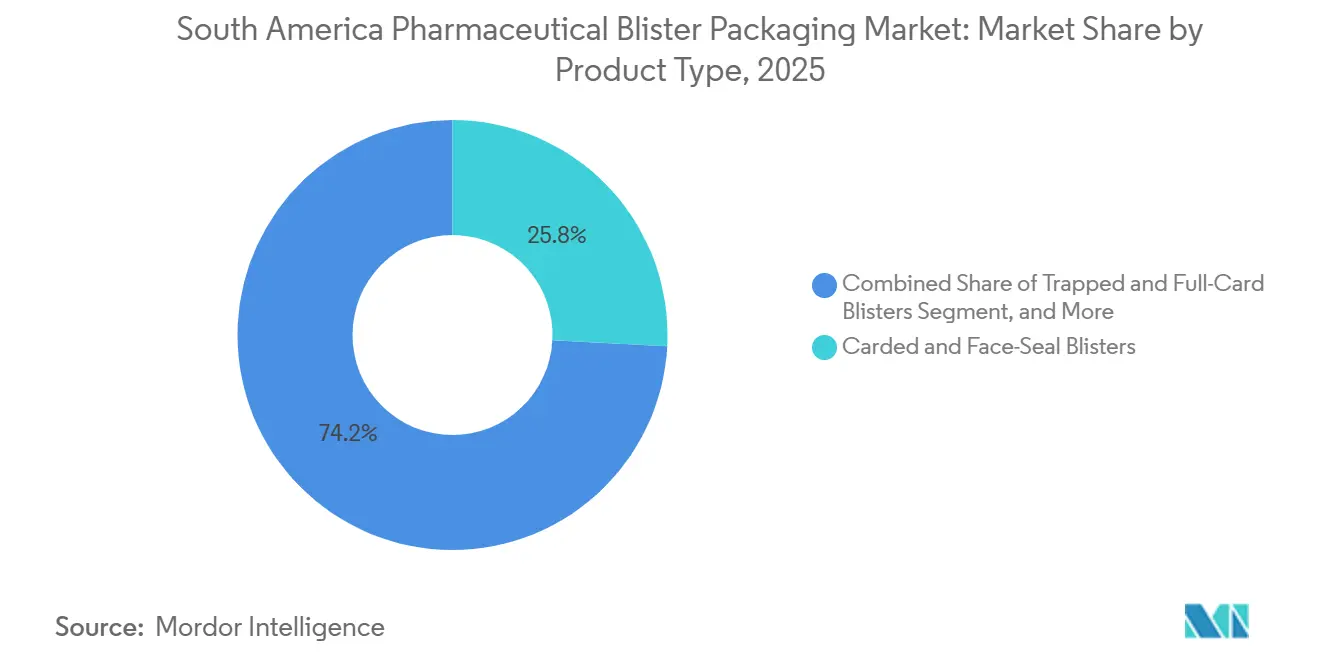
Child-Resistant Formats Outpace Conventional Blister GrowthCarded and face-seal blisters held 25.83% of the 2025 product-type share, making them the largest product category in the South America pharmaceutical blister packaging market. Their position reflects their established use for solid oral medicines sold through retail pharmacies and hospital distribution channels. The format works with common thermoforming equipment and suits high-volume generic-drug programs. It also allows pharmaceutical companies to standardize pack presentation across different tablet products. Clamshell blisters remain relevant for diagnostic kits and over-the-counter products that need physical product visibility or added protection This matters because packaging decisions must fit established pharmaceutical quality procedures, production schedules, and distribution practices across the region, and the category also remains useful for manufacturers that need a familiar pack configuration across multiple medicines and distribution settings, while keeping production planning aligned with established equipment and operator training.
Child-resistant and senior-friendly blisters are projected to expand at a 7.82% CAGR through 2031. This category addresses the need to prevent unintended access by children while allowing older patients to open prescribed medicines. It requires careful lidding selection and pack design because both objectives must be met in the same format. Trapped and full-card structures provide further tamper-evidence options for premium branded products. The South America pharmaceutical blister packaging industry is responding with designs that support safety, accessibility, and clear product identification The requirement also affects how manufacturers coordinate material qualification, line operation, product release, and pharmacy supply activities, creating a need for suppliers to work closely with pharmaceutical teams on opening performance, pack information, child protection expectations, and the practical needs of patients who manage recurring medicine schedules.

By Material:
Paper and Paperboard Challenge Plastic Film DominancePlastic films held 40.71% of the 2025 material share, supported by the wide use of thermoforming-grade PVC for solid oral medicines. PVC offers a familiar balance of cost, processing performance, and moderate moisture resistance for many established products. Aluminum foil remains essential as a lidding substrate and as a forming web in cold-form packs. Its demand is linked to the need for barrier protection in moisture-sensitive medicine categories. Specialty films such as PCTFE, COC, and aclar-based materials serve biologic and oncology applications where barrier requirements limit material substitution Its practical effect depends on whether the supplier can meet the customer’s stated specification without disrupting routine production planning, while material decisions also require attention to forming behavior, seal integrity, printing, supply availability, and the full set of product requirements that apply before a commercial medicine pack is released.
Paper and paperboard is expected to expand at a 7.51% CAGR through 2031 as pharmaceutical companies seek to reduce plastic content. Chilean and Colombian packaging requirements are strengthening the business case for structures that fit emerging recovery systems. The South America pharmaceutical blister packaging market size for paper and paperboard is projected to expand at a 7.51% CAGR through 2031. Constantia Flexibles presented PERPETUA and REGULA CIRC as pharmaceutical packaging approaches that focus on recyclable or PVC-free structures. Adoption will remain dependent on proving drug stability and manufacturability under regional regulatory expectations. The material shift is therefore likely to proceed product by product rather than through a uniform replacement of PVC This consideration is especially relevant where medicine producers manage broad product portfolios with different protection and dispensing needs, and the change favors providers that can explain how each option works in regional storage conditions and on available equipment, rather than offering barrier performance as a separate technical feature.
By Technology:
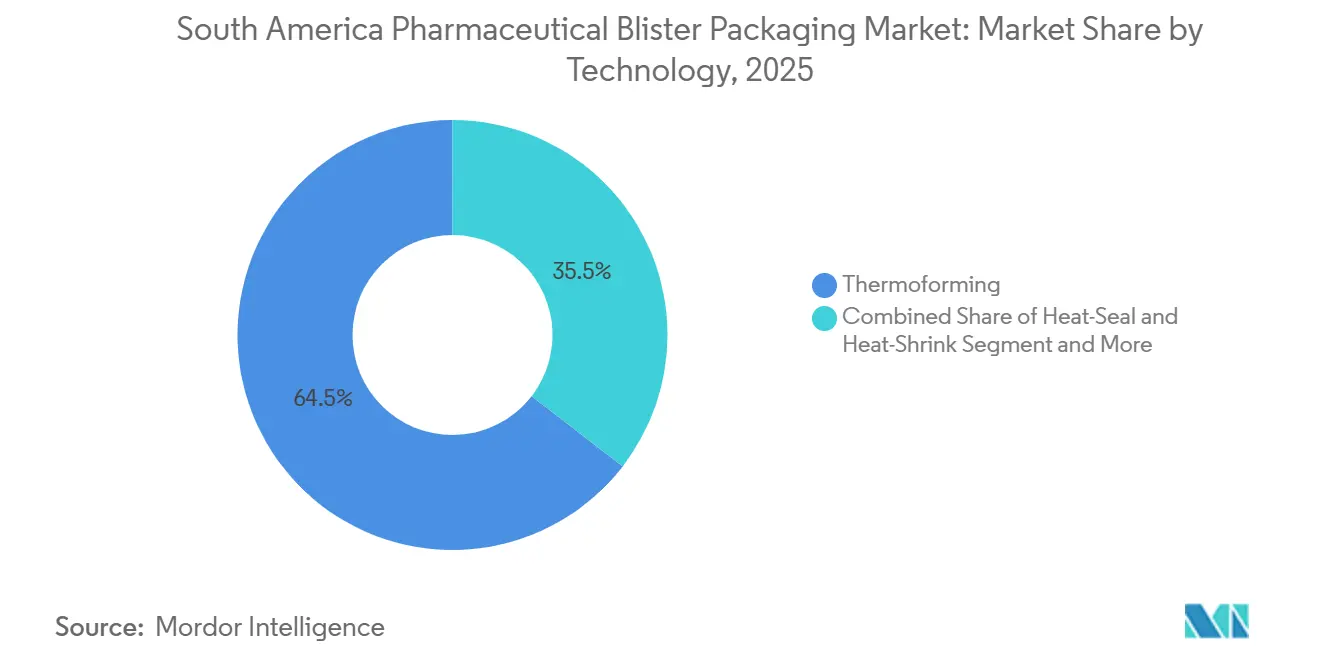
Cold Forming Gains Traction on Thermoformed FormatsThermoforming commanded 64.53% of the 2025 technology share because it suits high-volume oral solid packaging. It is compatible with standard PVC films and supports the production requirements of many generic-drug manufacturers. The established equipment base also makes thermoforming familiar to local converters and pharmaceutical quality teams. Its lower tooling requirements support routine packaging changes across broad product portfolios. This installed base preserves the technology's leading position in the South America pharmaceutical blister packaging market The issue links material selection with operating reliability, documented quality controls, and the everyday requirements of medicine distribution, while application needs vary by dosage form, so converters must match cavity design, lidding behavior, dose protection, and patient access with a customer’s established manufacturing and quality processes.
Cold forming is projected to expand at a 6.79% CAGR through 2031 because it offers a higher barrier for hygroscopic medicines. It is particularly relevant where tropical storage conditions increase the risk that moisture can affect product stability. Aluminum-based cold-form structures also support specialty medicine packs that require high protection during distribution. The technology can require more material and more specialized operating knowledge than standard thermoforming. Suppliers that provide validated materials, line support, and regulatory documentation can reduce this adoption barrier. Heat-seal and heat-shrink technologies retain a smaller role in diagnostic and medical-device packaging applications These conditions make supply continuity and validated performance central considerations for pharmaceutical companies choosing packaging partners End users also assess supplier performance through documentation, response time, and the ability to sustain a qualified pack through routine product changes, planned production campaigns, and changing compliance requirements.
By Application:
Tablets Anchor Demand as Oral Thin Films AccelerateTablets accounted for 49.78% of the 2025 application share, reflecting the importance of generic solid oral medicines in the region. Blister thermoforming offers a cost-effective way to package these large volumes in individual doses. Tablets also fit the dominant retail pharmacy and hospital dispensing models across Brazil and Argentina. The South America pharmaceutical blister packaging market share for tablets was 49.78% in 2025, which reflects this established production base. Capsules remain another important application because Brazil has a developed capsule supply ecosystem. These dosage forms continue to support demand for standard blister structures The same factors influence procurement decisions because changes in packaging can require coordination among manufacturing, quality, regulatory, and commercial teams Format selection remains a practical balance between patient handling, protection, production speed, and the validation effort required before a pharmaceutical company can make a durable commercial change.
Oral thin films and lozenges are expected to expand at a 7.94% CAGR through 2031. Their use can support products where fast onset and convenient administration are important to patients. These formats often require specialized forming equipment and packaging that protects the dose from humidity. Diagnostic kits also use peelable blisters to protect reactive strips during distribution and storage. Other applications, including effervescent tablets, support smaller but expanding volumes in retail self-medication channels. This mix broadens demand beyond conventional tablet packs without displacing the large installed base for standard solid oral products As a result, companies generally assess these options within existing production systems rather than treating packaging as an isolated purchase, and the category also remains useful for manufacturers that need a familiar pack configuration across multiple medicines and distribution settings, while keeping production planning aligned with established equipment and operator training.
By End User:
CDMOs Signal a Structural Outsourcing ShiftBranded and generic pharmaceutical manufacturers held 65.18% of the 2025 end-user share. Leading regional drug companies operate integrated packaging lines and retain direct control over primary-packaging specifications. Their large production runs support consistent demand for films, foil, and converted blister packs. These manufacturers also need reliable material supply because interruptions can affect medicine availability. The South America pharmaceutical blister packaging market continues to depend on their broad portfolios of established solid oral products This approach keeps attention on medicine protection, patient use, manufacturing practicality, and the documentation needed for regulated supply, creating a need for suppliers to work closely with pharmaceutical teams on opening performance, pack information, child protection expectations, and the practical needs of patients who manage recurring medicine schedules.
Contract development and manufacturing organizations are projected to expand at a 7.18% CAGR through 2031. Pharmaceutical companies are using outsourced capacity while regional contract producers pursue qualification for export-grade packaging standards. IFC financing for pharmaceutical businesses in Brazil, Argentina, Colombia, and El Salvador supports the expansion of regional production capabilities. Contract packaging organizations serve related needs, including child-resistant formats and serialization-compliant production. Both groups need validated lines before they can supply regulated multinational programs. This requirement favors operators able to invest in compliance systems, inspection equipment, and documented production controls The outcome is shaped by local conversion capacity as well as the ability to maintain consistent pack quality during routine commercial production, while material decisions also require attention to forming behavior, seal integrity, printing, supply availability, and the full set of product requirements that apply before a commercial medicine pack is released.
By Packaging Format:
Push-Through Formats Hold Share as Peelable Demand SurgesPush-through blisters retained 36.72% of the 2025 packaging-format share. The format is widely understood by patients and pharmacy staff, and it remains compatible with high-speed thermoforming operations. It is used across retail pharmacy and consumer healthcare channels because it provides a practical balance of protection, cost, and dispensing convenience. Its established role makes it difficult for alternative formats to displace in routine tablet packaging. The South America pharmaceutical blister packaging market size for push-through blisters remained supported by large generic-drug volumes in 2025 This matters because packaging decisions must fit established pharmaceutical quality procedures, production schedules, and distribution practices across the region, while the change favors providers that can explain how each option works in regional storage conditions and on available equipment, rather than offering barrier performance as a separate technical feature.
Peelable blisters are projected to expand at a 7.45% CAGR through 2031. Argentina's hospital unit-dose requirements support peelable, individually identifiable blisters for oral solid medicines. The format can also suit diagnostic products and medicines where a patient needs controlled access to each dose. Alu-Alu structures serve premium moisture-sensitive and temperature-sensitive drugs that need strong barrier protection. PVC-PVDC packs provide an intermediate barrier option for prescription medicines. PVC-PET and polypropylene formats are gaining attention where suppliers seek structures more compatible with material recovery objectives, while application needs vary by dosage form, so converters must match cavity design, lidding behavior, dose protection, and patient access with a customer’s established manufacturing and quality processes.
Geography Analysis
Brazil Pharmaceutical Blister Packaging Market
Brazil held 55.47% of the South America pharmaceutical blister packaging market share in 2025. São Paulo and Minas Gerais contain dense pharmaceutical manufacturing clusters and a large part of the region's packaging conversion capacity. The country's serialization framework has increased the need for compliant coding and verification on medicine packs. Eurofarma's Montes Claros complex began operations in October 2025 and produces more than 600 million solid-oral units each year. This production capacity supports continuing demand for blister films, foil, and conversion services. Brazil's biosimilar and oncology pipeline also increases the relevance of high-barrier packaging for selected products This matters because packaging decisions must fit established pharmaceutical quality procedures, production schedules, and distribution practices across the region, and these conditions also require suppliers to match regional material supply with the quality documentation and technical service expected by large medicine manufacturers, hospital customers, and retail distribution networks.
Argentina Pharmaceutical Blister Packaging Market
Argentina is projected to expand at a 7.62% CAGR through 2031, the fastest rate among the geographic segments. Regulatory requirements for QR or Data Matrix codes are prompting investment in packaging traceability systems. Pharmaceutical investment and contract manufacturing activity can support demand for compliant blister lines. At the same time, currency volatility can increase input costs for converters that depend on imported materials. Packaging suppliers need to manage both compliance investment and price uncertainty when serving Argentina. These conditions make local production capability and established customer relationships important competitive factors The requirement also affects how manufacturers coordinate material qualification, line operation, product release, and pharmacy supply activities, while the country’s faster expansion will depend on how effectively pharmaceutical manufacturers and converters manage investment needs alongside routine sourcing, quality approval, and product supply requirements. Packaging suppliers that can support validated production, stable material supply, and documentation for traceability requirements may be better placed to serve this changing customer base, while operators without those capabilities can face more difficult qualification processes.
South America Pharmaceutical Blister Packaging Market
Colombia remains smaller by volume but has specific packaging compliance requirements that affect converter decisions. Its medicine registration framework and braille-related packaging requirements add design and documentation work for pharmaceutical suppliers. Environmental rules also encourage interest in recyclable and mono-material structures. Chile is important for packaging sustainability because its recovery requirements place additional pressure on multilayer structures. Paraguay is emerging as a near-shoring location, and regional pharmaceutical capacity investments can create additional demand beyond Brazil. Peru and Uruguay mainly serve domestic generic demand and still source much packaging through regional trade. The South America pharmaceutical blister packaging market is therefore shaped by Brazil's scale, Argentina's faster expansion, and country-level regulations across the remaining markets These country differences mean that suppliers need a regional approach while retaining the flexibility to address local regulations, customer qualification practices, packaging preferences, and production-scale requirements.
Competitive Landscape
The South America pharmaceutical blister packaging market has a two-tier supply structure. Global material suppliers provide high-barrier films, laminates, and aluminum foils to regional converters and pharmaceutical customers. Important global suppliers include Constantia Flexibles, Klöckner Pentaplast, ACG Pharmapack, Bilcare, Perlen Packaging, Tekni-Plex, and UFlex. Regional specialists include Blisterpack Embalagens, Blistal, Serpac Embalagens Farmacêuticas, Dapack Embalagens, Berkes, Blipack, and Meprec. Material supply is moderately concentrated, while conversion and packaging services are more fragmented. Local converters retain contracts through proximity, established audit relationships, and familiarity with country-specific requirements This matters because packaging decisions must fit established pharmaceutical quality procedures, production schedules, and distribution practices across the region, and this structure gives local companies an important role in day-to-day supply, especially when customers need short response times, smaller production runs, and direct support during packaging qualification.
Sustainability has become an important area of product differentiation. Constantia Flexibles announced REGULA CIRC in August 2026 as a PVC-free cold-form pharmaceutical blister structure. Klöckner Pentaplast markets recyclable rigid pharmaceutical films that respond to the shift toward material recovery. These offers address the increasing need for formats that can meet environmental requirements without weakening medicine protection. Suppliers still need pharmaceutical customers to complete stability testing and regulatory validation before a new structure can be used at scale. This makes technical support and quality documentation part of the competitive offer, not an optional service The requirement also affects how manufacturers coordinate material qualification, line operation, product release, and pharmacy supply activities, while competitive success therefore depends on the ability to translate a material innovation into a dependable commercial packaging solution that works for the medicine, the production line, and the relevant quality system.
Serialization-ready, small-batch cold-form services are an area where regional capacity remains limited. Converters that can integrate code printing, inspection, and reporting systems are better positioned to serve contract producers. Compliance with pharmaceutical manufacturing requirements raises entry costs for suppliers without local operating history or qualified distribution. Global specialists such as Rollprint and Liveo Research can address niche needs in peelable lids and specialty lidding materials. Local companies remain important in mid-volume generic packaging because individual product lines may not justify a global supplier's operating model. Competitive activity therefore combines global material innovation with local service responsiveness. The result is a market where scale provides advantages in materials and technology, while regional operators compete through service, customer familiarity, and the practical execution of regulated packaging work.
South America Pharmaceutical Blister Packaging Industry Leaders
-
Constantia Flexibles Group GmbH
-
Tekni-Plex, Inc.
-
Klöckner Pentaplast Group
-
Bilcare Limited
-
Perlen Packaging AG
- *Disclaimer: Major Players sorted in no particular order
South America Pharmaceutical Blister Packaging Market Companies Covered in this Report
- Constantia Flexibles Group GmbH
- Tekni-Plex, Inc.
- Klöckner Pentaplast Group
- Bilcare Limited
- Perlen Packaging AG
- ACG Pharmapack Private Limited
- UFlex Limited
- Aluflexpack AG
- Liveo Research GmbH
- Rollprint Packaging Products, Inc.
- R-Pharm Germany GmbH
- Shanghai Haishun New Pharmaceutical Packaging Co., Ltd.
- Zibo Zhongnan Pharmaceutical Packaging Materials Co., Ltd.
- Nantong Huideseng Packaging Co., Ltd.
- Shanghai Hongli Pharmaceutical Packaging Materials Co., Ltd.
- Yangzhou Jerel Pharmaceutical New Material Co., Ltd.
- Svam Toyal Packaging Industries Private Limited
- Blisterpack Embalagens Ltda.
- Blistal S.A.
- Serpac Embalagens Farmacêuticas Ltda.
- Dapack Embalagens Ltda.
- Berkes S.A.
- Blipack S.A.
- Meprec S.A.S.
Recent Industry Developments in South America Pharmaceutical Blister Packaging Market
- August 2026: Laboratório Cristália assumed operation of the former Takeda pharmaceutical facility in Jaguariúna, São Paulo, following CADE approval. The ANVISA GMP-certified unit specializes in solid dosage forms, and Cristália projected a production capacity increase of 50-70% depending on pharmaceutical form. The development expanded solid-oral drug output and blister packaging demand in southeast Brazil.
- August 2026: Eurofarma received environmental authorization from CODEMA to expand its Montes Claros industrial complex with a new production line for Valda lozenges. The project extended production at one of the Southern Hemisphere's largest pharmaceutical plants and created additional demand for blister packaging materials at the same campus.
- August 2026: Constantia Flexibles announced REGULA CIRC, a PVC-free cold-forming blister structure for pharmaceutical applications. The product had an independently verified 88% sorting efficiency and a 50% lower carbon footprint than conventional PVC-containing Alu-Alu blisters. It targets pharmaceutical companies responding to evolving extended producer responsibility frameworks.
- May 2026: Elea's shareholders (Argentina) completed the acquisition of Cellera Farma, Brazil's youngest domestically controlled pharmaceutical manufacturer, targeting rapid portfolio expansion into the region's largest pharmaceutical market. The transaction is expected to unlock a projected BRL 500 million (approximately USD 85.5 million) additional revenue pipeline, generating commensurate blister packaging demand as Cellera scales its solid-oral dosage output.
South America Pharmaceutical Blister Packaging Market Report Scope
The South America Pharmaceutical Blister Packaging Market refers to the industry involved in the production, supply, and utilization of blister packaging solutions used for pharmaceutical products across countries such as Brazil, Argentina, Colombia, and the rest of South America.
The South America Pharmaceutical Blister Packaging Market Report is Segmented by Product Type (Carded and Face-Seal Blisters, Clamshell Blisters, Trapped and Full-Card Blisters, Child-Resistant and Senior-Friendly Blisters, and Other Product Types), Material (Plastic Films, Aluminum Foil, Paper and Paperboard, and Other Materials), Technology (Thermoforming, Cold Forming, and Heat-Seal and Heat-Shrink), Application (Tablets, Capsules, Oral Thin Films and Lozenges, Diagnostic Kits, and Other Applications), End User (Branded and Generic Pharmaceutical Manufacturers, Contract Development and Manufacturing Organizations, and Contract Packaging Organizations), Packaging Format (Push-Through Blisters, Peelable Blisters, Alu-Alu Blisters, PVC-PVDC Blisters, and PVC-PET and Polypropylene Blisters), and Geography (Brazil, Argentina, Colombia, and Rest of South America). The Market Forecasts are Provided in Terms of Value (USD).
Segmentation Overview
| Carded and Face-Seal Blisters |
| Clamshell Blisters |
| Trapped and Full-Card Blisters |
| Child-Resistant and Senior-Friendly Blisters |
| Other Product Types |
| Plastic Films |
| Aluminum Foil |
| Paper and Paperboard |
| Other Materials |
| Thermoforming |
| Cold Forming |
| Heat-Seal and Heat-Shrink |
| Tablets |
| Capsules |
| Oral Thin Films and Lozenges |
| Diagnostic Kits |
| Other Applications |
| Branded and Generic Pharmaceutical Manufacturers |
| Contract Development and Manufacturing Organizations |
| Contract Packaging Organizations |
| Push-Through Blisters |
| Peelable Blisters |
| Alu-Alu Blisters |
| PVC-PVDC Blisters |
| PVC-PET and Polypropylene Blisters |
| Brazil |
| Argentina |
| Colombia |
| Rest of South America |
| By Product Type | Carded and Face-Seal Blisters |
| Clamshell Blisters | |
| Trapped and Full-Card Blisters | |
| Child-Resistant and Senior-Friendly Blisters | |
| Other Product Types | |
| By Material | Plastic Films |
| Aluminum Foil | |
| Paper and Paperboard | |
| Other Materials | |
| By Technology | Thermoforming |
| Cold Forming | |
| Heat-Seal and Heat-Shrink | |
| By Application | Tablets |
| Capsules | |
| Oral Thin Films and Lozenges | |
| Diagnostic Kits | |
| Other Applications | |
| By End User | Branded and Generic Pharmaceutical Manufacturers |
| Contract Development and Manufacturing Organizations | |
| Contract Packaging Organizations | |
| By Packaging Format | Push-Through Blisters |
| Peelable Blisters | |
| Alu-Alu Blisters | |
| PVC-PVDC Blisters | |
| PVC-PET and Polypropylene Blisters | |
| By Geography | Brazil |
| Argentina | |
| Colombia | |
| Rest of South America |
Key Questions Answered in the Report
What is the size of the South America pharmaceutical blister packaging market?
The South America pharmaceutical blister packaging market was estimated at USD 1.26 billion in 2026 and is forecast to reach USD 1.72 billion by 2031, at a 6.42% CAGR. The outlook is supported by generic-drug production, serialization-related line investment, chronic-therapy volumes, and demand for moisture-protective packaging.
Which country has the largest pharmaceutical blister packaging demand in South America?
Brazil held 55.47% of regional demand in 2025, supported by its large pharmaceutical manufacturing base and serialization requirements. Its manufacturing clusters and large solid-oral production base support continuing demand for films, foil, converted blisters, and compliance-ready packaging services.
Which pharmaceutical blister packaging format is expanding fastest in South America?
Peelable blisters are expected to expand at a 7.45% CAGR through 2031, supported by hospital unit-dose requirements and diagnostic applications. The format supports individually identifiable doses and can meet hospital needs where controlled opening and medicine protection are required.
Why is cold-form packaging becoming more important for medicines in South America?
Cold-form structures provide high moisture protection for hygroscopic and specialty medicines stored in tropical conditions. These structures are used where conventional packs may not provide sufficient protection for hygroscopic or specialty medicines during storage and distribution.
What materials are gaining interest for pharmaceutical blisters in South America?
Paper and paperboard is expected to expand at a 7.51% CAGR through 2031, while recyclable and PVC-free structures are gaining attention. The transition remains product specific because pharmaceutical companies must establish stability, manufacturability, and regulatory suitability before qualifying a replacement pack.
How do serialization rules affect pharmaceutical packaging suppliers?
Suppliers need validated coding, inspection, and reporting capabilities to serve regulated pharmaceutical manufacturers and contract producers. These functions have become important because regulated medicine programs require consistent production records and demonstrated control over code application and verification.