
Market Overview
| Study Period | 2020 - 2031 |
|---|---|
| Forecast Data Period | 2026 - 2031 |
| Base Year Market Size (2025) | USD 0.38 Billion |
| Market Size (2026) | USD 0.41 Billion |
| Market Size (2031) | USD 0.56 Billion |
| Growth Rate (2026 - 2031) | 6.50 % |
| Market Concentration | Medium |
Major Players *Disclaimer: Major Players sorted in no particular order Image © Mordor Intelligence. Reuse requires attribution under CC BY 4.0. | |
South America Pancreatic Cancer Therapeutics and Diagnostics Market Analysis by Mordor Intelligence
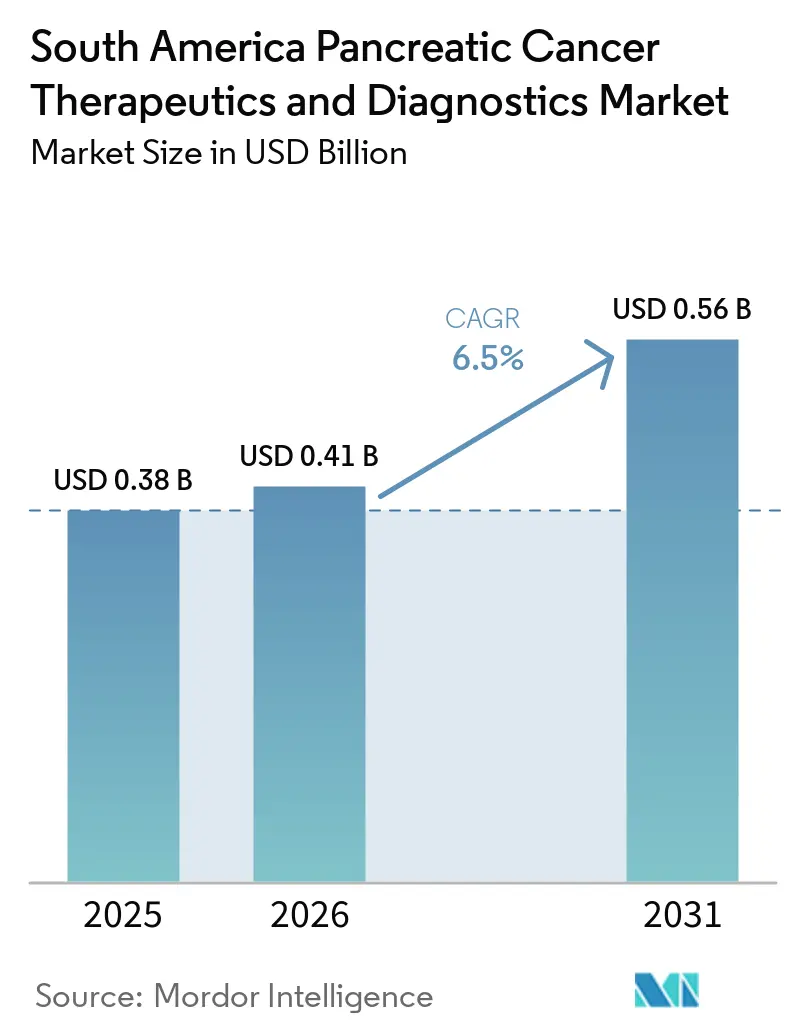
The South America Pancreatic Cancer Therapeutics and Diagnostics Market size was valued at USD 0.38 billion in 2025 and is estimated to grow from USD 0.41 billion in 2026 to reach USD 0.56 billion by 2031, at a CAGR of 6.5% during the forecast period (2026–2031).
Pancreatic cancer creates sustained demand because late-stage presentation remains common across the region. Brazil has the largest patient base and serves as the main regulatory and commercial entry point. Rising obesity and type 2 diabetes add to the disease burden and increase the need for treatment and testing. Combination chemotherapy remains central to care, while molecular profiling is becoming more important for treatment selection. Private oncology networks and reference laboratories are extending diagnostic access, although affordability and uneven public-system capacity continue to limit adoption outside major cities.
Key Report Takeaways
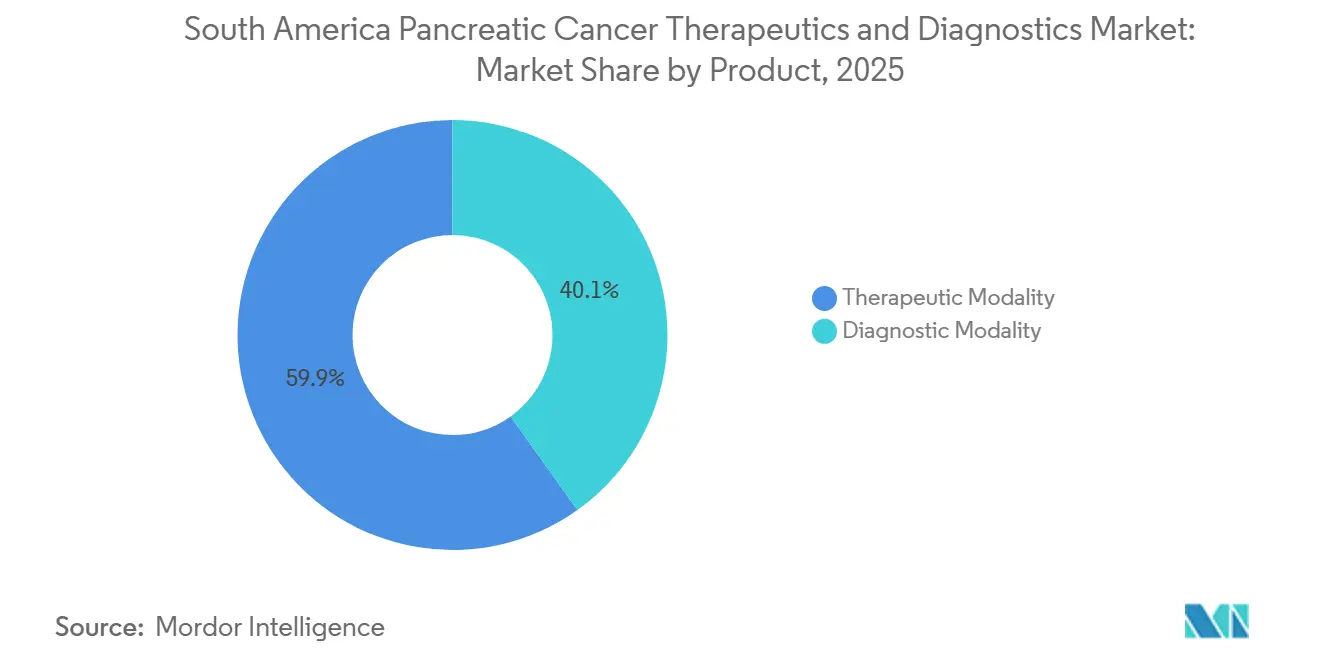
- By product, therapeutics held 59.87% of South America's pancreatic cancer therapeutics and diagnostics market share in 2025, while diagnostic modality is projected to grow at a 7.55% CAGR through 2031.
- By end user, hospitals and academic medical centers held 52.67% of South America's pancreatic cancer therapeutics and diagnostics market share in 2025, while diagnostic laboratories are projected to grow at an 8.56% CAGR through 2031.
- By geography, Brazil held 46.96% of South America's pancreatic cancer therapeutics and diagnostics market share in 2025, while Argentina is the projected-growing country through 2031.
Note: Market size and forecast figures in this report are generated using Mordor Intelligence’s proprietary estimation framework, updated with the latest available data and insights as of January 2026.
South America Pancreatic Cancer Therapeutics and Diagnostics Market Trends and Insights
Drivers Impact Analysis*
| DRIVER | (~) % IMPACT ON CAGR FORECAST | GEOGRAPHIC RELEVANCE | IMPACT TIMELINE |
|---|---|---|---|
| Increasing pancreatic cancer burden | +1.5% | Brazil, Argentina, Peru | Short term (≤ 2 years) |
| Expansion of advanced oncology diagnostics | +1.3% | Brazil, Argentina, Colombia | Medium term (2-4 years) |
| Rising use of combination chemotherapy regimens | +1.1% | Brazil, Argentina, Chile | Short term (≤ 2 years) |
| Growth of precision oncology and biomarker testing | +1.2% | Brazil, Argentina | Medium term (2-4 years) |
| Centralization of complex pancreatic cancer care | +0.7% | Brazil and Argentina | Short term (≤ 2 years) |
| Expansion of clinical trial activity in south america | +0.5% | Brazil and Argentina | Long term (≥ 4 years) |
| Source: Mordor Intelligence | |||
Increasing Pancreatic Cancer Burden Accelerates Treatment Demand
The rising pancreatic cancer burden supported demand in the South American pancreatic cancer therapeutics and diagnostics market. A January 2025 analysis reported that Brazil’s age-standardized incidence increased by 0.7% annually from 1990 to 2019 for both sexes, while Peru recorded the region’s sharpest increase, at 3.0% to 3.9% annually. Brazil’s annual case volume rose from 4,431 in 1990 to 14,430 in 2019, while Argentina recorded incidence rates of 12.7 per 100,000 men and 10.5 per 100,000 women, with rising mortality trends.[1] INCA projected 10,980 new pancreatic cancer cases annually in Brazil during the 2023–2025 estimation period, highlighting the need to expand treatment capacity beyond metropolitan hospitals.[2]
Expansion of Advanced Oncology Diagnostics Creates New Revenue Pools
Advanced diagnostics expanded beyond a limited number of metropolitan laboratories in the South American pancreatic cancer therapeutics and diagnostics market. Greater adoption of molecular testing linked diagnostic demand with targeted therapy approvals, as each treatment target required reliable patient identification before prescribing decisions. Companion diagnostics became increasingly integral to treatment access rather than a standalone laboratory service. Centralized laboratory models improved sample logistics and reporting capabilities for hospitals outside major cancer centers, supporting diagnostic revenue growth through biomarker selection and genomic profiling.
Rising Use of Combination Chemotherapy Regimens Sustains Therapeutic Market
Combination chemotherapy remained a key source of treatment activity in the South America pancreatic cancer therapeutics and diagnostics market. FOLFIRINOX was used for fit patients with metastatic pancreatic ductal adenocarcinoma, while gemcitabine plus nab-paclitaxel remained an established option. A Latin American single-center study found that gemcitabine plus nab-paclitaxel after FOLFIRINOX progression delivered outcomes comparable with Western and Asian benchmarks. NALIRIFOX demonstrated median overall survival of 11.1 months versus 9.2 months for gemcitabine plus nab-paclitaxel, and median progression-free survival of 7.4 months versus 5.6 months, increasing infusion, imaging, laboratory monitoring, and supportive care requirements.
Growth of Precision Oncology and Biomarker Testing Unlocks Targeted Therapy Access
Precision oncology became increasingly established in the South America pancreatic cancer therapeutics and diagnostics market. In February 2025, MGI Tech partnered with Oncoclínicas&Co to install the DNBSEQ-G400 sequencer at OC Medicina de Precisão in São Paulo. The center supported 1,000 genomic samples per month, including germline cancer-syndrome and somatic panels, while Oncoclínicas&Co operated 144 units across 40 Brazilian cities. Brazil’s Genomas Brasil program integrated large-scale genomics into the Unified Health System infrastructure, and KRAS profiling remained relevant as KRAS mutations occurred in more than 90% of pancreatic ductal adenocarcinoma cases.
Restraints Impact Analysis*
| RESTRAINT | (~) % IMPACT ON CAGR FORECAST | GEOGRAPHIC RELEVANCE | IMPACT TIMELINE |
|---|---|---|---|
| High cost of multimodal treatment and molecular testing | -0.8% | Brazil, Colombia, Peru, Chile | Short term (≤ 2 years) |
| Late diagnosis and limited resectability at presentation | -0.6% | All countries, particularly Peru and Colombia | Short term (≤ 2 years) |
| Public-system budget constraints and unequal treatment access | -0.9% | Brazil, Colombia, Peru | Medium term (2-4 years) |
| Fragmented tissue-to-genomics logistics outside major hubs | -0.5% | Non-metropolitan areas across all countries | Long term (≥ 4 years) |
| Source: Mordor Intelligence | |||
High Cost of Multimodal Treatment and Molecular Testing Limits Addressable Volume
High treatment and testing costs restricted the addressable patient population in the South American pancreatic cancer therapeutics and diagnostics market. An ISPOR Europe 2025 analysis reported annual oncology treatment costs of USD 50,054 in Brazil and USD 1,992 in Argentina, compared with USD 134,933 in the United States. Public procurement limits and purchasing-power constraints reduced prices but did not ensure access to advanced therapies or molecular tests. Guardant360 was available through reference laboratories, including Diagnósticos do Brasil, but limited coverage mandates kept uptake concentrated among private-pay and supplemental-insurance patients.
Late Diagnosis and Limited Resectability at Presentation Compresses Therapeutic Opportunity
Late diagnosis limited access to curative-intent treatment in the South American pancreatic cancer therapeutics and diagnostics market. INCA-related information indicated that 80% of Brazilian patients were diagnosed with advanced, non-resectable disease, directing demand toward palliative and later-line regimens. The BLENTI study at Hospital do Coração and the mirPANC 2 trial at Beneficência Portuguesa de São Paulo began in January 2025, reflecting demand for earlier, less invasive detection approaches. The mirPANC 2 trial evaluated a serum-based microRNA panel in patients starting FOLFIRINOX, while broader liquid-biopsy adoption required national-payer reimbursement.
*Our forecasts treat driver/restraint impacts as directional, not additive. The impact forecasts reflect baseline growth, mix effects, and variable interactions.
Segment Analysis
By Product: Diagnostic Modality Growth Reshaping a Therapeutics-Led Market
Diagnostic modalities are the fastest-growing product category in the South America pancreatic cancer therapeutics and diagnostics market, with a CAGR of 7.55% during 2026-2031. Therapeutics remains the larger revenue-generating category due to the widespread use of systemic treatment in advanced disease management. CT, MRI, and PET remain the highest-volume tools for staging and treatment monitoring, while high-volume centers in São Paulo, Buenos Aires, and Bogotá increasingly use endoscopic ultrasound. Biomarker testing and molecular diagnostics are expanding as treatment selection relies more heavily on genomic information; the February 2025 DNBSEQ-G400 deployment supported 1,000 somatic and germline samples per month.
The diagnostics segment benefits from the wider adoption of centralized testing services and trial-led liquid biopsy development. The mirPANC 2 and BLENTI studies in Brazil supported liquid biopsy evidence generation, while the Panuri study began in June 2026 to assess a urine proteolytic-enzyme test for pancreatic ductal adenocarcinoma detection. Therapeutic demand remains anchored in FOLFIRINOX and gemcitabine plus nab-paclitaxel, while olaparib is relevant for the 4%-7% of patients with germline BRCA mutations and pembrolizumab for the rare MSI-H subset. Immunotherapy remains limited by the immunosuppressive pancreatic tumor microenvironment, while radiotherapy is constrained by limited stereotactic body radiotherapy capacity outside major academic centers; ImmunityBio updated its Phase 1 neoadjuvant chemoimmunotherapy protocol in April 2026.
By End User: Diagnostic Laboratories Gaining Share Fastest as Molecular Testing Scales
Diagnostic laboratories are the fastest-growing end-user group in the South America pancreatic cancer therapeutics and diagnostics market, with a forecast CAGR of 8.56% during 2026-2031. Hospitals and academic medical centers retain the largest revenue position due to their provision of chemotherapy, advanced imaging, endoscopic procedures, and inpatient care. Laboratories are expanding as hospitals outsource comprehensive genomic testing when they lack in-house sequencing and bioinformatics capabilities. Guardant360 availability through reference laboratory networks supports centralized sample management, molecular result delivery, and companion diagnostic workflows.
Hospitals and academic medical centers remain critical for infusion-based treatment, complex imaging, and endoscopic procedures. Oncoclínicas&Co delivered 635,000 treatments annually across 144 units in 40 Brazilian cities, making it an important access point for pharmaceutical and diagnostic companies. Oncology specialty clinics are receiving a larger share of day-treatment chemotherapy as FOLFIRINOX moves from inpatient settings. Research institutes contribute through trial-linked imaging, pathology, and molecular workflows, while the industry favors hospitals for treatment delivery and laboratories for scalable molecular diagnostics.
Geography Analysis
Brazil held 46.96% of the South America pancreatic cancer therapeutics and diagnostics market share in 2025, supported by its established oncology infrastructure and position as the region’s primary regulatory and commercial gateway. The Genomas Brasil program integrated precision genomics into the Unified Health System and could expand testing beyond the private-pay base in São Paulo and Rio de Janeiro. ANVISA registered Onivyde in April 2025, and Servier made it commercially available at Brazilian oncology centers in February 2026.
The São Paulo corridor included Oncoclínicas&Co, Hospital do Coração, Beneficência Portuguesa, and AC Camargo Cancer Center, supporting clinical trial enrollment and complex diagnostic procedures. This concentration attracted diagnostic platform deployments and pharmaceutical sponsor activity. SUS genomic capacity could increase molecular testing volumes in secondary cities during the forecast period, and Brazil will remain the main source of regional treatment and diagnostic demand.
Colombia, Chile, Peru, and the rest of South America accounted for the remaining regional revenue share. Colombia’s age-standardized incidence declined by 0.5% annually from 1990 to 2019, although absolute cases increased with population growth and private diagnostic capacity expanded in Bogotá and Medellín. Chile showed no significant incidence change and recorded steady growth, supported by its public-private healthcare structure. Peru recorded the region’s sharpest annual incidence increase, ranging from 3.0% to 3.9% for both sexes, while cancer infrastructure at INEN and EsSalud remained a limiting factor. Differences in diagnostic access and treatment capacity between capital-city hubs and outlying areas shaped the South America pancreatic cancer therapeutics and diagnostics market.
Competitive Landscape
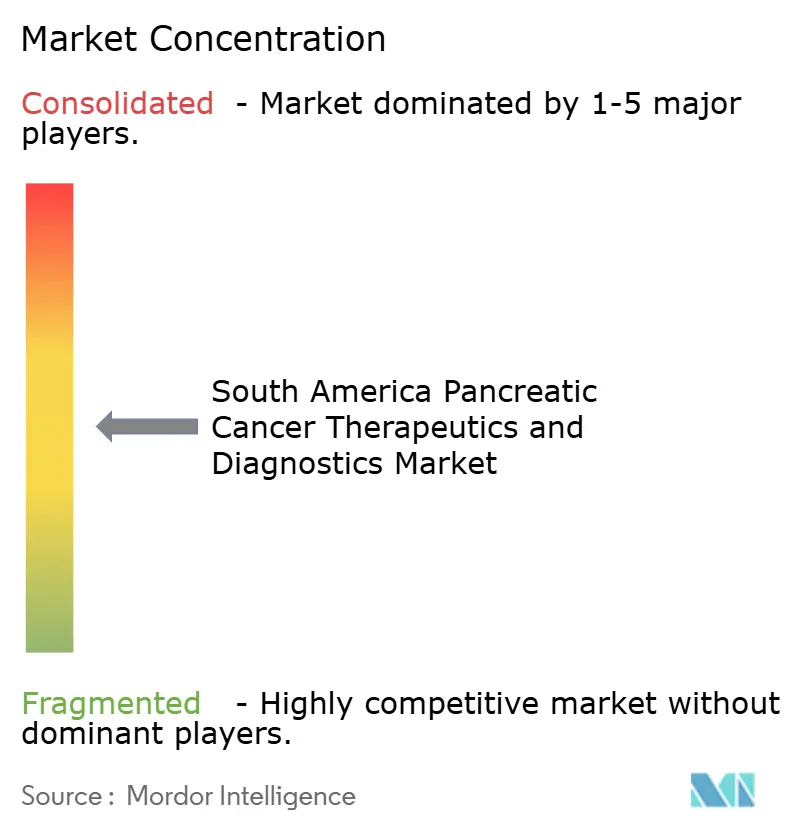
The South America pancreatic cancer therapeutics and diagnostics market has a moderately consolidated therapeutics segment and a fragmented diagnostics segment. AstraZeneca, Merck Sharp & Dohme, F. Hoffmann-La Roche, and Eli Lilly hold established positions through oncology portfolios and medical affairs networks in Brazil and Argentina. AstraZeneca supplies Lynparza for germline BRCA-mutated patients, Merck Sharp & Dohme supplies Keytruda for MSI-H cases, Roche offers FoundationOne CDx and Avastin, and Eli Lilly offers Gemzar. Competition depends on formulary access, physician engagement, and support for biomarker-led treatment selection.
Servier made Onivyde commercially available at Brazilian oncology centers in February 2026 as a post-gemcitabine option for metastatic pancreatic ductal adenocarcinoma. This launch demonstrates the opportunity for specialty pharmaceutical companies to address late-line patient groups that have received limited attention from larger competitors. The diagnostics landscape includes Illumina, Guardant Health, QIAGEN, Siemens Healthineers, GE HealthCare, regional laboratory networks, and Roche’s Foundation Medicine. Reimbursement limitations for high-cost therapies and molecular tests remain a key market constraint.
Siemens Healthineers uses long-term Value Partnerships with hospital networks in Brazil and Argentina, combining PET/CT, MRI, and AI-assisted oncology imaging through managed-service contracts. These arrangements can increase switching barriers for installed imaging systems. A 2026 study documented challenges in next-generation sequencing implementation at a Brazilian public hospital, highlighting the importance of training, workflow integration, and logistics. Daraxonrasib could create demand for KRAS mutation profiling if it receives local approval.
South America Pancreatic Cancer Therapeutics and Diagnostics Industry Leaders
-
AstraZeneca PLC
-
Novartis AG
-
Pfizer Inc.
-
Sanofi
-
F. Hoffmann-La Roche Ltd
- *Disclaimer: Major Players sorted in no particular order
Recent Industry Developments
- June 2026: Urteste S.A. initiated the Panuri Performance Study (NCT07587866), a prospective, multisite observational study of a urine proteolytic enzyme test for pancreatic ductal adenocarcinoma detection in symptomatic patients, with primary completion targeted for January 2028.
- June 2026: RASolute 302 results presented at ASCO 2026 showed median overall survival of 13.2 months with daraxonrasib versus 6.7 months with chemotherapy; the EMA granted orphan drug designation and initiated a phased marketing authorization review.
- February 2026: Servier made Onivyde commercially available at Brazilian oncology centers following ANVISA registration, providing a post-gemcitabine treatment option for metastatic pancreatic ductal adenocarcinoma supported by the Phase 3 NAPOLI-1 trial.
- February 2025: MGI Tech and Oncoclínicas&Co deployed the DNBSEQ-G400 platform at OC Medicina de Precisão in São Paulo, expanding throughput and potentially reducing per-test costs for comprehensive cancer profiling.
South America Pancreatic Cancer Therapeutics and Diagnostics Market Report Scope
As per the scope of the report, pancreatic cancer therapeutics and diagnostics refer to the medical tests used to find cancer in the pancreas and the medicines or procedures used to treat it. This field covers tools that spot tumors early, blood tests that check for warning signs, and therapies like surgery, radiation, and drugs to fight the disease.
The South American pancreatic cancer therapeutics and diagnostics market is segmented by product, end user, and geography. By product, the market is segmented into therapeutic modalities and diagnostic modalities. Therapeutic modalities include chemotherapy, targeted therapy, immunotherapy, radiotherapy, and combination therapy. Diagnostic modalities include imaging (CT, MRI, and PET), endoscopic ultrasound (EUS), biomarker testing, liquid biopsy, and molecular diagnostics. By end user, the market is segmented into hospitals and academic medical centers, oncology specialty clinics, diagnostic laboratories, and research institutes. By geography, the market is analyzed across Brazil, Argentina, Colombia, Chile, Peru, and the Rest of South America. The report offers market sizes and forecasts in terms of value (USD) for the above segments.
By Product
| Therapeutic Modality | Chemotherapy |
| Targeted Therapy | |
| Immunotherapy | |
| Radiotherapy | |
| Combination Therapy | |
| Diagnostic Modality | Imaging (CT, MRI, PET) |
| Endoscopic Ultrasound (EUS) | |
| Biomarker Tests | |
| Liquid Biopsy | |
| Molecular Diagnostics |
By End User
| Hospitals & Academic Medical Centers |
| Oncology Specialty Clinics |
| Diagnostic Laboratories |
| Research Institutes |
By Geography
| Brazil |
| Argentina |
| Colombia |
| Chile |
| Peru |
| Rest of South America |
| By Product | Therapeutic Modality | Chemotherapy |
| Targeted Therapy | ||
| Immunotherapy | ||
| Radiotherapy | ||
| Combination Therapy | ||
| Diagnostic Modality | Imaging (CT, MRI, PET) | |
| Endoscopic Ultrasound (EUS) | ||
| Biomarker Tests | ||
| Liquid Biopsy | ||
| Molecular Diagnostics | ||
| By End User | Hospitals & Academic Medical Centers | |
| Oncology Specialty Clinics | ||
| Diagnostic Laboratories | ||
| Research Institutes | ||
| By Geography | Brazil | |
| Argentina | ||
| Colombia | ||
| Chile | ||
| Peru | ||
| Rest of South America | ||
Key Questions Answered in the Report
What is the 2026 value of the South America pancreatic cancer therapeutics and diagnostics market?
The 2026 value is USD 0.408 billion, and the forecast value is USD 0.559 billion by 2031.
What is driving demand for pancreatic cancer treatment in South America?
Rising pancreatic cancer incidence, late-stage presentation, combination chemotherapy use, and wider molecular testing are supporting demand.
Which product category is growing fastest through 2031?
Diagnostic modality is forecast to expand at a CAGR of 7.55% during 2026-2031.
Which end user is growing fastest in pancreatic cancer testing and treatment?
Diagnostic laboratories are forecast to grow at a CAGR of 8.56% through 2031 as centralized molecular testing expands.
Which country leads regional revenue?
Brazil held 46.96% of regional revenue in 2025, supported by its oncology capacity and regulatory role.
What limits access to advanced pancreatic cancer care in South America?
High out-of-pocket costs, limited public reimbursement, late diagnosis, and uneven tissue-to-genomics logistics restrict wider access.