
South America Packaged Chia Seeds Market Size and Share
Market Overview
| Study Period | 2021 - 2031 |
|---|---|
| Forecast Data Period | 2026 - 2031 |
| Base Year Market Size (2025) | USD 35.45 Million |
| Market Size (2026) | USD 39.63 Million |
| Market Size (2031) | USD 72.66 Million |
| Growth Rate (2026 - 2031) | 12.89 % |
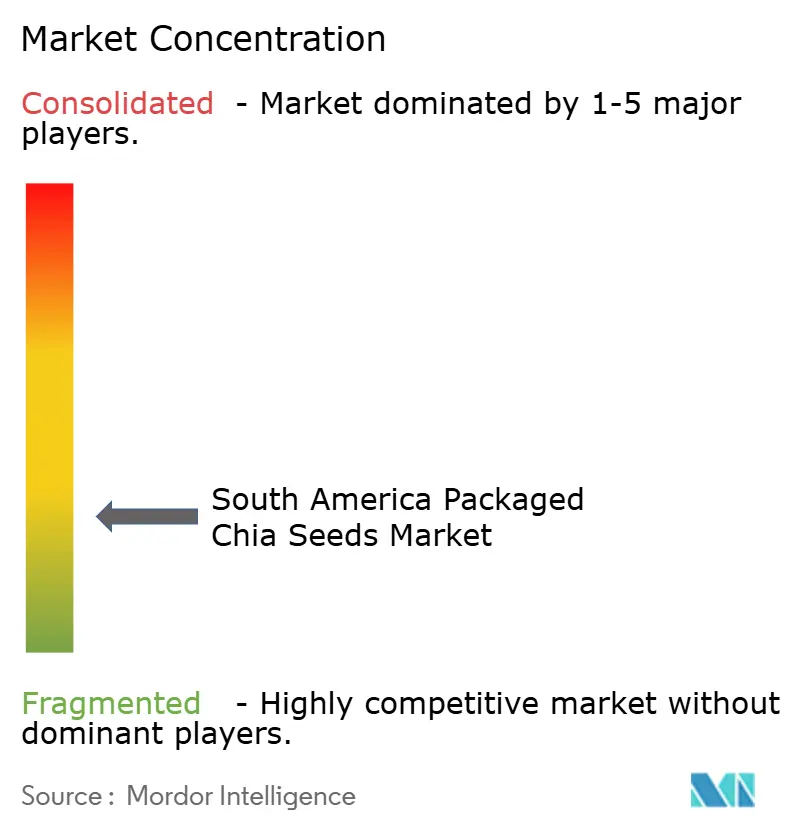
| Market Concentration | Low |
Major Players *Disclaimer: Major Players sorted in no particular order Image © Mordor Intelligence. Reuse requires attribution under CC BY 4.0. | |
South America Packaged Chia Seeds Market Analysis by Mordor Intelligence
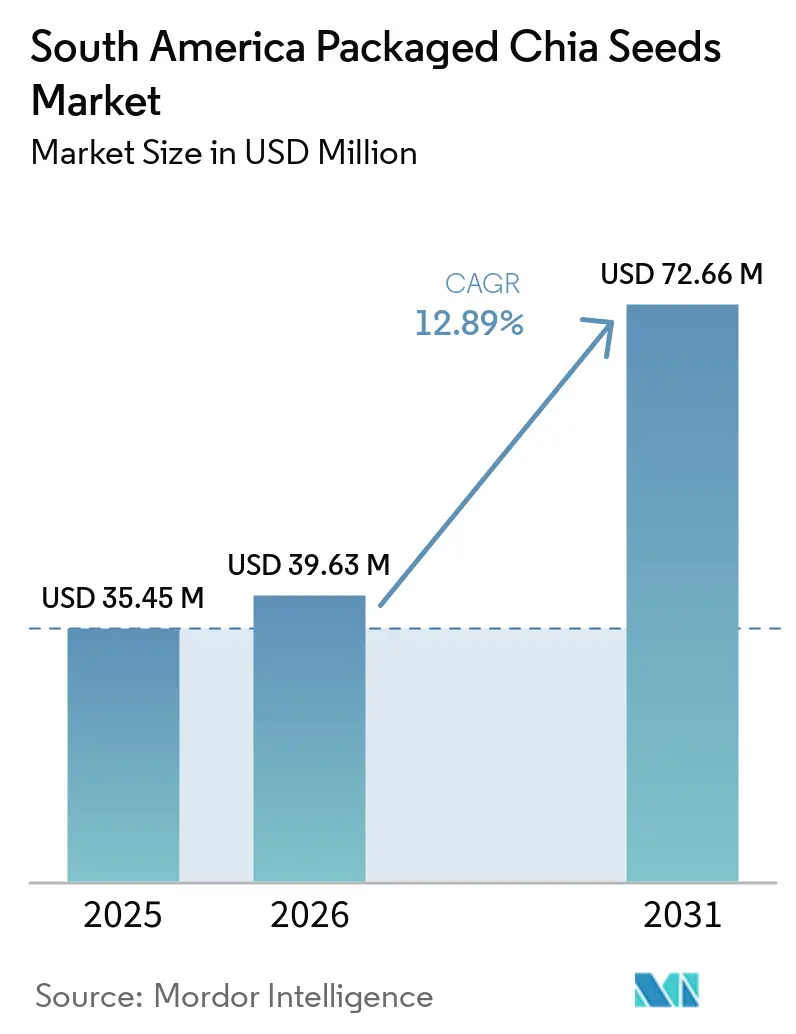
The South America Packaged Chia Seeds Market is expected to grow from USD 35.45 million in 2025 to USD 39.63 million in 2026, reaching USD 72.66 million by 2031, at a CAGR of 12.89% during 2026–2031. Market growth is supported by increasing consumer preference for natural and minimally processed foods, greater interest in nutrient-rich whole-seed products, and the growing integration of chia into everyday diets. The market is also benefiting from greater commercialization of chia through standardized cleaning, grading, sorting, quality control, and packaging processes. The availability of conventional and organic products, clearer ingredient and certification information, convenient pack formats, and expanding online purchasing options is strengthening consumer access and product visibility.
Key Report Takeaways
- By product type, black chia seeds held 52.32% of the South America chia seeds market share in 2025, while white chia seeds are forecast to grow at a 13.74% CAGR through 2031.
- By nature, conventional chia seeds accounted for 82.34% of the South America chia seeds market share in 2025, while organic chia seeds are projected to expand at a 15.12% CAGR through 2031.
- By packaging type, pouches captured 55.18% of the South America chia seeds market share in 2025, while resealable bags are expected to record a 14.86% CAGR through 2031.
- By distribution channel, supermarkets and hypermarkets represented 44.56% of the South America chia seeds market share in 2025, while online retail stores are forecast to grow at a 15.65% CAGR through 2031.
- By geography, Brazil accounted for 34.82% of the South America chia seeds market share in 2025, while Peru is expected to grow at a 14.67% CAGR through 2031.
Note: Market size and forecast figures in this report are generated using Mordor Intelligence’s proprietary estimation framework, updated with the latest available data and insights as of January 2026.
South America Packaged Chia Seeds Market Trends and Insights
Drivers Impact Analysis*
| Driver | (~) % Impact on CAGR Forecast | Geographic Relevance | Impact Timeline |
|---|---|---|---|
| Expansion of plant-based and gluten-free eating | +3.2% | Global demand spill-over, strongest in Brazil, Chile, and Colombia | Medium term (2–4 years) |
| Health and wellness positioning of omega-3 and fiber-rich seeds | +2.9% | Global; concentrated in Brazil and Argentina urban centres | Long term (≥ 4 years) |
| Growing use of chia in breakfast and everyday foods | +2.0% | Brazil, Argentina, Chile (core consumer markets) | Medium term (2–4 years) |
| Increasing consumer interest in natural and minimally processed foods | +1.8% | South America core markets, early gains in Colombia and Peru | Short term (≤ 2 years) |
| Expansion of single-origin chia products | +0.9% | Brazil, Peru, Chile (premium retail) | Medium term (2–4 years) |
| Development of regional chia trade and supply networks | +1.5% | South America (Paraguay, Bolivia, Peru as origin hubs) | Long term (≥ 4 years) |
| Source: Mordor Intelligence | |||
Expansion of Plant-Based and Gluten-Free Eating
The growing adoption of plant-based and gluten-free diets is driving demand in the South American packaged chia seeds market. Consumers are increasingly seeking naturally plant-derived and gluten-free food ingredients with simple, recognizable ingredient profiles, which aligns with chia seeds' inherent characteristics. This shift is also prompting retailers to allocate greater shelf space and introduce more product differentiation within packaged food categories. As plant-based and gluten-free dietary patterns become more established in consumer purchasing behavior, packaged chia seeds are benefiting from their natural compatibility with both trends, supporting broader consumer acceptance and market penetration.
Health and Wellness Positioning of Omega-3 and Fiber-Rich Seeds
The health and wellness positioning of omega-3 and fiber-rich seeds is driving the South American packaged chia seeds market, as the growing burden of obesity increases attention toward healthier food choices and nutritional quality. In 2025, more than 1.5 million adults were registered with obesity in Brazil's Food and Nutrition Surveillance System (SISVAN), according to the World Obesity Federation, highlighting the scale of the country's obesity challenge[1]. This environment is strengthening interest in nutrient-dense foods such as chia seeds, which are naturally rich in dietary fiber and provide plant-based omega-3 fatty acids (ALA), supporting their positioning as a health-oriented packaged food. The growing focus on obesity prevention and healthier eating creates a favorable environment for packaged chia seeds, particularly as consumers increasingly evaluate foods based on their nutritional attributes and contribution to healthier dietary patterns.
Growing Use of Chia in Breakfast and Everyday Foods
The growing use of chia in breakfast and everyday foods is driving the South American packaged chia seeds market by increasing the frequency with which consumers incorporate chia into their regular diets. Its versatility, mild flavor, and ability to blend easily with commonly consumed foods make chia suitable for routine consumption rather than occasional use. This supports repeated household purchases and encourages packaged chia seeds to move from a niche ingredient toward a more regularly purchased food product. As consumers increasingly seek convenient ingredients that can be incorporated into daily eating habits with minimal preparation, the broader integration of chia into everyday food consumption is supporting sustained demand for packaged chia seeds.
Increasing Consumer Interest in Natural and Minimally Processed Foods
Growing consumer interest in natural and minimally processed foods is driving the South American packaged chia seeds market. Consumers are increasingly favoring products with simple, recognizable ingredients and limited processing. Chia seeds align with this preference, as they can be marketed as a whole-seed product with minimal processing between harvesting and retail packaging, keeping their natural form and ingredient simplicity evident to consumers. This gives packaged chia seeds a clear positioning advantage, particularly as consumers pay closer attention to ingredient composition, processing levels, and product authenticity. The growing preference for clean and straightforward food choices is also encouraging greater acceptance of single-ingredient products, reducing the perception that packaged foods must involve complex formulations or extensive processing.
Restraints Impact Analysis*
| Restraint | (~) % Impact on CAGR Forecast | Geographic Relevance | Impact Timeline |
|---|---|---|---|
| High dependence on regional crop conditions | −2.2% | Paraguay, Bolivia, Peru (primary production zones) | Short term (≤ 2 years) |
| Competition from substitute seeds | −1.5% | South America urban markets | Medium term (2–4 years) |
| Quality inconsistency in fragmented supply chains | −1.3% | South America (smaller independent producers) | Medium term (2–4 years) |
| Packaging material and technology costs | −0.7% | South America (SMEs and regional producers) | Short term (≤ 2 years) |
| Source: Mordor Intelligence | |||
High Dependence on Regional Crop Conditions
High dependence on regional crop conditions is restraining the South American packaged chia seeds market. Chia production is concentrated within a relatively narrow geographic corridor spanning southern Paraguay, northeastern Argentina, and highland Bolivia. This concentration increases the market's exposure to localized weather disruptions, as unfavorable rainfall, temperature fluctuations, drought, or excessive moisture can affect crop yields and seed quality within the same production cycle. Tight weather windows further increase the sensitivity of cultivation and harvesting schedules to climate variability, while severe seasonal disruptions can reduce the availability of raw material for cleaning, grading, processing, and packaging. Supply interruptions can create procurement uncertainty and raw material cost fluctuations for packaged chia producers. The limited geographic diversification of production makes the packaged chia seeds supply chain more vulnerable to regional climate events, particularly when adverse conditions affect multiple major production areas simultaneously.
Competition from Substitute Seeds
Competition from substitute seeds is restraining the South American packaged chia seeds market. Flaxseed, hemp seeds, pumpkin seeds, and sesame seeds compete with chia seeds across health-food retail channels, offering consumers multiple alternatives within the packaged seed category. The availability of these substitutes increases competitive pressure for shelf space and consumer attention, particularly where seed products are positioned around natural, minimally processed, and nutrient-rich attributes. Consumers can readily switch between seed varieties based on taste, texture, price, availability, and preferred product characteristics, which limits chia seeds' ability to capture all incremental demand within the category. The presence of several established seed alternatives also gives retailers greater flexibility in allocating shelf space across competing products, which can constrain the visibility and distribution expansion of packaged chia seeds.
*Our forecasts treat driver/restraint impacts as directional, not additive. The impact forecasts reflect baseline growth, mix effects, and variable interactions.
Segment Analysis
By Product Type: Black Seeds Define the Commercial Baseline
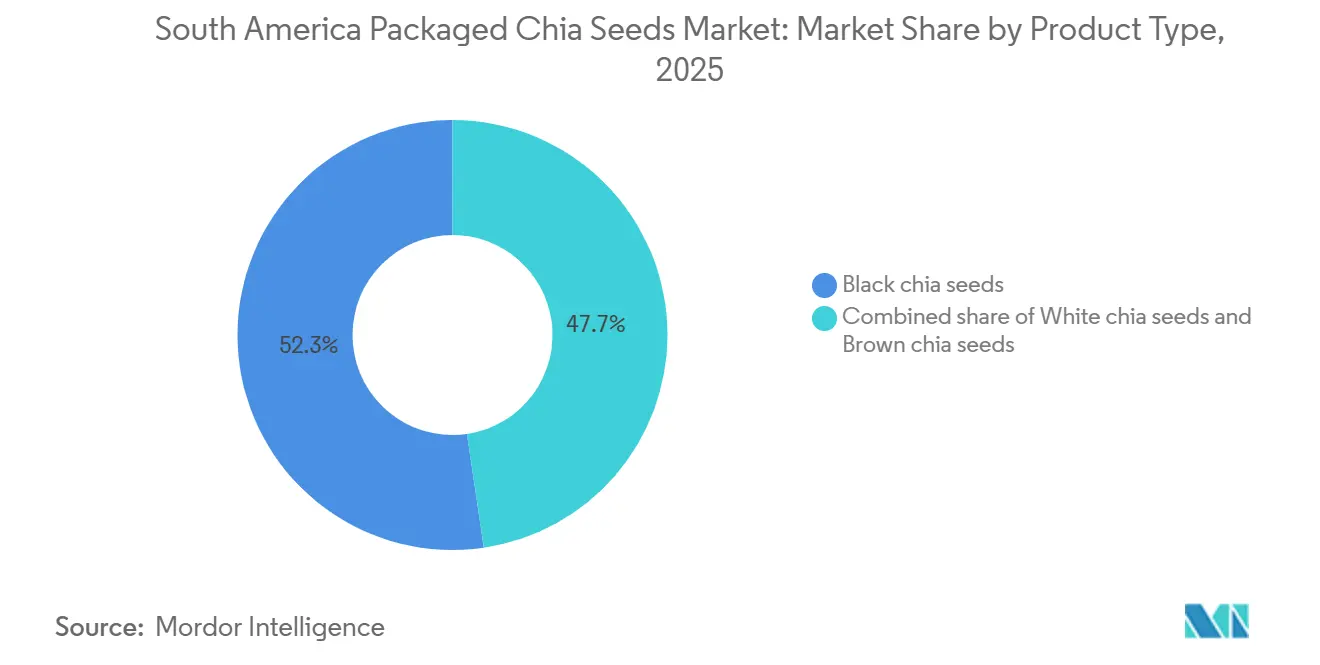
Black chia seeds accounted for 52.32% of the South America packaged chia seeds market in 2025, primarily due to their stronger availability within commercial seed supplies and the relative ease of sourcing, grading, and standardizing dark-seeded lots for retail packaging. Black chia is a widely established commercial seed type, providing packaged-seed processors with a broader and more consistent raw-material base compared with less prevalent color variants. Its distinct dark appearance also enables clear visual identification in transparent and windowed packaging, helping maintain consistent product presentation across different retail SKUs. The greater prevalence of dark-seeded varieties also reduces the need for highly selective sourcing or extensive color-based sorting when processors target predominantly black-seed packs, supporting more efficient preparation of standardized retail products.
White chia seeds are forecast to grow at a CAGR of 13.74% during 2026–2031, supported by increasing availability of white-seed varieties within commercial supply chains and greater differentiation of seed-color variants in packaged retail products. The segment benefits from its distinct light-colored appearance, which provides clear visual differentiation from the dominant black chia format and makes white chia suitable for brands seeking to diversify their packaged product portfolios. Its contrasting appearance can also support transparent and windowed packaging, allowing consumers to identify the seed type before purchase. As the packaged chia market becomes more differentiated by seed variety, greater consumer recognition of white chia, increasing availability from specialized seed lots, improved sorting and grading capabilities, and the introduction of distinct white-seed SKUs are expected to support faster segment expansion.

By Nature: Conventional Volume Anchors the Market, Organic Reshapes the Premium Tier
Conventional chia seeds accounted for 82.34% of the South America packaged chia seeds market in 2025, supported by their broader availability across commercial supply chains and their established position as the standard raw material for packaged chia products. Conventional seeds benefit from a larger sourcing pool, enabling processors to procure the volumes required for consistent retail production without the additional sourcing and certification requirements associated with organic products. The segment is also supported by simpler procurement and processing workflows, as conventional chia does not require organic-specific segregation, certification verification, or dedicated traceability procedures throughout the supply chain.
Organic chia seeds are forecast to be the fastest-growing segment, expanding at a CAGR of 15.12% during 2026–2031. Growth is supported by the increasing institutionalization of organic production, stronger certification frameworks, and greater visibility of organically produced foods across the South American packaged food industry. In Brazil, the Ministry of Agriculture and Livestock (MAPA) launched its XXI Annual Organic Production Campaign in July 2025, with initiatives focused on strengthening organic production networks and encouraging responsible consumption[2]. Such institutional support can improve awareness and recognition of certified organic products while reinforcing consumer confidence in organic labeling and production standards.
By Packaging Type: Pouches Hold the Shelf; Resealable Formats Drive Premiumization
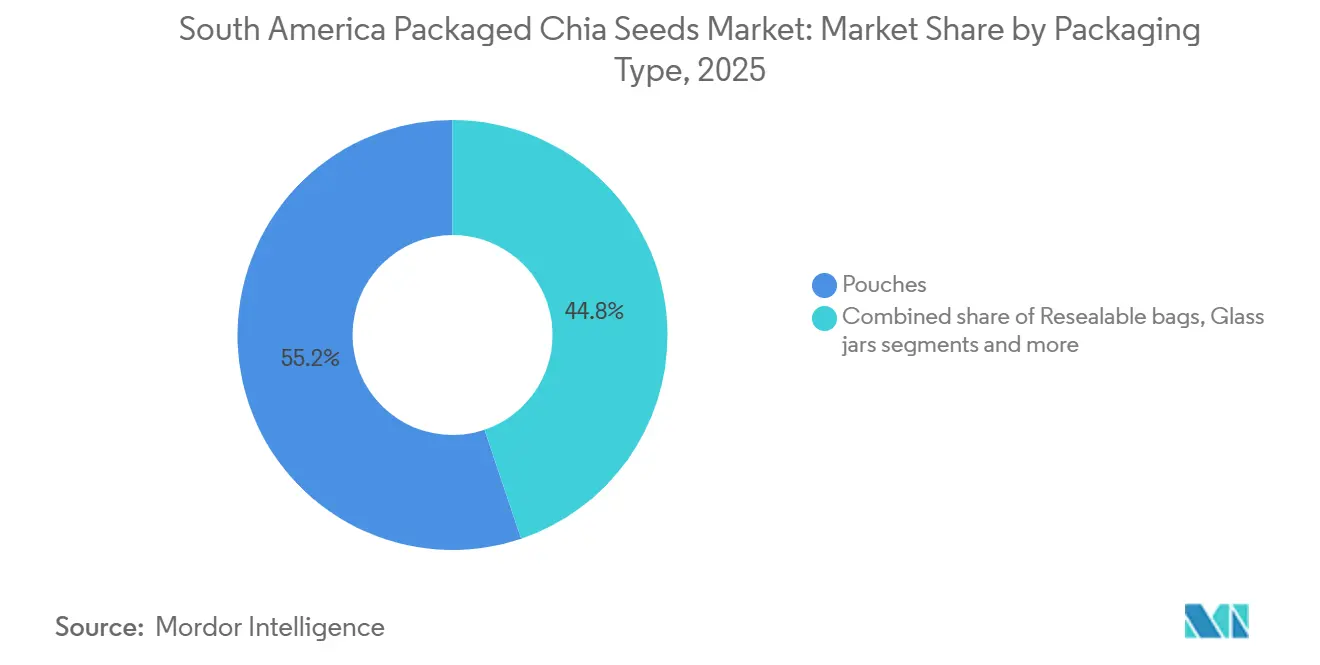
Pouches accounted for 55.18% of the South America packaged chia seeds market in 2025, supported by their suitability for standardized retail packaging, efficient material utilization, and flexibility across different pack sizes. Pouches offer a lightweight format that can be efficiently filled, sealed, stacked, and transported, making them well suited for packaged seeds where product protection and handling efficiency are important. Their adaptable structure also allows manufacturers to incorporate barrier layers that help protect chia seeds from moisture, oxygen, light, and external contaminants, supporting product quality throughout the retail shelf life.
Resealable bags are forecast to be the fastest-growing packaging format, expanding at a CAGR of 14.86% during 2026–2031, driven by their ability to combine product protection with repeated-use convenience. Resealable closures allow consumers to open and close the pack multiple times while limiting exposure to moisture and air between uses, which is particularly relevant for chia seeds that are commonly purchased in packs intended for repeated consumption. The format also reduces the need to transfer seeds into separate storage containers, while maintaining a compact footprint and supporting larger pack sizes. As packaging increasingly emphasizes freshness retention, ease of storage, portion management, and repeated access, resealable bags are positioned to gain share within the packaged chia seeds market.
By Distribution Channel: Supermarkets Set Volume; Online Retail Drives Premiumization
Supermarkets and hypermarkets accounted for 44.56% of the South America packaged chia seeds market in 2025, supported by their broad retail reach, established grocery infrastructure, and ability to offer multiple packaged chia seed variants within a single shopping environment. These outlets provide greater physical visibility for packaged products and allow consumers to compare pack sizes, prices, packaging formats, and product attributes directly on the shelf. Their established category-management systems enable packaged chia seeds to be positioned alongside other seeds, grains, and health-oriented grocery products, supporting consistent product availability and repeat purchases.
Online retail stores recorded the fastest growth in the distribution channel segment, with a CAGR of 15.65% during 2026–2031. This growth was supported by the expansion of digital purchasing across South America, particularly in Brazil. According to the International Trade Administration (ITA), 94 million Brazilians made online purchases in 2025, compared with 91 million in 2024, reflecting the continued expansion of the country's online consumer base. For packaged chia seeds, online retail provided access to a wider assortment of brands, pack sizes, organic variants, and specialized products, while digital product listings enabled consumers to review nutritional information, certifications, packaging details, and customer feedback before purchase. These characteristics supported online product discovery and the increasing adoption of e-commerce for packaged chia seed purchases.
Geography Analysis
Brazil accounted for 34.82% of the South America packaged chia seeds market in 2025, supported by its large and diversified food retail ecosystem, broad availability of packaged seed products, and established consumer access to chia through mainstream grocery channels. The country's extensive retail infrastructure provides packaged chia brands with multiple distribution points and enables wider availability across different pack sizes and product formats. The established packaged-food industry also supports efficient processing, packaging, and merchandising of chia seeds, reinforcing Brazil's share of the regional market.
Peru is forecast to be the fastest-growing market in the region, expanding at a CAGR of 14.67% during 2026–2031. Growth is supported by the country's expanding role in the regional chia supply chain and increasing integration with international markets. Its established agricultural-export infrastructure provides a foundation for greater commercialization of chia, while increasing processing and value-addition capabilities support the transition from bulk seed trade toward more standardized packaged products. Stronger availability of chia through organized retail and online channels is also expected to improve consumer access and support penetration of packaged formats through the forecast period.
Chile, Colombia, and the rest of South America accounted for the remaining share of the regional packaged chia seeds market in 2025, reflecting the distribution of market demand across other South American economies. Paraguay holds particular significance in the region's chia supply base. According to Paraguay's National Plant and Seed Quality and Health Service (SENAVE), the country generated USD 221.98 million in free-on-board (FOB) chia exports in 2025, with Paraguayan chia exported to 75 countries during the year[3]. This export activity supports the regional availability of chia as a raw material and contributes to downstream processing and packaged-product supply across South American markets.
Competitive Landscape
The South America Packaged Chia Seeds Market has a fragmented competitive landscape, with regional natural-food producers and established health-oriented food companies competing across conventional, organic, and specialty packaged chia segments. Regional players maintain a strong presence through locally established natural-food portfolios and retail distribution networks, while larger brands compete through broader product portfolios, organic positioning, and differentiated packaging formats. Notable participants in the market include Jasmine Alimentos Ltda., Vitalin Alimentos Ltda., Native Produtos Orgânicos Ltda., Mãe Terra Produtos Naturais Ltda., and Vitao Alimentos Ltda.
Companies are differentiating their offerings through organic certification, gluten-free positioning, seed varieties, pack formats, and minimally processed product positioning. Vitalin, for example, offers conventional chia, organic chia, and white chia in consumer-sized packs, providing exposure across both the nature and product-type segments of the market. Its organic chia is marketed as whole organic chia seeds in a 120g retail pack, while its white chia is offered separately as a packaged seed product. Jasmine similarly maintains a packaged chia seed offering in a 120g format and positions its broader portfolio around minimally processed and health-oriented foods.
Companies are strengthening their competitive positions through product portfolio expansion, greater retail availability, packaging differentiation, and clearer product segmentation. Organic and conventional variants allow players to address different consumer preferences and price points, while differentiated seed types provide additional opportunities to broaden product ranges. Retail-focused packaging strategies, including smaller consumer packs and resealable formats, are being used to improve convenience, storage, and product visibility. Companies are also emphasizing clean-label, natural, minimally processed, and certification-related attributes to differentiate within an increasingly crowded packaged seed category. Expansion across supermarkets, specialty natural-food retailers, and online retail channels further enables companies to increase product accessibility and strengthen brand visibility across South American markets.
South America Packaged Chia Seeds Industry Leaders
-
Jasmine Alimentos Ltda.
-
Vitalin Alimentos Ltda.
-
Native Produtos Orgânicos Ltda.
-
Mãe Terra Produtos Naturais Ltda.
-
Vitao Alimentos Ltda.
- *Disclaimer: Major Players sorted in no particular order
Recent Industry Developments
- February 2026: PEKTOS AG has been announced as an official regional distributor for Benexia's chia ingredient portfolio, including chia fiber concentrate, marking an expansion of Benexia's South American chia export networks.
- June 2025: Jasmine launched new packaging across its portfolio, incorporating clearer product information and highlighting attributes such as vegan, carbon-neutral, and recyclable packaging. Its portfolio includes a packaged chia seed product, making the packaging update relevant to its retail chia offering.
South America Packaged Chia Seeds Market Report Scope
Chia seeds are derived from the Salvia hispanica plant and are small, nutrient-dense seeds containing dietary fiber, plant-based protein, omega-3 fatty acids, minerals, and other nutritional components. The South America packaged chia seeds market is segmented by product type, nature, packaging type, and distribution channel. Based on product type, the market is segmented into white chia seeds, black chia seeds, and brown chia seeds. Based on nature, the market is segmented into organic chia seeds and conventional chia seeds. Based on packaging type, the market is segmented into pouches, resealable bags, glass jars, plastic containers/bottles, and others. Based on distribution channel, the market is segmented into supermarkets/hypermarkets, convenience and grocery stores, online retail stores, and other distribution channels. Based on geography, the market is segmented into Brazil, Argentina, Chile, Colombia, Peru, and the rest of South America. For each segment, the market sizing and forecast have been done based on the value (in USD million).
| White chia seeds |
| Black chia seeds |
| Brown chia seeds |
| Organic chia seeds |
| Conventional chia seeds |
| Pouches |
| Resealable bags |
| Glass jars |
| Plastic containers/bottles |
| Others |
| Supermarkets/Hypermarkets |
| Convenience and Grocery Stores |
| Online Retail Stores |
| Other Distribution Channels |
| Brazil |
| Argentina |
| Chile |
| Colombia |
| Peru |
| Rest of South America |
| By Product Type | White chia seeds |
| Black chia seeds | |
| Brown chia seeds | |
| By Nature | Organic chia seeds |
| Conventional chia seeds | |
| By Packaging Type | Pouches |
| Resealable bags | |
| Glass jars | |
| Plastic containers/bottles | |
| Others | |
| By Distribution Channel | Supermarkets/Hypermarkets |
| Convenience and Grocery Stores | |
| Online Retail Stores | |
| Other Distribution Channels | |
| By Geography | Brazil |
| Argentina | |
| Chile | |
| Colombia | |
| Peru | |
| Rest of South America |
Key Questions Answered in the Report
What is the projected growth rate of the South America chia seeds market?
The South America chia seeds market is forecast to grow at a 12.89% CAGR from 2026 to 2031, increasing from USD 39.63 million in 2026 to USD 72.66 million by 2031.
Which chia seed type holds the largest share in South America?
Black chia seeds held the largest share at 52.32% in 2025. Their availability, lower price than white varieties, and established retail presence support their position.
Which nature segment is growing fastest for chia seeds?
Organic chia seeds are the fastest-growing nature segment, with a projected CAGR of 15.12% through 2031. Certification requirements and demand for clean-label ingredients support this growth.
Which sales channel is expected to grow fastest for chia seeds?
Online retail stores are expected to grow at a 15.65% CAGR through 2031. Brazil’s expanding e-commerce base supports access to premium and specialized chia products.