
Market Overview
| Study Period | 2020 - 2031 |
|---|---|
| Forecast Data Period | 2026 - 2031 |
| Base Year Market Size (2025) | USD 199.24 Million |
| Market Size (2026) | USD 228.13 Million |
| Market Size (2031) | USD 419.15 Million |
| Growth Rate (2026 - 2031) | 12.94 % |
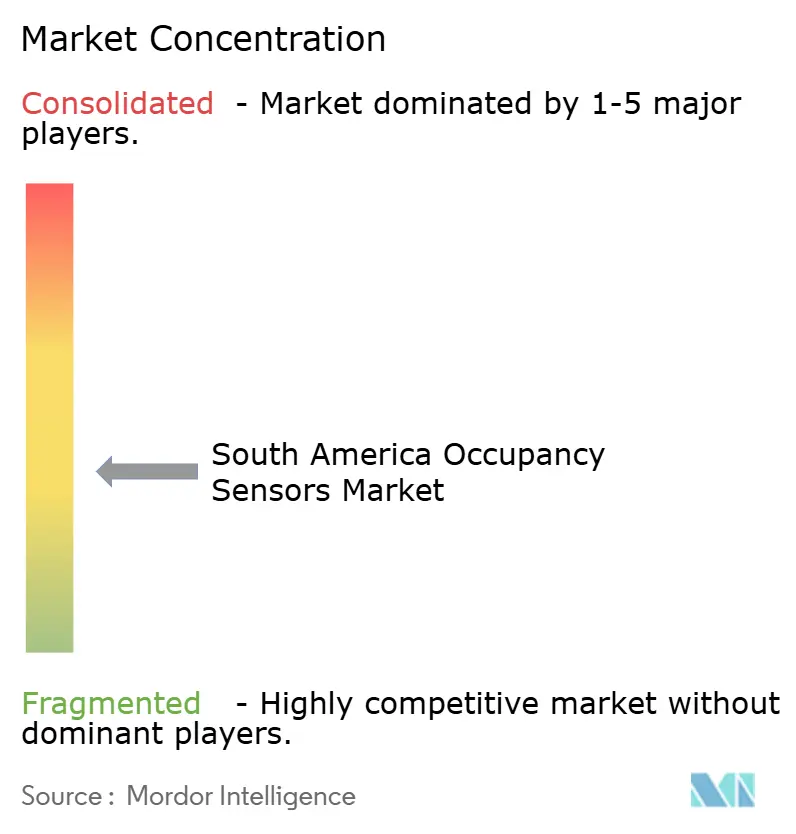
| Market Concentration | Medium |
Major Players *Disclaimer: Major Players sorted in no particular order Image © Mordor Intelligence. Reuse requires attribution under CC BY 4.0. | |
South America Occupancy Sensors Market Analysis by Mordor Intelligence
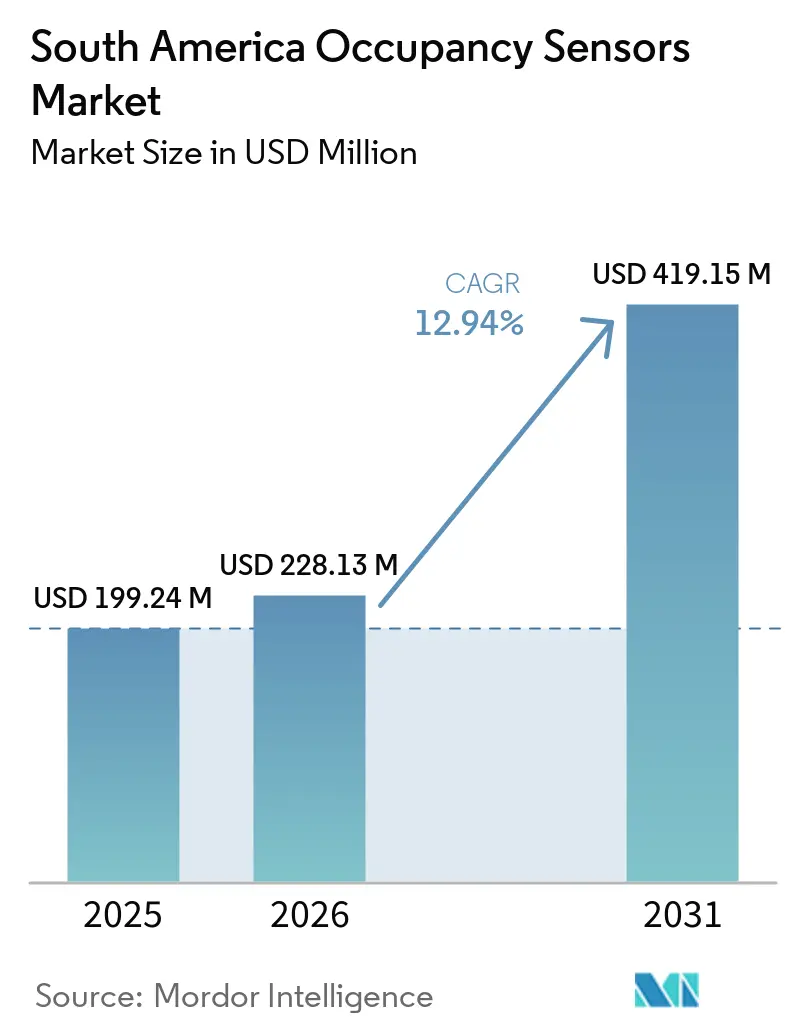
The South America occupancy sensors market size was valued at USD 199.24 million in 2025 and is estimated to grow from USD 228.13 million in 2026 to reach USD 419.15 million by 2031, at a CAGR of 12.94% during the forecast period (2026-2031). Energy costs and new efficiency rules are moving occupancy sensing from an optional control to a specified part of building projects. Brazil's building efficiency requirements and Colombia's certification pathways are making continuous occupancy data more relevant in commercial and public buildings. Hybrid work is also changing buying priorities because employers need evidence of how desks, rooms, and common areas are used. Suppliers are responding with connected sensors, privacy-preserving detection, and software that links data to lighting, ventilation, and portfolio decisions. The South America occupancy sensors market therefore has opportunities in both retrofit work and new construction, although legacy controls and uncertain payback remain obstacles.
Key Report Takeaways
- By network connectivity, wired infrastructure held 53.24% of the South America occupancy sensors market share in 2025, while wireless connectivity is projected to expand at a 13.41% CAGR through 2031.
- By technology, PIR sensors held 51.36% of the South America occupancy sensors market share in 2025, while mmWave/FMCW Radar is projected to expand at a 13.16% CAGR through 2031.
- By mounting type, ceiling-mounted sensors accounted for 47.63% of revenue in 2025, while in-fixture and embedded luminaire sensors are projected to expand at a 13.46% CAGR through 2031.
- By installation type, retrofit accounted for 58.91% of revenue in 2025, while new construction is projected to expand at a 13.52% CAGR through 2031.
- By building type, commercial buildings accounted for 44.18% of revenue in 2025, while healthcare and assisted living are projected to expand at a 13.37% CAGR through 2031.
- By application, lighting control held 38.42% revenue share in 2025, while people counting and space utilization is projected to expand at a 13.28% CAGR through 2031.
- By geography, Brazil held 46.38% of market value in 2025, while Colombia is projected to expand at a CAGR of 13.71% through 2031.
Note: Market size and forecast figures in this report are generated using Mordor Intelligence’s proprietary estimation framework, updated with the latest available data and insights as of January 2026.
Market Trends and Insights
Drivers Impact Analysis of South America Occupancy Sensors Market*
| Driver | (~) % Impact on CAGR Forecast | Geographic Relevance | Impact Timeline |
|---|---|---|---|
| Energy Efficiency and Utility Cost Reduction | +3.8% | Brazil and Chile core, spillover to Argentina and Colombia | Short term (≤ 2 years) |
| Smart Building and Building Management System Integration | +3.2% | Brazil and Colombia core, spillover to Argentina | Medium term (2-4 years) |
| Green Building Standards and Energy Conservation Requirements | +2.4% | Brazil, Colombia | Medium term (2-4 years) |
| Hybrid Work and Workspace Utilization Analytics | +2.0% | Brazil, Colombia, Chile | Short term (≤ 2 years) |
| Privacy-Safe Presence Intelligence for Sensitive Facilities | +1.0% | Brazil, Argentina | Short term (≤ 2 years) |
| Retrofit Demand From Wireless and Long-Life Battery Sensors | +0.9% | Colombia, Rest of South America | Medium term (2-4 years) |
| Source: Mordor Intelligence | |||
Energy Efficiency and Utility Cost Reduction Initiatives
Brazilian commercial and public buildings consume significant energy for HVAC, creating a practical case for controls that respond to occupied areas. Occupancy-responsive systems can dim or turn off lighting and adjust ventilation when rooms are empty. The South America occupancy sensors market benefits when these savings are considered together with maintenance and operating costs. Resolution CGIEE No. 4/2025 established minimum energy-efficiency indices for new buildings in Brazil, with phased requirements beginning in 2027 and additional requirements for commercial buildings in larger cities starting in 2028.[1] Zone-level controls are more useful than whole-floor switching in open office layouts because occupancy varies by room and time of day. This makes sensor selection depend on control detail and system compatibility, not only on unit cost.
Smart Building and Building Management System Integration
Occupancy data has become a useful input for building management systems that coordinate lighting, air conditioning, and reporting. In larger commercial projects, developers can select the sensor platform earlier because integration affects cabling, gateways, and control specifications. Multi-sensor mmWave FMCW systems have demonstrated people-counting and localization capabilities in operational indoor settings, which support real-time control decisions. The South America occupancy sensors market is therefore shifting toward products that can communicate through established building protocols. BACnet IP, DALI-2, KNX, and Matter-compatible approaches can reduce integration barriers when a project involves multiple suppliers. These capabilities also help consultants connect occupancy data with ventilation settings and indoor air quality practices.
Green Building Standards and Energy Conservation Requirements
Green building programs are linking energy performance requirements with measurable operational data. Colombia's Resolution 0194 of 2025 recognizes EDGE, LEED, and CASA Colombia pathways for demonstrating required energy and water savings in eligible new buildings. That framework increases the value of controls for documenting energy-related building activity. Brazil's efficiency rules create a comparable compliance signal for developers planning new commercial and public projects. Sensor systems do not achieve certification on their own, but they can support the broader lighting and HVAC controls needed to meet performance objectives. The South America occupancy sensors market is supported when projects require auditable results rather than design-stage claims alone.
Expansion of Hybrid Work and Workspace Utilization Analytics
Flexible work schedules have increased the need to understand how corporate space is used across the week. JLL reported that 72% of companies in South America used flexible schedules in 2025, including 86% in Brazil. Physical presence in São Paulo offices reached 71% across surveyed companies in 2025, while unused desks remained a regular issue. People-counting and utilization systems provide evidence to support desk allocation, meeting-room management, and lease decisions. The South America occupancy sensors market gains from this use case because it goes beyond simple lighting automation. It also favors platforms that can explain patterns across several buildings without recording identifiable images.
Restraints Impact Analysis of South America Occupancy Sensors Market*
| Restraint | (~) % Impact on CAGR Forecast | Geographic Relevance | Impact Timeline |
|---|---|---|---|
| High Upfront Cost and Retrofit Payback Uncertainty | -1.8% | South America, strongest in cost-sensitive small and medium-sized enterprise markets in tier-2 cities | Medium term (2-4 years) |
| Integration Complexity With Legacy Building Systems | -1.3% | Brazil and Argentina | Long term (≥ 4 years) |
| Privacy Governance for Camera-Based and Device-Tracking Systems | -0.7% | Brazil, Colombia | Short term (≤ 2 years) |
| Detection Errors in High-Density, Outdoor, and Irregular Spaces | -0.5% | High-density urban markets in Brazil and Argentina | Medium term (2-4 years) |
| Source: Mordor Intelligence | |||
High Upfront Cost and Retrofit Payback Uncertainty
A networked retrofit may require sensors, gateways, middleware, commissioning, and analytics software simultaneously. This cost can be difficult for mid-market landlords to approve when electricity savings are not measured against a common baseline. Different audit assumptions can produce very different payback periods for similar projects. The South America occupancy sensors market faces this issue most directly in smaller buildings and secondary cities, where owners may not have internal energy management staff. Wireless equipment with long-life batteries can reduce installation labor and help lower the initial hurdle. Brazil's efficiency timetable may also shorten procurement cycles as compliance becomes a clearer reason to invest.
Integration Complexity with Legacy Building Systems
Many older commercial sites in Brazil and Argentina use proprietary lighting and HVAC controls that predate open building protocols. Adding modern sensing may require gateways, custom middleware, and longer testing cycles. The difficulty often lies in converting an occupancy signal into a command that an older controller can accept. This raises labor costs and can reduce margins for systems integrators. Wireless products that provide BACnet IP or Modbus RTU outputs can help where a legacy controller supports those formats. The South America occupancy sensors market will face this constraint until building renovation and energy-efficiency modernization replace more of the older control bases.
*Our forecasts treat driver/restraint impacts as directional, not additive. The impact forecasts reflect baseline growth, mix effects, and variable interactions.
South America Occupancy Sensors Market Segment Analysis
By Network Connectivity:
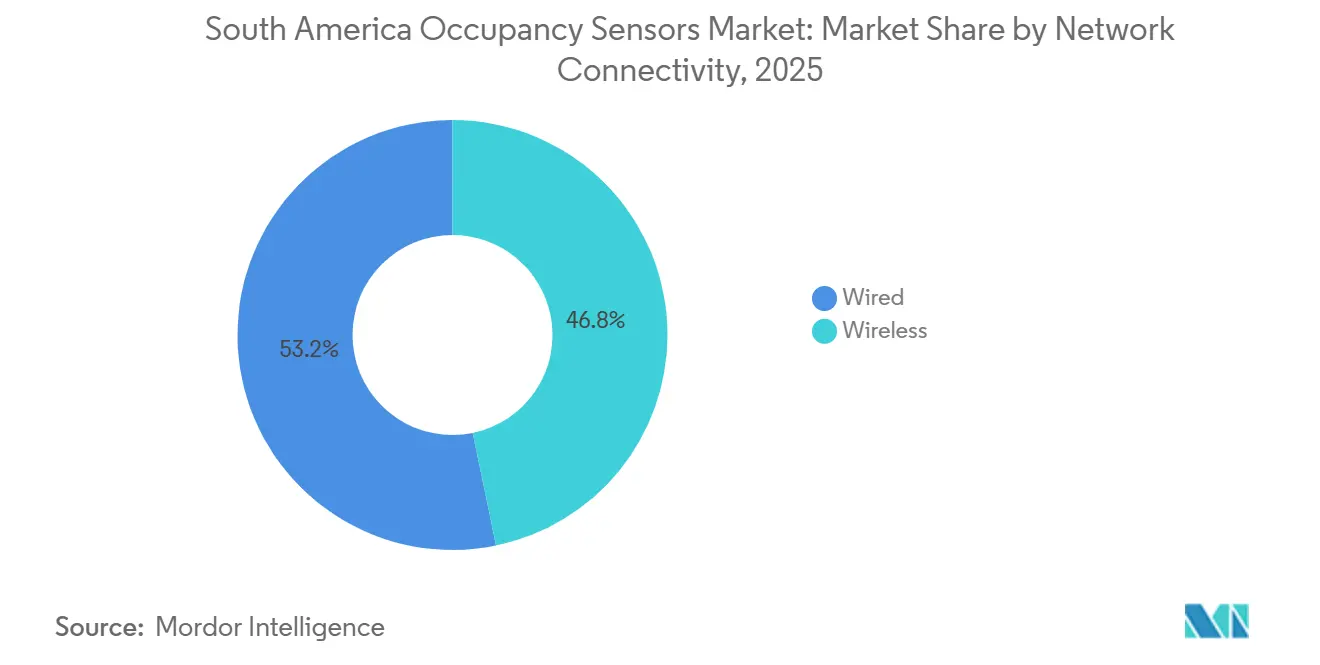
Wired Systems Retain a Broad Installed Base While Wireless Adoption BuildsWired infrastructure held 53.24% of the South America occupancy sensors market in 2025. Large commercial and institutional facilities often choose wired connections to ensure consistent data transmission for lighting and HVAC automation. Hospitals, ministries, and data centers can use Ethernet, BACnet MSTP, or DALI-2 arrangements in facility-wide projects. These approaches suit locations where radio-frequency conditions or battery maintenance create concerns. Wired designs can also suit projects that already have structured cabling and centralized building controls, particularly when facility teams want a single dependable pathway for lighting, ventilation, alarms, and energy reporting. They can simplify long-term supervision when a building has technical staff and a documented network plan. Their use remains strongest in spaces where service continuity carries more weight than rapid installation.
Wireless connectivity is projected to grow at a 13.41% CAGR from 2026 to 2031. It is useful in retrofits where installing cable through completed ceilings would disrupt tenants and add labor. Wi-Fi can use existing enterprise networks, while Zigbee supports dense mesh deployments and Z-Wave suits lower-power installations. PointGrab introduced CogniPoint 2 Flex in February 2026 as a Thread networking sensor for large enterprise deployments.[2] Thread and Matter compatibility can support projects seeking multi-vendor interoperability. Wireless adoption can narrow the gap with wired systems as module costs fall and retrofit projects become more common. It can also give installers flexibility where floor plans are changed often. This matters in leased offices because owners can avoid reopening finished surfaces during workplace redesigns.
By Technology:
PIR Leads Installed Systems While mmWave Expands in Precision UsesPIR sensors accounted for 51.36% of the technology category in 2025. Their installed base reflects long use in lighting circuits across commercial and residential buildings. PIR products are familiar to contractors and can provide reliable motion-based control in many tropical and temperate conditions. Ultrasonic systems remain relevant for detecting small seated movements. Microwave sensors are used in some outdoor perimeter and industrial logistics applications. Dual technology can reduce the risk that a single sensing method fails to identify a person in a challenging setting. Building managers may select the technology based on the room layout, expected activity, and the cost of missed detection.
mmWave/FMCW Radar is projected to grow at a 13.16% CAGR from 2026 to 2031. Dual- and multi-technology designs are gaining attention where a false-off event could affect patient safety or employee productivity. Texas Instruments offers the IWRL6432 module, which integrates a 60GHz antenna, power management, and flash memory for presence and occupancy detection. Research on multi-sensor mmWave FMCW systems supports the technology's ability to count and localize occupants in actual indoor environments. mmWave can detect micro-movements without capturing identifiable imagery, which can reduce the privacy concerns associated with cameras. This advantage supports the South America occupancy sensors market in healthcare and other sensitive locations. It can also make facility approvals more straightforward when the building operator needs presence data but does not want video storage. The technology remains relevant where seated or stationary occupants must be identified reliably.
By Mounting Type:
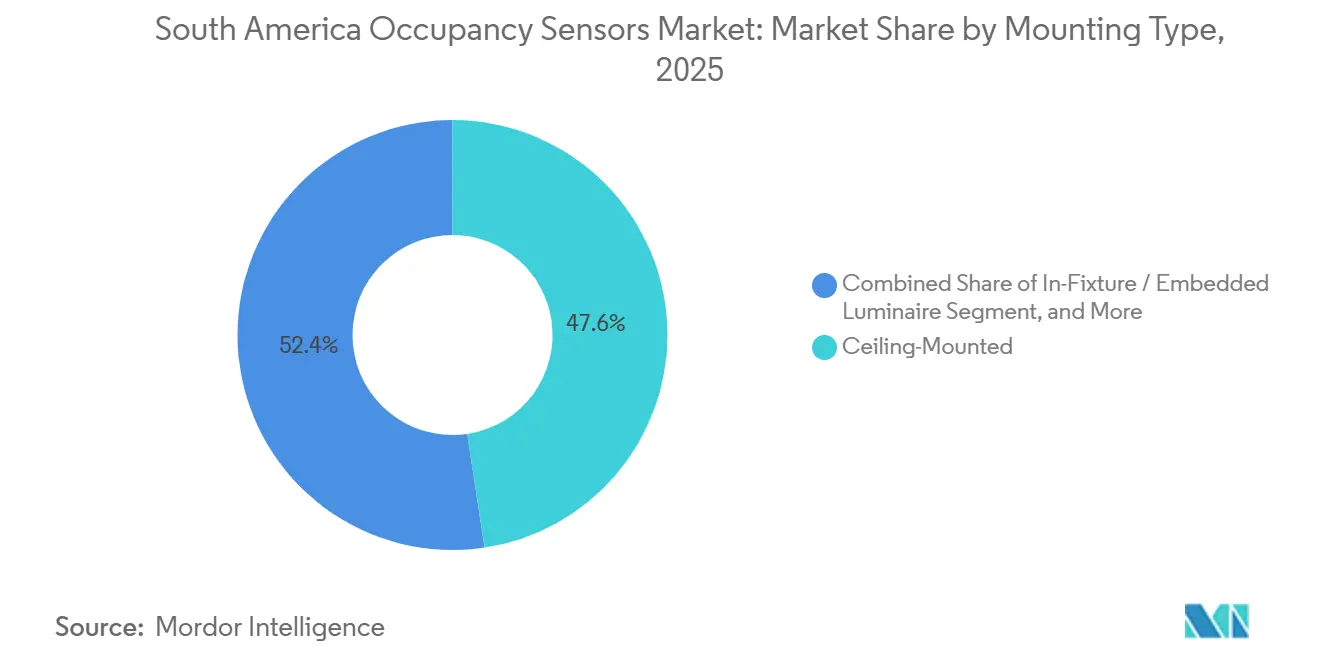
Ceiling Sensors Lead While Embedded Luminaires Gain New Project UseCeiling-mounted sensors held 47.63% of revenue in 2025. Their broad coverage can reduce the number of devices required in a room. They also work with 360° PIR and mmWave detection patterns and connect directly with overhead lighting circuits. Corridors, stairwells, and smaller offices can still favor wall-mounted units because their detection needs and access conditions differ. Desk and furniture-integrated equipment supports individual workstation monitoring in flexible office layouts. These products help workplace teams distinguish between a reserved desk and a desk that is actually occupied. They are relevant when employers allocate fewer desks than employees under hybrid work policies.
In-fixture and embedded luminaire sensors are projected to grow at a 13.46% CAGR from 2026 to 2031. The embedded approach removes a separate installation step and can reduce commissioning time during large office fit-outs. It also supports luminaire-level lighting control in new construction projects. LEED v5 applies to new project registrations from 2026 and places greater emphasis on operational performance. Continuous sensor data can support the operating information needed for such projects. The South America occupancy sensors market can benefit as designers choose integrated lighting and sensing systems earlier in the project cycle. Early selection gives the electrical contractor more clarity on wiring, commissioning, and control zoning. It also helps owners avoid separate changes after the ceiling and luminaires have been installed.

By Installation Type:
Retrofits Dominate Current Demand While New Construction Grows FasterRetrofit accounted for 58.91% of 2025 revenue. São Paulo, Buenos Aires, Bogotá, and Santiago have extensive commercial building stock that can be upgraded with lighting and HVAC controls. Owners in these locations are responding to energy costs and changing tenant expectations. Retrofit economics often favor battery-powered wireless sensors because they avoid extensive cable installation. Existing buildings can also phase projects floor by floor to spread capital spending. A phased approach lets the owner test operational savings before approving the next part of a portfolio. It can be practical where each floor has different tenants, operating hours, and control equipment.
New construction is projected to grow at a 13.52% CAGR from 2026 to 2031. Brazil's efficiency regulation requires minimum performance for new commercial buildings under its phased timetable, which strengthens the case for occupancy-responsive design. New projects can specify multi-protocol sensor stacks from the start and often deliver higher revenue per installation than incremental upgrades. Leviton introduced GreenConnect in August 2025 as a wireless lighting control platform that includes occupancy sensing. Colombia's commercial corridors and hospital projects in Peru, Paraguay, and Guyana also add to the new-building pipeline. The South America occupancy sensors industry is gaining from projects where controls are designed with the building rather than added later. Design-stage coordination can establish sensor coverage, data ownership, and the links to HVAC and lighting. It reduces the need for later compromises when ceiling access and controller capacity are limited.
By Building Type:
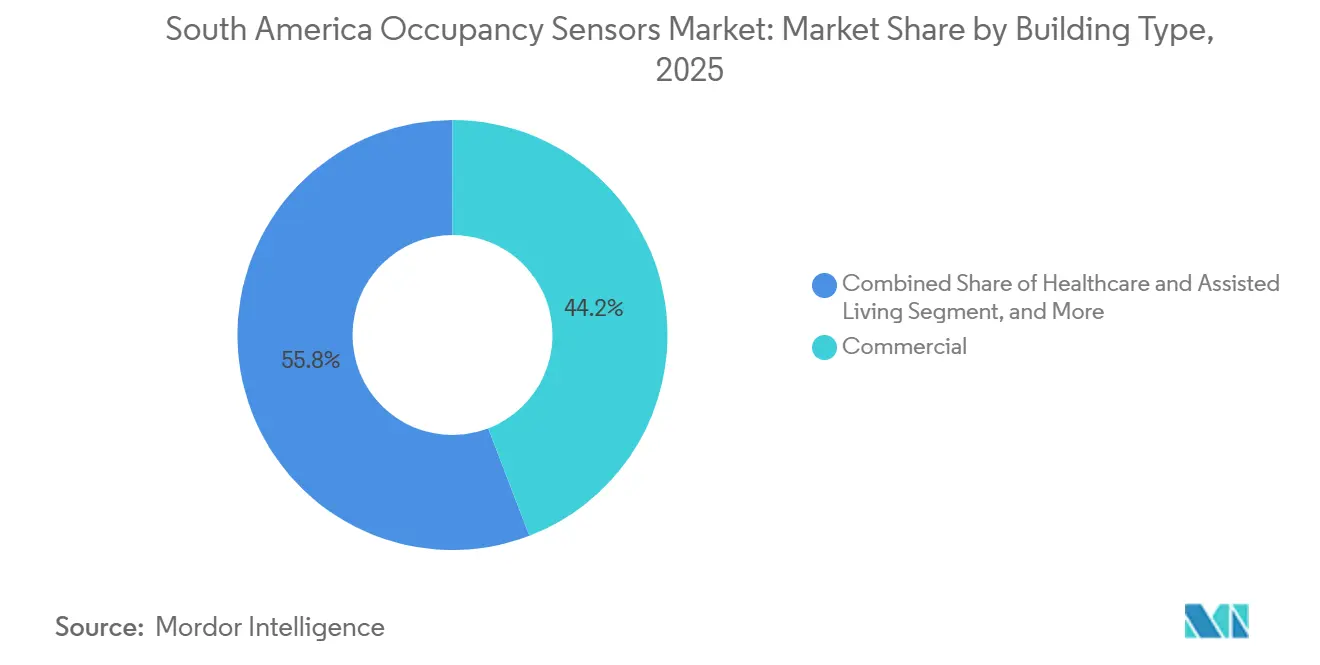
Commercial Sites Lead While Healthcare and Assisted Living AdvanceCommercial buildings accounted for 44.18% of 2025 revenue. Offices, retail locations, and hospitality facilities in major cities provide clear settings for lighting control and space measurement. Hybrid work has strengthened the use of data for space planning in corporate offices. Industrial and warehousing sites use high-bay PIR or microwave products for safety and lighting across large floorplates. Public and education buildings may create further demand as Brazilian public facilities work toward higher energy-efficiency requirements. Schools, ministries, and court facilities often have predictable operating patterns that allow controls to reduce unnecessary lighting and ventilation. Procurement rules may also place greater value on equipment that can demonstrate a measurable operating result.
Healthcare and assisted living are projected to grow at a 13.37% CAGR from 2026 to 2031. Hospitals need dependable monitoring in beds, restrooms, corridors, and shared spaces. Privacy-preserving sensing can provide presence alerts without using identifiable video. The Hospital Antonio Lorena project in Cusco covers 49,000 m² and has 523 beds, illustrating the scale of healthcare construction under way. Healthcare projects can favor mmWave and thermal options when patient care and data privacy are both important. This demand base gives the South America occupancy sensors market a higher-value application beyond standard commercial lighting. Healthcare buyers can assess sensor products against care quality, infection-control practices, staff response needs, and privacy requirements. These combined needs can make reliability and detection quality more important than the lowest purchase price.
By Application:
Lighting Control Holds the Largest Role While Space Analytics Adds ValueLighting control represented 38.42% of the 2025 application revenue. Automated switching and dimming remain the most established purpose for occupancy sensors in commercial and residential settings. HVAC and ventilation are other important applications because occupancy data can help adjust conditions to room use. In Brazil, HVAC accounts for a substantial share of energy use in commercial and public buildings, which makes demand-responsive control relevant. Security applications use dual-technology and microwave devices for perimeters and controlled areas. Bed and restroom monitoring remains a smaller, specialized use case in healthcare. These settings need alerts that support care teams without making patients feel continuously observed. Non-imaging sensors are particularly useful when providers want a practical balance between safety monitoring and personal privacy.
People counting and space utilization are projected to grow at a 13.28% CAGR from 2026 to 2031. Corporate users need validated headcount data to manage desks, rooms, and office footprints under flexible working patterns. VergeSense introduced its Large Spatial Model in 2026 to provide workplace spatial intelligence through its platform. Analytics can convert raw sensor readings into information used in lease planning and workplace management. This supports premium pricing for platforms that combine sensing with data interpretation. It also widens the South America occupancy sensors market from equipment sales to continuing software-supported services. Suppliers that support data interpretation can remain involved after installation through dashboards, updates, and portfolio analysis. That recurring relationship can differentiate a platform from a product that only triggers a light or ventilation control.
Geography Analysis
Brazil Occupancy Sensors Market
Brazil accounted for 46.38% of the regional market in 2025. The country has the region's largest commercial building stock and a broad base of electrical contractors. Brazil's CGIEE Resolution No. 4/2025 sets binding minimum efficiency indices for new buildings and establishes a clearer project pipeline for occupancy-related controls. São Paulo is an important center for sophisticated office fit-outs and connected building systems. Its corporate offices also show continued demand for utilization data as employers manage hybrid attendance. Brazil's certification activity and property-level incentives reinforce the use of systems that support measured energy performance.
Colombia Occupancy Sensors Market
Colombia is projected to grow at a 13.71% CAGR from 2026 to 2031. The country's green building activity and modernization of commercial space in Bogotá and Medellín support demand. Resolution 0194 of 2025 recognizes EDGE, LEED, and CASA Colombia for qualifying new-building energy and water targets.[3] The policy connects certification requirements with controls that provide usable building performance information. Wireless devices are relevant for owners who want lower disruption and installation costs. The South America occupancy sensors market has a favorable opening in Colombia because its projects can combine new construction, certification, and connected building systems.
South America Occupancy Sensors Market
Chile and the Rest of South America make up the remaining regional demand. Santiago shares the region's hybrid work adjustments and has institutional interest in energy-efficient building controls. Peru and Paraguay have active healthcare projects that need sensor infrastructure from the design stage. The Cusco hospital project has 49,000 m² of space and 523 beds, while Paraguay's Hospital Nacional de Itauguá has 1,039 beds. Guyana's Lethem Regional Hospital, announced in 2024 at GYD 6.5 billion (USD 31.1 million), points to healthcare infrastructure investment in smaller national markets. Smaller formal office markets may continue to choose cost-efficient PIR lighting controls over high-cost analytics platforms in the near term.
Competitive Landscape
The South America occupancy sensors market is moderately fragmented. Competition includes project-focused electrical and building-automation suppliers as well as software-led workspace-analytics providers. B.E.G. Brück Electronic, STEINEL, and Theben compete on sensing hardware, protocol support, and reliability in commercial, industrial, and healthcare conditions. Leviton and Lutron use lighting control portfolios and distributor relationships to pursue new construction projects. VergeSense, Butlr, Density, PointGrab, and XY Sense focus on occupancy data for enterprise real estate teams.
Suppliers are differentiating through sensor fusion, interoperability, and privacy. Butlr and Disruptive Technologies announced a March 2026 partnership that combined thermal-array coverage with desk-level IoT sensing in a shared platform. PointGrab's February 2026 launch of CogniPoint 2 Flex emphasized Thread networking for large enterprise deployments. Lutron announced additions to its Athena and Vive commercial systems in April 2026, including daylight-sensing options for wireless building control.[4] These moves show that vendors are connecting presence detection with lighting, HVAC, and workplace data rather than selling stand-alone devices.
Mid-market buildings of 5,000 to 20,000 m² in tier-2 Brazilian and Colombian cities remain less fully served. These customers need systems that fit local project budgets, import conditions, and installer skills. Premium analytics vendors may be difficult to justify for smaller sites, while basic hardware may not provide the data that owners want. This creates room for simpler interoperable packages that combine occupancy sensing with useful controls. No company share data is available for the leading suppliers, which is consistent with a market where several global brands and specialist platforms compete. The South America occupancy sensors market will remain shaped by the ability to balance reliability, privacy, installation effort, and local support.
South America Occupancy Sensors Industry Leaders
-
VergeSense, Inc.
-
Butlr, Inc.
-
PointGrab Ltd.
-
XY Sense Pty Ltd.
-
Density, Inc.
- *Disclaimer: Major Players sorted in no particular order
South America Occupancy Sensors Market Companies Covered in this Report
- VergeSense, Inc.
- Butlr, Inc.
- PointGrab Ltd.
- XY Sense Pty Ltd.
- Density, Inc.
- Occuspace, Inc.
- B.E.G. Brück Electronic GmbH
- STEINEL GmbH
- Theben AG
- Pressac Communications Limited
- Terabee SA
- Avi-on Labs, Inc.
- Enerlites, Inc.
- Leviton Manufacturing Co., Inc.
- Lutron Electronics Co., Inc.
- Intermatic Incorporated
- RAB Lighting Inc.
- Distech Controls Inc.
- KMC Controls, Inc.
Recent Industry Developments in South America Occupancy Sensors Market
- August 2026: Density, Inc. received US Patent D1138817, granted August 4, 2026, for the ornamental design of an occupancy sensing device, reflecting active IP development in the radar-based sensing segment and reinforcing the company's differentiation against thermal and camera-based competitors in privacy-sensitive market environments.
- June 2026: VergeSense joined the Logitech Collaboration Program, enabling direct integration of person-count data from Logitech Rally Bar and Spot workspace devices into the VergeSense platform, expanding occupancy data inputs for corporate real estate teams managing large mixed-technology sensor portfolios.
- May 2026: PointGrab Ltd. and WellStat launched a deep integration connecting PointGrab CogniPoint sensor data directly to HVAC, ventilation, and demand response systems within the WellStat building performance platform, replacing static scheduling with real-time occupancy-driven controls across EMEA and North America, a model with direct applicability to South American BMS upgrade projects.
- March 2026: Butlr, Inc. and Disruptive Technologies announced a strategic partnership combining Butlr's thermal-array occupancy platform with Disruptive Technologies' desk-level wireless sensors, delivering a privacy-first building intelligence stack that avoids camera-based sensing and reduces LGPD compliance friction for enterprise deployments in South American markets.
South America Occupancy Sensors Market Report Scope
The South America occupancy sensors market includes sensors that detect the presence or absence of people in indoor and outdoor spaces to automate lighting, HVAC, security, and other building systems. The report covers market trends, growth drivers, challenges, competitive landscape, and demand across key South American countries, including Brazil, Argentina, Colombia, Chile, and the Rest of South America.
The South America Occupancy Sensors Market Report is Segmented by Network Connectivity (Wired and Wireless [Wi-Fi, Zigbee, and Z-Wave]), Technology (Passive Infrared, Ultrasonic, Microwave, Dual- and Multi-Technology, and mmWave/FMCW Radar), Mounting Type (Ceiling-Mounted, Wall-Mounted, Desk- and Furniture-Integrated, and In-Fixture/Embedded Luminaire), Installation Type (Retrofit, and New Construction), Building Type (Residential, Commercial, Industrial and Warehousing, Healthcare and Assisted Living, and Government and Education), Application (Lighting Control, HVAC and Ventilation, Security and Surveillance, People Counting and Space Utilization, and Bed and Restroom Occupancy Monitoring), and Geography (Brazil, Argentina, Chile, Colombia, and Rest of South America). The Market Forecasts are Provided in Terms of Value (USD).
Segmentation Overview
By Network Connectivity
| Wired | |
| Wireless | Wi-Fi |
| Zigbee | |
| Z-Wave |
By Technology
| Passive Infrared |
| Ultrasonic |
| Microwave |
| Dual- and Multi-Technology |
| mmWave / FMCW Radar |
By Mounting Type
| Ceiling-Mounted |
| Wall-Mounted |
| Desk- and Furniture-Integrated |
| In-Fixture / Embedded Luminaire |
By Installation Type
| Retrofit |
| New Construction |
By Building Type
| Residential |
| Commercial |
| Industrial and Warehousing |
| Healthcare and Assisted Living |
| Government and Education |
By Application
| Lighting Control |
| HVAC and Ventilation |
| Security and Surveillance |
| People Counting and Space Utilization |
| Bed and Restroom Occupancy Monitoring |
By Geography
| Brazil |
| Argentina |
| Chile |
| Colombia |
| Rest of South America |
| By Network Connectivity | Wired | |
| Wireless | Wi-Fi | |
| Zigbee | ||
| Z-Wave | ||
| By Technology | Passive Infrared | |
| Ultrasonic | ||
| Microwave | ||
| Dual- and Multi-Technology | ||
| mmWave / FMCW Radar | ||
| By Mounting Type | Ceiling-Mounted | |
| Wall-Mounted | ||
| Desk- and Furniture-Integrated | ||
| In-Fixture / Embedded Luminaire | ||
| By Installation Type | Retrofit | |
| New Construction | ||
| By Building Type | Residential | |
| Commercial | ||
| Industrial and Warehousing | ||
| Healthcare and Assisted Living | ||
| Government and Education | ||
| By Application | Lighting Control | |
| HVAC and Ventilation | ||
| Security and Surveillance | ||
| People Counting and Space Utilization | ||
| Bed and Restroom Occupancy Monitoring | ||
| By Geography | Brazil | |
| Argentina | ||
| Chile | ||
| Colombia | ||
| Rest of South America | ||
Key Questions Answered in the Report
What is the size of the South America occupancy sensors market?
It is estimated at USD 228.13 million in 2026 and is forecast to reach USD 419.15 million by 2031, at a 12.94% CAGR.
Which connectivity type leads occupancy sensor adoption in South America?
Wired infrastructure led with 53.24% share in 2025, while wireless connectivity is forecast to grow faster at a 13.41% CAGR through 2031.
Which occupancy sensor technology is growing fastest in South America?
MmWave/FMCW Radar is projected to grow at a 13.16% CAGR from 2026 to 2031, supported by precise, privacy-preserving detection.
Why are commercial buildings important for occupancy sensor demand?
Commercial buildings accounted for 44.18% of 2025 revenue because offices, retail sites, and hotels use sensors for lighting, HVAC, and space management.
Which country is expected to grow fastest for occupancy sensors in South America?
Colombia is projected to grow at a 13.71% CAGR through 2031, supported by green building requirements and commercial property modernization.
How does hybrid work affect workplace sensing demand?
Flexible schedules increase demand for validated data on desk, room, and office use, supporting people counting and space utilization applications.