
South America Microgreens Market Size and Share
Market Overview
| Study Period | 2021 - 2031 |
|---|---|
| Forecast Data Period | 2026 - 2031 |
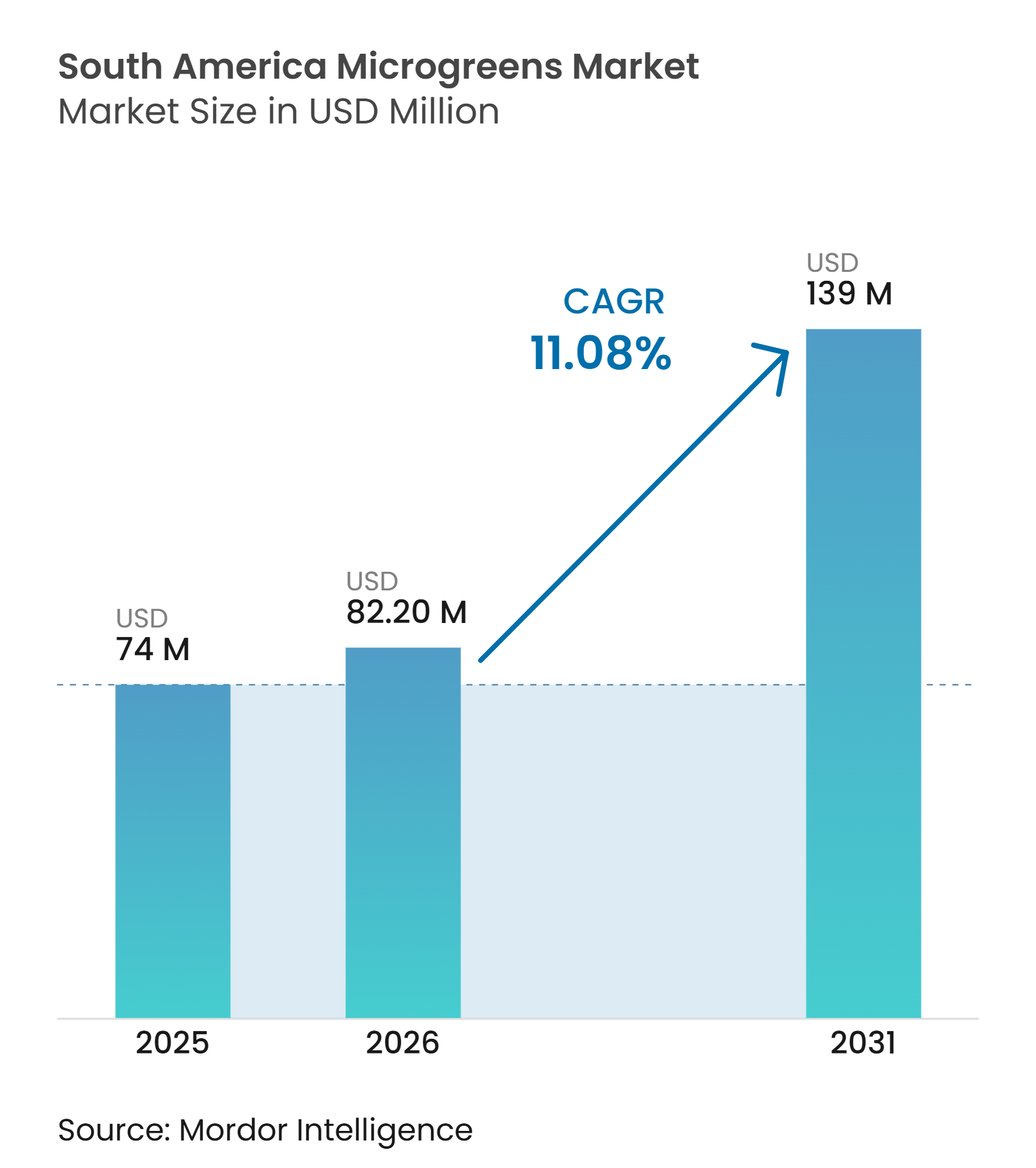
| Base Year Market Size (2025) | USD 74 Million |
| Market Size (2026) | USD 82.20 Million |
| Market Size (2031) | USD 139 Million |
| Growth Rate (2026 - 2031) | 11.08 % |
| Market Concentration | Low |
Major Players *Disclaimer: Major Players sorted in no particular order Image © Mordor Intelligence. Reuse requires attribution under CC BY 4.0. | |
South America Microgreens Market Analysis by Mordor Intelligence
The South America microgreens market size was valued at USD 74 million in 2025 and estimated to grow from USD 82.2 million in 2026 to reach USD 139 million by 2031, at a CAGR of 11.08% during the forecast period (2026–2031). The South America microgreens market is supported by short production cycles that enable growers to supply nearby restaurants and household buyers with a highly perishable product. Commercial demand remains centered on premium foodservice, where chefs use microgreens for presentation, flavor, and menu differentiation. Direct household delivery is expanding access in selected cities, particularly when producers can coordinate planting and delivery with recurring orders. Brazil provides the largest established demand base, while smaller urban markets have room for locally based suppliers. The opportunity depends on dependable food safety controls, cold handling, and the ability to convert a short harvest window into repeat purchases.
Key Report Takeaways
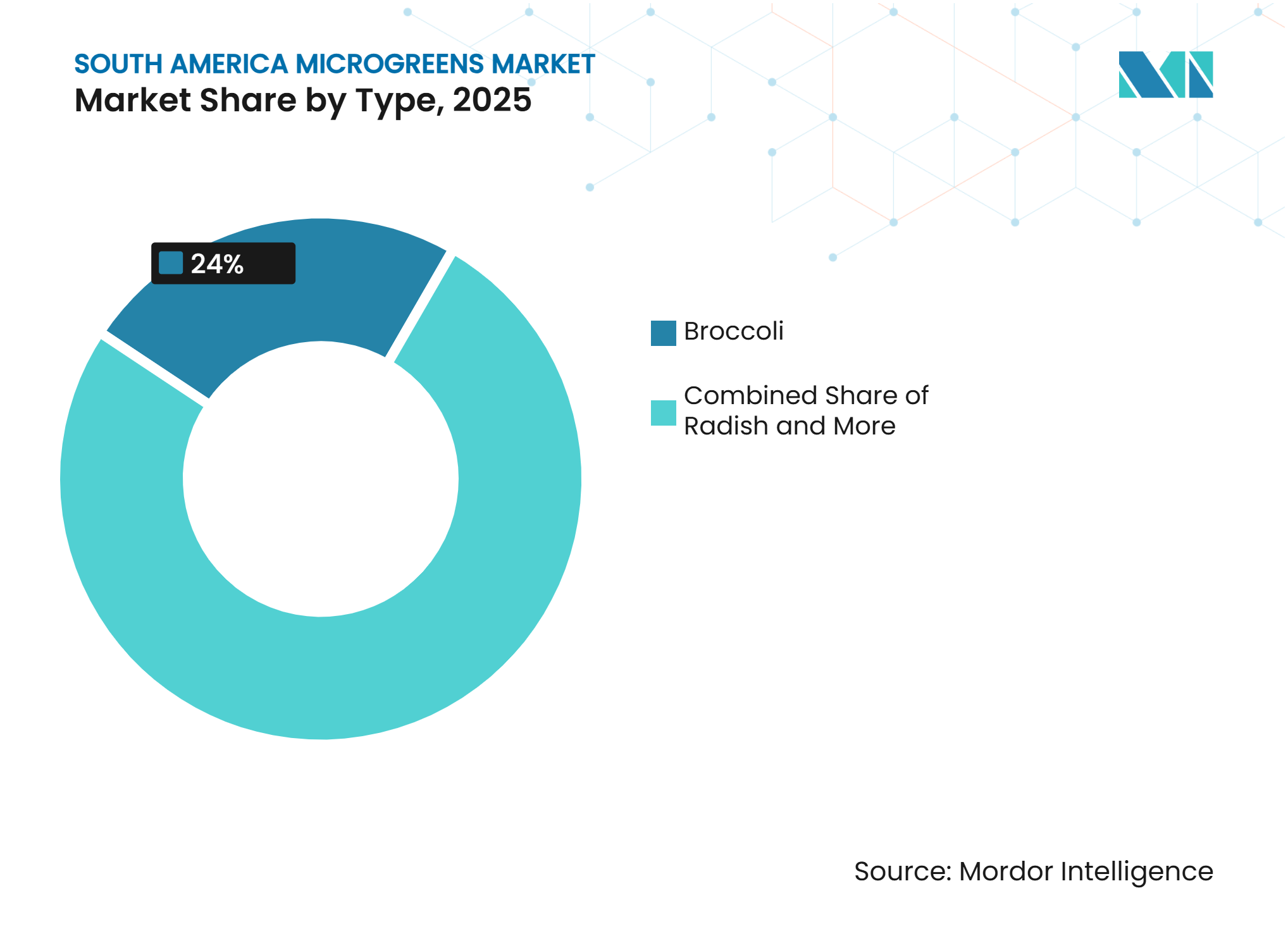
- By type, broccoli was the largest segment, accounted 24% of the South America microgreens market size in 2025, while radish is forecast to record the fastest CAGR of 13% during 2026–2031.
- By farming method, indoor farming was the largest segment, accounted 42% of the South America microgreens market share in 2025, while vertical farming is forecast to register the fastest CAGR of 13.5% during 2026–2031.
- By growth medium, soil was the largest segment, accounted 34% of the South Americ microgreens market share in 2025, while coconut coir is forecast to expand at the fastest CAGR of 13.2% during 2026–2031.
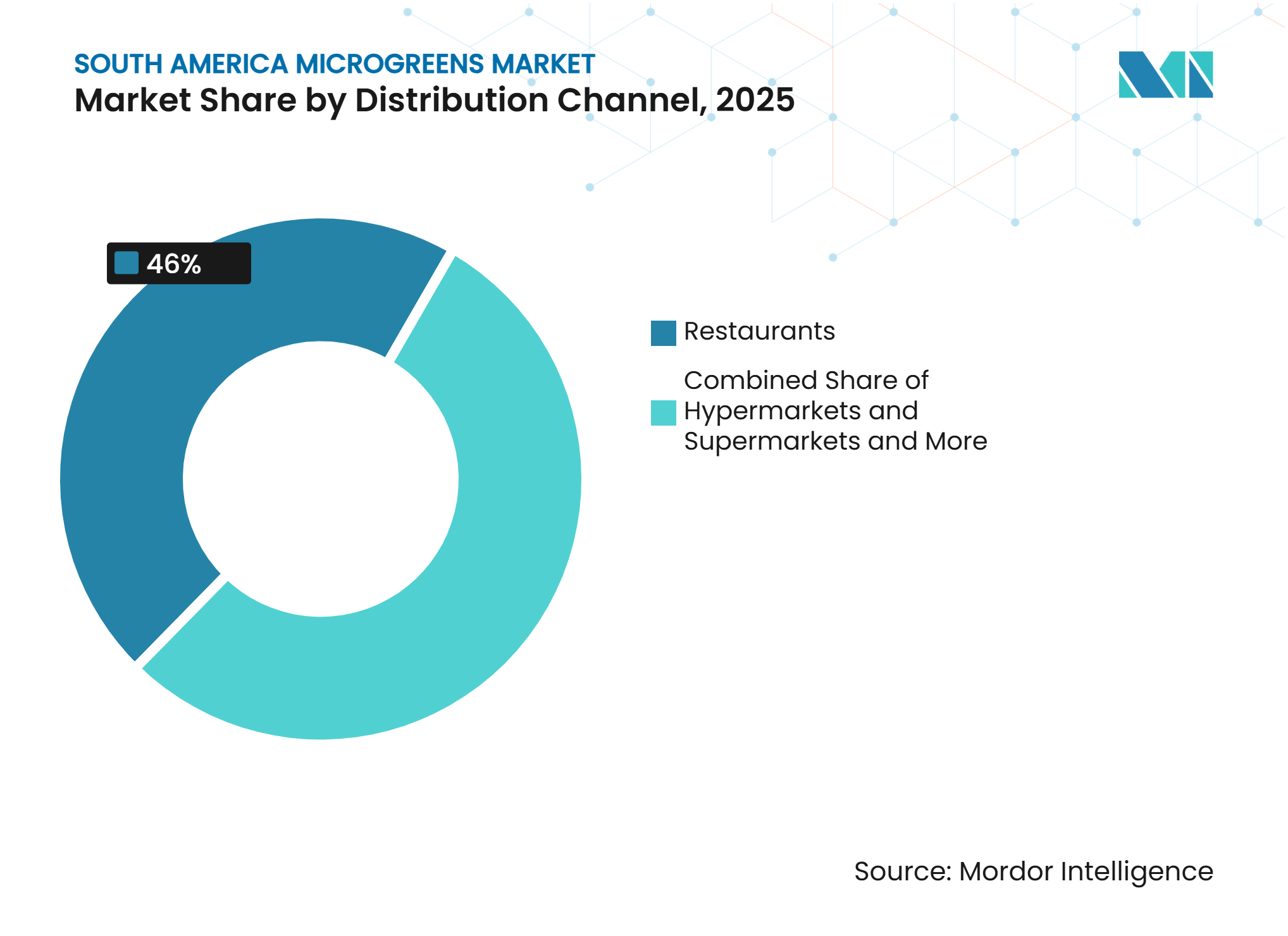
- By distribution channel, restaurants accounted for the largest share of revenue in 2025 at 46%, while other distribution channels are forecast to grow at the fastest CAGR of 14% during 2026–2031.
- By geography, Brazil was the largest segment with 52% revenue share in 2025, while the rest of South America is forecast to grow at the fastest CAGR of 12.5% during 2026–2031.
Note: Market size and forecast figures in this report are generated using Mordor Intelligence’s proprietary estimation framework, updated with the latest available data and insights as of January 2026.
Market Trends and Insights
Drivers Impact Analysis of South America Microgreens Market*
| Driver | (~) % Impact on CAGR Forecast | Geographic Relevance | Impact Timeline |
|---|---|---|---|
| Growing Use of Fresh Microgreens in South American Premium Foodservice | +2.40% | Brazil and Chile | Short term (≤ 2 years) |
| Increasing Consumer Demand for Nutrient-Dense Fresh Microgreens | +1.80% | Brazil and Chile | Medium term (2-4 years) |
| Expansion of Direct-to-Consumer and Online Fresh Microgreens Sales | +1.50% | Brazil and Rest of South America | Medium term (2-4 years) |
| Short Harvest-to-Delivery Cycles Supporting Local Fresh Supply | +2.00% | Brazil, Chile, Argentina, and Rest of South America | Short term (≤ 2 years) |
| Rising Demand for Chef-Specified Varieties, Mixes, and Harvest Formats | +1.70% | Brazil and Chile | Medium term (2-4 years) |
| Distributed Urban Production Reducing Freshness Losses in Secondary Markets | +1.30% | Rest of South America | Long term (≥ 4 years) |
| Source: Mordor Intelligence | |||
Growing Use of Fresh Microgreens in South American Premium Foodservice
Premium restaurants are an important outlet for the South America microgreens market because they place frequent, high-quality orders. Chefs use microgreens for color, texture, flavor, and plating, which favors suppliers that can provide clean, consistent product close to delivery. Restaurant clusters in São Paulo, Rio de Janeiro, and Santiago support short delivery routes and specialized variety orders. Buyers may request broccoli, radish, arugula, basil, fennel, peas, and mixed formats, which makes crop planning and dependable fulfillment commercially important. This channel provides an early revenue base for local farms, although demand remains concentrated in premium dining.
Increasing Consumer Demand for Nutrient-Dense Fresh Microgreens
Interest in nutrient-dense foods supports demand for fresh microgreens in both household and specialty retail channels. A 2025 study published in Scientific Reports (Nature Portfolio) found 825.53 mg gallic acid equivalents of total phenolics per 100 grams of fresh broccoli microgreens and 83.32% 2,2-diphenyl-1-picrylhydrazyl free-radical scavenging capacity in black radish microgreens[1]. The study also reported meaningful levels of vitamins, minerals, and other bioactive compounds across the evaluated microgreens. This nutritional profile directly supports the positioning of microgreens as nutrient-dense fresh foods, strengthening their relevance among health-conscious consumers. Rising consumer focus on nutritious food choices increases demand for fresh foods with concentrated nutritional and bioactive properties. As a result, increasing demand for nutrient-dense fresh foods directly supports the consumption and market growth of microgreens across South America.
Expansion of Direct-to-Consumer and Online Fresh Microgreens Sales
Direct-to-consumer sales reduce the number of handling steps between harvest and consumption, which is particularly important for perishable crops such as microgreens. Subscription-based orders allow growers to align seeding and harvesting with expected demand, reducing the risk of unsold products while creating more predictable purchasing patterns. In Brazil, VerdeVida offered daily, weekly, and monthly delivery options to restaurant and individual customers during 2025, demonstrating how online and direct delivery models extend access to fresh microgreens beyond specialty retail. These models also support recurring production and delivery cycles, although growers still require appropriate cold handling, packing, and direct customer service to maintain product quality. The wider adoption of these sales channels increases consumer access and encourages recurring purchases of fresh microgreens, directly supporting market growth across South America.
Short Harvest-to-Delivery Cycles Supporting Local Fresh Supply
Microgreens can reach harvestable size within 7 to 28 days after germination, depending on the species, enabling producers to maintain relatively short production cycles. Indoor and vertical systems using soilless methods can reduce water use by up to 95% compared with conventional field farming, thereby supporting production closer to urban consumption centers[2]. These characteristics facilitate urban production near restaurant and household customers, reducing the interval between harvest, packing, and delivery. HighFarm S.A. supplies restaurant and consumer accounts in Asunción, providing a Paraguay-specific example of this local production and distribution model. The broader regional benefit depends on reliable refrigeration, sanitation, packaging, and viable city-level delivery routes, while shorter production and delivery cycles strengthen the availability of fresh microgreens and support market growth across South America.
Restraints Impact Analysis of South America Microgreens Market*
| Restraint | (~) % Impact on CAGR Forecast | Geographic Relevance | Impact Timeline |
|---|---|---|---|
| High Freshness Losses From the Short Shelf Life of Harvested Microgreens | -1.50% | Rest of South America | Short term (≤ 2 years) |
| Food-Safety Compliance Costs for Raw, Ready-to-Eat Microgreens | -1.20% | Brazil and Argentina | Medium term (2-4 years) |
| Demand Concentration in Premium Urban Foodservice and Specialty Retail | -0.80% | Argentina and Rest of South America | Medium term (2-4 years) |
| Inconsistent Pack Sizes, Grading, and Shelf-Life Standards Increasing Unit Costs | -0.70% | Rest of South America | Long term (≥ 4 years) |
| Source: Mordor Intelligence | |||
High Freshness Losses From the Short Shelf Life of Harvested Microgreens
Shelf life is a material constraint because fresh microgreens are raw and highly perishable. A 2025 review reported deterioration within 10 to 14 days at 1 to 5 degrees Celsius and within 3 to 5 days at ambient temperature. This short shelf life limits the delivery radius for producers without a strong cold chain, particularly in secondary cities across the Rest of South America. Modified-atmosphere packaging and low-concentration aqueous ozone improve postharvest outcomes for arugula and radish microgreens, but packaging, equipment, and validation costs increase unit costs for small suppliers. These perishability and postharvest handling requirements increase distribution costs and limit market reach, thereby restraining the expansion of the South America microgreens market.
Inconsistent Pack Sizes, Grading, and Shelf-Life Standards Increasing Unit Costs
Inconsistent pack sizes, grading practices, and shelf-life expectations can increase handling costs for fresh microgreens suppliers in the rest of South America. Different buyer requirements for weights, mixes, labels, and delivery conditions make standardized packing and production planning more difficult. Small operators may incur higher labor and material costs when individual orders require separate preparation. Packaging and refrigeration also affect the postharvest quality of arugula microgreens[3]. Increasing the importance of consistent handling practices. More consistent specifications can reduce variation in packing and handling costs while preserving the flexibility required by restaurant customers, thereby reducing operational inefficiencies and supporting more cost-efficient microgreens supply across the region.
*Our forecasts treat driver/restraint impacts as directional, not additive. The impact forecasts reflect baseline growth, mix effects, and variable interactions.
South America Microgreens Market Segment Analysis
By Type:
Broccoli Supports Established Demand While Radish Leads GrowthBroccoli accounted for 24% of the South America microgreens market in 2025, making it the largest type segment. Its position reflects established use in premium restaurant garnish applications and consumer familiarity with the underlying vegetable. The crop belongs to the Brassicaceae family, which is associated with the phytochemical profile. This supports product differentiation, but the commercial advantage still depends on fresh appearance, reliable availability, and acceptable pricing. Broccoli is suitable for growers seeking a variety with an established place in both culinary and health-oriented product ranges.
Radish is forecast to be the fastest-growing type segment at a 13% CAGR during 2026–2031. Its appeal comes from a sharper flavor and visual intensity that can meet chef demand for more distinct plate components. Radish also gives suppliers a way to differentiate mixed packs without moving away from the fresh microgreens category. The crop's commercial value can be improved where post-harvest handling protects quality during delivery. Lettuce and chicory, arugula, basil, fennel, carrots, sunflowers, peas, and other types remain useful for restaurant and consumer combinations. Together, these varieties allow growers to serve different flavor preferences while retaining a focused production plan.



By Farming Method:
Indoor Farming Is Largest While Vertical Farming ExpandsIndoor farming accounted for 42% of the South America microgreens market in 2025, making it the largest farming method. The method supports controlled production close to urban customers and reduces exposure to outdoor weather conditions. For fresh microgreens, the central commercial benefit is a more predictable ability to plan harvests in line with restaurant and direct delivery orders. Indoor systems can also support consistent sanitation and packaging routines when they are properly managed. Brazil's southeastern urban centers provide the most established environment for this approach because local demand and delivery density support city-based growing.
Vertical farming is forecast to be the fastest-growing farming method, with a 13.5% CAGR during 2026–2031. Multi-tier production can increase the area available for production within limited urban space, which is useful when a supplier needs to operate close to buyers. The method is relevant in secondary cities because it can support a local farm without requiring a large site. Its commercial outcome depends on the ability to produce fresh microgreens at a cost that local foodservice and households can accept. Commercial greenhouses retain a role in southern Brazil and central Chile, where climate conditions can reduce energy needs. Other methods, including container and modular units, can serve smaller operators that supply concentrated local demand.
By Growth Medium:
Soil Is Largest While Coconut Coir Gains UseSoil accounted for 34% of the South America microgreens market in 2025, making it the largest growth medium segment. Smaller traditional growers may prefer it because it is familiar and widely accessible. Some buyers also associate soil-grown products with a natural production story, although commercial quality must be judged through safe handling and consistent product condition. Soil can support local production where growers have established practices and limited capital for new media. Its continuing use indicates that the regional category includes both basic and more controlled production formats.
Coconut coir is forecast to be the fastest-growing medium, with a 13.2% CAGR during 2026–2031. A 2025 study done by a Chilean institution on microgreens substrates reported that coconut coir supported moisture retention and offered useful characteristics for controlled production systems. These features are commercially relevant for fresh microgreens because early crop losses can reduce the volume available for committed orders. Coir can be particularly useful in indoor and vertical production where moisture management and cleanliness are operational priorities. Peat moss remains relevant where growers prioritize input cost, while tissue paper and other media such as jute mats can serve live-tray formats. Live-tray formats may allow roots to remain attached at sale, which can help preserve freshness after delivery.
By Distribution Channel:
Restaurants Are Largest While Other Channels Grow FastestRestaurants accounted for 46% of revenue in 2025 and were the largest distribution channel in the South America microgreens market. The channel values a fresh appearance, variety, and delivery timing, making it a suitable outlet for local growers. Frequent restaurant ordering can provide a predictable base of demand when the supplier consistently meets specifications. The channel also exposes producers to buyer concentration, as a small number of premium accounts may account for a large share of sales. This makes account retention and delivery reliability important commercial requirements for the category.
Other distribution channels are forecast to grow at the fastest CAGR of 14% during 2026–2031. This segment includes direct-to-consumer subscriptions, online platforms, and farmers' market sales. These routes can increase household access and reduce reliance on a small number of restaurant accounts. They also require growers to manage customer communication, order assembly, and last-mile delivery, which are different capabilities from supplying a chef. VerdeVida's 2025 recurring delivery plans in Brazil illustrate a country-level example of this approach. Hypermarkets and supermarkets remain a potential formal retail pathway when suppliers can meet consistent food safety, packaging, and replenishment requirements.

Geography Analysis
Brazil held 52% of the South America microgreens market in 2025 and was the largest geographic market. São Paulo and Rio de Janeiro provide a concentration of premium restaurants, retail options, and consumers willing to buy locally produced specialty food. The country also offers the most developed base for direct delivery models among the geographies considered. Brazilian growers benefit from dense urban routes, but they must manage a high standard of product consistency for restaurant and retail buyers. Agência Nacional de Vigilância Sanitária (ANVISA)'s 2024 food framework is commercially relevant because it establishes a formal compliance framework for raw and ready-to-eat products sold through Brazilian channels.
The Brazil market includes both established urban suppliers and businesses seeking to extend their delivery reach. Fazendas Bioma describes a cloud-connected farm model in Santa Catarina that combines remote production control with controlled-environment growing. The example is country-specific and relevant because operational control can support consistency in the production and supply of fresh microgreens. Its commercial significance comes from the ability to coordinate growing conditions and maintain product quality for local distribution. Brazil's scale does not remove the need for city-level supply, since a fresh product cannot be moved across long distances without careful time and temperature management. The country remains the key reference geography for suppliers seeking to build a formal and repeatable commercial model.
Chile has a smaller but commercially sophisticated position, with demand centered on Santiago's fine-dining and contemporary restaurant base. Chef-specified varieties have relevance in this city because culinary buyers can value differentiated fresh ingredients. Argentina retains demand in Buenos Aires and Córdoba through health-oriented specialty stores and emerging delivery options, although broader retail conditions remain difficult. The rest of South America is forecast to grow at the fastest 12.5% CAGR during 2026–2031. This area includes smaller urban markets in Colombia, Ecuador, Peru, and Paraguay, where local growers can address gaps that suppliers from larger cities cannot serve within a short freshness window. HighFarm S.A.'s local supply model in Asunción shows the country-specific role of controlled production for restaurant and consumer accounts in Paraguay.
Competitive Landscape
Market Concentration
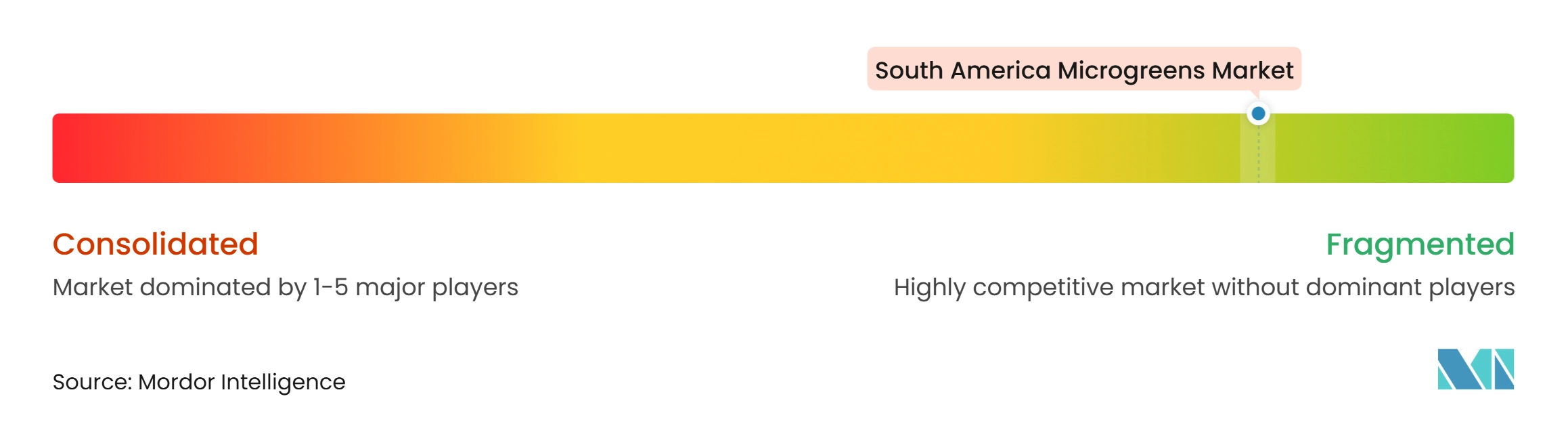
The South America microgreens market is fragmented, as no producer has a verified regional market share that establishes broad dominance. Competition is mainly local because freshness, delivery timing, and direct customer relationships are more important than distant scale. A farm supplying a restaurant cluster in one city may have little practical ability to serve a distant city within the required delivery window. This structure gives city-based specialists an opportunity to compete by offering fresh products, flexible mixes, and dependable service. It also limits a single supplier's ability to create a uniform regional distribution system. The result is a commercial landscape in which local operating discipline can matter more than brand visibility.
Fazendas Bioma uses controlled, connected farm operations in Brazil, positioning the company to manage production consistency in its home market. Vertigreen Chile offers same-day harvesting and delivery to restaurant kitchens in Santiago. This approach is commercially significant for Chile because it directly addresses the freshness requirement of foodservice customers in one concentrated urban market. HighFarm S.A. serves a similar local need in Asunción by supplying commercial and consumer accounts from controlled production. These examples do not establish regional leadership, but they show that the competitive basis is rooted in proximity and service. Operators that can manage harvest quality and delivery execution can build defensible local relationships.
Companies are also using recurring delivery plans, flexible package formats, and local production systems to reach more buyers. Such actions are commercially relevant because they address customer convenience and reduce product loss between harvest and sale. They should not be treated as evidence of a region-wide shift without broader supporting data. The white-space opportunity remains in cities with emerging premium foodservice and limited dedicated microgreens supply. Those locations may offer room for local entrants, but cold storage, food safety controls, and delivery economics remain key barriers. Competition will likely remain dispersed while the category depends on short harvest-to-delivery intervals and customer relationships that are difficult to manage from a remote location.
South America Microgreens Industry Leaders
-
Asolum Agricultura Tecnologica S.A. (Pink Farms)
-
Fazendas Bioma
-
HighFarm S.A.
-
VerdeVida
-
Delcampo por Tradición S.A.S.
- *Disclaimer: Major Players sorted in no particular order
South America Microgreens Market Companies Covered in this Report
- Asolum Agricultura Tecnologica S.A. (Pink Farms)
- VerdeVida
- Saibai
- Fazendas Bioma
- Röra Greens
- Mini Vegetales
- Vertigreen Chile
- Fractal
- HighFarm S.A.
- Aeroponica Paraguay
- Mizuna
- Colonia Green Factory
- Delcampo por Tradición S.A.S.
- Cultiva Ecuador
- Bio Bio
Recent Industry Developments in South America Microgreens Market
- June 2025: Fazendas Bioma launched a franchise expansion program for cloud-connected vertical microgreens farms in Brazil. This Brazil-specific expansion will expand local production beyond Florianópolis, which is relevant to the regional category because shorter local supply routes can improve the availability of fresh microgreens for retail and foodservice customers.
- September 2025: Fractal Agricultura in Córdoba, Argentina, reported commercial production of approximately 20–25 kg of microgreens and sprouts per week from only 15 square meters using indoor vertical cultivation. The company supplies restaurants and cafés while also serving household customers, illustrating the development of small-footprint urban production models that can serve local demand without conventional agricultural land.
- September 2025: Atama Alimentos in Ushuaia, Argentina, reported the expansion of its indoor production activities to microgreens, sprouts, and edible gourmet mushrooms, supplying supermarkets, restaurants, and Antarctic cruise operators. The company has also developed production techniques to manage seasonal demand, strengthening the ability of a remote producer to maintain commercial supply for hospitality and tourism customers.
South America Microgreens Market Report Scope
Microgreens are freshly cut, vegetable, herb, and grain seedlings harvested between the cotyledon and first true-leaf stages and sold either loose or as living trays to retail, food-service, and direct-to-consumer channels. The Microgreens Market report segments the industry into type (broccoli, lettuce and chicory, arugula, basil, fennel, carrots, sunflower, radish, peas, and other types), farming (indoor farming, vertical farming, commercial greenhouses, and other farming methods), growth medium (peat moss, soil, coconut coir, tissue paper, and other growth media), distribution channel (hypermarkets/supermarkets, restaurants, and other distribution channels), and geography (Brazil, Chile, and more). The market forecasts are provided in terms of value.
Segmentation Overview
| Broccoli |
| Lettuce and Chicory |
| Arugula |
| Basil |
| Fennel |
| Carrots |
| Sunflower |
| Radish |
| Peas |
| Other Types |
| Indoor Farming |
| Vertical Farming |
| Commercial Greenhouses |
| Other Farming Methods |
| Peat Moss |
| Soil |
| Coconut Coir |
| Tissue Paper |
| Other Growth Media |
| Hypermarkets and Supermarkets |
| Restaurants |
| Other Distribution Channels |
| Brazil |
| Chile |
| Argentina |
| Rest of South America |
| By Type | Broccoli |
| Lettuce and Chicory | |
| Arugula | |
| Basil | |
| Fennel | |
| Carrots | |
| Sunflower | |
| Radish | |
| Peas | |
| Other Types | |
| By Farming Method | Indoor Farming |
| Vertical Farming | |
| Commercial Greenhouses | |
| Other Farming Methods | |
| By Growth Medium | Peat Moss |
| Soil | |
| Coconut Coir | |
| Tissue Paper | |
| Other Growth Media | |
| By Distribution Channel | Hypermarkets and Supermarkets |
| Restaurants | |
| Other Distribution Channels | |
| By Geography | Brazil |
| Chile | |
| Argentina | |
| Rest of South America |
Key Questions Answered in the Report
What is the forecast for the South America microgreens market?
The market is forecast to rise from USD 82.2 million in 2026 to USD 139 million by 2031, at an 11.08% CAGR during 2026–2031. Growth depends on local production, formal handling, and repeat demand from foodservice and households.
Which type has the largest revenue position in South America?
Broccoli was the largest type, with 24% share in 2025. Radish is forecast to be the fastest-growing type at a 13% CAGR during 2026–2031, supported by distinctive flavor and culinary demand.
Which country leads regional demand for fresh microgreens?
Brazil was the largest geography, with 52% share in 2025, supported by major urban restaurant and direct delivery markets. Brazilian food safety requirements also shape the formal supply environment and increase the importance of traceability for commercial supply.
How do direct subscriptions affect commercial supply?
Subscription plans can provide confirmed orders before harvest, which helps growers plan production and reduce fresh-product waste. They can also make fresh microgreens more accessible to regular household buyers. This model is most effective when the producer has reliable local packing and delivery processes that preserve product quality.