
Market Overview
| Study Period | 2020 - 2031 |
|---|---|
| Forecast Data Period | 2026 - 2031 |
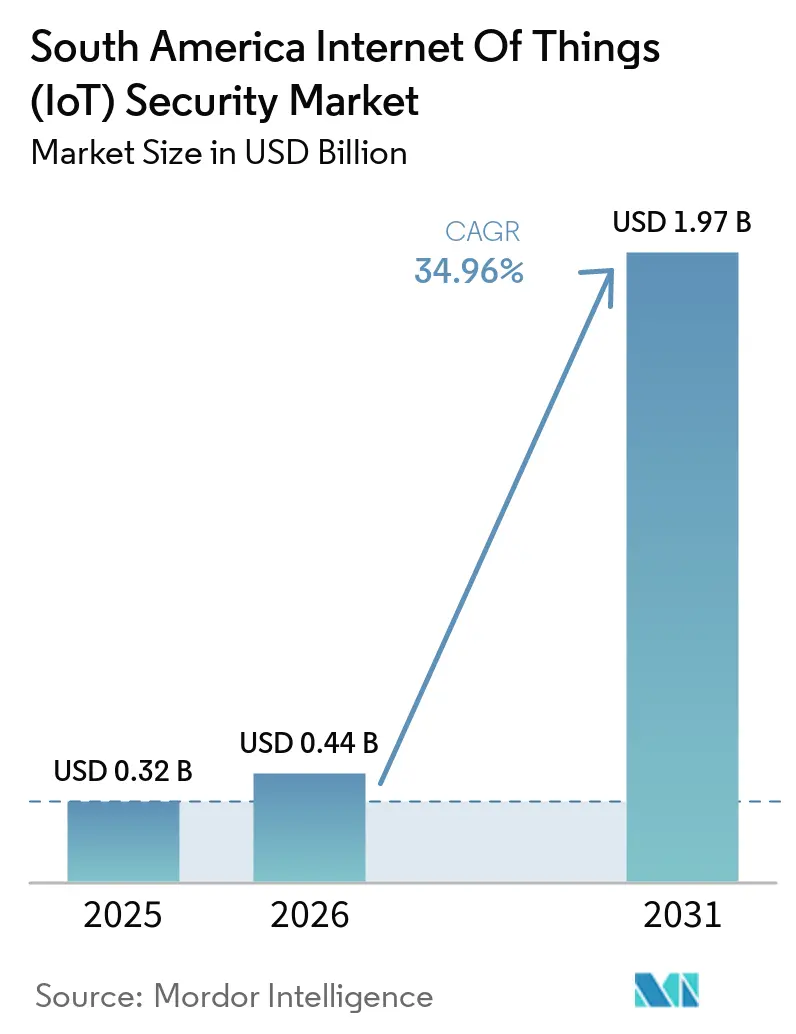
| Base Year Market Size (2025) | USD 0.32 Billion |
| Market Size (2026) | USD 0.44 Billion |
| Market Size (2031) | USD 1.97 Billion |
| Growth Rate (2026 - 2031) | 34.96 % |
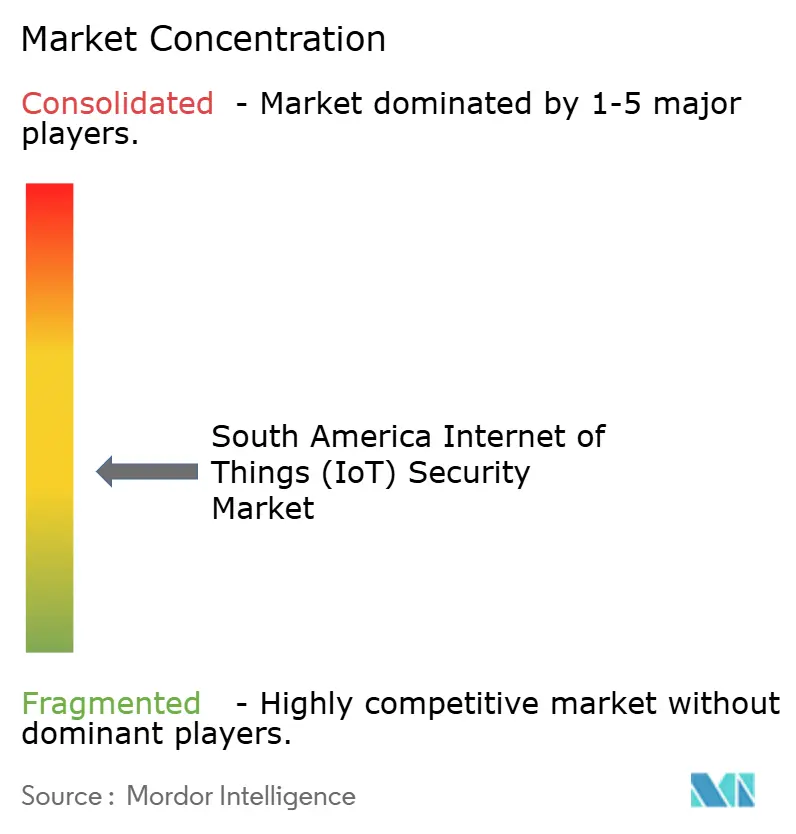
| Market Concentration | Medium |
Major Players *Disclaimer: Major Players sorted in no particular order Image © Mordor Intelligence. Reuse requires attribution under CC BY 4.0. | |
South America Internet Of Things (IoT) Security Market Analysis by Mordor Intelligence
The South America Internet of Things (IoT) security market size was valued at USD 0.32 billion in 2025 and estimated to expand from USD 0.44 billion in 2026 to reach USD 1.97 billion by 2031, at a CAGR of 34.96% during the forecast period (2026-2031). Connected industrial systems and critical infrastructure are creating broader security requirements across the region. The lack of cybersecurity specialists outside major cities is supporting demand for cloud-delivered monitoring and managed services. Ransomware and other disruptive incidents are shortening procurement cycles in manufacturing, energy, and public infrastructure. Security vendors are responding with integrated platforms, local service capacity, and products that support varied device fleets. Cost-sensitive deployments, standards fragmentation, and aging 3G equipment remain material limits, especially in rural and smaller enterprise settings.
Key Report Takeaways
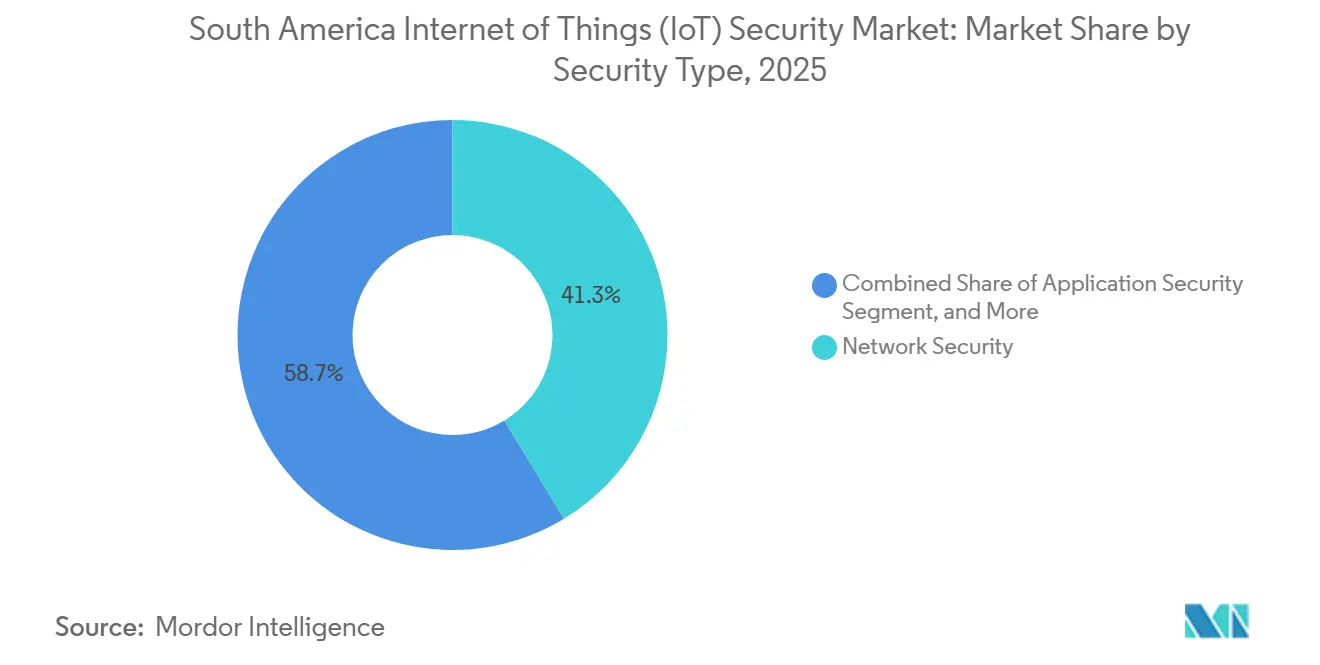
- By security type, Network Security held 41.32% of the South America Internet of Things (IoT) security market in 2025, while Cloud/Virtual Security is projected to expand at a 35.76% CAGR through 2031.
- By component, Solutions held 57.74% of the South America Internet of Things (IoT) security market share in 2025, while Services is projected to expand at a 35.37% CAGR through 2031.
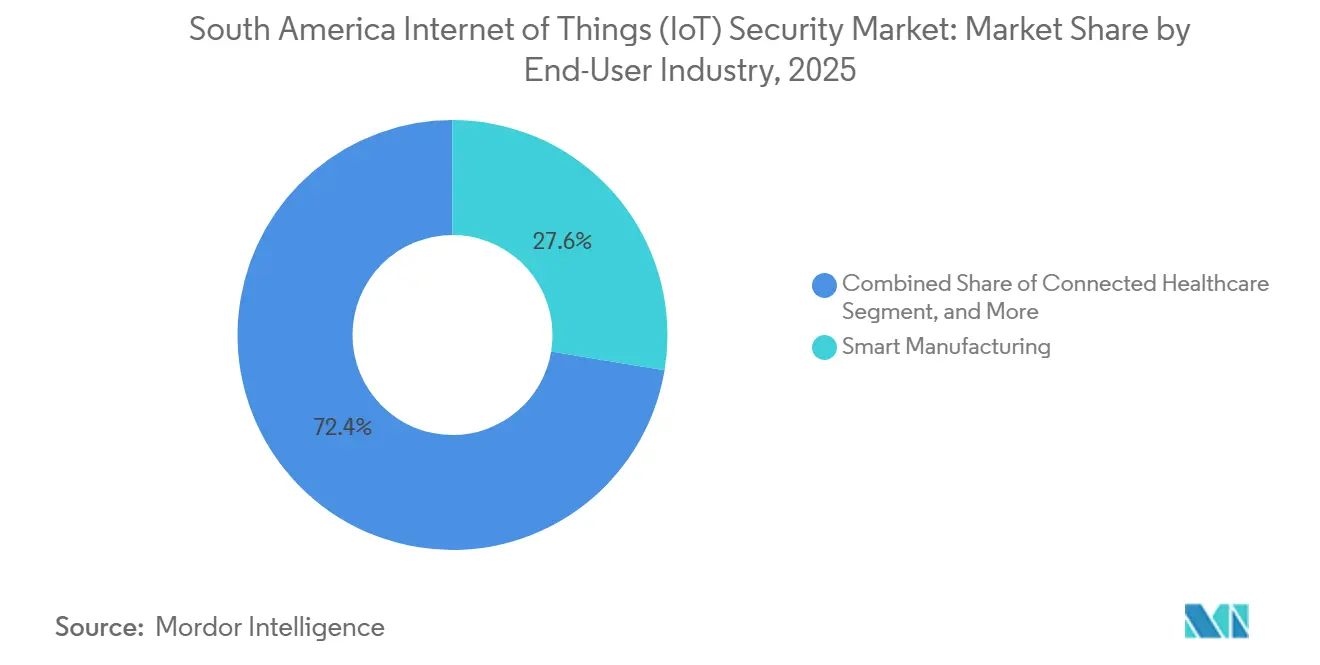
- By end-user industry, Smart Manufacturing held 27.63% of the South America IoT security market share in 2025, while Energy and Utilities is projected to expand at a 36.36% CAGR through 2031.
- By deployment mode, Cloud/SECaaS held 46.91% in 2025, while Hybrid Edge is projected to expand at a 35.54% CAGR through 2031.
- By geography, Brazil held 39.68% in 2025, while the rest of South America is projected to expand at a 35.51% CAGR through 2031.
Note: Market size and forecast figures in this report are generated using Mordor Intelligence’s proprietary estimation framework, updated with the latest available data and insights as of January 2026.
Market Trends and Insights
Drivers Impact Analysis of South America Internet Of Things (IoT) Security Market*
| Driver | (~) % Impact on CAGR Forecast | Geographic Relevance | Impact Timeline |
|---|---|---|---|
| Connected Industrial and Critical Infrastructure Assets | +8.0% | Brazil, Argentina, Chile, Colombia, Peru | Long term (≥ 4 years) |
| IoT Cyberattacks and Operational Disruption Risks | +7.0% | Brazil, Argentina, Venezuela, Chile | Medium term (2-4 years) |
| Brazil PAC 4.0 and Smart-City Security Procurement | +5.5% | Brazil, with spillover to Argentina and Colombia | Medium term (2-4 years) |
| 5G, NB-IoT, and Open Gateway Security Upselling | +4.0% | Brazil, Chile, Argentina, Colombia | Medium term (2-4 years) |
| IoT Cyber-Insurance for Continuous Monitoring | +3.0% | Brazil, Argentina, Chile | Short term (≤ 2 years) |
| Edge-Linux SBOM Adoption and Secure Procurement | +2.0% | Brazil, Chile, Colombia | Long term (≥ 4 years) |
| Source: Mordor Intelligence | |||
Expansion of Connected Industrial and Critical-Infrastructure Assets
Industrial digitalization is increasing the number of connected assets across oil and gas, mining, hydropower, and manufacturing sites. These assets require security coverage throughout their operating life, not only at the time of installation. A refinery or hydropower facility can operate equipment from 5 or more vendors, with different firmware practices and authentication methods. That mix makes a standardized perimeter defense insufficient for many operating environments. Security providers, therefore, need to combine asset visibility, integration work, and ongoing monitoring for each site. The South America Internet of Things (IoT) security market is benefiting as security engagements extend from one-time deployments into longer service relationships.
Rising IoT-Targeted Cyberattacks and Operational Disruption Risks
Cyberattacks on industrial environments are increasing the need for continuous monitoring among operators in South America. Manufacturing and energy utilities remain exposed because connected devices can provide entry points to broader operational systems. The fastest incidents in 2025 reached full data exfiltration in 1.2 hours, compared with 4.8 hours in 2024, reducing the time available for reactive response measures. Firmware in industrial devices may not be patched immediately because maintenance activity can interrupt production. Cloud-delivered managed security and SECaaS offerings address this issue through continuous detection and response coverage. This operating need supports demand for the South America Internet of Things (IoT) security market beyond traditional perimeter security tools.
Brazil PAC 4.0 and Smart-City Security Procurement
Brazilian smart-city programs are raising the security requirements for video sensors, data platforms, and connected urban infrastructure. Procurement requirements involving encryption, micro-segmentation, anomaly detection, and ISO/IEC 27001 can shift security spending toward recurring audits and monitoring. The resulting contracts favor service models that provide regular compliance support instead of a single capital purchase. ABNT and ABINC approved ABNT NBR ISO/IEC 20924:2025 and ABNT NBR ISO/IEC 30173:2025 during 2025.[1] A dedicated IoT device cybersecurity standard was planned for 2026, indicating a broader focus on device security requirements. These developments make Brazil an important source of regulatory-led opportunity for the market.
5G, NB-IoT, and Open Gateway Security Upselling
The rollout of 5G and NB-IoT networks is adding new device types to telecom and enterprise security environments. ANATEL Act No. 2105/2025 introduced certification requirements for devices that use 5G NB-NTN, 5G RedCap, and 4G LTE Cat 1bis technologies, effective from August 2025. The requirements link device deployment to current 3GPP standards and security assessment practices. STMicroelectronics obtained ANATEL certification for its ST87M01 NB-IoT module in Brazil during June 2026, supporting smart metering, street lighting, and agricultural deployments. Each new device population increases the number of endpoints requiring identity, access, network, and lifecycle security management. The South America IoT security market can benefit as telecom providers and managed service firms add security alongside connectivity services.
Restraints Impact Analysis of South America Internet Of Things (IoT) Security Market*
| Restraint | (~) % Impact on CAGR Forecast | Geographic Relevance | Impact Timeline |
|---|---|---|---|
| High Implementation and Integration Costs | -2.5% | Colombia, Peru, Argentina, Bolivia, Ecuador | Short term (≤ 2 years) |
| Fragmented IoT Standards and Interoperability Requirements | -1.5% | South America | Medium term (2-4 years) |
| Secure-Element Supply Constraints and Hardware Cost Inflation | -1.0% | Brazil, Chile, Argentina | Medium term (2-4 years) |
| Unpatchable Legacy 3G Devices in Rural Deployments | -0.5% | Peru, Bolivia, Ecuador, rural Brazil | Long term (≥ 4 years) |
| Source: Mordor Intelligence | |||
High Implementation and Integration Costs
IoT security deployments can require hardware, specialized labor, and continuing integration support. This cost structure is difficult for many small and mid-size industrial enterprises to sustain outside São Paulo, Buenos Aires, and Santiago. Operators frequently manage devices from several vendors with incompatible application programming interfaces, authentication approaches, and data formats. Custom work is often required before a central platform can collect and interpret device telemetry. The South America Internet of Things (IoT) security market, therefore, faces slower adoption where an operator cannot justify an extensive on-premise security stack. Cloud-based models can reduce some initial infrastructure needs, but they do not remove the cost of assessing and integrating legacy operational technology.
Fragmented IoT Standards and Interoperability Requirements
South American suppliers must often work across country-specific requirements and international security frameworks. Brazil uses ANATEL requirements, while companies may also need to consider ISO/IEC 27001 and IEC 62443 during product selection and audits. This multi-standard environment increases the time needed to localize products and assess vendor compliance. Integration is also difficult because many industrial control systems and SCADA platforms were not designed with open security application programming interfaces. Energy, water, and manufacturing operators can encounter gaps when linking legacy operational technology with modern IoT security platforms. These requirements can delay deployments in the South America Internet of Things (IoT) security market, particularly when a customer has a varied installed base.
*Our forecasts treat driver/restraint impacts as directional, not additive. The impact forecasts reflect baseline growth, mix effects, and variable interactions.
South America Internet Of Things (IoT) Security Market Segment Analysis
By Security Type:
Network Security Leads While Cloud Security AcceleratesNetwork Security accounted for 41.32% of the South America IoT security market in 2025, making it the largest security category. Industrial operators continue to prioritize the network layer because connected endpoints communicate through enterprise and operational networks. Phishing activity, malicious scripts, and web-based threats remain relevant risks for industrial control system users in the region. Kaspersky reported that ICS computers in South America faced email-client threats at 1.9 times the global average during the fourth quarter of 2025. The same report showed exposure to malicious phishing pages at 1.5 times the global rate during that quarter. These conditions support continuing demand for network visibility, segmentation, intrusion prevention, and threat monitoring.
Cloud/Virtual Security is projected to expand at a 35.76% CAGR from 2026 to 2031, the fastest rate among security types. It enables centralized monitoring of distributed device fleets without requiring a full security operation at each site. This model is useful for industrial facilities located far from major cybersecurity talent pools. Endpoint/Device Security is becoming increasingly relevant as device certification requirements draw greater attention to security controls at the hardware and firmware levels. Application Security also addresses risks created by connected dashboards, cloud-native industrial applications, and digital control interfaces. The market is likely to use network controls as its foundation while placing more monitoring and management functions in cloud environments.

By Component:
Solutions Lead While Services Gain GroundSolutions accounted for 57.74% of the South America Internet of Things (IoT) security market size in 2025. The category includes Identity and Access Management, Public Key Infrastructure, DDoS protection, IDS/IPS, encryption, and tokenization. These capabilities help organizations establish device identity and protect communications across manufacturing and energy environments. Machine-to-machine authentication is particularly important when large device fleets operate with limited direct human intervention. SABESP, Vivo, and IDEMIA Secure Transactions announced a 14-year partnership in August 2026 to connect 4.4 million eSIM-secured smart water meters in São Paulo City and São José dos Campos.[2] Such deployments demonstrate the operational scale at which security, identity, and connectivity controls need to work together.
Services are projected to expand at a 35.37% CAGR from 2026 to 2031. Managed Security Services and Professional Services can support companies that lack dedicated staff for ongoing detection, response, tuning, and incident handling. Implementation services also remain important where older devices need to connect with modern monitoring tools. Vendors can use service relationships to address the operational gap that follows an initial technology purchase. The South America IoT security industry is consequently supported by demand for both tools and the skilled personnel needed to operate them. Service delivery becomes more important when customers need continuous protection rather than periodic product upgrades.
By End-User Industry:
Smart Manufacturing Leads and Energy Utilities AccelerateSmart Manufacturing held 27.63% in 2025, the highest share among end-user industries. Automotive and agri-food facilities are deploying connected sensors and robotics that require network segmentation and firmware integrity monitoring. These measures support production continuity when connected systems are exposed to malicious activity or configuration failures. Manufacturing sites frequently combine older industrial control equipment with newer IoT hardware. This combination can create a need for security controls that work across varied protocols and device generations. The South America IoT security market is therefore supported by manufacturers that need to protect expanding industrial data flows without interrupting plant operations.
Energy and Utilities is projected to expand at a 36.36% CAGR from 2026 to 2031, the fastest rate among end-user industries. Energy systems face operational consequences when security incidents affect control, monitoring, or communications equipment. Connected Healthcare, Automotive and Mobility, and BFSI drive demand for connected medical equipment, mobility systems, and account security requirements. Government and Smart Cities are also becoming significant buyers of network security and identity management tools for urban IoT infrastructure. Retail and Logistics are building demand through connected supply chains and cold-chain monitoring systems in Brazil and Argentina. These end-user groups broaden the customer base for the South America Internet of Things (IoT) security market, even as manufacturing and utilities remain the central sources of demand.
By Deployment Mode:
Cloud/SECaaS Leads and Hybrid Edge Gains RelevanceCloud/SECaaS held 46.91% in 2025, making it the largest deployment mode. Many operators outside major metropolitan areas cannot maintain a full on-site security operations team. Cloud-delivered monitoring and response provide an accessible starting point for those customers. The approach also allows providers to support clients across multiple countries through centralized service capacity. It is especially relevant where industrial facilities have limited local access to certified IoT security engineers. The South America Internet of Things (IoT) security market is using Cloud/SECaaS to align security coverage with the region's uneven distribution of technical talent.
Hybrid Edge is projected to expand at a 35.54% CAGR from 2026 to 2031. Oil fields, remote mining sites, hydropower stations, and rural agricultural facilities often require local processing due to latency and connectivity constraints. These sites can still benefit from centralized threat intelligence and remote management. Neoenergia deployed a multi-access IoT connectivity ecosystem in Brazil in early 2026, combining private LTE, public LTE, and satellite connectivity via a single modem platform. On-premise deployments retain a role in high-security government and defense-related settings where data sovereignty requirements limit cloud connectivity. Hybrid architectures address the practical need to combine local operations with broader security oversight across the market.
Geography Analysis
Brazil Internet of Things (IoT) Security Market
Brazil held 39.68% of the South America Internet of Things (IoT) security market in 2025, the region's largest geographic share. Its position reflects technology investment, a domestic security ecosystem, and regulatory activity that affects connected equipment. Global vendors are expanding local capacity because Brazil can also support regional delivery. Fortinet expanded its physical presence across 24 Brazilian states during 2026. ANATEL device and telecommunications requirements add demand for security assessment, implementation, and compliance support. Brazil's regulatory environment is making security spending more closely linked to infrastructure procurement and operating requirements.
Argentina Internet of Things (IoT) Security Market
Argentina is the region's second-largest market. Its agribusiness, energy, and manufacturing sectors operate important assets at significant distances from Buenos Aires. This geographic structure favors cloud-delivered security and remote monitoring for operational technology. The country established a National Cybersecurity Center focused on protecting critical infrastructure.[3] Growing 5G adoption and established 4G NB-IoT use in agriculture and logistics are bringing additional endpoints into the security scope. Security providers, therefore, need to support remote assets without relying on a large local security team at every operating site.
Broader South America Internet of Things (IoT) Security Market
The rest of South America is projected to expand at a 35.51% CAGR from 2026 to 2031, the fastest geographic rate in the South America Internet of Things (IoT) security market. Colombia, Peru, Chile, Ecuador, Bolivia, and smaller markets are connecting industrial assets through digitalization initiatives in mining, agribusiness, and hydrocarbons. Colombia's fintech and smart-city activity supports demand for application and cloud security in Bogotá and Medellín. Peru and Ecuador present high-value operational technology security requirements in the mining sector. The Inter-American Development Bank has published governance guidance for operational technology cyber risk across energy, water, transportation, and manufacturing. Wider 5G and satellite-enabled NB-IoT coverage can expand the set of remote devices needing security coverage over the forecast period.
Competitive Landscape
The South America Internet of Things (IoT) security market is moderately fragmented. Cisco Systems, Palo Alto Networks, and Fortinet compete through network security, managed services, and broad integrated portfolios. Their platforms combine firewall, SASE, threat intelligence, and other tools that appeal to enterprise and utility customers. Nozomi Networks competes as an OT and IoT security specialist with passive asset discovery and real-time anomaly detection. Passive approaches are useful in production settings where active scanning could disrupt industrial operations. Regional managed service providers such as Tempest Serviços de Informática and Telefónica can differentiate through local delivery capacity and familiarity with compliance requirements.
The competitive landscape also includes demand for lower-cost, pre-integrated security solutions for small and mid-size industrial enterprises. Portuguese and Spanish threat intelligence can be more useful when it reflects regional attack patterns and local operating conditions. Device-lifecycle identity management is another need for multi-vendor NB-IoT deployments in utilities and agriculture. Broadcom's Symantec portfolio and CrowdStrike compete in endpoint detection and response for enterprise information technology environments. OT specialists can address protocols and operational conditions that general-purpose IT platforms may not fully cover. Product positioning in the South America Internet of Things (IoT) security industry, therefore, depends on the ability to combine IT security, operational technology visibility, managed response, and local support.
Vivo and Palo Alto Networks launched a jointly developed Agentic SOC at Febraban Tech 2026, combining Cortex XSIAM, Unit 42 MDR, Cortex XDR, threat intelligence automation, and Cortex Cloud capabilities for Brazilian enterprise customers. Palo Alto Networks also announced expanded Brazilian investment during May 2026, including in-country Unit 42 managed detection and response capacity, larger commercial and technical teams, and plans for an Executive Briefing Center in 2027. SABESP, Vivo, and IDEMIA Secure Transactions also announced their long-term smart water meter partnership during August 2026. These moves show how providers are linking security services with communications infrastructure and large connected-device programs. The available information does not provide a combined market share for leading suppliers. The market concentration score is therefore not assigned from the available evidence.
South America Internet Of Things (IoT) Security Industry Leaders
-
Cisco Systems, Inc.
-
IBM Corporation
-
Microsoft Corporation
-
Palo Alto Networks, Inc.
-
Fortinet, Inc.
- *Disclaimer: Major Players sorted in no particular order
South America Internet Of Things (IoT) Security Market Companies Covered in this Report
- Cisco Systems, Inc.
- International Business Machines Corporation
- Microsoft Corporation
- Palo Alto Networks, Inc.
- Fortinet, Inc.
- Check Point Software Technologies Ltd.
- Trend Micro Incorporated
- Broadcom Inc.
- CrowdStrike Holdings, Inc.
- Zscaler, Inc.
- Sophos Group plc
- Kaspersky Lab JSC
- Trellix
- Armis Security
- Dell Technologies Inc.
- Huawei Technologies Co., Ltd.
- Telefónica, S.A.
- Tempest Serviços de Informática S.A.
- VaultOne Software Ltd.
- Nozomi Networks Inc.
Recent Industry Developments in South America Internet Of Things (IoT) Security Market
- August 2026: Vivo and Palo Alto Networks launched a jointly developed Agentic SOC at Febraban Tech 2026, powered by Cortex XSIAM and integrating Unit 42 MDR, Cortex XDR, threat intelligence automation, and Cortex Cloud capabilities to provide Brazilian enterprise clients with AI-driven, 24/7 hybrid security operations. The partnership addressed the documented acceleration of cyberattacks, with data exfiltration times compressing to 1.2 hours in 2025 from 4.8 hours in 2024, and expanded Vivo's managed cybersecurity client base beyond 130 corporate accounts.
- August 2026: SABESP, the State of São Paulo's water and sanitation utility, Vivo, and IDEMIA Secure Transactions announced a 14-year strategic partnership to connect 4.4 million eSIM-secured smart water meters across São Paulo City and São José dos Campos. The deployment used IST's eSIM IoT platform compliant with the GSMA SGP.32 standard with post-quantum cryptographic agility. The initiative represented the world's largest secure IoT deployment for water management infrastructure.
- July 2026: CPFL Energia and TIM announced a strategic partnership to build the largest private telecommunications network in Brazil's electricity sector. The network covered 65 substations and 2,500 smart power grid devices across 51,000 km² using the 450 MHz radio frequency band. The BRL 60 million (USD 10.3 million) investment at the 2026 average exchange rate aimed to enable real-time control of grid operations for 980,000 customers across São Paulo and Rio Grande do Sul.
- May 2026: Palo Alto Networks announced expanded investments in Brazil at Ignite on Tour 2026 in São Paulo. The company established Unit 42 managed detection and response capabilities in-country, enlarged its commercial and technical teams, and planned an Executive Briefing Center for 2027. The investments positioned Brazil as a regional leadership platform covering 50% of the South American addressable cybersecurity market, based on the company's own estimates.
South America Internet Of Things (IoT) Security Market Report Scope
The South America Internet of Things (IoT) Security Market refers to the market for cybersecurity technologies, solutions, and services designed to protect connected devices, networks, applications, cloud environments, and data within IoT ecosystems from unauthorized access, cyberattacks, data breaches, malware, and other security threats. The market encompasses security solutions and services deployed across enterprise, industrial, healthcare, automotive, energy, financial, government, retail, logistics, and smart-city IoT environments.
The South America Internet of Things (IoT) Security Market Report is Segmented by Security Type (Network Security, Endpoint/Device Security, Application Security, and Cloud/Virtual Security), Component (Solutions, and Services), End-user Industry (Smart Manufacturing, Connected Healthcare, Automotive and Mobility, Energy and Utilities, BFSI, Government and Smart Cities, and Retail and Logistics), Deployment Mode (On-premise, Cloud/SECaaS, and Hybrid Edge), and Geography (Brazil, Argentina, and Rest of South America). The Market Forecasts are Provided in Terms of Value (USD).
Segmentation Overview
By Security Type
| Network Security |
| Endpoint/Device Security |
| Application Security |
| Cloud/Virtual Security |
By Component
| Solutions | IAM and PKI |
| DDoS Protection | |
| IDS/IPS | |
| Encryption and Tokenization | |
| Services | Professional Services |
| Managed Security Services |
By End-user Industry
| Smart Manufacturing |
| Connected Healthcare |
| Automotive and Mobility |
| Energy and Utilities |
| BFSI |
| Government and Smart Cities |
| Retail and Logistics |
By Deployment Mode
| On-premise |
| Cloud/SECaaS |
| Hybrid Edge |
By Geography
| Brazil |
| Argentina |
| Rest of South America |
| By Security Type | Network Security | |
| Endpoint/Device Security | ||
| Application Security | ||
| Cloud/Virtual Security | ||
| By Component | Solutions | IAM and PKI |
| DDoS Protection | ||
| IDS/IPS | ||
| Encryption and Tokenization | ||
| Services | Professional Services | |
| Managed Security Services | ||
| By End-user Industry | Smart Manufacturing | |
| Connected Healthcare | ||
| Automotive and Mobility | ||
| Energy and Utilities | ||
| BFSI | ||
| Government and Smart Cities | ||
| Retail and Logistics | ||
| By Deployment Mode | On-premise | |
| Cloud/SECaaS | ||
| Hybrid Edge | ||
| By Geography | Brazil | |
| Argentina | ||
| Rest of South America | ||
Key Questions Answered in the Report
What is the South America Internet of Things (IoT) security market size?
The regional total was USD 0.44 billion in 2026 and is forecast to reach USD 1.97 billion by 2031 at a 34.96% CAGR.
Which security type has the largest regional share?
Network Security led with a 41.32% share in 2025, supported by the need to protect industrial network environments.
Which deployment model is most widely used for IoT security in South America?
Cloud/SECaaS led deployment modes with a 46.91% share in 2025 because many sites require remote monitoring and response.
Which end-user sector is expanding fastest?
Energy and Utilities is projected to expand at a 36.36% CAGR through 2031, supported by operational and compliance requirements.
Which country leads regional demand?
Brazil held 39.68% in 2025, supported by its security ecosystem, connected infrastructure, and regulatory activity.
Why are managed security services relevant to connected assets?
Managed services provide continuous monitoring and response where organizations lack on-site cybersecurity specialists.