
South America International CEP Market Size and Share
Market Overview
| Study Period | 2020 - 2031 |
|---|---|
| Forecast Data Period | 2026 - 2031 |
| Base Year Market Size (2025) | USD 4.09 Billion |
| Market Size (2026) | USD 4.36 Billion |
| Market Size (2031) | USD 5.79 Billion |
| Growth Rate (2026 - 2031) | 5.84 % |
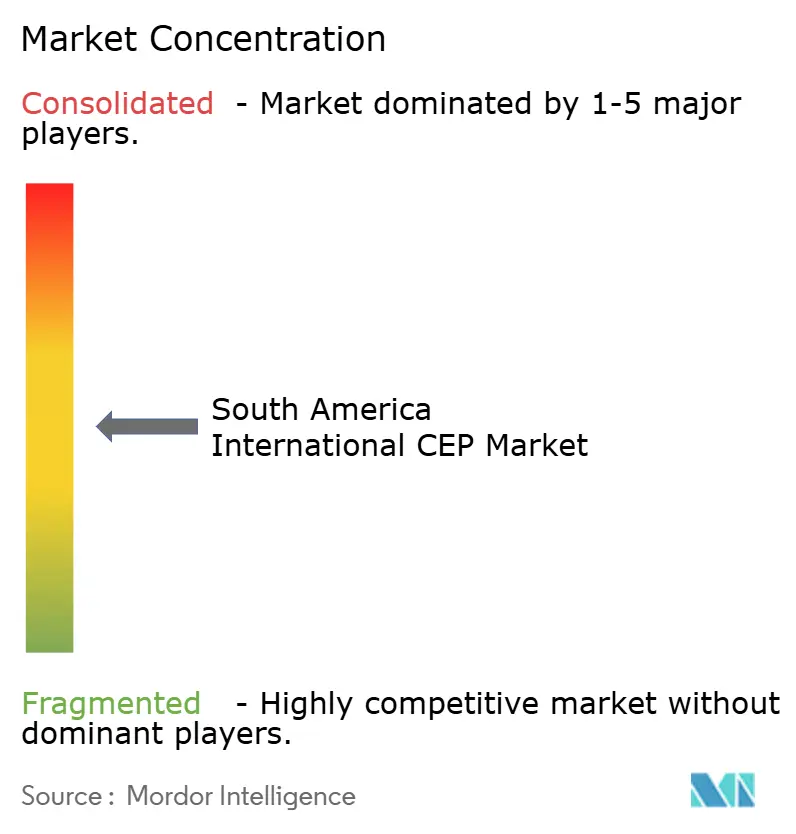
| Market Concentration | Medium |
Major Players *Disclaimer: Major Players sorted in no particular order Image © Mordor Intelligence. Reuse requires attribution under CC BY 4.0. | |
South America International CEP Market Analysis by Mordor Intelligence
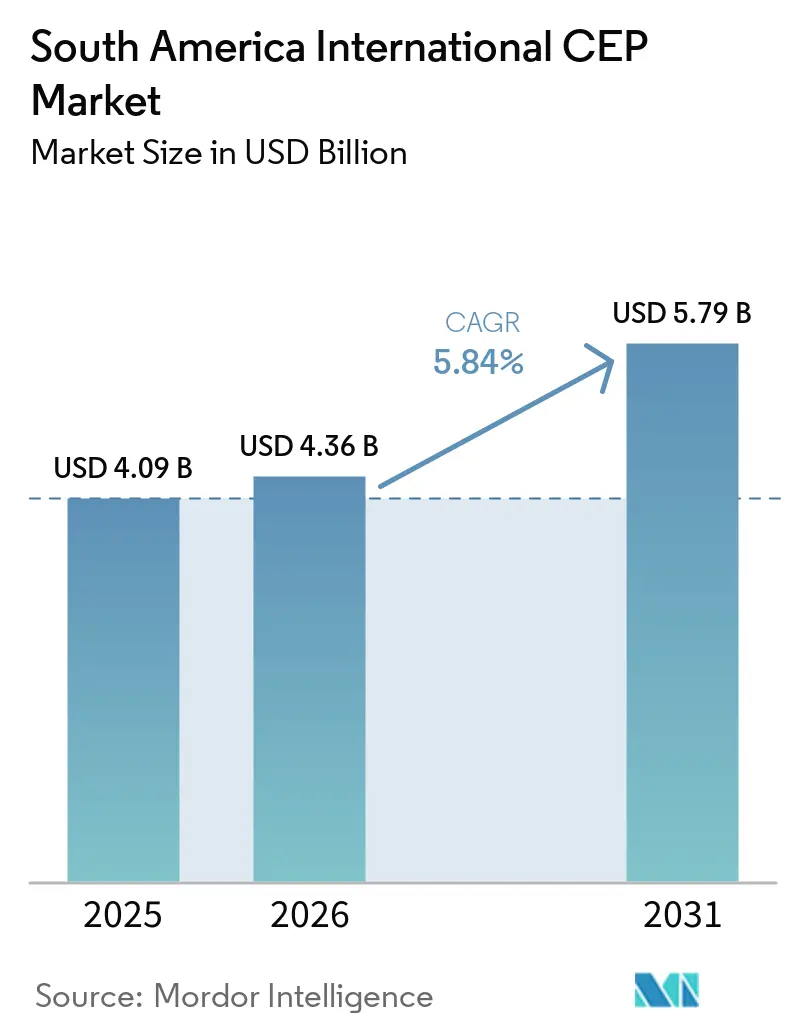
The South America International CEP Market size was valued at USD 4.09 billion in 2025, and it is expected to grow from USD 4.36 billion in 2026 to reach USD 5.79 billion in 2031, growing at a CAGR of 5.84% from 2026 to 2031.
Cross-border e-commerce, larger fulfillment networks, and customs modernization are supporting parcel flows across the region. Digital payments and direct-to-consumer selling are making cross-border purchases easier for more households. Carriers are also extending service coverage beyond major cities, which creates demand in locations that had fewer reliable delivery options. Currency volatility, freight costs, and security expenses continue to affect prices and operating margins. The South America International CEP market, therefore, combines steady demand for lower-cost parcel services with rising demand for faster, time-defined delivery.
Key Report Takeaways
- By speed of delivery, non-express services held 76.70% of the South America International CEP market share in 2025, while express services are projected to grow at a 6.76% CAGR through 2031.
- By business model, B2C held 52.66% of the South America International CEP market size in 2025 and is projected to grow at a 6.93% CAGR through 2031.
- By shipment weight, light-weight shipments held 73.06% of the South America International CEP market share in 2025 and are projected to grow at a 6.01% CAGR through 2031.
- By mode of transport, road held 52.9% of the South America International CEP market size in 2025, while air is projected to grow at a 6.96% CAGR through 2031.
- By end-user industry, manufacturing held 39.55% of the South America International CEP market share in 2025, while e-commerce is projected to grow at a 6.33% CAGR through 2031.
- By geography, Brazil held 50.32% of the South America International CEP market size in 2025, while Peru is projected to grow at a 6.92% CAGR through 2031.
Note: Market size and forecast figures in this report are generated using Mordor Intelligence’s proprietary estimation framework, updated with the latest available data and insights as of January 2026.
South America International CEP Market Trends and Insights
Drivers Impact Analysis*
| Driver | (~) % Impact on CAGR Forecast | Geographic Relevance | Impact Timeline |
|---|---|---|---|
| Cross-Border E-Commerce and Digital-Trade Expansion | +1.5% | Brazil, Colombia, Chile, Peru | Short term (≤ 2 years) |
| Growing Demand for Time-Definite International Delivery | +0.9% | Brazil, urban Argentina | Short term (≤ 2 years) |
| Customs Digitization and Trade-Facilitation Reforms | +0.7% | Brazil, Chile | Medium term (2-4 years) |
| E-Commerce Marketplace Fulfillment Investment | +1% | Brazil, Argentina | Short term (≤ 2 years) |
| South America-to-Asia Air-Cargo Corridor Development | +0.6% | Brazil, Peru, Chile | Long term (≥ 4 years) |
| Bonded Micro-Hubs and Border-Adjacent Fulfillment | +0.4% | Brazil, Uruguay-Argentina border, Paraguay corridor | Medium term (2-4 years) |
| Source: Mordor Intelligence | |||
Cross-Border E-Commerce and Digital-Trade Expansion
Cross-border digital trade is increasing the demand for international courier, express, and parcel services in South America. Chinese platforms, European fashion brands, and North American retailers are expanding direct-to-consumer fulfillment across the region. Brazil’s Pix payment system reduces settlement delays for merchants and supports faster order processing. Peru recorded USD 15.6 billion in e-commerce sales in 2025, a 21.2% increase from the previous year, and those sales represented 5.5% of the national GDP[1]Source: U.S. Department of Commerce, “Peru, eCommerce,” Trade.gov Country Commercial Guides, trade.gov. Smaller and more frequent online purchases are increasing the number of shipment events per household. This pattern supports the South America International CEP market because parcel frequency can rise even when the average order value remains limited.
Growing Demand for Time-Definite International Delivery
Demand for delivery certainty is shifting the service mix toward express products with specified delivery windows. Manufacturers need predictable transport for inbound parts that support scheduled production. Healthcare providers also need dependable delivery for temperature-sensitive pharmaceutical imports. These requirements make service quality, route reliability, and customs handling more important than a simple lowest-price offer. The South America International CEP market benefits when carriers secure longer-term contracts with industrial and healthcare customers. Such contracts can make revenue less exposed to changes in short-term e-commerce shipping volumes.
Customs Digitization and Trade-Facilitation Reforms
Brazil is moving import processing from the legacy Siscomex DI and LI system to the unified DUIMP declaration. The program is scheduled for completion by December 2026 and is intended to consolidate import filings in one digital interface. The program targets annual savings of BRL 40 billion (USD 7.5 billion) for Brazilian importers[2]Source: Brazil Federal Revenue Service, “Implementation Schedule, Single Foreign Trade Portal,” Gov.br, gov.br. Automated risk assessment may reduce physical inspections for compliant operators and improve delivery predictability. Brazil also updated the Remessa Conforme rules on May 12, 2026, affecting the duty treatment of international parcels. The South America International CEP market gives an advantage to carriers and brokers that can connect their processes to these systems early.
E-Commerce Marketplace Fulfillment Investment
Marketplace investment is changing how parcels move from international sellers to South American buyers. New fulfillment facilities can shorten delivery distances and improve inventory availability. These facilities also extend promised delivery coverage to secondary cities. This creates additional parcel events that platform-operated networks may not handle alone. Automated sorting capacity is especially relevant for small, frequent consignments. The South America International CEP market is becoming more dependent on the ability to link international linehaul capacity with local fulfillment and final-mile delivery.
Restraints Impact Analysis*
| Restraint | (~) % Impact on CAGR Forecast | Geographic Relevance | Impact Timeline |
|---|---|---|---|
| Macroeconomic Volatility and Foreign-Exchange Exposure | -0.8% | Argentina, Colombia, Brazil | Short term (≤ 2 years) |
| Uneven Road, Airport, and Border Infrastructure | -0.5% | Remote Brazil, Bolivia, Ecuador | Long term (≥ 4 years) |
| Cargo Theft and Security-Cost Inflation | -0.4% | Southeast Brazil, Colombia | Medium term (2-4 years) |
| Fragmented Customs, Tax, and Carrier-Data Standards | -0.3% | Brazil, Argentina, cross-border corridors | Long term (≥ 4 years) |
| Source: Mordor Intelligence | |||
Macroeconomic Volatility and Foreign-Exchange Exposure
Currency movements make cross-border pricing and carrier contract management more difficult. Carriers may receive payment in local currencies while paying for fuel and aircraft leases in USD. This mismatch can reduce margins even when shipment volumes increase. Rising freight costs on the Asia-Brazil corridor are a constraint on lower-value import demand. Argentina’s monetary conditions remain vulnerable to changes in trade conditions and commodity prices. The South America International CEP market must therefore balance customer affordability with the need to protect carrier margins.
Cargo Theft and Security-Cost Inflation
Cargo theft raises both direct loss exposure and the cost of maintaining reliable parcel networks. NTC&Logistica recorded 8,570 cargo theft incidents in Brazil in 2025, with 86.8% of incidents concentrated in the Southeast[3]Source: National Cargo Transport and Logistics Association, “Survey Shows Decline in Cargo Theft in 2025 but Continued High Impact,” NTC&Logística, portalntc.org.br. Carriers respond with tracking systems, protected routes, insurance, and tighter handoff procedures. These costs can be more difficult to recover on low-density inland routes. Pharmaceutical and electronics customers may require route-level security certification before signing service agreements. The South America International CEP market, therefore, faces a higher operating threshold in high-value parcel lanes.
*Our forecasts treat driver/restraint impacts as directional, not additive. The impact forecasts reflect baseline growth, mix effects, and variable interactions.
Segment Analysis
By Speed of Delivery: Non-Express Services Remain the Largest Category
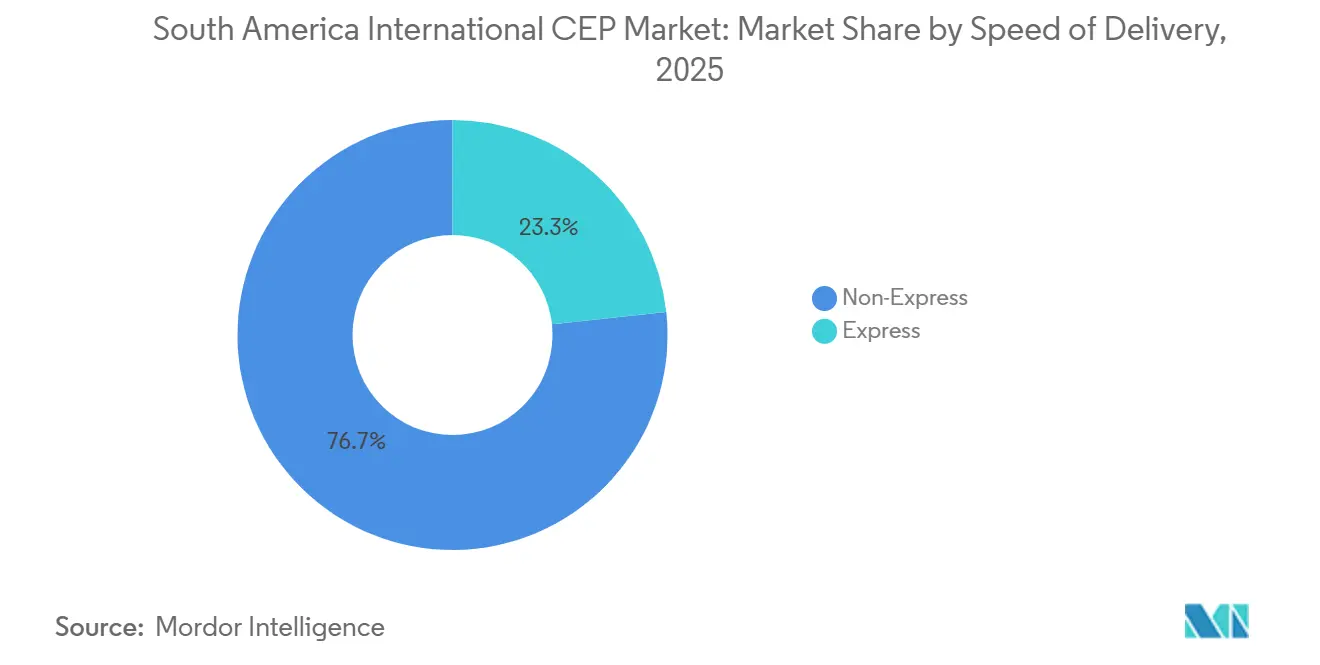
Non-express services held 76.70% of the South America International CEP market size in 2025. This position reflects the importance of cost-sensitive e-commerce imports and the challenge of serving dispersed populations. Economy services remain relevant for parcels that do not require a fixed delivery time. Rural Argentina, inland Brazil, and Peru’s highland corridors continue to depend on broad postal and road networks. Non-express volumes are not expected to decline in absolute terms during the forecast period. The category remains essential to the South America International CEP market because it provides the lower-cost option for high-volume parcel traffic.
Express services are forecast to grow at a 6.76% CAGR through 2031. This growth is supported by industrial and pharmaceutical customers that need time-defined inbound delivery. Express products also appeal to consumers willing to pay for shorter delivery windows. New air-cargo connections between Sao Paulo, Santiago, Lima, and overseas hubs can support faster international routing. The Capricorn Bi-Oceanic Corridor is a future surface option for selected cross-border routes. The South America International CEP market is therefore likely to retain a large economy-service base while express services make a larger contribution to revenue growth.



By Business Model: B2C Leads in Share and Growth
B2C held 52.66% of the South America International CEP market share in 2025 and is projected to grow at a 6.93% CAGR through 2031. It is the largest business-model segment and the fastest-growing segment. Direct-to-consumer retail gives international sellers access to buyers without a traditional local store network. It also creates a high frequency of smaller shipments that require customs, linehaul, and last-mile coordination. B2C demand is strongest where digital payments and platform fulfillment are becoming more widely used. The South America International CEP industry depends increasingly on this type of recurring parcel demand.
B2B remains important for manufacturers that import components, electronics subassemblies, and chemical inputs. These customers often use contracted delivery services and may require service-level commitments. C2C is smaller but serves informal cross-border sellers, especially on the Brazil-Paraguay and Argentina-Chile corridors. A gradual shift toward pre-positioned inventory as platforms move goods closer to buyers. This can reduce delivery time between order placement and parcel collection. The South America International CEP market will need flexible network capacity because B2C, B2B, and C2C shipments have different service expectations and shipment patterns.
By Shipment Weight: Light-Weight Shipments Drive Parcel Volumes
Light-weight shipments held 73.06% of the South America International CEP market size in 2025 and are projected to expand at a 6.01% CAGR through 2031. Apparel, accessories, consumer health products, and small electronics create a large share of these parcel flows. These products are commonly shipped from Asian origins or from fulfillment warehouses located closer to consumers. Their size makes them suitable for air and road parcel networks. Light-weight shipments also create demand for automated sorting and pickup-and-drop-off locations. The South America International CEP market has a strong incentive to improve processing density for this category.
Automation can improve handling speed and reduce costs compared with manual processing. This is important because low-weight parcels can generate limited revenue per kilogram. Operators need broad delivery density, effective sorting, and convenient collection points to protect unit economics. Medium-weight parcels support manufacturing supply chains, including automotive and electronics components. Heavy-weight shipments remain smaller and serve industrial equipment, mining, and energy-related needs. The South America International CEP market must serve these different shipment profiles without losing the efficiency achieved in high-volume light-weight traffic.
By Mode of Transport: Road Holds the Largest Position, While Air Grows Faster
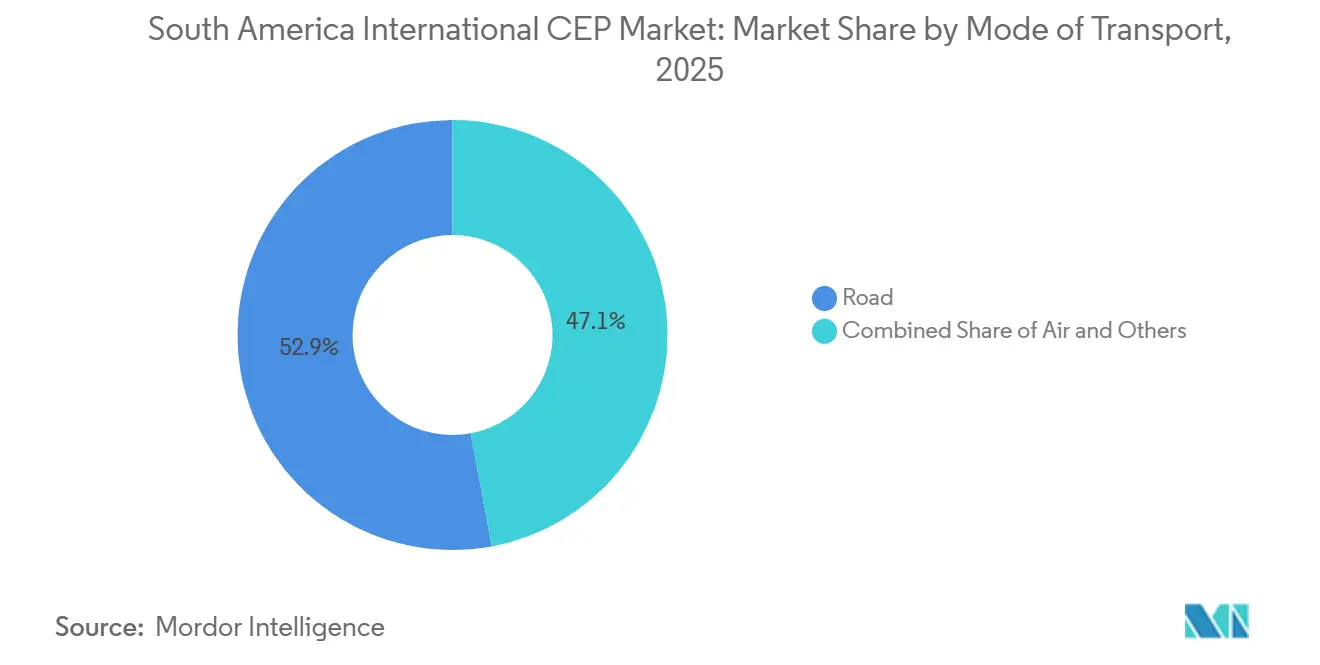
Road held 52.92% of the South America International CEP market share in 2025. Cross-border trucking links Brazil, Argentina, Chile, and Colombia, and supports a large share of non-express and medium-weight consignments. Road transport is often the most suitable option when delivery speed is less important than cost. It also connects distribution centers with locations that have limited air access. However, poor roads, border delays, and long distances can reduce predictability on some routes. The South America International CEP market continues to rely on road transport as its main regional service network.
Air is the fastest-growing transport category and is forecast to grow at a 6.96% CAGR through 2031. It supports pharmaceutical deliveries, electronics components, fast-fashion replenishment, and premium cross-border parcels. Air services are also useful where road infrastructure and border procedures make surface transit uncertain. More freighter capacity is connecting South American gateways with Asian and European hubs. Rail, sea, and multimodal services make up the remaining transport category and serve specialized needs. The South America International CEP market will continue to use road and air for most value, while multimodal services support selected industrial corridors.
By End-User Industry: Manufacturing Provides the Largest Base
Manufacturing held 39.55% of the South America International CEP market share in 2025. Brazil’s industrial clusters require recurring imports of automotive parts, electronics components, and chemical inputs. These shipments often operate under delivery schedules that support production continuity. Carriers serving manufacturers need dependable customs processes and delivery performance. Manufacturing customers can also use service-level agreements with clear transit commitments. The South America International CEP industry benefits from this stable source of recurring commercial parcel demand.
E-commerce is the fastest-growing end-user segment and is forecast to grow at a 6.33% CAGR through 2031. Platform logistics investment is extending delivery commitments into secondary cities and adding new parcel activity. Healthcare, BFSI, and offline wholesale and retail also contribute smaller but meaningful demand. Healthcare shipments require controlled conditions and reliable timing for pharmaceuticals. Primary industries generate seasonal demand for agricultural inputs, mining components, and agrichemicals. The South America International CEP market must combine broad consumer delivery coverage with specialized services for regulated and industrial users.
Geography Analysis
Brazil held 50.32% of the South America International CEP market share in 2025. Its scale reflects its large consumer base, economic position, and role as a major entry point for Asian imports. The South America International CEP market size in Brazil is also supported by its expanding fulfillment network and established gateway airports. The DUIMP migration and the Remessa Conforme update are changing the operating environment for imported parcels. These reforms can improve visibility and predictability for compliant operators. Brazil also faces currency exposure, road constraints in remote areas, and cargo security costs. Its balance of large parcel demand and operational complexity makes it central to regional carrier strategies.
Argentina, Chile, and Colombia provide different sources of demand for cross-border parcel operators. Argentina continues to show consumer demand for imported fashion and electronics despite macroeconomic uncertainty. Chile supports two-way parcel flows through its broad trade links and automated customs environment. Colombia is relevant to pharmaceutical imports and Andean air-cargo routes. Each country requires a different network approach because customs procedures, consumer demand, and transport links vary. The South America International CEP market gains from regional integration but still needs country-specific pricing and delivery models. Cross-border services remain sensitive to infrastructure quality and the ability to manage local regulations.
Peru is forecast to be the fastest-growing country in the South America International CEP market, with a 6.92% CAGR through 2031. Chancay processed more than 270,000 containers in its first full year and reduced Shanghai-Lima ocean transit times by up to 2 weeks. The increase in trade activity can support demand for faster delivery of pharmaceuticals, electronics, and machinery. Peru’s digital retail growth also supports more direct consumer parcel flows. Uruguay, Paraguay, Ecuador, Bolivia, and smaller Andean economies contribute through bonded micro-hubs, free-trade-zone activity, and regional gateway services. These smaller locations are important because they can connect emerging cross-border demand with major regional transport networks.
Competitive Landscape
The South America International CEP market has a medium concentration. DHL Group, FedEx, and UPS compete in premium time-defined lanes through established customs capabilities and air-gateway networks. Mercado Libre’s logistics operation, Loggi, Chilexpress, Andreani, and Correios compete across e-commerce and lower-cost parcel services. This structure combines international integrators with regional and domestic specialists. The largest global players are strong in complex cross-border requirements and higher-value services. Regional operators compete through local reach, service flexibility, and cost. The South America International CEP market is not controlled by one operator because service needs differ across countries and shipment types.
E-commerce platforms are expanding their role in logistics as they seek more control over delivery quality. This changes the relationship between marketplace operators and traditional carriers. Platform-operated fulfillment can improve inventory placement, sorting, and last-mile coordination. It can also create new shipment demand in areas where delivery coverage is improving. Carriers remain important for international linehaul, customs clearance, specialized deliveries, and routes outside platform networks. The South America International CEP market is therefore seeing closer competition between platform logistics and asset-based carriers. Operators that can combine local delivery capacity with dependable international handling are better placed to serve sellers and buyers.
DHL Group’s acquisition of Aero Cargas in Uruguay expands its Southern Cone presence in pharmaceutical and free-trade-zone logistics. UPS is investing more than USD 2 billion globally through 2028 in international, healthcare, and supply-chain businesses, with the Americas identified as a priority region[4]Source: UPS, “UPS Invests More Than USD 2 Billion to Give Customers Even Faster Service,” UPS Newsroom, about.ups.com.. Aramex reorganized its operating structure through its Accelerate28 program, with its 2025 results pointing to demand changes from nearshoring and regionalization. Competitive opportunities remain in bonded micro-hubs, pharmaceutical cold-chain services, and technology-enabled C2C flows. These opportunities require strong security controls, route knowledge, and compliance capabilities. The South America International CEP market remains competitive because global scale alone does not solve local delivery constraints.
South America International CEP Industry Leaders
FedEx
Chilexpress S.A.
Correos de Chile
United Parcel Service, Inc.
DHL Group
- *Disclaimer: Major Players sorted in no particular order

Recent Industry Developments
- September 2026: DHL Global Forwarding acquired Aero Cargas S.A., establishing its first direct operational presence in Uruguay. The deal brings more than 58 years of South American logistics expertise, Free Trade Zone operations, and pharmaceutical distribution capabilities serving over USD 1 billion in annual pharma flows through Uruguay to regional markets; Aero Cargas joins DHL's Peru–Ecuador–Argentina–Chile cluster under DHL Group's Strategy 2030.
- May 2026: Mercado Libre expanded its air logistics network to Patagonia (Argentina), connecting Ushuaia, Bariloche, Neuquen, and Trelew to 48-hour delivery coverage. The operation handles between 15,000 and 16,000 packages per day, making Argentina the 5th country in the region where the company operates dedicated cargo flights, as part of its USD 3.4 billion Argentina investment plan for 2026.
- May 2026: AliExpress and Correios (Brazil's state postal operator) signed a memorandum of understanding on May 31, 2026, in Hangzhou, during an official Brazilian government trade mission, to deepen cooperation in logistics, parcel tracking, and last-mile delivery efficiency. AliExpress designated Brazil as one of its 3 priority global growth markets for 2026, elevating the strategic importance of the partnership for cross-border inbound CEP volumes.
- April 2026: Mercado Libre acquired 2 logistics assets previously operated by Loggi, in Cajamar (So Paulo) and Sao Joao de Meriti (Rio de Janeiro), expanding its control over strategic distribution nodes near Brazil's 2 largest consumer markets. The acquisition includes physical infrastructure, sortation equipment, and long-term lease contracts.


South America International CEP Market Report Scope
| Express |
| Non-Express |
| Business-to-Business (B2B) |
| Business-to-Consumer (B2C) |
| Consumer-to-Consumer (C2C) |
| Light-Weight Shipments |
| Medium-Weight Shipments |
| Heavy-Weight Shipments |
| Air |
| Road |
| Others |
| E-Commerce |
| Financial Services (BFSI) |
| Healthcare |
| Manufacturing |
| Primary Industry |
| Wholesale and Retail Trade (Offline) |
| Others |
| Argentina |
| Brazil |
| Chile |
| Colombia |
| Peru |
| Rest of South America |
| By Speed of Delivery | Express |
| Non-Express | |
| By Business Model | Business-to-Business (B2B) |
| Business-to-Consumer (B2C) | |
| Consumer-to-Consumer (C2C) | |
| By Shipment Weight | Light-Weight Shipments |
| Medium-Weight Shipments | |
| Heavy-Weight Shipments | |
| By Mode of Transport | Air |
| Road | |
| Others | |
| By End-User Industry | E-Commerce |
| Financial Services (BFSI) | |
| Healthcare | |
| Manufacturing | |
| Primary Industry | |
| Wholesale and Retail Trade (Offline) | |
| Others | |
| By Country | Argentina |
| Brazil | |
| Chile | |
| Colombia | |
| Peru | |
| Rest of South America |


Key Questions Answered in the Report
What is the forecast for South America international CEP services?
Value is projected to reach USD 5.79 billion by 2031, growing at a 5.84% CAGR from 2026.
Which delivery speed category is growing fastest in South America?
Express services are projected to grow at a 6.76% CAGR through 2031, faster than non-express services.
Why is B2C parcel delivery important in South America?
B2C held 52.66% of value in 2025 and is projected to grow at a 6.93% CAGR through 2031.
Which country leads regional international CEP demand?
Brazil held 50.32% of the value in 2025, supported by its large consumer base and role as an import gateway.
Which country is forecast to grow fastest?
Peru is forecast to grow at a 6.92% CAGR through 2031, supported by trade activity and e-commerce demand.
What are the main risks for courier operators in South America?
Currency exposure, uneven infrastructure, cargo theft, and fragmented customs processes can increase costs and reduce delivery predictability.
Page last updated on:





