
South America Immersive Entertainment Market Size and Share
Market Overview
| Study Period | 2020 - 2031 |
|---|---|
| Forecast Data Period | 2026 - 2031 |
| Base Year Market Size (2025) | USD 5.61 Billion |
| Market Size (2026) | USD 6.38 Billion |
| Market Size (2031) | USD 12.65 Billion |
| Growth Rate (2026 - 2031) | 14.67 % |
| Market Concentration | Medium |
Major Players *Disclaimer: Major Players sorted in no particular order Image © Mordor Intelligence. Reuse requires attribution under CC BY 4.0. | |
South America Immersive Entertainment Market Analysis by Mordor Intelligence
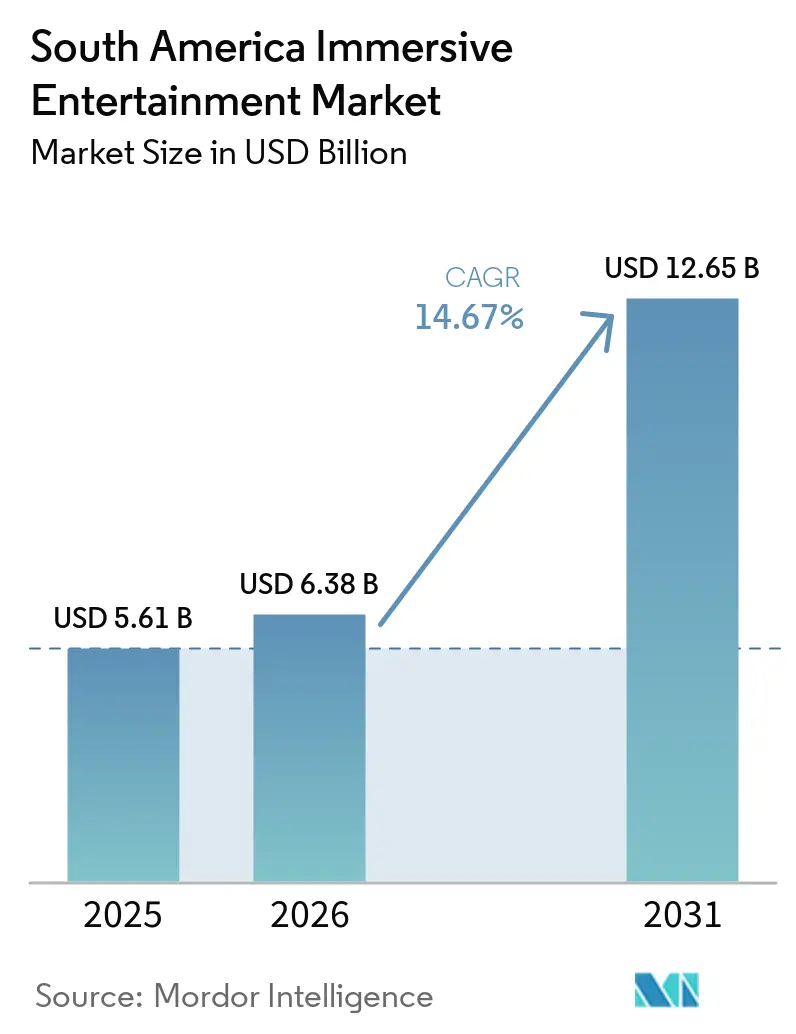
The South America immersive entertainment market size was valued at USD 5.61 billion in 2025 and USD 6.38 billion in 2026, and is projected to reach USD 12.65 billion by 2031, at a CAGR of 14.67% during the forecast period (2026-2031). Demand is moving toward location-based experiences that combine digital content with social leisure, particularly in large urban retail corridors. Brazil remains the regional center because it combines tourism assets, established attractions, and substantial brand activation activity. Operators are using mall leases, franchises, and partnerships to reduce the capital needed for new venues. Imported XR equipment and a limited pool of specialized creative and technical workers remain important operating constraints.
Key Report Takeaways
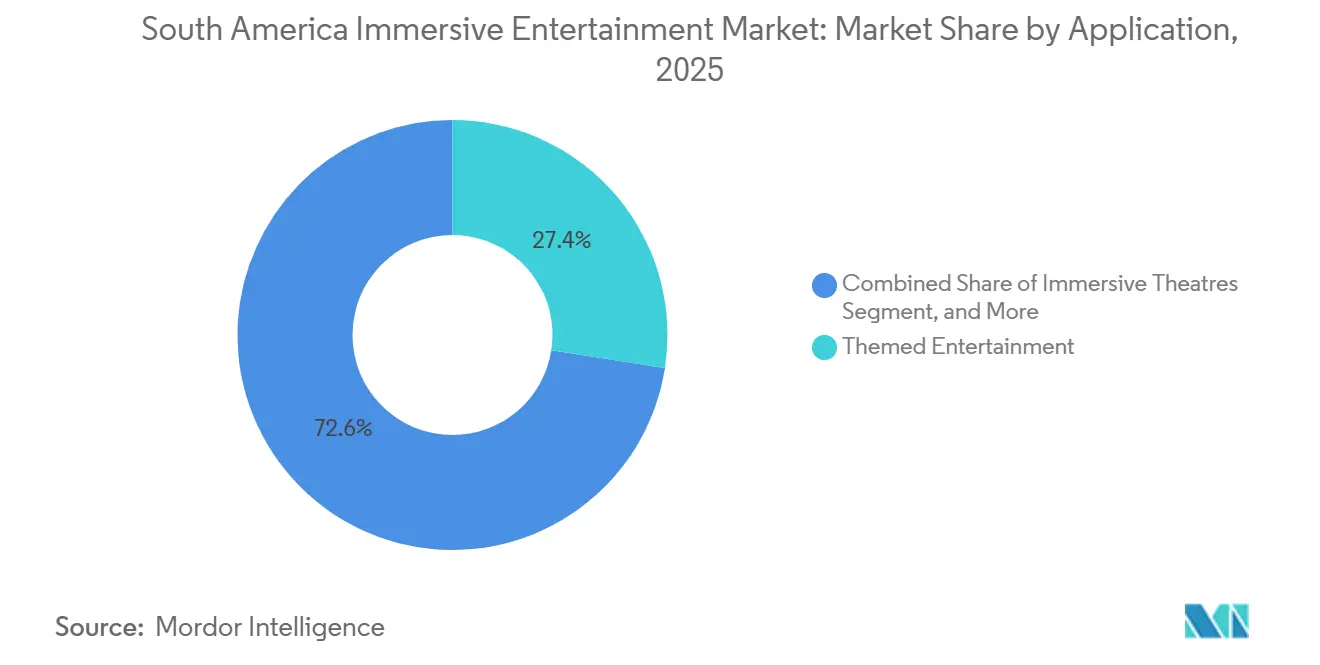
- By application, themed entertainment held 27.45% of the South America immersive entertainment market share in 2025, while live immersive gaming events are projected to expand at a 14.95% CAGR through 2031.
- By technology, virtual reality held 35.42% of the South America immersive entertainment market share in 2025, while mixed reality is projected to expand at a 15.17% CAGR through 2031.
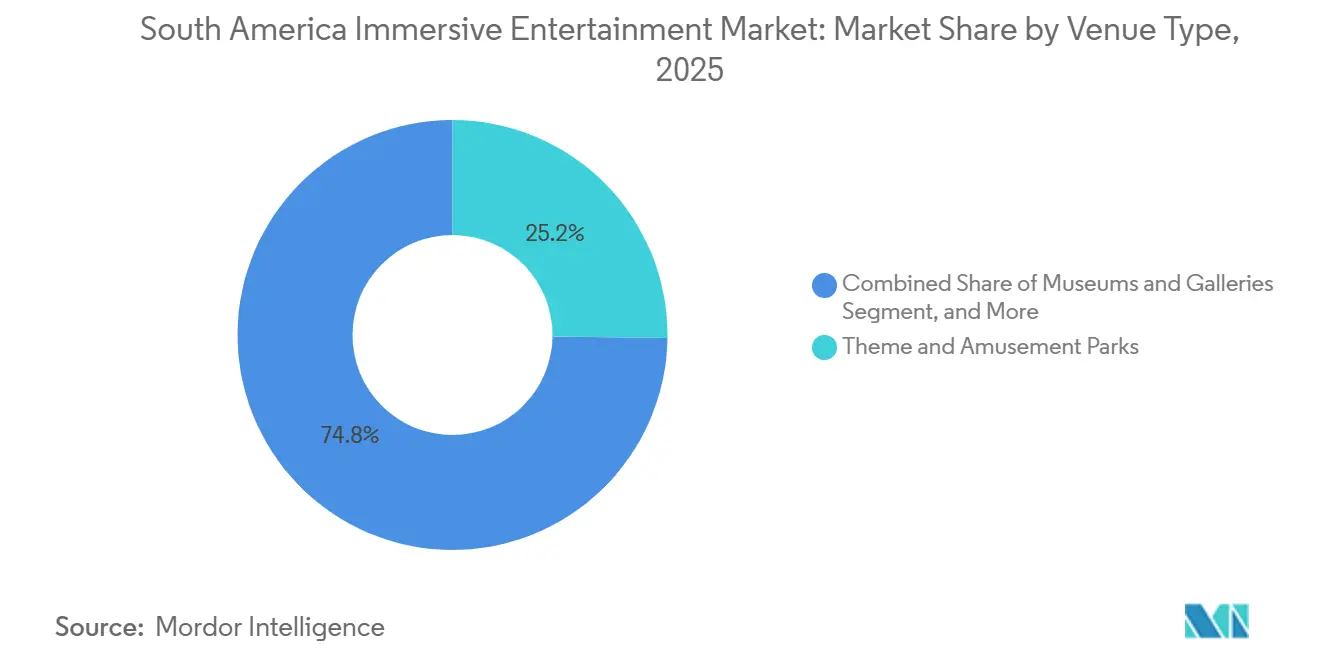
- By venue type, theme and amusement parks accounted for 25.23% of the South America immersive entertainment market size in 2025, while stand-alone immersive venues are projected to expand at a 15.34% CAGR through 2031.
- By revenue stream, ticket sales accounted for 57.34% of the South America immersive entertainment market size in 2025, while subscriptions and memberships are projected to expand at a 27.52% CAGR through 2031.
- By geography, Brazil held 42.34% share in 2025, while Argentina is projected to expand at a 15.45% CAGR through 2031 in the South America Immersive Entertainment Market.
Note: Market size and forecast figures in this report are generated using Mordor Intelligence’s proprietary estimation framework, updated with the latest available data and insights as of January 2026.
Market Trends and Insights
Drivers Impact Analysis of South America Immersive Entertainment Market*
| Driver | (~) % Impact on CAGR Forecast | Geographic Relevance | Impact Timeline |
|---|---|---|---|
| Location-Based Entertainment in Shopping Malls | +3.5% | Brazil, Argentina, Chile, and Colombia are primary markets. Peru and Uruguay are secondary markets | Short Term (≤ 2 Years) |
| VR Arcades and Family Entertainment Centers | +2.9% | Brazil is the core market, with spillover into Argentina and Chile | Short Term (≤ 2 Years) |
| Immersive Cultural and Art Experiences | +2.4% | Brazil, Colombia, and Peru have high relevance, with broader regional appeal | Medium Term (2-4 Years) |
| Brand Activation and Corporate Event Spending | +1.8% | São Paulo and Rio de Janeiro are core locations. Buenos Aires and Bogotá are emerging locations | Medium Term (2-4 Years) |
| Brazil Tourism and Attraction Ecosystem | +1.6% | Brazil is the main market, with links to regional tourism circuits | Medium Term (2-4 Years) |
| Lower Cost of Standalone VR Hardware and Wireless Headsets | +1.2% | The trend is global, with demand effects concentrated in Brazil and Argentina | Long Term (≥ 4 Years) |
| Source: Mordor Intelligence | |||
Expansion of Location-Based Entertainment in Shopping Malls
Shopping malls are converting retail vacancies into entertainment space as e-commerce changes the role of physical stores. This is lowering barriers for operators that need accessible urban locations and predictable visitor traffic. Mall owners in São Paulo, Buenos Aires, and Santiago are offering revenue-share leases and fit-out support to entertainment tenants. These arrangements reduce the initial capital burden for mid-sized immersive sites. In 2026, operators continued to use mall locations for multiplayer and mixed-reality experiences, often alongside existing cinema and food-service traffic. The South America immersive entertainment market benefits when malls treat immersive venues as visitor anchors rather than temporary users of vacant space.
Growth of VR Arcades and Family Entertainment Centers
VR arcades are moving from trial-oriented attractions toward venues designed for repeat visits and group participation. Wireless headsets reduce the need for fixed computing equipment at every station and simplify venue operations. Mixtou Experience and Hopi Hari opened a dedicated VR area in January 2026, using simulators that added paid experiences within an existing theme park.[1] Mixtou stated that it planned 60 new units in Brazil over 5 years, with BRL 100 million in investment (USD 17.2 million) at the 2025 exchange rate cited in the reported information. The model favors standardized equipment, recognizable games, and smaller sites that can be replicated across retail corridors. This supports the South America immersive entertainment market by allowing operators to extend beyond destination parks without building large greenfield facilities.
Rising Demand for Immersive Cultural and Art Experiences
Cultural institutions are widening the audience for immersive formats by hosting exhibitions that connect technology with public themes. These programs can reach visitors who may not routinely purchase gaming or amusement experiences. Museu do Amanhã hosted The Lumisphere Experience in November 2025, a 750-square-meter installation that used projection mapping and interaction to address climate issues.[2] The British Council presented Immersive Amazon in Belém during 2026, using 360-degree projections and spatialized sound to present work by Amazonian Indigenous artists in a free-admission setting. Public and institutional settings can reduce venue costs and create familiarity with immersive content among new audiences. The South America immersive entertainment market can therefore draw on a larger pool of visitors once commercial operators adapt experiences to local cultural interests.
Increasing Brand Activation and Corporate Event Spending
Brand activations are creating an additional income path for companies that design immersive environments. Corporate clients often seek experiences that extend visitor engagement beyond a conventional product presentation. Chevrolet used an immersive format for the Sonic 2027 launch in São Paulo in May 2026, serving 2,000 South American guests according to the reported information. Lenovo also used Arena Brasileira in São Paulo during the 2026 FIFA World Cup for customers, media, partners, and employees.[3] These contracts can help providers plan equipment use and creative staffing between consumer-facing events. The South America immersive entertainment market gains from this demand because suppliers can build a broader revenue base than admission tickets alone. Brand work also gives operators a way to test new formats before introducing them to the general public.
Restraints Impact Analysis of South America Immersive Entertainment Market*
| Restraint | (~) % Impact on CAGR Forecast | Geographic Relevance | Impact Timeline |
|---|---|---|---|
| High Upfront Cost of Immersive Entertainment Installations | -2.8% | The issue is regional and is strongest in secondary cities outside São Paulo and Buenos Aires | Medium Term (2-4 Years) |
| Limited Specialized Content and Technical Talent | -2.1% | The issue affects South America, with sharper shortages in Colombia, Peru, and Chile | Medium Term (2-4 Years) |
| Motion Sickness, Accessibility, and Health-Safety Concerns | -1.3% | The issue is global and is more prominent at family-focused venues in Brazil | Medium Term (2-4 Years) |
| Volatile Currency and Imported Hardware Exposure | -1.8% | Argentina faces the strongest exposure. Brazil, Colombia, and Chile face moderate exposure | Short Term (≤ 2 Years) |
| Source: Mordor Intelligence | |||
High Upfront Cost of Immersive Entertainment Installations
High installation costs continue to limit the spread of immersive venues into secondary and tertiary cities. Mid-sized formats can require USD 200,000 to USD 500,000 for projection systems, spatial audio, haptics, free-roam equipment, and site preparation. Larger destination experiences require additional spending on scenery, specialized systems, and licensed content. Brazil has 78 amusement and entertainment projects under development, backed by BRL 9.4 billion (USD 1.62 billion) using the exchange rate cited in the reported information. This level of investment favors established developers, large regional operators, and global licensors with access to funding. The South America immersive entertainment market, therefore, depends on franchises and revenue-share structures to make smaller locations commercially possible.
Limited Availability of Specialized Content and Technical Talent
The region has a limited supply of professionals who can combine XR development, spatial audio, real-time rendering, and locally relevant storytelling. This shortage limits the speed at which operators can refresh content and resolve technical problems. Many large experiences are based on global intellectual property rather than original Spanish- or Portuguese-language concepts. Imported franchises can attract visitors, but they also involve licensing costs that can pressure venue margins. Local immersive production incentives remain less developed than the capital requirements of the format. The South America immersive entertainment market may therefore favor operators that can retain specialized talent or secure continuing production support from international content partners.
*Our forecasts treat driver/restraint impacts as directional, not additive. The impact forecasts reflect baseline growth, mix effects, and variable interactions.
South America Immersive Entertainment Market Segment Analysis
By Application:
Themed Entertainment Leads While Gaming Events AccelerateThemed entertainment held 27.45% of the South America immersive entertainment market in 2025. Its position reflects the ability of theme parks and malls to add digital elements to familiar guest experiences. Existing venues can use their visitor traffic, food service, and operating teams to support new formats. This gives themed concepts a practical advantage over a stand-alone launch that must build demand from the beginning. The format also supports changes to programming without replacing the wider attraction infrastructure. Its established presence provides a useful base for operators that want to test new technology with existing guests. Haunted attractions and escape rooms have built a stable middle segment in Brazil and Colombia. Immersive theaters and experiential art museums are also gaining support through institutional partnerships. Exhibitions and retail installations remain relevant because consumer brands are using sensory formats during launches and festivals. Elseve Collagen Lifter operated immersive pop-ups in Rio de Janeiro and São Paulo from February through March 2026, with Rio sessions selling out within 24 hours according to the reported information.
Live immersive gaming events are projected to expand at a 14.95% CAGR between 2026 and 2031. The format combines physical navigation with game worlds, interactive challenges, and group participation. Gaming properties can use established fan communities to support attendance at live experiences. The events also create opportunities for merchandise, food service, and branded activities at the same site. Large productions require content owners, technical suppliers, producers, and local venue partners to work together. That coordination creates entry barriers for small operators but opens partnership opportunities for experienced local providers. The South America immersive entertainment industry can use global gaming franchises to attract audiences that already recognize the intellectual property. Buenos Aires benefits when major productions strengthen its profile as a location for large outdoor entertainment events. Operators must still adapt scheduling, payment methods, and visitor support to local conditions. This helps determine whether a global format can build repeat demand after its first launch.

By Technology:
Virtual Reality Leads While Mixed Reality ScalesVirtual reality held 35.42% of the South America immersive entertainment market by technology in 2025. Standalone headsets have supported this position in arcades, family centers, and theme park attractions. They reduce dependence on tethered computers and make multi-station layouts easier to deploy. The devices also make it easier for venues to reconfigure space as visitor volumes change. This flexibility matters in malls where operators may work within compact footprints. Augmented reality has found use in brand activations and outdoor events where digital overlays can complement physical settings. Spatial audio is increasingly embedded across theaters, gaming spaces, and exhibitions. It functions as an enabling feature rather than a separate destination category in many venues. Haptics and multisensory systems remain concentrated in flagship experiences because they require more calibration and investment. The technology mix reflects the preference for formats that can operate reliably within retail and attraction environments.
Mixed reality is projected to expand at a 15.17% CAGR through 2031. Pass-through cameras allow a visitor to see physical surroundings while digital content is placed over them. This can reduce the need for large projection domes and extensive construction. The format can also support shared activity because visitors remain aware of the same physical space. Realigate operated a 130-square-meter free-roam mixed-reality arena in Rio de Janeiro's Barra da Tijuca during 2025 and 2026, according to reported information. Meta increased the listed prices of Quest 3S and Quest 3 devices in April 2026 because of higher memory-chip costs. Higher device costs can affect expansion budgets, even where standalone systems remain less costly than tethered installations. Asset-light mixed-reality services can use existing retail space without a full destination-park buildout. The South America immersive entertainment industry may benefit from these models when they provide reliable content and ongoing technical support. Operators must balance this flexibility with spending on device replacement and software support.
By Venue Type:
Theme Parks Lead While Stand-Alone Venues ExpandTheme and amusement parks accounted for 25.23% of the South America immersive entertainment market by venue type in 2025. Their scale and existing visitor infrastructure provide a strong base for immersive additions. Parks can distribute capital costs across admission, food service, retail, and other activities. This model lets operators spread new content across several visitor touchpoints. It can also make it easier to market immersive attractions as part of a full-day visit. Grupo Cataratas manages AquaRio, Corcovado, and Iguaçu Falls and targets BRL 500 million (USD 86.2 million) in 2025 revenue at the exchange rate cited in the reported information. The company also expected visitor numbers to rise by 10% to 12% in 2025. Family and indoor entertainment centers offer a lower-capital route for operators serving repeat family visits in retail areas. Museums and galleries are extending this venue category through co-funded programs and cultural partnerships. These formats help the South America immersive entertainment market serve both tourists and local visitors.
Stand-alone immersive venues are projected to expand at a 15.34% CAGR through 2031. These venues can occupy adaptable retail space and offer a focused, paid experience centered on a single theme. They can also generate revenue without the staffing scale required for a full amusement park. Their smaller footprint can make site selection easier in dense urban locations. The format requires clear programming and regular refreshes because it cannot rely on a wider park offer. MultiVerso Experience announced BRL 12 million (USD 2.1 million) at the 2025 exchange rate cited in the reported information, for a 4,800-square-meter permanent site in São Paulo. The venue was expected to combine exhibitions, VR, gaming, corporate events, food and beverage, and retail. This model moves leading operators beyond temporary pop-ups toward permanent destinations. Pop-up installations still provide a lower-risk way for global licensors to test audience response. Jurassic World: The Experience began in Bogotá in April 2025 before a planned Argentina staging in 2026.
By Revenue Stream:
Ticket Sales Lead While Memberships Gain GroundTicket sales accounted for 57.34% of South America immersive entertainment revenue in 2025. The concentration shows that most venues still depend on admission rather than a broad set of income sources. Gate revenue can be vulnerable when discretionary spending weakens or visitor demand changes by season. Hardware amortization, content licensing, and occupancy costs can remain fixed even when attendance varies. This makes it important for operators to increase spending per visit where the venue format allows it. Food and beverage, merchandise, sponsorship, and licensing can reduce that exposure when they are developed alongside ticketing. Brand partnerships are becoming more important in this context. Sadia installed a two-story, 100-square-meter immersive space at Lollapalooza Brasil in March 2026, according to the reported information. Licensed permanent attractions are also expected to create additional royalty models when they are supported by credible operators and long-term venue commitments. Diverse income streams can help operators maintain investment in content refreshes during softer attendance periods.
Subscriptions and memberships are projected to expand at a 27.52% CAGR through 2031. These models aim to convert single visits into repeated attendance over a defined period. Streaming services have familiarized many consumers with recurring access, which makes membership concepts easier to explain. For operators, memberships can improve revenue visibility and support pricing for additional sessions. They can also provide useful information on booking habits and preferred experiences. The model remains at an early stage across South American venues, leaving room for operators that develop useful benefits and accessible price points. Operators must still maintain content quality and reliable booking systems to retain members. First movers can build stronger relationships with frequent visitors before rivals develop similar programs. The South America immersive entertainment industry is likely to use memberships alongside ticketing rather than replace general admission entirely. Successful programs will need to offer enough variety to encourage repeat visits across different customer groups.
Geography Analysis
Brazil Immersive Entertainment Market
Brazil dominated the South America immersive entertainment market in 2025 by holding 42.34% of the market. The country combines a dense base of attractions, large tourism assets, and corporate activation spending in São Paulo and Rio de Janeiro. Its project pipeline includes 78 entertainment developments supported by BRL 9.4 billion (USD 1.62 billion) at the exchange rate cited in the reported information. ANCINE content classifications shape programming for immersive theaters and cinematic VR venues. Brazil's institutional venues also support international cultural projects that introduce immersive experiences to wider audiences.
Argentina and Colombia Immersive Entertainment Market
Argentina and Colombia are the most active secondary geographies in the South America immersive entertainment market, with Argentina expected to register a CAGR of 15.45% through 2031. Buenos Aires was selected for Jurassic World: The Experience, following the franchise's 2025 South American debut in Bogotá. This sequence gives global licensors a route to launch experiences across major regional capitals. Bogotá remains important because it has already hosted major touring intellectual property exhibitions. The two countries can support regional touring models because they pair large urban audiences with growing experience-event infrastructure.
South America Immersive Entertainment Market
Chile, Peru, Uruguay, and other South American markets are at earlier stages of development. Fever opened Dopamine Land in Santiago in December 2025, with 9 multisensory rooms and an optional VR station. Peru entered the licensed exhibition format when El Principito L'Experience opened in Lima in July 2026, according to reports. These markets give the South America immersive entertainment market additional locations for franchise expansion and touring installations.
Competitive Landscape
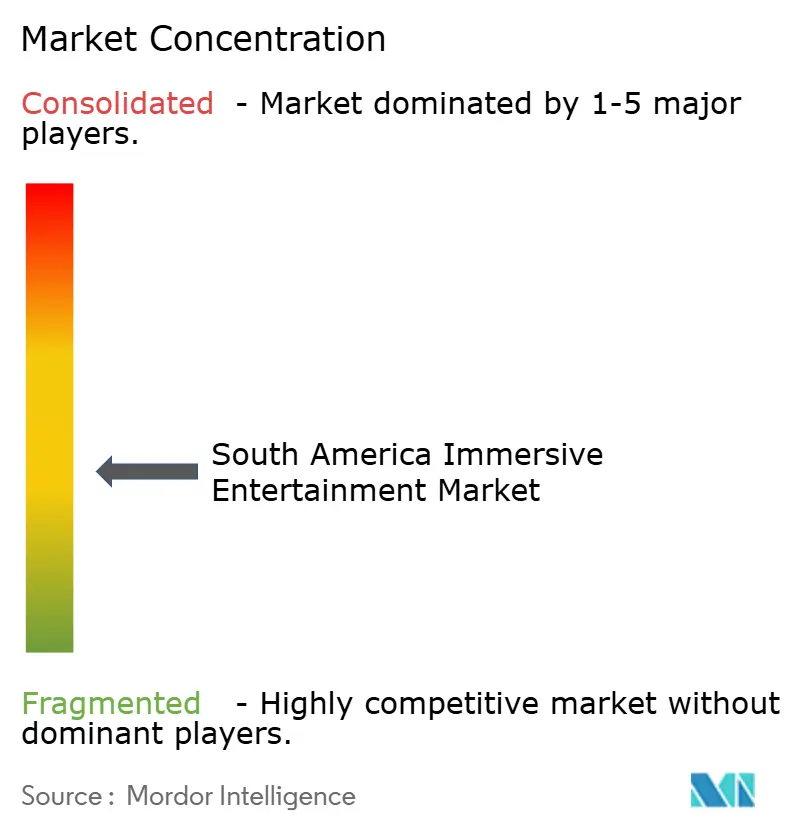
The South America immersive entertainment market is fragmented across global intellectual-property owners, regional venue operators, and hardware providers. Global content owners include Universal Destinations and Experiences, Hasbro, Microsoft's Minecraft group, and Banijay Live Studio. Regional operators and integrators include Grupo Cataratas, Mixtou Experience, MultiVerso Experience, Hello Park, and VR do Brasil. Hardware and platform suppliers include Meta Platforms, HTC, Barco, and Sony. These groups serve different parts of the value chain and do not compete on the same terms.
Global licensors often use touring experiences before committing to permanent sites. Regional operators tend to use franchises and mall leases to manage unit-level capital needs. Banijay Live Studio and Univrse launched The Black Mirror Experience at Shopping Eldorado in São Paulo in July 2026. The venue used a hybrid of VR and physical sets for small groups. DreamPark's platform provides another model by placing mixed-reality attractions inside existing locations with Meta Quest equipment.
Safety, operational consistency, and content refresh capability can influence which operators secure partnerships with malls and institutions. Currency exposure also affects competition because many XR systems are imported and priced in USD. Local storytelling remains an area of differentiation because many major experiences are imported franchises. The South America immersive entertainment market has no disclosed concentration data for leading operators.
South America Immersive Entertainment Industry Leaders
-
Meta Platforms, Inc.
-
Sony Group Corporation
-
Samsung Electronics Co., Ltd.
-
Microsoft Corporation
-
Grupo Cataratas
- *Disclaimer: Major Players sorted in no particular order
South America Immersive Entertainment Market Companies Covered in this Report
- 3dar
- Apple Inc.
- Barco NV
- Casa Mais
- Google LLC
- Grupo Cataratas
- Hello Park LLC
- HTC Corporation
- HQSoftware
- IMAX Corporation
- Meta Platforms, Inc.
- Microsoft Corporation
- Mixtou Experience
- MultiVerso Experience
- Novaworks
- Qualcomm Incorporated
- Samsung Electronics Co., Ltd.
- Sense Arq
- Sony Group Corporation
- Storyland Studios
- Universal Destinations & Experiences
- Visualfarm
- VR do Brasil
- VRMKT
Recent Industry Developments in South America Immersive Entertainment Market
- July 2026: Banijay Live Studio, Universe, and WOW Exibições launched The Black Mirror Experience at Shopping Eldorado in São Paulo. The 60-minute VR and physical-set experience opened for groups of up to 6 participants, with tickets starting at BRL 65 (USD 11.2).
- June 2026: NEON and Universal Destinations and Experiences announced Jurassic World: The Experience for Buenos Aires, the franchise's first Argentina staging.
- May 2026: The British Council presented Immersive Amazon at Espaço Cultural Casa das Onze Janelas in Belém, using projection mapping, spatialized soundscapes, and live performances.
- April 2026: Jurassic World completed one year since its opening, with the experience opened in Bogotá at Vive Claro - Distrito Cultural, representing the franchise's first South American venue.
South America Immersive Entertainment Market Report Scope
The South America Immersive Entertainment Market refers to the industry encompassing technology-driven entertainment experiences that blend physical and digital environments to create highly engaging, interactive, and multisensory experiences for consumers.
The South America Immersive Entertainment Market Report is Segmented by Application (Themed Entertainment, Haunted Attractions and Escape Rooms, Immersive Theatres, Experiential Art Museums, Exhibitions and Retail Installations, and Live Immersive Gaming Events), Technology (Virtual Reality (VR), Augmented Reality (AR), 3D Audio and Spatial Sound, Mixed Reality (MR), and Haptics and Multisensory Tech), Venue Type (Theme and Amusement Parks, Family/Indoor Entertainment Centers, Museums and Galleries, Stand-Alone Immersive Venues, and Pop-Up and Temporary Installations), and Revenue Stream (Ticket Sales, Food and Beverage, Merchandise, Sponsorship and Brand Partnerships, IP Licensing and Royalties, and Subscription and Memberships), and Geography (Brazil, Argentina, Colombia, and Rest of South America). The Market Forecasts are Provided in Terms of Value (USD).
Segmentation Overview
| Themed Entertainment |
| Haunted Attractions and Escape Rooms |
| Immersive Theatres |
| Experiential Art Museums |
| Exhibitions and Retail Installations |
| Live Immersive Gaming Events |
| Virtual Reality (VR) |
| Augmented Reality (AR) |
| 3D Audio and Spatial Sound |
| Mixed Reality (MR) |
| Haptics and Multisensory Tech |
| Theme and Amusement Parks |
| Family/Indoor Entertainment Centers |
| Museums and Galleries |
| Stand-Alone Immersive Venues |
| Pop-Up and Temporary Installations |
| Ticket Sales |
| Food and Beverage |
| Merchandise |
| Sponsorship and Brand Partnerships |
| IP Licensing and Royalties |
| Subscription and Memberships |
| Brazil |
| Argentina |
| Colombia |
| Rest of South America |
| By Application | Themed Entertainment |
| Haunted Attractions and Escape Rooms | |
| Immersive Theatres | |
| Experiential Art Museums | |
| Exhibitions and Retail Installations | |
| Live Immersive Gaming Events | |
| By Technology | Virtual Reality (VR) |
| Augmented Reality (AR) | |
| 3D Audio and Spatial Sound | |
| Mixed Reality (MR) | |
| Haptics and Multisensory Tech | |
| By Venue Type | Theme and Amusement Parks |
| Family/Indoor Entertainment Centers | |
| Museums and Galleries | |
| Stand-Alone Immersive Venues | |
| Pop-Up and Temporary Installations | |
| By Revenue Stream | Ticket Sales |
| Food and Beverage | |
| Merchandise | |
| Sponsorship and Brand Partnerships | |
| IP Licensing and Royalties | |
| Subscription and Memberships | |
| By Geography | Brazil |
| Argentina | |
| Colombia | |
| Rest of South America |
Key Questions Answered in the Report
What is the Size of the South America Immersive Entertainment Market?
The South America immersive entertainment market size is estimated at USD 6.38 Billion in 2026 and is forecast to reach USD 12.65 Billion by 2031 at a 14.67% CAGR.
Which Application Leads Immersive Entertainment in South America?
Themed entertainment led with a 27.45% share in 2025, supported by theme parks and established mall-based attractions.
Which Technology Is Expanding Fastest Across South American Immersive Venues?
Mixed reality is projected to expand at a 15.17% CAGR through 2031 because it can combine digital content with existing physical spaces.
Why Are Shopping Malls Important for Immersive Venues in South America?
Malls provide visitor traffic, flexible space, and, in some cases, revenue-share lease structures that lower entry barriers for operators.
What Is the Largest Revenue Stream for Immersive Entertainment Operators?
Ticket sales represented 57.34% of revenue in 2025, although subscriptions and memberships have the fastest projected expansion at a 27.52% CAGR.
Which Country Leads Immersive Entertainment Activity in South America?
Brazil leads because it has the region's largest attraction pipeline, established tourism infrastructure, and extensive corporate activation activity.