
South America Grapes Harvesters Market Size and Share
Market Overview
| Study Period | 2021 - 2031 |
|---|---|
| Forecast Data Period | 2026 - 2031 |
| Base Year Market Size (2025) | USD 159.23 Million |
| Market Size (2026) | USD 175.02 Million |
| Market Size (2031) | USD 291.43 Million |
| Growth Rate (2026 - 2031) | 10.74 % |
| Market Concentration | Medium |
Major Players *Disclaimer: Major Players sorted in no particular order Image © Mordor Intelligence. Reuse requires attribution under CC BY 4.0. | |
South America Grapes Harvesters Market Analysis by Mordor Intelligence
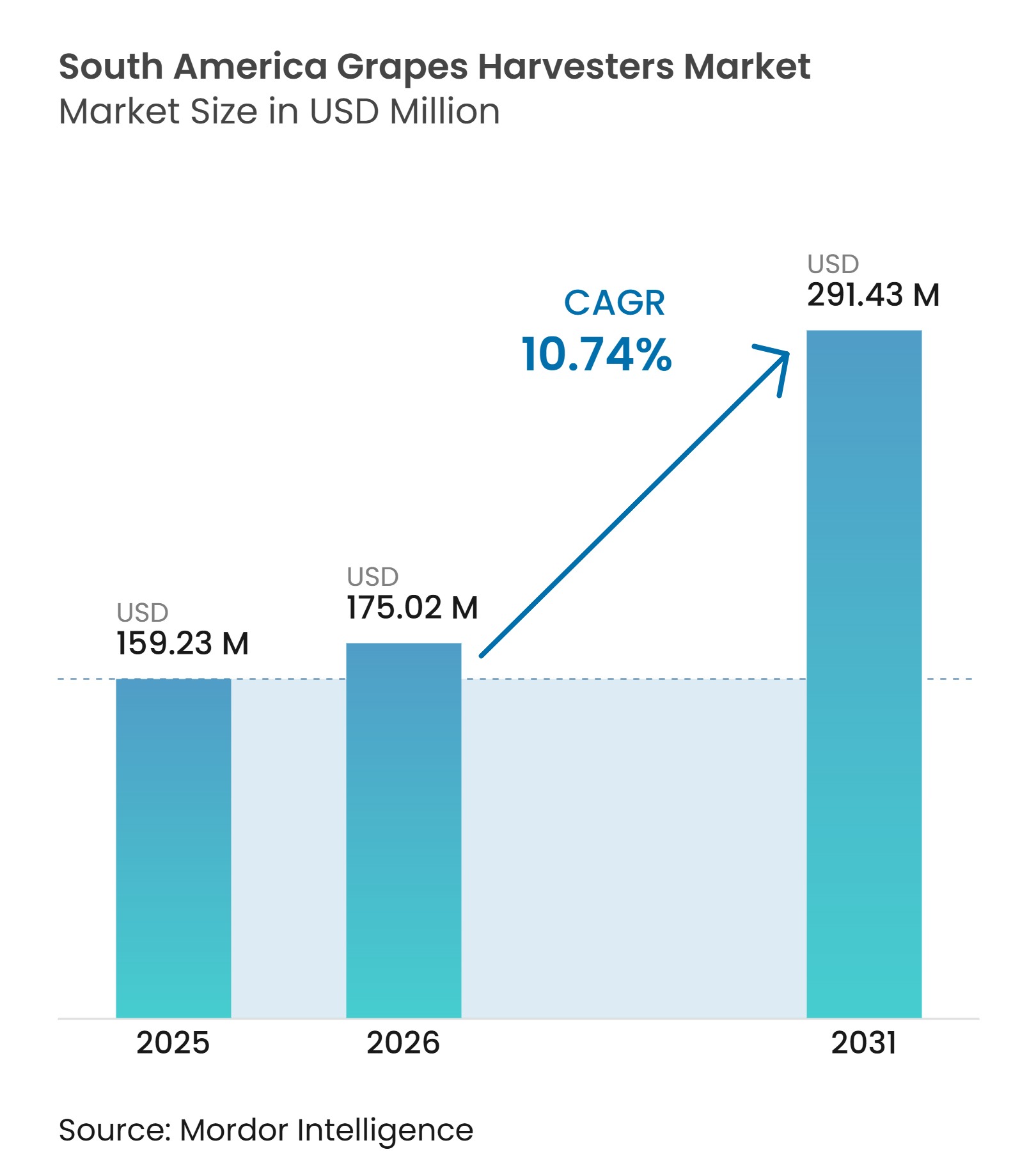
The South America grapes harvesters market size was valued at USD 159.23 million in 2025 and is estimated to grow from USD 175.02 million in 2026 to reach USD 291.43 million by 2031, at a CAGR of 10.74% during the forecast period (2026-2031). Labor shortages and higher harvesting costs are driving the adoption of mechanized collection in commercial vineyards. Earlier harvest timing in Chile is also increasing the value of equipment that can complete work within narrow ripeness windows.[1]Cooperative fleets and contractor services allow vineyards to access machines without bearing the full cost of ownership. Brazil presents a significant opportunity, as equipment financing and research on adapted systems can extend mechanization beyond established wine regions.[2]The market is also moving toward equipment that records field activity and supports traceability requirements.
Key Report Takeaways
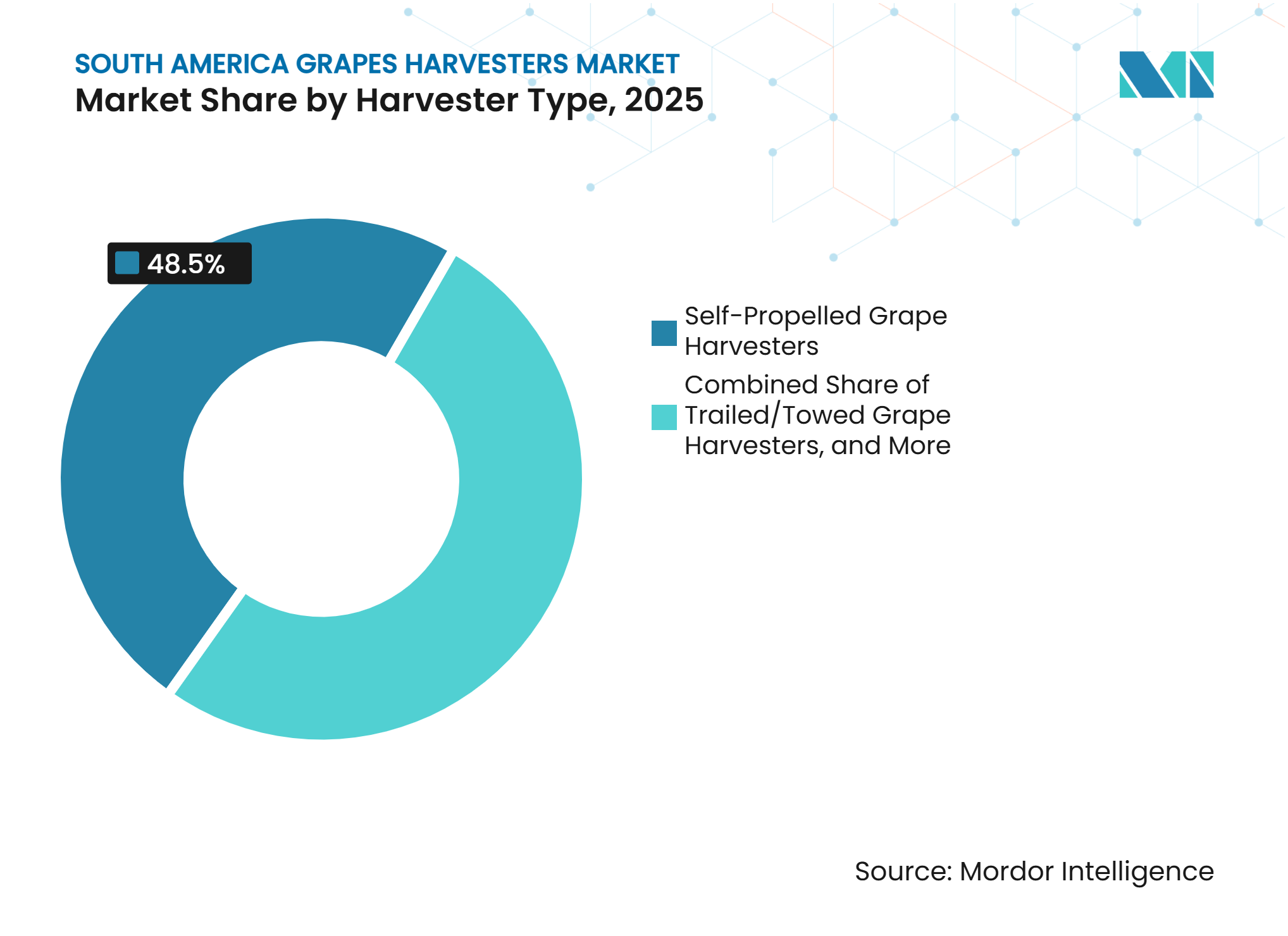
- By harvester type, self-propelled grape harvesters held 48.5% of the South America grapes harvesters market share in 2025, while tractor-mounted grape harvesters are forecast to grow at a CAGR of 11.8% from 2026 to 2031.
- By mode of operation, assisted/precision-guided operation accounted for 54.2% of the South America grapes harvesters market in 2025, while autonomous/semi-autonomous operation is forecast to grow at a CAGR of 13.2% from 2026 to 2031.
- By power source, diesel-powered accounted for 66.8% of the market share in 2025, while electric powered harvesters are forecast to grow at a CAGR of 14.0% from 2026 to 2031.
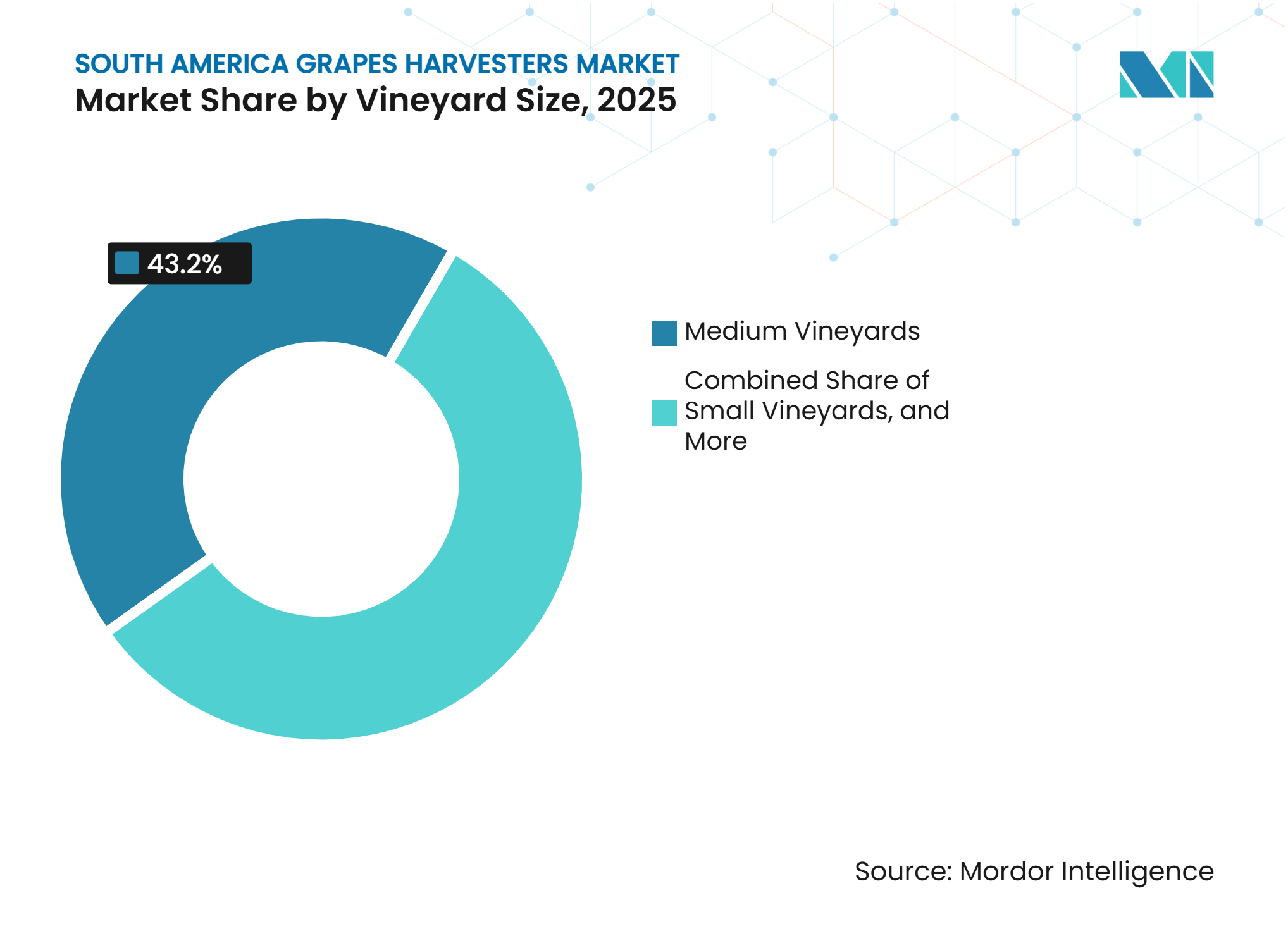
- By vineyard size, medium vineyards held 43.2% of the market in 2025, while small vineyards are forecast to grow at a CAGR of 12.4% from 2026 to 2031.
Note: Market size and forecast figures in this report are generated using Mordor Intelligence’s proprietary estimation framework, updated with the latest available data and insights as of January 2026.
Market Trends and Insights
Drivers Impact Analysis of South America Grapes Harvesters Market*
| Driver | (~) % Impact on CAGR Forecast | Geographic Relevance | Impact Timeline |
|---|---|---|---|
| Vineyard labor scarcity and wage inflation | +2.8% | Argentina, Chile, Brazil | Short term (≤ 2 years) |
| Export-oriented winery throughput requirements | +2.0% | Chile, Argentina | Medium term (2-4 years) |
| Rising contractor and cooperative harvesting services | +1.7% | Argentina, Brazil, Chile | Medium term (2-4 years) |
| Vineyard modernization in Chile and Argentina | +2.2% | Chile, Argentina | Medium term (2-4 years) |
| Brazil’s early-stage mechanization catch-up | +1.8% | Brazil, Peru, Colombia | Long term (≥ 4 years) |
| Retrofit demand for data-ready harvesting | +1.1% | Chile, Argentina, Brazil | Medium term (2-4 years) |
| Source: Mordor Intelligence | |||
Vineyard Labor Scarcity and Wage Inflation
Argentina’s cooperative wine sector employs more than 10,000 harvest workers, while seasonal labor availability has tightened as rural workers shift toward urban employment.[3] Mechanized harvest costs rose 37% year over year in Mendoza during the 2026 season, largely because rental charges are linked to the USD cost of machines. Manual harvesting costs also increased, reducing the cost advantage of relying entirely on crews. Labor shortages can support demand for mechanical harvesting by reducing growers’ reliance on seasonal crews during compressed harvesting periods. Contracted machine rates of USD 700 per hectare are increasingly attractive for estates with larger harvest areas, particularly where growers prioritize reliable completion dates, fewer staffing gaps, and a more predictable flow of fruit to the winery.
Export-Oriented Winery Throughput Requirements
Export wineries must harvest grapes within specific ripeness windows to protect fruit quality and processing schedules. Catena Zapata operated 3 New Holland Braud harvesters across more than 1,000 hectares in several Argentine provinces, demonstrating the scale achievable with an estate fleet. Self-propelled harvesters recorded a field capacity of 1.34 hectares per hour, compared with 0.81-0.87 hectares per hour for towed equipment. This capacity difference is significant when weather and ripeness reduce the available harvesting period. Chile's 2026 harvest in the Limarí Valley began 12 days earlier than the prior year, increasing the need for quick vineyard decisions. The South America grapes harvesters market benefits from machines that deliver reliable throughput during compressed harvest periods, particularly where winery receiving capacity and vineyard ripeness must be coordinated on the same day.
Rising Contractor and Cooperative Harvesting Services
Contractor services reduce the capital burden for vineyards that do not have enough acreage to justify a dedicated machine. Shared fleets also give small and medium producers access to current equipment and trained operators. Cooperatives can organize machine access across member vineyards, allowing a single fleet to support several growers within the same season. This approach improves equipment utilization and makes operator experience available to vineyards that would not maintain an in-house crew. The South America grapes harvesters market benefits from these shared-service models because a single fleet decision can affect multiple vineyards. “Contractor fleets could provide an adoption pathway for electric and semi-autonomous equipment because equipment costs can be distributed across multiple estates, achieve greater machine utilization over the season, and introduce new systems gradually to established customers.
Vineyard Modernization in Chile and Argentina
Chile and Argentina have expanded the use of espalier and vertical shoot positioning systems, which are more compatible with mechanical harvesting. Research supported by Chile’s National Research and Development Agency found that training system selection strongly influences vineyard value and productivity, with some systems achieving 63% higher productivity. New plantings and replanting cycles create an opportunity to align row design with machine requirements. Chile’s modernization programs support vineyard infrastructure work that can improve access to mechanized harvesting. Tractor-mounted systems offer a lower initial investment compared with self-propelled equipment, supporting adoption by modernizing estates. The South America grapes harvesters market can expand as vineyard improvements remove physical barriers to machine operation, allowing growers to consider equipment decisions alongside planting and trellising decisions rather than treating harvesting machinery as a later investment.
Restraints Impact Analysis of South America Grapes Harvesters Market*
| Restraint | (~) % Impact on CAGR Forecast | Geographic Relevance | Impact Timeline |
|---|---|---|---|
| High upfront cost and foreign exchange exposure | -1.4% | Argentina, Brazil | Short term (≤ 2 years) |
| Narrow rows, training system variation, and slope limits | -0.8% | Chile, Argentina | Medium term (2-4 years) |
| Limited local parts and technician coverage | -0.7% | Brazil, Argentina | Medium term (2-4 years) |
| Premium grape quality and selective harvesting needs | -0.5% | Chile, Argentina | Long term (≥ 4 years) |
| Source: Mordor Intelligence | |||
High Upfront Cost and Foreign Exchange Exposure
Commercial grape harvesters sold in South America are imported, exposing buyers to exchange-rate fluctuations at the time of purchase. For a medium-sized estate, a self-propelled unit can represent several seasons of manual harvesting costs, making financing terms as important as machine specifications in many purchasing decisions. In Argentina, peso volatility can increase the local currency cost of imported machinery before delivery. The 37% rise in Mendoza's contracted mechanical harvest cost in 2026 demonstrated how USD-linked rental prices are passed through to vineyard users. In Brazil and Argentina, import certification and tariff requirements can further increase total acquisition costs, particularly when buyers must account for logistics, commissioning, and long-term service needs before a machine begins generating revenue.
Narrow Rows, Espalier Variability, and Slope Limits
Some established vineyards were planted with row spacing and training systems that are less compatible with conventional mechanical harvesters. Replanting, re-trellising, and terrain preparation can require substantial investment before a grower can deploy a harvester. Steep parcels in Chile's coastal valleys and Argentina's foothill areas restrict the use of standard self-propelled equipment. Chilean research identified the training system as a major determinant of mechanical harvesting performance. Specialized machines can operate in difficult terrain, but their higher cost limits their appeal to a narrow group of growers. The South America grape harvesters market depends on vineyard renewal cycles to expand the area that machines can serve, as equipment design alone cannot resolve all row-width, gradient, and trellis limitations that were established when older vineyards were planted.
*Our forecasts treat driver/restraint impacts as directional, not additive. The impact forecasts reflect baseline growth, mix effects, and variable interactions.
South America Grapes Harvesters Market Segment Analysis
By Harvester Type:
Self-Propelled Grape Harvesters Lead While Tractor-Mounted Grape Harvesters Broaden AccessSelf-propelled grape harvesters held a 48.5% revenue share in 2025. Their 1.34-hectare hourly field capacity exceeded the 0.81-0.87 hectares recorded for towed equipment. Large estates and contractors use this productivity to complete broad harvesting areas within short quality windows. Trailed and towed machines remain important for users seeking lower initial capital requirements. Cooperative models in Argentina support their use because utilization can be shared across several vineyards.
Tractor-mounted grape harvesters are forecast to be the fastest-growing subcategory within the harvester type, registering a CAGR of 11.8% from 2026 to 2031. They offer a more accessible option for growers with compatible rows but limited capital for self-propelled equipment. CRF Costruzioni’s VP10 and VP16 attachments and Grégoire’s GT3 demonstrate the range of configurations available for different row widths. The South America grapes harvesters market is moving beyond a focus on large estate purchases. Broader product coverage helps suppliers serve vineyards with different operating and financing conditions, including growers that first enter mechanization through a shared fleet and later consider dedicated ownership.



By Mode of Operation:
Precision Guidance Leads While Autonomous Systems Grow FastestAssisted and precision-guided operation held the largest share within the mode-of-operation category, accounting for 54.2% of the market in 2025. These machines combine GPS-based steering and yield displays with continued operator control, allowing users to improve consistency while retaining direct management of harvest settings. Autonomous/semi-autonomous operations are forecast to grow at a CAGR of 13.2% from 2026 to 2031. Their appeal is linked to precision guidance, digital harvest records, and the potential to reduce dependence on seasonal operators in suitable vineyard settings, where field conditions permit reliable navigation. This growth reflects interest in navigation, data collection, and labor-saving functions in high-value vineyards.
Autonomous operation is not likely to develop at the same pace across every South American region. Variable row geometry, slope conditions, and limited technical support can slow adoption in inland areas. Central Chile and Mendoza have stronger conditions for earlier uptake due to established vineyards and export-oriented operations. PeK Automotive’s Slopehelper Grape Picker is designed for steep-terrain vineyard work and uses a non-shaking collection approach. The South America grapes harvesters market will benefit where automation can address both labor availability and traceability requirements, while maintaining sufficient operator oversight for vineyards with uneven terrain and changing field conditions.
By Power Source:
Diesel Remains the Mainstay While Electric Equipment Gains InterestDiesel-powered equipment accounted for 66.8% revenue share in 2025. Fuel distribution networks and established maintenance practices support diesel use across most vineyard areas. Many rural regions still lack the high-capacity charging infrastructure required for fully electric harvesters. Diesel equipment will remain central to fleet decisions during the 2026-2031 period, as established users can rely on familiar fuel supply, service routines, and operating practices across both large estates and contractor fleets.
Electric platforms are forecast to be the fastest-growing power-source category, registering a CAGR of 14.0% from 2026 to 2031. Initial opportunities for electric equipment are likely to be concentrated in vineyard areas with reliable electricity access, particularly established wine-producing regions such as central Chile and Mendoza. Contractors may find electric units attractive when stable electricity prices can offset diesel and transport costs. The transition will depend on charging access, fleet utilization, and financing for new technology. The South America grapes harvesters market can use this shift to offer lower-emission options without immediately displacing diesel equipment, allowing buyers to match power choices.
By Vineyard Size:
Medium Estates Lead While Small Vineyards Expand FasterMedium vineyards held the leading position by value, accounting for a 43.2% share of the market in 2025, supported by viable machine use and a large number of potential customers. These estates can access contractors or participate in cooperative fleets without assuming the full cost of ownership. Medium estates also provide a steady base for dealers offering maintenance, finance, and operator support, as their recurring machine use can justify stronger relationships with local distributors and contractor service providers. This group remains important to the market's value base throughout the forecast period.
Small vineyards are forecast to grow at a CAGR of 12.4% from 2026 to 2031. Lower-cost tractor-mounted machines and expanding contractor access improve their ability to use mechanized harvesting. BNDES rural credit is relevant, as it has increased support for small producers and machinery purchases. Demand from small vineyards can grow as access models become more practical, particularly when cooperative purchasing and equipment sharing lower the financial commitment required from each participating grower.

Geography Analysis
Argentina and Chile form the established core of the South America grapes harvesters market. Argentina’s national mechanized harvest penetration was 21% in 2025. Mature dealer networks and cooperative fleets give commercial vineyards greater access to equipment and service. Mendoza’s cooperative sector has supported contracted machine use across its member network. Chile’s vineyard modernization support encourages trellising and row design that can accommodate machinery. Chile’s 2026 harvest began 12 days earlier than in 2025 in the Limarí Valley, reinforcing the value of fast harvesting capacity CONCHA Y TORO.
Brazil presents a significant incremental opportunity in the South America grapes harvesters market. Its large Serra Gaúcha vineyard area has had lower machine use because latada systems do not readily suit conventional harvesters. Brazil’s 2025/26 Harvest Plan provided BRL 70 billion (USD 13.0 billion) in agricultural financing, supporting investments across the sector, including machinery and equipment. BNDES data indicate that more than 95% of approved rural credit was directed toward machinery and equipment purchases as of June 2025. These financing initiatives can support agricultural mechanization and create opportunities for equipment suppliers.
Peru and Colombia remain earlier-stage markets for specialized grape harvesters. Their vineyard activity is more closely linked to table grapes than to wine grapes, which limits demand for specialized wine-grape harvesting equipment. Colombia remains an earlier-stage market for specialized grape harvesters, with a smaller wine-grape production base than Argentina and Chile. This approach gives the South America grapes harvesters market a practical path to cover smaller wine regions.
Competitive Landscape
Market Concentration
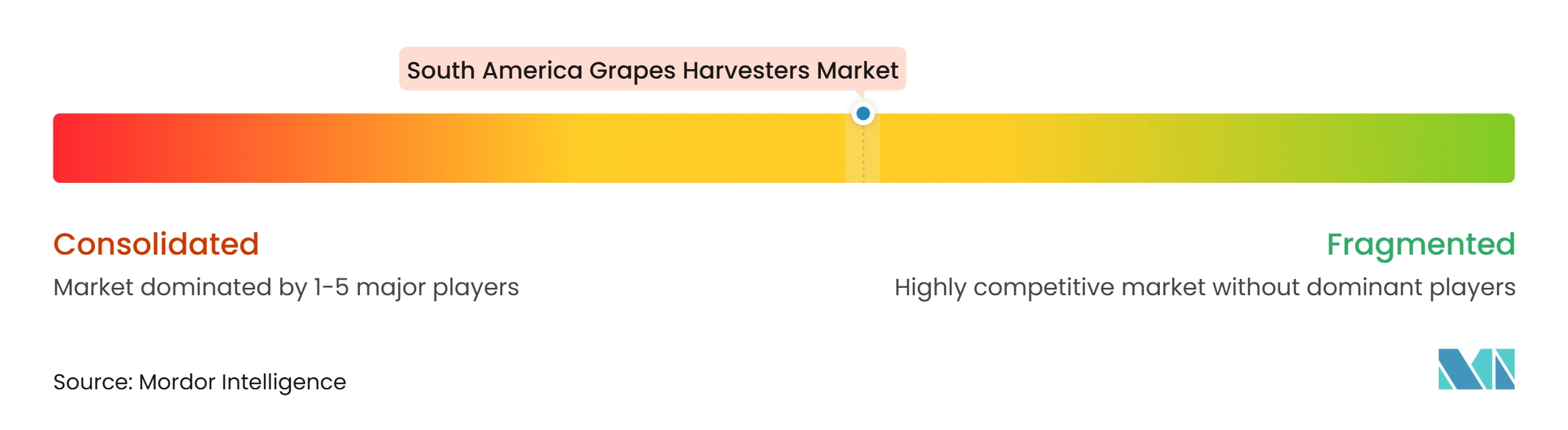
The South America grape harvesters market was moderately concentrated, with competition led by established OEMs such as Pellenc S.A.S., New Holland Agriculture, Oxbo International Corporation, Grégoire S.A.S., and ERO GmbH. European manufacturers have a strong installed base due to their focus on harvesting precision and specialized vineyard equipment. Oxbo International Corporation offers the Oxbo 620 tow-behind grape harvester for operations seeking a lower-capital alternative. This configuration can suit contractors and cooperatives that need to serve multiple vineyards with one machine. PeK Automotive offers the Slopehelper Grape Picker for steep vineyards where standard self-propelled machines have operating limits. Andreoli Engineering S.r.l. developed the UT110-CH500 with CH engineering GmbH for high-gradient grape harvesting conditions. These offerings address different terrain, investment, and operating needs across the region.
The main opportunity areas are affordable tractor-mounted systems and stronger local service coverage. Faster repair support can reduce the risk associated with equipment failure during a short harvest period. Suppliers that invest in technician training and parts availability can strengthen their position with remote vineyard operators. Competition remains fragmented below the leading OEM groups, leaving room for specialized configurations and distributor partnerships. Suppliers in the South America grapes harvesters market need to match technology with local vineyard layouts, financing conditions, and service requirements.
South America Grapes Harvesters Industry Leaders
-
Pellenc S.A.S.
-
New Holland Agriculture (CNH Industrial N.V.)
-
Oxbo International Corporation (Ploeger Oxbo Group B.V.)
-
Grégoire S.A.S. (SDF S.p.A.)
-
ERO GmbH
- *Disclaimer: Major Players sorted in no particular order
South America Grapes Harvesters Market Companies Covered in this Report
- Pellenc S.A.S.
- New Holland Agriculture (CNH Industrial N.V.)
- Oxbo International Corporation (Ploeger Oxbo Group B.V.)
- Grégoire S.A.S. (SDF S.p.A.)
- ERO GmbH
- Alma
- CRF Costruzioni S.r.l.
- Bobard
- Andreoli Engineering S.r.l.
- CH engineering GmbH
- Leda AG
- I.ME.CA S.n.c. di Macorigh M. and C.
- PeK Automotive d.o.o.
- GRV
- Nairn Harvesters (Reese Group Ltd.)
Recent Industry Developments in South America Grapes Harvesters Market
- May 2026: New Holland Agriculture unveiled the Braud 9070L harvester at Sitevinitech 2026 in Mendoza, Argentina. The model features lower fuel consumption, the IMS 2.0 shaking system, IntelliView IV monitor, and the FieldOps telemetry portal for real-time remote performance monitoring and digital field mapping.
- February 2026: World Agritech featured Catena Zapata's long-running mechanized harvest program in Argentina, where 3 New Holland Braud harvesters now cover more than 1,000 hectares annually across multiple provinces including La Pampa, San Juan, and La Rioja.
- January 2026: Nova Aliança Vinícola Cooperativa in Brazil concluded the 2026 harvest with record results, processing approximately 50 million kilograms, approximately 25% above the cooperative's initial projection of 40 million kilograms. The cooperative processes approximately 6% of Brazil’s total grape production, highlighting the scale of grape processing in the Serra Gaúcha region and the potential relevance of mechanized harvesting solutions as equipment becomes better adapted to local vineyard systems.
South America Grapes Harvesters Market Report Scope
Grape harvesters are agricultural machines designed for the mechanical harvesting of grapes from vineyards. They automate the harvesting process by removing grapes from vines and collecting them for further processing or handling.
The South America Grapes Harvesters Market is Segmented by Harvester Type (Self-Propelled Grape Harvesters, Trailed/Towed Grape Harvesters, and Tractor-Mounted Grape Harvesters), by Mode of Operation (Manual Steering and Operation, Assisted/Precision-Guided Operation, and Autonomous/Semi-Autonomous Operation), by Power Source (Diesel-Powered, Hybrid, and Electric), by Vineyard Size (Small Vineyards, Medium Vineyards, and Large Vineyards), and by Geography (Brazil, Argentina, Chile, Peru, Colombia, Rest of South America). The Market Forecasts are Provided in Terms of Value (USD).
Segmentation Overview
| Self-Propelled Grape Harvesters |
| Trailed/Towed Grape Harvesters |
| Tractor-Mounted Grape Harvesters |
| Manual Steering and Operation |
| Assisted/Precision-Guided Operation |
| Autonomous/Semi-Autonomous Operation |
| Diesel-Powered |
| Hybrid |
| Electric |
| Small Vineyards |
| Medium Vineyards |
| Large Vineyards |
| Brazil |
| Argentina |
| Chile |
| Peru |
| Colombia |
| Rest of South America |
| By Harvester Type | Self-Propelled Grape Harvesters |
| Trailed/Towed Grape Harvesters | |
| Tractor-Mounted Grape Harvesters | |
| By Mode of Operation | Manual Steering and Operation |
| Assisted/Precision-Guided Operation | |
| Autonomous/Semi-Autonomous Operation | |
| By Power Source | Diesel-Powered |
| Hybrid | |
| Electric | |
| By Vineyard Size | Small Vineyards |
| Medium Vineyards | |
| Large Vineyards | |
| By Geography | Brazil |
| Argentina | |
| Chile | |
| Peru | |
| Colombia | |
| Rest of South America |
Key Questions Answered in the Report
What is the size of the South America grapes harvesters market?
The South America grapes harvesters market was valued at USD 175.02 million in 2026 and is forecast to reach USD 291.43 million by 2031, growing at a CAGR of 10.74%.
What is driving demand for the South America grapes harvesters market?
Labor shortages, rising harvesting costs, narrow harvesting windows, vineyard modernization, and shared equipment services are driving demand for grape harvesters in South America.
Which harvester type holds the leading position?
Self-propelled grape harvesters led the market with a 48.5% revenue share in 2025, supported by their higher field capacity and suitability for larger vineyard operations.
Which operating mode is growing fastest?
Autonomous and semi-autonomous grape harvesters are forecast to grow at a CAGR of 13.2% through 2031, driven by precision guidance and reduced dependence on seasonal operators.
Which vineyard size is expected to expand fastest?
Small vineyards are forecast to grow at a CAGR of 12.4% through 2031, supported by contractor services, shared ownership, and cooperative equipment arrangements.