
Market Overview
| Study Period | 2020 - 2031 |
|---|---|
| Forecast Data Period | 2026 - 2031 |
| Base Year Market Size (2025) | USD 1.83 Billion |
| Market Size (2026) | USD 1.91 Billion |
| Market Size (2031) | USD 2.48 Billion |
| Growth Rate (2026 - 2031) | 5.36 % |
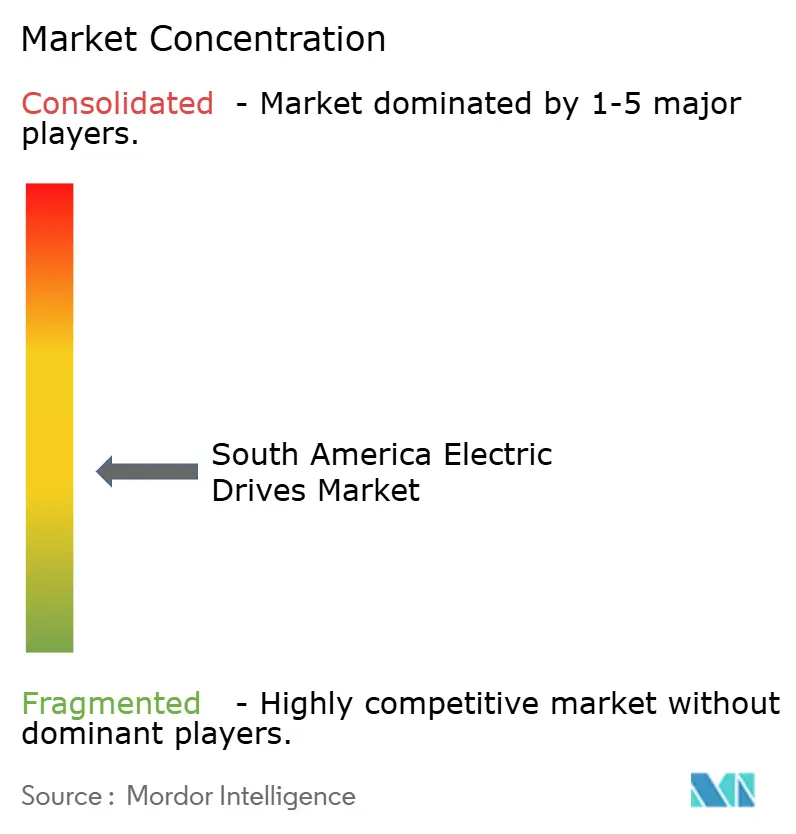
| Market Concentration | Medium |
Major Players *Disclaimer: Major Players sorted in no particular order Image © Mordor Intelligence. Reuse requires attribution under CC BY 4.0. | |
South America Electric Drives Market Analysis by Mordor Intelligence
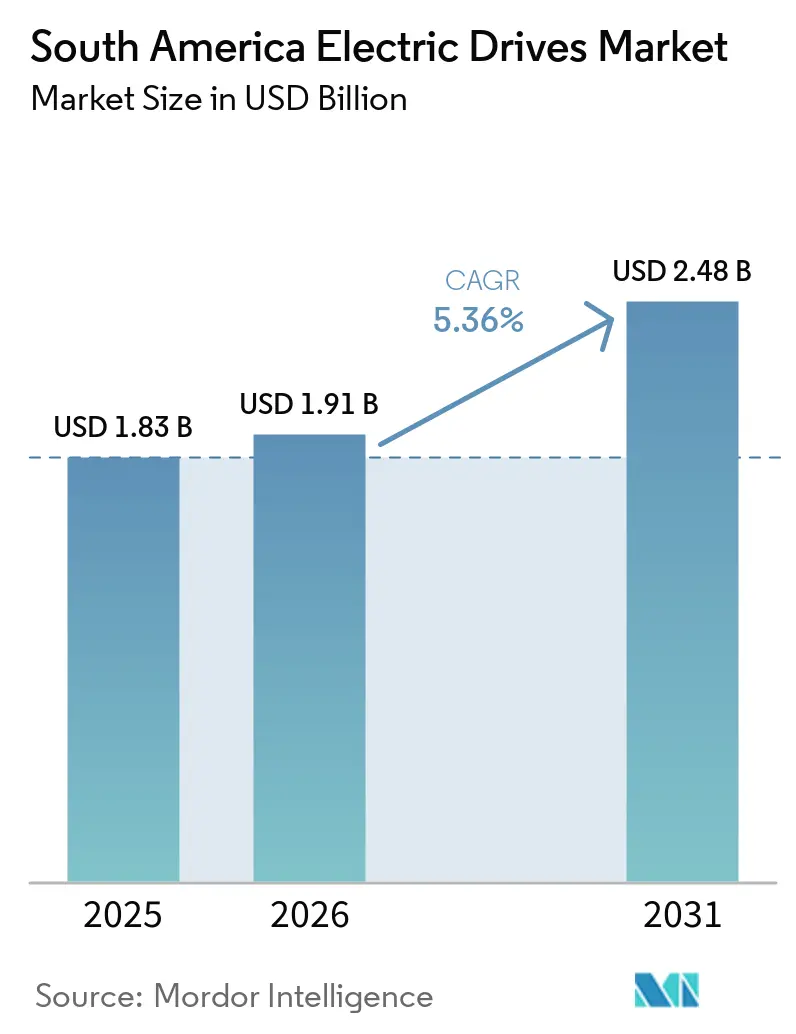
The South America Electric Drives Market size was valued at USD 1.83 billion in 2025 and is estimated to grow from USD 1.91 billion in 2026 to reach USD 2.48 billion by 2031, at a CAGR of 5.36% during the forecast period (2026-2031). Higher energy costs are making variable-speed control more relevant in industrial facilities with pumps, fans, compressors, and other motor-driven equipment. Replacement activity in older factories is also supporting demand as operators update fixed-speed systems and reduce process disruptions. Mining, oil and gas, food processing, water treatment, and pulp production remain important sources of demand across South America. Suppliers are increasingly competing through local service coverage, digital commissioning, and motor-drive packages rather than hardware alone. Imported components, financing constraints, and currency movements continue to limit adoption among smaller industrial users.
Key Report Takeaways
- By product, AC drives held 68.47% of the South America Electric Drives Market share in 2025, while servo drives are forecast to grow at a CAGR of 5.92% through 2031.
- By voltage, low-voltage drives accounted for 74.62% of revenue in 2025, while medium-voltage drives are forecast to grow at a CAGR of 6.21% through 2031.
- By power rating, installations below 250 kW held 52.34% of revenue in 2025, while installations above 500 kW are forecast to grow at a CAGR of 5.74% through 2031.
- By end-user industry, oil and gas held 21.68% of revenue in 2025, while food and beverages are forecast to grow at a CAGR of 6.63% through 2031.
- By geography, Brazil held 42.68% of the South America Electric Drives Market share in 2025, while Chile is forecast to grow at a CAGR of 6.17% through 2031.
Note: Market size and forecast figures in this report are generated using Mordor Intelligence’s proprietary estimation framework, updated with the latest available data and insights as of January 2026.
Market Trends and Insights
Drivers Impact Analysis of South America Electric Drives Market*
| Driver | (~) % Impact on CAGR Forecast | Geographic Relevance | Impact Timeline |
|---|---|---|---|
| Industrial Automation and Brownfield Modernization | +1.4% | Brazil, Argentina, Rest of South America | Medium term (2-4 years) |
| Motor Efficiency and Energy Cost Reduction Mandates | +1.2% | Brazil, Chile, and Colombia | Long term (≥ 4 years) |
| Mining, Metals, Pulp and Paper, and Water Infrastructure Investment | +1.1% | Chile, Brazil, Argentina, and Peru | Medium term (2-4 years) |
| Precision Motion Demand From Battery, Automotive, and Packaging Lines | +0.8% | Brazil | Short term (≤ 2 years) |
| Local Motor Drive Ecosystem Expansion Led by Brazilian Manufacturers | +0.5% | Brazil, Argentina, and Chile | Long term (≥ 4 years) |
| Drive Level Predictive Maintenance for Remote and Harsh Environment Assets | +0.4% | Chile, Brazil, and Argentina | Medium term (2-4 years) |
| Source: Mordor Intelligence | |||
Industrial Automation and Brownfield Modernization
Manufacturers are replacing fixed-speed equipment with variable-speed systems in aging production sites across South America. This activity supports replacement demand in the South America Electric Drives Market, especially in Brazil’s established industrial areas. The replacement decision increasingly reflects production needs as well as energy savings. Digital commissioning can reduce engineering work and shorten site disruption during complex retrofits. Rockwell Automation reported reduced project-delivery time and engineering effort at Falcare Industrial Equipment in Brazil in February 2026.[1] Suppliers with field technicians and established service networks are better positioned for multi-drive retrofit work.
Motor Efficiency and Energy Cost Reduction Mandates
Brazil’s efficiency rules support replacement cycles for older motors and associated control equipment. Pairing an efficient motor with a drive can reduce electricity use in variable-torque applications such as pumps and fans. The United Nations Environment Program identifies motor-system policies as a route to faster deployment of efficient electric motors.[2] The South America Electric Drives Market also benefits when upgrades include harmonic and safety requirements. ABB installed 15 ACQ580 drives and high-efficiency motors at 4 Saneago pumping stations in Goiás. The project reduced energy consumption by 25%, equal to more than 6,000 MWh annually, and generated annual savings of BRL 3.4 million (USD 586,000).[3]
Mining, Metals, Pulp and Paper, and Water Infrastructure Investment
Large mining and industrial projects are creating demand for higher-power drive equipment across South America. Chile’s mining investment pipeline includes copper concentrators, desalination assets, and processing facilities that require motor control and electrical integration. The U.S. International Trade Administration reported that Chile’s mining sector had a substantial project pipeline during 2026. Brazil’s water and sanitation upgrades also support demand for pump drives, while pulp and paper projects require large electrical systems. The South America Electric Drives Market gains service opportunities that extend beyond the original equipment order.
Precision Motion Demand From Battery, Automotive, and Packaging Lines
Battery production, vehicle assembly, and automated packaging are increasing the demand for servo and AC drives in Brazil. BYD planned investment of up to BRL 500 million (USD 98 million) in localized battery production and targeted annual output of 150,000 electric vehicles at Camaçari by the end of 2026. Bosch announced a BRL 1 billion (USD 172 million) investment in April 2026 for high-voltage electric motor production lines in Brazil. Production lines for welding, module handling, sorting, and palletizing require accurate motion control. The South America Electric Drives Market benefits as these facilities move from plant construction into operation.
Restraints Impact Analysis of South America Electric Drives Market*
| Restraint | (~) % Impact on CAGR Forecast | Geographic Relevance | Impact Timeline |
|---|---|---|---|
| High Upfront Cost Versus Contactor Starters | -0.9% | Brazil, Argentina, Rest of South America | Short term (≤ 2 years) |
| Currency Volatility and Imported Power Electronics Exposure | -0.7% | Brazil and Argentina | Medium term (2-4 years) |
| Limited Regional Service Skills Outside Major Industrial Hubs | -0.5% | Rest of South America, rural Brazil, and Argentina | Long term (≥ 4 years) |
| Harmonic, Thermal, and Grid Compatibility Retrofit Complexity | -0.3% | Brazil, Peru, and Colombia | Medium term (2-4 years) |
| Source: Mordor Intelligence | |||
High Upfront Cost Versus Contactor Starters
Variable-frequency drive systems can cost 3 to 8 times more than comparable direct-on-line contactor starters. This price gap remains a material barrier for small and medium enterprises with limited access to financing. Higher domestic interest rates in Brazil during 2025 increased the cost hurdle for projects with smaller motor loads. Many operators still assess equipment using purchase cost rather than lifetime electricity use. Large industrial operators can adopt drives through formal energy-management programs, while smaller facilities may continue to select contactors and soft starters. This two-speed purchasing pattern moderates near-term growth in the South America Electric Drives Market.
Currency Volatility and Imported Power Electronics Exposure
Imported power-electronics components expose drive suppliers and buyers to exchange-rate changes. Brazil sourced 45% of its electrical and electronics inputs from China during 2025, according to ABINEE reporting. Currency changes can increase local costs for IGBT modules, capacitors, and control boards. The OECD described the macroeconomic conditions and policy adjustments affecting Argentina’s recovery during 2025. The South America electric drives market can experience order delays when replacement-part costs are uncertain. Uncertain costs can also reduce spare stock and lengthen repair times at remote industrial sites.
*Our forecasts treat driver/restraint impacts as directional, not additive. The impact forecasts reflect baseline growth, mix effects, and variable interactions.
South America Electric Drives Market Segment Analysis
By Product:
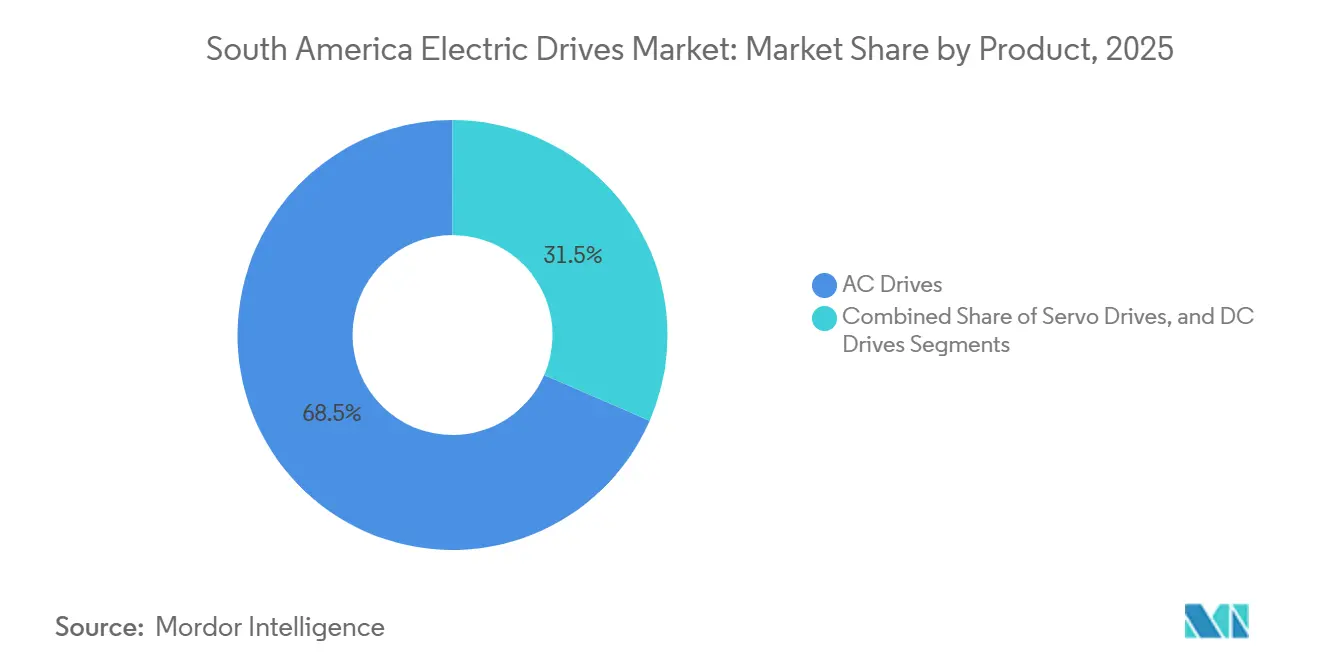
AC Drives Lead Volume While Servo Drives Expand in Premium ApplicationsAC drives accounted for 68.47% of product revenue in 2025 and were the largest product category in the South America Electric Drives Market. They are widely used in pumps, fans, air-handling equipment, and compressors because they provide variable-speed control for common industrial loads. Their installed base supports replacement demand across water treatment, food processing, and general manufacturing. DC drives continued to serve older equipment in pulp, printing, and metalworking applications. Servo drives are forecast to grow at a CAGR of 5.92% through 2031.
Servo systems enable precise, repeatable motion in filling, labeling, packaging, electronics, and vehicle assembly. Their growth reflects new automated production capacity in Brazil rather than the scale of the installed AC-drive base. Safety requirements for automated equipment also favor systems with integrated safety functions. Suppliers are positioning servo drives as part of wider motion-control packages. Higher-value applications that need accurate machine control support demand these systems.

By Voltage:
Low-Voltage Systems Sustain the Installed Base While Medium-Voltage Projects GrowLow-voltage drives accounted for 74.62% of revenue in 2025, driven by the large number of motors below 690 V. These systems serve food plants, water networks, HVAC equipment, and discrete manufacturing lines. Their broad installed base provides recurring demand even when larger capital projects are delayed. Medium-voltage drives are forecast to grow at a CAGR of 6.21% through 2031. The low-voltage share reflects volume demand rather than the value of individual orders.
Copper concentrators, offshore compression systems, pulp mills, and high-capacity treatment plants are central applications for medium-voltage equipment. Such projects have longer approval, installation, and service cycles than low-voltage replacements. Electrical systems in new mines are increasingly designed around large electric motors and integrated controls. This approach raises the importance of suppliers that can provide equipment, site support, and long-term maintenance. The South America Electric Drives Market covers voltage tiers with different purchase cycles and customer requirements.
By Power Rating:
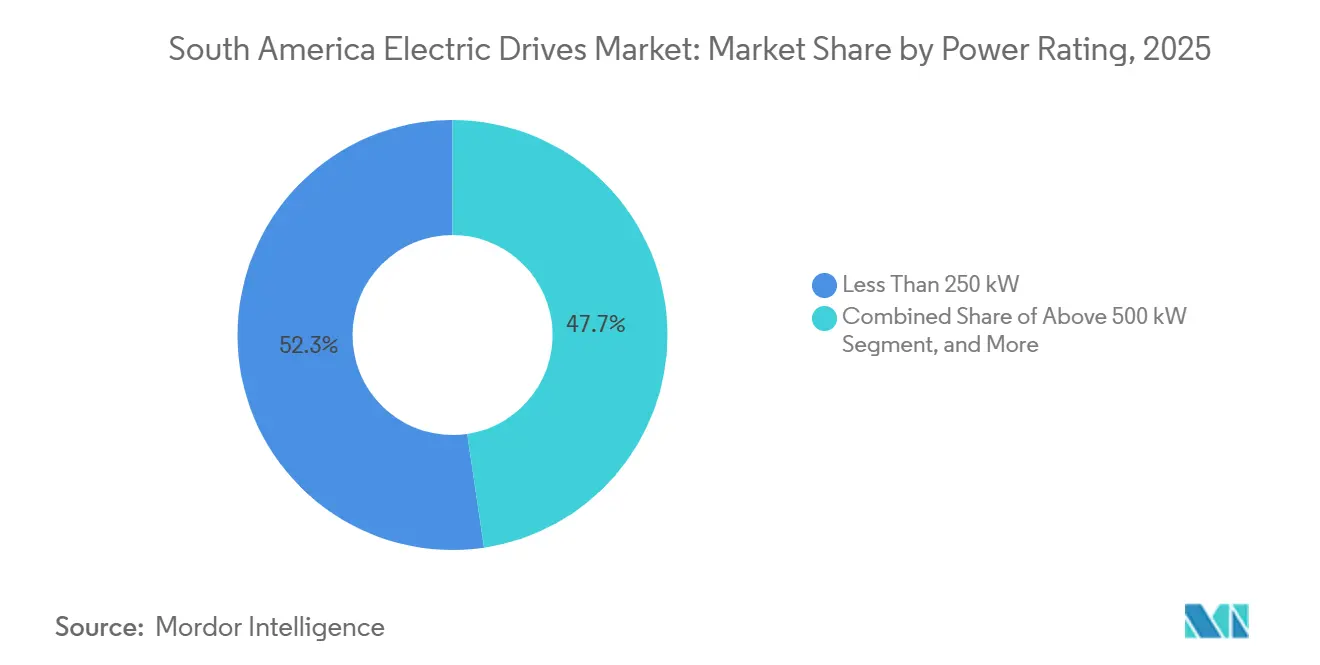
Small Installations Lead Volume While High-Power Projects Increase FasterInstallations below 250 kW held 52.34% of revenue in 2025 and remained the largest power-rating band. They serve the region’s large population of small pumps, fans, HVAC units, and light-manufacturing equipment. This band benefits from recurring replacement demand and lower project complexity. Installations above 500 kW are forecast to grow at a CAGR of 5.74% through 2031. The 251-500 kW range serves chemical, petrochemical, and medium-scale mining loads.
Copper processing, pulp digesters, and offshore compressor trains require drives with high output and reliable site support. These orders often include related motors, switchgear, commissioning, and lifecycle services. WEG announced BRL 1.1 billion (USD 190 million) of industrial expansion investment in September 2025 for large equipment production in Brazil. The investment strengthens regional component capacity for large-scale projects. The South America Electric Drives Market depends on the timing of investment in mining, energy, and process industries.[4]
By End-User Industry:
Oil and Gas Leads Demand While Food and Beverages Grow FastestOil and gas held 21.68% of end-user revenue in 2025 and remained the largest customer group. Offshore production, compression, pumping, refining, and processing equipment require high-specification motor control systems. Petrobras plans capital expenditure of USD 19.6 billion during 2026, focused on pre-salt production and refinery modernization. Food and beverages are forecast to grow at a CAGR of 6.63% through 2031. Food production requires increasing automation in filling, packaging, and material handling.
Rockwell Automation supported Tate and Lyle’s automated facility in Matão, São Paulo, with process-control applications from material handling to chemical dosing. Water and wastewater systems also create demand for pump-drive systems as municipalities expand treatment capacity. Chemicals, power generation, HVAC, pulp and paper, and discrete industries provide additional demand across South America. Demand across these end users reduces dependence on any one industrial cycle. The regional outlook depends on project execution in its largest energy-intensive
Geography Analysis
Brazil Electric Drives Market
Brazil held 42.68% of regional revenue in 2025 and remained the largest South America Electric Drives Market. Its demand base includes food and beverage production, vehicle assembly, pulp and paper, petrochemicals, water utilities, and offshore energy. Petrobras’s offshore program supports demand for electrically driven compression and automation systems. ABB won an electrical and automation contract for Petrobras’s next-generation FPSO vessels, including P-84 and P-85. WEG announced BRL 2.6 billion (USD 448 million) in investment during 2025 to expand capacity and innovation.
Chile Electric Drives Market
Chile is forecast to grow at a CAGR of 6.17% through 2031, the fastest rate in the regional market. Copper mining is the central driver of demand for high-power drives, gearless mill systems, and related services. The U.S. International Trade Administration identified mining investment as a significant source of equipment demand in Chile during 2026. Mining projects require local technical support and certification capacity. This demand supports equipment and service opportunities across the country.
South America Electric Drives Market
Argentina’s industrial recovery and energy investment support selective demand for machinery and high-power drives. The OECD reported that Argentina’s GDP grew 5.8% year on year in the first quarter of 2025 after its 2024 contraction. Vaca Muerta activities require pumps and compressors for drilling and processing operations. Peru, Colombia, Ecuador, and Uruguay contribute demand from municipal water systems, food processing, and mining activity.
Competitive Landscape
The South America Electric Drives Market is moderately concentrated among ABB, Siemens, WEG, Schneider Electric, and Rockwell Automation. These suppliers compete through product breadth, service coverage, technical certification, and integrated automation platforms. WEG has a regional manufacturing advantage that can support delivery times and local warranty coverage. Large customers increasingly assess lifecycle support alongside equipment performance. This favors companies with local engineers and established parts networks.
Siemens and Schneider Electric are developing digital offerings that support commissioning, data management, and condition monitoring. ABB won an electrical and automation contract for Petrobras’s next-generation FPSO vessels in 2025. WEG expanded its large-equipment manufacturing plans in Brazil during 2025. These moves combine motion equipment with data and maintenance services. The regional market rewards suppliers that can support equipment and operational improvement.
Danfoss, Yaskawa, SEW-EURODRIVE, Bonfiglioli, Lenze, Parker-Hannifin, Delta Electronics, Kollmorgen, and Fuji Electric compete strongly in the mid-market. Price competition is most visible in the sub-250 kW AC-drive category, where import-based suppliers are expanding. Predictive maintenance services remain an opportunity at remote mines and water facilities. Competition remains centered on service quality, application engineering, and price discipline.
South America Electric Drives Industry Leaders
-
ABB Ltd
-
Siemens AG
-
WEG S.A.
-
Schneider Electric SE
-
Danfoss A/S
- *Disclaimer: Major Players sorted in no particular order
South America Electric Drives Market Companies Covered in this Report
- ABB Ltd
- Siemens AG
- WEG S.A.
- Schneider Electric SE
- Danfoss A/S
- Rockwell Automation, Inc.
- Yaskawa Electric Corporation
- Mitsubishi Electric Corporation
- Nidec Corporation
- Fuji Electric Co., Ltd.
- Hitachi, Ltd.
- Toshiba International Corporation
- Emerson Electric Co.
- Eaton Corporation plc
- TMEIC Corporation
- SEW-EURODRIVE GmbH & Co KG
- Bonfiglioli Riduttori S.p.A.
- Lenze SE
- Parker-Hannifin Corporation
- Delta Electronics, Inc.
- Kollmorgen Corporation
- Envases del Plata S.A.
- Impress Brasil Embalagens Metálicas Ltda.
- Metalgráfica Industria e Comércio Ltda.
Recent Industry Developments in South America Electric Drives Market
- August 2026: ABB and Vale formalized a strategic alliance to expand automation, AI, and digitalization across multiple iron ore processing facilities in Brazil, building on a first-phase project at the Conceição II plant in Itabira that delivered a 25% productivity increase. The partnership creates a replicable technology framework for automating Vale's broader beneficiation network, with drive-level motion control embedded in the operational standard across future sites.
- June 2026: chneider Electric signed a definitive agreement to acquire Cognite Holding, an industrial AI and data-operations software company, for USD 3.1 billion. The acquisition integrates Cognite's industrial data platform with Schneider's Aveva software suite, enhancing predictive automation and drive condition-monitoring capabilities for South American industrial clients.
- April 2026: Petrobras approved the final investment decision for the SEAP I deepwater project in the Sergipe-Alagoas Basin. Combined with the December 2025 decision for SEAP II, the 2 modules target combined production of 240,000 barrels per day and combined investment of BRL 60 billion (USD 10.3 billion).
- April 2026: Bosch announced a BRL 1 billion (USD 172 million) investment in Brazil to establish production lines for high-voltage electric motors and related components for commercial vehicles.
South America Electric Drives Market Report Scope
The South America Electric Drives Market refers to electronic devices that control the speed, torque, and direction of electric motors across various industrial applications. These drives are categorized by product type (AC, DC, and servo), voltage levels (low and medium), and power ratings, and are essential for optimizing energy consumption and process precision. They are widely deployed across the region's oil and gas, water and wastewater, food and beverage, and manufacturing sectors to improve operational efficiency and reduce mechanical wear.
The South America Electric Drives Market Report is Segmented by Product (AC Drives, DC Drives, and Servo Drives), Voltage (Low-Voltage Drives and Medium-Voltage Drives), Power Rating (Less Than 250 kW, 251-500 kW, and Above 500 kW), End-User Industry (Oil and Gas, Water and Wastewater, Chemicals and Petrochemicals, Food and Beverages, Power Generation, HVAC, Pulp and Paper, Discrete Industries, and Other End-User Industries), and Geography (Brazil, Chile, Argentina, and Rest of South America). The Market Forecasts are Provided in Terms of Value (USD).
Segmentation Overview
By Product
| AC Drives |
| DC Drives |
| Servo Drives |
By Voltage
| Low-Voltage Drives |
| Medium-Voltage Drives |
By Power Rating
| Less Than 250 kW |
| 251-500 kW |
| Above 500 kW |
By End-User Industry
| Oil and Gas |
| Water and Wastewater |
| Chemicals and Petrochemicals |
| Food and Beverages |
| Power Generation |
| HVAC |
| Pulp and Paper |
| Discrete Industries |
| Other End-User Industries |
By Geography
| Brazil |
| Chile |
| Argentina |
| Rest of South America |
| By Product | AC Drives |
| DC Drives | |
| Servo Drives | |
| By Voltage | Low-Voltage Drives |
| Medium-Voltage Drives | |
| By Power Rating | Less Than 250 kW |
| 251-500 kW | |
| Above 500 kW | |
| By End-User Industry | Oil and Gas |
| Water and Wastewater | |
| Chemicals and Petrochemicals | |
| Food and Beverages | |
| Power Generation | |
| HVAC | |
| Pulp and Paper | |
| Discrete Industries | |
| Other End-User Industries | |
| By Geography | Brazil |
| Chile | |
| Argentina | |
| Rest of South America |
Key Questions Answered in the Report
What is the South America Electric Drives Market size?
The South America Electric Drives Market is estimated at USD 1.91 billion in 2026 and is forecast to reach USD 2.48 billion by 2031 at a 5.36% CAGR.
Which product category leads demand for electric drives in South America?
AC drives led product revenue with 68.47% in 2025 because they are widely used in pumps, fans, compressors, and air-handling systems.
Which electric drive application is growing fastest in South America?
Food and beverages are forecast to grow at a CAGR of 5.74% through 2031, supported by automated production and packaging equipment.
Which country leads demand for electric drives in South America?
Brazil held 42.68% of regional revenue in 2025, supported by its broad industrial base and local equipment manufacturing.
Why are medium-voltage drives gaining demand in South America?
Mining, offshore energy, pulp production, and major water projects require high-capacity motor control systems, supporting 8.94% forecast growth through 2031.
What limits electric drive adoption among smaller facilities?
Higher upfront equipment costs, financing constraints, imported component exposure, and limited service skills can delay replacement decisions.