
Market Overview
| Study Period | 2021 - 2031 |
|---|---|
| Forecast Data Period | 2026 - 2031 |
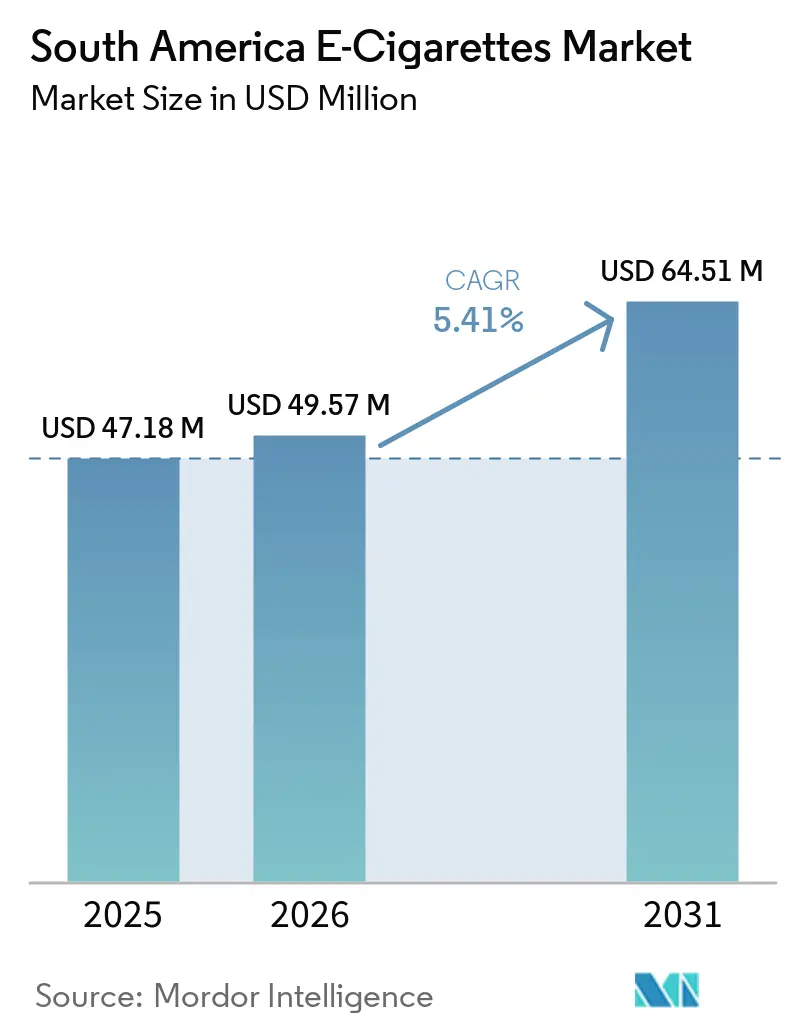
| Base Year Market Size (2025) | USD 47.18 Million |
| Market Size (2026) | USD 49.57 Million |
| Market Size (2031) | USD 64.51 Million |
| Growth Rate (2026 - 2031) | 5.41 % |
| Market Concentration | Medium |
Major Players *Disclaimer: Major Players sorted in no particular order Image © Mordor Intelligence. Reuse requires attribution under CC BY 4.0. | |
South America E-Cigarettes Market Analysis by Mordor Intelligence
The South America e-cigarette market size was valued at USD 47.18 million in 2025 and estimated to grow from USD 49.57 million in 2026 to reach USD 64.51 million by 2031, at a CAGR of 5.41% during the forecast period (2026-2031). The region is shifting from informal sales toward licensed, taxable channels, particularly in Colombia, Chile, Peru, Paraguay, and Argentina. This transition increases the visibility of consumer demand for established brands and retailers, enabling them to better assess market potential and develop compliant commercial strategies. Adult tobacco use in the Americas declined from 159 million in 2000 to 129 million in 2025, while adult consumer interest in lower-exposure alternatives continues to grow, supporting demand for e-cigarette products in regulated markets[1]. Regulatory clarity supports investments in compliant retail, distribution, and product registration systems, thereby strengthening product availability and consumer access through formal channels. However, bans, illicit supply, and import costs continue to constrain formal sales in the South America e-cigarette market, limiting the expansion of authorized brands and retailers.
Key Report Takeaways
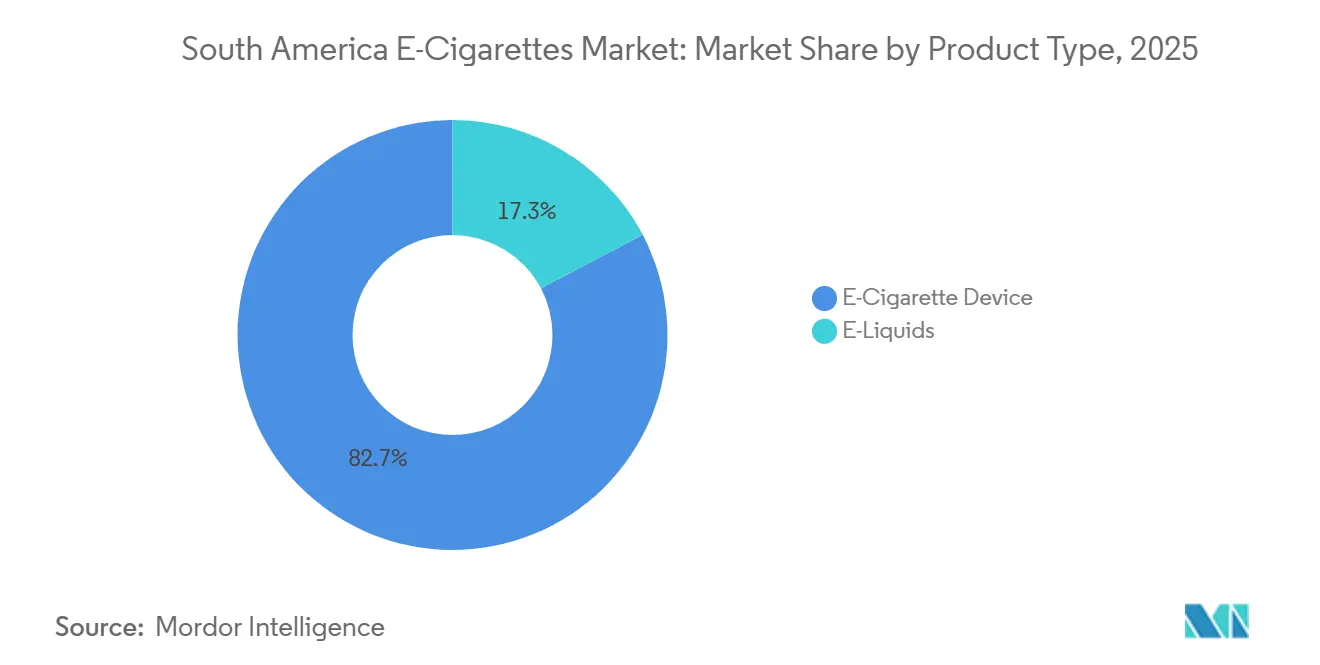
- By product type, e-cigarette devices accounted for the largest share of the South America e-cigarette market, at 82.72% in 2025, while e-liquids are projected to grow at the fastest CAGR of 7.45% during 2026-2031.
- By category, closed vaping systems accounted for the largest share of the South America e-cigarette market, at 74.37% in 2025, while open vaping systems are projected to grow at the fastest CAGR of 7.98% during 2026-2031.
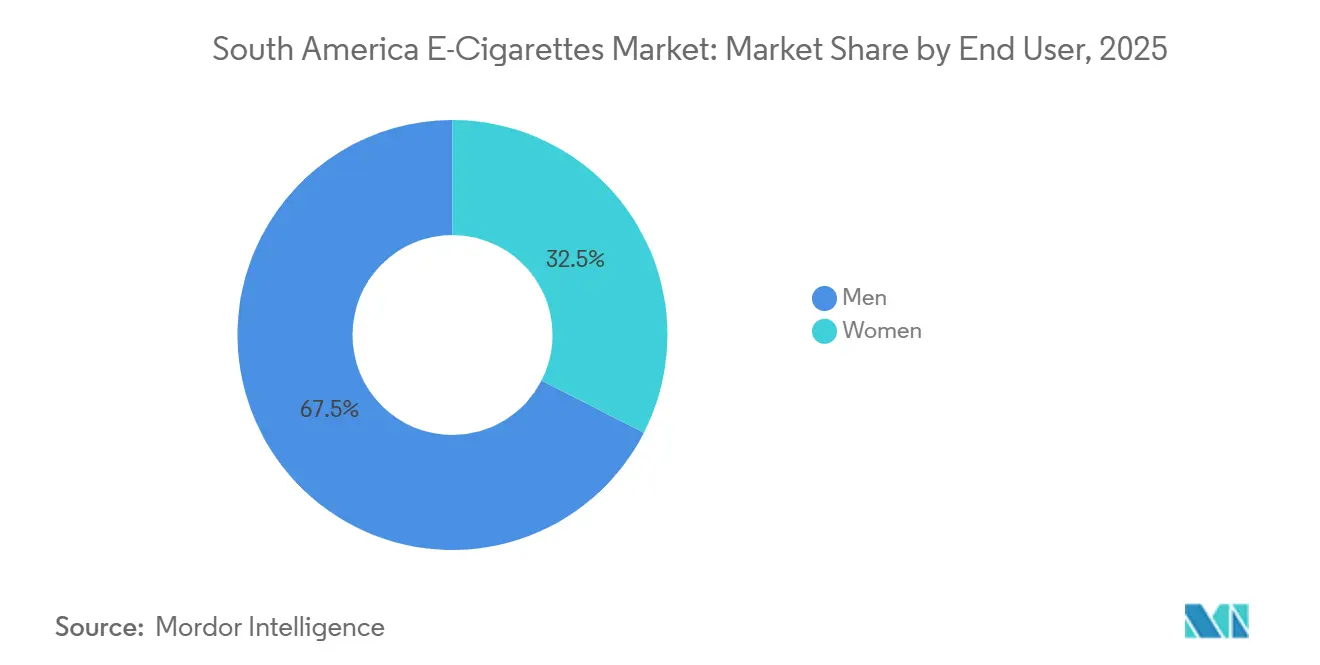
- By end user, men accounted for the largest share of the South America e-cigarette market, at 67.49% in 2025, while women are projected to grow at the fastest CAGR of 8.64% during 2026-2031.
- By distribution channel, offline retail accounted for the largest share of the South America e-cigarette market, at 70.51% in 2025, while online retail is projected to grow at the fastest CAGR of 9.22% during 2026-2031.
- By geography, Colombia accounted for the largest share of the South America e-cigarette market, at 43.16% in 2025, while Peru is projected to grow at the fastest CAGR of 7.92% during 2026-2031.
Note: Market size and forecast figures in this report are generated using Mordor Intelligence’s proprietary estimation framework, updated with the latest available data and insights as of January 2026.
South America E-Cigarettes Market Trends and Insights
Drivers Impact Analysis*
| Driver | (~) % Impact on CAGR Forecast | Geographic Relevance | Impact Timeline |
|---|---|---|---|
| Digital discovery and social commerce reach among adult consumers | +0.8% | Colombia, Peru, with spillover to Chile and Argentina | Short term (≤ 2 years) |
| Regulatory normalization in Colombia, Chile, Peru, and Paraguay | +1.2% | Colombia, Chile, Peru, Paraguay, with early effects in Buenos Aires | Medium term (2-4 years) |
| Product innovation in closed-pod and high-capacity disposable devices | +0.7% | Colombia and Chile, supported by global supply chains | Short term (≤ 2 years) |
| Adult-smoker switching and refillable-system adoption | +0.9% | Colombia and Chile | Medium term (2-4 years) |
| Cross-border access to products unavailable through domestic retail | +0.6% | Argentina, Bolivia, Ecuador, and Uruguay border corridors | Medium term (2-4 years) |
| Localized flavors and nicotine-strength preferences | +0.5% | Colombia, Peru, and Paraguay | Long term (≥ 4 years) |
| Source: Mordor Intelligence | |||
Digital Discovery and Social-Commerce Reach Among Adult Consumers
Digital product discovery reaches adult consumers before they make formal purchase decisions in the South America e-cigarette market. Social media platforms, online marketplaces, and delivery applications have normalized product searches and repeat purchases in Colombia, Peru, and Argentina. Colombia's Superintendence of Industry and Commerce issued Resolution No. 30838 in May 2025 to regulate consumer access to information on vaping products. While the resolution addresses information access, authorities face greater challenges in monitoring digital promotion and peer-to-peer visibility at scale. Therefore, compliant local-language content and verified online purchasing systems can serve as valuable commercial capabilities. Online sellers that demonstrate effective age-verification processes and maintain product documentation will be better positioned as enforcement becomes more stringent.
Regulatory Normalization in Colombia, Chile, Peru, and Paraguay
Regulatory changes are shifting informal sales into licensed and taxable channels across several South American countries. Colombia’s Law 2354 of 2024 extended tobacco control regulations to e-cigarettes, establishing requirements that support a formal retail environment[2]. Chile’s Decree No. 41 took effect in May 2025 and introduced health-warning requirements for electronic nicotine delivery systems and vaping liquids. Peru implemented advertising restrictions and age-verification requirements under Law No. 32159; however, the supplied material did not include complete implementation details regarding flavors. Paraguay’s Law No. 7508 of 2025 requires product registration, limits imports to closed-device formats, and caps nicotine concentrations at 20 mg/mL[3]. These clearer regulations enable compliant suppliers to plan investments in product registration, retail access, and legal distribution across the South American e-cigarette market.
Product Innovation in Closed-Pod and High-Capacity Disposable Devices
Product design can reduce practical barriers for adult consumers trying e-cigarettes for the first time. Pre-filled pods, magnetic battery systems, visible liquid chambers, and battery indicators minimize maintenance requirements and technical adjustments. These features support closed systems, which adults widely use to gain a simpler initial experience. ELFBAR introduced its King Series in June 2025, featuring adjustable controls for coolness, sweetness, sourness, and nicotine strength. This product approach reflects demand for controlled flavor and nicotine delivery rather than a single, uniform format. Importers must also account for the International Air Transport Association requirement, effective January 2026, that lithium batteries contained in equipment transported by air must not exceed a 30% state of charge.
Adult-Smoker Switching and Refillable-System Adoption
Adult tobacco users represent a significant potential customer base for the South America e-cigarette market. Chile recorded the highest adult tobacco-use prevalence in the Americas, at 28.7%, compared with the regional average of 16.6% among adults aged 15 years and above. Refillable systems may appeal to adults who prioritize lower per-use costs and a broader selection of e-liquids. The supplied research indicates that open systems can reduce per-use costs by 40%–60% compared with proprietary pod systems. It also cites a peer-reviewed study dated 2026 on Chilean usage patterns, which found that initiation often occurred in social settings and that women accounted for 77.8% of qualitative interview participants. These findings indicate that product positioning and retail strategies may need to account for social consumption patterns and varied consumer preferences. Product form factor, retail accessibility, and consistent nicotine delivery may influence the development of demand among adult users.
Restraints Impact Analysis*
| Restraint | (~) % Impact on CAGR Forecast | Geographic Relevance | Impact Timeline |
|---|---|---|---|
| Country-level bans and uneven regulatory recognition | -1.5% | Brazil, Venezuela, and Argentina during its transition to legal sales | Long term (≥ 4 years) |
| Illicit and counterfeit product competition | -1.2% | South America, especially the Paraguay-Argentina-Brazil corridor | Medium term (2-4 years) |
| Battery, shipping, and product-compliance constraints | -0.5% | Air-freight-dependent South American importers | Short term (≤ 2 years) |
| Currency volatility and import-cost inflation | -0.7% | Argentina, Colombia, and Peru | Short term (≤ 2 years) |
| Source: Mordor Intelligence | |||
Country-Level Bans and Uneven Regulatory Recognition
Brazil continues to prohibit the manufacturing, importation, and sale of e-cigarettes under ANVISA Resolution RDC No. 855/2024. This ban excludes the continent's largest consumer base from legal sales, although informal demand persists. According to the supplied material, 4 million people in Brazil used e-cigarettes through informal channels during the ban. Venezuela also restricts the development of a formal local market by prohibiting manufacturing and imports. Informal suppliers can undercut the prices of licensed products by avoiding registration, taxation, and labeling costs. This price advantage can sustain informal distribution channels and limit the development of regulated e-cigarette markets. Regional enforcement cooperation remains important; however, the PAHO tobacco-control strategy does not establish a binding enforcement mechanism.
Illicit and Counterfeit Product Competition
Illicit products continue to restrain licensed sales in the South American e-cigarette market. In January 2025, the World Customs Organization's Operation FRONPIAS involved 14 customs administrations and intercepted nearly 14 million items, with tobacco and e-cigarette products accounting for 89% of the total seized quantity. Brazil's enforcement agencies also reported significant e-cigarette seizures across ports, airports, and road networks in 2024. While seizure data highlight the substantial volume of products in transit, they do not capture products that reach informal retail channels. Counterfeit products may lack reliable ingredient disclosures, child-resistant packaging, and consistent nicotine delivery, posing risks to consumers and legitimate suppliers. The continued circulation of illicit products also undermines regulatory oversight and limits revenue opportunities for compliant manufacturers and authorized retailers.
*Our forecasts treat driver/restraint impacts as directional, not additive. The impact forecasts reflect baseline growth, mix effects, and variable interactions.
Segment Analysis
By Product Type: Hardware Anchors Value While E-Liquids Build Recurring Demand
E-cigarette devices accounted for 82.72% of the South American e-cigarette market share in 2025. This substantial share reflects the requirement for each new user to purchase hardware before generating recurring spending on consumables. Disposable devices are gaining traction in Colombia and Peru because they require minimal setup at the point of purchase. Rechargeable devices support longer usage periods and can drive repeat purchases over time. Retailers benefit from offering hardware for hands-on evaluation through specialty stores, convenience outlets, and other formal retail channels. The device category remains closely linked to the expansion of the installed user base. As adoption increases, demand for entry-level and advanced device formats is likely to broaden across the region.
E-liquids are forecast to register the fastest product-type CAGR of 7.45% during 2026–2031. This faster growth highlights the increasing importance of repeat consumable purchases as users continue vaping after their initial device purchase. The expansion of formal retail channels in Colombia can facilitate replenishment by increasing the number of purchase locations. This expansion can shift e-liquid purchases from planned shopping trips to more frequent, convenience-driven purchases. In 2025, PAHO warned about flavored tobacco and nicotine products and reported an e-cigarette prevalence of 5.4% among adolescents in the Americas. Brands must therefore prepare for stricter flavor regulations while maintaining compliant product documentation and locally appropriate product portfolios. Regulatory developments may also influence product availability and the range of e-liquid formulations offered through formal retail channels.

By Category: Closed Systems Lead While Open Systems Gain Through Refill Economics
Closed vaping systems accounted for 74.37% of the South America e-cigarette market in 2025. Pre-filled pods eliminate the need to handle e-liquids or adjust device settings, making these systems more accessible to adult consumers seeking a straightforward initial product experience. Closed systems also enable brands to maintain product traceability through controlled cartridge and device supply. Their distribution model supports consistent retailer margins and clearer compliance procedures. These characteristics underpin their broad adoption across regulated and newly formalizing national markets. This format is particularly suited to markets where standardized products and controlled distribution channels support regulatory oversight.
Open vaping systems are projected to record the fastest category CAGR of 7.98% during 2026-2031. Refillable tanks appeal to cost-conscious and technically engaged adult consumers seeking a broader range of e-liquid options. The supplied material indicates that open systems can reduce per-use costs by 40% to 60% compared with proprietary pods. The supplied draft also indicates that a substantial share of consumers in Colombia prefer open systems. However, Paraguay's Law No. 7508/2025 restricts legal imports and manufacturing to closed-device formats. These varying country-level requirements favor brands that can meet regulatory compliance obligations while addressing distinct consumer preferences. As regulations evolve across the region, manufacturers will need to adapt their product portfolios to country-specific legal frameworks.
By End User: Men Hold the Largest Base While Women Expand Faster
Men accounted for 67.49% of the South American e-cigarette market share in 2025. This distribution reflects the category’s early association with device-focused user communities and social adoption patterns. Manufacturers have traditionally targeted this consumer base through product performance, battery capacity, and broad retail availability. Expanding formal distribution channels can also increase access for consumers who do not visit specialty vape shops. As the largest end-user group, men remain significant for hardware sales and established retail demand, while also providing the installed base that supports subsequent consumable purchases.
Women are projected to register the fastest CAGR among end-user groups, at 8.64%, during 2026–2031. Slimmer devices, discreet form factors, and a wider range of flavors may increase product relevance across different adult purchasing situations. A 2025 study published in Frontiers in Public Health examined gender-related considerations in e-cigarette use and tobacco-control policy. A peer-reviewed Chilean study published in 2026 found no population-level difference in past-year use by sex and reported that women represented 77.8% of qualitative interview participants. Philip Morris International reported that VEEV shipped more than 1 billion equivalent units globally in the first quarter of 2026, highlighting the commercial scale of closed-pod formats. The available evidence links growth in the women’s segment to device form factors, flavor variety, and retail settings rather than cosmetic product modifications.
By Distribution Channel: Offline Retail Retains Scale While Online Retail Grows Faster
Offline retail accounted for 70.51% of regional e-cigarette sales in 2025. Physical stores enable consumers to examine devices before making an initial purchase. Specialty vape stores, tobacconists, convenience outlets, and modern retail channels provide immediate access to products. In Colombia, formalization has supported expansion into chain convenience stores and shopping center kiosks, according to the supplied material. These channels reduce uncertainty for adults seeking direct product information before purchase. Consequently, offline retail remains the primary channel for device trials and initial purchases.
Online retail is projected to register the fastest CAGR among distribution channels, at 9.22% during 2026-2031. Digital channels benefit from consumer purchasing behaviors already established through social media, online marketplaces, and delivery platforms. In 2025, Colombia's SIC directed Rappi, Almacenes Éxito, Dislicores, and 8 other platforms to implement age-verification and delivery identification checks. Although these requirements increase costs, they can help compliant operators differentiate themselves from informal sellers. Verified age-gating and documented delivery procedures can serve as practical barriers to entry for less formal participants. The South America e-cigarette market is likely to favor online operators that combine regulatory compliance, multi-brand product discovery, and reliable last-mile delivery.
Geography Analysis
Colombia is projected to account for 43.16% of the South America e-cigarette market size in 2025, making it the region’s largest national market. Law 2354/2024 provides suppliers with a recognized legal framework for commercialization and formal retail planning. The country offers consumer access through convenience stores, shopping centers, e-commerce platforms, and delivery applications. This distribution network is more developed than those in many neighboring markets. Newer brands, including Vaporesso, Dragbar, and GluCloud, have expanded the supplier base. Although Colombia’s tax and licensing obligations may increase retail prices, they also indicate continued state oversight of a formal product category.
Peru is projected to record the fastest regional CAGR of 7.92% during 2026–2031. The supplied material attributes this growth to an expanding importer base and demand that is developing faster than regulatory implementation. Peru’s framework establishes advertising, age-verification, and labeling requirements for nicotine and substitute products. Enforcement activities may benefit suppliers that already comply with Spanish-language labeling, manufacturer-information, and product-record requirements. The market’s growth profile also reflects continued cross-border and digital purchasing behavior. Formal compliance capabilities will become increasingly important as implementing regulations become more specific.
The rest of South America will present varied regulatory and competitive conditions in 2026. British American Tobacco launched Vuse in Chile in March 2025 after the country’s electronic nicotine delivery system framework takes effect. Argentina’s Resolution 549/2026 formalized a category that has long operated through informal trade, while the supplied material indicates that Decree 305/2026 imposes higher import duties. Paraguay will operate under Law No. 7508/2025, which links product registration, nicotine limits, tax obligations, and closed-device formats. Brazil remains outside the legal South America e-cigarette market because of ANVISA’s comprehensive prohibition. These differences make country-specific compliance and supply planning essential for regional market participation.
Competitive Landscape
The South America e-cigarette market concentration remains moderate. British American Tobacco and Philip Morris International hold the most established multinational commercial positions in Colombia, Chile, and Peru. However, they compete with a broad range of import brands and Chinese hardware suppliers. The supplied material identified more than 30 active import brands in Peru alone. This structure limits the ability of any single supplier to establish uniform regional dominance. It also makes distribution capabilities, regulatory documentation, and product availability key competitive factors.
British American Tobacco operates Vuse in Colombia, Chile, and Peru. According to the supplied material, its March 2025 launch in Chile established a licensed presence following the implementation of the country’s regulatory framework. The supplied material also states that Philip Morris International’s VEEV closed-pod platform exceeded 1 billion equivalent units shipped globally in the first quarter of 2026. This milestone supports Philip Morris International’s focus on closed-pod products that provide consistent nicotine delivery and require minimal operating complexity. The supplied material further noted that PMI was preparing to commercialize smoke-free products in Argentina. These developments indicate that leading suppliers are using regulatory openings to establish formal channels for adult consumers.
According to the supplied material, Shenzhen IVPS, GeekVape, Vaporesso, and ELFBAR compete based on price, flavor selection, and open-system flexibility. Their routes to consumers include specialty retailers, online marketplaces, and cross-border e-commerce platforms. Registration, ingredient-disclosure, and labeling requirements can increase participation costs for suppliers that lack regional compliance infrastructure. ELFBAR’s June 2025 King Series launch added adjustable flavor-intensity settings and expanded its open-pod product lineup. Paraguay’s closed-device requirement provides suppliers with established closed-pod capabilities a clear compliance advantage. Companies that offer compliant localized flavors and documented refill options can address market gaps in Colombia and Chile without relying on informal supply channels.
South America E-Cigarettes Industry Leaders
-
British American Tobacco PLC
-
Philip Morris International Inc.
-
Smoore International Holdings Limited
-
RELX Technology
-
Imperial Brands PLC
- *Disclaimer: Major Players sorted in no particular order

Recent Industry Developments
- May 2026: Argentina's Ministry of Health issued Resolution 549/2026, establishing a comprehensive regulatory framework for electronic cigarettes and other next-generation nicotine products. The resolution shifts the country from a prohibition-based approach to a registration and control model. It provides compliant manufacturers and distributors with a clearer pathway to operate under defined sanitary oversight while increasing requirements for product quality documentation and formal market entry.
- June 2025: ELFBAR launched the King Series globally, introducing adjustable flavor intensity settings for coolness, sweetness, sourness, and nicotine strength. The company also expanded its ELFX open pod system lineup with the ELFX MINI and ELFX ULTRA, targeting markets including South America through a diversified closed- and open-system product portfolio.
- May 2025: Colombia's SIC issued Resolución No. 30838, requiring vaping product sellers to establish formal protocols for consumer access to information. Separately, the SIC ordered Rappi, Almacenes Éxito, Dislicores, and eight additional platforms to implement age verification and ID checks at delivery for e-cigarette products, thereby professionalizing the online distribution channel.
- March 2025: British American Tobacco launched Vuse in Chile, marking its first commercial entry following the enactment of Chile's ENDS regulatory framework. The launch established a licensed retail presence in a market that had previously been accessible only through informal channels.
South America E-Cigarettes Market Report Scope
E-cigarettes are electronic devices that heat a liquid formulation typically containing nicotine, flavorings, and other ingredients to generate an aerosol that the user inhales. The South America E-Cigarettes Market is segmented by product type, category, end user, distribution channel, and geography. Based on product type, the market is segmented into e-cigarette devices and e-liquid, with e-cigarette devices further segmented into disposable and non-disposable. Based on category, the market is segmented into open vaping systems and closed vaping systems. Based on end user, the market is segmented into men and women. Based on distribution channel, the market is segmented into offline retail and online retail. Based on geography, the market is segmented into Colombia, Peru, and the rest of South America. For each segment, the market sizing and forecast have been done based on the value (in USD).
By Product Type
| E-Cigarette Device | Disposable |
| Non-Disposable | |
| E-Liquid |
By Category
| Open Vaping Systems |
| Closed Vaping Systems |
By End User
| Men |
| Women |
By Distribution Channel
| Offline Retail |
| Online Retail |
By Geography
| Colombia |
| Peru |
| Rest of South America |
| By Product Type | E-Cigarette Device | Disposable |
| Non-Disposable | ||
| E-Liquid | ||
| By Category | Open Vaping Systems | |
| Closed Vaping Systems | ||
| By End User | Men | |
| Women | ||
| By Distribution Channel | Offline Retail | |
| Online Retail | ||
| By Geography | Colombia | |
| Peru | ||
| Rest of South America |
Key Questions Answered in the Report
What is the projected value of the South America e-cigarette market by 2031?
The South America e-cigarette market is forecast to reach USD 64.51 million by 2031, growing at a 5.41% CAGR from 2026.
Which product type has the largest share in South America?
E-cigarette devices led product type with an 82.72% share in 2025.
Why is Peru the fastest-growing country for e-cigarettes?
Peru is forecast to grow at 7.92% through 2031 because its importer base is broadening and formal compliance systems are developing.
Which sales channel is growing fastest for e-cigarettes in South America?
Online retail is forecast to expand at a 9.22% CAGR during 2026-2031, supported by marketplaces, delivery platforms, and age-verification systems.