
South America Data Center Water Treatment and Recycling Market Size and Share
Market Overview
| Study Period | 2021 - 2032 |
|---|---|
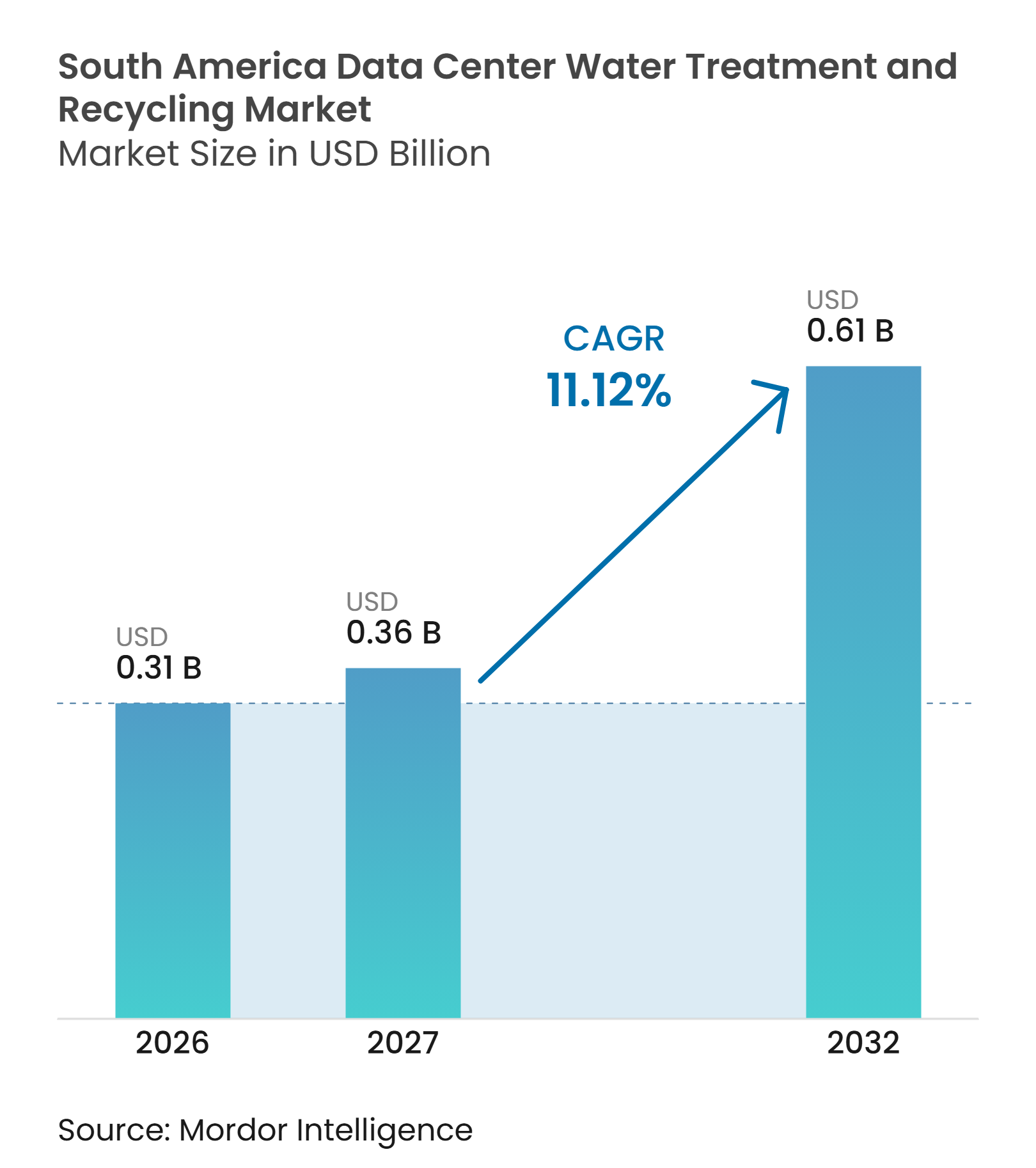
| Base Year Market Size (2026) | USD 0.31 Billion |
| Market Size (2027) | USD 0.36 Billion |
| Market Size (2032) | USD 0.61 Billion |
| Growth Rate (2027 - 2032) | 11.12 % |
| Fastest Growing Market | Asia-Pacific |
| Largest Market | North America |
Major Players *Disclaimer: Major Players sorted in no particular order Image © Mordor Intelligence. Reuse requires attribution under CC BY 4.0. | |
South America Data Center Water Treatment and Recycling Market Analysis by Mordor Intelligence
The South America data center water treatment and recycling market size is projected to expand from USD 0.31 billion in 2026 and USD 0.34 billion in 2027 to USD 0.61 billion by 2032, registering a CAGR of 11.12% between 2027 to 2032. AI-ready infrastructure is increasing the need for reliable cooling-water treatment as operators move from air-cooled equipment to liquid-cooled server designs. New campuses are making water treatment part of site design because cooling circuits require consistent water quality from the first day of operation. Municipal reclaimed-water programs are beginning to lower supply risk for non-potable cooling applications, especially in São Paulo. The South America data center water treatment and recycling market also faces uneven water availability, high capital requirements for advanced systems, and limited reuse infrastructure outside the largest cities. Suppliers that combine equipment, water chemistry, monitoring, and operating services are better placed to support large, long-term projects.
Key Report Takeaways
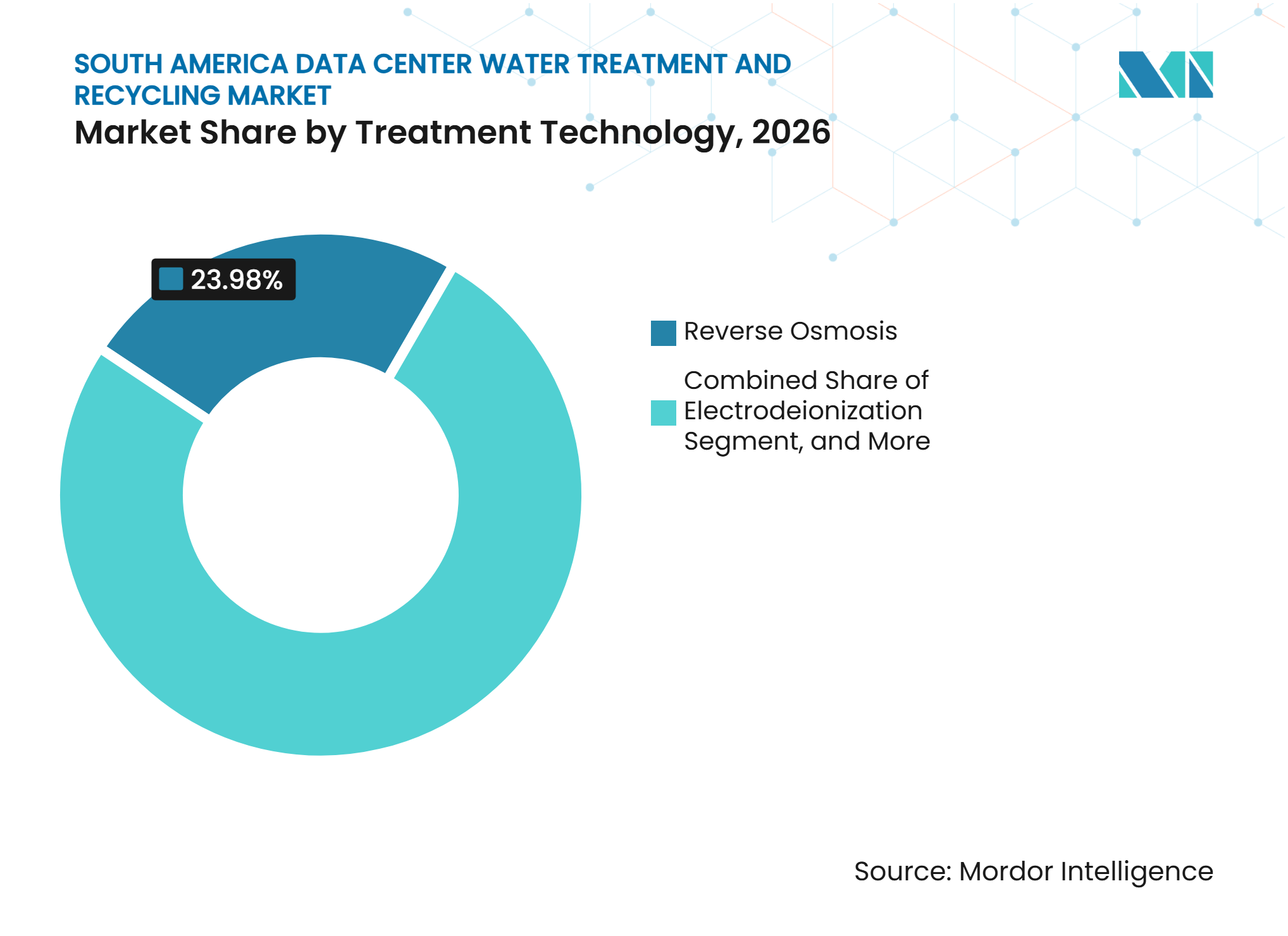
- By treatment technology, reverse osmosis held 23.98% of the South America data center water treatment and recycling market share in 2026, while electrodeionization is projected to expand at an 11.34% CAGR through 2032.
- By water source, municipal water held 32.16% share in 2026, while reclaimed municipal wastewater is expected to expand at an 11.47% CAGR through 2032.
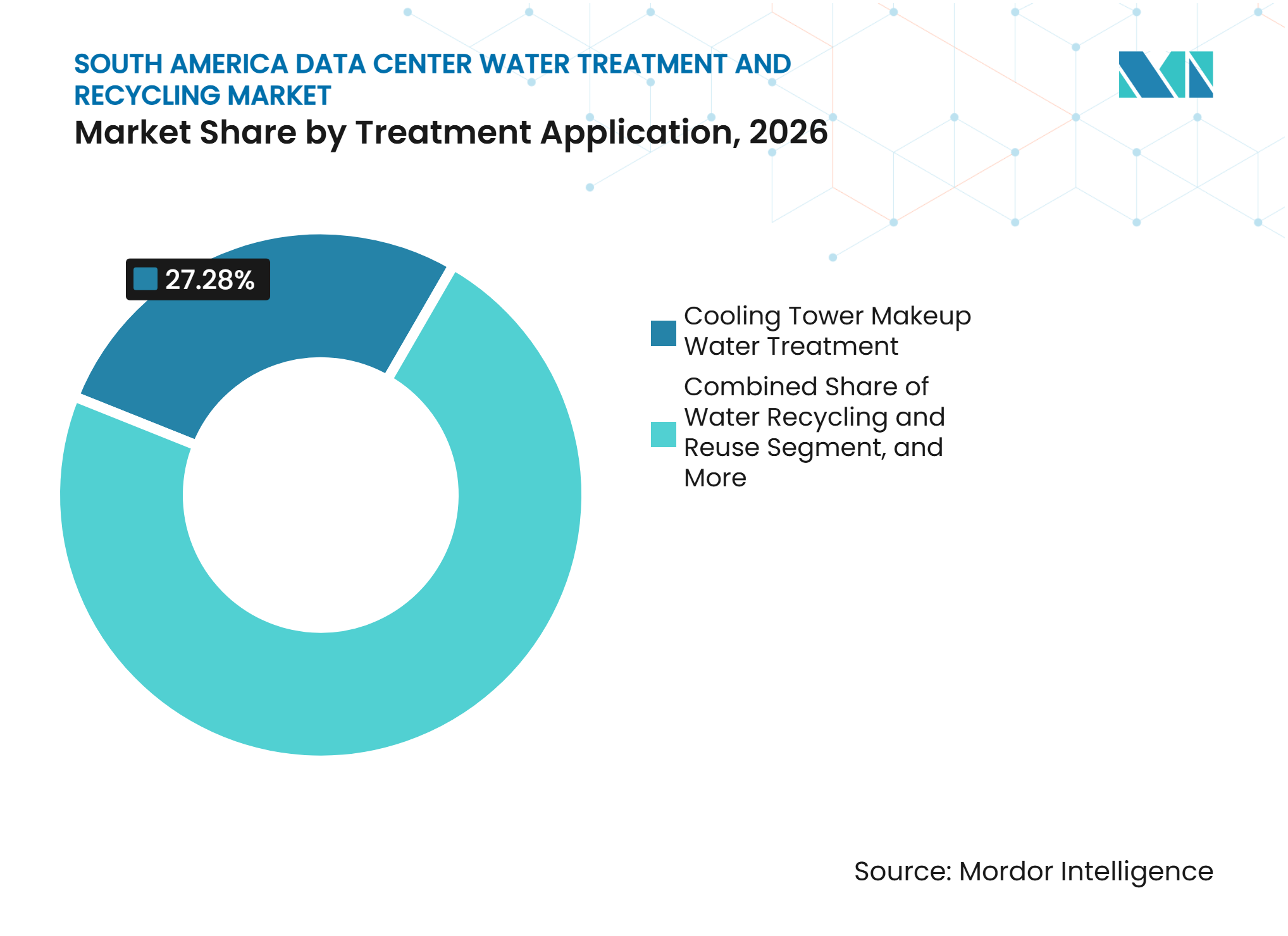
- By treatment application, cooling tower makeup water accounted for 27.28% of the South America data center water treatment and recycling market size in 2026, while water recycling and reuse is projected to advance at an 11.88% CAGR through 2032.
- By solution type, water treatment equipment held 40.77% share in 2026, while water quality monitoring and control systems are expected to expand at an 11.73% CAGR through 2032.
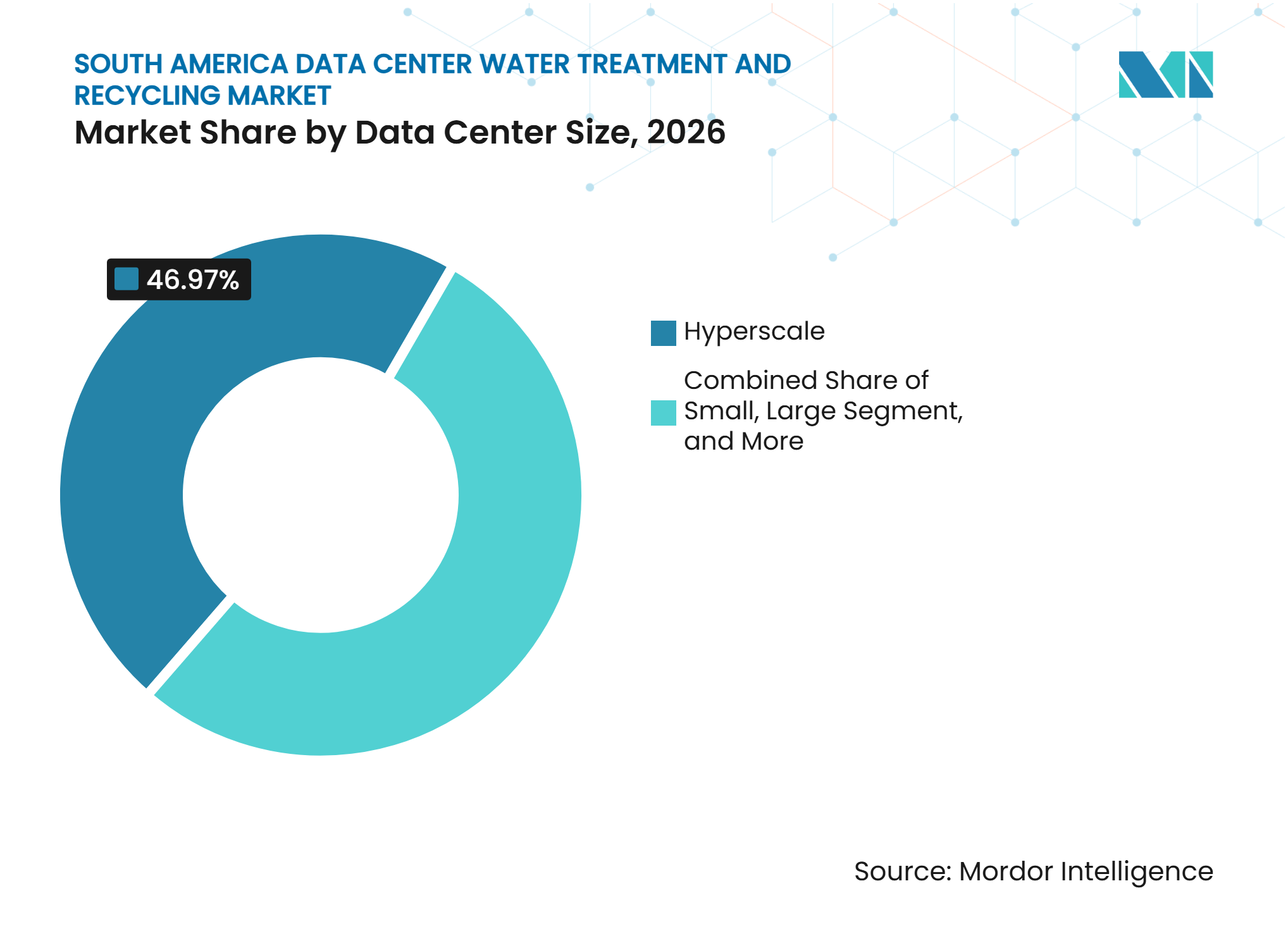
- By data center size, hyperscale data centers held 46.97% share in 2026 and are projected to advance at an 11.94% CAGR through 2032.
- By data center type, cloud service providers held 45.23% share in 2026 and are expected to expand at an 11.86% CAGR through 2032.
- By geography, Brazil held 58.18% share in 2026, while Colombia is projected to expand at an 11.59% CAGR through 2032.
Note: Market numbers in this report are based on Mordor Intelligence's proprietary estimation framework, which combines nine months of actuals with Q4 projections for base year 2026.
Market Trends and Insights
Drivers Impact Analysis of South America Data Center Water Treatment and Recycling Market*
| Driver | (~) % Impact on CAGR Forecast | Geographic Relevance | Impact Timeline |
|---|---|---|---|
| AI-Ready Data Center Expansion | +2.8% | Global, concentrated in Brazil, Colombia, and Chile | Short term (≤ 2 years) |
| Liquid-Cooled AI Rack Adoption | +2.2% | Brazil and Chile core, spillover to Colombia | Short term (≤ 2 years) |
| Hyperscale and Colocation Campus Expansion | +1.8% | Brazil and Colombia | Medium term (2-4 years) |
| Water-Efficiency Requirements in Data Center Projects | +1.4% | Brazil, Chile, and Colombia | Medium term (2-4 years) |
| Municipal Reclaimed-Water Network Growth | +1.0% | Brazil, including São Paulo and Ceará, and Chile | Medium term (2-4 years) |
| Closed-Loop and Zero-WUE Cooling Designs | +0.8% | Chile and Brazil | Long term (≥ 4 years) |
| Source: Mordor Intelligence | |||
AI-Ready Data Center Expansion Multiplies Per-Facility Water Treatment Loads
GPU-dense AI racks produce thermal loads of 50-150 kW per rack, compared with 5-15 kW for conventional servers. This change increases the need for water-based cooling and raises treatment capacity requirements at each campus. South America data center water treatment and recycling market demand therefore rises with the number and size of AI deployments rather than with server counts alone. New AI campuses increasingly require reverse osmosis, electrodeionization, and monitoring systems at commissioning instead of adding them later. Colombia’s data center pipeline includes construction projects that will require purpose-built water infrastructure as capacity expands. This favors suppliers that can design complete treatment systems for large facilities.[1]
Rising Adoption of Liquid-Cooled AI Racks Redefines Water Quality Requirements
Direct liquid cooling can capture up to 95% of server heat and reduce evaporative losses by 90% compared with legacy cooling towers. Closed-loop circuits are sensitive to corrosion, scaling, and biological contamination, so they require continuous treatment and monitoring. A water-quality excursion can damage high-value server components, making reliable chemistry control important to operators. Ecolab’s 3D TRASAR technology illustrates the use of automated monitoring and dosing for direct-to-chip cooling applications. A 2025 study found that resin-wafer electrodeionization can support zero-liquid-discharge treatment of cooling-tower blowdown with energy use of 0.057-0.537 kWh/m³. These conditions increase the demand for treatment trains that provide consistent low-conductivity water.[2]
Hyperscale and Colocation Campus Expansion Concentrates Treatment Procurement
Hyperscale construction is concentrating water-treatment purchasing in a smaller number of larger facilities. ODATA committed USD 1.3 billion to the DC BG02 and DC BG03 campuses near Bogotá, which are planned to provide 144 MW of combined capacity. Scala’s Barueri campus is designed for 600 MW of eventual IT capacity. Brazilian industry research states that a closed-loop campus requires 23,000 liters of water per installed MW. Ascenty had 26 data centers operating and 12 under construction across South America in 2026. These projects favor suppliers that can provide long-duration equipment, chemicals, monitoring, and service contracts.[3]
Increasing Water-Efficiency Requirements in Data Center Projects Drive Treatment Investment
Brazil enacted REDATA in September 2026 and tied federal tax incentives to a Water Usage Effectiveness index at or below 0.05 L/kWh. This requirement makes closed-loop cooling, water monitoring, blowdown recovery, and advanced pretreatment more important for eligible projects. The threshold is tighter than the 0.15-0.30 L/kWh range reported by leading global hyperscalers in 2025. Colombia’s National AI Policy also supports data center development that uses water-efficient technologies. Water-quality monitoring and control systems benefit because compliance requires measured and verifiable consumption data. The South America data center water treatment and recycling market consequently has a stronger link between environmental compliance and equipment procurement.
Restraints Impact Analysis of South America Data Center Water Treatment and Recycling Market*
| Restraint | (~) % Impact on CAGR Forecast | Geographic Relevance | Impact Timeline |
|---|---|---|---|
| Drought-Related Water Allocation Restrictions | -1.5% | Chile and Peru | Short term (≤ 2 years) |
| High Cost of Advanced Reuse and Zero-Liquid-Discharge Systems | -1.2% | Brazil, Chile, and Colombia | Medium term (2-4 years) |
| Lengthy Environmental and Water-Use Approvals | -0.7% | Chile and Colombia | Medium term (2-4 years) |
| Limited Secondary-City Treatment Infrastructure | -0.5% | Rest of South America | Long term (≥ 4 years) |
| Source: Mordor Intelligence | |||
Drought-Related Water Allocation Restrictions Introduce Supply and Permitting Risk
Multi-year drought conditions in Chile and Peru are limiting cooling-water availability in important data center locations. Facilities in stressed basins face periodic allocation reviews under Chile’s Water Code. The legal process makes site selection, community engagement, and water planning more consequential for new developments. Regulatory uncertainty can extend project timelines and delay water-treatment investment even when scarcity creates a need for advanced treatment. A planned USD 200 million facility in Santiago faced a court-mandated redesign and eventual permit withdrawal. Water scarcity can therefore raise demand for recycling while slowing projects that would purchase those systems.
High Capital Cost of Advanced Reuse and Zero-Liquid-Discharge Systems Limits Adoption Below Hyperscale Scale
Zero-liquid-discharge systems combine membrane bioreactors, high-recovery reverse osmosis, and electrodeionization. Their equipment, engineering, and commissioning requirements can exceed the budgets of sites below 20 MW of IT capacity. Membrane-based ZLD can reduce energy demand by 50% and operating costs by 30% compared with thermal ZLD alternatives. Veolia’s Vitória Water Reclamation Station became viable through a partnership between an industrial consortium and a municipal sanitation authority. This model can support large campuses but is less accessible to smaller enterprise and colocation sites. The result is a two-tier pattern in which hyperscale operators adopt advanced reuse first and smaller facilities retain basic filtration and softening.
*Our forecasts treat driver/restraint impacts as directional, not additive. The impact forecasts reflect baseline growth, mix effects, and variable interactions.
South America Data Center Water Treatment and Recycling Market Segment Analysis
By Treatment Technology:
Reverse Osmosis Leads While Electrodeionization Supports Ultrapure Water RequirementsReverse osmosis held 23.98% of the South America data center water treatment and recycling market share in 2026. It is the main demineralization option because it can treat groundwater, municipal water, and pretreated reclaimed water before downstream polishing. Filtration and ultrafiltration protect membranes, while ion exchange and softening manage hardness and silica in conventional circuits. Chemical treatment and disinfection control microbial risks in warm and humid settings. These systems form the core treatment train for cooling-water preparation.
Electrodeionization is projected to expand at an 11.34% CAGR through 2032. Liquid-cooled AI racks require product water below 10 μS/cm without chemical regeneration. A 2025 peer-reviewed study reported advanced EDI systems can produce water at up to 18 MΩ·cm resistivity with 0.1-0.3 kWh/m³ of energy use. QUA Group launched its FEDI GIGA system in August 2025 with product-water resistivity up to 17 MΩ·cm. The technology supports chemical-free polishing for direct liquid cooling and zero-liquid-discharge applications.



By Water Source:
Municipal Water Leads While Reclaimed Wastewater Builds MomentumMunicipal water held 32.16% of the South America data center water treatment and recycling market size in 2026. It remains the main source in São Paulo, Bogotá, and Santiago, where potable-water networks and industrial allocation arrangements are established. Groundwater is planned for selected southern Brazilian projects using closed heat-exchange systems. Surface water is secondary because drought periods can limit abstraction. Industrial recycled water and other alternatives remain early-stage options.
Reclaimed municipal wastewater is expected to expand at an 11.47% CAGR through 2032. Operators use it to reduce potable-water dependence and improve Water Usage Effectiveness performance. Sabesp signed a 2026 agreement to provide 11,000 m³ each month to a hyperscale facility in Barueri, with a planned direct pipeline connection. Brazil uses less than 1% of its water consumption through reuse despite its treatment infrastructure potential. Utility contracts could make reclaimed supply a stronger site-selection factor.
By Treatment Application:
Cooling Tower Makeup Water Leads While Recycling and Reuse Expand FastestCooling tower makeup water accounted for 27.28% of the South America data center water treatment and recycling market size in 2026. Evaporative cooling remains common at operating facilities across the region. The application needs coagulation, filtration, softening, and biocide dosing to manage scale, corrosion, and microbial activity. Chilled-water and closed-loop systems are gaining importance with direct liquid cooling. Wastewater treatment is subject to environmental discharge requirements in Brazil and Colombia.
Water recycling and reuse is projected to advance at an 11.88% CAGR through 2032. High-recovery treatment can return cooling-tower blowdown to service instead of discharging it. ODATA stated that its South American campuses use closed-loop systems without evaporative towers to reduce cooling-water use. Zero-liquid-discharge and concentrate management command specialized work because of demanding operations and regulations. The market is shifting toward treatment designs that recover water within the site.

By Solution Type:
Equipment Leads While Monitoring Systems Gain ImportanceWater treatment equipment held 40.77% share in 2026. Reverse-osmosis skids, membrane housings, electrodeionization modules, and filtration vessels account for a large portion of installation costs. Large plants require multiple membrane vessels and chemical-dosing units before operations begin. Chemicals remain important because liquid cooling needs specialized corrosion and biological control. Operation and maintenance services support long-term supplier relationships and recurring revenue.
Water quality monitoring and control systems are expected to expand at an 11.73% CAGR through 2032. REDATA requires measurable water-efficiency data, and real-time monitoring helps facilities manage chemistry in liquid-cooled equipment. Ecolab reports that its connected monitoring portfolio includes more than 100,000 devices globally. Engineering remains important where alternative feed water has variable quality. ISO 46001:2019 is increasingly relevant in procurement requirements.
By Data Center Size:
Hyperscale Facilities Drive Scale and Treatment ComplexityHyperscale facilities held a 46.97% share in 2026 and are projected to expand at an 11.94% CAGR through 2032. This is the only size category where the largest segment is also the fastest-growing. Their scale increases water-quality risk and water-recovery opportunity. Brazilian industry research estimates a closed-loop hyperscale campus requires 23,000 liters of water per installed MW. Large projects often justify full-cycle treatment and continuous monitoring systems.
Large data centers in the 10-30 MW range need similar functions but often select modular systems to limit initial spending. Medium and small facilities more commonly use softening and basic filtration and install ZLD only when local water restrictions require it. AI workloads are concentrating in larger campuses, concentrating procurement in fewer contracts. Global providers with engineering, chemicals, equipment, and O&M capabilities have an advantage. Research notes that data center water use can create ecological risk from heated discharge and salinity in blowdown.
By Data Center Type:
Cloud Providers Set the Direction for Advanced TreatmentCloud service providers held a 45.23% share in 2026. AWS, Microsoft Azure, and Google Cloud anchor major development in Brazil, Chile, and Colombia. Their water stewardship commitments influence supplier specifications and site selection decisions. These commitments also encourage the adoption of water-efficient cooling and infrastructure solutions. Amazon has pledged water positivity in its direct operations by 2030. Google reported that 87% of its global freshwater withdrawals in 2025 came from low- to medium-stress sources.
Cloud service providers are expected to expand at an 11.86% CAGR through 2032. Veolia and Amazon announced a 2026 collaboration to develop modular reclaimed-water treatment systems. Equinix’s ST2 expansion in Santiago uses liquid cooling that recycles 90% of the water used. Enterprise and edge sites generally rely on standard softening and biocide programs. Their expansion in less-developed municipal markets creates a role for regional service providers.
Geography Analysis
Brazil
Brazil held 58.18% of the South America data center water treatment and recycling market share in 2026. São Paulo state has dense clusters of hyperscale facilities from Ascenty, Scala, ODATA, Equinix, and Elea Digital. ABDC projected installed IT capacity in Brazil would reach 1 GW by the end of 2025. Scala’s Barueri campus is designed for 600 MW of eventual capacity. REDATA made a Water Usage Effectiveness index of 0.05 L/kWh or less a condition for federal tax incentives in September 2026.
Chile
Chile has active or planned campuses from Equinix, Scala, ODATA, Ascenty, EdgeConneX, and TECfusions. Water stress requires stronger recycling and closed-loop designs than in many regional locations. Equinix’s ST2 project in Santiago recycles 90% of water used through liquid cooling. TECfusions’ planned 100 MW Puente Alto campus is designed for a zero-water-use approach.
Chile, Colombia, Argentina, and Peru
Colombia is projected to expand at an 11.59% CAGR through 2032. Bogotá had 58 MW of operational capacity and 300 MW of planned capacity in mid-2026. ODATA’s USD 1.3 billion Bogotá-area development is a central source of near-term demand. Colombia’s National AI Policy includes water-efficient technology requirements for new facilities. Argentina and Peru remain earlier-stage locations, though Peru faces water-stress pressures similar to Chile.
Competitive Landscape
Market Concentration
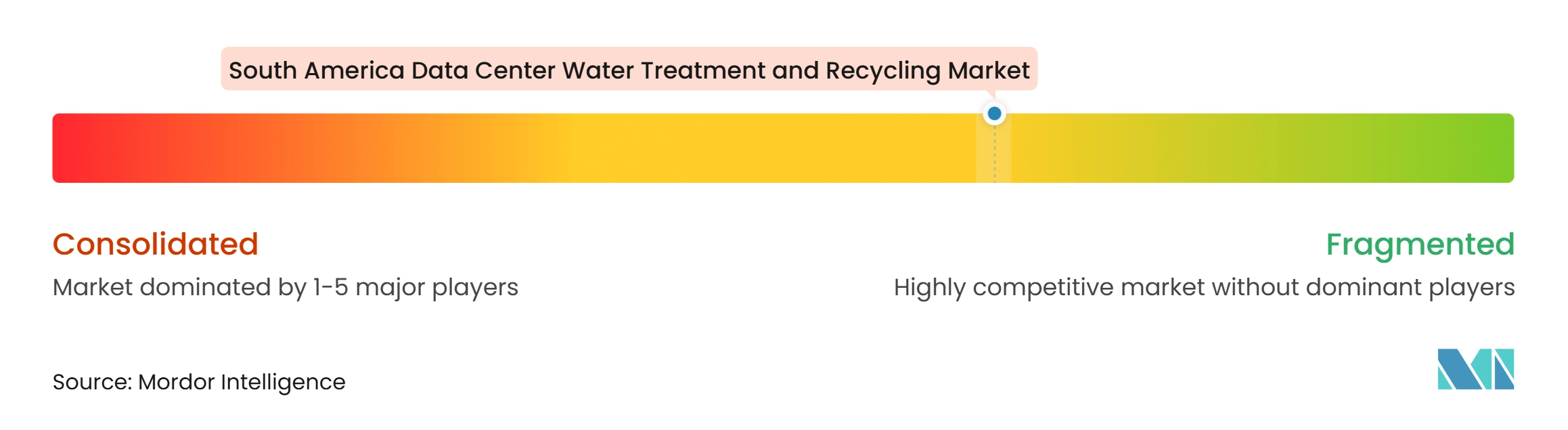
The South America data center water treatment and recycling market is moderately fragmented. Veolia Environnement SA, Ecolab Inc., and Xylem Inc. compete with membrane specialists, chemical suppliers, and regional engineering contractors. The 4 leading vendors in the wider South American water-treatment sector collectively hold 40-45% of revenue. The remaining revenue is distributed among equipment distributors, specialty chemical providers, and engineering, procurement, and construction contractors. Integrated agreements combining equipment, chemistry, and digital monitoring are an important competitive approach.
Veolia and Amazon announced a 2026 collaboration on modular containerized reclaimed-water treatment systems. The design can be adapted across Amazon’s portfolio where wastewater infrastructure is suitable. Ecolab completed its acquisition of Ovivo in Q1 2026, adding ultrapure-water capabilities relevant to high-performance chip manufacturing. This portfolio can support liquid-cooled AI applications requiring high-purity makeup water. QUA Group’s FEDI GIGA system illustrates specialized work in chemical-free ultrapure water production.
Secondary cities such as Fortaleza, Medellín, Cali, and Mendoza have rising demand but limited established provider coverage. Reclaimed-water integration offers an opening for firms that can connect on-site plants with municipal networks. Real-time sensor data supports predictive dosing and membrane maintenance. Compliance requirements favor suppliers that can document water efficiency through certified monitoring equipment.
South America Data Center Water Treatment and Recycling Industry Leaders
-
Veolia Environnement SA
-
Ecolab Inc.
-
Xylem Inc.
-
SUEZ
-
Kurita Water Industries Ltd.
- *Disclaimer: Major Players sorted in no particular order
South America Data Center Water Treatment and Recycling Market Companies Covered in this Report
- Veolia Environnement SA
- Ecolab Inc.
- Xylem Inc.
- SUEZ
- Kurita Water Industries Ltd.
- DuPont de Nemours, Inc.
- Solenis LLC
- Aquatech International LLC
- Gradiant Corporation
- Pentair plc
- Toray Industries, Inc.
- Nitto Denko Corporation
- IDE Technologies Ltd.
- Ovivo Inc.
- Alfa Laval AB
- BWT Holding GmbH
- Grundfos Holding A/S
- Lenntech B.V.
- ProMinent GmbH
- Scala Data Centers S.A.
- Ascenty Data Centers e Telecom Ltda.
- ODATA S.A.
- Equinix, Inc.
- EdgeConneX Inc.
- Elea Digital S.A.
- GTD Grupo Teleductos S.A.
- SONDA S.A.
- Cirion Technologies Holdings LLC
- Entel S.A.
- IPXON Networks
Recent Industry Developments in South America Data Center Water Treatment and Recycling Market
- October 2026: Ascenty confirmed a USD 1 billion investment plan across South American data center operations, with 85% directed toward Brazil, Chile, and Mexico. The company had 26 data centers in operation and 12 under construction, with SPO05, BRL 300 million (USD 55 million), online in São Paulo and SPO06, BRL 600 million (USD 110 million), under construction. Each new campus requires purpose-built water treatment installations, representing significant procurement opportunities for treatment technology providers.
- September 2026: Brazil enacted REDATA, the Special Tax Regime for Data Center Services, conditioning corporate tax incentives on data centers achieving a WUE index of 0.05 L/kWh or less annually and 100% renewable energy supply. The regime, set out in Provisional Measure 1,318/2025 and signed into law by the President in September 2026, is the most stringent statutory water-efficiency standard for data centers in South America and will compel operators seeking incentives to deploy advanced closed-loop cooling and water recycling systems.
- April 2026: Veolia and Amazon announced a collaboration to develop modular, containerized reclaimed-water treatment systems for Amazon data centers, with the first facility to use reclaimed cooling water in Mississippi, United States, expected operational in 2027. The system is projected to reuse more than 83 million gallons of potable water annually per facility, and Veolia stated the modular design is intended for global replication at Amazon sites where suitable wastewater infrastructure exists, a deployment model directly applicable to South American campuses.
- March 2026: Sabesp signed an agreement to supply 11,000 m³ of reclaimed wastewater per month to a hyperscale data center in Barueri, Greater São Paulo, marking the first formal reclaimed-water supply contract between a South American municipal utility and a data center operator. Initial delivery is by tanker truck, and a direct pipeline from ETE Barueri is planned for future phases. The arrangement establishes a public-private water reuse model that Sabesp indicated it aims to replicate with other digital infrastructure operators.
South America Data Center Water Treatment and Recycling Market Report Scope
The South America Data Center Water Treatment and Recycling Market refers to the regional market for technologies, equipment, chemicals, monitoring systems, engineering services, and O&M offerings used to treat, condition, recycle, and manage water within data centers across South America, primarily for cooling systems, liquid-cooling loops, and wastewater management.
The South America Data Center Water Treatment and Recycling Market Report is Segmented by Treatment Technology (Filtration and Ultrafiltration, Reverse Osmosis, Ion Exchange and Water Softening, Electrodeionization, Chemical Treatment and Disinfection, Membrane Bioreactors, and Other Water Treatment Technologies), Water Source (Municipal Water, Groundwater, Surface Water, Reclaimed Municipal Wastewater, Industrial Recycled Water, and Other Alternative Water Sources), Treatment Application (Cooling Tower Makeup Water Treatment, Chilled Water and Closed-Loop Water Treatment, Boiler and Heat Rejection System Water Treatment, Wastewater Treatment, Water Recycling and Reuse, and Zero-Liquid-Discharge and Concentrate Management), Solution Type (Water Treatment Equipment, Water Treatment Chemicals, Water Quality Monitoring and Control Systems, Treatment Plant Design and Engineering, and Operation and Maintenance Services), Data Center Size (Small, Medium, Large, and Hyperscale), Data Center Type (Colocation, Cloud Service Providers, and Enterprise and Edge), and Geography (Brazil, Chile, Colombia, Argentina, Peru, and Rest of South America). The Market Forecasts Are Provided in Terms of Value (USD).
Segmentation Overview
| Filtration and Ultrafiltration |
| Reverse Osmosis |
| Ion Exchange and Water Softening |
| Electrodeionization |
| Chemical Treatment and Disinfection |
| Membrane Bioreactors |
| Other Water Treatment Technologies |
| Municipal Water |
| Groundwater |
| Surface Water |
| Reclaimed Municipal Wastewater |
| Industrial Recycled Water |
| Other Alternative Water Sources |
| Cooling Tower Makeup Water Treatment |
| Chilled Water and Closed-Loop Water Treatment |
| Boiler and Heat Rejection System Water Treatment |
| Wastewater Treatment |
| Water Recycling and Reuse |
| Zero-Liquid-Discharge and Concentrate Management |
| Water Treatment Equipment |
| Water Treatment Chemicals |
| Water Quality Monitoring and Control Systems |
| Treatment Plant Design and Engineering |
| Operation and Maintenance Services |
| Small |
| Medium |
| Large |
| Hyperscale |
| Colocation |
| Cloud Service Providers |
| Enterprise and Edge |
| Brazil |
| Chile |
| Colombia |
| Argentina |
| Peru |
| Rest of South America |
| By Treatment Technology | Filtration and Ultrafiltration |
| Reverse Osmosis | |
| Ion Exchange and Water Softening | |
| Electrodeionization | |
| Chemical Treatment and Disinfection | |
| Membrane Bioreactors | |
| Other Water Treatment Technologies | |
| By Water Source | Municipal Water |
| Groundwater | |
| Surface Water | |
| Reclaimed Municipal Wastewater | |
| Industrial Recycled Water | |
| Other Alternative Water Sources | |
| By Treatment Application | Cooling Tower Makeup Water Treatment |
| Chilled Water and Closed-Loop Water Treatment | |
| Boiler and Heat Rejection System Water Treatment | |
| Wastewater Treatment | |
| Water Recycling and Reuse | |
| Zero-Liquid-Discharge and Concentrate Management | |
| By Solution Type | Water Treatment Equipment |
| Water Treatment Chemicals | |
| Water Quality Monitoring and Control Systems | |
| Treatment Plant Design and Engineering | |
| Operation and Maintenance Services | |
| By Data Center Size | Small |
| Medium | |
| Large | |
| Hyperscale | |
| By Data Center Type | Colocation |
| Cloud Service Providers | |
| Enterprise and Edge | |
| By Geography | Brazil |
| Chile | |
| Colombia | |
| Argentina | |
| Peru | |
| Rest of South America |
Key Questions Answered in the Report
What is the size of the South America data center water treatment and recycling sector?
It is projected to expand from USD 0.31 billion in 2026 and USD 0.34 billion in 2027 to USD 0.61 billion by 2032, at an 11.12% CAGR.
Which treatment technology leads data center water treatment in South America?
Reverse osmosis held the largest share at 23.98% in 2026, while electrodeionization is expected to record an 11.34% CAGR through 2032.
Why are water recycling systems becoming more important for data centers?
Recycling and reuse are projected to advance at an 11.88% CAGR because operators seek to reduce freshwater dependence and meet water-efficiency requirements.
Which country has the largest regional demand for these systems?
Brazil held 58.18% share in 2026, supported by hyperscale development in São Paulo and the REDATA water-efficiency requirements.
Which end user is expected to create the most demand for advanced treatment?
Hyperscale data centers held 46.97% share in 2026 and are projected to record an 11.94% CAGR through 2032.
What makes Chile a distinct location for data center water management?
Chiles high water stress is increasing the use of closed-loop, water-recycling, and zero-water-use designs at new campuses.