
South America Data Center Video Surveillance Market Size and Share
Market Overview
| Study Period | 2021 - 2032 |
|---|---|
| Forecast Data Period | 2027 - 2032 |
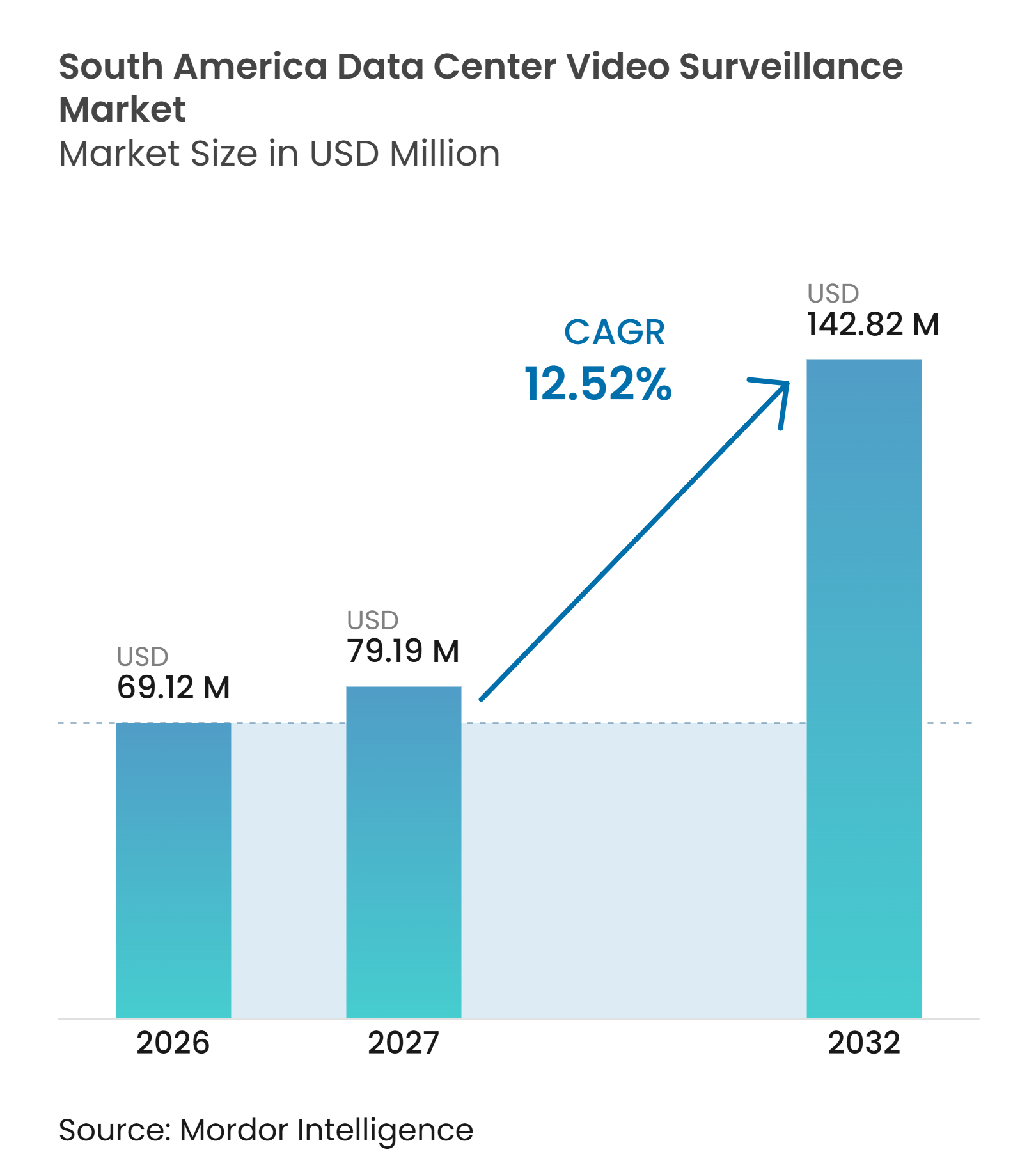
| Base Year Market Size (2026) | USD 69.12 Million |
| Market Size (2027) | USD 79.19 Million |
| Market Size (2032) | USD 142.82 Million |
| Growth Rate (2027 - 2032) | 12.52 % |
| Market Concentration | Medium |
Major Players *Disclaimer: Major Players sorted in no particular order Image © Mordor Intelligence. Reuse requires attribution under CC BY 4.0. | |
South America Data Center Video Surveillance Market Analysis by Mordor Intelligence
The South America data center video surveillance market size is valued at USD 69.12 million in 2026 and is forecast to reach USD 142.82 million by 2032, advancing at a CAGR of 12.52% from 2027 to 2032. Brazil’s expanding hyperscale capacity is increasing the need for perimeter coverage, access records, and monitoring of electrical and cooling equipment. New AI workloads also raise the value of continuous monitoring because GPU-dense facilities concentrate high-value equipment and operate with narrower cooling margins. Compliance requirements are moving procurement toward connected systems that can preserve video, document access events, and support audit reviews. Providers that combine cameras, management software, analytics, and local delivery support are better placed to address these requirements. The South America data center video surveillance market also benefits from the replacement of legacy analog installations with IP-based and analytics-enabled systems.
Key Report Takeaways
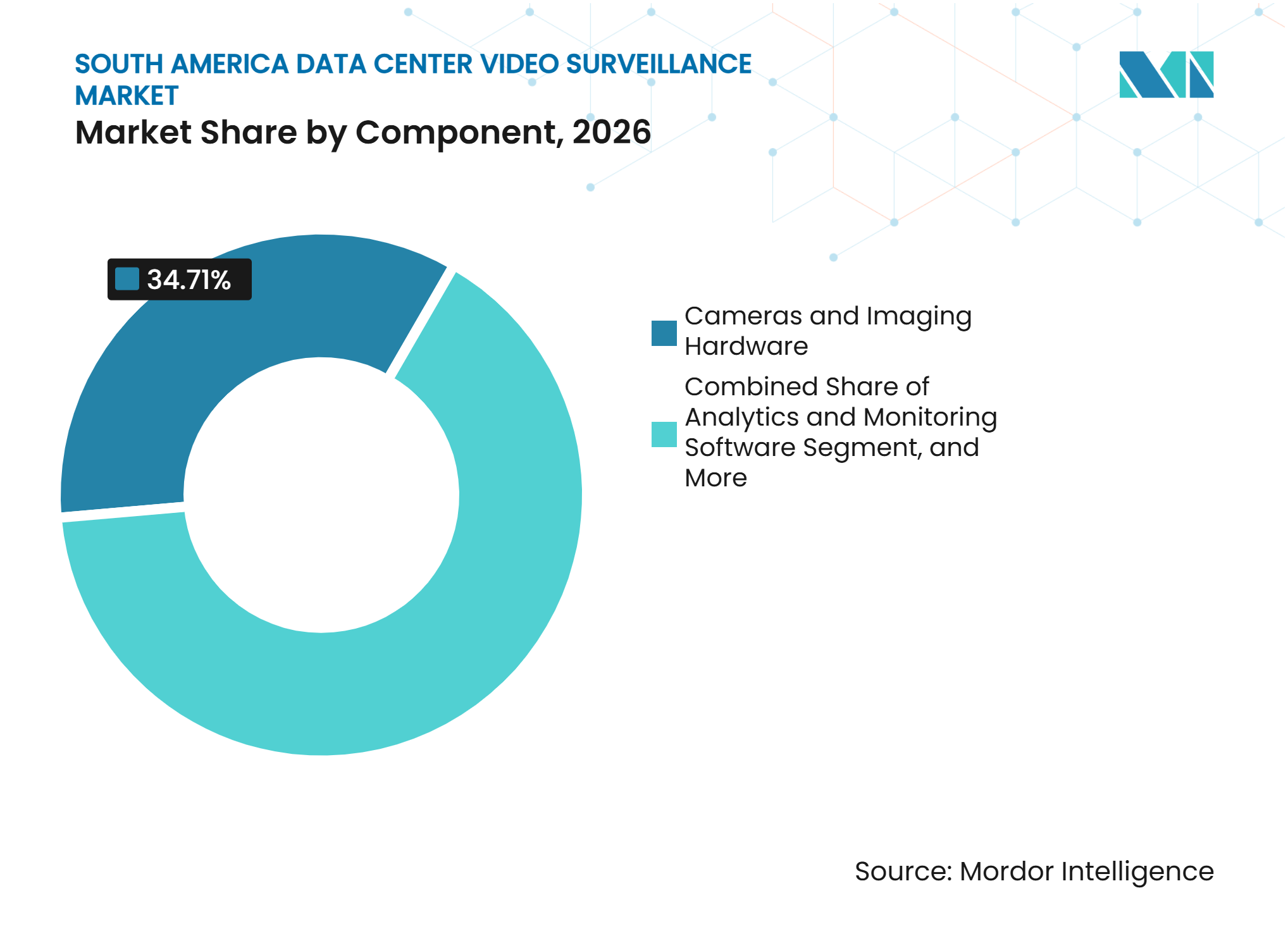
- By component, Cameras and Imaging Hardware held 34.71% of the South America data center video surveillance market share in 2026, while Analytics and Monitoring Software is projected to expand at a 15.26% CAGR through 2032.
- By camera type, Fixed Cameras accounted for 63.28% of the camera mix in 2026, while Pan-Tilt-Zoom Cameras are projected to expand at a 13.92% CAGR through 2032.
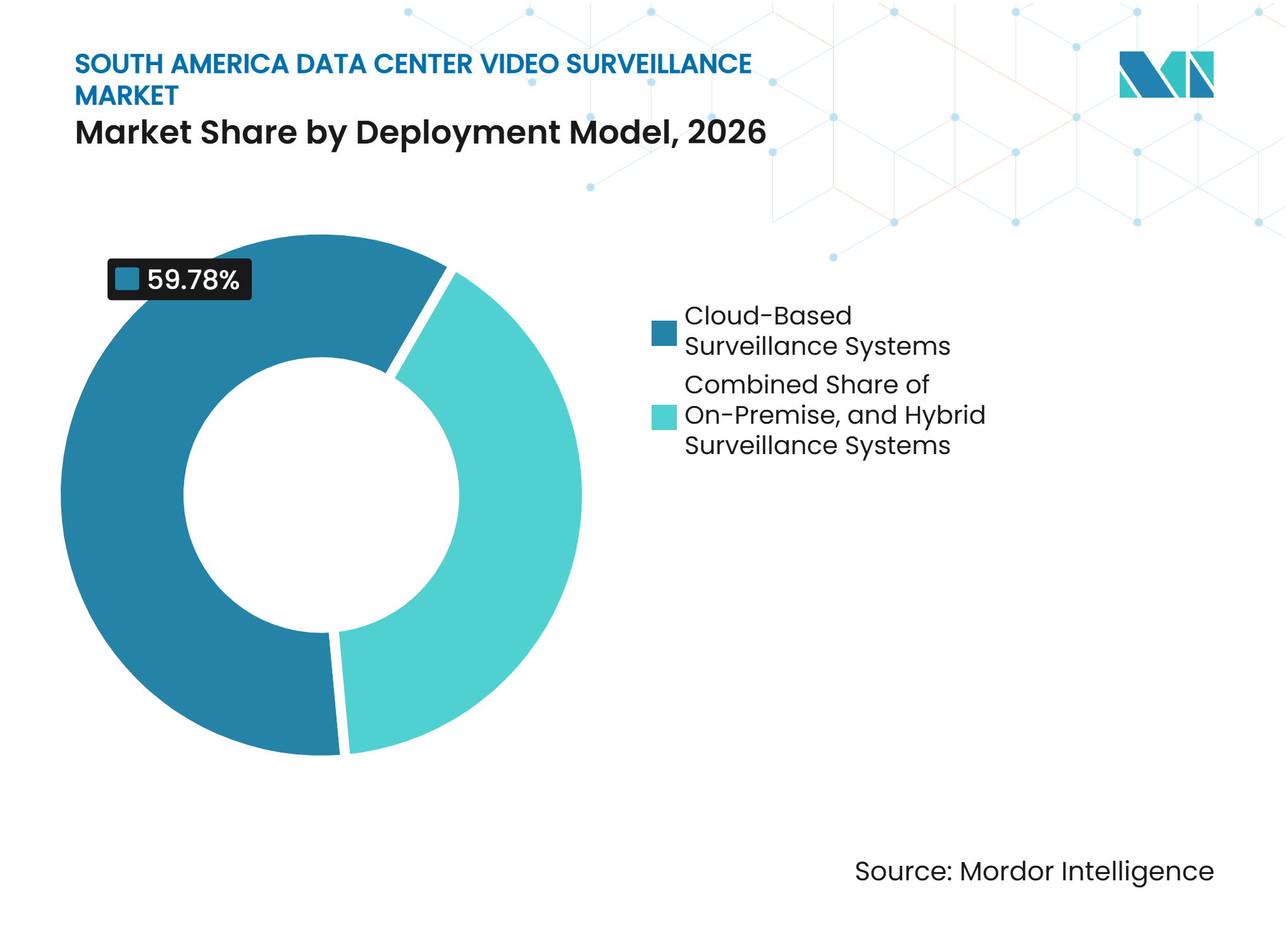
- By deployment model, Cloud-Based Surveillance Systems accounted for 59.78% of the South America data center video surveillance market size in 2026 and are projected to expand at a 14.39% CAGR through 2032.
- By application, Perimeter and External Area Monitoring held 26.54% share in 2026, while Electrical and Mechanical Room Monitoring is projected to expand at a 16.59% CAGR through 2032.
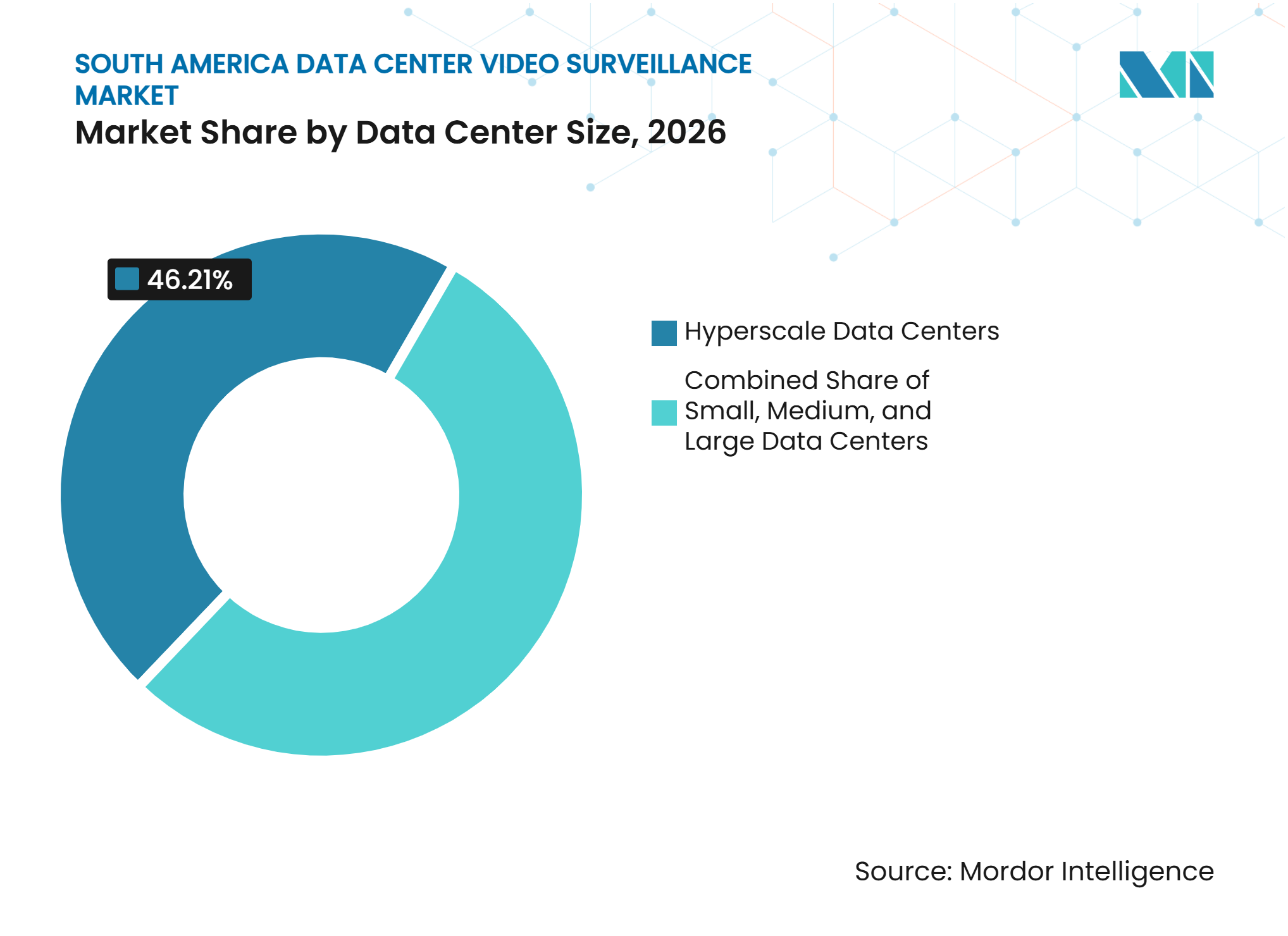
- By data center size, Hyperscale facilities held 46.21% share in 2026 and are projected to expand at a 15.27% CAGR through 2032.
- By data center type, Colocation data centers held 36.64% share in 2026, while Cloud Service Providers are projected to expand at a 13.38% CAGR through 2032.
- By geography, Brazil held 46.58% share in 2026, while Argentina is projected to expand at a 16.91% CAGR through 2032.
Note: Market numbers in this report are based on Mordor Intelligence's proprietary estimation framework, which combines nine months of actuals with Q4 projections for base year 2026.
Market Trends and Insights
Drivers Impact Analysis of South America Data Center Video Surveillance Market*
| Driver | (~) % Impact on CAGR Forecast | Geographic Relevance | Impact Timeline |
|---|---|---|---|
| Expansion of Hyperscale and Colocation Data Centers | +2.5% | Brazil, Argentina, Rest of South America | Short term (≤ 2 years) |
| Rising Compliance Requirements for Auditable Physical Access | +2.0% | Brazil, Chile, Rest of South America | Medium term (2-4 years) |
| Increasing AI and Cloud Workloads in Brazil and Chile | +2.0% | Brazil, Chile, Argentina | Short term (≤ 2 years) |
| Migration from Analog CCTV to IP and Analytics-Enabled Systems | +1.5% | Brazil, Argentina, Rest of South America | Medium term (2-4 years) |
| High-Density Rack Growth Increasing Blind-Spot and Perimeter Risk | +1.0% | Hyperscale campuses in Brazil and Chile | Short term (≤ 2 years) |
| Longer Video Retention Requirements Increasing Storage Optimization Demand | +0.8% | Global, led by Brazil and Chile | Long term (≥ 4 years) |
| Source: Mordor Intelligence | |||
Expansion of Hyperscale and Colocation Data Centers
Tier III and Tier IV facilities require more complex camera installation than ordinary commercial buildings. Redundant power paths, protected cable routes, and equipment resistant to vibration and electromagnetic interference increase installation costs. Constant operation, high airflow, and dense GPU equipment can also shorten replacement cycles for some hardware. Retrofit work adds further constraints because installers must protect active operations and work around existing cabling and cooling layouts. These conditions can delay upgrades by smaller colocation providers, especially where access to financing is limited. The South America data center video surveillance market faces slower conversion of technically outdated analog systems when the cost of a full retrofit is high.
Rising Compliance Requirements for Auditable Physical Access
Brazil’s Anatel Resolution No. 780/2025 set conformity assessment and homologation requirements for data centers linked to telecommunications networks. The resolution requires measures against unauthorized access, damage, and internal and external threats. Existing facilities have a 3-year compliance period after the operational procedure is published, creating a defined replacement and upgrade cycle.[1] Chile’s Cybersecurity Framework Law No. 21.663 also places qualifying data centers within a more formal cybersecurity framework. These requirements favor video systems that link recordings to access events and retain time-stamped records. The South America data center video surveillance market therefore has a clearer path toward integrated video management platforms than stand-alone CCTV systems.
Increasing AI and Cloud Workloads in Brazil and Chile
AI computing is changing the physical risk profile of large facilities in Brazil and Chile. GPU-dense server areas increase the consequence of cooling disruption and create a greater need to monitor critical power and mechanical infrastructure. Microsoft confirmed 2 GPU compute parks in the Campinas metropolitan area, signaling a new category of capacity deployment in Brazil.[2] Surveillance architecture is consequently serving both security and operating-resilience needs. Axis Communications reported that many organizations are combining edge AI for immediate filtering with cloud resources for broader storage and correlation.[3] The South America data center video surveillance market can benefit where thermal monitoring and access monitoring are designed as part of the same operating model.
Migration From Analog CCTV to IP and Analytics-Enabled Systems
Analog systems do not provide the resolution, system integration, or event data needed for modern audit requirements. IP cameras can transmit motion events, thermal alerts, and access records into enterprise security platforms. This enables operators to examine one time-stamped record rather than reconcile separate camera and access-control logs. Axis Communications stated that its Zipstream technology can reduce bandwidth and storage requirements by 50% compared with standard IP streams. Lower storage and bandwidth requirements help address one barrier to the replacement of analog systems. The South America data center video surveillance market is therefore shifting toward architectures that balance local video retention with cloud-based analytics.
Restraints Impact Analysis of South America Data Center Video Surveillance Market*
| Restraint | (~) % Impact on CAGR Forecast | Geographic Relevance | Impact Timeline |
|---|---|---|---|
| High Integration and Lifecycle Costs for Mission-Critical Facilities | -1.5% | Brazil, Chile, Argentina | Medium term (2-4 years) |
| Privacy and Biometric-Processing Compliance Complexity | -1.2% | Brazil, Chile, Rest of South America | Medium term (2-4 years) |
| Cybersecurity Exposure From Connected Cameras and VMS Platforms | -0.9% | Global, concentrated in Brazil and Chile | Short term (≤ 2 years) |
| Limited Availability of Certified Data Center Security Integrators | -0.7% | Argentina, Rest of South America, Brazil | Long term (≥ 4 years) |
| Source: Mordor Intelligence | |||
High Integration and Lifecycle Costs for Mission-Critical Facilities
Tier III and Tier IV facilities require more complex camera installation than ordinary commercial buildings. Redundant power paths, protected cable routes, and equipment resistant to vibration and electromagnetic interference increase installation costs. Constant operation, high airflow, and dense GPU equipment can also shorten replacement cycles for some hardware. Retrofit work adds further constraints because installers must protect active operations and work around existing cabling and cooling layouts. These conditions can delay upgrades by smaller colocation providers, especially where access to financing is limited. The South America data center video surveillance market faces slower conversion of technically outdated analog systems when the cost of a full retrofit is high.
Privacy and Biometric-Processing Compliance Complexity
Brazil’s LGPD classifies biometric data, including facial geometry, as sensitive personal data. This creates stronger obligations for consent, processing limits, security controls, and access management than those associated with ordinary CCTV footage. Brazil’s data protection authority took preventive action in July 2025 concerning a retailer’s sharing of CCTV footage, showing a more active approach to video-data governance. Chile’s Private Security Law No. 21.659 also has requirements relevant to traceable and auditable video records for higher-risk infrastructure. These obligations extend procurement timelines because data residency, retention rules, and access logging must be considered during system design. They also raise the cost of surveillance systems that use facial recognition or other biometric functions.
*Our forecasts treat driver/restraint impacts as directional, not additive. The impact forecasts reflect baseline growth, mix effects, and variable interactions.
South America Data Center Video Surveillance Market Segment Analysis
By Component:
Analytics Software Supports Faster AdoptionCameras and Imaging Hardware held 34.71% of regional revenue in 2026. Cameras remain the starting point for any new installation because operators need coverage across external boundaries, entrances, loading areas, corridors, and critical rooms. Fixed units and specialized cameras establish the physical visibility needed before software can add further value. High-resolution equipment is particularly important in large campuses where operators need usable images across broad outdoor areas and long internal corridors. Video Management Software and Storage and Recording Hardware form the next layer of spending. They support recording, search, playback, retention, and documented evidence for incident reviews. Installation, Integration, and Support Services also remain important because data center systems require commissioning, configuration, testing, and long-term maintenance.
Analytics and Monitoring Software is projected to expand at a 15.26% CAGR through 2032. This part of the South America data center video surveillance market is gaining attention because it can identify access exceptions, thermal anomalies, and events across multiple camera feeds. Johnson Controls introduced exacqVision 26.0 in 2026 with advanced in-platform AI search and broader camera compatibility. Software can make existing camera networks more useful without requiring all physical devices to be replaced at the same time. It also creates a recurring revenue stream for providers through licenses, updates, and support agreements. Suppliers that show compatibility with security information and event management systems have an advantage in compliance-sensitive facilities. The strongest offerings link video, access information, and system alerts in one interface. This shifts the role of surveillance from passive recording toward active operating support.



By Camera Type:
PTZ Cameras Extend Dynamic Perimeter CoverageFixed Cameras held 63.28% of the camera mix in 2026. Their use is strongest in areas where continuous coverage from a stable field of view is sufficient. Typical locations include data-hall corridors, entrance lanes, loading bays, and perimeter fencing. Fixed units are also cost-effective when a facility needs a large number of camera points. The South America data center video surveillance market size for fixed camera deployments is supported by resolution upgrades from HD systems to 4K and ultra-HD equipment. Thermal cameras serve a separate role by detecting activity in darkness and monitoring heat signatures near critical equipment. Low-light and infrared cameras are used in secondary corridors and loading zones where normal cameras may not deliver clear forensic imagery.
Pan-Tilt-Zoom Cameras are projected to expand at a 13.92% CAGR through 2032. These cameras allow security teams to examine changing conditions without installing a fixed camera for every potential line of sight. Axis Communications released the AXIS Q6411-LE Bispectral PTZ Camera in September 2025 with thermal detection, 31x optical zoom, edge AI, and FIPS 140-3 Level 3 certified secure key storage. Teledyne FLIR released the PT-Series AI SR in June 2025 with 4K visible imaging, 640×512 thermal imaging, and onboard edge AI. These products indicate a shift from basic pan-tilt capability toward multi-spectral platforms that can detect, verify, and follow events. The South America data center video surveillance market can gain from higher average selling prices as demand moves toward these advanced capabilities. PTZ equipment is particularly relevant for wide perimeters and facilities with variable threat scenarios.
By Deployment Model:
Cloud Platforms Lead Adoption and GrowthCloud-Based Surveillance Systems held 59.78% of regional revenue in 2026. They provide centralized management for operators that run camera fleets across more than 1 site. Centralized analytics can also help teams compare events across campuses without moving staff between locations. The model supports expansion because additional cameras and users can be added without the same local infrastructure burden as an entirely on-premise system. It can simplify software updates and standardize controls across facilities. Data residency remains an important issue in South America, particularly where operators must retain certain footage locally. As a result, many cloud deployments use local storage or edge processing alongside centralized analytics.
Cloud-Based Surveillance Systems are projected to expand at a 14.39% CAGR through 2032. Axis Communications found that hybrid architectures are increasingly used to combine immediate processing at the edge with broader cloud storage and analysis. On-Premise Surveillance Systems still have a significant role in older facilities and enterprises that require direct local control over stored video. Hybrid Surveillance Systems have become strategically important because they combine local response speed with wider monitoring and archival capability. This arrangement can help operators meet data-residency requirements while still using cloud tools for cross-site analysis. The South America data center video surveillance market favors suppliers that can offer all 3 deployment options. Procurement teams often require this flexibility because different facilities in the same portfolio may have different compliance and operating requirements. Providers that impose a single architecture risk exclusion from complex data center projects.

By Application:
Electrical and Mechanical Rooms Gain PriorityPerimeter and External Area Monitoring held 26.54% of regional revenue in 2026. External protection commonly receives early budget priority because unauthorized entry, theft, and deliberate damage can affect facility operations. Cameras at fencing, vehicle gates, entrance lanes, and external access points help teams detect activity before it reaches critical infrastructure. Entrance and Access Point Monitoring forms another major area of spending. These systems are often paired with cards or biometric tools to create an auditable record of physical access. Data Hall and Internal Corridor Monitoring addresses insider risk and accidental interference with equipment. Loading Bay and Delivery Area Monitoring is becoming more important as construction activity increases the movement of valuable equipment and materials.
Electrical and Mechanical Room Monitoring is projected to expand at a 16.59% CAGR through 2032. Thermal cameras installed around UPS equipment, bus bars, and cooling systems can identify unusual heat patterns before a component fails. This is valuable because power and cooling interruptions can create significant availability risk for a data center. Video systems in these rooms therefore serve as an operating tool as well as a security tool. The South America data center video surveillance market benefits when these budgets are funded through both facilities and security functions. Remote Site and Campus Monitoring also becomes more useful as operators add sites in secondary cities. AI-assisted remote review can reduce the need for large on-site security teams in locations with limited specialist staffing. This supports more consistent oversight across distributed infrastructure portfolios.
By Data Center Size:
Hyperscale Facilities Combine Scale and SpeedHyperscale facilities held 46.21% of regional revenue in 2026. These campuses have wide perimeters, multiple power halls, large cooling systems, and extensive server areas. Each of these areas requires a different camera placement and monitoring approach. Large sites also need security teams to review information efficiently because they cannot rely on manual observation of every camera feed. Equinix reported more than USD 270 million in Brazilian infrastructure investment across 2025 and 2026. At campuses above 60 MW, analytics becomes more practical than a model based only on manual camera review. This makes hyperscale projects a major source of demand for integrated video and monitoring systems.
Hyperscale facilities are projected to expand at a 15.27% CAGR through 2032. Large and Medium data centers are the next spending tier because they must also meet customer requirements, insurance conditions, and compliance expectations. Small data centers have a smaller spending base because the economics of advanced IP surveillance can be harder to justify for limited footprints. Edge computing is slowly changing this position in secondary cities. Facilities supporting financial services and healthcare workloads may require infrastructure-grade security even when their physical size is modest. Subscription-based video management software and camera-as-a-service arrangements can reduce initial capital requirements. The South America data center video surveillance market is therefore not limited to large campuses, although hyperscale facilities account for the highest concentration of demand. Flexible commercial models can help providers reach smaller operators without changing the technical standard of the solution.
By Data Center Type:
Colocation Anchors Revenue and CSPs AdvanceColocation data centers held 36.64% of regional revenue in 2026. Multi-tenant facilities need more complex surveillance arrangements than single-user sites. Operators must segment camera access for different tenants and preserve video records that can resolve questions of access, liability, or service performance. They also have to show enterprise customers that physical access controls are operating as stated in contracts. This creates demand for reliable storage, permissions, and documented audit trails. Colocation providers added a record 184 MW of regional capacity in 2025, reinforcing their installed-base lead. The segment’s scale creates continued demand for camera hardware, video management platforms, and specialist integration services.
Cloud Service Providers are projected to expand at a 13.38% CAGR through 2032. Their self-build programs are associated with AI compute demand in Brazil and Argentina. CSP campuses usually operate with highly standardized internal security rules across their facilities. These rules can include perimeter analytics, thermal monitoring of critical equipment, and continuous records of data-hall entry. Enterprise and Edge Data Centers give more weight to integration with building management and IT governance systems. Open-platform video management systems have an advantage in these mixed environments because they support camera fleets from several manufacturers. The South America data center video surveillance market also benefits from remote monitoring in edge locations, where staffing resources are often limited. Suppliers that connect legacy devices with new analytics tools can address this diverse set of requirements.
Geography Analysis
Brazil
Brazil held 46.58% of regional revenue in 2026. The São Paulo-Campinas corridor remains the region’s most concentrated hyperscale location, with Brazil crossing 1 GW of commissioned IT capacity during the first quarter of 2026. Equinix expanded its Brazilian footprint across 2025 and 2026, including activities in São Paulo and Rio de Janeiro. Brazil’s regulatory environment supports demand because Anatel Resolution No. 780/2025 establishes a compliance cycle for telecommunications-linked data centers. The South America data center video surveillance market size in Brazil is also supported by new AI facilities that need stronger access and equipment monitoring.
Argentina
Argentina is projected to expand at a 16.91% CAGR through 2032. Sur Energy and OpenAI signed a Letter of Intent in October 2025 for the planned 500 MW Stargate Argentina facility in Patagonia, structured under Argentina’s RIGI investment framework. If completed, the project could support significant demand for perimeter, access-control, and operating-resilience monitoring. Existing colocation activity around Buenos Aires also establishes a base for integrated surveillance procurement. Argentina’s renewable-energy potential and engineering capability support its position as an emerging location for larger digital infrastructure projects. The South America data center video surveillance market would benefit as these developments move from planning into construction and operation. Delivery, however, will depend on project execution and the availability of specialist security integration capacity.
Chile and the Rest of South America
Chile and the Rest of South America have a demand profile shaped by regulation and enterprise infrastructure investment. Chile’s Cybersecurity Framework Law No. 21.663 took effect on January 1, 2025, creating a formal framework for qualifying operators. Chile’s Private Security Law No. 21.659 also strengthens the need for traceable video systems in relevant high-risk settings. These requirements favor IP systems that can produce auditable logs and integrate with access controls. Colombia, Peru, and the wider Andean area provide additional opportunities as cloud regions and enterprise infrastructure develop. Their near-term opportunity is smaller than Brazil’s or Argentina’s because hyperscale pipelines are less concentrated. The South America data center video surveillance market can nevertheless be more accessible through remote monitoring and scalable cloud management for suppliers with regional delivery capabilities.
Competitive Landscape
Market Concentration
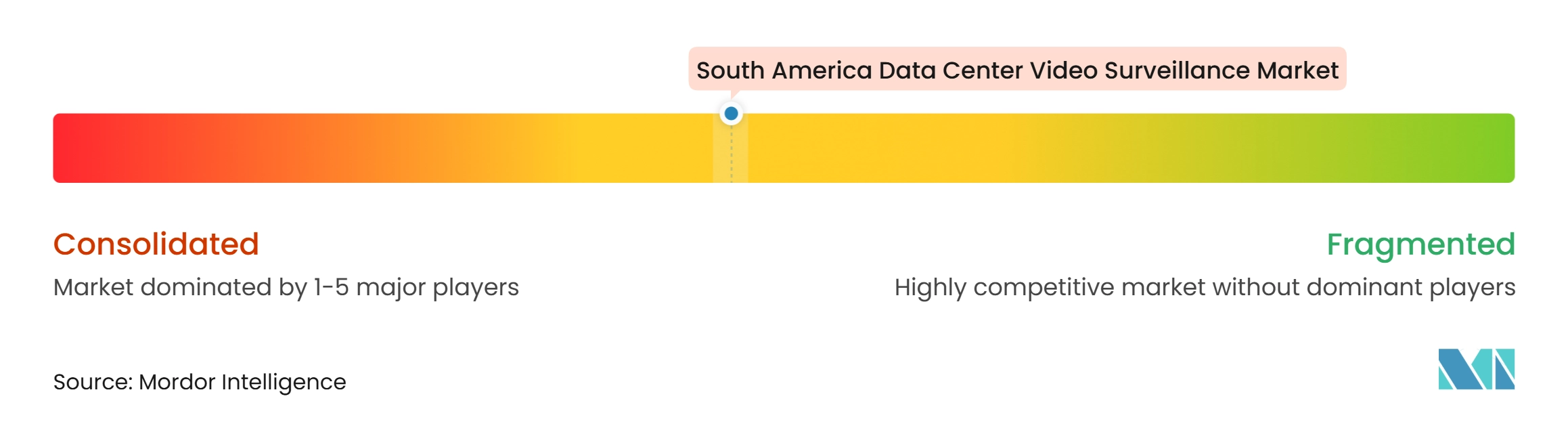
The South America data center video surveillance market is moderately fragmented, with global hardware vendors, video management software providers, and regional integrators active across different parts of the value chain. Dahua, Axis Communications, Bosch, Hanwha Vision, Honeywell, and Intelbras compete through product portfolios, channel reach, software capabilities, and local support. No provider holds a dominant position across all countries, deployment types, and product categories. Intelbras has a distinct local position through Brazilian manufacturing, distribution coverage, and its AI-enabled CFTV Defense IA offering. Hardware suppliers face increasing pressure to show software compatibility, device security, and support for integrated compliance records. Managed surveillance services are an important opportunity because some hyperscale operators prefer contracts that include installation, monitoring, and equipment refreshes. This supports recurring supplier relationships rather than one-time product transactions.
Cloud-native video management platforms are changing competition by increasing the importance of recurring software subscriptions. Johnson Controls introduced CCURE IQ 3.2, integrated video management, automated incident management, and AI-enabled Illustra camera analytics at ISC West 2026. The product direction brings access control and video functions into a single interface for mission-critical sites. Axis Communications also strengthened its regional route to market through a December 2025 distribution relationship with DACAS for Argentina, Bolivia, and Paraguay. These actions address an important market need because regional installation quality and technical support can affect buyer confidence. Providers with open application interfaces also have an advantage when customers operate mixed fleets of legacy and new camera equipment.
Advanced device security is becoming another factor in vendor selection. Axis Communications released the Q6411-LE Bispectral PTZ Camera with ARTPEC-9 edge AI and FIPS 140-3 Level 3 certified secure key storage. Teledyne FLIR introduced its PT-Series AI SR with visible and thermal imaging in a pan-tilt platform, designed to support detection and tracking at critical infrastructure sites. These products show why critical-infrastructure buyers increasingly assess device-level controls as well as image quality. Camera-agnostic platforms that support natural-language search across varied fleets also present a challenge to hardware-led suppliers. The competitive position of any vendor will depend on integration capability, regional service coverage, cybersecurity controls, and the ability to meet local data and privacy requirements. The South America data center video surveillance market remains open to both global vendors and locally established participants because customer requirements vary by site and country.
South America Data Center Video Surveillance Industry Leaders
-
Hangzhou Hikvision Digital Technology Co., Ltd.
-
Zhejiang Dahua Technology Co., Ltd.
-
Intelbras S.A. Industria de Telecomunicacao Eletronica Brasileira
-
Axis Communications AB
-
Motorola Solutions, Inc.
- *Disclaimer: Major Players sorted in no particular order
South America Data Center Video Surveillance Market Companies Covered in this Report
- Zhejiang Dahua Technology Co., Ltd.
- Intelbras S.A. Industria de Telecomunicacao Eletronica Brasileira
- Axis Communications AB
- Motorola Solutions, Inc.
- Robert Bosch GmbH
- Hanwha Vision Co., Ltd.
- Honeywell International Inc.
- Johnson Controls International plc
- Teledyne FLIR LLC
- Panasonic Corporation
- VIVOTEK Inc.
- Eagle Eye Networks, Inc.
- Verkada Inc.
- Genetec Inc.
- NEC Corporation
- Infinova International, Inc.
- Zhejiang Uniview Technologies Co., Ltd.
- Tiandy Technologies Co., Ltd.
- Allied Universal
- Milestone Systems A/S
Recent Industry Developments in South America Data Center Video Surveillance Market
- August 2026: Axis Communications reopened its Buenos Aires commercial office as a strategic hub for Argentina, Uruguay, and Paraguay, with Cono Sur first-half 2026 results reported ahead of company expectations. The move deepens direct channel coverage in the fastest-growing sub-regional data center market.
- March 2026: Johnson Controls announced C•CURE IQ VMS, C•CURE IQ Incident Management with automated event-driven workflows, exacqVision 26.0 with advanced in-platform AI search, the Illustra Panoramic Camera with a 188° AI-detection field of view, and Illustra 360 Varifocal Cameras at ISC West 2026. These introductions converge access control and video surveillance into a single enterprise interface for mission-critical environments.
- March 2026: Axis Communications unveiled security products at ISC West 2026, including private cellular equipment for camera deployment without cabling, a global-shutter camera, and a bispectral camera for perimeter intrusion detection and temperature monitoring. These technologies will support physical security and operational monitoring at data centers in South America.
- March 2026: Schneider Electric and NVIDIA announced blueprints for designing, simulating, and operating AI factories. The blueprints integrate AVEVA architecture with NVIDIA Omniverse and test NVIDIA Nemotron AI for alarm management. The collaboration uses video and telemetry to support AI management, surveillance, monitoring, security, anomaly detection, and visibility in South American data centers.
South America Data Center Video Surveillance Market Report Scope
The South America Data Center Video Surveillance Market encompasses technologies and services that enable visual security, monitoring, and surveillance of data center facilities. It includes solutions designed to enhance physical security, detect unauthorized activities, support incident response, and provide real-time operational visibility across critical infrastructure environments. The market is driven by increasing concerns over facility protection, asset security, business continuity, and the growing adoption of intelligent surveillance systems with advanced monitoring and analytics capabilities.
The South America Data Center Video Surveillance Market is Segmented by Component (Cameras and Imaging Hardware, Video Management Software, Storage and Recording Hardware, Analytics and Monitoring Software, and Installation, Integration, and Support Services), Camera Type (Fixed Cameras, Pan-Tilt-Zoom Cameras, Thermal Cameras, and Specialized Low-Light and Infrared Cameras), Deployment (On-Premise Surveillance Systems, Cloud-Based Surveillance Systems, and Hybrid Surveillance Systems), Application (Perimeter and External Area Monitoring, Entrance and Access Point Monitoring, Data Hall and Internal Corridor Monitoring, Electrical and Mechanical Room Monitoring, Loading Bay and Delivery Area Monitoring, and Remote Site and Campus Monitoring), Size (Small, Medium, Large, Hyperscale), Data Center Type (Colocation, Cloud Service Provider(CSPs), Enterprise / Edge, and Edge Data Centers), and Country (Brazil, Argentina, and Rest of South America). The Market Forecasts are Provided in Terms of Value (USD).
Segmentation Overview
| Cameras and Imaging Hardware |
| Video Management Software |
| Storage and Recording Hardware |
| Analytics and Monitoring Software |
| Installation, Integration, and Support Services |
| Fixed Cameras |
| Pan-Tilt-Zoom Cameras |
| Thermal Cameras |
| Specialized Low-Light and Infrared Cameras |
| On-Premise Surveillance Systems |
| Cloud-Based Surveillance Systems |
| Hybrid Surveillance Systems |
| Perimeter and External Area Monitoring |
| Entrance and Access Point Monitoring |
| Data Hall and Internal Corridor Monitoring |
| Electrical and Mechanical Room Monitoring |
| Loading Bay and Delivery Area Monitoring |
| Remote Site and Campus Monitoring |
| Small |
| Medium |
| Large |
| Hyperscale |
| Colocation |
| Cloud Service Provider(CSPs) |
| Enterprise / Edge |
| Edge Data Centers |
| Brazil |
| Argentina |
| Rest of South America |
| By Component | Cameras and Imaging Hardware |
| Video Management Software | |
| Storage and Recording Hardware | |
| Analytics and Monitoring Software | |
| Installation, Integration, and Support Services | |
| By Camera Type | Fixed Cameras |
| Pan-Tilt-Zoom Cameras | |
| Thermal Cameras | |
| Specialized Low-Light and Infrared Cameras | |
| By Deployment Model | On-Premise Surveillance Systems |
| Cloud-Based Surveillance Systems | |
| Hybrid Surveillance Systems | |
| By Application | Perimeter and External Area Monitoring |
| Entrance and Access Point Monitoring | |
| Data Hall and Internal Corridor Monitoring | |
| Electrical and Mechanical Room Monitoring | |
| Loading Bay and Delivery Area Monitoring | |
| Remote Site and Campus Monitoring | |
| By Data Center Size | Small |
| Medium | |
| Large | |
| Hyperscale | |
| By Data Center Type | Colocation |
| Cloud Service Provider(CSPs) | |
| Enterprise / Edge | |
| Edge Data Centers | |
| By Country | Brazil |
| Argentina | |
| Rest of South America |
Key Questions Answered in the Report
What is the size of the South America data center video surveillance market?
The market is valued at USD 69.12 million in 2026 and is forecast to reach USD 142.82 million by 2032, advancing at a 12.52% CAGR from 2027 to 2032.
Which component is expected to expand fastest in data center video surveillance?
Analytics and Monitoring Software is projected to expand at a 15.26% CAGR through 2032 as operators use video data for access review and equipment monitoring.
Why are cloud-based surveillance platforms important for data centers?
Cloud-Based Surveillance Systems held 59.78% share in 2026 and are projected to expand at a 14.39% CAGR because they support centralized management and scalable analytics.
Which application is projected to expand fastest across South American facilities?
Electrical and Mechanical Room Monitoring is projected to expand at a 16.59% CAGR through 2032 because power and cooling equipment requires continuous observation.
Which country has the largest share of regional demand?
Brazil held 46.58% share in 2026, supported by the São Paulo-Campinas data center corridor and formal physical-security requirements.
What makes hyperscale facilities important to suppliers?
Hyperscale facilities held 46.21% share in 2026 and are projected to expand at a 15.27% CAGR through 2032, requiring wide perimeter and critical-infrastructure coverage.