
South America Data Center Technical Workforce Market Size and Share
Market Overview
| Study Period | 2021 - 2032 |
|---|---|
| Forecast Data Period | 2027 - 2032 |
| Base Year Market Size (2026) | USD 1.68 Billion |
| Market Size (2027) | USD 1.97 Billion |
| Market Size (2032) | USD 4.18 Billion |
| Growth Rate (2027 - 2032) | 16.24 % |
| Market Concentration | Medium |
Major Players *Disclaimer: Major Players sorted in no particular order Image © Mordor Intelligence. Reuse requires attribution under CC BY 4.0. | |
South America Data Center Technical Workforce Market Analysis by Mordor Intelligence
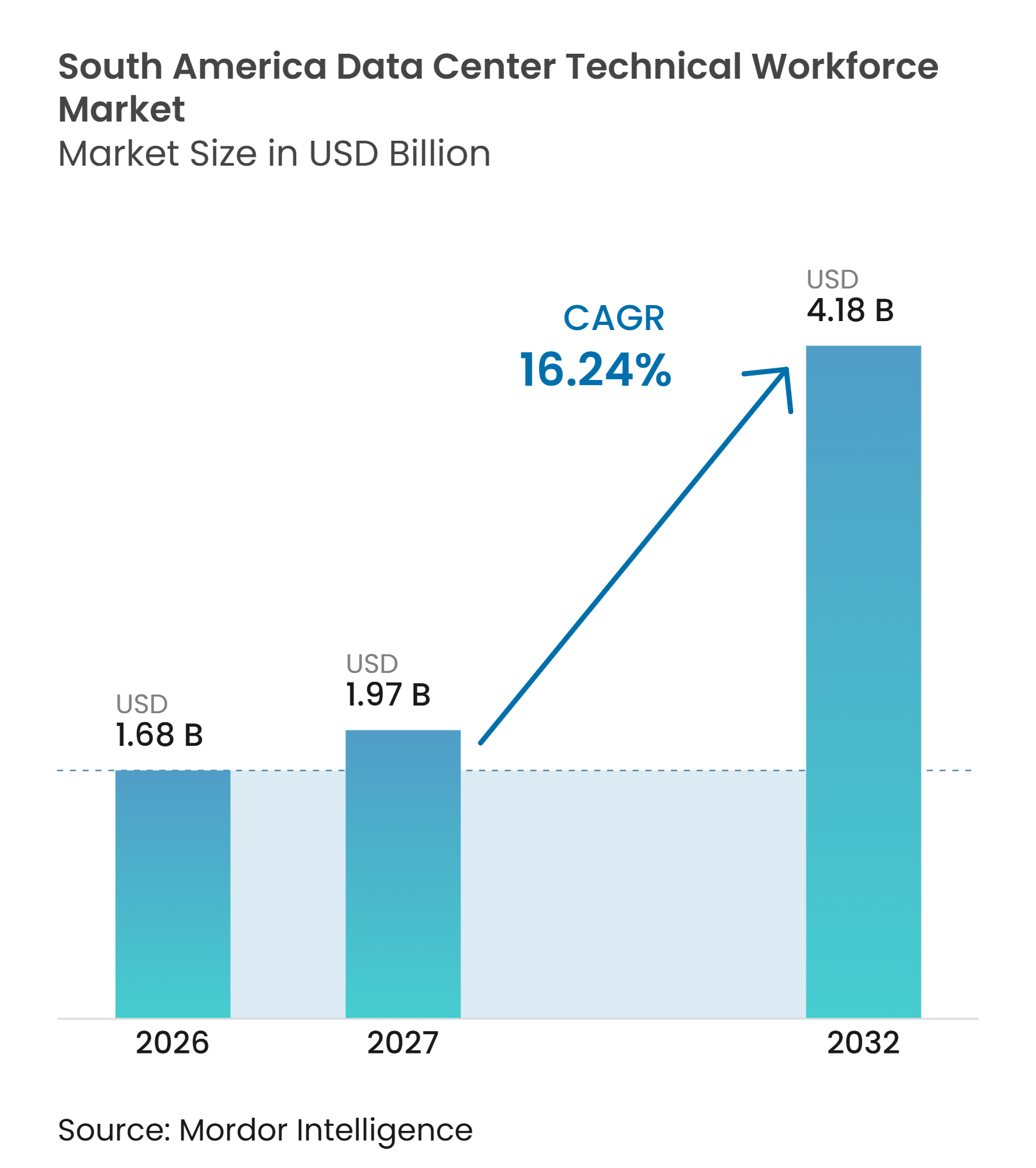
The South America data center technical workforce market size is valued at USD 1.68 billion in 2026 and is forecast to reach USD 4.18 billion by 2032, registering a CAGR of 16.24% during 2027-2032. Demand is rising as cloud providers add capacity, AI workloads require more complex facilities, and operators need people who can maintain critical systems around the clock. Brazil is the regional center of activity, while Chile is attracting investment at the fastest rate. Construction demand is moving faster than the regional supply of trained electrical, mechanical, cooling, and network professionals. This gap gives training providers and specialist service firms an important role in the South America data center technical workforce market.
Key Report Takeaways
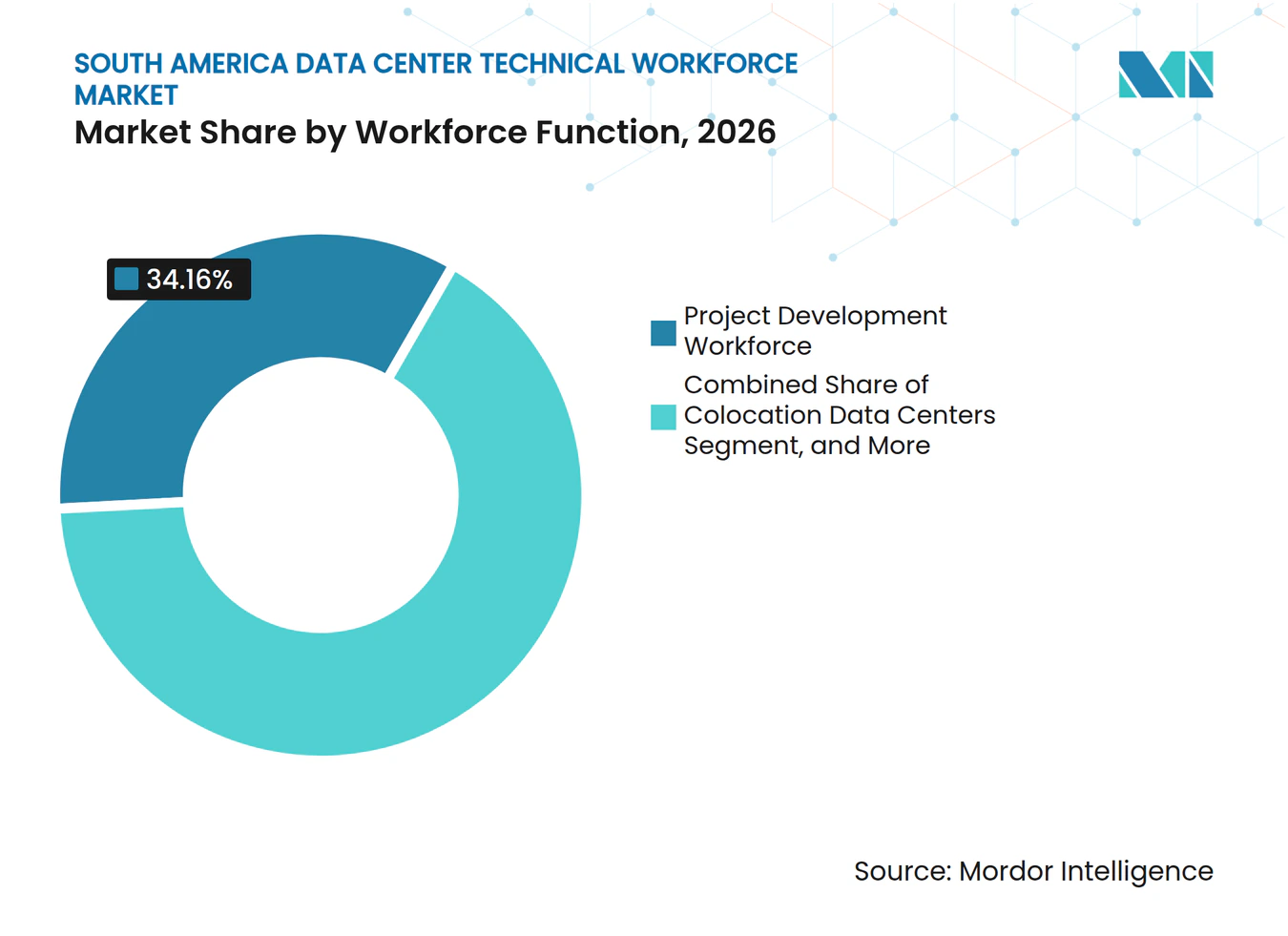
- By workforce function, Project Development Workforce held 34.16% of the South America data center technical workforce market share in 2026 and is projected to expand at a 17.29% CAGR through 2032.
- By employment model, In-house Workforce held 55.76% revenue share in 2026, while External Workforce Services is projected to expand at a 17.42% CAGR through 2032.
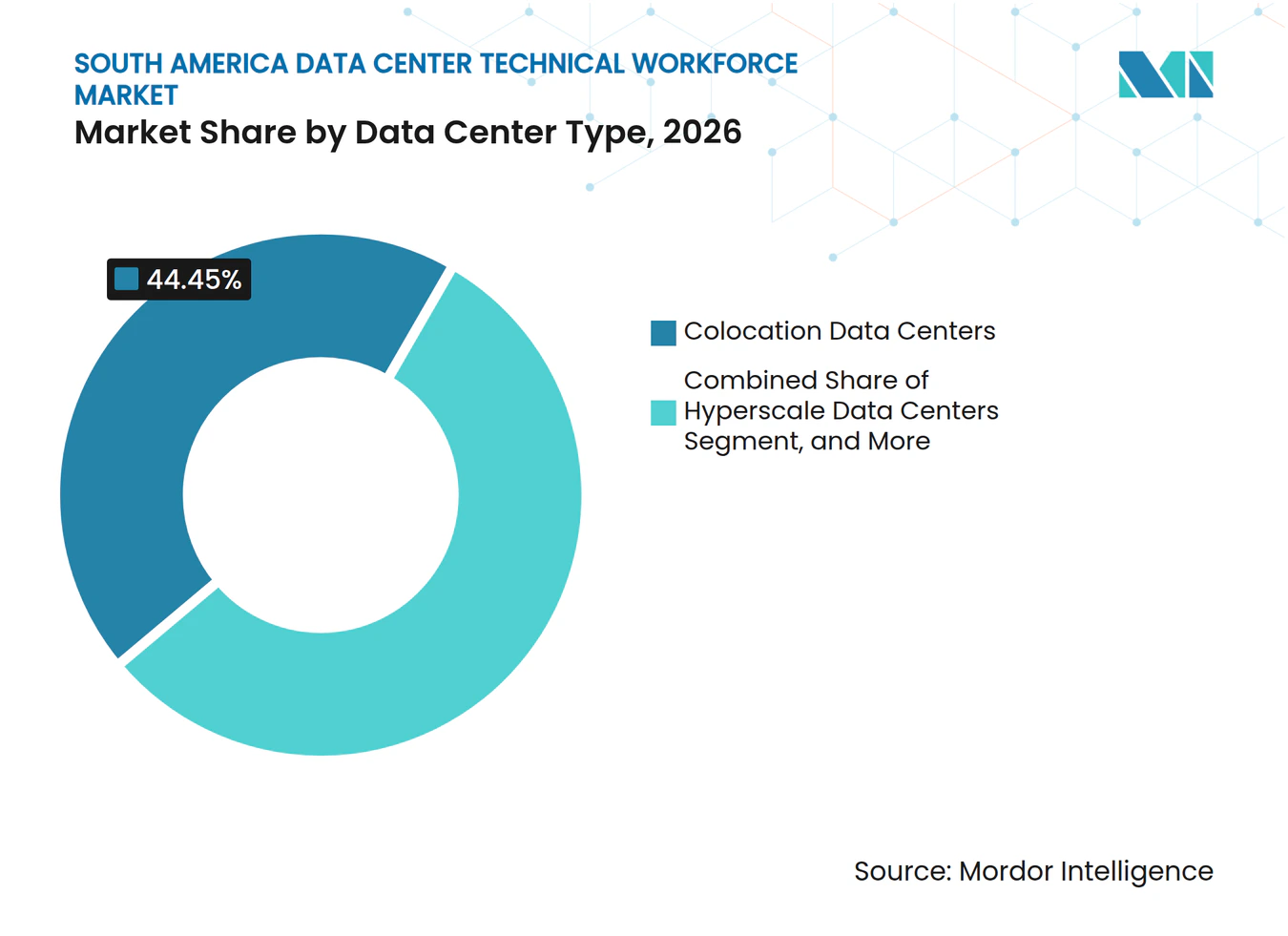
- By data center type, Colocation Data Centers accounted for 44.45% revenue share in 2026, while Hyperscale Data Centers is projected to expand at a 17.86% CAGR through 2032.
- By geography, Brazil held 58.14% revenue share in 2026, while Chile is projected to expand at a 17.92% CAGR through 2032.
Note: Market numbers in this report are based on Mordor Intelligence's proprietary estimation framework, which combines nine months of actuals with Q4 projections for base year 2026.
Market Trends and Insights
Drivers Impact Analysis of South America Data Center Technical Workforce Market*
| Driver | (~) % Impact on CAGR Forecast | Geographic Relevance | Impact Timeline |
|---|---|---|---|
| Cloud Region and Hyperscale Capacity Expansion | +4.0% | Brazil, especially São Paulo, Fortaleza, and Campinas, and Chile, especially Santiago and Quilicura | Short term (≤ 2 years) |
| AI Workload Growth and High-Density Infrastructure Deployment | +3.2% | Brazil, with expanding activity in Chile and Argentina | Medium term (2–4 years) |
| Submarine Cable Landings and Interconnection-Led Facility Expansion | +1.8% | Brazil, Argentina, and Uruguay | Medium term (2–4 years) |
| Data Sovereignty and Local Processing Requirements | +1.5% | Brazil, Chile, and Argentina | Medium term (2–4 years) |
| Renewable Power Procurement and Sustainable Data Center Development | +1.0% | Brazil and Chile, with expansion across the rest of South America | Long term (≥ 4 years) |
| Outsourcing and Certification Demand for 24/7 Critical-Facility Operations | +0.8% | Brazil, Chile, and Argentina | Medium term (2–4 years) |
| Source: Mordor Intelligence | |||
Cloud Region and Hyperscale Capacity Expansion
The rollout of cloud regions in Brazil and Chile is the largest demand driver for the South America data center technical workforce market. Brazil is adding a significant volume of capacity, and projects need design engineers, installers, commissioning staff, and operations teams before they can enter service. Each large campus also raises demand at nearby colocation and interconnection sites, so staffing needs extend beyond the facility that initially receives the investment. Staffing requirements also persist after construction because critical facilities require continuous operations. This makes the South America data center technical workforce market sensitive to overlapping construction schedules in major hubs.
AI Workload Growth and High-Density Infrastructure Deployment
AI workloads are changing the skills required in the South America data center technical workforce market. Operators need specialists in liquid cooling, high-density power systems, and GPU cluster management rather than only general facilities technicians. Ascenty signed 150 MW of AI contracts in 2026 and linked them to USD 1.2 billion of investment in 4 hyperscale facilities in the São Paulo region.[1] Vertiv expanded its Barueri training center in November 2025 with liquid-cooling equipment for AI-centered data center training. Liquid-cooled environments require mechanical, electrical, and IT teams to work together during installation and operations. The shift makes the South America data center technical workforce market more dependent on specialist technical skills.
New cable routes are creating concentrated demand for technical labor near South American landing points. V.tal and Meta announced a 280 km Malbec extension to Porto Alegre in May 2025, with a planned 2027 landing and a direct connection to a Tecto data center. Such projects require commissioning engineers, interconnection architects, and network operations technicians. Those profiles are usually based close to the landing point and cannot be moved quickly from inland facilities. The South America data center technical workforce market, therefore, benefits when cable investment is followed by local data center construction.
Data Sovereignty and Local Processing Requirements
Data protection rules create a sustained need for trained local staff, especially in cybersecurity, operations, and compliance roles. The European Commission issued a draft adequacy decision for Brazil in September 2025, increasing the importance of strong data protection processes for organizations handling European Union personal data.[2] Brazil’s PL 4218/2025 proposes a National Digital Sovereignty Policy that would apply oversight to strategic digital infrastructure. Operators serving financial services, healthcare, and government customers must demonstrate dependable security and operational practices. Local credentials become more valuable when staffing across borders cannot meet regulatory or client expectations. This regulatory setting supports demand for specialized local personnel.
Restraints Impact Analysis of South America Data Center Technical Workforce Market*
| Restraint | (~) % Impact on CAGR Forecast | Geographic Relevance | Impact Timeline |
|---|---|---|---|
| Shortage of Mission-Critical Electrical and Mechanical Specialists | -2.0% | Brazil, Chile, and Argentina, with acute gaps in Fortaleza, Porto Alegre, and Biobío | Short term (≤ 2 years) |
| Training Pipeline Lag for AI Infrastructure and Liquid-Cooling Skills | -1.5% | Brazil, with a secondary effect in Chile | Medium term (2–4 years) |
| High Attrition from Shift Work, On-Call Burden, and Cross-Industry Competition | -1.2% | São Paulo, Santiago, and Buenos Aires | Medium term (2–4 years) |
| Fragmented Certification Recognition and Uneven Labor Standards Across Countries | -0.8% | South America, particularly cross-border activity between Brazil, Chile, and Argentina | Long term (≥ 4 years) |
| Source: Mordor Intelligence | |||
Shortage of Mission-Critical Electrical and Mechanical Specialists
The shortage of electrical, mechanical, and cooling specialists limits the pace at which new facilities can be staffed and operated. Uptime Institute reported continued recruiting and retention pressure among data center owners and operators in its 2026 global survey.[3] The issue is more difficult in emerging hubs because vocational training systems are smaller than in major cities. Chile also faces a recurring shortage of technology workers, including precision-cooling technicians needed across the operating chain. As new projects compete for the same people, labor costs and project risk increase. This pressure is reshaping the South America data center technical workforce market toward specialist external services.
Training Pipeline Lag for AI Infrastructure and Liquid-Cooling Skills
Training capacity has not kept pace with the skills required for AI infrastructure and liquid cooling. These systems need knowledge of coolant management, pressure controls, maintenance analytics, and coordinated mechanical and IT operations. Vertiv’s November 2025 program provides hands-on liquid-cooling training in Brazil, but the available instruction base remains much smaller than expected regional demand. A coalition that included Equinix Foundation, ODATA, Cisco, Vertiv, and Generation launched a 14-week workforce program in May 2026 for 50 participants. These initiatives demonstrate industry action, yet they initially prepare entry-level staff more readily than experienced specialists. The training gap remains a material constraint for the South America data center technical workforce market.
*Our forecasts treat driver/restraint impacts as directional, not additive. The impact forecasts reflect baseline growth, mix effects, and variable interactions.
South America Data Center Technical Workforce Market Segment Analysis
By Workforce Function:
Project Development Combines Scale With the Fastest ExpansionProject Development Workforce held 34.16% of the South America data center technical workforce market size in 2026 and is projected to expand at a 17.29% CAGR through 2032. The combination of a leading position and the highest growth rate reflects the large number of concurrent greenfield projects across the region. Design and engineering teams are needed early because AI-ready facilities must be planned for liquid cooling, high-voltage power delivery, and dense computing loads. Ada Infrastructure began construction of its GRU10 campus in São Paulo in June 2026, with the full project designed for 300 MW across 2 onsite substations. The first phase was expected to employ as many as 1,000 workers during an 18-24 month construction period.
Facility Operations and Maintenance Workforce is the second-largest function and includes data center operations, facility management, and maintenance and reliability roles. Its expansion is limited by the same talent shortage that affects project delivery. A facility can be physically complete but still face delayed revenue if qualified operations staff are not available at handover. The IT and Digital Infrastructure Workforce is advancing because cloud migration and AI deployment require stronger network, cybersecurity, and infrastructure capabilities. The AI Infrastructure sub-segment is gaining importance as teams manage dense computing clusters while monitoring environmental conditions.



By Employment Model:
External Services Gain Ground as Specialist Demand RisesIn-house Workforce held 55.76% of revenue in 2026, reflecting operators’ continued preference for direct control of critical facility staff. This model is especially common among established Brazilian colocation platforms that built internal teams as they expanded their sites. External Workforce Services is projected to expand at a 17.42% CAGR through 2032 as operators seek skills that are difficult to build in-house. Managed-service providers can combine specialists across several customer locations and help operators respond to short-term demand. This increases the importance of external providers in the South America data center technical workforce market.
The line between internal and external employment is becoming less distinct at the highest skill levels. Operators are retaining core operations teams while using specialists for liquid-cooling commissioning, AI infrastructure deployment, and cybersecurity operations. This hybrid model limits the risk of maintaining expensive specialist headcount during uneven construction cycles. The training coalition formed in Brazil is intended to support both employment channels, not only direct hiring. Senior specialists still need experience in live critical environments, even where training programs provide an entry route.
By Data Center Type:
Colocation Remains Established While Hyperscale Changes Skills DemandColocation Data Centers held 44.45% of the South America data center technical workforce market size in 2026. Their leading position reflects the region’s established use of third-party facilities for enterprise workloads, interconnection, and cloud access. The segment relies heavily on data center operations, facility management, and network infrastructure professionals. Cirion obtained Tier III Design Documents certification for its SAN2 facility in Chile in April 2026. Colocation facilities offer a stable base of technical employment even when construction activity shifts between cities.
Hyperscale Data Centers are projected to expand at a 17.86% CAGR through 2032 and are increasing the need for high-voltage power engineers, cooling specialists, and AI infrastructure technicians. Their larger scale creates work that cannot be handled by general facilities staff alone. Scala AI City received approval for a 5 GW power connection in Rio Grande do Sul in April 2025. Enterprise, edge, and modular facilities make up the remaining demand base. Local power reliability issues in some markets continue to require on-site electrical expertise.

Geography Analysis
Brazil Data Center Technical Workforce Market
Brazil held 58.14% of the South America data center technical workforce market share in 2026. Its large enterprise base, established colocation ecosystem, renewable energy supply, and broad pool of technical institutions support this position. New capacity in São Paulo, Fortaleza, and other centers continues to pull in project development and operations staff. Brazil will remain the main source of scale for the South America data center technical workforce market.
Chile Data Center Technical Workforce Market
Chile is projected to expand at a 17.92% CAGR through 2032. Microsoft’s Chile Central region and AWS’s Santiago commitment have turned the Santiago-Quilicura corridor into a key area for construction, commissioning, and operations roles. Scala completed a USD 328 million financing package in July 2025 for 3 hyperscale facilities and a power substation across Curauma, Lampa, and Huechuraba 2. Chile’s National Data Center Plan links digital infrastructure with sustainability and workforce development priorities. The remaining shortfall in qualified technical staff will remain an important constraint as the project pipeline advances.
South America Data Center Technical Workforce Market
Argentina’s activity is centered on Buenos Aires, where enterprise connectivity supports demand for colocation operations and IT support roles. Its RIGI framework has stimulated interest in strategic infrastructure, although several large proposals have not reached a final investment decision. If projects in Patagonia or Buenos Aires proceed, they will need rapid workforce development without Brazil’s level of training depth. Colombia, Peru, and smaller markets are mostly supported by enterprise and edge deployments. Regional service providers that can work across local certification and labor systems are well placed to serve these locations.
Competitive Landscape
Market Concentration
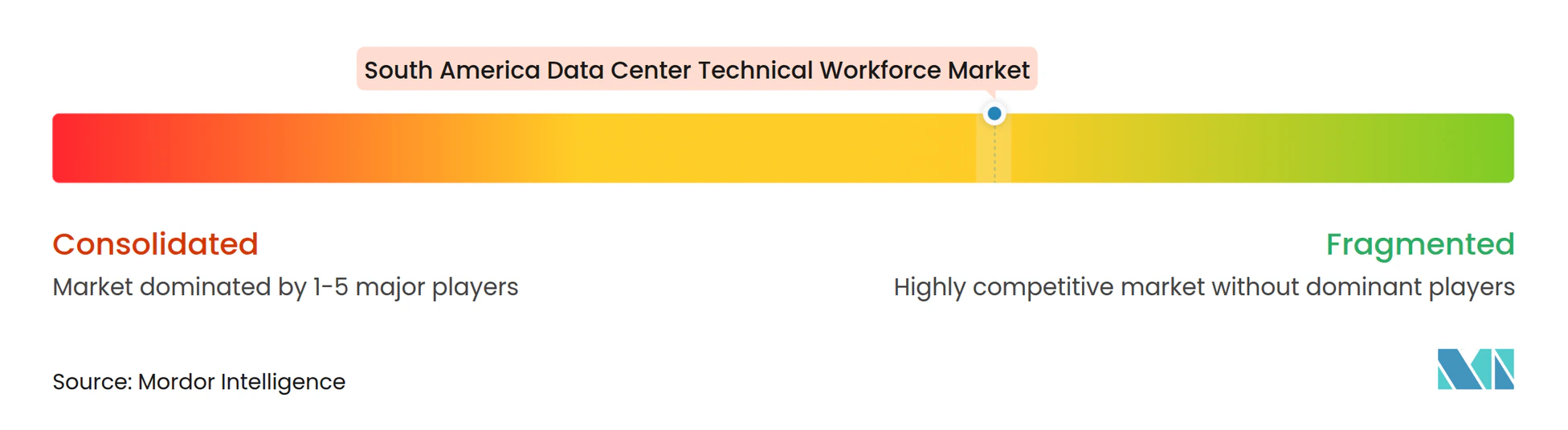
The South America data center technical workforce market is moderately fragmented. Global IT-service firms, facility management specialists, and regional data center operators serve different parts of the value chain. Kyndryl, Accenture, CBRE, and JLL compete for managed-service and advisory work, especially with regulated customers. Regional operators such as Ascenty, Scala Data Centers, ODATA, and Cirion are also competing for the same talent by developing internal standards and training pathways. The South America data center technical workforce market rewards firms that can combine local operating knowledge with specialist technical capabilities.
Automation is becoming one response to limited staffing. Cirion reported that an AI module in its DCIM platform reduced HVAC energy consumption by 13.8% at its Bogotá BOG2 data center and planned a regional rollout in 2026. This can reduce manual effort in monitoring while raising the technical level required of the staff who remain. Uptime Institute Tier certification continues to distinguish operators that can demonstrate reliable design, construction, and operations practices. Equinix received Tier III Certification of Constructed Facility for its SP4-3 and SP4-4 IBX+ phases in São Paulo in September 2025.
Demand gaps are most visible in liquid-cooling services and in outsourced operations for Argentina, Colombia, and Peru. Smaller providers such as SONDA and TIVIT have local relationships and knowledge of national labor requirements. They must still build specialist capacity quickly enough to address AI-related demand. Automation does not remove the need for trained engineers. No combined market share for the largest providers is available, so the market concentration score cannot be assigned using the required share-based method.
South America Data Center Technical Workforce Industry Leaders
-
Kyndryl, Inc.
-
Schneider Electric SE
-
Vertiv Holdings Co
-
CBRE Group, Inc.
-
JLL (Jones Lang LaSalle Incorporated)
- *Disclaimer: Major Players sorted in no particular order
South America Data Center Technical Workforce Market Companies Covered in this Report
- Kyndryl, Inc.
- Schneider Electric SE
- Vertiv Holdings Co
- CBRE Group, Inc.
- JLL (Jones Lang LaSalle Incorporated)
- Accenture plc
- Equinix, Inc.
- Digital Realty Trust, Inc.
- Ascenty Data Centers e Telecomunicacoes S.A.
- Scala Data Centers S.A.
- ODATA Brasil S.A.
- Amazon Web Services, Inc.
- Microsoft Corporation
- Google LLC
- NTT Global Data Centers Holding Pte. Ltd.
- Cirion Technologies, LLC
- Sonda S.A.
- TIVIT Terceirização de Processos, Serviços e Tecnologia S.A.
- DPR Construction
- Uptime Institute, LLC
- EPI Equipamentos e Serviços Ltda.
- Huawei Technologies Co., Ltd.
- NVIDIA Corporation
- Cisco Systems, Inc.
Recent Industry Developments in South America Data Center Technical Workforce Market
- October 2026: Cirion Technologies published its 4th Sustainability Report, disclosing that it reduced total greenhouse gas emissions by 11% in 2025 compared with 2024, equivalent to avoiding the annual emissions of approximately 3,000 cars, with reductions of 10.3% in Scope 2, market-based, and 13.4% in Scope 3. The company guarantees 100% renewable energy through I-REC certificates at its data centers in Peru, Brazil, Colombia, and Chile. The AI module integrated into its DCIM platform reduced HVAC consumption by 13.8% at its Bogotá BOG2 data center, with regional rollout across South America planned for 2026.
- September 2026: Brazil's President Luiz Inácio Lula da Silva signed into law a bill exempting data centers from several import taxes on equipment, contingent on meeting water-efficiency limits for cooling systems, procuring contracted electricity from renewable or low-emission sources, and investing locally an amount equal to 2% of the value of products acquired under the incentive. The legislation is expected to accelerate large-scale data center commitments and indirectly expand the certified technical workforce required for qualifying facilities.
- June 2026: Ada Infrastructure announced the groundbreaking of the first phase of its GRU10 campus in São Paulo, the company's first project in Brazil, among 9 global inflight campuses. The full campus is designed to reach 300 MW of IT capacity across 2 onsite substations, supporting cloud, AI/ML, and GPU workloads. Construction of the first phase is expected to last 18-24 months and is projected to employ up to 1,000 workers.
- June 2026: Elea Data Centers and AXIA Energia announced South America's first AI-neutral data center in the Amazon region, BEL1, located in Belém, Pará. With an initial capacity of 7.5 MW backed by anchor-client demand and expandable to 100 MW in future phases, the facility will operate on 100% renewable energy supplied through a Power Purchase Agreement with AXIA Energia.
South America Data Center Technical Workforce Market Report Scope
The South America Data Center Technical Workforce Market refers to the demand for, supply of, and services related to skilled personnel required to design, construct, commission, operate, maintain, secure, and upgrade data center facilities across South American countries, including Brazil, Chile, Colombia, Argentina, Peru, and others; it encompasses roles such as electrical and mechanical engineers, HVAC and cooling technicians, high-voltage electricians, UPS and generator specialists, network and IT infrastructure engineers, cybersecurity personnel, controls and automation technicians, commissioning experts, facility managers, and trained operations staff serving hyperscale, colocation, enterprise, edge, and AI-enabled data centers.
Segmentation Overview
| Project Development Workforce | Design and Engineering Workforce |
| Construction and Installation Workforce | |
| Testing and Commissioning Workforce | |
| Facility Operations and Maintenance Workforce | Data Center Operations Workforce |
| Facility Management Workforce | |
| Maintenance and Reliability Workforce | |
| IT and Digital Infrastructure Workforce | IT Hardware and Cloud Infrastructure Workforce |
| Network Infrastructure Workforce | |
| Cybersecurity and Technical Security Workforce | |
| AI Infrastructure Workforce |
| In-house Workforce |
| External Workforce Services |
| Hyperscale Data Centers |
| Colocation Data Centers |
| Enterprise, Edge and Modular Data Centers |
| Brazil |
| Chile |
| Argentina |
| Rest of South America |
| By Workforce Function | Project Development Workforce | Design and Engineering Workforce |
| Construction and Installation Workforce | ||
| Testing and Commissioning Workforce | ||
| Facility Operations and Maintenance Workforce | Data Center Operations Workforce | |
| Facility Management Workforce | ||
| Maintenance and Reliability Workforce | ||
| IT and Digital Infrastructure Workforce | IT Hardware and Cloud Infrastructure Workforce | |
| Network Infrastructure Workforce | ||
| Cybersecurity and Technical Security Workforce | ||
| AI Infrastructure Workforce | ||
| By Employment Model | In-house Workforce | |
| External Workforce Services | ||
| By Data Center Type | Hyperscale Data Centers | |
| Colocation Data Centers | ||
| Enterprise, Edge and Modular Data Centers | ||
| By Geography | Brazil | |
| Chile | ||
| Argentina | ||
| Rest of South America | ||
Key Questions Answered in the Report
What is the South America data center technical workforce market size?
The market is valued at USD 1.68 billion in 2026 and is forecast to reach USD 4.18 billion by 2032, at a 16.24% CAGR during 20272032.
Which workforce function leads regional demand?
Project Development Workforce holds 34.16% revenue share in 2026 and is projected to expand at a 17.29% CAGR through 2032.
Why are data center employers seeking more specialized workers?
AI workloads and liquid-cooling systems require skills in high-density power, cooling, commissioning, GPU infrastructure, and combined IT-facility operations.
Which employment model is expanding most quickly?
External Workforce Services is projected to expand at a 17.42% CAGR through 2032 as operators seek specialist capabilities that are difficult to maintain internally.
Which country has the largest regional demand base?
Brazil holds 58.14% revenue share in 2026, supported by its installed infrastructure, technical base, and ongoing project activity.
Which data center type is expanding fastest?
Hyperscale Data Centers is projected to expand at a 17.86% CAGR through 2032, increasing demand for power, cooling, and AI infrastructure specialists.