
Market Overview
| Study Period | 2020 - 2031 |
|---|---|
| Forecast Data Period | 2026 - 2031 |
| Base Year Market Size (2025) | USD 3.04 Billion |
| Market Size (2026) | USD 3.28 Billion |
| Market Size (2031) | USD 4.72 Billion |
| Growth Rate (2026 - 2031) | 7.55 % |
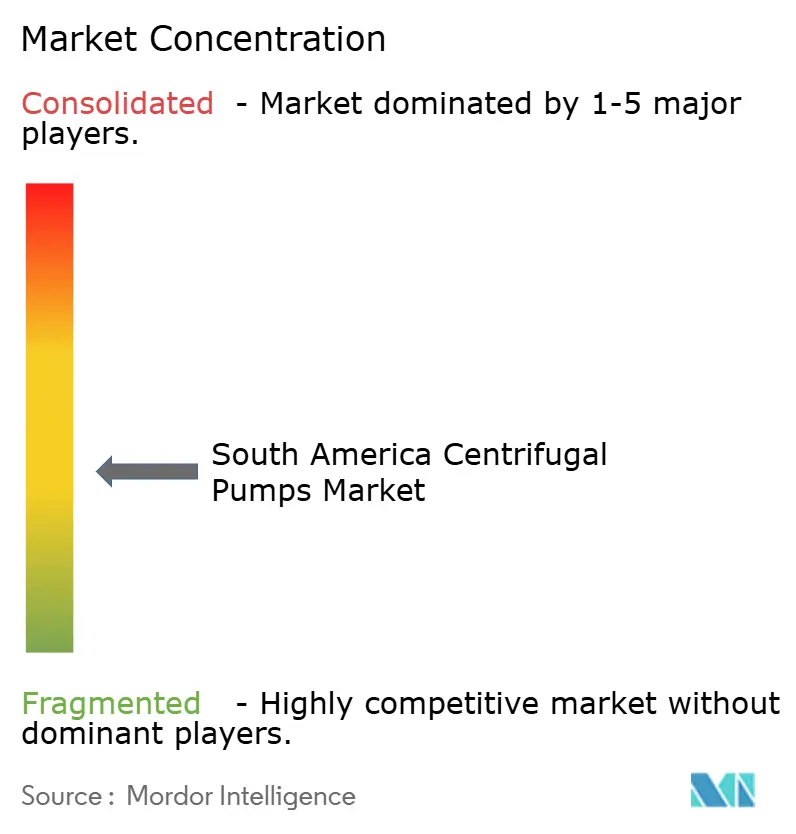
| Market Concentration | Medium |
Major Players *Disclaimer: Major Players sorted in no particular order Image © Mordor Intelligence. Reuse requires attribution under CC BY 4.0. | |
South America Centrifugal Pumps Market Analysis by Mordor Intelligence
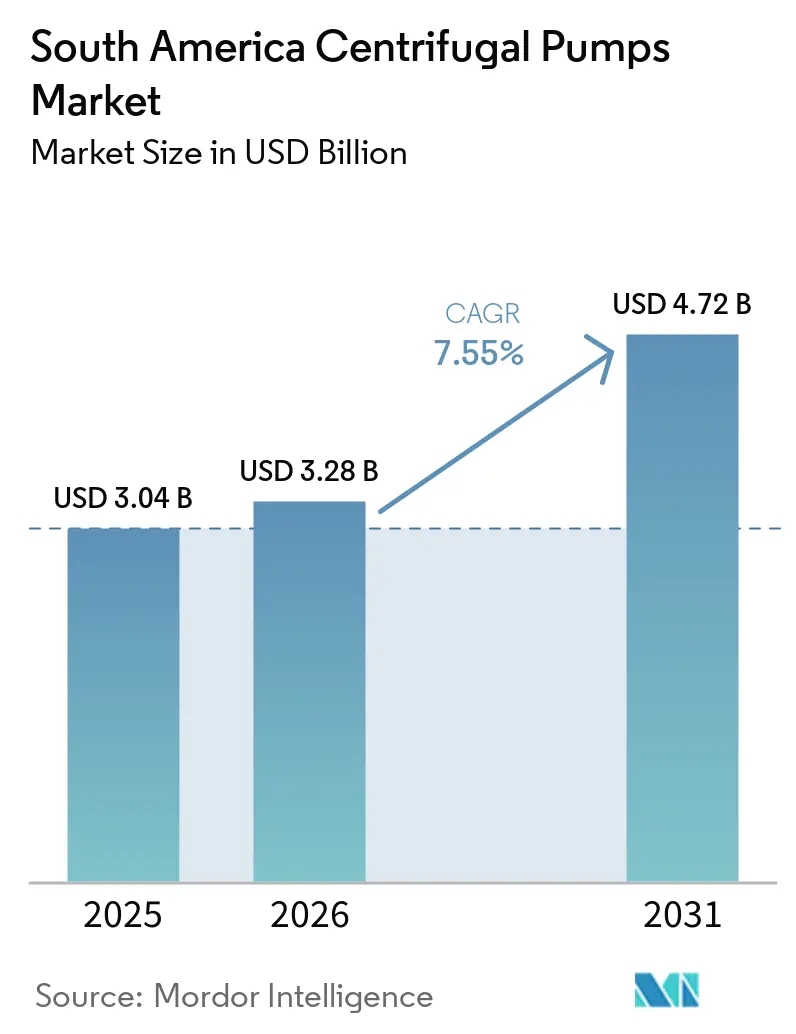
The South America Centrifugal Pumps Market size was valued at USD 3.04 billion in 2025 and estimated to grow from USD 3.28 billion in 2026 to reach USD 4.72 billion by 2031, at a CAGR of 7.55% during the forecast period (2026-2031). Brazil’s sanitation framework supports a continuing pipeline of water and wastewater projects, while mining, energy, and irrigation programs broaden equipment demand across South America. Contracted sanitation investment has exceeded USD 68 billion since 2020, supporting procurement of treatment, conveyance, and network upgrades. Project owners are also placing greater weight on service coverage, local spare parts access, and equipment monitoring when selecting suppliers. This favors suppliers that can support customers after installation, rather than firms that compete only on the initial equipment price. The South America Centrifugal Pumps Market remains exposed to project delays, currency pressure, and price competition in standard equipment categories. a
Key Report Takeaways
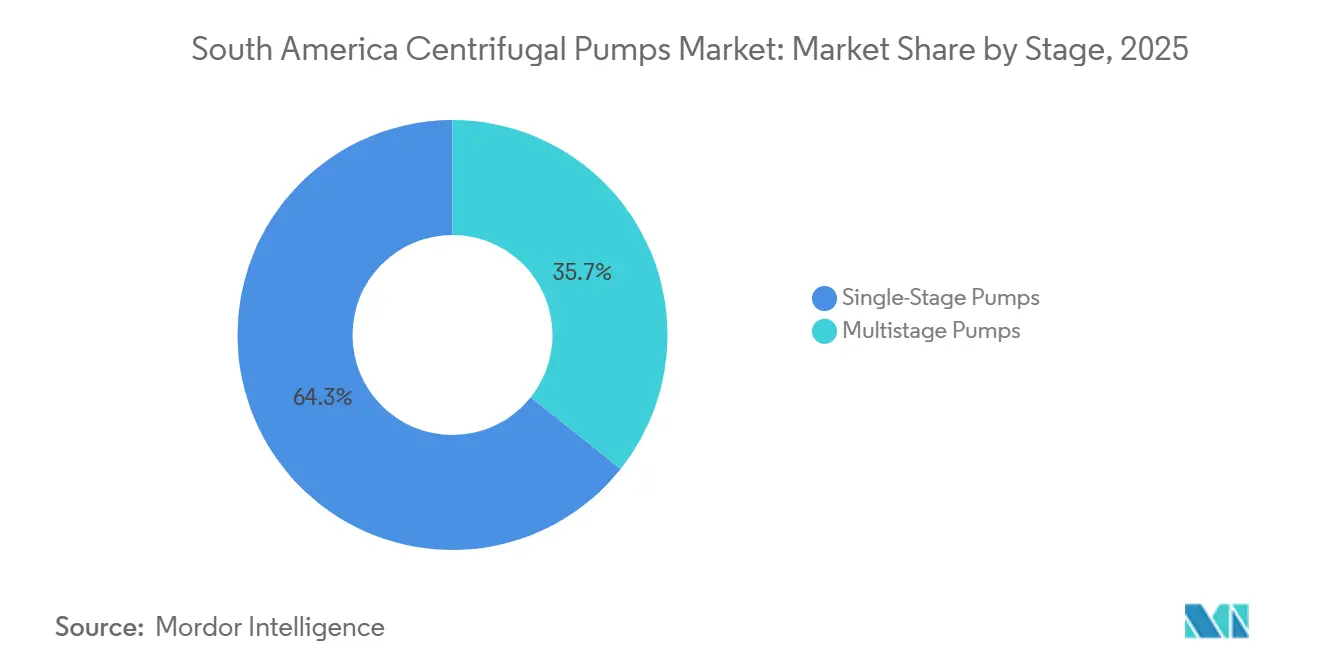
- By stage, single-stage pumps held 64.29% South America Centrifugal Pumps Market revenue share in 2025, while multistage pumps are forecast to grow at an 8.13% CAGR through 2031.
- By pump design, radial-flow pumps accounted for 73.82% revenue share in 2025, while mixed-flow pumps are forecast to expand at an 8.43% CAGR through 2031.
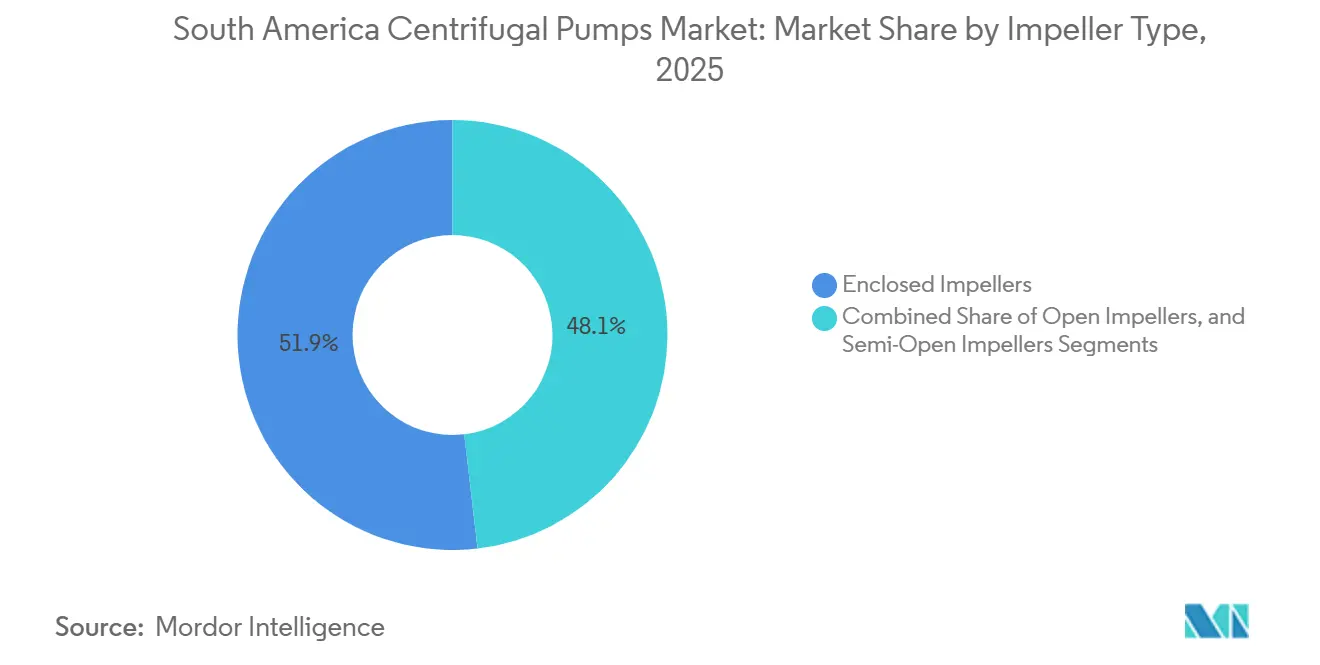
- By impeller type, enclosed impellers held 51.86% South America Centrifugal Pumps Market revenue share in 2025, while open impellers are forecast to grow at an 8.54% CAGR through 2031.
- By application, oil and gas accounted for 29.47% revenue share in 2025, while food and beverages are forecast to advance at an 8.61% CAGR through 2031.
- By geography, Brazil held 37.94% of the South America Centrifugal Pumps Market share in 2025 and is forecast to expand at an 8.51% CAGR through
Note: Market size and forecast figures in this report are generated using Mordor Intelligence’s proprietary estimation framework, updated with the latest available data and insights as of January 2026.
South America Centrifugal Pumps Market Trends and Insights
Drivers Impact Analysis*
| Driver | (~) % Impact on CAGR Forecast | Geographic Relevance | Impact Timeline |
|---|---|---|---|
| Brazil Sanitation Investment and Pump Replacement | +2.1% | Brazil, with early activity in São Paulo, Pernambuco, Pará, and Maranhão | Short term (≤ 2 years) |
| Offshore Oil and Gas and Refinery Expansion | +1.7% | Brazil pre-salt fields, REGAP, RNEST, and Argentina gas infrastructure | Medium term (2-4 years) |
| Mining Dewatering and Tailings-Water Management | +1.4% | Chile copper and lithium, Brazil iron ore and critical minerals, and Argentina copper | Long term (≥ 4 years) |
| Irrigation Modernization and Agribusiness Expansion | +0.8% | Brazil, Argentina, Peru, Colombia, and Ecuador | Medium term (2-4 years) |
| Energy-Efficiency Retrofits and Variable-Speed Adoption | +0.6% | South America, concentrated in Brazilian and Chilean industrial areas | Medium term (2-4 years) |
| Localized Engineering and Shorter Spare-Parts Lead Times | +0.3% | Brazil, Chile, and Argentina industrial centers | Medium term (2-4 years) |
| Source: Mordor Intelligence | |||
Brazil Sanitation Investment and Pump Replacement
Brazil’s sanitation concession program is a major near-term driver of demand for the South America Centrifugal Pumps Market. Contracted investment under the sanitation framework exceeded USD 68 billion by February 2026.[1]U.S. Department of Commerce, International Trade Administration, “Brazil Water Infrastructure Deals Update,” trade.gov The framework seeks 99% potable-water coverage and 90% wastewater collection by 2033, even as more than 35 million people still lack potable-water access. Maranhão planned a concession covering 214 municipalities and USD 3.4 billion in investment. Pará’s statewide Aegea concession involved nearly USD 4 billion, while Santa Catarina’s utility program involved more than USD 5.4 billion. These programs support both equipment deliveries and the ongoing service cycle that follows construction.
Offshore Oil and Gas and Refinery Expansion
Oil and gas investment supports demand for engineered pumping systems with demanding reliability and materials requirements. Refinery upgrades and deepwater developments support utility, transfer, and high-pressure pumping requirements. Such projects require equipment built for continuous process duty, corrosive fluids, and strict site safety procedures. Suppliers also need recognized engineering qualifications for critical service applications. Local technical support is important during installation, commissioning, and maintenance. These conditions raise the importance of capability beyond standard equipment supply.
Mining Dewatering and Tailings-Water Management
Mining operations require equipment for dewatering, water transfer, and conveyance of desalinated water. Chile’s desalination framework was enacted in March 2026 and created a unified structure for seawater intake, treatment, pipelines, and brine discharge. This framework can reduce uncertainty around project approvals for mine-water systems. Confirmed in June 2026 that desalinated water had reached Codelco’s Radomiro Tomic mine through the SADDN project.[2]Techint E&C, “Techint E&C Reaches New Milestone in One of Chile’s Largest Water Infrastructure Projects for Mining,” techint.com The system includes 3 high-pressure pumping stations and moves water over 160 kilometers to operations at elevations above 3,000 meters. The South America Centrifugal Pumps Market gains from projects that combine water security needs with long operating lives.
Irrigation Modernization and Agribusiness Expansion
Agricultural operators are moving from gravity-fed systems toward pressurized irrigation networks with automated control. Demonstrated a connected irrigation deployment with Ceolin Group across more than 17,000 hectares in southern Brazil and northern Argentina. Argentina completed the Yaucha-Pareditas irrigation modernization tender in late 2025, covering a 90,000 m³ regulation reservoir and 27 kilometers of pressurized pipeline.[3]Departamento General de Irrigación, “Irrigación Concretó la Licitación del Proyecto de Modernización del Sistema de Riego Yaucha Área Pareditas,” irrigacion.gov.ar These systems require dependable equipment throughout the agricultural cycle. They also create demand for services after initial equipment procurement. The South America Centrifugal Pumps Market benefits when irrigation programs improve water-use control and reduce operating losses.[4]KSB SE and Co. KGaA, “PumpDrive Flexible Speed Control for Maximum Efficiency,” ksb.com
Restraints Impact Analysis*
| Restraint | (~) % Impact on CAGR Forecast | Geographic Relevance | Impact Timeline |
|---|---|---|---|
| Capital-Project Delays from Commodity-Price Volatility | -1.8% | Chile copper, Brazil iron ore and crude oil, and Argentina gas and copper | Medium term (2-4 years) |
| Energy Consumption and Lifecycle-Cost Sensitivity | -0.9% | South America, especially large industrial users in Brazil and Chile | Long term (≥ 4 years) |
| Cavitation from Poor System Design and Variable Water Quality | -0.6% | Brazil water-quality variability and Chile altitude and water chemistry | Medium term (2-4 years) |
| Low-Cost Local Competition and Imported Component Exposure | -0.5% | Brazil and Argentina standard commercial pump categories | Short term (≤ 2 years) |
| Source: Mordor Intelligence | |||
Capital-Project Delays from Commodity-Price Volatility
Mining and energy projects can defer equipment purchases when commodity prices weaken or planning assumptions change. This affects the South America Centrifugal Pumps Market because large projects can represent substantial individual orders. A delayed mine expansion can delay water transfer, dewatering, and process-equipment packages simultaneously. High-altitude projects require designs that reflect water chemistry, solids exposure, elevation, and cooling conditions. Fiscal uncertainty can also lead public entities and state-linked companies to reallocate infrastructure budgets. Suppliers with broad installed bases are less exposed because service revenue can continue when new projects are postponed.
Energy Consumption and Lifecycle-Cost Sensitivity
Energy use is an important purchasing consideration for industrial pump customers. Reported 43% energy savings for variable-load pump systems that moved from constant to variable-speed control, while variable-speed packages may add 15% to 25% to unit cost. States that its PumpDrive speed-control system can reduce energy use by up to 60% in suitable conditions. Premium configurations still require correct sizing, commissioning, and operator training. Changes to electricity tariffs can make lifecycle savings difficult to assess. The South America Centrifugal Pumps Market may consequently have longer sales cycles for high-efficiency systems.
*Our forecasts treat driver/restraint impacts as directional, not additive. The impact forecasts reflect baseline growth, mix effects, and variable interactions.
Segment Analysis
By Stage: Single-Stage Pumps Retain Broad Utility Demand While Multistage Units Grow in High-Pressure Service
Single-stage pumps accounted for 64.29% of revenue in 2025, supported by municipal water, heating and cooling, and general process uses. Their lower unit cost supports replacement purchases for large installed fleets. Routine maintenance is comparatively straightforward for local service providers. Brazilian and Argentine suppliers also have established supply chains for standard single-stage configurations. This availability helps customers manage downtime and replacement needs. Single-stage equipment remains important where duty conditions do not require several pressure stages. The South America Centrifugal Pumps Market continues to rely on this category for regular utility and process applications.
Multistage pumps are forecast to grow at an 8.13% CAGR from 2026 to 2031. High-head water transfer, reverse-osmosis feed systems, and offshore injection services support the South America Centrifugal Pumps Market size for multistage pumps. Coastal mining water systems need high-pressure equipment for long-distance transfer to elevated operations. The SADDN project demonstrates the demanding conditions of this operating environment. Refinery upgrades can also require stacked-stage pump packages for critical services. These units carry higher engineering requirements and support greater value per installation. Suppliers must provide technical support throughout the design, commissioning, and maintenance phases.


By Pump Design: Radial-Flow Pumps Serve Diverse Duties While Mixed-Flow Pumps Gain in High-Volume Applications
Radial-flow pumps accounted for 73.82% revenue share in 2025 within the South America Centrifugal Pumps Market. Their broad operating range supports oil and gas circuits, water utilities, chemical transfer, and general industrial duties. Operators can cover many applications with a limited range of radial-flow models. This simplifies inventory planning and spare-parts management. The design also suits customers who require consistent equipment performance across varied sites. Its leading position reflects the breadth of industrial and municipal applications across South America. Local and international manufacturers both participate in this established category.
Mixed-flow pumps are forecast to advance at an 8.43% CAGR through 2031. These systems are suited to high-volume services with low-to-moderate head requirements. Irrigation lift stations, mine dewatering systems, and urban stormwater facilities are relevant areas of demand. Domestic manufacturers can compete for industrial contracts by combining local manufacturing with certified supply chains. Their local production can also improve access to replacement parts. Axial-flow pumps remain focused on drainage and flood-control duties where very high flow and low head are
By Impeller Type: Enclosed Impellers Lead Clean-Fluid Duties While Open Designs Address Hygiene and Solids Challenges
Enclosed impellers accounted for 51.86% of revenue in 2025. The South America Centrifugal Pumps Market uses enclosed designs widely in clean-water utilities, oil and gas facilities, and power plants. Their geometry supports efficient, clean-fluid operation and limits areas where contaminants can accumulate. This makes them suitable for applications with stable fluid conditions. Their installed base also supports ongoing replacement demand. Equipment users select enclosed designs when process cleanliness and energy performance are central requirements. The category remains the principal choice for many standardized clean-fluid services.
Open impellers are forecast to grow at an 8.54% CAGR through 2031. Open designs can help with cleaning in food, beverage, and pharmaceutical applications. They can also handle process fluids containing suspended solids in mining and tailings-water services. Brazil’s food processors must follow hygiene requirements set by ANVISA for relevant operations. This supports demand for sanitary equipment and cleaning-focused system designs. Semi-open impellers retain a role in wastewater, pulp and paper, and sugar-energy applications. These services need a balance between solids handling and operating efficiency. The segment structure reflects varied fluid conditions across the South America Centrifugal Pumps Market.

By Application: Oil and Gas Leads Revenue While Food and Beverages Grow Through Sanitary Equipment Investment
Oil and gas accounted for 29.47% of the South America centrifugal pumps market share in 2025. Offshore production, gas processing, refineries, and related utility systems drive demand for support equipment. These applications often require engineered materials, stringent testing, and continuous-duty reliability. Refinery and deepwater projects support demand for higher-specification pumping packages in Brazil. Equipment suppliers also need responsive service for critical process operations. Water and wastewater are other important applications because sanitation concessions support recurring procurement. Mining, chemicals, petrochemicals, and power generation remain specification-intensive demand centers.
Food and beverages are forecast to grow at an 8.61% CAGR through 2031. Processors are investing in sanitary configurations that support cleaning procedures and product-contact requirements. Brazil’s protein export and packaged food sectors drive demand for this equipment. Hygienic pump designs can command higher prices than general commercial configurations. Pharmaceutical and biotechnology customers also require sanitary equipment that aligns with applicable ANVISA requirements. These customers value material quality, cleanability, and dependable documentation. The South America Centrifugal Pumps Market offers opportunities for manufacturers to combine hygienic design with prompt technical support.
Geography Analysis
Brazil held 37.94% of the South America Centrifugal Pumps Market in 2025 and is forecast to grow at an 8.51% CAGR through 2031. Its position is supported by investment in sanitation, oil and gas activity, and agricultural processing. Contracted sanitation investment surpassed USD 68 billion by February 2026. Maranhão, Pará, and Santa Catarina each have major water and wastewater programs in progress. These projects support demand for municipal equipment, systems integration, and maintenance. Petrobras investment also supports demand for higher-specification pumping packages. Brazil’s large installed base makes local service coverage and spare parts availability especially important.
Chile is driven by mining, water management, and desalinated water conveyance. The SADDN system moves water over more than 160 kilometers to supply mine operations at elevations above 3,000 meters. These operating conditions require high-pressure equipment and specialized technical support. Chile’s March 2026 desalination framework supports clearer approval processes for seawater projects. Argentina has a different demand profile centered on gas processing, mining, and irrigation modernization. The Yaucha-Pareditas project supports pressurized irrigation infrastructure in Mendoza. These countries create demand for suppliers with specialized engineering capability.
Peru, Colombia, Ecuador, and smaller South American economies provide a growing base of municipal and agricultural demand. Peru’s irrigation plans support the use of pressurized pumping systems in agricultural areas. Colombia’s water-treatment investment and Ecuador’s industrial expansion add smaller, stable equipment volumes. These countries have greater exposure to municipal water and wastewater than to large energy projects. Their demand can therefore be less dependent on individual mining or refinery decisions. The South America Centrifugal Pumps Market benefits when suppliers can adapt equipment and service models to local procurement practices. Regional coverage also helps manufacturers capture maintenance demand after project completion.
Competitive Landscape
The South America Centrifugal Pumps Market is moderately fragmented. Global suppliers are prominent in engineered applications, while local manufacturers compete strongly in standard commercial equipment. KSB operates 8 companies, employs 1,600 people, and has 1 foundry, 3 manufacturing plants, and 14 SupremeServ branches across South America. KSB identifies Brazil, Chile, and Argentina as representing 92% of its regional volume. This physical presence matters for equipment commissioning, repair, and spare parts delivery. Customers often value local support when a pump failure can interrupt essential operations.
Flowserve reported an FPD order backlog of USD 2,044.8 million at December 31, 2025, compared with USD 1,930.4 million 1 year earlier. Its 2025 annual report identified 6 facilities in South America. Ebara announced the acquisition of Germek in Brazil in October 2025. The acquisition added a manufacturer serving fire-fighting and agricultural pump applications. Ebara also acquired Asanvil in December 2024, expanding its distribution position in south-central South America. These moves show that suppliers use local capability and distribution reach to strengthen their regional position.
FAMAC, IMBIL, OMEL, and Fabricadora de Bombas compete through local manufacturing and faster access to components. Domestic sourcing can reduce hard-currency exposure for buyers in price-sensitive projects. OMEL’s 2025 catalog documented its ANSI-ASME and API centrifugal pump range. Digital monitoring is another area where global suppliers are seeking differentiation. KSB markets PumpDrive as a speed-control solution with energy savings of up to 60% in suitable conditions. Competition is therefore based on engineering capability, delivery speed, service access, and lifecycle performance, not only equipment price.
South America Centrifugal Pumps Industry Leaders
Grundfos Holding A/S
Xylem Inc.
Flowserve Corporation
Sulzer Ltd
KSB SE & Co. KGaA
- *Disclaimer: Major Players sorted in no particular order

Recent Industry Developments
- August 2026: YPF, Eni, and XRG submitted the USD 51 billion Argentina LNG project for RIGI approval, covering upstream gas production in Neuquén, offshore floating liquefaction units with combined capacity of 12 million tonnes per annum, and dedicated pipeline infrastructure. USD 29 billion of the total is expected to be invested by 2031, creating sustained demand in the South America Centrifugal Pumps Market across gas-processing and liquefaction circuits.
- June 2026: Techint E&C confirmed that desalinated water reached the new reservoir at Codelco’s Radomiro Tomic mine. The SADDN project integrates seawater intake, desalination, and 3 high-pressure pumping stations across more than 160 kilometers of pipeline to mining operations above 3,000 meters.
- March 2026: Chile enacted a legal framework for seawater desalination that covers seawater intake, treatment plants, pipelines, and brine-discharge systems. The framework reduces permitting risk for high-head centrifugal pump procurement in mining operations.
- January 2026: Ebara Corporation completed the acquisition of 100% of Germek in Brazil through Ebara Bombas América do Sul, adding a manufacturer of pump units for fire-fighting and agriculture to its South American portfolio.


South America Centrifugal Pumps Market Report Scope
The South America Centrifugal Pumps Market refers to mechanical devices that use rotational energy to move fluids through a system via an impeller. These pumps are available in single-stage and multistage configurations, featuring various impeller types (open, semi-open, enclosed) and flow designs (radial, mixed, axial). They are essential for fluid transfer, circulation, and processing across the region's water and wastewater, oil and gas, mining, chemical, and HVAC sectors.
The South America Centrifugal Pumps Market Report is Segmented by Stage (Single-Stage Pumps and Multistage Pumps), Pump Design (Radial-Flow Pumps, Mixed-Flow Pumps, and Axial-Flow Pumps), Impeller Type (Open Impellers, Semi-Open Impellers, and Enclosed Impellers), Application (Water and Wastewater, Chemicals and Petrochemicals, HVAC and Building Services, Oil and Gas, Food and Beverages, Mining and Metals, Power Generation, Pharmaceuticals and Biotechnology, and Other Applications), and Geography (Brazil, Chile, Argentina, and Rest of South America). The Market Forecasts are Provided in Terms of Value (USD).
By Stage
| Single-Stage Pumps |
| Multistage Pumps |
By Pump Design
| Radial-Flow Pumps |
| Mixed-Flow Pumps |
| Axial-Flow Pumps |
By Impeller Type
| Open Impellers |
| Semi-Open Impellers |
| Enclosed Impellers |
By Application
| Water and Wastewater |
| Chemicals and Petrochemicals |
| HVAC and Building Services |
| Oil and Gas |
| Food and Beverages |
| Mining and Metals |
| Power Generation |
| Pharmaceuticals and Biotechnology |
| Other Applications |
By Geography
| Brazil |
| Chile |
| Argentina |
| Rest of South America |
| By Stage | Single-Stage Pumps |
| Multistage Pumps | |
| By Pump Design | Radial-Flow Pumps |
| Mixed-Flow Pumps | |
| Axial-Flow Pumps | |
| By Impeller Type | Open Impellers |
| Semi-Open Impellers | |
| Enclosed Impellers | |
| By Application | Water and Wastewater |
| Chemicals and Petrochemicals | |
| HVAC and Building Services | |
| Oil and Gas | |
| Food and Beverages | |
| Mining and Metals | |
| Power Generation | |
| Pharmaceuticals and Biotechnology | |
| Other Applications | |
| By Geography | Brazil |
| Chile | |
| Argentina | |
| Rest of South America |


Key Questions Answered in the Report
What is the South America Centrifugal Pumps Market size?
The South America Centrifugal Pumps Market was valued at USD 3.04 billion in 2025, is estimated at USD 3.28 billion in 2026, and is forecast to reach USD 4.72 billion by 2031 at a 7.55% CAGR.
What is driving centrifugal pump demand in South America?
Sanitation investment in Brazil, mine-water systems in Chile, oil and gas projects, and pressurized irrigation programs are important demand sources.
Which centrifugal pump stage is most widely used in South America?
Single-stage pumps held 64.29% revenue share in 2025 because they are widely used in municipal water, heating and cooling, and general industrial services.
Which application is growing fastest for centrifugal pumps?
Food and beverages is forecast to grow at an 8.61% CAGR through 2031, supported by investment in sanitary processing equipment.
Which country leads centrifugal pump demand in South America?
Brazil held 37.94% share in 2025 and is forecast to grow at an 8.51% CAGR through 2031, supported by sanitation, energy, and agricultural activity.
How do suppliers compete in centrifugal pumping systems?
Suppliers compete through technical capability, local production, spare-parts availability, service coverage, energy performance, and monitoring solutions.
Page last updated on:





