
South America Bottling Line Accumulating and Collating Machinery Market Size and Share
Market Overview
| Study Period | 2021 - 2032 |
|---|---|
| Forecast Data Period | 2027 - 2032 |
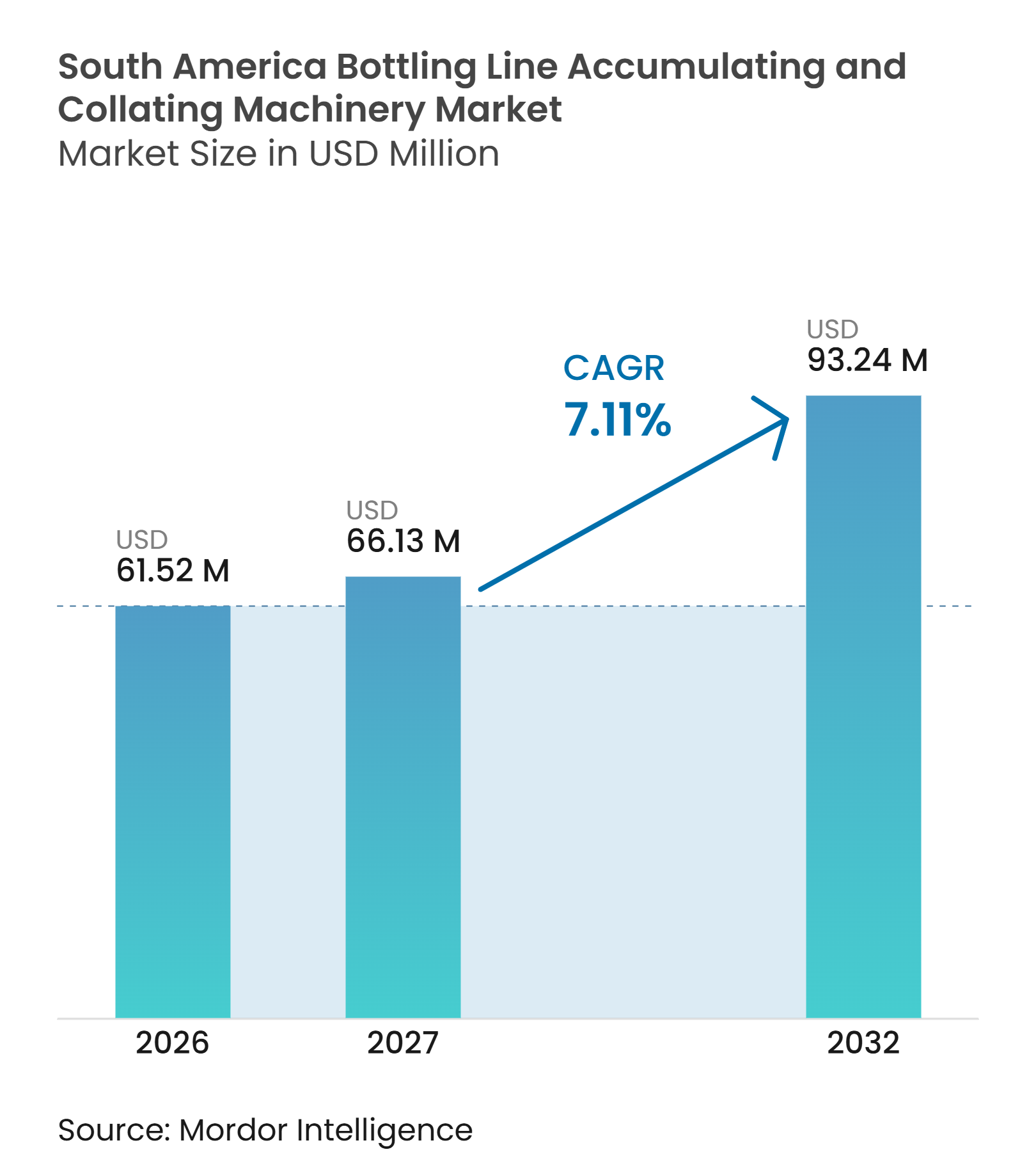
| Base Year Market Size (2026) | USD 61.52 Million |
| Market Size (2027) | USD 66.13 Million |
| Market Size (2032) | USD 93.24 Million |
| Growth Rate (2027 - 2032) | 7.11 % |
| Market Concentration | Medium |
Major Players *Disclaimer: Major Players sorted in no particular order Image © Mordor Intelligence. Reuse requires attribution under CC BY 4.0. | |
South America Bottling Line Accumulating and Collating Machinery Market Analysis by Mordor Intelligence
The South America bottling line accumulating and collating machinery market size was valued at USD 61.52 million in 2026 and is forecast to reach USD 93.24 million by 2032, at a CAGR of 7.11% during 2027-2032. The South America bottling line accumulating and collating machinery market is supported by investments in faster beverage filling lines, which require buffers, lane control, and collating equipment to maintain continuous output. Returnable packaging adds equipment needs because bottles move through washing, inspection, filling, labeling, and packing at different speeds. Bottlers are also seeking lines that can handle more package sizes without long changeovers. Suppliers with integrated filling, labeling, conveying, and digital control capabilities are well-positioned for large projects, while local suppliers remain relevant for retrofit work and service response. Currency exposure and a shortage of skilled integration technicians can delay procurement decisions, particularly for imported systems.
Key Report Takeaways
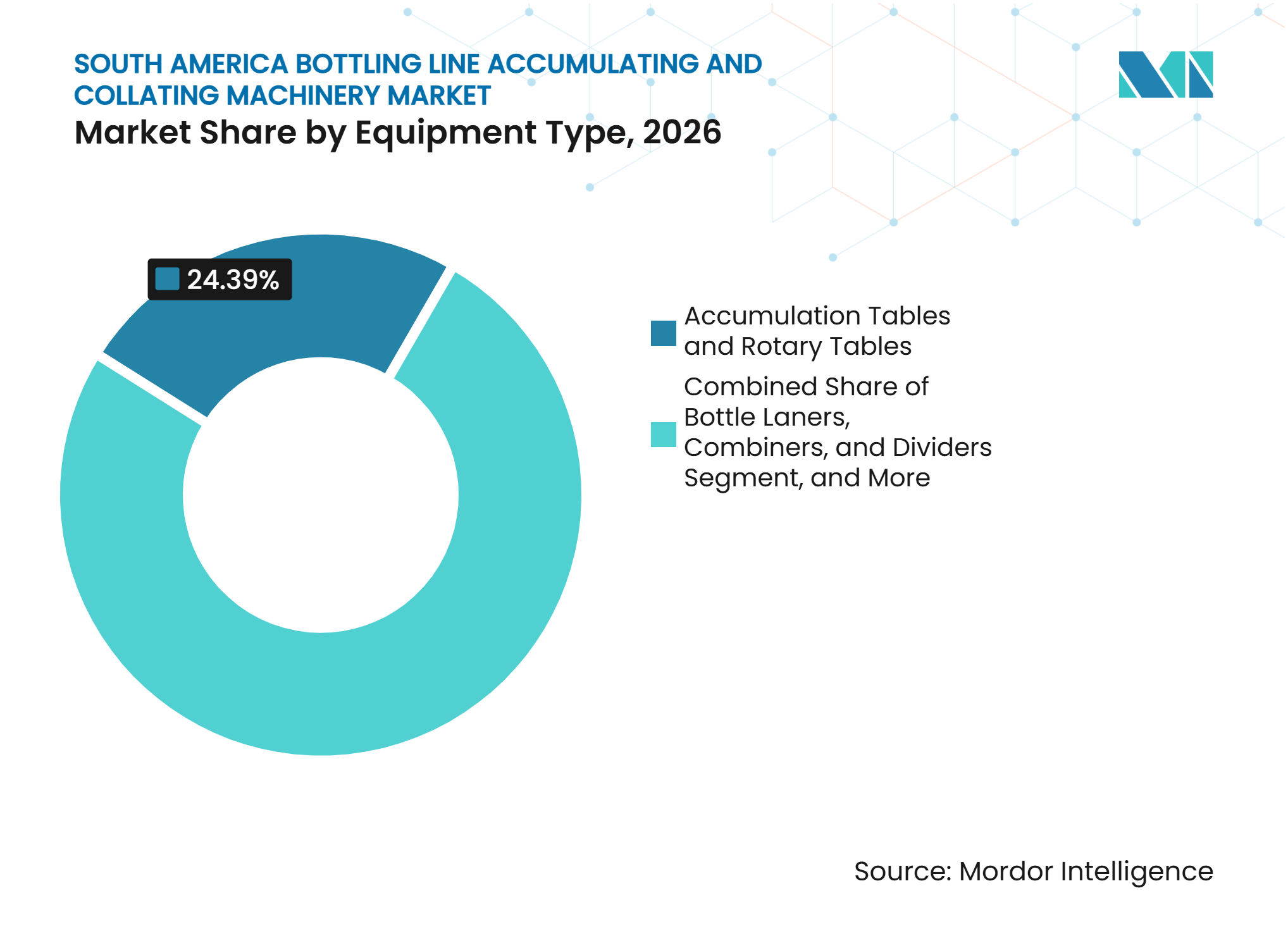
- By equipment type, Accumulation Tables and Rotary Tables held 24.39% of the South America bottling line accumulating and collating machinery market in 2026, while Inline, Serpentine, and Mass-Flow Accumulators are projected to expand at a 7.92% CAGR through 2032.
- By material type, Plastic Containers held 57.62% of demand in 2026 in the South America bottling line accumulating and collating machinery market, while Metal and Aluminum are expected to grow at a 7.86% CAGR through 2032.
- By container shape, Round Containers accounted for 69.84% of demand in 2026, while Specialty and Irregular Geometries Containers are projected to grow at a 7.59% CAGR through 2032.
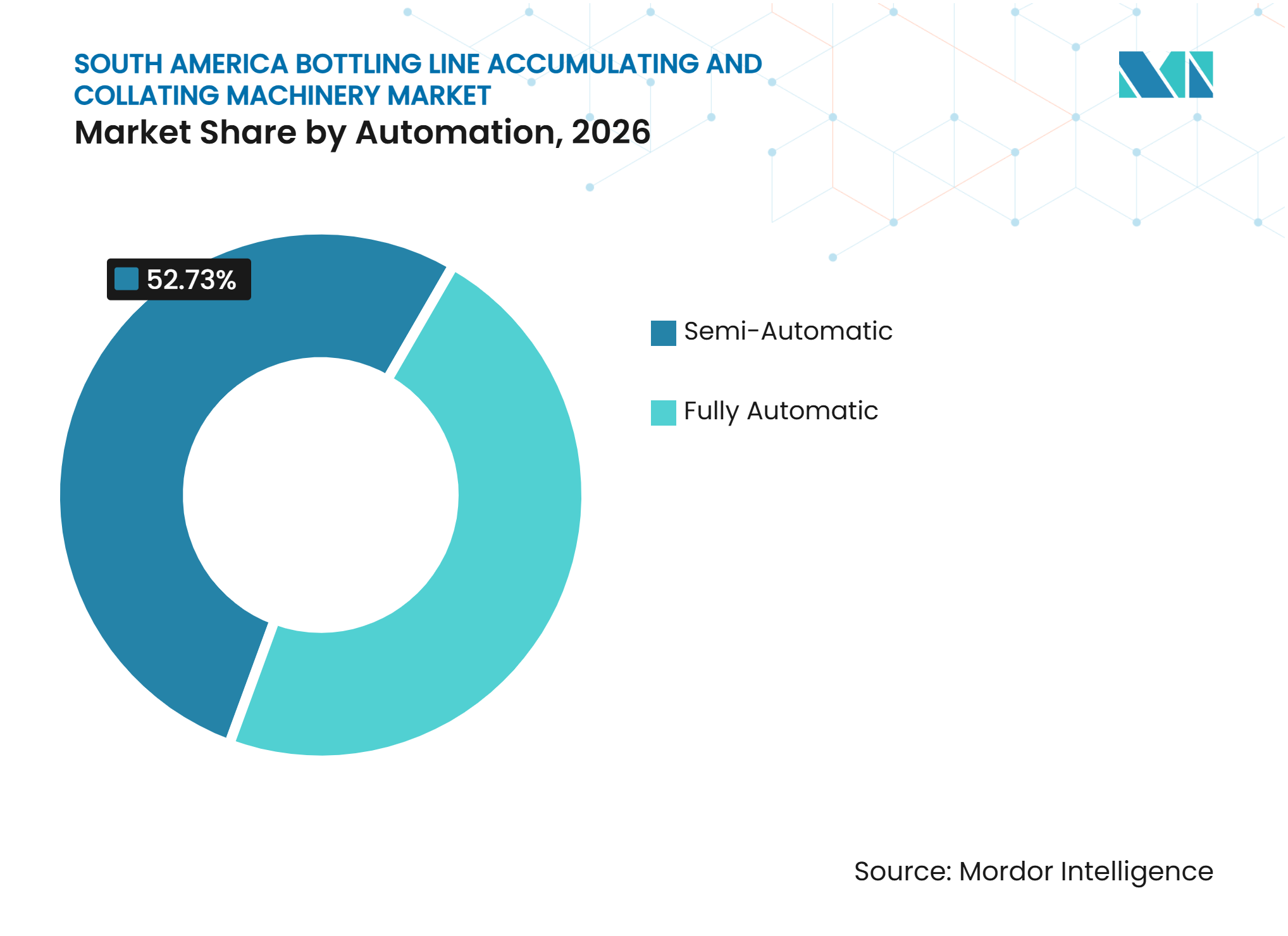
- By automation, Semi-Automatic Systems accounted for 52.73% of demand in 2026, while Fully Automatic Systems are expected to expand at a 7.81% CAGR through 2032.
- By end user, Beverage Producers accounted for 55.28% of demand in 2026, while Food and Dairy Producers are projected to grow at a 7.56% CAGR through 2032.
- By geography, Brazil held 61.47% of regional demand in 2026, while Argentina is projected to expand at a 7.94% CAGR through 2032.
Note: Market numbers in this report are based on Mordor Intelligence's proprietary estimation framework, which combines nine months of actuals with Q4 projections for base year 2026.
Market Trends and Insights
Drivers Impact Analysis of South America Bottling Line Accumulating and Collating Machinery Market*
| Driver | (~) % Impact on CAGR Forecast | Geographic Relevance | Impact Timeline |
|---|---|---|---|
| Beverage Production Capacity Expansion | +2.0% | South America, concentrated in Brazil and Argentina | Short term (≤ 2 years) |
| Shift From Manual to Automated Secondary Packaging | +1.6% | Brazil, Colombia, Argentina | Medium term (2-4 years) |
| Growth in Returnable and Refillable Beverage Formats | +1.0% | Argentina, Brazil, Chile | Short term (≤ 2 years) |
| Demand for Flexible Multi-SKU Bottling Lines | +0.8% | Brazil, Colombia | Medium term (2-4 years) |
| Predictive Maintenance and Connected Line Controls | +0.5% | Brazil, with spillover to Argentina and Colombia | Long term (≥ 4 years) |
| Localization of Beverage and Contract Packaging Manufacturing | +0.4% | Brazil, Colombia, Chile | Medium term (2-4 years) |
| Source: Mordor Intelligence | |||
Expansion of Beverage Production Capacity
Beverage capacity additions create direct demand for end-of-line equipment because each high-speed filler requires buffers between filling, labeling, and secondary packaging. HEINEKEN opened its Passos brewery in Brazil in November 2025 after an investment of more than EUR 400 million (USD 436 million), with 4 filling lines supplied by Krones.[1] Krones reported that the project included canning, non-returnable glass, and returnable glass lines, which require different accumulation approaches. Coca-Cola Andina also activated new production lines during 2025 and identified further spending on returnable packaging in its 2026 capital plan. These projects turn production expansion into orders for accumulation tables, combiners, lane dividers, and related controls. The South America bottling line accumulating and collating machinery market therefore benefits when producers build capacity rather than only replace existing equipment.
Migration From Manual to Automated Secondary Packaging
Manual secondary packaging remains common among smaller producers, but labor-intensive cells become less practical as line speed and format variation increase. PMMI reported that 38.9% of South American packaging professionals identified automation as their most critical operational need in 2026. Brazil's NR-12 framework requires machinery safeguards that raise the cost of retaining older manual systems when equipment is modified. The regulation can make a new automated cell more attractive than a complex retrofit for a producer that is already addressing guarding and safety controls. Automation also improves the consistency of bottle spacing and lane transfer before packing. This shift supports demand for integrated accumulation equipment in Brazil, Colombia, and Argentina.
Growth of Returnable and Refillable Beverage Formats
Returnable formats require more coordination than one-way packaging because each bottle passes through several stages of processing before it is refilled. Reginald Lee inaugurated a USD 18.5 million returnable packaging line in Ranelagh, Argentina, in May 2025, with capacity for 18,000 bottles per hour. Coca-Cola Andina also opened a returnable packaging plant in Mendoza in February 2025. The company reported a 45.5% returnability rate for carbonated beverages in Argentina, demonstrating the operating scale of this format. Washers, inspection systems, fillers, and labelers do not always run at the same rate, so buffer zones must accommodate flow changes without manual intervention. This requirement raises the role of inspection-compatible accumulation tables and controlled transfer systems in the South America bottling line accumulating and collating machinery market.
Demand for Flexible Multi-SKU Bottling Lines
Beverage producers are operating more container sizes and product variants on the same physical line. This change shifts purchasing decisions from maximum fixed speed toward reliable format handling and faster transitions. KHS supplied Fruki Bebidas in Brazil with a PET filling line that handles formats from 0.5 liters to 2.0 liters at speeds of up to 52,000 bottles per hour. Such operating requirements favor inline and mass-flow architectures that provide deeper buffers than basic rotary tables. Sidel presented flexible aseptic configurations for products such as milk, cappuccino, protein drinks, and isotonics at Fispal Tecnologia 2026. The South America bottling line accumulating and collating machinery market can benefit as producers specify accumulation equipment that supports varied formats rather than a single, stable package.
Restraints Impact Analysis of South America Bottling Line Accumulating and Collating Machinery Market*
| Restraint | (~) % Impact on CAGR Forecast | Geographic Relevance | Impact Timeline |
|---|---|---|---|
| High Upfront Cost for Complete End-of-Line Cells | -1.8% | South America, most acute for mid-market producers in Brazil and Argentina | Short term (≤ 2 years) |
| Import Dependence and Currency Volatility | -1.4% | Argentina, with spillover to Brazil and Colombia | Short term (≤ 2 years) |
| Shortage of Automation-Integration Technicians | -0.7% | Brazil, Argentina, Colombia | Medium term (2-4 years) |
| Fragmented Regional After-Sales Coverage | -0.5% | Peru, Chile, Rest of South America | Long term (≥ 4 years) |
| Source: Mordor Intelligence | |||
A complete accumulation and collating cell requires spending on conveyors, controls, safety systems, integration, and commissioning. This cost has a greater effect on mid-sized producers, which represent many bottling sites across the region. These companies often must choose between investment in a filler and investment in end-of-line equipment during the same budget cycle. The filler generally receives priority because it directly increases output. Capital constraints can limit modernization at mid-sized industrial sites, particularly where machinery financing requires collateral. The resulting investment pattern favors continuous upgrades by larger bottlers, while smaller operators may defer automation or pursue limited retrofits. This cost structure keeps demand for modular and phased installations relevant across the South America bottling line, accumulating and collating machinery market.
Many high-throughput systems are supplied by OEMs that price equipment in EUR or USD, while customers generate revenue in local currencies. This exposes buyers to fluctuations in the Argentine peso, Brazilian real, and Colombian peso between the quotation, financing, and import clearance stages. Currency movements can delay decisions even where there is a clear operating need for the equipment. Argentina's import procedures add another point of uncertainty for machinery buyers that depend on overseas supply. Brazilian manufacturers can reduce some exposure through BRL-denominated contracts, but their portfolios do not always match the performance requirements of the highest-speed lines. The South America bottling line accumulating and collating machinery market is therefore vulnerable to procurement cycles that follow financing and exchange-rate conditions rather than factory demand alone.
*Our forecasts treat driver/restraint impacts as directional, not additive. The impact forecasts reflect baseline growth, mix effects, and variable interactions.
South America Bottling Line Accumulating and Collating Machinery Market Segment Analysis
By Equipment Type:
Advanced Accumulators Support Higher-Speed, Multi-Format OperationsAccumulation Tables and Rotary Tables held 24.39% of regional demand in 2026. Their established role as an entry-level solution supports adoption at mid-sized beverage, food, and consumer goods facilities. Mechanical simplicity makes these systems easier to add to semi-automatic infeed arrangements. They also have a lower initial cost than more complex accumulation layouts. Producers use them where container flow is stable, and changeovers are limited. Standalone Collators and Grouping Systems address downstream pack formation needs. Bi-Directional and Recirculating Accumulators provide more buffer depth where the line layout permits recirculation. Alpine, Spiral, and Vertical Accumulators are relevant where plant footprint or multi-floor production conditions restrict horizontal space.
Inline, Serpentine, and Mass-Flow Accumulators are projected to expand at a 7.92% CAGR from 2027 to 2032. These architectures are well-suited to high-speed, mixed-SKU operations where a rotary table cannot provide sufficient buffer depth. New greenfield filling lines need equipment that protects throughput when downstream packing or labeling briefly slows. The systems can also support better product flow through complex line paths. Bottle Laners, Combiners, and Lane Dividers remain necessary as producers add secondary packaging after filling. PMMI reported that South American operations are increasingly prioritizing integrated line configurations over stand-alone machines. This operating preference supports suppliers that can coordinate accumulation, conveying, and controls across the whole line. The equipment category also gives buyers a way to reduce disruptions without replacing the filler itself.



By Material Type:
Plastic Containers Lead While Metal and Aluminum Gain UsePlastic Containers held 57.62% of material-type demand in 2026. PET is widely used for carbonated soft drinks, water, and nonalcoholic ready-to-drink beverages across South America. Its low weight and consistent cylindrical form suit many existing conveyor and accumulation configurations. This broad installed base supports continued demand for equipment designed around PET bottle handling. Glass remains important for returnable beverages and premium spirits, where handling tolerances can be more demanding. Carton and Composite Containers maintain demand in dairy and juice applications. Each container material affects line speed, stability, and the design of guides and transfer points. These requirements keep material-specific engineering important in the South America bottling line accumulating and collating machinery market.
Metal and Aluminum are expected to grow at a 7.86% CAGR through 2032. The shift reflects more use of aluminum cans in premium beverages and sparkling water. HEINEKEN's Passos brewery entered service with a dedicated high-speed canning line. Coca-Cola FEMSA inaugurated its first can production line in Uruguay in May 2026 as part of its South American expansion. COCA-COLA FEMSA Grupo RFK also expanded can-line capacity at its Paraná facility. High-throughput can lines need controlled accumulation because manual buffer management cannot maintain stable flow at their operating speed. Brazil's INMETRO requirements for packaging quality and traceability also support more disciplined process control at these lines.
By Container Shape:
Round Formats Remain Standard While Specialty Forms ExpandRound Containers held 69.84% of demand in 2026. Their dominance reflects the operating efficiency of circular containers in common beverage applications. Circular symmetry can reduce conveyor wear and simplify lane handling. Rotary tables can operate efficiently across a wide range of diameters for round PET and glass bottles. The format spans single-serve PET through 2-liter returnable glass. This versatility makes round containers the practical choice for high-volume operations. Non-Round and Shaped Containers serve premium personal care, spirits, and specialty food applications. Their differentiated appearance can support brand positioning, but they require more careful handling through the line.
Specialty and Irregular Geometries Containers are projected to grow at a 7.59% CAGR from 2027 to 2032. Craft beverage and functional food brands use distinct packages to differentiate products at retail. These forms can be more difficult to stabilize, combine, and orient than round bottles. Sidel highlighted systems capable of transitioning between round and non-round formats in a single production shift at Fispal Tecnologia 2026. This capability can reduce the need for separate dedicated lines when producers launch specialty SKUs. Accumulation systems for irregular geometries often need active orientation control rather than passive storage. The requirement creates demand for software-integrated controls and higher-value line engineering. It also makes suppliers with expertise in format more relevant to producers pursuing frequent product launches.
By Automation:
Fully Automatic Systems Gain Momentum from Digital IntegrationSemi-Automatic Systems accounted for 52.73% of demand in 2026. The share reflects the large installed base of partially modernized lines across the region. Operators still manage buffers and transfers at designated intervention points in many facilities. This approach allows mid-tier producers to direct limited capital toward filling and primary packaging. It can also defer the cost of full end-of-line integration. Brazil's NR-12 requirements are narrowing the range of manual intervention that is practical on upgraded machinery. The compliance factors are increasing the value of safer layouts and controlled transfer systems. Semi-automatic equipment nevertheless remains relevant where production volumes and formats are stable.
Fully Automatic Systems are expected to expand at a 7.81% CAGR through 2032. A study published through IEEE ETCM found that an IoT-integrated program increased OEE by 15.53 percentage points and improved mean time between failures from 12 hours to 20 hours within one operating year. These performance outcomes improve the economic case for systems that use connected controls and predictive maintenance. Fully automatic systems reduce dependence on manual buffer management as lines become more complex. They also provide data that can support faster response to stoppages and format changes. The South America bottling line accumulating and collating machinery industry is consequently moving toward equipment that combines mechanical handling with connected control functions.

By End User:
Beverage Producers Lead While Food and Dairy Producers Build DemandBeverage Producers accounted for 55.28% of end-user demand in 2026. Their position reflects continuous-flow operations that need to manage speed differences between filling, labeling, and secondary packaging. Accumulation equipment helps prevent a local disruption from stopping the whole line. Beverage plants also operate at high speeds where buffer depth is essential. Pharmaceutical, Personal Care, Chemical, and other users account for the remainder of demand. These users have their own packaging and compliance requirements. ANVISA guidelines for pharmaceutical packaging contribute to the need for controlled handling and automated processes. The end-user base therefore extends beyond beverages, even though beverage producers remain the largest source of demand.
Food and Dairy Producers are projected to expand at a 7.56% CAGR from 2027 to 2032. Single-serve packs and broader product ranges are increasing the complexity of food and dairy lines. Nestlé Brasil announced BRL 450 million (USD 83.49 million) for a manufacturing expansion in 2025, including new beverage lines and palletization infrastructure. Tetra Pak introduced its Factory OS platform in Peru and other South American markets to support connected plant operations.[2] Food producers using integrated production management need equipment with compatible data interfaces. This requirement supports accumulation systems that can share performance and condition data with plant platforms. Dairy and food applications also use materials and shapes that require reliable product handling. These conditions broaden the addressable opportunity for the South America bottling line accumulating and collating machinery market.
Geography Analysis
Brazil
Brazil held 61.47% of the South America bottling line accumulating and collating machinery market size in 2026. The country has the region's largest concentration of high-speed bottling lines and a substantial beverage production base. Grupo RFK inaugurated a BRL 400 million (USD 68 million) facility in Paraná in July 2026, developed with Krones and designed to produce up to 2 million units per day.[3] The company stated that the plant uses AI-based production management and targets 90% operational efficiency. Coca-Cola Andina added production lines and planned further investment in returnable packaging in Brazil. Large projects create demand for accumulation, collating, and control systems that match the performance of new fillers. ANVISA and NR-12 regulatory requirements support capital-intensive solutions that improve hygiene, safety, and operational repeatability. Suppliers that can provide local commissioning, parts, and integration support have a clear advantage in the South America bottling line accumulating and collating machinery market.
Argentina
Argentina is projected to grow at a 7.94% CAGR from 2027 to 2032. Returnable and refillable packaging is the central driver of new line investment in the country. Reginald Lee opened a USD 18.5 million returnable line in Ranelagh in May 2025, with a capacity of 18,000 bottles per hour. Coca-Cola Andina also inaugurated a returnable packaging facility in Mendoza during February 2025. Returnable bottles must move across washing, inspection, filling, and labeling systems with different operating rates. Accumulation buffers therefore play a larger role than in a simple one-way line. The 45.5% returnability rate reported by Coca-Cola Andina for carbonated beverages shows that the country has a developed base for this operating model. Import licensing and currency conditions remain compliance and procurement considerations for equipment buyers. Service capability and local support can become decisive where delivery and commissioning timing are uncertain. These conditions make returnable-line projects a material growth driver for the South America bottling-line accumulating and collating machinery market.
Colombia, Chile, Peru, and the Rest of South America
Colombia, Chile, Peru, and the Rest of South America offer broader opportunities as mid-tier bottlers make more meaningful end-of-line automation investments. Chile's wine and spirits export activity supports demand for equipment capable of handling glass containers with consistent control. Vidrala acquired Cristalerías Toro in March 2026, strengthening its position in glass packaging in Chile. The transaction may support more standardized glass supply and investments in higher-throughput handling. In Peru, an IoT-based maintenance program increased machine availability by 8.71% and reduced unplanned downtime by 68.68%. These operating improvements support the adoption of systems with monitoring and predictive maintenance functions. Coca-Cola FEMSA inaugurated a can production line in Uruguay in May 2026, adding local manufacturing capability for its portfolio. The mix of glass, can, and food applications creates varied demand, while weaker after-sales coverage outside major hubs leaves room for distributors and service-focused entrants. This diversity broadens the South America bottling line accumulating and collating machinery market beyond its two largest national markets.
Competitive Landscape
Market Concentration
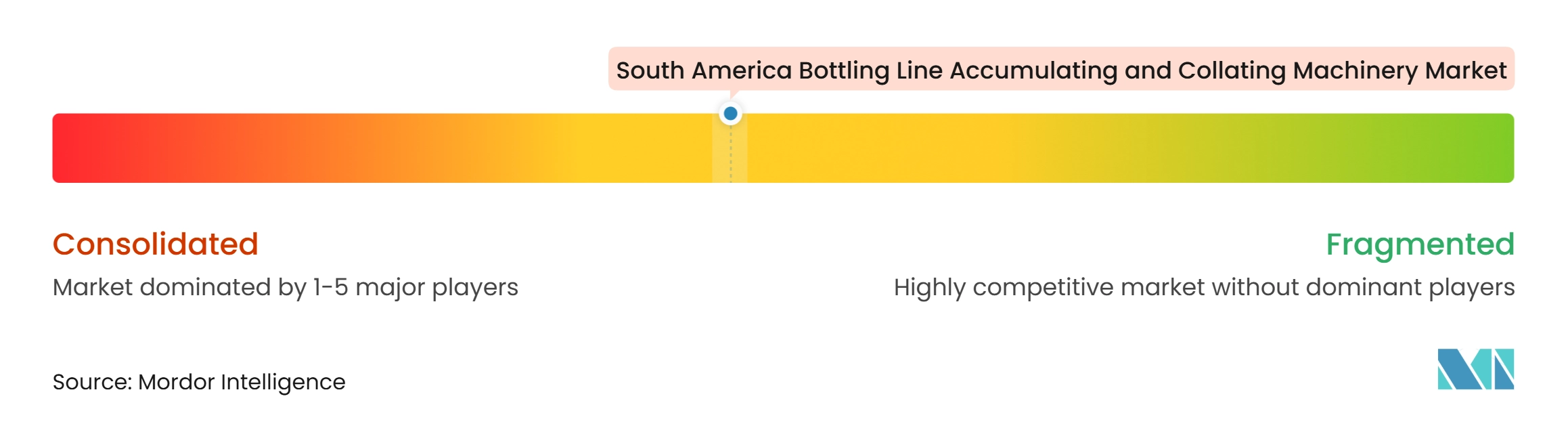
The South America bottling line accumulating and collating machinery market is moderately consolidated at the high end and fragmented across the mid-market. Krones, KHS, and Sidel have strong positions with large beverage accounts because they can package, accumulate, and collate with filling and labeling systems. An integrated offer reduces the number of interfaces a bottler must manage during installation and commissioning. Krones supplied all 4 filling lines for HEINEKEN's Passos brewery, including canning and returnable glass applications.[4] The project shows how OEMs can build their role around a full line instead of a stand-alone machine sale. Digital data recording and OEE analysis are increasingly part of project specifications. ISO 11161 also matters in tender discussions because it addresses the safety of integrated machinery systems.
KHS uses line speed, format range, and resource efficiency to compete for projects that need flexible PET handling. Its Fruki Bebidas installation in Brazil operates across 0.5-liter and 2.0-liter formats and can produce up to 52,000 bottles per hour. Sidel is promoting aseptic and multi-format line configurations for beverage categories with varied product and packaging requirements. These offers place value on flexible accumulation and transfer equipment rather than on fixed-speed conveying alone. Suppliers that combine machinery with controls can make a stronger case for uptime and format management. They must also demonstrate safe integration across multiple machines. Large bottlers can favor these suppliers where they value a single party accountable for line performance.
Brazilian manufacturers, including Zegla, Robopac Brasil, and Indumak, compete most directly in retrofits and stand-alone projects. Their local presence can provide BRL-denominated contracts, faster access to parts, and shorter commissioning timelines. Colombia, Chile, and Peru remain less well served by resident application engineers and stocked parts inventories. This gap creates an opportunity for regional distributors to expand on-site service coverage. Competition in the South America bottling line accumulating and collating machinery market is likely to center on integration quality, service response, financing terms, and the ability to handle more formats on a single line.
South America Bottling Line Accumulating and Collating Machinery Industry Leaders
-
Krones AG
-
KHS GmbH
-
Sidel Group
-
Sàrl SACMI Cooperativa Meccanici Imola S.C.
-
Barry-Wehmiller Companies, Inc.
- *Disclaimer: Major Players sorted in no particular order
South America Bottling Line Accumulating and Collating Machinery Market Companies Covered in this Report
- Krones AG
- KHS GmbH
- Sidel Group Sàrl
- SACMI Cooperativa Meccanici Imola S.C.
- Barry-Wehmiller Companies, Inc.
- OCME S.r.l.
- SMI S.p.A.
- ProMach, Inc.
- Coesia S.p.A.
- Syntegon Technology GmbH
- OPTIMA packaging group GmbH
- Robopac Brasil Indústria e Comércio Ltda.
- Zegla Indústria e Comércio de Máquinas Ltda.
- Sanmartin do Brasil Equipamentos Industriais Ltda.
- Tecna Engenharia de Máquinas Ltda.
- Indumak Máquinas e Equipamentos Ltda.
- FTM Packaging Solutions Corp.
- ISP Latinoamérica S.A.
- Nercon, Inc.
- Arrowhead Systems, Inc.
- Hartness International, Inc.
- Intralox, L.L.C.
- Ambaflex International B.V.
- Hytrol Conveyor Company, Inc.
Recent Industry Developments in South America Bottling Line Accumulating and Collating Machinery Market
- September 2026: Italian packaging group Goglio acquired 100% of Brazilian packaging producer Cristal Embalagens in Santa Catarina through its subsidiary Mega Goglio to expand its industrial footprint in South America. It reinforces regional supply chains and increases local demand for automated downstream collating, multipack grouping, and end-of-line handling systems.
- July 2026: Grupo RFK inaugurated its BRL 400 million (USD 68 million) manufacturing facility in São José dos Pinhais, Paraná, developed with Krones, covering 300,000 square meters and producing up to 2 million units per day. The plant doubles can-line capacity, raising PET production by 70%, and targets 90% operational efficiency through AI-based production management.
- May 2026: Coca-Cola FEMSA announced USD 51 million for the Nuevo Norte distribution center in Argentina, operating on 100% self-sufficient energy, and simultaneously disclosed the inauguration of its first can production line in Uruguay at a USD 8.5 million investment, enabling full local can manufacturing for its South American portfolio.
- May 2026: Krones AG showcased next-generation bottling, intralogistics, and PET recycling systems at interpack 2026 (May 5–11) and Plastics Recycling LATAM (May 17–18). It introduced modular accumulating buffers, smart conveying, and rPET-ready handling solutions directly to Latin American beverage bottlers seeking higher line efficiency and circular packaging compliance.
South America Bottling Line Accumulating and Collating Machinery Market Report Scope
The South America bottling line accumulating and collating machinery market comprises equipment used in bottling lines to manage product flow, reduce production interruptions, and organize bottles or containers for downstream packaging processes. This machinery includes accumulation systems that temporarily hold products between production stages and collating systems that arrange products into predefined patterns for efficient packing, labeling, and palletizing.
The South America Bottling Line Accumulating and Collating Machinery Market Report is Segmented by Equipment Type (Bi-Directional and Recirculating Accumulators, Alpine, Spiral, and Vertical Accumulators, Inline, Serpentine, and Mass-Flow Accumulators, Standalone Collators and Grouping Systems, Bottle Laners, Combiners, and Dividers, Accumulation Tables and Rotary Tables, and Other Equipment Types), Material Type (Plastic, Glass, Metal and Aluminum, and Carton and Composite Containers), Container Shape (Round Containers, Non-Round / Shaped Containers, and Specialty and Irregular Geometries Containers), Automation (Semi-Automatic, and Fully Automatic), End User (Beverage Producers, Food and Dairy Producers, Pharmaceutical and Healthcare Producers, Personal Care and Cosmetics Producers, Chemical and Household Product Producers, and Other End Users), and Geography (Brazil, Argentina, Colombia, Chile, Peru, and Rest of South America). The Market Forecasts are Provided in Terms of Value (USD).
Segmentation Overview
| Bi-Directional and Recirculating Accumulators |
| Alpine, Spiral, and Vertical Accumulators |
| Inline, Serpentine, and Mass-Flow Accumulators |
| Standalone Collators and Grouping Systems |
| Bottle Laners, Combiners, and Dividers |
| Accumulation Tables and Rotary Tables |
| Other Equipment Types |
| Plastic |
| Glass |
| Metal and Aluminum |
| Carton and Composite Containers |
| Round Containers |
| Non-Round / Shaped Containers |
| Specialty and Irregular Geometries Containers |
| Semi-Automatic |
| Fully Automatic |
| Beverage Producers |
| Food and Dairy Producers |
| Pharmaceutical and Healthcare Producers |
| Personal Care and Cosmetics Producers |
| Chemical and Household Product Producers |
| Other End Users |
| Brazil |
| Argentina |
| Colombia |
| Chile |
| Peru |
| Rest of South America |
| By Equipment Type | Bi-Directional and Recirculating Accumulators |
| Alpine, Spiral, and Vertical Accumulators | |
| Inline, Serpentine, and Mass-Flow Accumulators | |
| Standalone Collators and Grouping Systems | |
| Bottle Laners, Combiners, and Dividers | |
| Accumulation Tables and Rotary Tables | |
| Other Equipment Types | |
| By Material Type | Plastic |
| Glass | |
| Metal and Aluminum | |
| Carton and Composite Containers | |
| By Container Shape | Round Containers |
| Non-Round / Shaped Containers | |
| Specialty and Irregular Geometries Containers | |
| By Automation | Semi-Automatic |
| Fully Automatic | |
| By End User | Beverage Producers |
| Food and Dairy Producers | |
| Pharmaceutical and Healthcare Producers | |
| Personal Care and Cosmetics Producers | |
| Chemical and Household Product Producers | |
| Other End Users | |
| By Geography | Brazil |
| Argentina | |
| Colombia | |
| Chile | |
| Peru | |
| Rest of South America |
Key Questions Answered in the Report
What is the size of the South America bottling line accumulating and collating machinery market?
The South America bottling line accumulating and collating machinery market size is USD 61.52 million in 2026 and is projected to reach USD 93.24 million by 2032, at a 7.11% CAGR from 2027 to 2032.
What equipment type leads demand in South America?
Accumulation Tables and Rotary Tables lead demand with a 24.39% share in 2026, supported by lower entry cost and compatibility with semi-automatic lines.
Which container material is driving equipment demand?
Plastic Containers hold 57.62% of material-type demand in 2026, while Metal and Aluminum are projected to grow fastest at a 7.86% CAGR through 2032.
Why are fully automatic systems gaining adoption?
Fully Automatic Systems are projected to grow at a 7.81% CAGR through 2032 because connected controls and predictive maintenance can improve uptime and reduce manual intervention.
Which country is expected to grow fastest?
Argentina is projected to grow at a 7.94% CAGR through 2032, supported by investment in returnable and refillable beverage packaging lines.