
South America Boiler Feed Pumps Market Size and Share
Market Overview
| Study Period | 2022 - 2032 |
|---|---|
| Forecast Data Period | 2027 - 2032 |
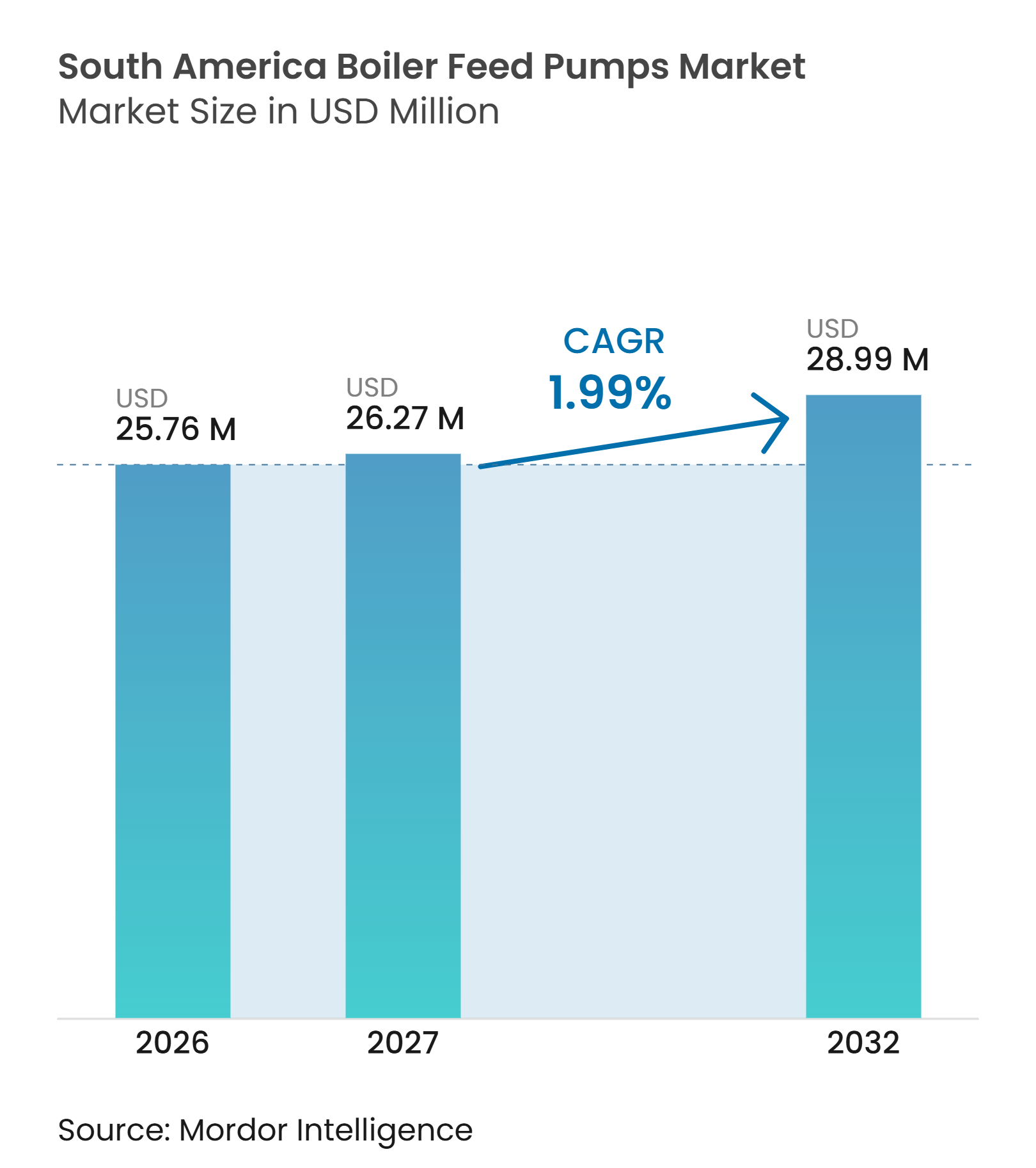
| Base Year Market Size (2026) | USD 25.76 Million |
| Market Size (2027) | USD 26.27 Million |
| Market Size (2032) | USD 28.99 Million |
| Growth Rate (2027 - 2032) | 1.99 % |
| Market Concentration | Medium |
Major Players *Disclaimer: Major Players sorted in no particular order Image © Mordor Intelligence. Reuse requires attribution under CC BY 4.0. | |
South America Boiler Feed Pumps Market Analysis by Mordor Intelligence
The South America Boiler Feed Pumps Market size was valued at USD 25.76 million in 2026 and is estimated to grow from USD 26.27 million in 2027 to reach USD 28.99 million by 2032, at a CAGR of 1.99% during the forecast period (2027-2032). Demand is tied to essential steam systems rather than short-term equipment purchases, because boiler operation cannot continue without reliable feed-water delivery at the required pressure. Thermal power, biomass cogeneration, refinery utilities, and industrial boilers require reliable feed-water systems throughout their operating life, creating a recurring need for replacement, repair, and performance upgrades. Replacement decisions usually follow reliability requirements and planned shutdown schedules, which makes order timing depend more on operating conditions than on day-to-day commodity pricing. Brazil, Argentina, and Chile support demand through biomass, refinery, pulp, gas-processing, and mining projects, with each country serving a different mix of end uses. Suppliers are responding with local engineering, variable-speed upgrades, and condition-monitoring services that make reliability part of the offering and help operators manage maintenance resources.
Key Report Takeaways
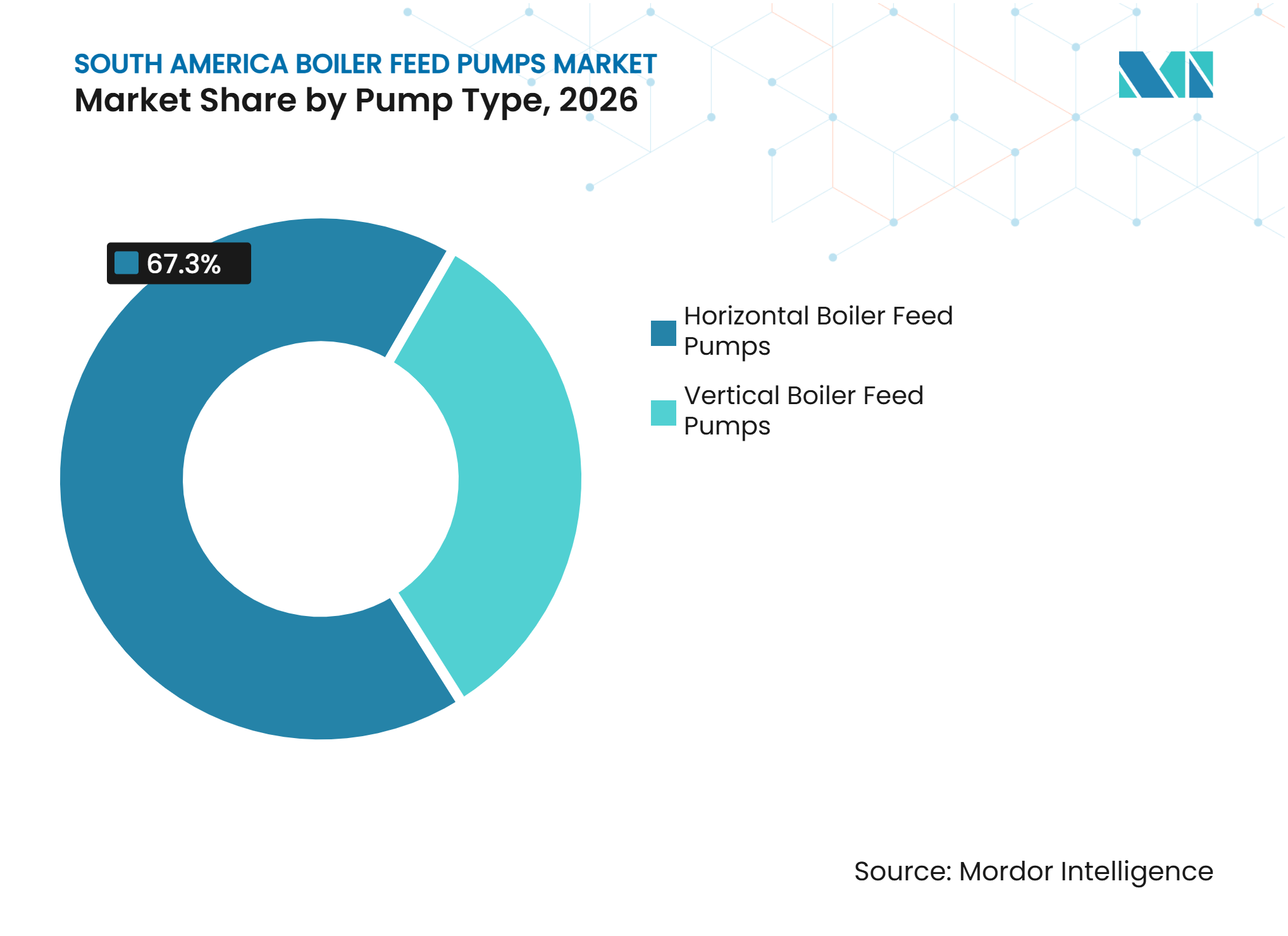
- By pump type, horizontal configurations held 67.3% of South America boiler feed pumps market share in 2026, while vertical configurations are forecast to expand at a 2.4% CAGR through 2032.
- By pump design, multistage centrifugal pumps held 46.8% of the South America boiler feed pumps market share in 2026, while barrel-type pumps are forecast to expand at a 2.2% CAGR through 2032.
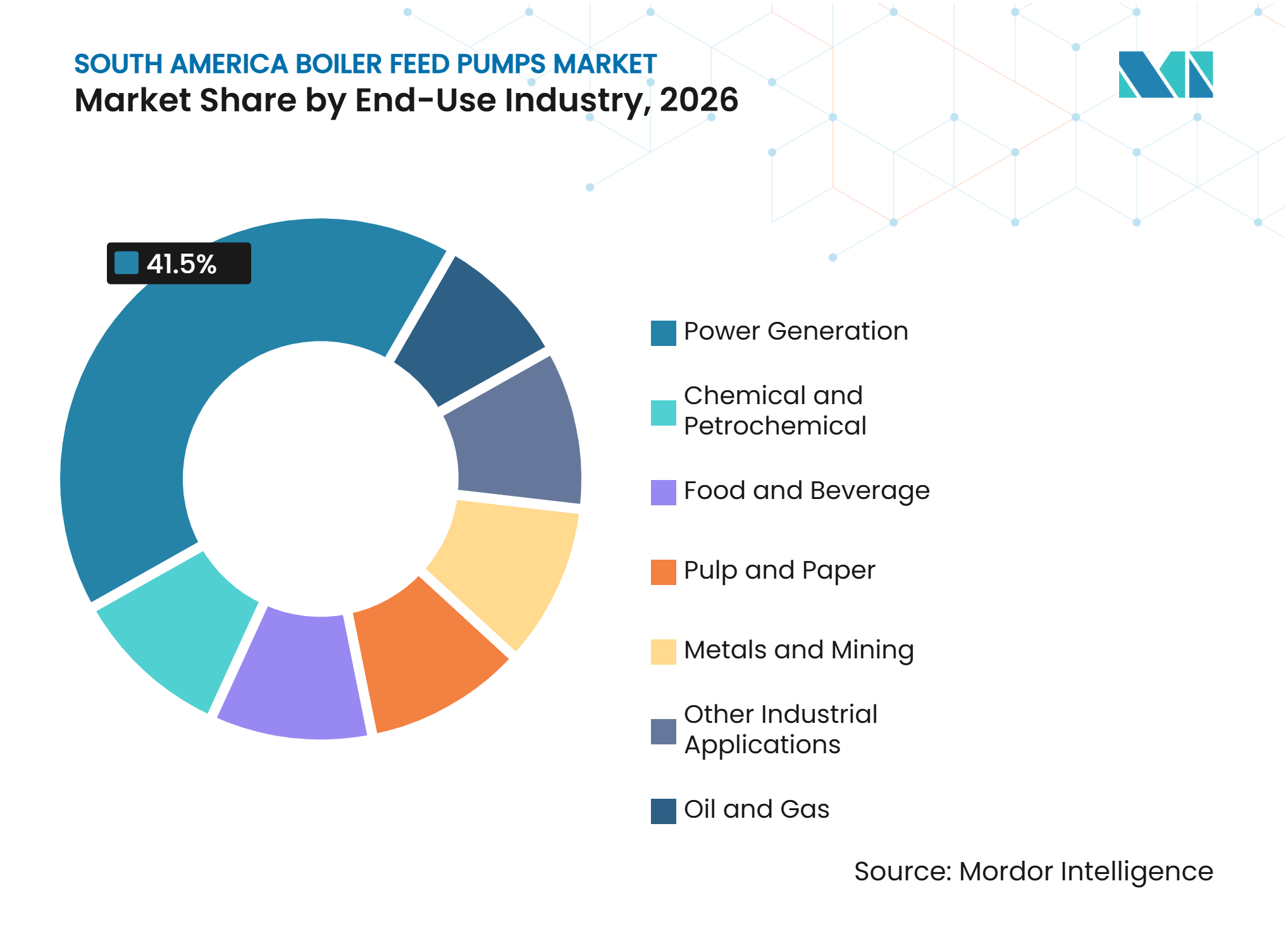
- By end-use industry, power generation held 41.5% share in 2026, while oil and gas is forecast to expand at a 2.7% CAGR through 2032.
- By geography, Brazil held 44.2% share in 2026, while Argentina is forecast to expand at a 2.9% CAGR through 2032.
Note: Market numbers in this report are based on Mordor Intelligence's proprietary estimation framework, which combines nine months of actuals with Q4 projections for base year 2026.
Market Trends and Insights
Drivers Impact Analysis of South America Boiler Feed Pumps Market*
| Driver | (~) % Impact on CAGR Forecast | Geographic Relevance | Impact Timeline |
|---|---|---|---|
| Expansion Of Biomass-Fired Sugar And Ethanol Capacity | +0.4% | Brazil, Southeast and Midwest | Short term (≤ 2 years) |
| Thermal Power Plant Replacement And Reliability Upgrades | +0.5% | Brazil, with early activity in Argentina | Medium term (2-4 years) |
| Boiler Modernization In Pulp And Paper Production | +0.3% | Brazil and Argentina, Misiones | Short term (≤ 2 years) |
| Growth Of Oil And Gas Refining And Gas-Processing Capacity | +0.4% | Argentina, Vaca Muerta corridor, and Brazil | Medium term (2-4 years) |
| Mining Water-Reuse And Desalinated-Water Conveyance | +0.2% | Chile, Atacama and Tarapacá, with spillover to Peru | Medium term (2-4 years) |
| Localization Of High-Pressure Pump Engineering And Aftermarket Services | +0.1% | Brazil and Argentina as regional hubs | Long term (≥ 4 years) |
| Source: Mordor Intelligence | |||
Expansion of Biomass-Fired Sugar and Ethanol Capacity
Brazil’s corn and sugarcane ethanol sector is adding steam-generation capacity that supports equipment demand across both new and existing bioenergy sites. The Vale do Pontal expansion plans to raise steam capacity from 230 to 430 tons per hour, showing the scale of boiler work associated with the project. The project demonstrates why biomass facilities need upgraded feed-water equipment when boiler output rises, and auxiliary systems must operate at the new duty level. Corn ethanol plants also operate across a longer annual cycle than many sugarcane units, which can alter the pattern of maintenance compared with seasonal assets. Longer operating hours raise duty cycles and can increase demand for parts, inspections, and maintenance support across the installed base. RenovaBio gives bioenergy producers a policy framework that can reduce delays in biomass boiler spending and improve visibility for plant operators.
Thermal Power Plant Replacement and Reliability Upgrades
Older thermal assets are reaching a point where replacement can be more practical than reactive maintenance, particularly where outages create wider production or grid-reliability consequences. Petrobras issued a tender for a 50 MW combined-cycle modernization of the REDUC U-1320 unit, including a heat-recovery boiler and steam turbogenerator. Boiler feed pumps in flexible thermal plants can face cavitation, shaft damage, thrust-disk wear, and corrosion during frequent start-stop operation.[1] These conditions can shorten maintenance intervals and raise the value of designs suited to variable operating loads. Variable-speed retrofits can address these operating conditions while reducing power consumption and emissions.[2] This creates work in the aftermarket as well as demand for new pumps, helping suppliers participate before a full asset replacement is approved.
Boiler Modernization in Pulp and Paper Production
Pulp and paper modernization supports the South America boiler feed pumps market through recovery-boiler projects at large production sites. ANDRITZ received an order from Suzano to modernize electrostatic precipitators on recovery boilers A and C at Aracruz in Brazil.[3] The last upgraded unit is scheduled to start in the second quarter of 2027.[4] Kraft recovery boilers work at higher steam pressures than many sugarcane boilers, increasing the importance of durable pump selection. This duty favors multistage, high-pressure, and barrel-type designs that can meet the operating requirement. Environmental compliance requirements also support replacement of older boiler systems with more efficient recovery units, linking emissions work with equipment procurement.
Growth of Oil and Gas Refining and Gas-Processing Capacity
Vaca Muerta is supporting refinery and gas-processing investment that requires process steam for heating, stabilization, and related operations. YPF planned USD 3.3 billion of investment in Vaca Muerta during 2025 and targeted production of 200,000 barrels per day by year-end. Transportadora de Gas del Sur (TGS) received a USD 560 million contract to expand the Perito Moreno gas pipeline by 14 million cubic meters per day. Processing plants need steam for heating and related operations, so investments in transport and treatment infrastructure can create related boiler-system needs. This cycle combines new facilities, expansion projects, and reliability work at existing sites. It gives suppliers a broader range of opportunities than a single project category and may balance the timing of orders across several types of facilities.
Restraints Impact Analysis of South America Boiler Feed Pumps Market*
| Restraint | (~) % Impact on CAGR Forecast | Geographic Relevance | Impact Timeline |
|---|---|---|---|
| Imported Component And Currency Exposure | -0.4% | Argentina, Brazil, and Chile | Medium term (2-4 years) |
| Project Delays From Commodity-Price Volatility | -0.3% | Brazil, Argentina, and Chile | Medium term (2-4 years) |
| High Capital And Lifecycle Costs Of High-Pressure Pump Systems | -0.2% | South America’s mid-tier industrial buyers | Medium term (2-4 years) |
| Limited Regional Availability Of Specialized Maintenance Skills | -0.1% | Rest of South America and parts of Brazil’s interior | Long term (≥ 4 years) |
| Source: Mordor Intelligence | |||
Imported Component and Currency Exposure
Many high-pressure components still depend on imports, leaving equipment pricing exposed to currency movements and supply timing. Barrel casings, duplex stainless-steel impellers, and mechanical seals can have limited qualified regional supply, especially for the most demanding applications. KSB has described how import restrictions required changes to its local production approach in South America. Foreign-exchange controls in Argentina can make payment timing uncertain for orders priced in USD. Suppliers may respond by adding currency-risk premiums to contracts, which can raise costs for end users and delay approvals. Building qualified local manufacturing capacity requires investment and lengthy approval cycles, so import exposure may persist even when suppliers expand local operations.
Project Delays from Commodity-Price Volatility
Investment plans can move with oil, copper, iron ore, and agricultural commodity prices, since those sectors influence cash flow and capital allocation in the region. Project owners may delay or reduce the scope of investments when prices fall or when uncertainty makes returns harder to assess. This often postpones pump orders rather than eliminating replacement needs, because the installed equipment still must meet reliability requirements. Argentina’s Incentive Regime for Large Investments (RIGI) framework can provide more stable timelines for projects that qualify under its incentives. Brazil’s RenovaBio policy can offer a similar source of visibility for bioenergy projects. These timing changes can concentrate orders into short periods and increase working-capital pressure for smaller suppliers that have less flexibility in production and inventory.
*Our forecasts treat driver/restraint impacts as directional, not additive. The impact forecasts reflect baseline growth, mix effects, and variable interactions.
South America Boiler Feed Pumps Market Segment Analysis
By Pump Type:
Horizontal Configurations Sustain Dominant ShareHorizontal configurations held 67.3% of the South America boiler feed pumps market share in 2026. Their established use in thermal power, refinery utilities, and industrial boilers supports this position across many of the region’s mature sites. Between-bearings shaft arrangements can handle high temperatures and variable-speed duty, which remains useful where operating loads change. Their layout can also make maintenance easier during planned boiler outages because access is familiar to maintenance teams. Brazil’s installed base of sugarcane cogeneration and thermal equipment supports repeat orders for replacement units and spare parts.
Vertical configurations are forecast to grow at a 2.4% CAGR through 2032. Their smaller footprint can suit compact biomass systems, refinery cogeneration units, and offshore utilities where the equipment layout is constrained. Variable-speed retrofits can reduce energy use and emissions in boiler feed systems. Existing boiler and turbine configurations can also favor vertical arrangements where piping geometry limits available space and redesign would increase project cost. The South America boiler feed pumps market is therefore retaining a large horizontal installed base while finding additional demand in compact projects, modular facilities, and retrofit work.



By Pump Design:
Multistage Centrifugal Leads, Barrel-Type AdvancesMultistage centrifugal pumps held 46.8% of the South America boiler feed pumps market share in 2026. They offer broad hydraulic coverage at moderate discharge pressures, which is relevant for many cogeneration and industrial boiler applications. Their stage-by-stage construction can simplify repair work for cost-conscious operators who need to return equipment quickly to service. Sugarcane and corn ethanol applications commonly operate within pressure ranges that suit this design. This makes the configuration a regular choice for cogeneration facilities in Brazil.
Barrel-type pumps are forecast to grow at a 2.2% CAGR through 2032. Their double-casing design is suited to recovery boilers and combined-cycle facilities with high steam pressures and demanding temperature conditions. This design can provide hydraulic containment and thermal resistance where ring-section or axially split designs are less suitable. High specification and qualification requirements can limit opportunities for low-cost regional suppliers and reinforce the position of established manufacturers. Ruhrpumpen presents its GP BB4 pump for applications requiring cold-start capability and management of thermal transients.
By End-Use Industry:
Power Generation Commands Share, Oil and Gas Grows FastestPower generation held 41.5% of the South America boiler feed pumps market in 2026. Thermal utilities, refinery cogeneration facilities, and biomass plants all require feed-water systems that must operate reliably throughout scheduled and unplanned operating cycles. The region has a broad population of generating units, from utility boilers to bagasse power blocks, which creates many individual maintenance and replacement decisions. This installed base supports recurring replacement demand regardless of short-term commodity changes because continued steam generation depends on equipment availability. Pulp and paper follow through black-liquor recovery boilers at major eucalyptus pulp operations.
Oil and gas is forecast to grow at 2.7% CAGR through 2032. Vaca Muerta supports this expansion through crude treatment, stabilization, and gas-processing facilities that need dependable process heat. Sulzer’s contract to supply water-injection pump packages for Petrobras’ P-84 and P-85 Floating Production Storage and Offloading units (FPSOs) shows continued demand for high-pressure rotating equipment in Brazil’s oil and gas projects. Mining adds a smaller but developing source of demand where mineral processing, desalination, and power systems intersect. These end uses give the South America boiler feed pumps market a more diverse order base and reduce dependence on a single application.

Geography Analysis
Brazil: Base Load of Regional Demand
Brazil held 44.2% of the South America boiler feed pumps market size in 2026. Biomass cogeneration, refinery utilities, and pulp recovery boilers support the country’s demand, giving it exposure to several industrial investment cycles rather than one source of orders. Petrobras’ planned REDUC U-1320 modernization includes a 50 MW combined-cycle block with a heat-recovery boiler and steam turbogenerator. The project brings a direct requirement for boiler-related rotating equipment and reflects the replacement needs within older refinery infrastructure. Brazil also has demand from greenfield biomass projects, thermal upgrades, and pulp mill modernization. Suppliers with domestic engineering and service capacity can be better placed to meet procurement and local-content requirements. KSB’s Jundiaí operation provides centrifugal-pump fabrication, machining, testing, and assembly in Brazil.
Argentina: Vaca Muerta Drives Boiler Demand
Argentina is forecast to grow at a 2.9% CAGR through 2032. Vaca Muerta development is expanding the need for processing infrastructure and associated steam systems, although import and currency conditions remain important for project delivery. TGS’s Perito Moreno pipeline expansion adds 14 million cubic meters per day of transportation capacity and three compressor stations. The wider infrastructure buildout increases the number of facilities that may require boiler-side engineering and related maintenance support. Oil and gas projects also face currency and import constraints that can affect procurement timing. The Régimen de Incentivo a las Grandes Inversiones (RIGI) investment framework can offer more predictable schedules for eligible projects. Global service suppliers are positioning for this activity through local repair and energy-efficiency capabilities. The country also has pulp and paper demand, which broadens its project base beyond upstream oil and gas.
Chile: Mining Water Infrastructure Demand
Chile’s mining sector is increasing its use of seawater and desalinated water in process operations. Techint completed the Interconexión pumping project for Collahuasi in May 2025, including a 15.2-kilometer pipeline and 7-pump system operating at 4,600 meters. This type of water infrastructure requires high-head equipment and supports demand for specialized pump engineering at difficult operating elevations. Chile’s demand is more closely connected to mining water systems than to the broad biomass base found in Brazil. Colombia, Peru, and Ecuador contribute through refining, petrochemical processing, mineral projects, and industrial boilers. These countries reduce the concentration of South America boiler feed pumps market share in the two largest national markets. Their smaller project volumes still create opportunities where suppliers can provide local support, repair capability, and field service.
Competitive Landscape
Market Concentration
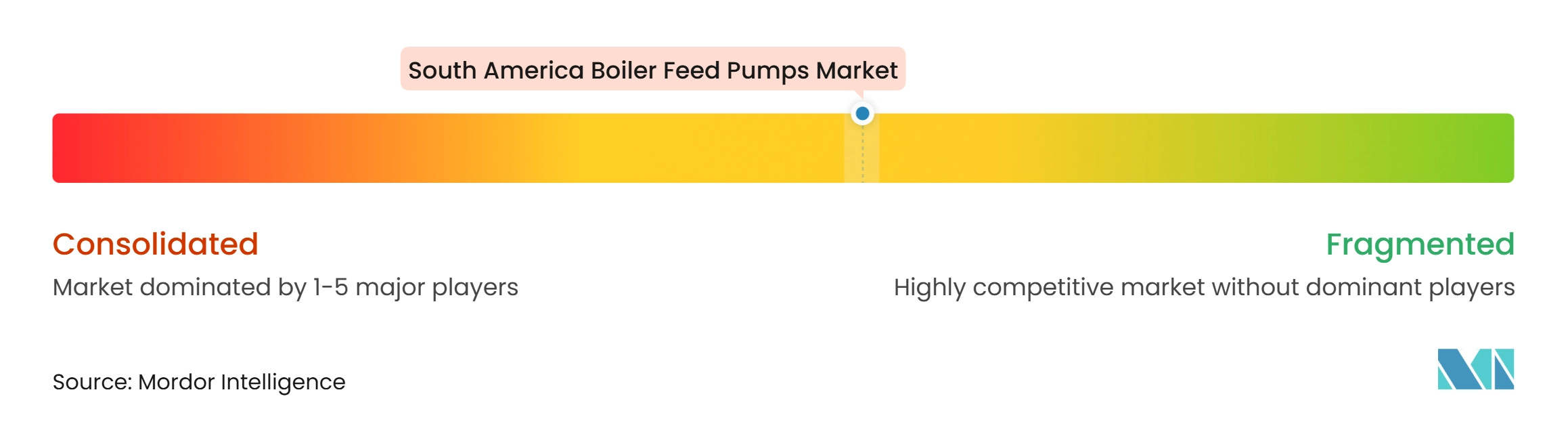
The South America boiler feed pumps market has a moderate level of concentration. Flowserve, Sulzer, KSB, EBARA, and Ruhrpumpen participate in higher-value original-equipment work, while FB Bombas and FAMAC Motobombas address lower-specification applications where price and local availability carry more weight. KSB reported 6.2% order-intake growth in the Americas in 2025, while its Pumps Segment grew 6.1%, supported by energy and petrochemical activity. Local manufacturing, testing, and service capacity can be decisive where buyers seek local content and shorter support times. KSB’s Brazilian manufacturing capabilities strengthen its ability to compete for such work.
Product design remains important in high-pressure applications. Ruhrpumpen positions its GP BB4 pump around cold starts and variable thermal conditions. This capability fits thermal plants that cycle more often than traditional baseload units and need equipment designed for repeated temperature changes. Sulzer also highlights reliability measures for boiler-feed pumps in flexible thermal generation. Suppliers can use this operating focus to differentiate beyond nominal efficiency ratings and to frame service around uptime. High-pressure engineering requirements can also limit entry by smaller competitors that lack the required qualification record.
Service models are becoming more relevant as operators manage older assets and constrained maintenance teams. Torishima has used a spare-pump maintenance model that permits overhaul work without interrupting production. Pleuger appointed Tecnium as its authorized representative in Brazil during November 2025 to extend coverage in energy, water, and mining applications. Digital monitoring and managed reliability services are an opening for suppliers that can guarantee uptime and provide operators with clearer maintenance planning. Regional companies still face pressure from global original-equipment manufacturers on certifications and from imported alternatives on cost.
South America Boiler Feed Pumps Industry Leaders
-
Flowserve Corporation
-
Sulzer Ltd
-
KSB SE & Co. KGaA
-
Grundfos Holding A/S
-
EBARA Corporation
- *Disclaimer: Major Players sorted in no particular order
South America Boiler Feed Pumps Market Companies Covered in this Report
- ANDRITZ AG
- DESMI A/S
- EBARA Corporation
- Fabricadora de Bombas (FB Bombas)
- FAMAC Motobombas Ltda.
- Flowserve Corporation
- Grundfos Holding A/S
- IMBIL – Indústria e Manutenção de Bombas ITA Ltda.
- ITT Inc. (Goulds Pumps)
- Kirloskar Brothers Limited
- KSB SE & Co. KGaA
- OMEL Bombas e Compressores Ltda.
- Ruhrpumpen Group
- SPX FLOW, Inc.
- Sulzer Ltd.
- Sundyne LLC
- The Weir Group PLC
- Torishima Pump Mfg. Co., Ltd.
- Wilo SE
- Xylem Inc.
Recent Industry Developments in South America Boiler Feed Pumps Market
- March 2026: Brazil awarded contracts for up to 19 GW of thermal and hydroelectric generation capacity through a record power capacity auction. Winning projects are expected to attract approximately USD 12.35 billion (BRL 64.5 billion) in investment. The awarded portfolio includes gas- and coal-fired generation projects involving Petrobras, Eneva, Ambar Energia, and Karpowership, alongside hydropower projects.
- October 2025: The Argentine government awarded TGS a USD 560 million contract to expand the Perito Moreno gas pipeline by 14 million cubic meters per day. The project includes 3 compressor stations with 90,000 HP of compression capacity from Tratayén, Neuquén, to Salliqueló, Buenos Aires.
- August 2025: Petrobras issued a tender on Petronect for the REDUC thermoelectric unit U-1320 modernization at its Duque de Caxias refinery. The tender specified a 50 MW net combined-cycle block comprising a gas turbine, heat-recovery boiler, and counter-pressure steam turbogenerator.
- May 2025: Techint Engineering and Construction completed the Interconexión water pumping system for the Collahuasi mine in Chile’s Tarapacá Region. The project delivered a 15.2-kilometer pipeline and 7-pump system operating at 4,600 meters.
South America Boiler Feed Pumps Market Report Scope
A boiler feed pump (BFP) is a specialized high-pressure device that supplies feedwater to a steam boiler to maintain the required water and steam generation levels.
South America boiler feed pumps market is segmented into pump type, pump design, end-use industry, and geography. By pump type, the market is segmented into horizontal boiler feed pumps, and vertical boiler feed pumps. By pump design, the market is divided into multistage centrifugal pumps, single-stage centrifugal pumps, barrel-type boiler feed pumps, and ring-section boiler feed pumps. By end-use industry, the market is divided into power generation, oil and gas, chemical and petrochemical, food and beverage, pulp and paper, metals and mining, and other industrial applications. The report also covers the market size and forecasts for the South America boiler feed pumps market across 3 countries. For each segment, the market sizing and forecasts have been provided on the basis of value (USD).
Segmentation Overview
| Horizontal Boiler Feed Pumps |
| Vertical Boiler Feed Pumps |
| Multistage Centrifugal Pumps |
| Single-Stage Centrifugal Pumps |
| Barrel-Type Boiler Feed Pumps |
| Ring-Section Boiler Feed Pumps |
| Power Generation |
| Oil and Gas |
| Chemical and Petrochemical |
| Food and Beverage |
| Pulp and Paper |
| Metals and Mining |
| Other Industrial Applications |
| Brazil |
| Argentina |
| Chile |
| Rest of South America |
| By Pump Type | Horizontal Boiler Feed Pumps |
| Vertical Boiler Feed Pumps | |
| By Pump Design | Multistage Centrifugal Pumps |
| Single-Stage Centrifugal Pumps | |
| Barrel-Type Boiler Feed Pumps | |
| Ring-Section Boiler Feed Pumps | |
| By End-Use Industry | Power Generation |
| Oil and Gas | |
| Chemical and Petrochemical | |
| Food and Beverage | |
| Pulp and Paper | |
| Metals and Mining | |
| Other Industrial Applications | |
| By Geography | Brazil |
| Argentina | |
| Chile | |
| Rest of South America |
Key Questions Answered in the Report
What is the projected value of the South America boiler feed pumps market by 2032?
The South America boiler feed pumps market is projected to reach USD 28.99 million by 2032, after reaching USD 26.27 million in 2027. The forecast CAGR is 1.99%, reflecting essential replacement and project-led demand across regional steam systems.
Which pump type has the largest share in South America?
Horizontal configurations held 67.3% share in 2026 because of their established use in utility, refinery, and industrial boiler applications. Their maintainable layout and ability to handle high-temperature, variable-speed duty support repeat replacement and spare-parts demand.
Which boiler feed pump design is growing fastest in South America?
Barrel-type pumps are forecast to grow at a 2.2% CAGR through 2032, supported by high-pressure recovery boilers and combined-cycle systems. Their double-casing construction is suited to applications that need hydraulic containment and tolerance for demanding thermal conditions.
Which end-use sector is growing fastest for boiler feed pumps?
Oil and gas is forecast to grow at a 2.7% CAGR through 2032, supported by processing investment linked to Vaca Muerta and Brazil. Crude treatment, stabilizers, and gas-processing facilities require process steam and related feed-water equipment.
Which country leads demand for boiler feed pumps in South America?
Brazil held 44.2% share in 2026, supported by biomass cogeneration, refinery utilities, and pulp recovery boilers. Its mix of biomass projects, refinery upgrades, and pulp modernization gives it a wider range of equipment needs than many regional markets.
Why are service capabilities important for pump suppliers in South America?
Local engineering, spare-pump maintenance, variable-speed upgrades, and monitoring can reduce downtime for operators managing aging assets. These services also help suppliers participate in retrofit activity before an operator commits to a complete replacement order. For the South America boiler feed pumps market, the model can align supplier support with planned shutdowns, currency constraints, limited specialist availability, and the operating needs of biomass, refinery, pulp, and mining customers.