
Market Overview
| Study Period | 2020 - 2031 |
|---|---|
| Forecast Data Period | 2026 - 2031 |
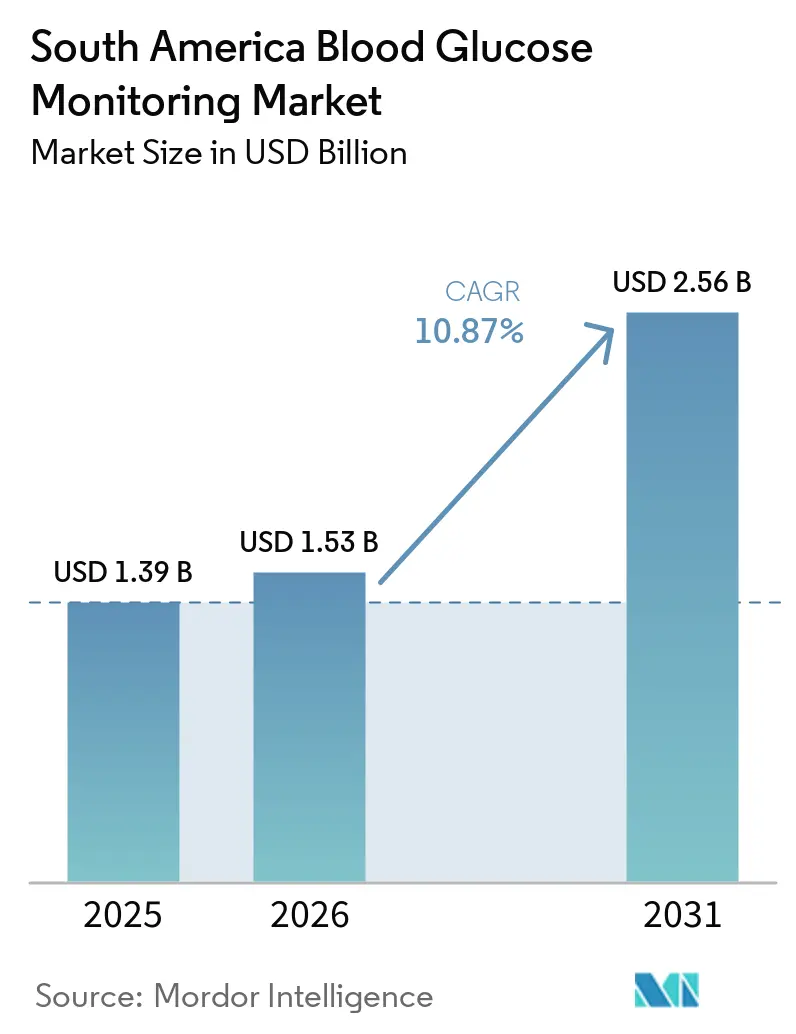
| Base Year Market Size (2025) | USD 1.39 Billion |
| Market Size (2026) | USD 1.53 Billion |
| Market Size (2031) | USD 2.56 Billion |
| Growth Rate (2026 - 2031) | 10.87 % |
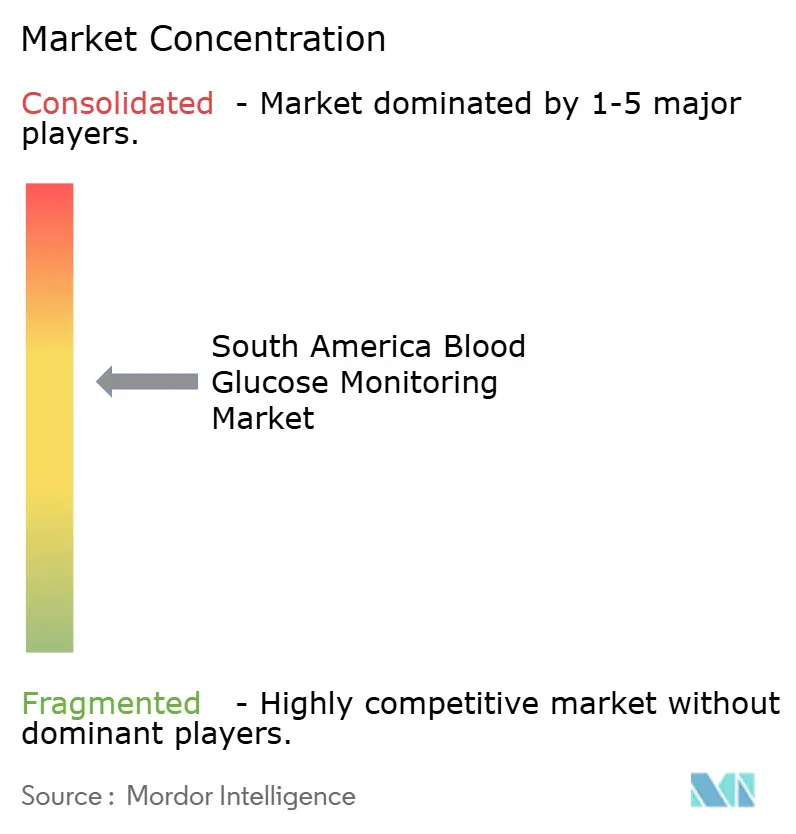
| Market Concentration | Medium |
Major Players *Disclaimer: Major Players sorted in no particular order Image © Mordor Intelligence. Reuse requires attribution under CC BY 4.0. | |
South America Blood Glucose Monitoring Market Analysis by Mordor Intelligence
The South America Blood Glucose Monitoring Market size was valued at USD 1.39 billion in 2025 and is estimated to grow from USD 1.53 billion in 2026 to reach USD 2.56 billion by 2031, at a CAGR of 10.87% during the forecast period (2026-2031).
The South America blood glucose monitoring market is supported by a large and growing population requiring diabetes care. South and Central America had 35.4 million people living with diabetes in 2024, and this figure is projected to reach 52 million by 2050. Undiagnosed diabetes remains a key demand driver, as patient identification creates an ongoing need for testing supplies and monitoring devices. Public procurement, reimbursement policies, pharmacy availability, fragmented procurement processes, import dependency, and stricter product requirements influence access to continuous glucose monitoring devices across the region.
Key Report Takeaways
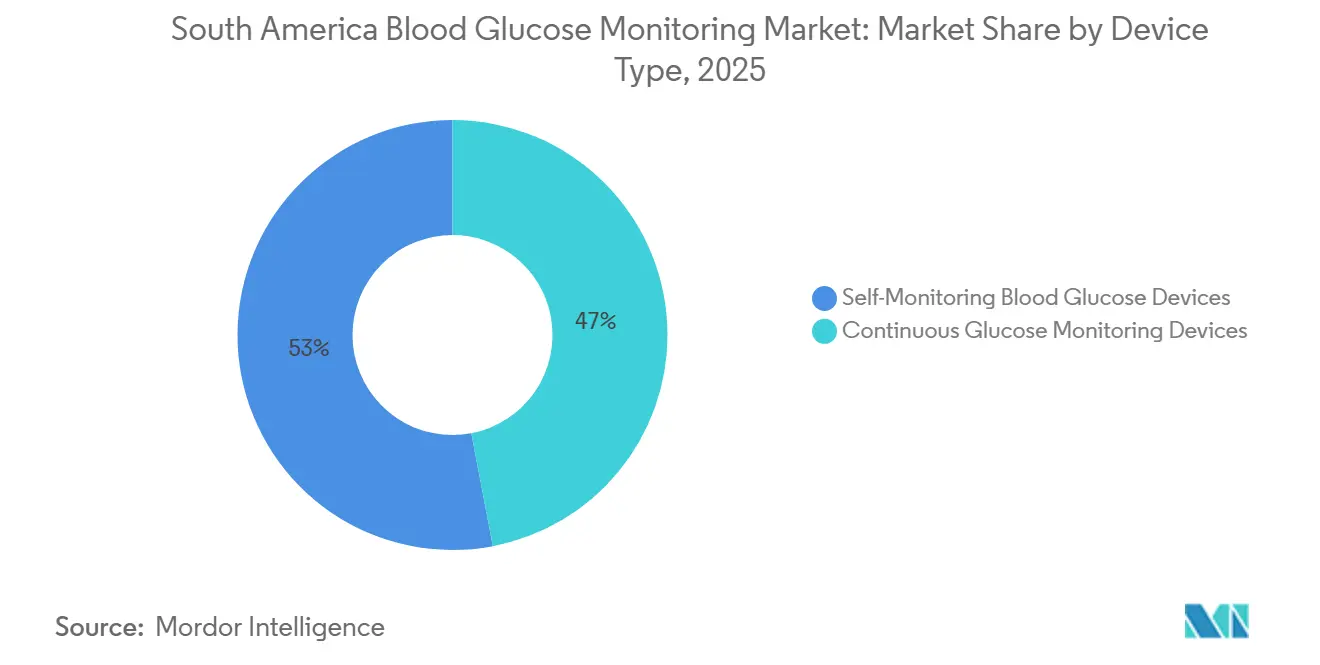
- By device type, self-monitoring blood glucose devices held 53.01% of the South America blood glucose monitoring market share in 2025, while continuous glucose monitoring devices are projected to grow at a 12.67% CAGR through 2031.
- By patient type, Type 2 diabetes accounted for 85.30% of regional demand in 2025 and is projected to expand at a 14.34% CAGR through 2031.
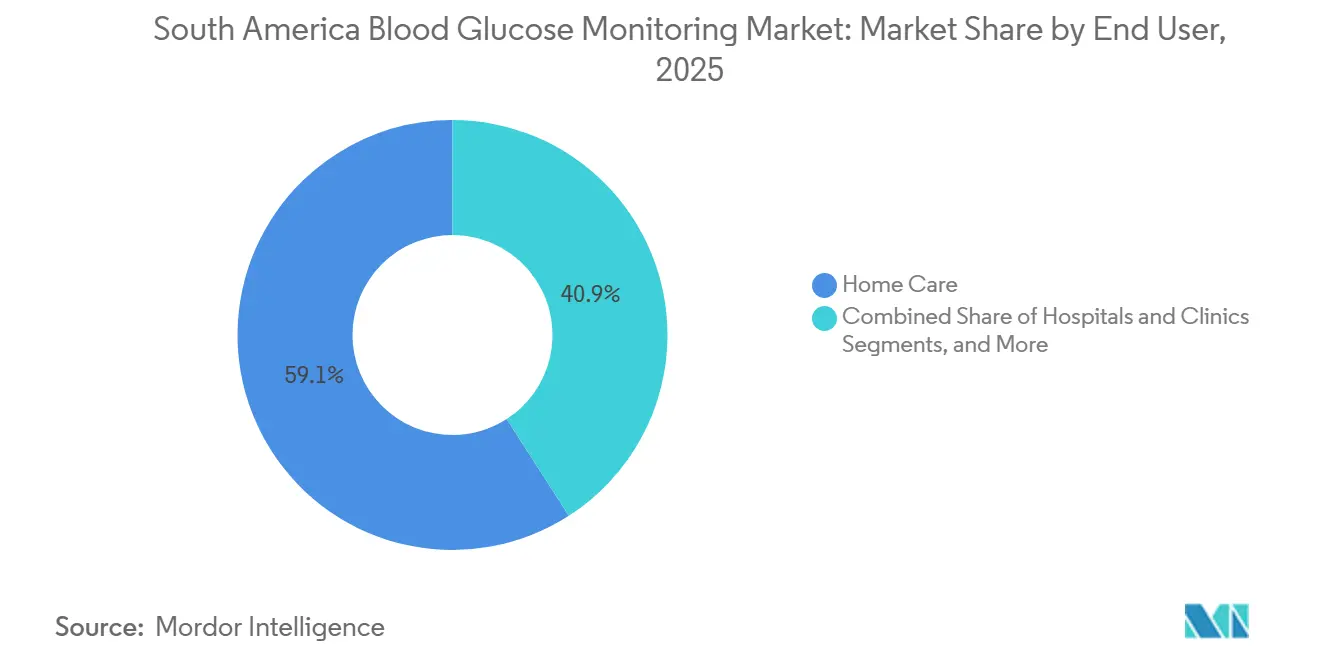
- By end user, home care held 59.10% of demand in 2025 and is projected to advance at an 11.21% CAGR through 2031.
- By distribution channel, retail pharmacies accounted for 54.78% of demand in 2025, while e-commerce and direct-to-consumer channels are projected to grow at an 11.71% CAGR through 2031.
- By geography, Brazil held 57.70% of regional revenue in 2025 and is expected to grow at an 11.47% CAGR through 2031.
Note: Market size and forecast figures in this report are generated using Mordor Intelligence’s proprietary estimation framework, updated with the latest available data and insights as of January 2026.
Market Trends and Insights
Drivers Impact Analysis of South America Blood Glucose Monitoring Market*
| DRIVER | (~) % IMPACT ON CAGR FORECAST | GEOGRAPHIC RELEVANCE | IMPACT TIMELINE |
|---|---|---|---|
| Rising diabetes burden and undiagnosed population | +2.8% | Brazil, Argentina, and Colombia | Long term (≥ 4 years) |
| Expansion of public health procurement and essential technology access | +2.0% | Brazil, Argentina, Chile, Peru, and Colombia | Medium term (2-4 years) |
| Increasing CGM reimbursement and health benefit inclusion | +2.1% | Chile, Argentina, and Brazil | Short term (≤ 2 years) |
| Pharmacy-led and direct-to-consumer sensor adoption | +1.5% | Urban Brazil, Argentina, and Colombia | Short term (≤ 2 years) |
| Remote diabetes management and connected care | +1.2% | Brazil, Chile, Ecuador, Colombia, and Peru | Medium term (2-4 years) |
| Local distributor and specialist clinic networks | +0.5% | Argentina, Colombia, Chile, and Peru | Long term (≥ 4 years) |
| Source: Mordor Intelligence | |||
Rising Diabetes Burden and Undiagnosed Population
The South American blood glucose monitoring market is supported by the region’s growing diabetes burden. South and Central America recorded 35.4 million people with diabetes in 2024, and this figure is projected to increase by 46% to 52 million by 2050.[1] The 2025 IDF analysis reported that 42.8% of adults with diabetes worldwide were undiagnosed in 2024, representing 251.7 million people. PAHO reported in 2025 that 43 million people in the Americas lacked access to diabetes treatment, highlighting the gap between clinical need and access.[2]
Expansion of Public Health Procurement and Essential Technology Access
Public procurement is expanding the South American blood glucose monitoring market beyond private retail demand. Brazil’s national reimbursement position did not prevent state and municipal programs from expanding local access to monitoring technologies. This structure creates multiple purchasing channels and supports a more resilient demand base. Suppliers must meet location-specific product specifications, purchasing volumes, contract periods, registration, and accuracy requirements.
Increasing CGM Reimbursement and Health Benefit Inclusion
Reimbursement policies are shifting demand from discretionary retail purchases to covered clinical supplies. Chile’s revised GES decree took effect on December 1, 2025, and included continuous glucose monitoring for individuals under 18 with Type 1 diabetes and pregnant women with Type 1 diabetes. Brazil reviewed real-time CGM for Type 1 diabetes under the SUS through Consulta Pública 63/2026. These measures created clearer access pathways for clinically eligible users and increased supplier requirements related to payer criteria and delivery obligations.
Pharmacy Led and Direct to Consumer Sensor Adoption
Retail pharmacies remain an important access point for monitoring devices and recurring supplies. App-connected products support prescription fulfillment, sensor data review, and regular replenishment. E-commerce and direct-to-consumer channels are expected to grow faster than other distribution channels through 2031. This trend increases the importance of pharmacy networks, digital ordering, and patient support services while sustaining demand for conventional self-monitoring supplies.
Restraints Impact Analysis of South America Blood Glucose Monitoring Market*
| RESTRAINT | (~) % IMPACT ON CAGR FORECAST | GEOGRAPHIC RELEVANCE | IMPACT TIMELINE |
|---|---|---|---|
| High out-of-pocket costs and uneven insurance coverage | -1.2% | Brazil, Argentina, Peru, and the rest of South America | Long term (≥ 4 years) |
| Import dependence, currency volatility, and tender price pressure | -0.9% | Argentina, Brazil, and Colombia | Medium term (2-4 years) |
| Fragmented regulatory and reimbursement pathways | -0.5% | Brazil, Argentina, and other regional markets | Medium term (2-4 years) |
| Limited interoperability, training, and data connectivity infrastructure | -0.4% | Peru, Bolivia, rural Brazil, and interior Colombia | Long term (≥ 4 years) |
| Source: Mordor Intelligence | |||
High Out of Pocket Cost and Uneven Insurance Coverage
High device costs continue to limit access to diabetes monitoring products, particularly where public coverage remains unavailable. This creates disparities between users covered by private insurance or local programs and those relying on public healthcare systems. The pace of coverage expansion across income groups and geographies influences the South American blood glucose monitoring market. Brazil’s consultation on real-time CGM in SUS remains significant, as a national decision could expand access for a large population of patients with Type 1 diabetes. Until coverage becomes more consistent, lower-cost self-monitoring devices and public dispensing programs will remain important.
Import Dependence, Currency Volatility, and Tender Price Pressure
Most continuous monitoring sensors sold in the region are imported, exposing suppliers to currency fluctuations and logistics costs. These factors can increase the delivered costs of devices and consumables, while public tenders often prioritize the lowest compliant bid. Suppliers must balance public-sector volumes with margins that support local distribution and regulatory activities. New registration and prior-review requirements can further raise compliance costs for smaller importers. The South American blood glucose monitoring market may favor companies with strong local partnerships, established service networks, and product portfolios suited to public and private channels.
*Our forecasts treat driver/restraint impacts as directional, not additive. The impact forecasts reflect baseline growth, mix effects, and variable interactions.
South America Blood Glucose Monitoring Market Segment Analysis
By Device Type:
CGM Adoption Is Expanding While SMBG Retains Its Core RoleSelf-monitoring blood glucose devices held 53.01% of regional demand in 2025. The segment remains essential because glucometers, test strips, and lancets are affordable and widely used across public healthcare and home-care settings. Test strips and lancets generate recurring revenue through regular patient replenishment, while conventional glucometers remain a common entry point for newly diagnosed patients. Hospitals, clinics, and public programs maintain substantial installed bases, and a 2025 real-world study in Brazil found better glycemic control among flash glucose monitoring users than traditional monitoring users. SMBG will remain relevant where affordability and access are key decision factors.
Continuous glucose monitoring devices are forecast to grow at a 12.67% CAGR from 2026 to 2031. The category includes sensors and receiver or transmitter units that provide more frequent glucose information, supported by reimbursement activity, product availability, and clinical adoption. The 2025 Latin American consensus set out 12 recommendations for evaluating CGM systems, including accuracy and post-market surveillance considerations. Product accuracy, safety, patient support, local training, and customer service are becoming key supplier selection criteria. These clinical and policy developments are expected to support CGM market growth while creating higher entry barriers for lower-specification products.
By Patient Type:
Type 2 Diabetes Drives Volume and Technology UseType 2 diabetes accounted for 85.30% of regional demand in 2025 and is projected to grow at a 14.34% CAGR through 2031. This patient group represents the largest user base and is increasingly adopting continuous monitoring as insulin therapy becomes more intensive. Routine glucose assessment and consumable replenishment support the South American blood glucose monitoring market size for Type 2 diabetes. A 2025 study from Pontificia Universidad Javeriana reported that a digital ecosystem for ambulatory Type 2 diabetes care reduced median HbA1c from 9.1% to 7.0% over three months. Such outcomes support payer assessments of structured monitoring and may expand reimbursement eligibility for this patient group.
Type 1 diabetes patients represent a smaller population but have a strong clinical need for continuous glucose monitoring. Coverage decisions in Chile and the ongoing Brazilian review have placed Type 1 diabetes at the center of public CGM discussions. Chile’s GES framework has formalized access for eligible people under 18 and pregnant women with Type 1 diabetes. Gestational diabetes and other patient categories require intensive monitoring, specialist oversight, and products suited to pediatric and pregnancy care. Reliable education and follow-up remain critical for safe device use across these clinical pathways.
By End User:
Home Care Is Moving Monitoring Closer to PatientsHome care accounted for 59.10% of demand in 2025 and is expected to grow at an 11.21% CAGR through 2031. Patients are increasingly managing long-term diabetes outside hospitals and clinics, while remote monitoring programs allow clinical teams to review data from home. This model can reduce routine in-person visits when supported by appropriate care processes and shift fulfillment toward pharmacies and digital channels. The South American blood glucose monitoring market is adapting to demand for simple setup, dependable supply, and understandable data. Practical patient training remains essential, particularly for users without regular specialist support.
Hospitals and clinics remain important for diagnosis, device initiation, and acute complication management. Specialist teams introduce CGM systems and support patients in interpreting readings, while diagnostic laboratories provide HbA1c testing and periodic glycemic assessments. Trinity Biotech began the commercial rollout of the Premier Hb9210 HbA1c column system in Brazil in March 2026 after receiving local regulatory approval. Employer wellness programs, occupational health clinics, and telemedicine providers are expanding metabolic monitoring in workplace and remote-care settings. Coordination between institutional care, home supply channels, and reimbursement policies will shape continuity of care.

By Distribution Channel:
Retail Remains Largest While Digital Supply ExpandsRetail pharmacies held 54.78% of the distribution demand in 2025. They remain a familiar purchase and refill channel for glucometers, strips, lancets, and sensors, providing immediate access for privately insured and self-paying users. Their market position reflects proximity to patients and the ability to manage recurring supply requirements. Increasing product availability may intensify competition for shelf space and pharmacy network agreements. Manufacturers need dependable inventory, clear product support, and effective value communication to maintain pharmacy relationships.
E-commerce and direct-to-consumer channels are projected to expand at an 11.71% CAGR through 2031. These channels simplify scheduled replenishment and can integrate devices, data platforms, and fulfillment into a unified patient experience. They are particularly relevant for manufacturers offering connected applications and direct patient support tools. Institutional procurement remains essential for high-volume SMBG supplies in Brazil and other public systems, where tender eligibility, formulary inclusion, and pricing determine participation. Digital channels are likely to complement rather than replace pharmacy and public distribution.
Geography Analysis
Brazil Blood Glucose Monitoring Market
Brazil held 57.70% of regional revenue in 2025 and is forecast to grow at an 11.47% CAGR through 2031. Its large public health system makes procurement policy critical for SMBG and CGM suppliers. Brazil reviewed real-time CGM for Type 1 diabetes through Consulta Pública 63/2026, with the outcome potentially influencing access across the public care system. Local programs and retail pharmacy networks also support distribution to private-pay and insured users. Brazil remains the region’s key market for product launches, procurement, and connected-care adoption.
Argentina and Colombia Blood Glucose Monitoring Market
Argentina and Colombia offer distinct expansion opportunities in the South America blood glucose monitoring market. Argentina’s coverage framework supports demand by making eligible diabetes supplies a formal benefit, although import dependence and currency volatility affect local pricing. Colombia presents opportunities for digital diabetes care and products addressing gaps before broader reimbursement decisions. Both markets require suppliers to navigate local distribution, regulatory, and payer structures. Companies that ensure training, service, and supply continuity are better positioned for growth.
South America Blood Glucose Monitoring Market
Chile, Peru, and the Rest of South America are smaller markets but remain active. Chile’s GES decree created guaranteed CGM access for defined Type 1 diabetes groups and supported connected-care models beyond specialist centers. A 2026 Ecuador cohort study showed that structured telemonitoring reduced HbA1c and emergency department visits in a public hospital setting. Peru received connected glucose monitoring products, supporting telemonitoring across dispersed populations. These markets value remote support and reliable replenishment as care shifts toward community and home settings.
Competitive Landscape
The South America blood glucose monitoring market has a moderately consolidated upper tier. Abbott Laboratories, Roche Diagnostics, Medtronic, and Dexcom hold established positions in premium continuous glucose monitoring (CGM) and self-monitoring of blood glucose (SMBG) categories. Abbott’s FreeStyle Libre platform has a broad presence across pharmacy and institutional channels, while Roche continues to expand its connected monitoring offerings through Accu-Chek products. These companies compete on product performance, channel coverage, clinical support, and regulatory readiness. However, regional and lower-priced competitors continue to create pressure for accessible pricing and reliable service.
Competition is increasing in the mid-tier segment as manufacturers introduce differentiated sensor features and establish local distributor partnerships. The 2025 Latin American consensus on CGM evaluation provides a reference framework for accuracy, safety, and post-market monitoring. Suppliers with validated clinical data are better positioned to meet higher performance requirements. Opportunities remain in pump-integrated systems, rural access, and pregnancy-related monitoring. Local partnerships remain essential as regulations, procurement structures, and reimbursement policies vary across countries.
Several company initiatives highlight the shift toward connected monitoring. Trinity Biotech began the Brazilian rollout of its Premier Hb9210 HbA1c platform in March 2026 after receiving local approval. MiniMed launched Instinct sensors in Europe in June 2026 for use with its 780G system, demonstrating a cross-brand sensor approach that could support future closed-loop strategies. These developments indicate growing competition based on interoperability, analytical performance, and connected-device options. The South America blood glucose monitoring market may reward companies that adapt relevant product capabilities to regional care settings.
South America Blood Glucose Monitoring Industry Leaders
-
Abbott Laboratories
-
DexCom, Inc.
-
F. Hoffmann-La Roche Ltd
-
Medtronic plc
-
LifeScan, Inc.
- *Disclaimer: Major Players sorted in no particular order
South America Blood Glucose Monitoring Market Companies Covered in this Report
- Abbott Laboratories
- Acon Laboratories
- AgaMatrix, Inc.
- Arkray
- Ascensia Diabetes Care Holdings AG
- Bionime
- Dexcom
- Roche
- Insulet
- I-Sens
- Lifescan
- MEDISANA GmbH
- Medtronic
- Nipro
- Nova Biomedical
- Rossmax
- Senseonics, Inc.
- Tandem Diabetes Care
- Trividia Health, Inc.
- Ypsomed
Recent Industry Developments in South America Blood Glucose Monitoring Market
- August 2026: CONITEC opened Public Consultation No. 63/2026 to assess the inclusion of real-time CGM sensors in Brazil’s SUS for Type 1 diabetes patients, receiving thousands of public contributions by August 17, 2026.
- March 2026: Trinity Biotech launched the Premier Hb9210 HbA1c column system in Brazil following local regulatory approval, targeting the country’s diagnostic laboratory segment.
- December 2025: Chile’s revised GES decree expanded CGM coverage to patients under 18 years of age and pregnant women with Type 1 diabetes.
South America Blood Glucose Monitoring Market Report Scope
As per the scope of the report, blood glucose monitoring is the routine measurement of sugar concentration in the blood, serving as a critical practice for managing diabetes. It helps detect dangerous high or low blood sugar levels and guides daily decisions regarding food, exercise, and medications.
The South American blood glucose monitoring market is segmented by device type, patient type, end user, distribution channel, and geography. By device type, the market includes self-monitoring blood glucose devices, comprising glucometers, test strips, and lancets and lancing devices, as well as continuous glucose monitoring devices, comprising sensors, receivers, and transmitters. By patient type, the market is segmented into Type 1 diabetes, Type 2 diabetes, gestational diabetes, and others. By end user, the market is segmented into home care, hospitals and clinics, diagnostic laboratories, and others. By distribution channel, the market is segmented into institutional procurement, retail pharmacies, and e-commerce and direct-to-consumer channels. By geography, the market is analyzed across Brazil, Argentina, Colombia, Chile, Peru, and the Rest of South America. The report also covers the estimated market sizes and trends for these countries and the Rest of South America. The report offers market sizes and forecasts in terms of value (USD) for the above segments.
Segmentation Overview
By Device Type
| Self-Monitoring Blood Glucose Devices | Glucometer Devices |
| Test Strips | |
| Lancets and Lancing Devices | |
| Continuous Glucose Monitoring Devices | Sensors |
| Receivers and Transmitters |
By Patient Type
| Type 1 Diabetes |
| Type 2 Diabetes |
| Gestational Diabetes and others |
By End User
| Home Care |
| Hospitals and Clinics |
| Diagnostic Laboratories |
| Others |
By Distribution Channel
| Institutional Procurement |
| Retail Pharmacies |
| E-Commerce and Direct-to-Consumer |
By Geography
| Brazil |
| Argentina |
| Colombia |
| Chile |
| Peru |
| Rest of South America |
| By Device Type | Self-Monitoring Blood Glucose Devices | Glucometer Devices |
| Test Strips | ||
| Lancets and Lancing Devices | ||
| Continuous Glucose Monitoring Devices | Sensors | |
| Receivers and Transmitters | ||
| By Patient Type | Type 1 Diabetes | |
| Type 2 Diabetes | ||
| Gestational Diabetes and others | ||
| By End User | Home Care | |
| Hospitals and Clinics | ||
| Diagnostic Laboratories | ||
| Others | ||
| By Distribution Channel | Institutional Procurement | |
| Retail Pharmacies | ||
| E-Commerce and Direct-to-Consumer | ||
| By Geography | Brazil | |
| Argentina | ||
| Colombia | ||
| Chile | ||
| Peru | ||
| Rest of South America | ||
Key Questions Answered in the Report
What is the size of the South America blood glucose monitoring sector?
The South America blood glucose monitoring market size is USD 1.53 billion in 2026 and is forecast to reach USD 2.56 billion by 2031 at a CAGR of 10.87%.
Which device category leads regional demand?
Self-monitoring blood glucose devices led with 53.01% of demand in 2025, supported by affordability and recurring use of strips and lancets.
Which blood glucose monitoring device category is growing fastest?
Continuous glucose monitoring devices are projected to grow at a 12.67% CAGR from 2026 to 2031.
Why is home care important for blood glucose monitoring?
Home care held 59.10% of demand in 2025 and is projected to grow at an 11.21% CAGR through 2031 as remote monitoring expands.
Which country has the largest regional demand?
Brazil held 57.70% of regional revenue in 2025 and is forecast to grow at an 11.47% CAGR through 2031.
What could improve access to continuous glucose monitoring in Brazil?
Brazil's Consulta Pública 63/2026 evaluated real-time CGM coverage for Type 1 diabetes in SUS, which could expand public access if incorporated.