
Market Overview
| Study Period | 2019 - 2031 |
|---|---|
| Forecast Data Period | 2026 - 2031 |
| Base Year Market Size (2025) | USD 501.21 Million |
| Market Size (2026) | USD 544.01 Million |
| Market Size (2031) | USD 819.13 Million |
| Growth Rate (2026 - 2031) | 8.54 % |
| Market Concentration | Medium |
Major Players
*Disclaimer: Major Players sorted in no particular order Image © Mordor Intelligence. Reuse requires attribution under CC BY 4.0. |
|
South America Automotive Camera Market Analysis by Mordor Intelligence
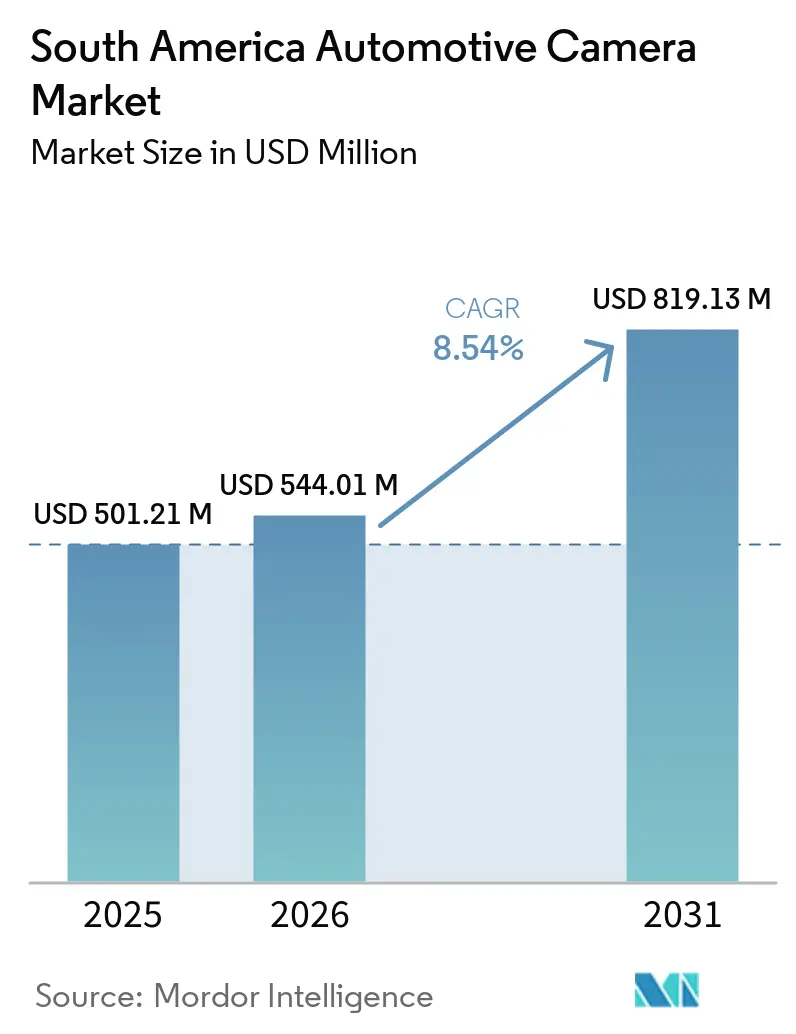
The South American automotive camera market was valued at USD 501.21 million in 2025 and is projected to expand from USD 544.01 million in 2026 to USD 819.13 million by 2031, registering a CAGR of 8.54% between 2026 and 2031. Brazil’s completed rear-visibility implementation and its expanding driver-assistance rules have moved cameras from optional equipment toward standard vehicle content. The South American automotive camera market also benefits from Chinese vehicle makers that offer camera-based features on lower-priced models, increasing pressure on established manufacturers to include similar equipment. Vehicle production, fleet electrification, and local supply arrangements shape the opportunity differently across the region. Demand is strongest where regulations, assembly activity, and commercial fleet requirements support camera installation. Currency weakness, expensive vehicle financing, tariffs, and separate national approvals could limit the pace at which lower-cost vehicles receive more advanced camera packages.
Key Report Takeaways
- By vehicle type, passenger vehicles accounted for 73.84% of the South American automotive camera market share in 2025 and are projected to grow at a 11.87% CAGR through 2031.
- By propulsion and fuel type, ICE vehicles held 72.68% of the regional automotive camera revenue share in 2025, while BEVs are forecast to grow at an 11.24% CAGR through 2031.
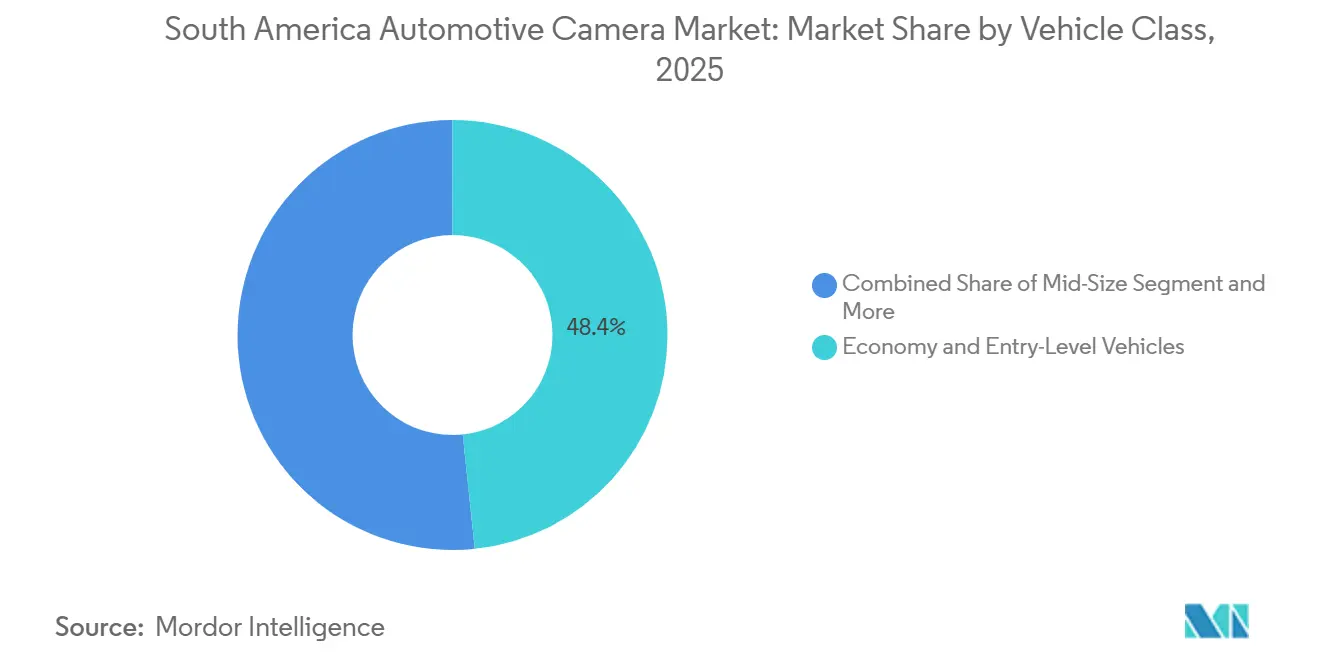
- By vehicle class, economy and entry-level vehicles accounted for 48.35% of revenue in 2025 and are projected to grow at a 9.12% CAGR through 2031.
- By sales channel, dealer and retail sales held 53.16% of revenue in 2025, while online direct-to-consumer sales are forecast to grow at an 11.18% CAGR through 2031.
- By end user, individual and private buyers held 62.58% of revenue in 2025, while mobility operators are forecast to grow at an 11.09% CAGR through 2031.
- By country, Brazil accounted for 36.74% of regional revenue in 2025 and is forecast to grow at a 9.18% CAGR through 2031.
Note: Market size and forecast figures in this report are generated using Mordor Intelligence’s proprietary estimation framework, updated with the latest available data and insights as of January 2026.
South America Automotive Camera Market Trends and Insights
Drivers Impact Analysis*
| Driver | (~) % Impact on CAGR Forecast | Geographic Relevance | Impact Timeline |
|---|---|---|---|
| Chinese OEM Price and Feature Competition | +1.8% | Brazil, Argentina, Colombia | Short term (≤ 2 years) |
| OEM Nearshoring and Regional Value Content Compliance | +1.4% | South America supply chain | Medium term (2-4 years) |
| Vehicle Safety and ADAS-Linked Incentive Programs in Brazil | +1.2% | Brazil | Short term (≤ 2 years) |
| Electrified Fleet and Public Transport Procurement | +0.9% | Chile, Colombia, Brazil | Medium term (2-4 years) |
| E-Commerce-Driven Last-Mile Fleet Demand | +0.8% | Brazil, Colombia | Short term (≤ 2 years) |
| Digital Vehicle Retail, Trade-In and Financing Platforms | +0.6% | Brazil, Colombia, Argentina | Medium term (2-4 years) |
| Source: Mordor Intelligence | |||
Chinese OEM Price and Feature Competition
Chinese automakers have raised the standard level of camera equipment in the South American automotive camera market. Their models commonly include surround-view cameras, forward-collision warning, and lane-departure assistance at prices previously associated with basic internal-combustion vehicles. This has encouraged manufacturers such as Stellantis and Volkswagen to bring camera integration forward on economy models. Volkswagen’s planned investment in South America of BRL 20 billion (approximately USD 3.93 billion) demonstrates how competitive product changes can affect camera adoption across the South American automotive camera market[1] "VW increases models to be launched in South America," Marklines, marklines.com.
OEM Nearshoring and Regional Value Content Compliance
Regional trade disciplines and stricter national regulations that require high regional-content thresholds are increasingly influencing the South American automotive supply chain. Under Mercosur trade frameworks, passenger vehicles must meet specific Regional Content Index (RCI) requirements, often maintaining a 50% regional content baseline between major hubs such as Brazil and Argentina, to qualify for preferential tariff-free cross-border trade. This regulatory environment creates stronger incentives for manufacturers to localize high-technology electronics, including vehicle camera modules, advanced driver-assistance systems (ADAS), and telematics systems, which have historically relied heavily on imported components.
Vehicle Safety and ADAS-Linked Incentive Programs in Brazil
Brazil’s MOVER program links automotive tax incentives with investments in vehicle safety, technology, and driver-assistance systems. Companies seeking program benefits are required to allocate between 0.3% and 1.8% of eligible gross automotive product revenue to research and development. The program also provides tax advantages for hybrid flex-fuel and ethanol vehicles through December 2026. InTec's scoring framework assigns value to safety technologies such as automatic emergency braking systems that rely on camera-based sensing. This increases the relevance of camera systems across flex-fuel, ethanol, hybrid, and electric vehicle platforms rather than limiting adoption to premium vehicles. Continued development of camera and radar technologies in Brazil can also support greater localization of automotive sensing systems.
Electrified Fleet and Public-Transport Procurement
The electric bus fleet in South America and the Caribbean grew strongly in 2025, reaching 9,115 vehicles—a 40% increase from the previous year and a tenfold increase since 2017 [2]Jefferson Hishiyama da Silva, "Electric bus market in Latin America, 2025," ICCT, theicct.org. The adoption of battery-electric buses (BEBs) primarily drove this growth, as BEBs increasingly surpassed trolleybuses as the region’s dominant electric bus type. The regional market remained highly concentrated, with Chile, Colombia, and Brazil accounting for 80% of the fleet. Deployments were concentrated in a few major cities. Buses measuring 12–15 meters were the predominant electric bus type and accounted for the vast majority of vehicles in operation. BYD, Foton, and Yutong were the leading electric bus manufacturers in the region.
Restraints Impact Analysis*
| Restraint | (~) % Impact on CAGR Forecast | Geographic Relevance | Impact Timeline |
|---|---|---|---|
| High Borrowing Costs and Currency-Driven Affordability Pressure | -1.5% | Brazil, Argentina, Colombia, Peru | Short term (≤ 2 years) |
| Import Tariffs and Fragmented National Homologation | -1.2% | Brazil, Andean markets | Medium term (2-4 years) |
| CKD, Battery and Automotive-Chip Logistics Exposure | -0.8% | Brazil | Short term (≤ 2 years) |
| High Cost of Advanced ADAS Camera Systems | -0.5% | Argentina, Peru, Ecuador, Rest of South America | Long term (≥ 4 years) |
| Source: Mordor Intelligence | |||
High Borrowing Costs and Currency-Driven Affordability Pressure
High vehicle financing costs across several South American countries limit the amount consumers are willing to spend on optional vehicle features. Currency depreciation in markets such as Brazil and Argentina can also increase the local cost of imported camera modules and electronic components. When local purchasing power does not keep pace with component costs, manufacturers may prioritize simpler camera packages for economy vehicles. This can reduce average camera revenue per vehicle even when overall vehicle volumes increase. Weak consumer demand and production adjustments in markets such as Argentina can further affect the number of camera-equipped vehicles entering secondary and aftermarket channels.
Import Tariffs and Fragmented National Homologation
Brazil applies a 35% import tariff on completely assembled and semi-knocked-down (SKD) vehicles, increasing costs at the points where camera-related components and vehicle supply chains cross international borders[3]"Resolutions from the 238th Ordinary Meeting of the Executive Management Committee (Gecex)," Ministry of Development, Industry, Trade and Services, gov.br . Differences in approval and homologation frameworks across Brazil and Andean markets require suppliers to maintain market-specific qualification and compliance processes. Differences in rear-visibility and camera-related requirements across countries limit suppliers' ability to fully standardize products across the region. This fragmentation can constrain economies of scale and maintain pricing pressure, particularly in the entry-level automotive camera segment.
*Our forecasts treat driver/restraint impacts as directional, not additive. The impact forecasts reflect baseline growth, mix effects, and variable interactions.
Segment Analysis
By Vehicle Type: Passenger Vehicles Define Revenue Concentration
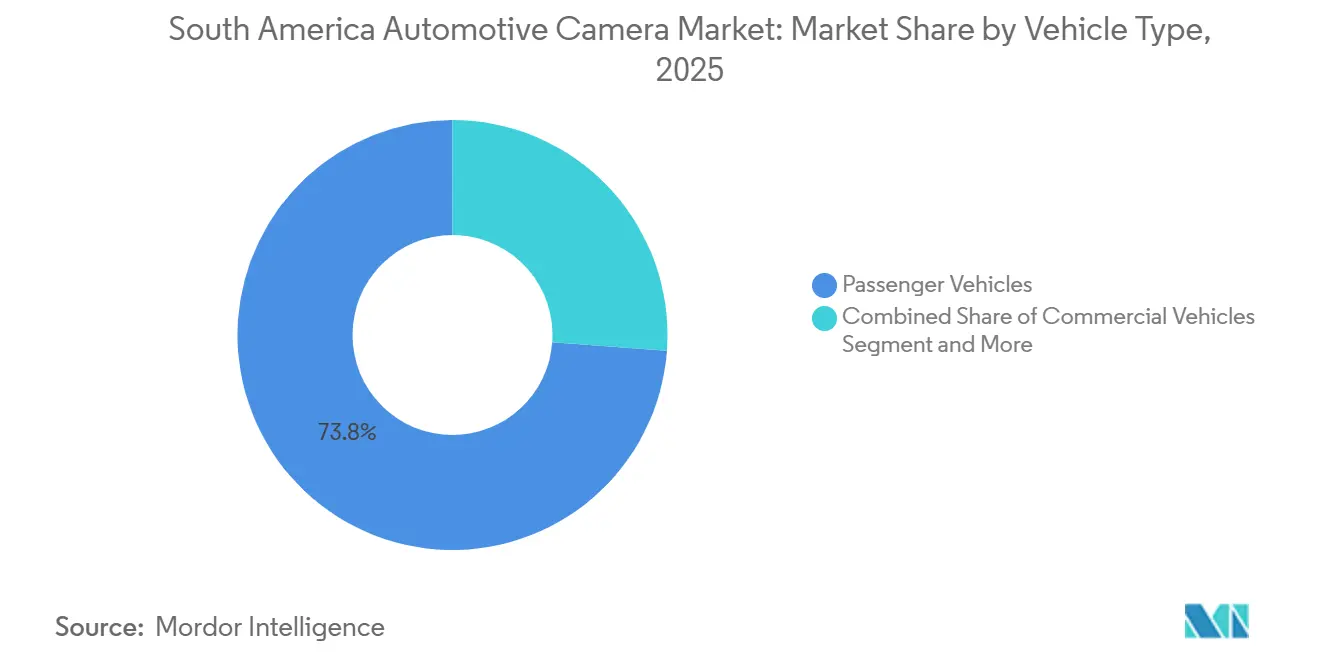
Passenger Vehicles accounted for 73.84% of the South American automotive camera market in 2025, making them the dominant vehicle category. Passenger cars are also expected to remain the fastest-growing segment, registering an 11.87% CAGR from 2026 to 2031. Increasing adoption of rear-view cameras, parking assistance, surround-view systems, and camera-based ADAS is expanding camera content across sedans, hatchbacks, SUVs, and crossovers. SUVs and crossovers generally feature more camera content due to their larger dimensions and greater integration of driver-assistance and parking technologies. As these features increasingly move into mainstream models, passenger cars are expected to remain the primary contributor to regional camera demand.
Commercial vehicles represent the second major application area, supported by increasing use of cameras for blind-spot monitoring, rear visibility, fleet safety, and video telematics. Light commercial vehicles benefit from growing fleet and logistics applications, while heavy trucks and buses have greater requirements for multi-camera visibility systems. Off-highway and specialized vehicles remain smaller applications but provide additional opportunities for camera-based monitoring and safety systems.



By Propulsion and Fuel Type: BEV Growth Changes Camera Content Economics
Internal-combustion engine vehicles accounted for 72.68% of the South American automotive camera market in 2025, reflecting the region's large installed base of ICE vehicles. Battery-electric vehicles are expected to be the fastest-growing propulsion segment, registering an 11.24% CAGR from 2026 to 2031. Electrified vehicles increasingly incorporate multiple cameras for parking, surround-view monitoring, driver assistance, and automated safety functions. As EV penetration increases, higher camera content per vehicle is expected to support camera revenue growth beyond the underlying increase in vehicle volumes.
ICE vehicles will nevertheless remain the primary source of camera demand during the forecast period because of their significantly larger installed base. Hybrid, flex-fuel, and ethanol-powered vehicles, particularly in Brazil, provide an additional transition segment in which camera-based safety and convenience features are increasingly incorporated. The propulsion mix is therefore expected to evolve gradually, with BEVs contributing an increasing share of new camera installations while ICE vehicles continue to anchor the existing market.
By Sales Channel: Dealer and Retail Sales Remain the Primary Route
Dealer and retail sales accounted for 53.16% of the South American automotive camera market in 2025. Online direct-to-consumer sales are expected to be the fastest-growing channel, with an 11.18% CAGR from 2026 to 2031. Dealer channels remain important because factory-fitted camera systems are typically integrated into vehicle trims, option packages, and OEM safety configurations. Consumers generally purchase these systems as part of the vehicle rather than as standalone components.
Online channels are gaining relevance as consumers become more comfortable comparing camera specifications, prices, compatibility, and installation requirements digitally. This is particularly relevant to aftermarket products such as rear-view cameras, parking cameras, dash cameras, and retrofit ADAS systems. Digital channels can also improve product visibility among price-sensitive buyers and smaller fleet operators.
By End User: Private Buyers Dominate While Mobility Operators Expand Rapidly
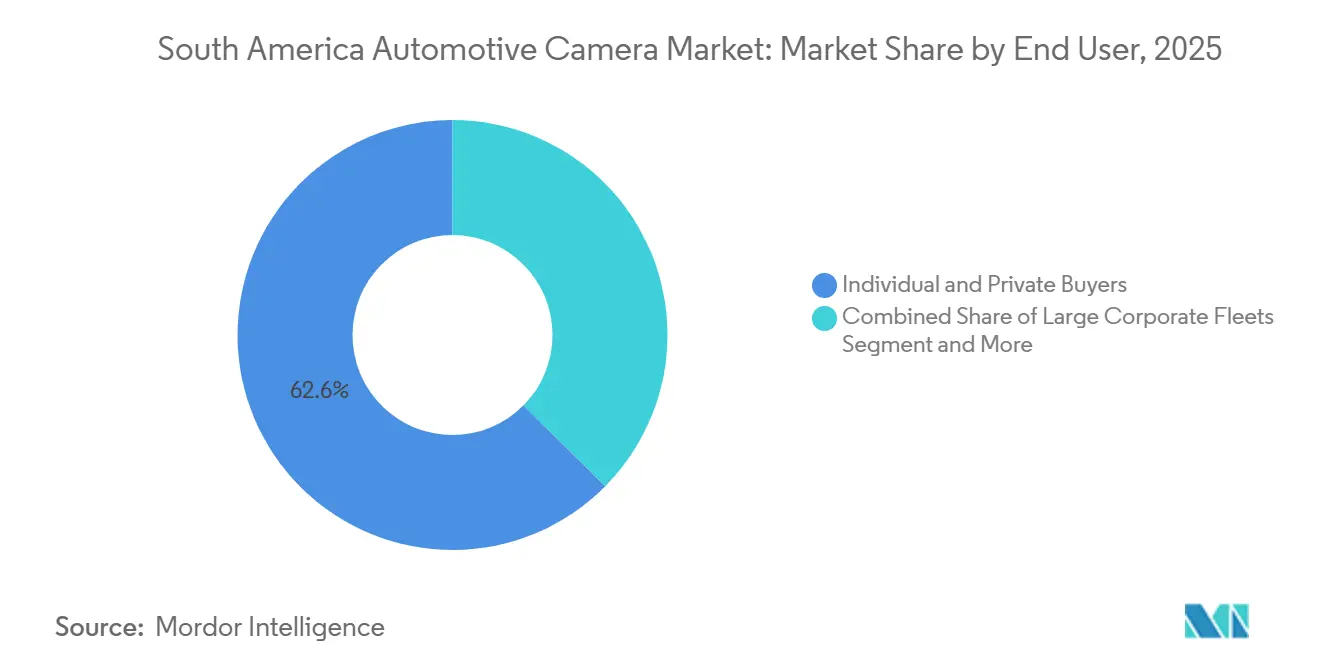
Individual and private buyers accounted for 62.58% of the South American automotive camera market in 2025. Mobility operators are projected to be the fastest-growing end-user segment, recording an 11.09% CAGR from 2026 to 2031. Private vehicle owners remain the largest customer base due to the substantial passenger-vehicle population and the increasing availability of factory-fitted camera systems.
Mobility operators, including ride-hailing companies, delivery fleets, rental fleets, and subscription-based mobility providers, increasingly use camera systems for safety, incident recording, driver monitoring, and liability management. Fleet applications can also require multiple cameras per vehicle, increasing the amount of camera content compared with conventional private-vehicle applications. The expansion of commercial video telematics and fleet management solutions is expected to further support this segment.
By Vehicle Class: Economy Vehicles Anchor Market Volume
Economy and entry-level vehicles accounted for 48.35% of the South American automotive camera market in 2025 and are expected to remain the fastest-growing vehicle class, with a 9.12% CAGR from 2026 to 2031. The segment's leading position reflects the importance of affordable vehicles across South American markets and the increasing inclusion of basic camera functionality in lower-priced models.
Rear-view and parking cameras are becoming increasingly common in economy vehicles as OEMs seek to improve safety and maintain feature competitiveness. Chinese manufacturers are contributing to this trend by offering higher levels of standard equipment at competitive price points. Established manufacturers are responding by expanding camera availability across entry-level and mid-range models. While premium vehicles continue to generate higher camera content per vehicle, economy models provide a substantially larger installed-volume opportunity.
Geography Analysis
Brazil accounted for 36.74% of the South American automotive camera market in 2025. The country combines a large domestic vehicle assembly base, established safety requirements, growing electrification, and increasing local production by Chinese manufacturers. Its regulatory framework provides a relatively strong foundation for camera-based safety technology, while MOVER further supports the adoption of advanced vehicle technologies. São Paulo's expanding electric bus fleet also underscores Brazil’s importance in the market for camera-equipped public transport and passenger vehicles.
Brazil is projected to grow at a 9.18% CAGR from 2026 to 2031. The expansion of electric-vehicle sales and charging infrastructure provides an additional source of demand for cameras. Chinese manufacturers are also exploring expanded production capacity in the region, potentially increasing the localization of camera modules and camera-equipped vehicle production.
Chile, Colombia, Argentina, Peru, Ecuador, and other South American countries form a second group with varying regulatory, economic, and purchasing conditions. Chile’s electric bus fleet reached approximately 2,505 vehicles in 2025 and is projected to reach around 4,400 by the end of 2026. Colombia’s electric-vehicle growth and Bogotá’s electric bus procurement are supporting commercial camera demand. Argentina continues to support the production and model updates of camera-equipped vehicles, although macroeconomic conditions constrain demand. Peru and Ecuador remain relatively early-stage markets, creating opportunities for aftermarket distributors and fleet-focused suppliers as camera adoption expands.
Competitive Landscape
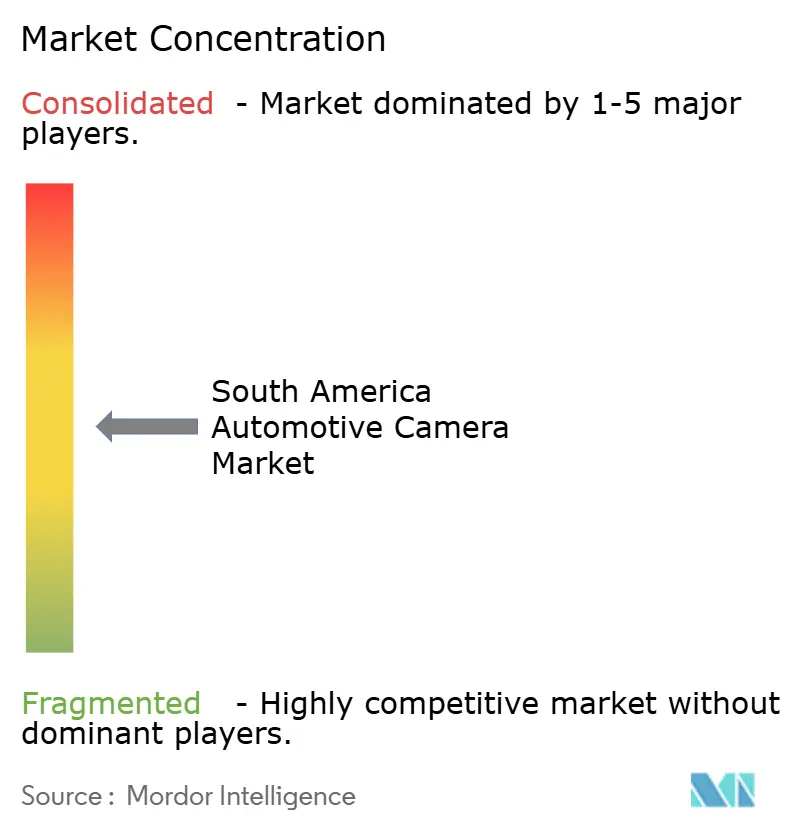
The South American automotive camera market is moderately concentrated at the vehicle manufacturer level. Stellantis accounted for 20% of regional vehicle sales, equivalent to 563,000 vehicles, between January and July 2026, and 27% of vehicle sales in Brazil. This position makes Stellantis a major channel for camera-equipped vehicles in the region. At the camera supplier level, Bosch, Continental, Valeo, and ZF Friedrichshafen supply major OEM-fit camera modules. Their engineering and validation operations near Brazilian assembly plants support their established market positions. Mobileye’s EyeQ platform also highlights the growing role of software-integrated driver-assistance systems in OEM supply agreements.
The aftermarket and fleet-retrofit segment is more fragmented than the OEM supply segment. Distributors and specialized camera and telematics providers compete in this segment, particularly for small and medium-sized fleets. Lower-priced Chinese camera modules can compete in certain Andean markets. However, Brazil’s certification requirements may protect incumbent suppliers in the region’s largest national market. Stellantis plans to begin production of Leapmotor vehicles at its Goiana facility in November 2026, introducing Chinese camera and driver-assistance architectures into South American vehicle production. Volkswagen’s hybrid vehicle initiatives in São Bernardo do Campo further demonstrate how manufacturers are adapting product strategies to electrification and feature-based competition.
Supplier proximity to vehicle assembly clusters remains important for engineering support, validation, and compliance with local-content requirements. Bosch’s presence in Campinas and Continental’s operations in the ABC Paulista region position these suppliers near major vehicle production sites. This proximity gives established suppliers an advantage that smaller competitors may find difficult to replicate. Camera systems increasingly integrate hardware and software, further strengthening suppliers with established OEM development relationships. Regional engineering investments by established suppliers underscore the need to maintain these relationships as local-content requirements gain importance.
South America Automotive Camera Industry Leaders
-
Continental AG
-
Valeo SE
-
Robert Bosch GmbH
-
Aptiv PLC
-
ZF Friedrichshafen AG
- *Disclaimer: Major Players sorted in no particular order

Recent Industry Developments
- July 2026: Stellantis confirmed that Leapmotor vehicle production will begin at its Goiana, Pernambuco facility in Brazil, introducing Chinese camera and ADAS architectures into Fiat and Peugeot model platforms across South America, with 4 new electrified models announced through the Dongfeng partnership.
- February 2026: BYD has publicly committed to sourcing 50% of vehicle components locally at its Camaçari facility in Brazil by the end of 2026. The company also plans to export vehicles to Argentina and other countries. Total planned investment in the site amounts to BRL 5.5 billion (approximately USD 1.1 billion), with capacity expected to scale to 300,000 units annually.


South America Automotive Camera Market Report Scope
The South American automotive camera market is segmented by vehicle type, propulsion, fuel type, vehicle class, sales channel, end user, and country. By vehicle type, the market is segmented into passenger, commercial, and off-highway vehicles. By propulsion and fuel type, the market is segmented into internal-combustion engine vehicles and electrified vehicles. By vehicle class, the market is segmented into economy and entry-level, midsize, full-size, and premium. By sales channel, the market is segmented into OEM-owned stores, independent dealers, fleet and corporate sales, and online direct-to-consumer. By end user, the market is segmented into individual and private buyers, SME fleets, large corporate fleets, government and municipal fleets, and mobility operators. By country, the market is segmented into Brazil, Argentina, Colombia, Chile, Peru, Ecuador, and the rest of South America. The report provides market size and forecasts for value (USD) and volume (units) across all the above-mentioned segments.
By Vehicle Type
| Passenger Vehicles | Hatchbacks |
| Sedans | |
| SUVs and Crossovers | |
| Multi-Purpose Vehicles | |
| Commercial Vehicles | Light Commercial Pickups |
| Light Commercial Vans | |
| Heavy Trucks | |
| Buses and Coaches | |
| Off-Highway Vehicles | Agricultural Tractors |
| Construction Equipment |
By Propulsion and Fuel Type
| Internal-Combustion Engine Vehicles | Gasoline |
| Diesel | |
| Flexible-Fuel and Ethanol | |
| CNG and LNG | |
| Electrified Vehicles | Battery-Electric Vehicles |
| Hybrid Electric Vehicles | |
| Plug-In Hybrid Electric Vehicles | |
| Fuel-Cell Electric Vehicles |
By Vehicle Class
| Economy and Entry-Level |
| Mid-Size |
| Full-Size and Premium |
By Sales Channel
| OEM-Owned Stores |
| Independent Dealers |
| Fleet and Corporate Sales |
| Online Direct-to-Consumer |
By End User
| Individual and Private Buyers |
| Small and Medium-Sized Enterprise Fleets |
| Large Corporate Fleets |
| Government and Municipal Fleets |
| Mobility Operators |
By Country
| Brazil |
| Argentina |
| Colombia |
| Chile |
| Peru |
| Ecuador |
| Rest of South America |
| By Vehicle Type | Passenger Vehicles | Hatchbacks |
| Sedans | ||
| SUVs and Crossovers | ||
| Multi-Purpose Vehicles | ||
| Commercial Vehicles | Light Commercial Pickups | |
| Light Commercial Vans | ||
| Heavy Trucks | ||
| Buses and Coaches | ||
| Off-Highway Vehicles | Agricultural Tractors | |
| Construction Equipment | ||
| By Propulsion and Fuel Type | Internal-Combustion Engine Vehicles | Gasoline |
| Diesel | ||
| Flexible-Fuel and Ethanol | ||
| CNG and LNG | ||
| Electrified Vehicles | Battery-Electric Vehicles | |
| Hybrid Electric Vehicles | ||
| Plug-In Hybrid Electric Vehicles | ||
| Fuel-Cell Electric Vehicles | ||
| By Vehicle Class | Economy and Entry-Level | |
| Mid-Size | ||
| Full-Size and Premium | ||
| By Sales Channel | OEM-Owned Stores | |
| Independent Dealers | ||
| Fleet and Corporate Sales | ||
| Online Direct-to-Consumer | ||
| By End User | Individual and Private Buyers | |
| Small and Medium-Sized Enterprise Fleets | ||
| Large Corporate Fleets | ||
| Government and Municipal Fleets | ||
| Mobility Operators | ||
| By Country | Brazil | |
| Argentina | ||
| Colombia | ||
| Chile | ||
| Peru | ||
| Ecuador | ||
| Rest of South America | ||


Key Questions Answered in the Report
What is the forecast for the South America automotive camera market?
The market is projected to grow from USD 544.01 million in 2026 to USD 819.13 million by 2031, at an 8.54% CAGR, supported by ADAS adoption, electrification, Chinese OEM penetration, and expanding vehicle assembly.
Which vehicle type generates the most automotive camera demand in South America?
Passenger vehicles accounted for 73.84% of 2025 revenue, supported by rising factory-fit rear-view, surround-view, and driver-assistance camera adoption across mainstream vehicles.
Why are battery-electric vehicles important for automotive camera sales?
BEVs are projected to grow at an 11.24% CAGR, as electrified vehicles typically incorporate greater camera and sensor content, while hybrid and electric-bus programs provide additional demand.
Which country leads automotive camera adoption in South America?
Brazil accounted for 36.74% of 2025 revenue, supported by local vehicle production, safety requirements, MOVER incentives, and increasing electrified and camera-equipped vehicle adoption.
How do fleet operators affect camera demand in South America?
Mobility operators are projected to grow at an 11.09% CAGR, with ride-hailing, delivery, corporate, and municipal fleets increasingly adopting cameras for safety, telematics, insurance, and liability management.
What limits wider adoption of vehicle cameras in South America?
High financing costs, currency depreciation, import tariffs, and fragmented national homologation requirements can raise system costs and slow adoption, particularly in economy vehicle
Page last updated on:





