
Market Overview
| Study Period | 2020 - 2031 |
|---|---|
| Forecast Data Period | 2026 - 2031 |
| Base Year Market Size (2025) | USD 3.42 Billion |
| Market Size (2026) | USD 3.69 Billion |
| Market Size (2031) | USD 5.91 Billion |
| Growth Rate (2026 - 2031) | 9.88 % |
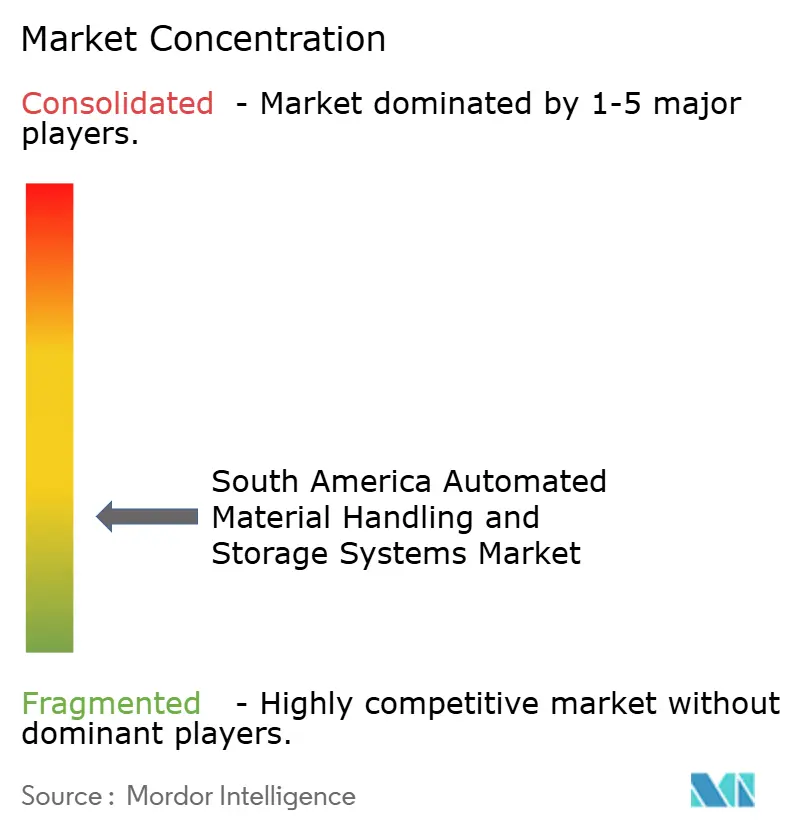
| Market Concentration | Low |
Major Players *Disclaimer: Major Players sorted in no particular order Image © Mordor Intelligence. Reuse requires attribution under CC BY 4.0. | |
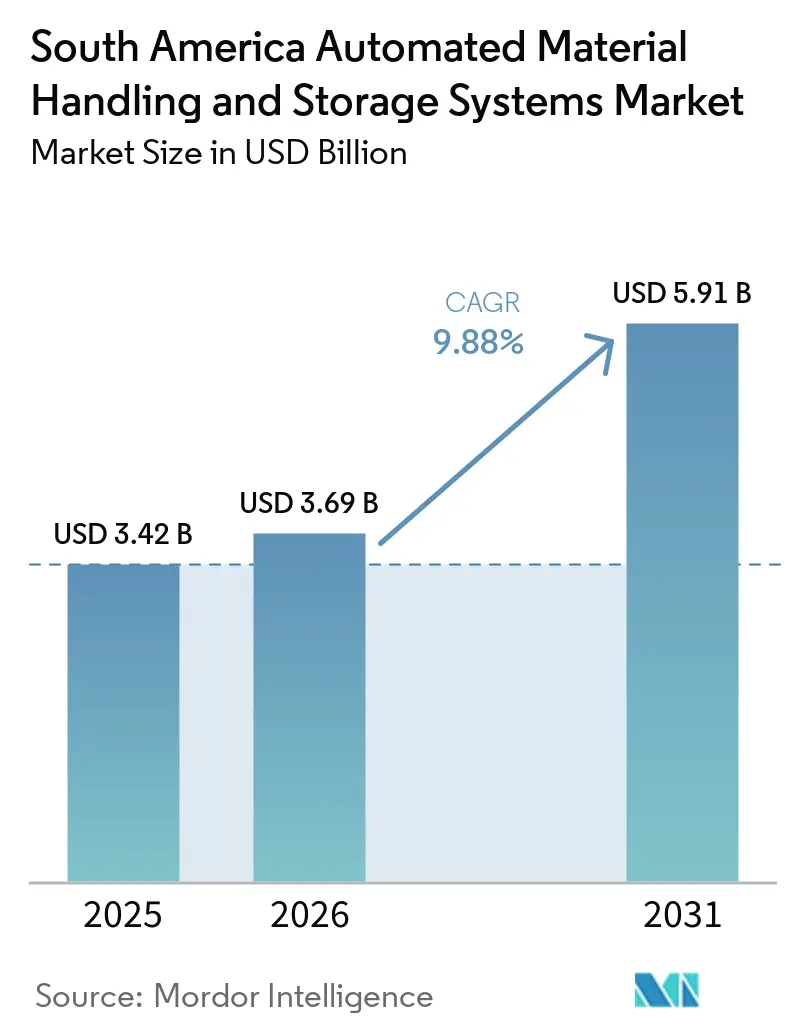
South America Automated Material Handling and Storage Systems Market Analysis by Mordor Intelligence
The South America automated material handling and storage systems market size was valued at USD 3.42 billion in 2025 and estimated to expand from USD 3.69 billion in 2026 to reach USD 5.91 billion by 2031, at a CAGR of 9.88% during the forecast period (2026-2031). Faster fulfillment requirements are increasing demand for conveyors, robotics, and integrated control systems across retail, logistics, and manufacturing sites. Brazil remains the region's main spending center because its distribution and industrial base can support larger automation projects. Colombia is expected to gain momentum as nearshoring activity expands demand along trade corridors and distribution networks. Suppliers are increasingly combining equipment, software, installation, and maintenance services because customers need systems that work together from commissioning through daily operations. Modular projects create an opening among mid-sized operators, although capital costs, integration work, power reliability, and engineering skills continue to slow deployment.
Key Report Takeaways
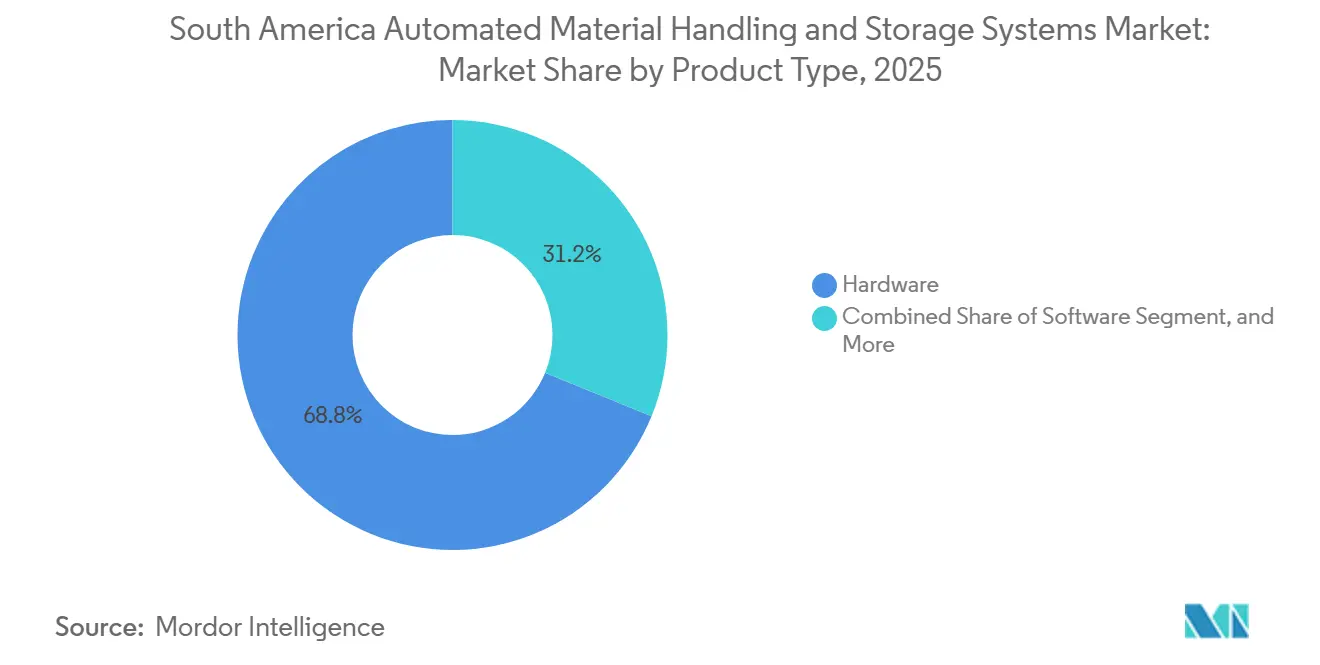
- By product type, hardware held 68.83% of the South America automated material handling and storage systems market share in 2025, while software is projected to expand at a 10.48% CAGR through 2031.
- By equipment type, automated conveyors accounted for 29.31% revenue share in 2025, while autonomous mobile robots are expected to register a 10.87% CAGR through 2031.
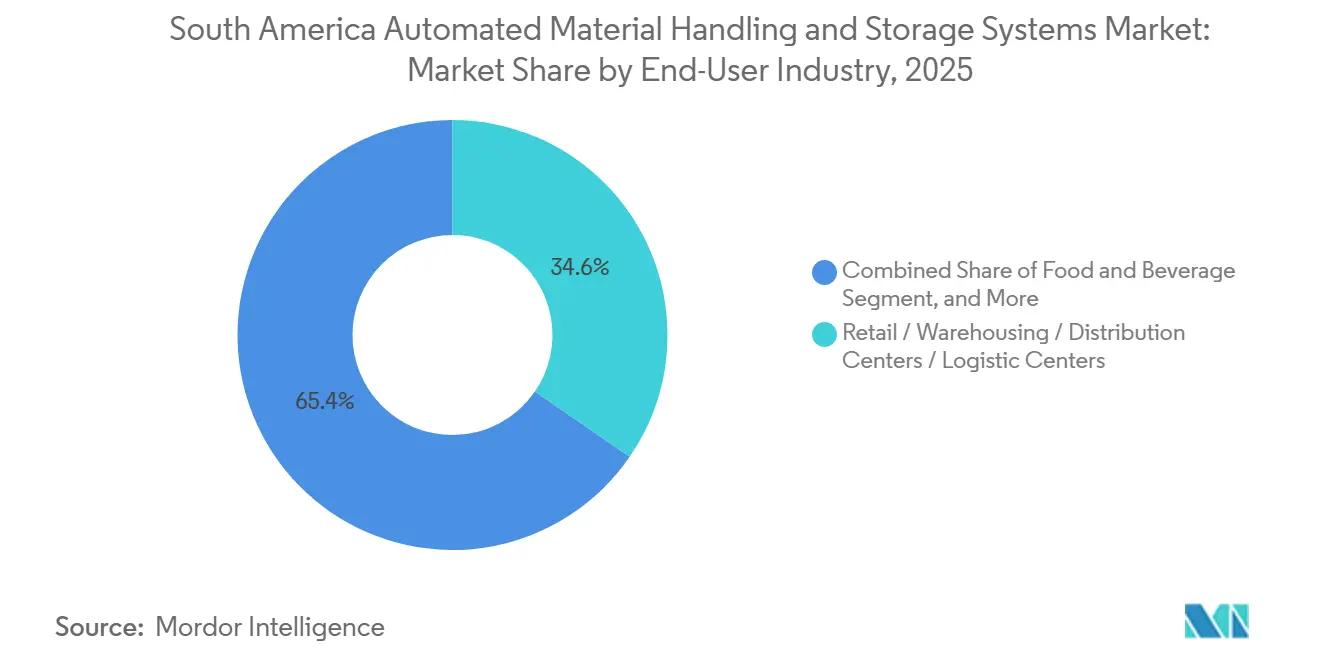
- By end-user industry, retail, warehousing, distribution centers, and logistics centers represented 34.58% share in 2025, while post and parcel is projected to expand at an 11.64% CAGR through 2031.
- By function, transportation held 33.26% share in 2025, while sorting is expected to expand at a 10.76% CAGR through 2031.
- By geography, Brazil accounted for 62.92% share in 2025, while Colombia is projected to expand at a 10.61% CAGR through 2031.
Note: Market size and forecast figures in this report are generated using Mordor Intelligence’s proprietary estimation framework, updated with the latest available data and insights as of January 2026.
Market Trends and Insights
Drivers Impact Analysis of South America Automated Material Handling and Storage Systems Market*
| Driver | (~) % Impact on CAGR Forecast | Geographic Relevance | Impact Timeline |
|---|---|---|---|
| E-Commerce and Omnichannel Fulfillment Expansion | +2.2% | Brazil core, spillover to Colombia and Argentina | Short term (≤ 2 years) |
| Labor Scarcity and Rising Handling Costs | +1.8% | Brazil, Argentina, and Colombia | Short term (≤ 2 years) |
| Warehouse Space Optimization and Inventory Accuracy | +1.3% | Brazil core, Chile and Colombia secondary | Medium term (2-4 years) |
| Manufacturing Modernization and Industry 4.0 Adoption | +1.2% | Brazil, Colombia, and Argentina | Medium term (2-4 years) |
| Brownfield Automation Through Modular Mobile Robotics | +1.0% | Brazil and Colombia | Short term (≤ 2 years) |
| Brazil-Led Regional Fulfillment Infrastructure Investment | +0.9% | Brazil primary, with regional spillover | Medium term (2-4 years) |
| Source: Mordor Intelligence | |||
E-Commerce and Omnichannel Fulfillment Expansion
South American e-commerce activity is placing new demands on the speed and consistency of regional distribution networks. The regional e-commerce sector is projected to exceed USD 215 billion in 2026, with an expansion rate 1.5 times the global average. MercadoLibre announced a BRL 57 billion (USD 10 billion) investment plan for Brazil in 2026, including 14 new distribution centers, bringing its network to 42 locations.[1] This expansion makes fulfillment capacity a fixed operating capability rather than a service purchased only when volumes rise. Operators in São Paulo and Rio de Janeiro need compact systems that can support short order-to-dispatch cycles in urban fulfillment sites. Conveyor sortation and autonomous mobile robot picking systems are therefore relevant where order volumes and product ranges change frequently. Lower payment processing costs through Brazil's Pix system can also leave operators with more working capital for automation projects.
Labor Scarcity and Rising Handling Costs
Brazil's labor structure raises the effective cost of manual handling and strengthens the business case for automation. The reported effective hourly cost can be 70% to 100% higher than base wages because of the country's employment-related obligations. Import levies can also raise the delivered price of automation equipment to 2 to 3 times comparable prices in the United States. These conditions favor local suppliers that can compete on operating cost, integration support, and service availability rather than equipment price alone. WEG and Senior Sistemas demonstrated a Brazilian-developed AMR-WMS integration in 2025, and the companies reported typical returns in under 18 months.[2] Financing from BNDES can further reduce the upfront burden for eligible projects, particularly where automation is linked to industrial modernization.
Warehouse Space Optimization and Inventory Accuracy
High urban land costs are encouraging warehouse operators to use vertical space more effectively rather than expanding building footprints. Automated storage and retrieval systems, vertical lift modules, and high-bay robot fleets help sites increase storage density within existing facilities. HAI Robotics deployed its HaiPick System 3 at RD Saúde's Viana facility in Brazil, using 12-meter storage to provide 62,000 locations and designed throughput of 1,140 totes per hour. Pharmaceutical distribution also requires traceability for regulated goods, which raises the value of accurate inventory controls in cold-chain operations. Food and beverage distributors face similar pressure where product handling and inventory records must remain reliable. The South America automated material handling and storage systems market can therefore benefit when automation supports both compliance and warehouse productivity.
Manufacturing Modernization and Industry 4.0 Adoption
Industrial modernization programs are supporting investment in connected manufacturing and internal material flow systems. Brazil has earmarked BRL 186.6 billion, equal to USD 37.3 billion, for industrial modernization and aims to increase the share of digitalized firms from 23.5% to 90% by 2033. BNDES also maintains a BRL 10 billion Industry 4.0 credit line at the SELIC rate minus 1.5% for automation, robotics, and connected infrastructure. Colombia's Bancoldex programs provide a similar policy direction, although a shortage of integration specialists limits project uptake. Connected factory systems can provide operating data to support later automation decisions once an initial installation is in place. Argentina's duty exemptions for advanced industrial controls add support for automotive and heavy manufacturing sites that are reconfiguring production lines.
Restraints Impact Analysis of South America Automated Material Handling and Storage Systems Market*
| Restraint | (~) % Impact on CAGR Forecast | Geographic Relevance | Impact Timeline |
|---|---|---|---|
| High Upfront Capital and Extended Payback Periods | -2.5% | Brazil and Argentina, with South America-wide relevance | Short term (≤ 2 years) |
| Integration Complexity Across WMS, ERP, and Controls | -1.8% | South America-wide, highest in Argentina and Colombia | Medium term (2-4 years) |
| Power Reliability and Maintenance-Service Constraints | -1.2% | Argentina, northern Andes, and Rest of South America | Long term (≥ 4 years) |
| Limited Local Availability of Specialized Automation Talent | -0.9% | South America-wide, acute in Colombia and Peru | Long term (≥ 4 years) |
| Source: Mordor Intelligence | |||
High Upfront Capital and Extended Payback Periods
A robotic material handling cell can cost 2.5 to 4 times the base equipment price once tooling, guarding, programming, and commissioning are included. Imported equipment can carry an additional cost burden in Brazil because several duties apply to the delivered system. High interest rates in Brazil and Argentina lengthen the financial return period for operators that cannot fund projects internally. Currency volatility in Argentina caused some textile and industrial manufacturers to postpone planned upgrades during 2024 and 2025. Suppliers are responding with starter systems below USD 50,000 and emerging subscription models for robotics, but contract complexity can discourage cautious buyers. Brazil's ongoing move to a dual value-added tax structure could reduce procurement delays and lower import costs once the transition is complete.
Integration Complexity Across WMS, ERP, and Controls
Many facilities in South America use separate ERP, manufacturing execution, warehouse management, and legacy control systems. This fragmented base makes modern automation projects more difficult because data and workflows must be aligned before a system can operate reliably. Integration work can be the largest discretionary item in a software deployment budget and can rival hardware costs. Commissioning schedules also tend to exceed global benchmarks when systems of different ages and designs must exchange operational data. Dematic showed an AI-based multi-code reading system in 2026 that processes 6,000 boxes per hour without label application, reducing dependence on clean upstream warehouse data. Brazil's LGPD data rules impose governance requirements on shared-network logistics projects and can raise the threshold for final system approval.
*Our forecasts treat driver/restraint impacts as directional, not additive. The impact forecasts reflect baseline growth, mix effects, and variable interactions.
South America Automated Material Handling and Storage Systems Market Segment Analysis
By Product Type:
Software Gains Ground Alongside HardwareHardware accounted for 68.83% of the South America automated material handling and storage systems market share in 2025. Conveyors, mobile robots, storage equipment, and automated storage systems accounted for the largest share of spending during the early phase of adoption. Hardware remains essential because physical movement, storage, and sorting cannot be delivered through software alone. Its leading position also reflects the large equipment purchases required for high-throughput distribution and production sites. Software is projected to expand at a 10.48% CAGR from 2026 to 2031. Warehouse management, execution, control, and fleet management platforms are now commonly included in AMR and ASRS projects. The South America automated material handling and storage systems market size for software is supported by buyers who need visibility across equipment and operating workflows. Integrated bids increasingly combine equipment, control layers, and operating data under a single supplier relationship.
Services cover installation, systems integration, maintenance, and support after a site begins operating. These activities remain important because many operators lack internal teams with deep automation engineering experience. The installed base is expanding in Brazil and Colombia, which creates a need for preventive maintenance arrangements. Remote monitoring and predictive maintenance are also becoming more relevant where equipment is connected through industrial internet systems. The service relationship can help operators identify performance issues before they interrupt fulfillment or production work. SENAI has expanded automation technician certification programs in partnership with equipment vendors, helping to develop the local service talent pipeline. WEG and Senior Sistemas also show how local software and equipment partnerships can make a bundled offer more relevant to Brazilian buyers.

By Equipment Type:
Conveyors Lead While AMRs Add FlexibilityAutomated conveyors held 29.31% of equipment revenue in 2025. They remain widely used in high-volume retail, e-commerce, airport, food, and beverage operations. Belt, roller, pallet, and overhead conveyor systems address different throughput and facility-layout requirements. Their established position reflects the continuing need for predictable movement across large sorting and fulfillment sites. Mobile robots include automated guided vehicles and autonomous mobile robots, which operate under distinct conditions. Automated guided vehicles are suitable for repeatable high-load routes in port and automotive environments. Autonomous mobile robots are projected to expand at a 10.87% CAGR from 2026 to 2031. The South America automated material handling and storage systems market supports their use because these units can be deployed in brownfield locations with less fixed infrastructure.
Automated storage and retrieval systems are being adopted where storage density and traceability are essential. Fixed-aisle cranes, carousels, and vertical lift modules are relevant to pharmaceutical, food and beverage, and electronics sites. HAI Robotics' deployment at RD Saúde used 85 robots and 62,000 storage locations within the existing Viana distribution center. Palletizers remain important for consumer goods operations that need repetitive handling of large volumes. Sortation equipment is also gaining attention as courier networks add regional hubs and manage a wider variety of parcels. Ypê completed an automated distribution center in Amparo in 2025, equipped with 77 autonomous robots and 50,000 pallet positions. Its layer-picking system supported mixed-SKU palletization at the facility. The equipment mix is widening as buyers seek systems that can support both stable high-volume work and more variable order flows.
By End-User Industry:
Retail Leads as Post and Parcel ExpandsRetail, warehousing, distribution centers, and logistics centers accounted for 34.58% of the South America automated material handling and storage systems market size in 2025. This position reflects the scale of Brazil's e-commerce distribution network and the need to shorten delivery times. Large platform operators are building fulfillment networks that give them greater control of storage, picking, and dispatch operations. MercadoLibre's 2026 Brazil program included 14 new distribution centers, increasing the network from 28 to 42 sites. Automotive sites continue to use conveyors and automated guided vehicles for line-side delivery. Electrified vehicle programs can require revised material flows and create demand for flexible internal transport. Food and beverage facilities are also adopting automated storage and picking, where cold-chain control and traceability requirements apply.
Post and parcel is expected to expand at an 11.64% CAGR from 2026 to 2031. Express couriers and last-mile providers need sortation capacity as parcel volumes increase across national networks. Loggi, Jadlog, and Correios-related operations illustrate the broad set of operators that can require automated parcel handling. General manufacturing contributes to demand across many facility types and production environments. Pharmaceutical companies need accurate storage and fulfillment processes because serialization and cold-chain requirements increase operational demands. Electronics and semiconductor manufacturers also require controlled movement and handling of components. Airport operations represent a smaller but specialized application for baggage and cargo automation in São Paulo and Rio de Janeiro. Mining, maintenance, cosmetics, and agricultural input distribution provide additional demand beyond the region's main industrial clusters.
By Function:
Transportation Maintains Scale as Sorting AcceleratesTransportation held 33.26% of functional revenue in 2025. It includes conveyors, automated guided vehicles, and AMR fleets that move goods between receiving, storage, picking, packing, and dispatch areas. The function remains central to large distribution centers because product movement links every part of the fulfillment process. Conveyor infrastructure has a strong role in Brazilian sortation and distribution sites with consistent flows. Storage is another important function and includes ASRS, vertical lift modules, and pallet shuttle systems. Urban facilities value cubic efficiency where additional horizontal space is limited or costly. Packaging and palletizing support producers of food, beverage, and consumer goods. Assembly and kitting applications are more common in automotive and electronics manufacturing facilities.
Sorting is projected to expand at a 10.76% CAGR from 2026 to 2031. Growing parcel volumes and a broader range of stock-keeping units make large-scale manual sortation difficult. Dematic's multi-code reading system was designed to process 6,000 boxes per hour without label application. Sorting systems can use warehouse management data to adjust batch allocation and routes based on current order profiles. This can reduce later picking work by directing items to the right workflow earlier. Assembly and kitting remain the smallest function by revenue share. Brazilian electronics and cosmetics contract manufacturers are using flexible robotic cells to handle more product variations without extensive manual reconfiguration. The South America automated material handling and storage systems market is therefore broadening beyond transport equipment toward more specialized operating functions.
Geography Analysis
Brazil Automated Material Handling and Storage Systems Market
Brazil held 62.92% of the South America automated material handling and storage systems market share in 2025. Its leading position is supported by the region's largest e-commerce activity and manufacturing base. The Brazilian industrial modernization program allocates BRL 186.6 billion (USD 37.3 billion) and aims for 90% digitalization among industrial firms by 2033. BNDES provides a BRL 10 billion Industry 4.0 credit line at the SELIC rate minus 1.5% for eligible automation projects. São Paulo's Guarulhos logistics corridor has concentrated high-throughput sites, including DHL Supply Chain's 50,000-square-meter automated hub with 120 AMRs. Brazil's tax reform is moving from fragmented levies to a dual value-added tax system during its 2026 transition period. This change is expected to reduce equipment procurement lead times and lower delivered import costs after implementation is complete.
Colombia and Argentina Automated Material Handling and Storage Systems Market
Colombia is projected to expand at a 10.61% CAGR from 2026 to 2031. Pacific trade corridors are attracting electronics assembly and pharmaceutical cold-chain exports associated with nearshoring activity. Bancoldex programs support automation and digital transformation, but a limited supply of integration skills has restricted their use. A.P. Moller-Maersk identified Colombia as an important Pacific-gateway logistics location in its 2025 regional update.[3] This position supports the demand for automated cargo-handling and inland distribution systems. Argentina remains important for automotive and fast-moving consumer goods despite recent macroeconomic instability. Andreani demonstrated continued investment in parcel automation by deploying high-speed sorters capable of processing 26,000 packages per hour.
South America Automated Material Handling and Storage Systems Market
The rest of South America includes Chile, Peru, Ecuador, Uruguay, Paraguay, and Bolivia. These countries contribute to demand in mining-related handling, agricultural logistics, and airport cargo operations. Chile has requirements and mining automation programs that create more focused demand for storage and conveyor systems. Peru's agricultural export cold chain supports demand for automated temperature-controlled storage. International AMR suppliers are increasingly using local systems integrators to enter these countries. This route reflects the value of local commissioning support, where in-house automation engineering capacity is limited.
Competitive Landscape
The South America automated material handling and storage systems market is fragmented, with global integrators, specialized equipment suppliers, and local Brazilian system builders serving different project sizes and applications. KION Group, operating through Dematic, STILL, Linde MH, and Daifuku, uses broad equipment and software portfolios to pursue larger multisite contracts. SSI Schaefer, Vanderlande, and Swisslog compete in automated storage and retrieval and airport logistics projects that require substantial application engineering. KION reported EUR 11.3 billion (USD 12.2 billion) in 2025, and renamed its Supply Chain Solutions segment Intelligent Automation Solutions from fiscal 2026. Interroll focuses on modular conveyor and sortation platforms. Mecalux has a local installation base in Brazil and Argentina, while Jungheinrich operates a manufacturing hub in São Paulo, Brazil. These suppliers can compete through their equipment range, local presence, and service capacity.
Local providers include Scheffer Logística e Automação, Automni Tecnologia, and Translift Sistemas de Movimentação. They compete on proximity, Portuguese-language support, and faster local service response times. This can be important for mid-sized buyers that do not meet the minimum project scale preferred by global suppliers. Global firms are responding by building deeper local service capabilities and offering more flexible system configurations. Smaller projects below USD 1 million represent a relevant opening among Brazilian companies that have not invested in large distribution-center automation. Pay-per-use AMR models and automation-as-a-service options can lower entry barriers for these operators. Suppliers are also differentiating through machine vision, AI-supported sortation, and digital tools for facility simulation.
KION displayed an AI-powered multi-code-reading conveyor system at Intermodal South America 2026, with a capacity of 6,000 boxes per hour without label application. The system demonstrates a focus on reducing data-quality barriers that often slow warehouse automation projects. KION also acquired a 70% stake in Smart Innovation NV in 2026 to advance the development of autonomous pallet trucks for production environments. The move supports technology development that may be relevant to warehouse and logistics operations in South America later. WEG and Senior Sistemas presented a locally developed AMR-WMS combination in 2025, integrating AI-based navigation with real-time order orchestration. HAI Robotics completed its pharmaceutical ASRS installation at RD Saúde, demonstrating how vertical storage and robot fleets can meet traceability and density requirements. Competition remains distributed across equipment categories, technology models, local service, and project scale rather than concentrated among a small group of suppliers.
South America Automated Material Handling and Storage Systems Industry Leaders
-
KION GROUP AG
-
DAIFUKU CO., LTD.
-
SSI SCHAEFER GROUP
-
Toyota Industries Corporation
-
Honeywell International Inc.
- *Disclaimer: Major Players sorted in no particular order
South America Automated Material Handling and Storage Systems Market Companies Covered in this Report
- DAIFUKU CO., LTD.
- KION GROUP AG
- SSI SCHAEFER GROUP
- Toyota Industries Corporation
- Honeywell International Inc.
- Vanderlande Industries B.V.
- Murata Machinery, Ltd.
- Mecalux, S.A.
- BEUMER Group GmbH & Co. KG
- KNAPP AG
- TGW Logistics Group GmbH
- Kardex Holding AG
- Swisslog Holding AG
- Fives Group
- Interroll Holding AG
- Jungheinrich AG
- Elettric 80 S.p.A.
- Scheffer Logística e Automação Ltda.
- Automni Tecnologia Ltda.
- Translift Sistemas de Movimentação Ltda.
Recent Industry Developments in South America Automated Material Handling and Storage Systems Market
- May 2026: KION South America, through its STILL and Dematic brands, participated in FEIND 2026 in Indaiatuba, São Paulo, presenting intralogistics and automation solutions at the location of its South American headquarters.
- April 2026: KION South America, through Dematic, STILL, and Linde MH, exhibited at Intermodal South America 2026 in São Paulo, launching an AI-powered multi-code reading conveyor system capable of processing 6,000 boxes per hour without label application, alongside AutoStore ASRS and autonomous AGV solutions, reinforcing its integrated supply chain automation strategy across Brazil.
- March 2026: MercadoLibre announced a BRL 57 billion investment plan for Brazil in 2026, equivalent to USD 10 billion, including 14 new distribution centers that would bring its network to 42 sites, creating procurement demand for automated conveyors, AMRs, and sortation systems across São Paulo and nearby logistics corridors.
- February 2026: KION Group reported EUR 11.3 billion in fiscal year 2025 revenue, equivalent to USD 12.2 billion, and renamed its Supply Chain Solutions segment Intelligent Automation Solutions, effective from fiscal year 2026, reflecting its focus on software-led and AI-supported system orchestration.
South America Automated Material Handling and Storage Systems Market Report Scope
The South America Automated Material Handling and Storage Systems Market refers to the market for automated equipment, software, and associated services used to handle, transport, store, retrieve, sort, package, palletize, and move materials, products, and goods within manufacturing, warehousing, distribution, logistics, and other industrial and commercial facilities. The market includes automated systems designed to improve material-flow efficiency, operational productivity, inventory management, throughput, accuracy, and workplace safety, while reducing reliance on manual material handling.
The South America Automated Material Handling and Storage Systems Market Report is Segmented by Product Type (Hardware, Software, and Services), Equipment Type (Mobile Robots, Automated Storage and Retrieval System (ASRS), Automated Conveyor, Palletizer, and Sortation System), End-user Industry (Airport, Automotive, Food and Beverage, Retail/Warehousing/Distribution Centers/Logistic Centers, General Manufacturing, Pharmaceuticals, Post and Parcel, Electronics and Semiconductor Manufacturing, and Other End-user Industries), Function (Storage, Transportation, Sorting, Packaging, and Assembly), and Geography (Brazil, Argentina, Colombia, and Rest of South America). The Market Forecasts are Provided in Terms of Value (USD).
Segmentation Overview
By Product Type
| Hardware |
| Software |
| Services |
By Equipment Type
| Mobile Robots | Automated Guided Vehicle (AGV) | Automated Forklift |
| Automated Tow / Tractor / Tug | ||
| Unit Load | ||
| Assembly Line | ||
| Special Purpose | ||
| Autonomous Mobile Robots (AMR) | ||
| Automated Storage and Retrieval System (ASRS) | Fixed Aisle | |
| Carousel | ||
| Vertical Lift Module | ||
| Automated Conveyor | Belt | |
| Roller | ||
| Pallet | ||
| Overhead | ||
| Palletizer | Conventional | |
| Robotic | ||
| Sortation System |
By End-user Industry
| Airport |
| Automotive |
| Food and Beverage |
| Retail / Warehousing / Distribution Centers / Logistic Centers |
| General Manufacturing |
| Pharmaceuticals |
| Post and Parcel |
| Electronics and Semiconductor Manufacturing |
| Other End-user Industries |
By Function
| Storage |
| Transportation |
| Sorting |
| Packaging |
| Assembly |
By Geography
| Brazil |
| Argentina |
| Colombia |
| Rest of South America |
| By Product Type | Hardware | ||
| Software | |||
| Services | |||
| By Equipment Type | Mobile Robots | Automated Guided Vehicle (AGV) | Automated Forklift |
| Automated Tow / Tractor / Tug | |||
| Unit Load | |||
| Assembly Line | |||
| Special Purpose | |||
| Autonomous Mobile Robots (AMR) | |||
| Automated Storage and Retrieval System (ASRS) | Fixed Aisle | ||
| Carousel | |||
| Vertical Lift Module | |||
| Automated Conveyor | Belt | ||
| Roller | |||
| Pallet | |||
| Overhead | |||
| Palletizer | Conventional | ||
| Robotic | |||
| Sortation System | |||
| By End-user Industry | Airport | ||
| Automotive | |||
| Food and Beverage | |||
| Retail / Warehousing / Distribution Centers / Logistic Centers | |||
| General Manufacturing | |||
| Pharmaceuticals | |||
| Post and Parcel | |||
| Electronics and Semiconductor Manufacturing | |||
| Other End-user Industries | |||
| By Function | Storage | ||
| Transportation | |||
| Sorting | |||
| Packaging | |||
| Assembly | |||
| By Geography | Brazil | ||
| Argentina | |||
| Colombia | |||
| Rest of South America | |||
Key Questions Answered in the Report
What is the size of the South America automated material handling and storage systems market?
The market was valued at USD 3.42 billion in 2025, is estimated at USD 3.69 billion in 2026, and is projected to reach USD 5.91 billion by 2031.
What is driving adoption of automated handling and storage systems in South America?
E-commerce fulfillment needs, rising handling costs, warehouse density requirements, and industrial modernization programs are increasing adoption.
Which product type leads regional spending?
Hardware led with 68.83% share in 2025, while software is projected to expand at a 10.48% CAGR through 2031.
Which equipment category is expanding fastest?
Autonomous mobile robots are expected to register a 10.87% CAGR from 2026 to 2031 because they suit brownfield facilities and shorter installation cycles.
Which end-user application is expected to expand fastest?
Post and parcel is projected to expand at an 11.64% CAGR through 2031 as courier and last-mile networks add sorting capacity.
Which country has the largest regional presence?
Brazil led with 62.92% share in 2025, supported by its e-commerce scale, manufacturing base, and financing programs for industrial automation.