
Market Overview
| Study Period | 2020 - 2031 |
|---|---|
| Forecast Data Period | 2026 - 2031 |
| Base Year Market Size (2025) | USD 224.53 Million |
| Market Size (2026) | USD 241.94 Million |
| Market Size (2031) | USD 350.82 Million |
| Growth Rate (2026 - 2031) | 7.71 % |
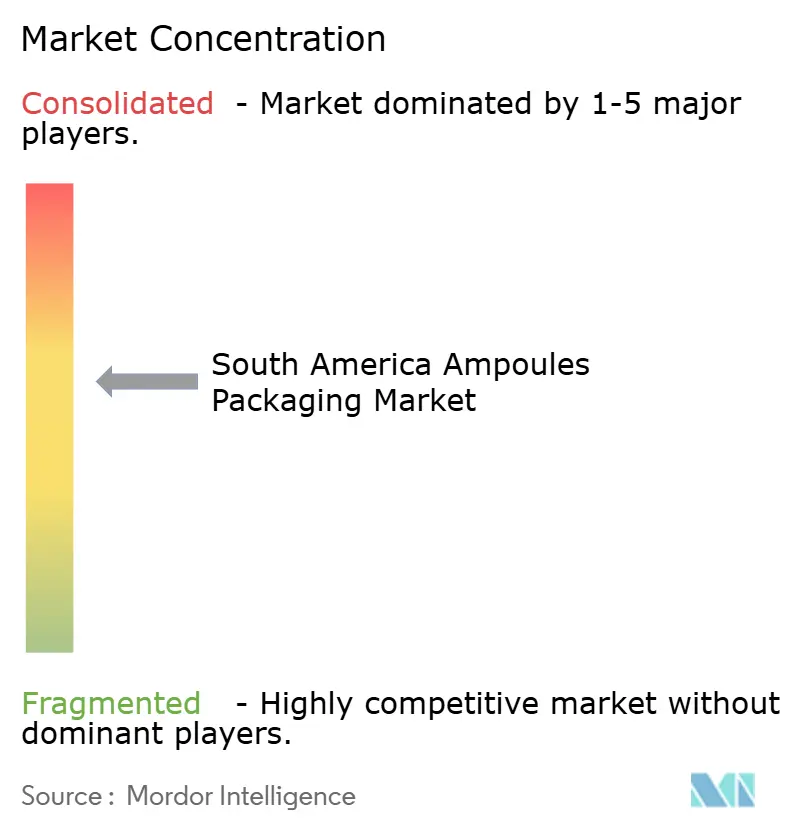
| Market Concentration | Medium |
Major Players *Disclaimer: Major Players sorted in no particular order Image © Mordor Intelligence. Reuse requires attribution under CC BY 4.0. | |
South America Ampoules Packaging Market Analysis by Mordor Intelligence
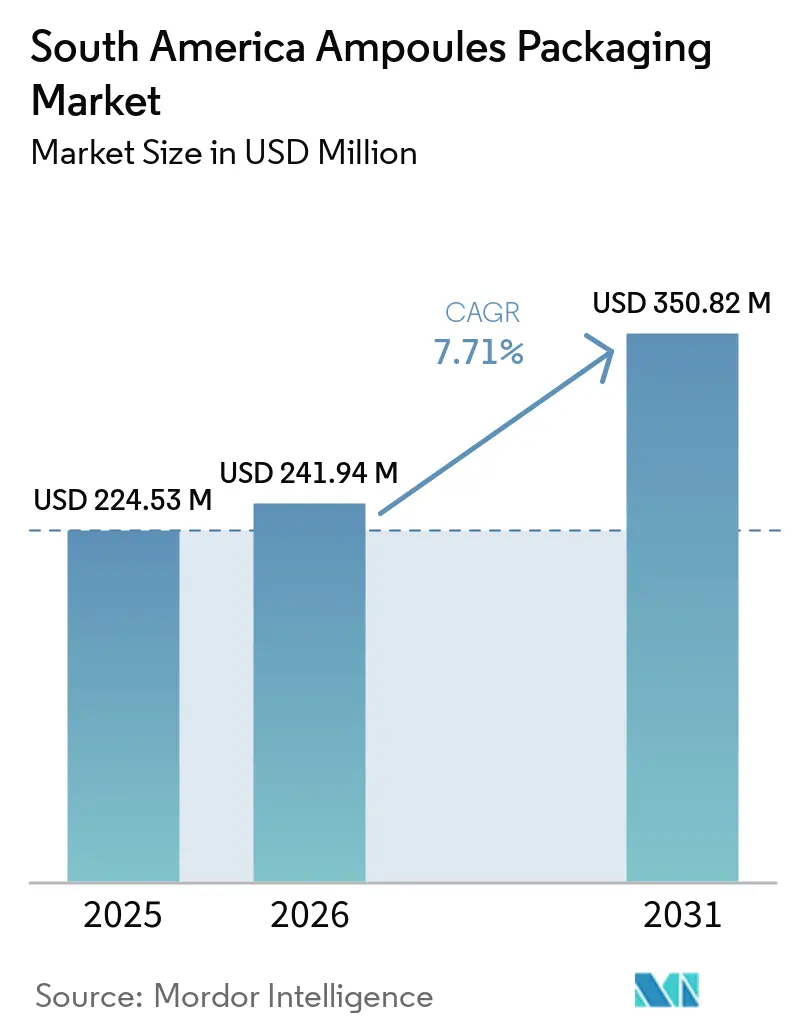
The South America ampoules packaging market size was valued at USD 224.53 million in 2025 and estimated to grow from USD 241.94 million in 2026 to reach USD 350.82 million by 2031, at a CAGR of 7.71% during the forecast period (2026-2031). Injectable drug investment in Brazil and Argentina is moving demand closer to formulation and fill-finish sites, particularly within São Paulo's pharmaceutical corridor and the developing Minas Gerais manufacturing hub. This supports suppliers that can provide documented sterility performance, product qualification, and dependable delivery rather than only low unit prices. Biologics, biosimilars, vaccines, and GLP-1 generics are increasing the need for validated single-dose containers and extending the value of established local manufacturing relationships. Serialization requirements and demand for lower-extractables packaging are also raising the importance of quality systems and supplier integration in the South America ampoules packaging market. Reliance on imported Type I borosilicate glass tubing, procurement lead times of 12-20 weeks, and currency volatility remain structural constraints that can lengthen purchasing cycles and raise landed costs.
Key Report Takeaways
- By material type, glass held 72.46% of the South America ampoules packaging market share in 2025, while plastic ampoules are projected to expand at a CAGR of 8.19% through 2031.
- By ampoule type, straight-stem formats accounted for 38.42% of the South America ampoules packaging market in 2025, while easy-open formats are projected to grow at a CAGR of 8.24% through 2031.
- By capacity, 3-5 mL ampoules held 42.83% of the market value in 2025, while ampoules above 10 mL are projected to advance at a CAGR of 7.96% through 2031.
- By manufacturing technology, conventional tubular forming accounted for 68.92% of the market value in 2025, while advanced laser scoring is projected to grow at a CAGR of 8.37% through 2031.
- By end-user industry, pharmaceutical applications accounted for 81.46% of the market value in 2025 and are projected to grow at a CAGR of 8.28% through 2031.
- By geography, Brazil held 46.17% of market value in 2025, while Argentina is projected to expand at a CAGR of 8.46% through 2031.
Note: Market size and forecast figures in this report are generated using Mordor Intelligence’s proprietary estimation framework, updated with the latest available data and insights as of January 2026.
South America Ampoules Packaging Market Trends and Insights
Drivers Impact Analysis*
| Driver | (~) % Impact on CAGR Forecast | Geographic Relevance | Impact Timeline |
|---|---|---|---|
| Expansion of Injectable Drug Manufacturing in Brazil | +2.0% | Brazil, spillover to Argentina and Chile | Short term (≤ 2 years) |
| Growth of Biologics, Vaccines, and Specialty Injectables | +1.8% | Brazil, Argentina, Colombia | Medium term (2-4 years) |
| Rising Demand for Single-Dose Sterile Packaging | +1.2% | Brazil, Argentina | Short term (≤ 2 years) |
| Increasing Adoption of Serialization-Ready Primary Packaging | +0.8% | Brazil, Argentina | Short term (≤ 2 years) |
| Demand for Low-Extractables Packaging for Sensitive Formulations | +0.6% | Brazil, Argentina | Medium term (2-4 years) |
| Localization of Fill-and-Finish Capacity in South America | +0.6% | Brazil, Argentina, Colombia | Long term (≥ 4 years) |
| Source: Mordor Intelligence | |||
Expansion of Injectable Drug Manufacturing in Brazil
Brazil is adding injectable drug capacity across established pharmaceutical locations, creating a direct need for more qualified sterile primary packaging. Novo Nordisk announced an expansion of DKK 8 billion (USD 1.16 billion) at its Montes Claros site in Minas Gerais, one of South America's largest insulin production facilities, in April 2025.[1]Novo Nordisk, “DKK 8 Billion Investment in Expansion of Production Facilities in Montes Claros,” Novo Nordisk, novonordisk.com The program adds aseptic production lines, a quality control laboratory, and warehouse capacity, and construction is expected to be completed in 2028. Blanver announced a BRL 592 million (USD 116 million) investment to establish a new injectable manufacturing plant in Mairiporã, São Paulo. The company secured BRL 420 million (USD 82 million) in funding from BNDES and FINEP. A separate injectable facility in Santa Catarina was built with an investment exceeding BRL 160 million (USD 27.7 million), expanding capacity beyond the São Paulo and Minas Gerais corridor. These sites need packaging suppliers that can satisfy ANVISA good manufacturing practice expectations, complete qualification work, and maintain supply after a product enters commercial manufacture.
Growth of Biologics, Vaccines, and Specialty Injectables
Biologic medicines require sterile primary containers with documented material performance because their formulations can be sensitive to interaction with the packaging surface. Brazil approved 14 biosimilars in 2025, and each product requires validated sterile packaging and stability work before commercial launch. Bio-Manguinhos is installing 4 isolator filling lines for high-volume production of sterile biologics, underscoring the scale of public-sector capacity being added. Funed activated an injectable-grade unit for domestic aflibercept production through its partnership with Bionovis and Samsung Bioepis in March 2026. These initiatives distribute demand across public institutions and commercial manufacturers, rather than concentrating it in a single group of buyers. The South America ampoules packaging market benefits when suppliers can provide the material knowledge, validated processes, and consistent specifications required for these programs.
Rising Demand for Single-Dose Sterile Packaging
Single-dose ampoules reduce the risk created when a multi-dose container is entered more than once during medication preparation or administration. Hard borosilicate glass ampoules provide a hermetic barrier against air, moisture, and microbial intrusion, supporting the sterility expected for sensitive injectable medicines. This performance supports their continued use in hospital purchasing, where product handling and medication safety are important. The March 2026 expiry of the semaglutide patent in Brazil has encouraged local manufacturers to develop competing GLP-1 products, increasing demand for qualified single-dose packaging. Multiple product launches can create concurrent demand for qualification and favor suppliers that already serve local injectable manufacturers. Institutional purchasing in Colombia and Chile also supports pre-validated single-dose formats used in hospital channels, thereby creating demand less dependent on consumer medicine spending.
Increasing Adoption of Serialization-Ready Primary Packaging
Brazil requires medicines to carry machine-readable 2D codes on secondary packaging from January 2026, making traceability systems a standard supply-chain requirement. Argentina extended comparable traceability requirements for pharmaceutical specialties in 2026, with QR or Data Matrix codes required on secondary packaging. These rules encourage pharmaceutical manufacturers to work with packaging partners that have validated print-quality systems and data-management processes. After these systems have been qualified, changing a supplier can create additional validation work and increase the cost of opportunistic purchasing. EMS acquired Fresenius Kabi's injectable operations in Goiás in November 2025, including manufacturing, research, and distribution capabilities, illustrating the continuing focus on integrated injectable supply chains. Serialization requirements can therefore reinforce established supply relationships among compliant partners in the South America ampoules packaging market.
Restraints Impact Analysis*
| Restraint | (~) % Impact on CAGR Forecast | Geographic Relevance | Impact Timeline |
|---|---|---|---|
| Import Dependence for Pharmaceutical-Grade Glass Tubing | -1.5% | Brazil, Argentina, Chile | Long term (≥ 4 years) |
| Currency Volatility and High Landed Costs for Imported Packaging | -1.2% | Argentina, Brazil | Short term (≤ 2 years) |
| Ampoule Breakage and Particulate Contamination Risk | -0.8% | Global, with acute impact in Brazil and Argentina | Medium term (2-4 years) |
| Limited Availability of High-Speed Inspection and Conversion Equipment | -0.5% | Brazil, Colombia, Chile | Long term (≥ 4 years) |
| Source: Mordor Intelligence | |||
Import Dependence for Pharmaceutical-Grade Glass Tubing
South American converters rely on imported Type I borosilicate glass tubing for high-purity pharmaceutical applications, and the supplied research states that reliance exceeds 70% across the region. European and specialized Asian forming centers supply much of this material, leading to greater exposure to concentrated global sources and longer procurement cycles. Standard lead times of 12-20 weeks limit converters' ability to respond quickly when regional fill-finish demand rises. New upstream glass-tubing capacity requires lengthy investment and commissioning periods, while South American investment remains better suited to standard products than to high-end Type I requirements. Converters use buffer inventories and long-term contracts to protect production schedules, but these measures increase working-capital requirements. ANVISA container-closure integrity expectations also narrow the range of tubing sources that can be used for registered medicines, making import dependency a structural issue rather than a short-term imbalance.
Currency Volatility and High Landed Costs for Imported Packaging
Pharmaceutical-grade ampoule inputs are commonly priced in USD while manufacturers and converters sell finished goods in local currencies, creating an ongoing cost mismatch. The supplied research estimated that a 10% depreciation of the Brazilian real can raise landed costs for high-purity glass tubing by 5-8% because imported inputs represent a large share of demand. In Argentina, import procedures for specialty inputs can extend procurement periods to 45-90 days and make just-in-time supply harder to maintain. These conditions require more inventory, tie up cash, and reduce the certainty needed for fixed-term purchasing arrangements. Brazil's 2026 drug price ceiling can limit injectable medicine manufacturers' ability to pass higher packaging costs on to customers. Suppliers may use price-escalation clauses to manage this exposure, but buyers can resist them when their own pricing is constrained.
*Our forecasts treat driver/restraint impacts as directional, not additive. The impact forecasts reflect baseline growth, mix effects, and variable interactions.
Segment Analysis
By Material Type: Glass Leads While Plastic Expands in Aseptic Formats
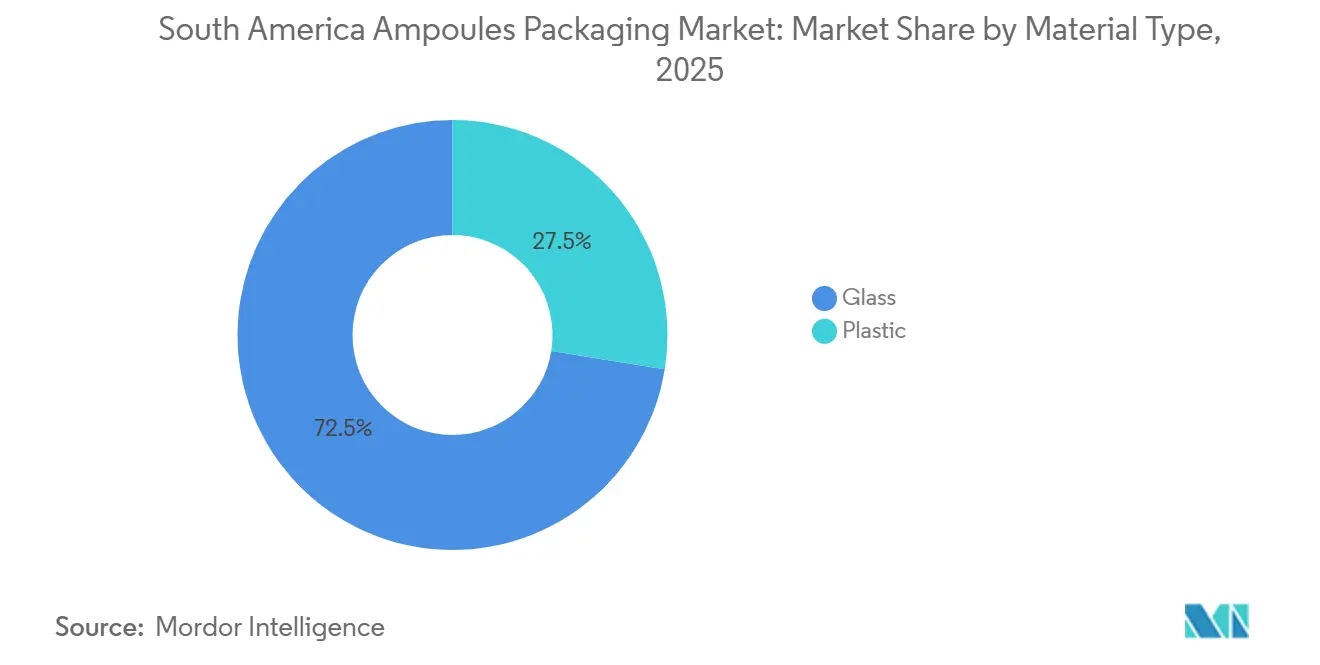
Glass held 72.46% of the South America ampoules packaging market share in 2025, reflecting its established role in pharmaceutical containers for sterile injectable medicines. Type I borosilicate glass is chemically inert, withstands thermal shock, and provides the hermetic seal needed to protect parenteral products during storage and distribution. These properties help manufacturers manage pH change, delamination, and metallic ion migration, which can affect sensitive biologics and other injectable formulations. The Brazilian Farmacopeia, along with other pharmacopeial standards used by drug manufacturers, supports glass specifications for many pharmaceutical applications. Demand is concentrated where product quality records, container-closure integrity, and material consistency are required before a medicine can be registered or released.
Glass suppliers, therefore, serve the most regulated part of regional packaging demand and benefit from the concentration of injectable production in Brazil and Argentina. Plastic ampoules are projected to grow at a CAGR of 8.19% through 2031, led by applications that benefit from blow-fill-seal processing. This technology forms, fills, and seals the container in a single aseptic sequence, reducing handling associated with pre-formed containers. It can lower logistics costs for large-volume runs and is relevant to personal care, veterinary products, and selected lower-acuity pharmaceutical applications. Plastic is not displacing glass across high-sensitivity medicines, because each material addresses different quality, cost, and filling needs in the South America ampoules packaging market.


By Ampoule Type: Easy-Open Formats Gain Through Safety Requirements
Straight-stem ampoules accounted for 38.42% of the South America ampoules packaging market size in 2025, making them the largest format within the ampoule type segmentation. Their design is compatible with standard filling lines and familiar to hospital pharmacies, which supports continued use across established injectable supply chains. The format is used for antibiotics, hormones, analgesics, and other routine injectable medicines supplied to hospitals and clinics. Funnel-type and closed-form designs support more specialized clinical uses in which liquid management during dispensing is important. Controlled hospital settings may choose these designs when pharmacists handling procedures or product presentation require a specific format.
The installed base of conventional production equipment and well-understood user practices continue to support demand for straight-stem ampoules. Easy-open formats are projected to grow at a CAGR of 8.24% through 2031 and include one-point-cut, score-ring, and color-break-ring products. Hospitals value formats that enable a cleaner opening without additional tools, helping reduce injury risk for nurses and pharmacists. Precise score-line placement adds manufacturing steps and can increase per-unit cost compared with straight-stem production. Buyers are increasingly accepting this cost when it supports medication safety and sterile barrier performance
By Capacity: Mid-Volume Formats Lead While Larger Sizes Gain Ground
The 3-5 mL range accounted for 42.83% of the South America ampoule packaging market share in 2025, reflecting strong installed demand for routine hospital injectables. This size is suitable for many antibiotics, analgesics, hormonal medicines, and antiemetics that form the core of hospital formulary demand. Its broad use supports recurring purchases across Brazil, Argentina, and Colombia, where providers need familiar formats for standard administration procedures. Ampoules below 2 mL are used for concentrated specialty products, including epinephrine, certain immunosuppressants, and high-potency anesthetics. The 6-10 mL range supports larger-dose anesthetics and selected oncology adjunct products, giving suppliers a range of specifications around the leading size band.
Ampoules above 10 mL are projected to grow at a CAGR of 7.96% through 2031 as biologic treatments require more container volume per dose. Intravenous immunoglobulins, GLP-1 receptor agonists, and monoclonal antibody infusion adjuncts can require these larger primary containers. The development of generic semaglutide products in Brazil is also changing requirements for some single-dose packaging formats. Larger formats use more glass per container, which can increase revenue even where unit volumes remain lower than in mid-volume applications. Nuova OMPI has operated a glass ampoule, vial, and cartridge facility in Sete Lagoas, Minas Gerais, since 2017, demonstrating the regional precision-glass capacity available to support specification-intensive demand.
By Manufacturing Technology: Laser Scoring Grows Faster Than Conventional Forming
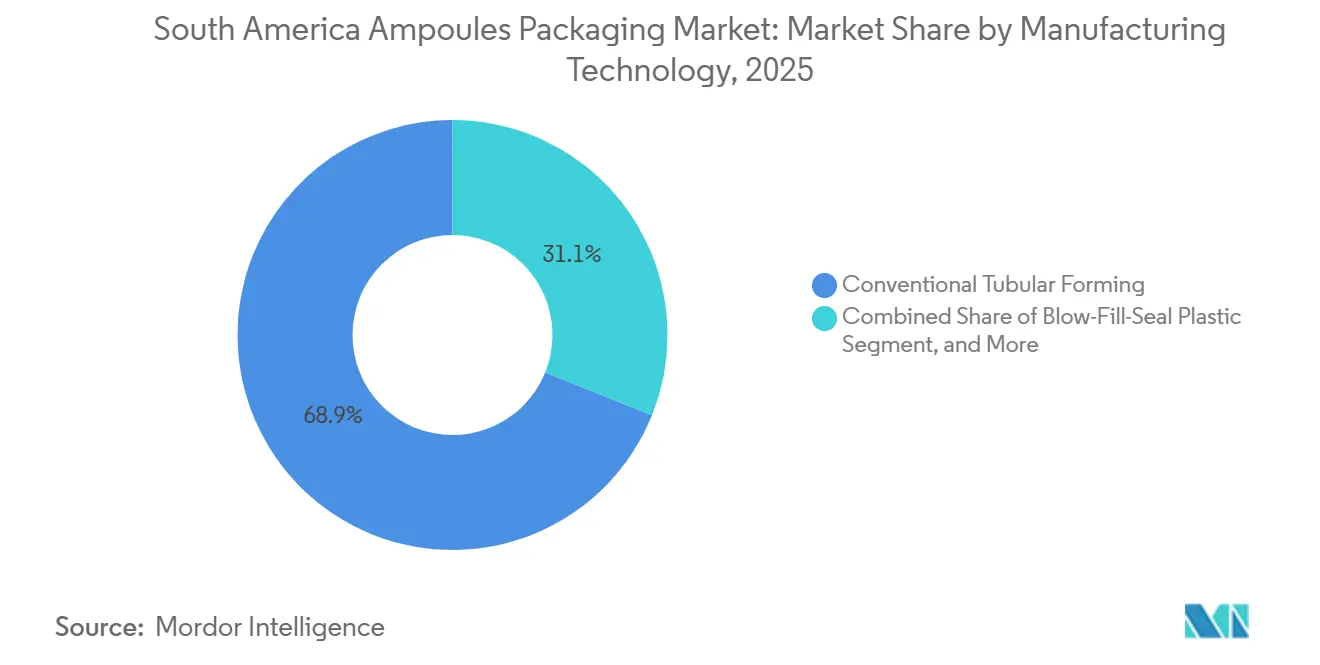
Conventional tubular forming accounted for 68.92% of South America's ampoule packaging market in 2025, supported by a broad installed base of tubing-to-ampoule conversion lines. Manufacturers use flame-processing equipment to create the ampoule body, neck, and tip from pharmaceutical-grade glass tubing. The method has an established good manufacturing practice qualification record among regional fill-finish operations, which limits the need for changes in supplier validation. It also has a lower capital cost than specialized laser and precision-scribing systems, which matters for suppliers serving generic injectable manufacturers. These practical advantages will preserve the technology's central role during the forecast period, even as new methods receive investment.
Advanced laser scoring is projected to expand at a CAGR of 8.37% through 2031, the fastest rate among manufacturing technologies. Laser-scribed score lines can improve opening consistency and reduce particles, which aligns with quality expectations for injectable drug containers. Blow-fill-seal is a distinct manufacturing pathway because it forms the container during filling rather than converting a pre-formed glass tube. Argentina updated its requirements for closed-system, large-volume parenteral production in 2026, supporting this approach for relevant applications.[2]Administração Nacional de Medicamentos, Alimentos y Tecnología Médica, “ANMAT,” ANMAT, argentina.gob.ar SCHOTT Pharma reported EUR 445.4 million (USD 486 million) in Drug Containment Solutions revenue for the first 9 months of fiscal 2026, with 9.2% constant-currency growth, underlining continued investment in advanced containment solutions.

By End-User Industry: Pharmaceuticals Combine Scale with Faster Growth
Pharmaceutical applications accounted for 81.46% of South America ampoules packaging market size in 2025 and are projected to grow at a CAGR of 8.28% through 2031. Injectable medicines need sealed primary packaging that meets sterility, tamper-evidence, and container-closure requirements before they can be supplied to healthcare providers. Every new biologic, biosimilar, and GLP-1 generic requires packaging qualification as part of product development and regulatory submission. Regulatory activity, therefore, feeds directly into demand for qualified ampoules rather than only increasing demand after a treatment has been commercially established. Pharmaceutical customers also require evidence on extractables, leachables, and material consistency, making this segment the main source of both volume and technical requirements.
Personal care and cosmetics constitute a separate source of unit demand, driven by hair treatments, skin-active concentrates, and botanical products sold in single-dose formats. These products use ampoules to protect a dose and support premium product positioning, rather than to meet clinical delivery requirements. Plastic and color-printed variants may be suitable, as these applications do not require the same pharmaceutical-grade material specifications. Purchase decisions give more weight to appearance, handling, and cost, which widens the role for lower-cost converters. Pharmaceutical applications continue to set the technical baseline for the South America ampoules packaging industry while personal care expands format variety and unit demand.
Geography Analysis
Brazil held 46.17% of the South America ampoules packaging market share in 2025, supported by the country's position as the region's largest pharmaceutical manufacturing base. São Paulo contains the region's largest concentration of aseptic fill-finish facilities and pharmaceutical laboratories. Minas Gerais is emerging as a second important production hub as investments in injectable manufacturing move beyond the traditional São Paulo corridor. Novo Nordisk announced an expansion of BRL 6.4 billion (USD 1.09 billion) in Montes Claros in April 2025, including additional aseptic lines, quality-control capacity, and warehouse space. Blanver also announced a BRL 592 million (USD 101 million) injectable plant project in Mairiporã, São Paulo, which includes a sterile filling unit.
Brazil's broad manufacturing capacity creates steady demand for pharmaceutical packaging but also exposes converters to imported high-purity tubing and USD-denominated costs. Argentina is projected to expand at a CAGR of 8.46% through 2031, the highest rate in the South America ampoules packaging market. Buenos Aires province has a bioscience and biosimilar manufacturing cluster, which provides a base for locally produced injectable medicines. Peso volatility and restrictions on imported specialty inputs can extend procurement timelines to 45-90 days under the conditions described in the supplied research. These pressures increase the value of local and regional packaging supply because manufacturers cannot always rely on consistent spot imports. Investment in plastic ampoule equipment also points to gradual import substitution in relevant polymer applications.
Chile has an import-intensive pharmaceutical sector that relies on validated glass ampoules supplied by multinational companies. Private healthcare demand for branded injectables can support higher unit values than in some other regional markets. Colombia is expanding hospital injectable demand through public healthcare coverage and a broader formulary for treatments that require sterile single-dose packaging. Peru, Ecuador, Bolivia, Paraguay, Uruguay, and Venezuela form a fragmented procurement group shaped by public tenders and regional biosimilar distribution. Venezuela's PharmaSteril facility is expected to begin operating in 2027 using German blow-fill-seal technology and could reduce injectable imports for large-volume parenteral formats in northern South America.[3]Diario Las Américas, “Tecnología Alemana en el Caribe: PharmaSteril Transforma el Mercado Regional,” Diario Las Américas, diariolasamericas.com Smaller sterile ampoule demand across the rest of this geography is expected to remain import dependent in the near term.
Competitive Landscape
The South America ampoules packaging market has moderate concentration in pharmaceutical-grade supply, led by SCHOTT Pharma and Gerresheimer. Pharmacopeial documentation and long-standing qualification records support suppliers' market positions. Their position is strongest where medicine manufacturers need documented compliance and consistent supply across multi-product injectable portfolios. SCHOTT Pharma's Itupeva facility in Brazil supports its regional pharmaceutical supply relationships. The company's Drug Containment Solutions business reported strong revenue growth during the period.
Gerresheimer reported a revenue decline and a substantial fall in adjusted EBITDA during the fiscal year. The company attributed the result partly to softer demand in cosmetics and delayed offtake by pharmaceutical customers, indicating that packaging end markets are not moving at the same pace. A clear opportunity remains in validated mid-tier ampoule supply for Brazil's growing generics injectable segment. Global premium suppliers can face high qualification and service costs in this part of the market. Unregistered importers may not meet ANVISA supplier approval requirements for regulated pharmaceutical customers. ANVISA-registered Indian and Chinese manufacturers may be better placed to serve this space when they can combine competitive cost with documented compliance.
Vertical integration is becoming a practical competitive response to input cost volatility and qualification complexity. Fagron completed its acquisition of Vepakum in March 2026 after antitrust clearance, adding 2 packaging facilities in São Paulo to its South American operations.[4]Fagron, “Fagron Completes Acquisition of Vepakum in Latin America,” Fagron, fagron.com The transaction links packaging manufacturing with pharmaceutical compounding, shared distribution, and local customer relationships. SCHOTT Pharma launched cartriQ BioPure in March 2026 using enhanced FIOLAX Pro tubing for sensitive biologics. Its focus on lower sodium and aluminum ion performance and documented extractables and leachables illustrates how chemical quality is becoming a differentiator.
South America Ampoules Packaging Industry Leaders
Gerresheimer AG
SCHOTT Pharma AG & Co. KGaA
Stevanato Group S.p.A.
Nipro PharmaPackaging International N.V.
SGD S.A.
- *Disclaimer: Major Players sorted in no particular order

Recent Industry Developments
- March 2026: SCHOTT Pharma launched cartriQ BioPure, a glass cartridge line manufactured from enhanced FIOLAX Pro tubing. The product has documented sub-ISO-limit sodium and aluminum ion performance, an improved extractables and leachables profile, and a compliance design for evolving USP 660 draft requirements. It targets sensitive biologics that require stringent container-closure integrity.
- March 2026: Fundação Ezequiel Dias in Minas Gerais received representatives from Bionovis and Samsung Bioepis as part of a Productive Development Partnership for domestic aflibercept production. The program uses a previously idle injectable-grade production unit that meets water-for-injection quality requirements. The initiative aims to reduce SUS expenditure on the biologic through domestic aseptic manufacturing.
- March 2026: Fagron completed its acquisition of Vepakum, a pharmaceutical packaging provider operating 2 facilities in São Paulo, Brazil, following antitrust clearance from CADE in February 2026. The transaction was initially announced in December 2025. It integrates packaging manufacturing into Fagron's South American pharmaceutical compounding operations and supports shared production and distribution infrastructure.
- November 2025: EMS acquired Fresenius Kabi's injectable drug manufacturing operations in Goiás, Brazil, including a manufacturing plant, RandD capabilities, and distribution infrastructure. The transaction marked EMS's re-entry into injectable medicines. It added antibiotics and corticosteroids that require sterile primary packaging and was estimated to add USD 30 million in annual revenue as the manufacturing base is integrated.


South America Ampoules Packaging Market Report Scope
The South America ampoules packaging market covers packaging solutions designed to store and protect sterile liquid formulations, including pharmaceuticals, vaccines, biologics, and diagnostic products. It also evaluates market size, growth trends, competitive landscape, key drivers, challenges, and emerging opportunities during the study period.
The South America Ampoules Packaging Market Report is Segmented by Material Type (Glass, and Plastic), Ampoule Type (Straight-Stem, Funnel-Type, Closed (Form D), and Easy-Open (OPC, Score-Ring, and CBR)), Capacity (Less Than 2 mL, 3-5 mL, 6-10 mL, and More Than 10 mL), Manufacturing Technology (Conventional Tubular Forming, Blow-Fill-Seal Plastic, and Advanced Laser Scoring), End-User Industry (Pharmaceutical, and Personal Care and Cosmetics), and Geography (Brazil, Argentina, Chile, Colombia, and Rest of South America). The Market Forecasts are Provided in Terms of Value (USD).
By Material Type
| Glass |
| Plastic |
By Ampoule Type
| Straight-stem |
| Funnel-type |
| Closed (Form D) |
| Easy-Open (OPC, Score-Ring, CBR) |
By Capacity
| Less than 2 mL |
| 3-5 mL |
| 6-10 mL |
| More than 10 mL |
By Manufacturing Technology
| Conventional Tubular Forming |
| Blow-Fill-Seal Plastic |
| Advanced Laser Scoring |
By End-user Industry
| Pharmaceutical |
| Personal Care and Cosmetics |
By Geography
| Brazil |
| Argentina |
| Chile |
| Colombia |
| Rest of South America |
| By Material Type | Glass |
| Plastic | |
| By Ampoule Type | Straight-stem |
| Funnel-type | |
| Closed (Form D) | |
| Easy-Open (OPC, Score-Ring, CBR) | |
| By Capacity | Less than 2 mL |
| 3-5 mL | |
| 6-10 mL | |
| More than 10 mL | |
| By Manufacturing Technology | Conventional Tubular Forming |
| Blow-Fill-Seal Plastic | |
| Advanced Laser Scoring | |
| By End-user Industry | Pharmaceutical |
| Personal Care and Cosmetics | |
| By Geography | Brazil |
| Argentina | |
| Chile | |
| Colombia | |
| Rest of South America |


Key Questions Answered in the Report
What is the size of the South America ampoules packaging market?
The South America ampoules packaging market size is USD 241.94 million in 2026 and is forecast to reach USD 350.82 million by 2031 at a 7.71% CAGR.
What is driving demand for ampoule packaging in South America?
Injectable drug investment, biologics and biosimilar production, GLP-1 generic activity, and demand for single-dose sterile containers are the main factors. Traceability requirements also favor qualified suppliers that can support pharmaceutical quality systems.
Which material leads ampoule packaging demand in South America?
Glass led with 72.46% share in 2025 because Type I borosilicate glass meets the handling, material consistency, and sterile barrier needs of many injectable medicines.
Which ampoule format is growing fastest in South America?
Easy-open formats are projected to grow at a CAGR of 8.24% through 2031. One-point-cut, score-ring, and color-break-ring options support cleaner opening and can reduce handling risks for hospital staff.
Which country is expected to grow fastest for ampoule packaging?
Argentina is projected to grow at a CAGR of 8.46% through 2031, supported by biosimilar manufacturing, local capacity investment, and a need to reduce exposure to uncertain imported specialty inputs.
Why do imported glass inputs affect regional suppliers?
Imported pharmaceutical-grade tubing creates exposure to 12-20 week lead times, USD pricing, and currency volatility. Converters may need buffer inventory and long-term contracts, which increases working-capital requirements.
Page last updated on:





