
Market Overview
| Study Period | 2020 - 2031 |
|---|---|
| Forecast Data Period | 2026 - 2031 |
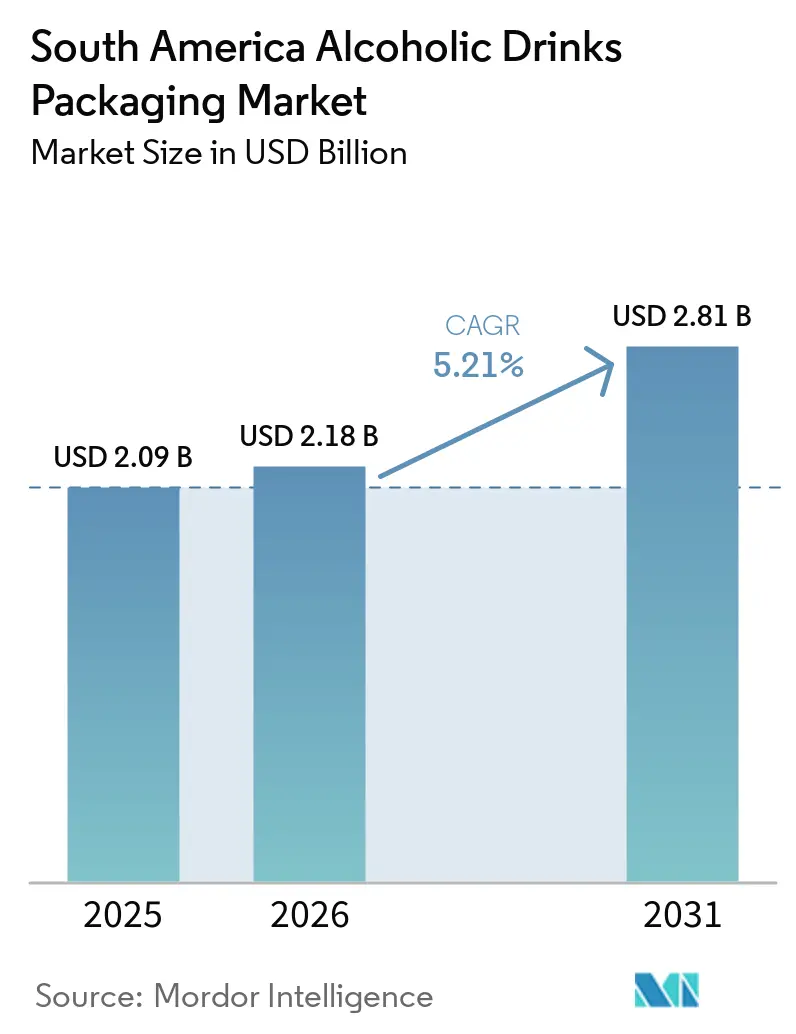
| Base Year Market Size (2025) | USD 2.09 Billion |
| Market Size (2026) | USD 2.18 Billion |
| Market Size (2031) | USD 2.81 Billion |
| Growth Rate (2026 - 2031) | 5.21 % |
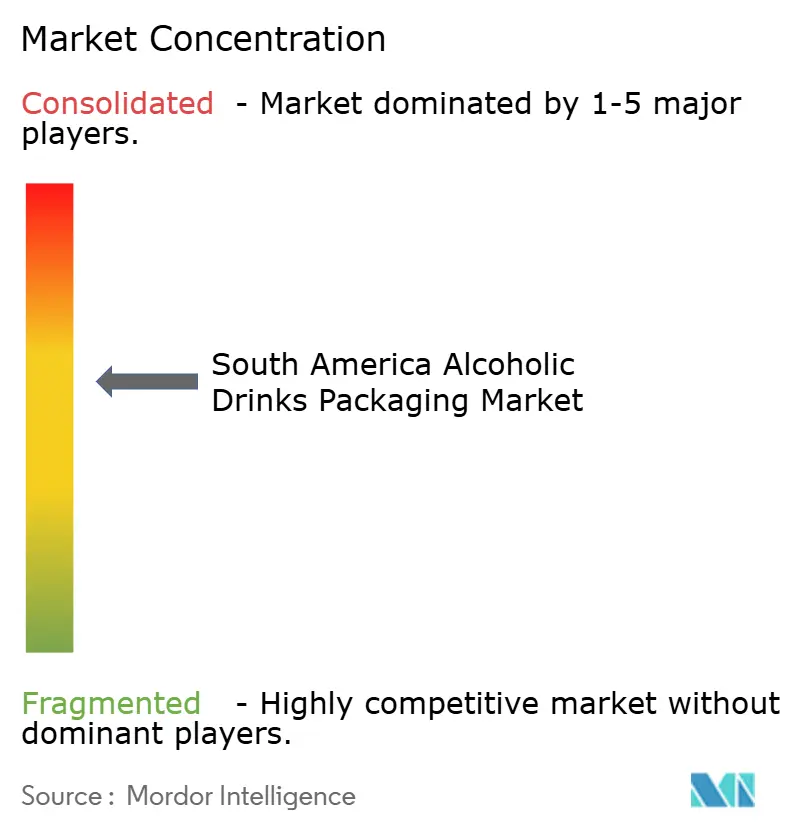
| Market Concentration | Medium |
Major Players *Disclaimer: Major Players sorted in no particular order Image © Mordor Intelligence. Reuse requires attribution under CC BY 4.0. | |
South America Alcoholic Drinks Packaging Market Analysis by Mordor Intelligence
The South America alcoholic drinks packaging market size was valued at USD 2.09 billion in 2025 and is estimated to expand from USD 2.18 billion in 2026 to reach USD 2.81 billion by 2031, at a CAGR of 5.21% during the forecast period from 2026 to 2031. Premium beer, spirits, and wine are raising the value placed on package design, bottle weight, closure quality, and product presentation in both retail and hospitality settings. Ready-to-drink cocktails are increasing demand for formats that are portable, easy to chill, suitable for single servings, and practical for consumption away from home. Recyclable aluminum and returnable glass systems are shaping supplier investment and buyer selection, particularly where brands need credible material recovery or reuse arrangements. The South America alcoholic drinks packaging market also reflects a divide between Brazil’s large, established production base and smaller markets that are changing their format mix in response to local retail conditions. Suppliers that can combine dependable supply, technical compliance, recycled content, custom design, and workable logistics are better placed to serve brands across the region.
Key Report Takeaways
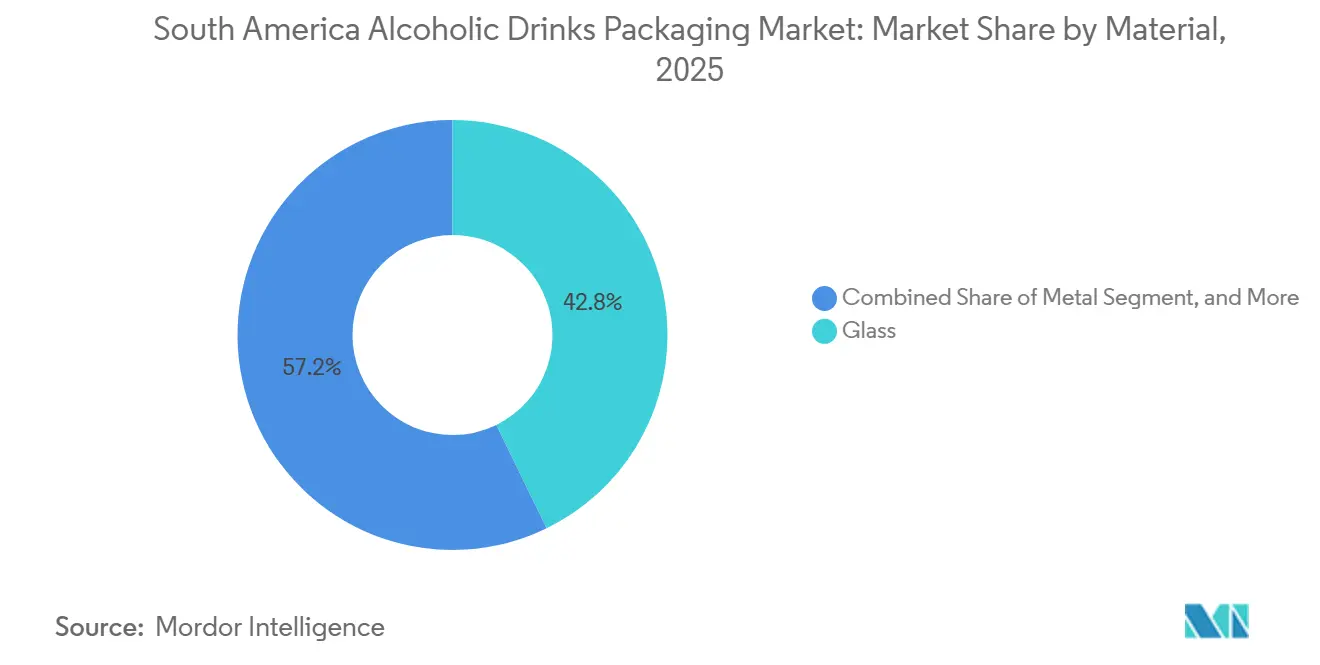
- By material, glass held 42.78% of the South America alcoholic drinks packaging market share in 2025, while metal is projected to expand at a 6.01% CAGR through 2031.
- By package type, bottles held 63.82% of the South America alcoholic drinks packaging market share in 2025, while metal cans are expected to expand at a 5.89% CAGR through 2031.
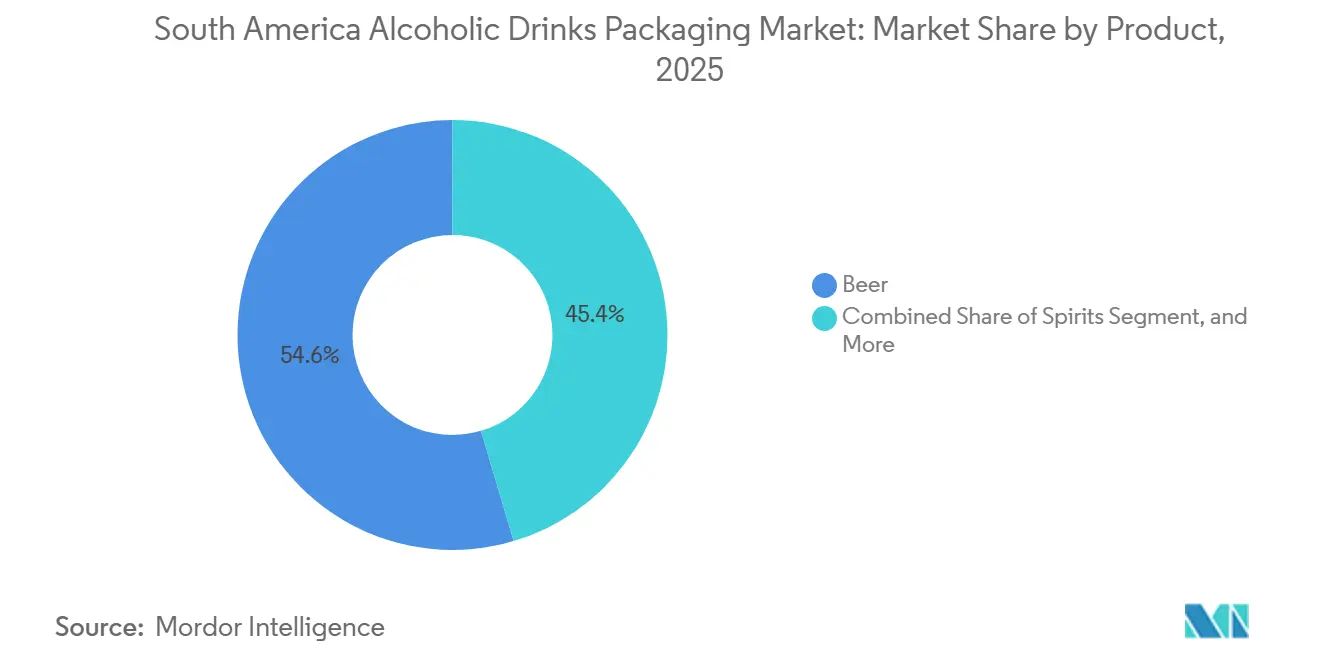
- By product, beer accounted for 54.59% of the South America alcoholic drinks packaging market size in 2025, while ready-to-drink cocktails are projected to expand at a 6.18% CAGR through 2031.
- By distribution channel, off-trade retail held 61.18% of the market in 2025, while e-commerce is expected to expand at a 5.98% CAGR through 2031.
- By geography, Brazil held 62.91% of the market in 2025, while Argentina is projected to expand at a 5.77% CAGR through 2031.
Note: Market size and forecast figures in this report are generated using Mordor Intelligence’s proprietary estimation framework, updated with the latest available data and insights as of January 2026.
South America Alcoholic Drinks Packaging Market Trends and Insights
Drivers Impact Analysis*
| Driver | (~) % Impact on CAGR Forecast | Geographic Relevance | Impact Timeline |
|---|---|---|---|
| Premiumization of Beer, Spirits, and Wine Packaging | +1.2% | Brazil and Argentina, concentrated in São Paulo, Rio de Janeiro, and Buenos Aires | Short term (≤ 2 years) |
| Growth of Ready-to-Drink Cocktail Formats | +1.0% | Brazil and Argentina, with spillover to Chile and Colombia | Medium term (2-4 years) |
| Expansion of Recyclable Metal Can Applications | +0.8% | Brazil, with early adoption in Argentina and Chile | Medium term (2-4 years) |
| Rising Adoption of Returnable Glass Bottle Systems | +0.6% | Argentina, with early adoption in Uruguay | Long term (≥ 4 years) |
| E-Commerce and Small-Pack Demand | +0.5% | Brazil and Greater Buenos Aires | Short term (≤ 2 years) |
| Expansion of Non-Alcoholic and Low-Alcohol Beverage Packaging | +0.4% | Brazil, with spillover to Argentina and Chile | Medium term (2-4 years) |
| Source: Mordor Intelligence | |||
Premiumization of Beer, Spirits, and Wine Packaging
Premium positioning is making the primary pack more important in how alcoholic beverage brands present their products, particularly when a bottle or can must signal quality before consumers try the product. Distinctive glass shapes, embossing, controlled color choices, and smaller production runs support craft and premium offerings that seek a visible difference from mainstream products. Heavier amber bottles remain relevant for rum, cachaça, and whisky because they protect products while creating a differentiated shelf presence for domestic and export-facing brands. This shift places greater value on suppliers that can provide design support, consistent manufacturing quality, and practical guidance on the performance of bottles and closures. It also makes price-only competition less effective for the South America alcoholic drinks packaging market, since producers increasingly evaluate presentation, quality assurance, and the ability to execute a defined design. Packaging suppliers must therefore serve customers who treat the container as part of the brand, while still meeting the operational needs of filling, transport, retail display, and return logistics.
Growth of Ready-to-Drink Cocktail Formats
Brazil ranked eighth worldwide for ready-to-drink volume in 2024, with consumption close to 180 million liters, and the category expanded by more than 4% between 2023 and 2024.[1]Associação Brasileira de Embalagem, “Tetra Pak Brasil Avança No Segmento De Bebidas Alcoólicas Prontas Para Beber,” Associação Brasileira de Embalagem, abre.org.br Ready-to-drink cocktails generally use metal cans, directly linking product demand with container production requirements and the availability of can-filling capacity. The format meets the demand for portable products for outdoor, social, and convenience-led occasions, where glass is less practical and single servings are easier to manage. In Brazil, the category has moved beyond a limited niche and is influencing packaging decisions among established beverage producers that already manage beer, spirits, and non-alcoholic portfolios. Ready-to-drink cocktails also support a broader format mix in the South America alcoholic drinks packaging market, because brand owners may use cans, cartons, labels, and secondary packs for the same category. Suppliers that secure filling and container contracts in this category can participate in related demand for closures, labels, printed cans, multipacks, and protective secondary packaging.
Expansion of Recyclable Metal Can Applications
Brazil’s aluminum beverage can recycling rate exceeded 97% in 2024, providing a strong foundation for the supply of recovered material and for collection-led circularity programs. The Brazilian sector sold 34.1 billion aluminum cans in 2025, its second-highest recorded annual volume, which demonstrates the scale of the existing can ecosystem. Water, ready-to-drink beverages, and canned cachaça have broadened demand beyond conventional beer and soft drinks, reducing dependence on a single end-use category. The established collection network gives beverage brands a clear basis for recycled-content and circularity claims in Brazil, where recovery is embedded in the beverage can supply chain. Ball and Grupo Mariza launched Brazil’s first canned beverage with an Aluminum Stewardship Initiative responsible sourcing seal in 2024, showing how certification can reach finished consumer products. These conditions favor suppliers with certified sourcing, recycled-material capabilities, and technical systems that help brand owners substantiate their packaging claims in the South America alcoholic drinks packaging market.
Rising Adoption of Returnable Glass Bottle Systems
Returnable glass can reduce the need for new raw materials because a bottle is used for multiple filling cycles before it is collected for recycling. This feature supports cost control for brewers during periods of material price pressure while allowing them to retain a familiar format for consumers and retailers. Heineken’s Passos brewery in Minas Gerais became fully operational in February 2026 with 4 filling lines, including a dedicated returnable 0.66-liter glass line. The investment shows that returnable glass remains part of long-term filling capacity decisions, rather than serving only as a short-term response to costs. Reuse can slow the increase in new glass units while preserving the role of glass in beverage distribution, refill programs, and local delivery systems. For the South America alcoholic drinks packaging market, this favors suppliers that can manage durable bottles, collection arrangements, washing requirements, and recycled cullet supply.
Restraints Impact Analysis*
| Restraint | (~) % Impact on CAGR Forecast | Geographic Relevance | Impact Timeline |
|---|---|---|---|
| Volatility in Aluminum, Glass, Resin, and Energy Costs | -1.0% | South America, with concentrated exposure in Argentina and Brazil | Short term (≤ 2 years) |
| Uneven Collection and Recycling Infrastructure | -0.7% | Rest of South America, with partial exposure in Argentina and Chile | Long term (≥ 4 years) |
| Bulk Wine Exports Limiting Local Packaging Demand | -0.5% | Argentina and Chile | Medium term (2-4 years) |
| Packaging Compliance Complexity Across National Markets | -0.3% | Brazil and the Mercosur bloc | Medium term (2-4 years) |
| Source: Mordor Intelligence | |||
Volatility in Aluminum, Glass, Resin, and Energy Costs
Material and energy price changes remain a structural challenge for packaging producers across South America, because containers depend on inputs whose cost can move independently of beverage demand. Argentina’s currency instability can raise the local cost of imported aluminum sheet and glassmaking inputs, placing particular pressure on producers that rely on foreign-currency purchases. Glass furnaces require substantial energy, which makes changes in energy tariffs important to container costs and to suppliers' ability to maintain stable pricing. These pressures complicate fixed-price contracts and can postpone decisions on molds, new can formats, or upgrades to filling and conversion equipment. Smaller converters and regional fillers have fewer tools to manage currency and energy risk than multinational producers with broader procurement and financial resources. The South America alcoholic drinks packaging market, therefore, rewards suppliers with flexible sourcing, transparent pricing arrangements, and the operational ability to adjust product mixes when input conditions change.
Uneven Collection and Recycling Infrastructure
Brazil has a mature aluminum can collection system, but comparable systems are less developed for other materials and across several regional markets, creating wide differences in access to recovered material. This difference limits access to post-consumer recycled glass and resin for producers outside the strongest collection networks, especially when local supply is insufficient or inconsistent. It also makes circularity claims harder for brands to support consistently across the region, because collection results and recycled-content availability differ by country and material. A 2026 regional study found that reuse and recycling efforts in Argentina, Colombia, and Chile were fragmented, small-scale, or dependent on pilot funding. The lack of national-scale deposit-return systems in larger economies constrains the supply of recovered feedstock and can complicate long-term procurement planning. These gaps can increase procurement risk for the South America alcoholic drinks packaging market and reduce the pace at which suppliers can scale recycled-content formats outside Brazil.
*Our forecasts treat driver/restraint impacts as directional, not additive. The impact forecasts reflect baseline growth, mix effects, and variable interactions.
Segment Analysis
By Material: Glass Holds Value While Metal Gains Momentum
Glass held 42.78% of the South America alcoholic drinks packaging market share in 2025, retaining its central position in beer and spirits packaging across established production centers. Beer, spirits, and wine bottling traditions support demand for glass across Brazil, Argentina, and Chile, where brands have long used bottles for retail distribution and on-premise service. Glass also serves brand needs in premium categories that use bottle shape, color, closure design, and weight to distinguish products in crowded retail environments. Technical compliance requirements for food-contact materials can raise the qualification threshold for suppliers, especially where containers, closures, and liners are evaluated as a complete system. The material remains important where product protection, shelf appearance, reuse arrangements, and established filling lines all matter to beverage producers.
Metal is projected to expand at a 6.01% CAGR from 2026 to 2031, supported by ready-to-drink cocktails, canned cachaça, and lower-alcohol beverages that favor convenience and portability. The material’s collection system in Brazil strengthens its relevance to beverage brands seeking recyclable formats and a clear recovery pathway after consumption. Plastic remains relevant for cost-sensitive beer products and selected ready-to-drink formats, particularly where low weight and lower handling risk affect package choice. Other materials include carton formats that offer transport efficiency and shelf-stable storage, giving brand owners another option for selected ready-to-drink products. The South America alcoholic drinks packaging market is therefore not moving toward a single material, but toward a mix shaped by product use, price point, retail setting, and distribution needs.



By Package Type: Bottles Retain Scale While Cans Support New Occasions
Bottles held 63.82% of the South America alcoholic drinks packaging market share in 2025, reflecting installed filling infrastructure, consumer familiarity, and their broad use across beverage categories. Glass and PET bottles remain common across breweries and distilleries because they fit existing operations and accommodate a range of product sizes. Bottles also provide an established presentation format for craft, premium, and spirits brands that rely on visual differentiation at the point of sale. Existing bottle lines provide operational continuity for producers serving multiple package sizes, price tiers, and distribution channels from the same facility. Returnable bottle systems further support the package type in selected beer channels, where collection and refilling can be integrated with local delivery systems.
Metal cans are expected to expand at a 5.89% CAGR from 2026 to 2031, as ready-to-drink products create additional consumption occasions outside traditional beer and wine settings. Crown announced a third high-speed line at Ponta Grossa in May 2025, raising planned annual capacity from 2.4 billion to 3.6 billion cans, with commercial production targeted for the third quarter of 2026.[2]Crown Holdings, Inc., “Crown Holdings, Inc. To Add Third Line to Ponta Grossa, Brazil Beverage Can Plant,” Crown Holdings, Inc., crowncork.com Pouches retain a niche role in portable wine and flavored spirits applications, where reduced breakage risk and easy carrying are useful. Other package types include bag-in-box formats used for multi-serve wine, particularly where consumers and retailers seek economical formats. This package mix allows the South America alcoholic drinks packaging market to serve established retail products, hospitality needs, and newer convenience-led formats.
By Product: Beer Provides Scale While Ready-to-Drink Cocktails Shape Demand
Beer accounted for 54.59% of the South America alcoholic drinks packaging market size in 2025, making it the largest product category for containers, closures, labels, and related components. Its broad use in off-trade retail supports consistent requirements for bottles, cans, multipacks, promotional packs, and display-ready secondary packaging. Beer producers also use returnable glass in some channels and can formats in others, allowing the category to support multiple material systems simultaneously. This variety gives packaging suppliers multiple routes to serve the same customer base, even when consumer preferences differ by price point or occasion. The category continues to anchor production planning across the region because its high volume supports the utilization of both glass and can-filling assets.
Ready-to-drink cocktails are projected to grow at a 6.18% CAGR from 2026 to 2031 and are closely linked to can demand, as the format is widely used for single servings. Brazil’s ready-to-drink segment showed stronger volume expansion than the global average between 2023 and 2024. Spirits benefit from premium packaging, especially for whisky, rum, and gin, which commonly use distinctive bottles and closures. Wine remains important in Argentina and Chile, although bulk exports limit the amount bottled locally, thereby reducing some domestic container demand. Cider and flavored malt beverages remain smaller categories, but they create demand for differentiated packs in secondary cities and local craft channels.
By Distribution Channel: Off-Trade Retail Leads While Digital Sales Change Packaging Needs
Off-trade retail held 61.18% of the market in 2025, supported by supermarkets, hypermarkets, convenience stores, and other established retail outlets across the region. This channel requires a wide range of bottles, cans, multipacks, promotional bundles, and shelf-ready formats that can support product visibility and handling. It also creates demand for secondary packaging that supports shelf display, promotional activity, and the movement of products through distribution centers. On-trade and hotel, restaurant, and café outlets place greater emphasis on draught formats, large bottles, and brand presentation to support on-site consumption. Duty-free sales remain smaller in volume, but they can influence premium spirits package design because they emphasize giftability, travel suitability, and international brand cues.
E-commerce is expected to expand at a 5.98% CAGR from 2026 to 2031, underscoring the importance of packaging that protects products throughout delivery. Glass bottles require protective secondary packaging to reduce breakage in last-mile logistics, particularly when multiple bottles are shipped in a single order. This requirement links primary package selection with inserts, dividers, outer packs, and the ability to manage handling across warehouse and delivery operations. Digital sales can also increase the value of package appearance because products are selected online, delivered directly to homes, and often given as gifts. The South America alcoholic drinks packaging market has an opportunity in packaging systems that combine presentation, delivery protection, and practical unpacking for consumers.
Geography Analysis
Brazil held 62.91% of the South America alcoholic drinks packaging market share in 2025 and remained the region’s principal demand center for containers and related packaging components. Its retail base, beverage production capacity, and established aluminum collection network support demand across both glass and metal formats, while its scale provides suppliers with a large local customer base. The country’s aluminum can recycling rate exceeded 97% in 2024. Diversification into ready-to-drink cocktails and canned cachaça broadens the demand base for can producers, alongside the established beer category.
Argentina is projected to expand at a 5.77% CAGR from 2026 to 2031, the fastest rate among the geographic segments. Ready-to-drink cocktails and returnable glass are important to its evolving package mix, while local producers also face continuing sensitivity to input costs. Returnable formats can help brewers manage raw material exposure during periods of currency pressure by allowing bottles to remain in use across several cycles. A 2025 bill submitted to Argentina’s Chamber of Deputies proposed an extended producer responsibility framework for post-consumer packaging. If enacted, the proposal could influence material selection, collection responsibilities, and recycled-content decisions across beverage supply chains.
Chile, Colombia, Peru, Bolivia, and other markets make up the rest of the South America alcoholic drinks packaging market, where demand is more varied and local infrastructure differs considerably. Bulk wine exports in Chile limit local demand for bottles that would otherwise be used for exported wine, even though wine remains central to the country’s beverage identity. Craft spirits and premium bottled wine still provide opportunities for differentiated glass packaging where presentation and smaller production runs matter. Colombia’s urban consumers support demand for portable, ready-to-drink, and canned formats, particularly in settings that favor convenience and single servings. Peru and Bolivia face infrastructure constraints, although the expansion of organized retail can support the gradual adoption of glass and cans in higher-income urban areas.
Competitive Landscape
The South America alcoholic drinks packaging market includes global suppliers in metal and glass, alongside regional producers and vertically integrated beverage companies that also influence demand from within the value chain. Ball Corporation, Crown Holdings, Ardagh Group, O-I Glass, Verallia, and CANPACK operate across relevant packaging categories and compete through different combinations of capacity, material expertise, and local coverage. Competition varies by material, customer relationships, local manufacturing presence, and the extent to which suppliers can support both routine volumes and specialized packaging needs. Larger suppliers can serve multinational beverage customers with multi-country capacity, established technical processes, and broader procurement relationships. Regional producers compete on proximity, response time, local service, and format customization, which can be important for smaller beverage brands.
Crown’s Ponta Grossa expansion is a clear example of capacity investment in Brazil’s can supply chain and reflects the importance of southern Brazil to beverage can production. The company announced that its third line would increase the plant’s annual capacity to 3.6 billion cans, with production targeted for the third quarter of 2026. Heineken’s Passos brewery added both can and glass filling lines, including a returnable glass line, to support continued demand for multiple package formats. Ball’s work with Grupo Mariza on an Aluminum Stewardship Initiative-certified canned beverage illustrates the role of traceability and material certification in finished beverage packaging.[3]Ball Corporation, “Ball and Grupo Mariza Launch the First Canned Juice with an ASI Seal in Brazil,” Ball Corporation, ball.com
Suppliers are differentiating themselves through recycled content, technical certifications, reliable logistics, custom design, and the capacity to work with beverage brands across different production scales. Companies with metal and glass capabilities can respond to changing preferences without relying on a single substrate, which is useful when bottles and cans serve different occasions. Smaller converters can retain a role where customers need local service, shorter production runs, or support for specialized formats. Secondary protective packaging for e-commerce remains a distinct opportunity, as primary containers require additional protection during delivery. The South America alcoholic drinks packaging market remains moderately concentrated, with capacity investment, sustainability credentials, operational reliability, and customer service shaping supplier positions.
South America Alcoholic Drinks Packaging Industry Leaders
Amcor plc
Ball Corporation
Crown Holdings, Inc.
Verallia S.A.
Tetra Pak International S.A.
- *Disclaimer: Major Players sorted in no particular order

Recent Industry Developments
- August 2026: Ball Corporation published an op-ed by Tamires Silvestre, Director of Sustainability for Ball South America, underscoring the aluminum can's circular value in South American markets and supporting Chile's Ley REP implementation as a model for regional recycling systems.
- July 2026: Ardagh Group reported 6% adjusted EBITDA growth in the second quarter of 2026 versus the prior-year quarter. Ardagh Metal Packaging performance was strongly ahead of expectations, and Ardagh Glass Packaging achieved 3% global volume growth despite a challenging macroeconomic environment.
- April 2026: Abralatas reported that the Brazilian aluminum can sector sold 34.1 billion units in 2025, with water, ready-to-drink beverages, and cachaça contributing to category diversification.
- February 2026: Heineken's new brewery in Passos, Minas Gerais, Brazil became fully operational, with all 4 filling lines, 2 for cans and 2 for glass bottles, running at capacity, producing up to 5 million hectoliters of beer annually. The facility includes one returnable 0.66-liter glass line and one non-returnable longneck glass line.


South America Alcoholic Drinks Packaging Market Report Scope
The South America Alcoholic Drinks Packaging Market comprises the materials, containers, and packaging solutions used for the production, filling, storage, transportation, distribution, and sale of alcoholic beverages across South America. The market includes packaging formats designed to protect alcoholic drinks from contamination, light, oxygen, and physical damage while supporting product shelf life, convenience, portability, branding, and consumer appeal.
The South America Alcoholic Drinks Packaging Report is Segmented by Material (Metal, Glass, Plastic, and Other Materials), Package Type (Bottles, Metal Cans, Pouches, and Other Package Types), Product (Beer, Spirits, Wine, Ready-To-Drink Cocktails, and Other Products), Distribution Channel (Off-Trade Retail, On-Trade/HoReCa, E-Commerce, and Duty Free), and Geography (Brazil, Argentina, and Rest of South America). The Market Forecasts are Provided in Terms of Value (USD).
By Material
| Metal |
| Glass |
| Plastic |
| Other Materials |
By Package Type
| Bottles |
| Metal Cans |
| Pouches |
| Other Package Types |
By Product
| Beer |
| Spirits |
| Wine |
| Ready-To-Drink Cocktails |
| Other Products |
By Distribution Channel
| Off-Trade Retail |
| On-Trade / HoReCa |
| E-Commerce |
| Duty Free |
By Geography
| Brazil |
| Argentina |
| Rest of South America |
| By Material | Metal |
| Glass | |
| Plastic | |
| Other Materials | |
| By Package Type | Bottles |
| Metal Cans | |
| Pouches | |
| Other Package Types | |
| By Product | Beer |
| Spirits | |
| Wine | |
| Ready-To-Drink Cocktails | |
| Other Products | |
| By Distribution Channel | Off-Trade Retail |
| On-Trade / HoReCa | |
| E-Commerce | |
| Duty Free | |
| By Geography | Brazil |
| Argentina | |
| Rest of South America |


Key Questions Answered in the Report
What is the size of the South America alcoholic drinks packaging market?
The South America alcoholic drinks packaging market size was USD 2.18 billion in 2026 and is forecast to reach USD 2.81 billion by 2031 at a 5.21% CAGR. The estimate reflects demand for packaging used across beer, spirits, wine, and ready-to-drink beverages.
Which material holds the largest share in alcoholic drinks packaging across South America?
Glass held 42.78% of the regional market share in 2025, supported by established beer, spirits, and wine bottling practices. It remains important where product presentation, established filling lines, and returnable systems influence material choice.
Why are metal cans gaining relevance for alcoholic beverages in South America?
Ready-to-drink cocktails are forecast to expand at a 6.18% CAGR through 2031, and the format commonly uses metal cans. Brazil’s established can collection network also gives brands a clear recovery route for aluminum containers.
Which package type is most widely used for alcoholic beverages in South America?
Bottles held 63.82% of the regional market share in 2025, reflecting installed filling infrastructure and use in premium categories. Bottles are used in glass and PET formats across retail, hospitality, and returnable beer channels.
Which country leads alcoholic drinks packaging demand in South America?
Brazil held 62.91% of the regional market in 2025, supported by its beverage production base, retail network, and aluminum collection system. Its scale supports demand for both bottles and cans across several alcoholic beverage categories.
What factors affect supplier competition in alcoholic drinks packaging?
Suppliers compete through capacity, recycled content, technical compliance, custom design, and reliable service for beverage producers. They also need to support different materials, package sizes, and distribution requirements across individual South American countries.
Page last updated on:





