
Solvent Recovery and Recycling Market Size and Share
Market Overview
| Study Period | 2021 - 2031 |
|---|---|
| Market Size (2026) | USD 1.23 Billion |
| Market Size (2031) | USD 1.67 Billion |
| Growth Rate (2026 - 2031) | 6.27 % |
| Fastest Growing Market | Asia-Pacific |
| Largest Market | North America |
| Market Concentration | Low |
Major Players *Disclaimer: Major Players sorted in no particular order Image © Mordor Intelligence. Reuse requires attribution under CC BY 4.0. | |
Solvent Recovery and Recycling Market Analysis by Mordor Intelligence
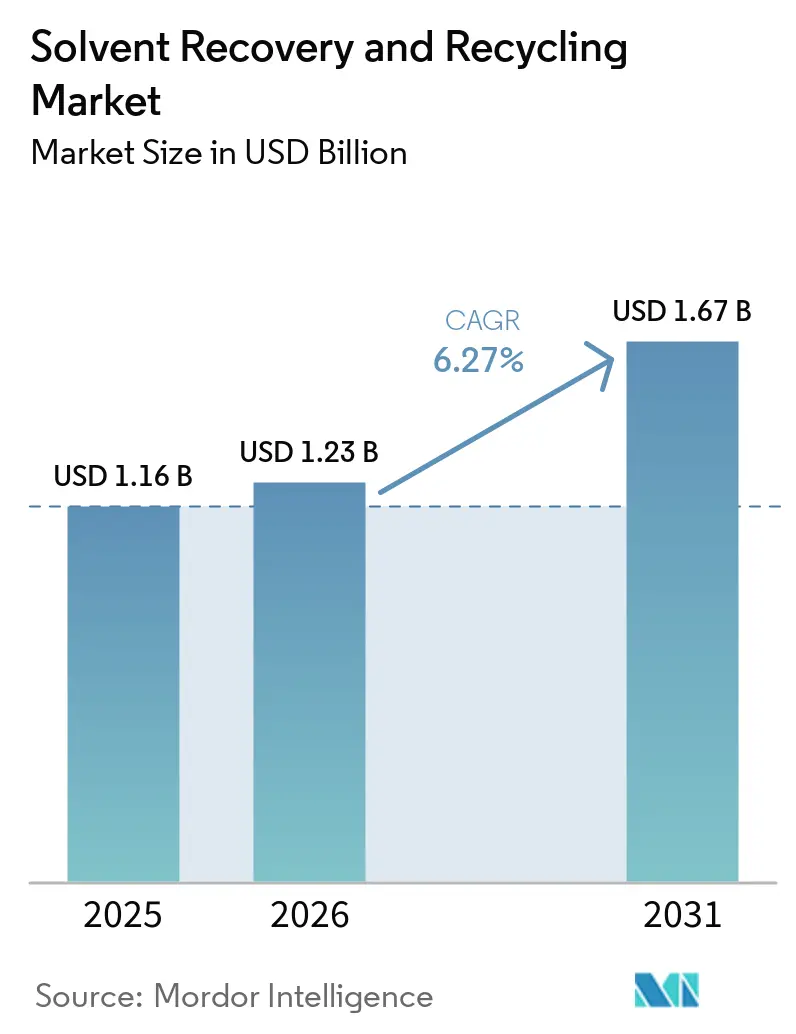
The Solvent Recovery and Recycling Market size was valued at USD 1.16 billion in 2025 and is estimated to grow from USD 1.23 billion in 2026 to reach USD 1.67 billion by 2031, at a CAGR of 6.27% during the forecast period (2026-2031). The solvent recovery and recycling market is increasingly shaped by manufacturers that treat spent solvents as recoverable production inputs rather than as material for disposal. Regulatory enforcement, volatile virgin-solvent costs, and the need to secure high-purity supply are strengthening the business case for closed-loop systems. Battery, pharmaceutical, semiconductor, and specialty chemical production are widening the addressable base for the solvent recovery and recycling market, especially where N-Methyl-2-Pyrrolidone (NMP) recovery is required. Providers are responding with on-site equipment, managed-service contracts, and hybrid separation systems that reduce energy demand or improve purity. High initial capital requirements and the shift toward waterborne, powder-coat, and high-solids formulations remain limits on adoption in parts of the solvent recovery and recycling market.
Key Report Takeaways
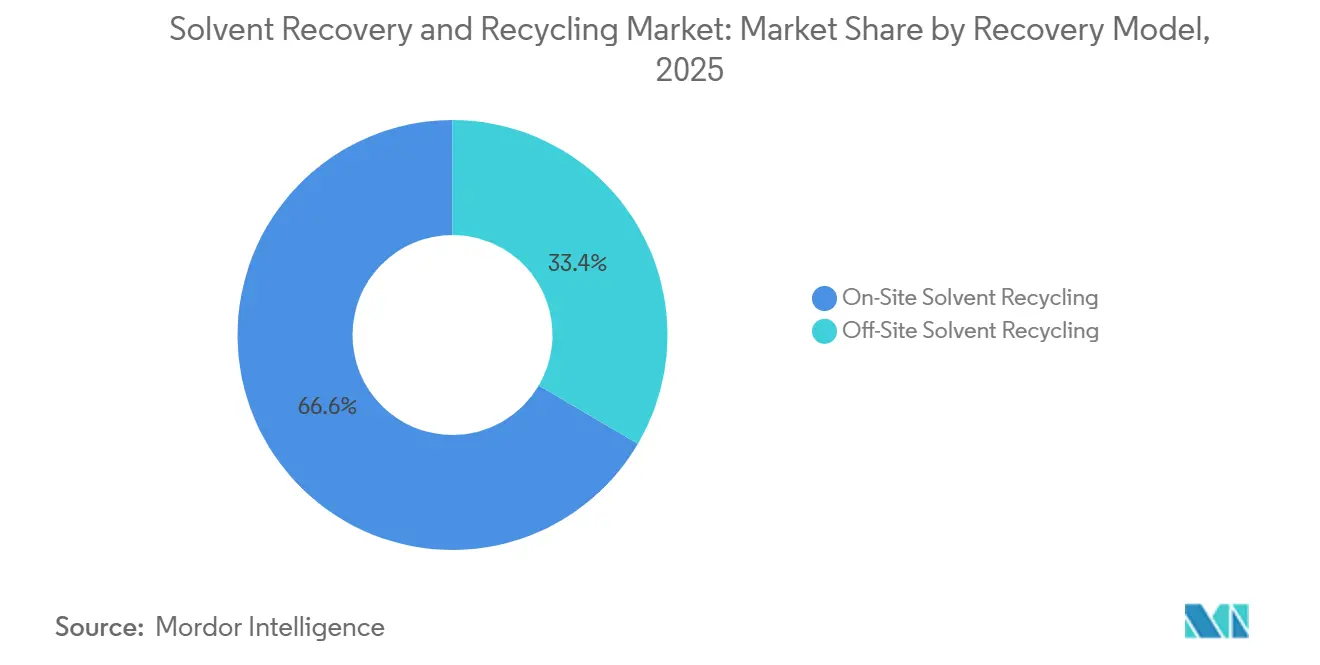
- By recovery model, on-site solvent recycling held 66.57% of the solvent recovery and recycling market share in 2025 and is projected to advance at a 6.89% CAGR through 2031.
- By technology, distillation held 48.12% of the solvent recovery and recycling market share in 2025, while membrane separation is projected to advance at a 7.15% CAGR through 2031.
- By solvent type, NMP held 19.28% of the solvent recovery and recycling market share in 2025, while cresol is projected to advance at a 7.37% CAGR through 2031.
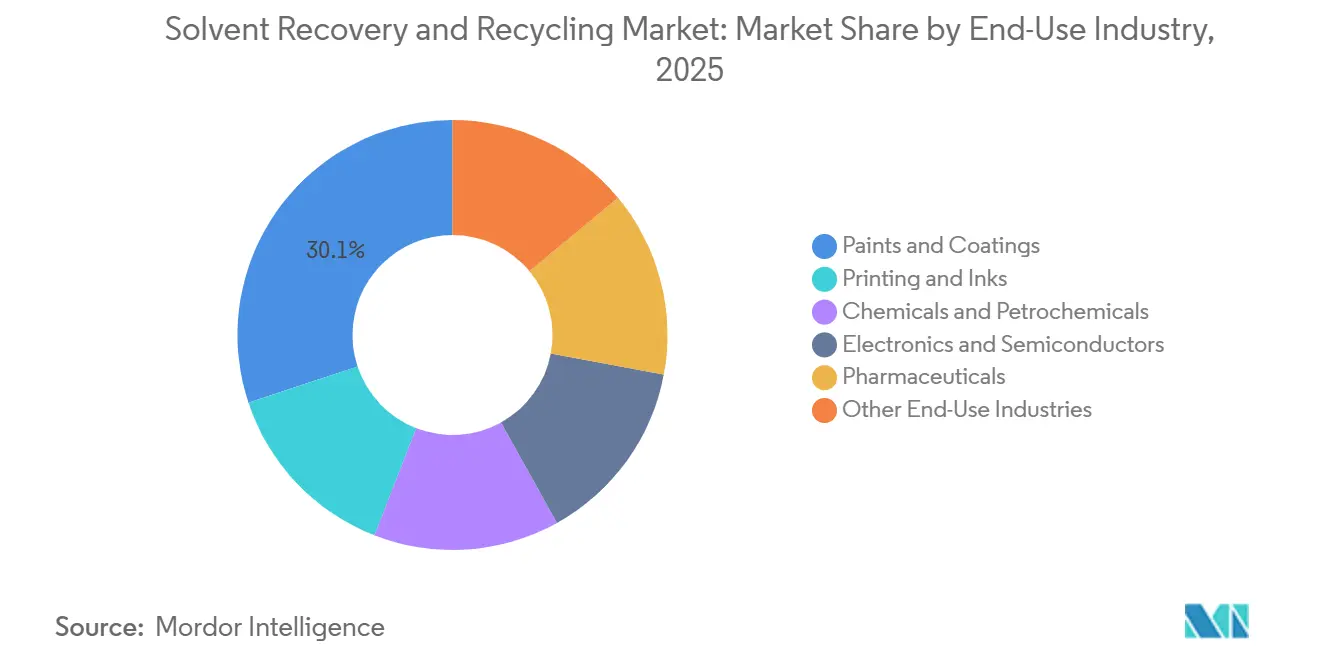
- By end-use industry, paints and coatings held 30.11% of the solvent recovery and recycling market share in 2025, while pharmaceuticals are projected to advance at a 7.72% CAGR through 2031.
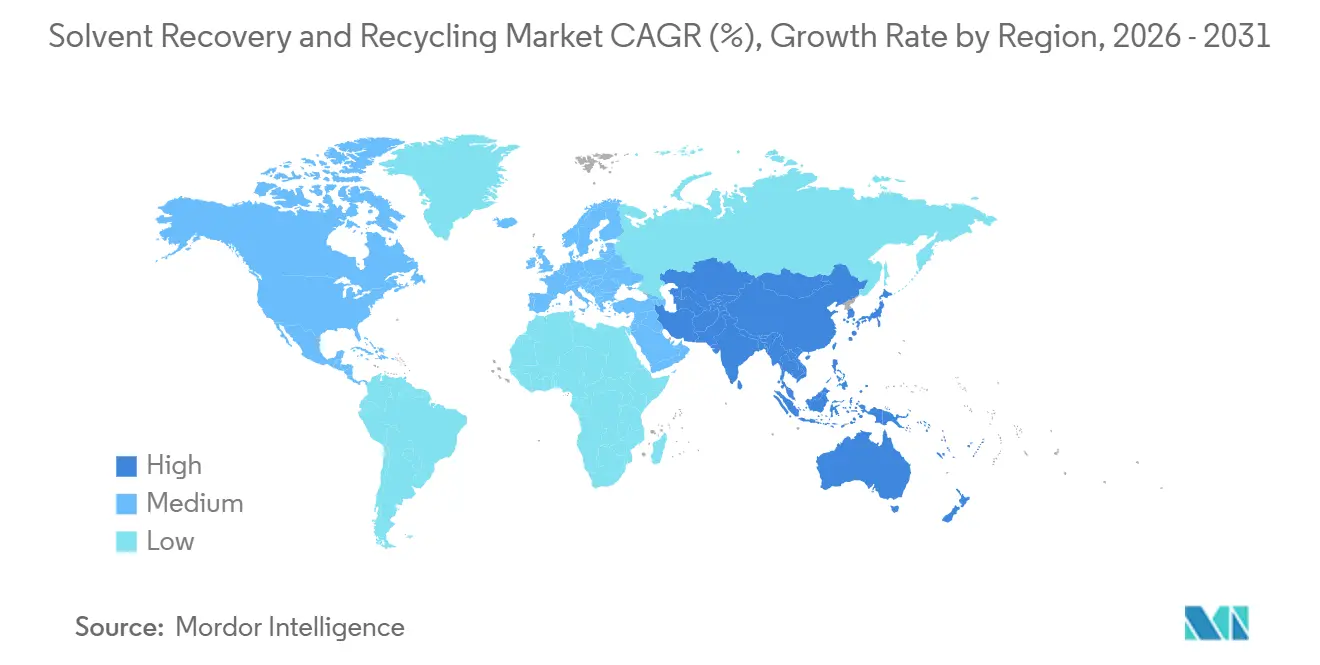
- By geography, North America held 34.12% of the solvent recovery and recycling market share in 2025, while Asia-Pacific is projected to advance at a 7.45% CAGR through 2031.
Note: Market size and forecast figures in this report are generated using Mordor Intelligence’s proprietary estimation framework, updated with the latest available data and insights as of January 2026.
Global Solvent Recovery and Recycling Market Trends and Insights
Drivers Impact Analysis*
| Driver | (~) % Impact on CAGR Forecast | Geographic Relevance | Impact Timeline |
|---|---|---|---|
| Stricter VOC and Hazardous Air Pollutant Compliance | +2.0% | Global, with concentrated enforcement in North America, EU, and China | Medium term (2–4 years) |
| Virgin Solvent and Disposal Cost Volatility | +1.5% | Global, strongest pricing pressure in North America and Europe | Short term (≤ 2 years) |
| Expansion of Pharmaceutical, Electronics and Specialty Chemical Manufacturing | +1.1% | APAC core, spillover to Europe and North America | Long term (≥ 4 years) |
| Closed-Loop Purity and Traceability Requirements in Regulated Manufacturing | +0.8% | North America and EU, with emerging requirements in South Korea and Japan | Medium term (2–4 years) |
| NMP Recovery Demand from Lithium-Ion Battery Manufacturing | +0.6% | APAC core (China, South Korea), expanding to North America and EU | Long term (≥ 4 years) |
| Source: Mordor Intelligence | |||
Stricter VOC and Hazardous Air Pollutant Compliance
Stricter volatile organic compound (VOC) and hazardous air pollutant rules are accelerating equipment investment across the solvent recovery and recycling market. The U.S. Environmental Protection Agency (EPA) finalized amendments to the Synthetic Organic Chemical Manufacturing Industry New Source Performance Standards in April 2024, covering relevant distillation operations constructed or modified after April 25, 2023[1]. Directive (EU) 2024/1785 amended the Industrial Emissions Directive and established a revised framework for industrial emission controls. The revised European provisions apply from July 2026, which narrows the time available for facilities relying on off-site disposal to plan compliant investments. China also published GB/T 46839-2025, which sets technical specifications for NMP exhaust-gas recovery and waste-liquid recycling equipment used in lithium-battery production. These measures make recovery systems part of production compliance rather than a discretionary environmental upgrade for many operators.
Virgin Solvent and Disposal Cost Volatility
Virgin solvent and disposal costs are drawing increasing attention to recovery as a means of managing operating risk in the solvent recovery and recycling market. A mid-scale industrial facility spending USD 150,000 each year on solvent management can recover 85%-95% of waste solvent through a closed-loop system, with reported annual savings of USD 80,000-120,000 and payback periods of 12-36 months. Pharmaceutical-grade isopropanol and acetone prices fluctuated sharply between 2020 and 2025, making internal recovery useful even where regulation is not the immediate driver. Operators with 90% recovery capability are less exposed to spot-market shortages and price spikes than those dependent only on procurement. CleanPlanet Chemical recycled more than 20 million pounds of solvent waste in 2025 through its AlwaysClean platform and avoided more than 30,000 metric tons of greenhouse gas emissions. Subscription-based deployment also reduces the initial access barrier for facilities that cannot support a conventional capital purchase.
Expansion of Pharmaceutical, Electronics and Specialty Chemical Manufacturing
Expansion in pharmaceutical, electronics, and specialty chemical production is creating new demand for high-purity recovery systems. India exported USD 30.47 billion in pharmaceutical products in fiscal year 2024-2025, supporting solvent-intensive active pharmaceutical ingredient production. Multi-step active pharmaceutical ingredient synthesis can generate millions of liters of solvent waste per batch, while International Council for Harmonisation (ICH) Q3C residual-solvent requirements support high-purity recovery practices. Semiconductor wafer fabrication also uses specialty solvents, including dimethyl sulfoxide (DMSO) and N,N-dimethylacetamide (DMAC), for photoresist stripping. New fabrication capacity in Taiwan, South Korea, the United States, and Europe broadens the potential service base. Specialty chemical producers facing Registration, Evaluation, Authorisation and Restriction of Chemicals (REACH) restrictions are also investing in recovery loops for polar aprotic solvents that remain difficult to replace.
Closed-Loop Purity and Traceability Requirements in Regulated Manufacturing
Closed-loop purity and traceability requirements favor systems that keep material streams within the manufacturing site. Pharmaceutical manufacturers must document solvent handling and reuse carefully when producing active pharmaceutical ingredients under Good Manufacturing Practice (GMP) controls. This requirement makes on-site recovery more attractive when mixed-stream processing could complicate the chain of identity. The same issue applies to electronics producers that require stringent contamination control for specialty solvent reuse. Recovery vendors are therefore competing on monitoring, validation support, and the ability to deliver near-virgin solvent purity. These capabilities make the solvent recovery and recycling market more dependent on technical service and process assurance than on equipment capacity alone.
Restraints Impact Analysis*
| Restraint | (~) % Impact on CAGR Forecast | Geographic Relevance | Impact Timeline |
|---|---|---|---|
| High Capital Requirements and Uncertain Payback | -0.9% | Global, concentrated among SMEs in Asia-Pacific and South America | Medium term (2–4 years) |
| Low-Cost Virgin Solvents and Substitution Toward Low-Solvent Formulations | -0.7% | North America and Europe, where waterborne coating adoption is highest | Long term (≥ 4 years) |
| Mixed-Stream Variability and Recovered-Solvent Qualification Complexity | -0.5% | Global, most acute in pharmaceutical and electronics manufacturing | Medium term (2–4 years) |
| Source: Mordor Intelligence | |||
High Capital Requirements and Uncertain Payback
High capital requirements remain a material constraint in the solvent recovery and recycling market. Commercial systems require an initial investment from USD 200,000 to USD 5 million, depending on capacity, solvent type, and required purity. Facilities can delay purchases when virgin-solvent prices weaken, and projected returns fall below internal investment thresholds. Recycling-as-a-service models address the upfront capital issue, but their contract commitments and volume minimums do not suit every batch process or facility size. Smaller operators can also face a mismatch between long-term savings and shorter budget approval cycles. This gap continues to slow adoption, even where recovered material can reduce disposal and procurement costs.
Low-Cost Virgin Solvents and Substitution Toward Low-Solvent Formulations
Low-cost virgin solvents and the move toward low-solvent formulations reduce part of the available feedstock for recovery systems. Paints and coatings, the largest end-use category in 2025, are shifting toward waterborne, powder-coat, and high-solids systems. The EPA amended aerosol-coating VOC limits in January 2025, while California Rule 1113 applies limits below 50 g/L for architectural coatings. These rules encourage reformulation away from solvent-based products in established markets. Bio-based solvents are also attracting specialty chemical investment under circular-economy programs. The resulting reduction in solvent waste can limit demand from a customer base that remains important to the solvent recovery and recycling market.
*Our forecasts treat driver/restraint impacts as directional, not additive. The impact forecasts reflect baseline growth, mix effects, and variable interactions.
Segment Analysis
By Recovery Model: On-Site Recycling Anchors Demand Across Industries
On-site solvent recycling held 66.57% of the solvent recovery and recycling market size in 2025 and is projected to advance at a 6.89% CAGR through 2031. Facilities use point-of-use units to recover material close to where it is generated. This approach reduces transport costs and the risk associated with moving hazardous materials. It also protects proprietary formulations that operators may be unwilling to send to a centralized processor. CleanPlanet Chemical recovered more than 20 million pounds of solvent waste through its software-calibrated AlwaysClean platform in 2025. Its financing facility, announced in August 2026, supports broader North American deployment through a managed subscription model. These models help users adopt recovery without making a full upfront equipment purchase.
Off-site solvent recycling remains relevant where an in-house installation cannot be justified. It also serves hazardous streams that need specialized centralized treatment infrastructure. Centralized plants can consolidate expertise for complex solvent mixtures and difficult treatment requirements. However, transport requirements and formulation confidentiality continue to favor on-site systems for many regulated applications. The solvent recovery and recycling industry is therefore moving toward a model in which on-site units handle repeatable, high-volume streams. The balance between these models depends on plant throughput, solvent composition, and required documentation.
By Technology: Distillation Leads Demand, While Membrane Separation Reshapes the Efficiency Curve
Distillation held 48.12% of the solvent recovery and recycling market size in 2025, while membrane separation is projected to advance at a 7.15% CAGR through 2031. Distillation remains widely used across contamination profiles, boiling points, and batch sizes. Established certification pathways and operator familiarity support its continuing role in regulated facilities. Adsorption and crystallization support solvent streams where distillation is less economical or where distinct purity targets apply. Other methods, including cryogenic condensation and extraction, address specific industrial requirements. Membrane separation uses close to one-tenth of the energy of conventional thermal approaches. This energy profile is making it more relevant to sites managing carbon-intensity reporting requirements.
Hybrid systems are extending the range of applications for membrane technology. Vapor-permeation and distillation configurations can reduce energy requirements for ethanol dehydration by 63%. Hybrid pervaporation-distillation can reduce life-cycle emissions for isopropanol recovery by 91%. A 2025 study found that a coupled pervaporation-adsorption process reduced NMP waste-liquid water content from 8.3% to 0.014%, reaching electronics-grade requirements for lithium-battery production. This result supports the use of membrane-thermal combinations where vacuum distillation alone may not provide an economic solution. In the solvent recovery and recycling market, technology selection is increasingly defined by energy use, purity requirements, and solvent-specific separation challenges. Distillation is likely to remain important while hybrid systems expand into demanding recovery applications.
By Solvent Type: NMP Leads by Revenue, Cresol Gains on Application Diversity
NMP held 19.28% of the solvent recovery and recycling market size in 2025, while cresol is projected to advance at a 7.37% CAGR through 2031. NMP is used in lithium-ion battery cathode slurry preparation and in semiconductor and pharmaceutical manufacturing. China’s GB/T 46839-2025 establishes technical requirements for NMP recovery equipment in lithium-battery production. A 10 GWh-per-year gigafactory can consume 3,000-8,000 metric tons of NMP each year. Battery manufacturers can use 10,000-20,000 gallons each month, making recovery economics compelling where capture rates reach 90%-95%.
DMSO, N,N-Dimethylformamide (DMF), and DMAC remain important within high-purity recovery applications. Pharmaceutical active-ingredient synthesis can make recovery of these solvents valuable because individual batch solvent costs are substantial. ICH Q3C limits provide a direct incentive to control residual solvent quality. Cresol serves pharmaceutical, agrochemical, and specialty chemical applications, supporting its projected growth. China’s NMP standard also establishes a regulatory precedent for other high-volume polar aprotic solvents as hazard requirements become stricter. Other solvent types form a diverse group whose recovery economics depend on site conditions and end use. The solvent recovery and recycling industry must therefore match recovery technology to solvent chemistry and the quality specification for reuse. This requirement favors suppliers with application-specific process knowledge.
By End-Use Industry: Paints and Coatings Anchors Revenue, While Pharmaceuticals Lead Growth
Paints and coatings held 30.11% of the market share in 2025, while pharmaceuticals are projected to advance at a 7.72% CAGR through 2031. Pharmaceutical growth is supported by active pharmaceutical ingredient capacity expansion in India and Southeast Asia. GMP documentation is increasing the use of closed-loop solvent recovery and reuse in drug synthesis. ICH Q3C and European Union GMP Annex 15 requirements make batch-level traceability important. These controls often favor on-site systems because centralized mixed-stream handling can complicate identity management. Paint and coatings manufacturers already maintain mature recovery practices. The American Coatings Association stated that 97% of waste solvents from U.S. paint and coatings manufacturing facilities are reclaimed for future use.
Printing and inks continue to contribute solvent streams that can be collected and reprocessed. Chemicals and petrochemicals benefit from regulatory substitution projects that create high-purity waste streams suitable for recovery. Electronics and semiconductors are becoming more important as advanced fabrication capacity raises specialty-solvent consumption. Solvent recovery also serves adhesives, food processing, and textile manufacturing, where demand follows local industrial output. Growth in the solvent recovery and recycling market differs by end use because each sector produces a different solvent mix and follows different quality controls. Pharmaceutical applications prioritize purity, traceability, and validation. Coatings applications prioritize waste handling, operational efficiency, and compliance. These distinct needs support a mix of equipment providers and service-based recovery models.

Geography Analysis
North America held 34.12% of the solvent recovery and recycling market share in 2025. U.S. National Emission Standards for Hazardous Air Pollutants enforcement and an established commercial recovery ecosystem support the region’s position. CLEAN HARBORS, INC., through its Safety-Kleen Systems network, recycles more than 16 million gallons of solvent each year across 9 recycling centers. Canada contributes mining and energy-sector solvent streams. Mexico’s automotive coatings export base is also creating recovery demand that is aligned with manufacturer sustainability requirements. Safety-Kleen Sustainability Solutions reported record second-quarter results in 2026, with segment margin rising more than 70% year over year. The company also disclosed a USD 600 million, 10-year disposal contract covering incineration and complex wastewater volumes for a customer expanding U.S. manufacturing operations.
Asia-Pacific is projected to advance at a 7.45% CAGR through 2031 in the solvent recovery and recycling market. China is central to regional demand because GB/T 46839-2025 specifies technical requirements for NMP exhaust-gas recovery in lithium-battery production. The standard specifies that combined low-temperature condensation and molecular-sieve rotor adsorption systems should achieve 90%-95% NMP recovery from electrode-coating exhaust. India exported USD 30.47 billion in pharmaceutical products in fiscal year 2024-2025, supporting recurring solvent waste from active pharmaceutical ingredient production. South Korea and Japan add demand through semiconductor fabrication and electric-vehicle battery manufacturing. ASEAN countries remain at an earlier adoption stage, but electronics and specialty chemical investment is widening the future service base.
Europe is influenced by Directive (EU) 2024/1785, whose revised emissions provisions apply from July 2026[2]. Germany is an important national market because of its automotive, specialty coatings, and chemical manufacturing base. Dürr Aktiengesellschaft installed an Oxi.X RE regenerative thermal oxidation system at Orafol’s Oranienburg production expansion in 2025 to treat solvent-laden exhaust air from laminating and coating operations. The United Kingdom, France, and the Nordic countries have established recovery frameworks, while Italy and other European countries are adding pharmaceutical and specialty chemical capacity. Tradebe acquired a majority stake in Soltec (Ireland) Ltd in June 2026, strengthening its United Kingdom-Ireland solvent recovery and waste-management network. South America and the Middle East and Africa remain smaller markets. OFRU Recycling’s 2024 distribution partnership with Jordanian Lines for Printing and Packaging supports commercial development in the Middle East.
Competitive Landscape
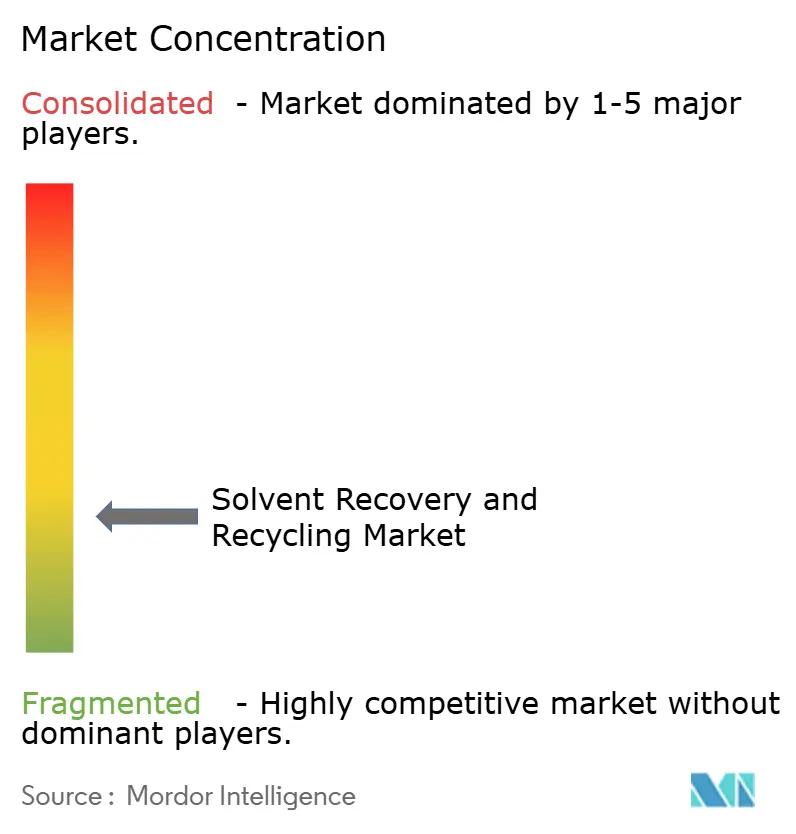
The solvent recovery and recycling market is highly fragmented, with the top five players including Veolia, CLEAN HARBORS, INC., Tradebe, Dürr Aktiengesellschaft, and Sulzer Ltd. Dürr Aktiengesellschaft, Koch Modular Process Systems, Sulzer Ltd, OFRU Recycling, and Spooner Industries Ltd compete through equipment performance for specific solvent types and purity requirements. Maratek, CleanPlanet Chemical, and Progressive Recovery, Inc. focus on application knowledge and service models that can serve customers outside the largest centralized networks. Continuous-flow on-site units, real-time purity monitoring, and membrane-enhanced hybrid distillation are important areas of technical competition. CleanPlanet Chemical’s AlwaysClean platform combines on-site recovery with managed-service delivery.
Competition in the solvent recovery and recycling market also reflects differences in customer requirements. Large environmental service providers have an advantage where customers need collection, treatment, disposal, and recycling under a single contract. Specialized suppliers can compete where complex azeotropes, high-purity streams, or site-specific integration are more important than service-network breadth. Pharmaceutical applications remain a significant opportunity because traceability requirements favor closed-loop, on-site systems. Southeast Asia’s electronics manufacturing corridor also offers scope for dedicated service providers as production capacity grows. Smaller companies such as CycleSolv, Indaver, and CBG Biotech differentiate through specialized batch recovery, chemical depolymerization, and application-specific service. These focused capabilities create areas of competition that larger providers may address through acquisition.
CleanPlanet Chemical secured a USD 25 million Hardware-as-a-Service financing facility in August 2026 to support the deployment of its on-site industrial solvent recycling systems across North America. Tradebe’s June 2026 acquisition of a majority stake in Soltec (Ireland) Ltd expanded its position in solvent distillation and transfer-station services. Sulzer Ltd secured a July 2026 contract from WPU, a Vitol subsidiary, to provide PyroCon pyrolysis-condensation technology for a Netherlands chemical-recycling facility. The facility is designed to process 80,000 metric tons of end-of-life plastic waste annually into reusable chemical feedstock. These actions show that suppliers are broadening their capabilities across waste treatment, chemical recycling, and managed equipment deployment. The solvent recovery and recycling market is consequently likely to retain both large integrated providers and specialized technical operators.
Solvent Recovery and Recycling Industry Leaders
-
Veolia
-
CLEAN HARBORS, INC.
-
Tradebe
-
Dürr Aktiengesellschaft
-
Sulzer Ltd
- *Disclaimer: Major Players sorted in no particular order
Recent Industry Developments
- May 2026: Tradebe acquired a majority stake in Soltec (Ireland) Ltd., a specialist transfer station and solvent recycling business in Mullingar, Ireland. The acquisition expanded Tradebe’s solvent recycling and distillation capabilities, supporting the growing need for industrial solvent recovery and resource reuse.
- September 2025: Ragn-Sells and Vilokan inaugurated the Solvent Recycling Solutions facility in Sweden, with a capacity to process up to 20,000 tons of waste solvents annually. The facility uses advanced separation technology to recover solvents such as acetone, ethanol, methanol, and glycol, strengthening commercial-scale solvent recycling and circular material flows.
Global Solvent Recovery and Recycling Market Report Scope
Solvent recovery and recycling involves the collection, purification, and reuse of solvents generated from industrial processes to reduce solvent consumption, waste generation, and operating costs. These systems use physical and separation-based processes to recover solvents while maintaining the required quality for reuse.
The Solvent Recovery and Recycling Market is segmented by recovery model, technology, solvent type, end-use industry, and geography. By recovery model, the market is segmented into on-site solvent recycling and off-site solvent recycling. By technology, the market is segmented into distillation, adsorption, membrane separation, crystallization, and other technologies. By solvent type, the market is segmented into NMP (N-methyl-2-pyrrolidone), DMSO (dimethyl sulfoxide), cresol, DMF (N,N-dimethylformamide), DMAC (N,N-Dimethylacetamide), and other solvent types. By end-use industry, the market is segmented into paints and coatings, printing and inks, chemicals and petrochemicals, electronics and semiconductors, pharmaceuticals, and other end-use industries. The report also covers the market size and forecasts for solvent recovery and recycling across 15 countries. For each segment, the market sizing and forecasts have been done on the basis of value (USD).
| On-Site Solvent Recycling |
| Off-Site Solvent Recycling |
| Distillation |
| Adsorption |
| Membrane Separation |
| Crystallization |
| Other Technologies |
| NMP (N-Methyl-2-Pyrrolidone) |
| DMSO (Dimethyl Sulfoxide) |
| Cresol |
| DMF (N,N-Dimethylformamide) |
| DMAC (N,N-Dimethylacetamide) |
| Other Solvent Types |
| Paints and Coatings |
| Printing and Inks |
| Chemicals and Petrochemicals |
| Electronics and Semiconductors |
| Pharmaceuticals |
| Other End-Use Industries |
| Asia-Pacific | China |
| India | |
| Japan | |
| South Korea | |
| ASEAN Countries | |
| Rest of Asia-Pacific | |
| North America | United States |
| Canada | |
| Mexico | |
| Europe | Germany |
| United Kingdom | |
| France | |
| Italy | |
| NORDIC Countries | |
| Rest of Europe | |
| South America | Brazil |
| Argentina | |
| Rest of South America | |
| Middle East and Africa | Saudi Arabia |
| South Africa | |
| Rest of Middle East and Africa |
| By Recovery Model | On-Site Solvent Recycling | |
| Off-Site Solvent Recycling | ||
| By Technology | Distillation | |
| Adsorption | ||
| Membrane Separation | ||
| Crystallization | ||
| Other Technologies | ||
| By Solvent Type | NMP (N-Methyl-2-Pyrrolidone) | |
| DMSO (Dimethyl Sulfoxide) | ||
| Cresol | ||
| DMF (N,N-Dimethylformamide) | ||
| DMAC (N,N-Dimethylacetamide) | ||
| Other Solvent Types | ||
| By End-Use Industry | Paints and Coatings | |
| Printing and Inks | ||
| Chemicals and Petrochemicals | ||
| Electronics and Semiconductors | ||
| Pharmaceuticals | ||
| Other End-Use Industries | ||
| By Geography | Asia-Pacific | China |
| India | ||
| Japan | ||
| South Korea | ||
| ASEAN Countries | ||
| Rest of Asia-Pacific | ||
| North America | United States | |
| Canada | ||
| Mexico | ||
| Europe | Germany | |
| United Kingdom | ||
| France | ||
| Italy | ||
| NORDIC Countries | ||
| Rest of Europe | ||
| South America | Brazil | |
| Argentina | ||
| Rest of South America | ||
| Middle East and Africa | Saudi Arabia | |
| South Africa | ||
| Rest of Middle East and Africa | ||
Key Questions Answered in the Report
What is the size of the solvent recovery and recycling market?
The solvent recovery and recycling market stands at USD 1.23 billion in 2026 and is projected to reach USD 1.67 billion by 2031.
What is driving demand for solvent recovery and recycling systems?
Tighter VOC and hazardous-air-pollutant rules, solvent and disposal cost volatility, and expanding pharmaceutical, electronics, and battery production are supporting demand.
Which recovery model held the largest share in 2025?
On-site solvent recycling held 66.57% of the market share in 2025.
Which technology is expected to grow fastest through 2031?
Membrane separation is projected to advance at a 7.15% CAGR through 2031, supported by lower energy use and hybrid-process applications.