
Sol-Gel Products Market Size and Share
Market Overview
| Study Period | 2020 - 2031 |
|---|---|
| Forecast Data Period | 2026 - 2031 |
| Historical Data Period | 2020 - 2024 |
| Growth Rate | 10.36 % |
| Fastest Growing Market | Asia Pacific |
| Largest Market | North America |
Major Players *Disclaimer: Major Players sorted in no particular order Image © Mordor Intelligence. Reuse requires attribution under CC BY 4.0. | |
Sol-Gel Products Market Analysis by Mordor Intelligence
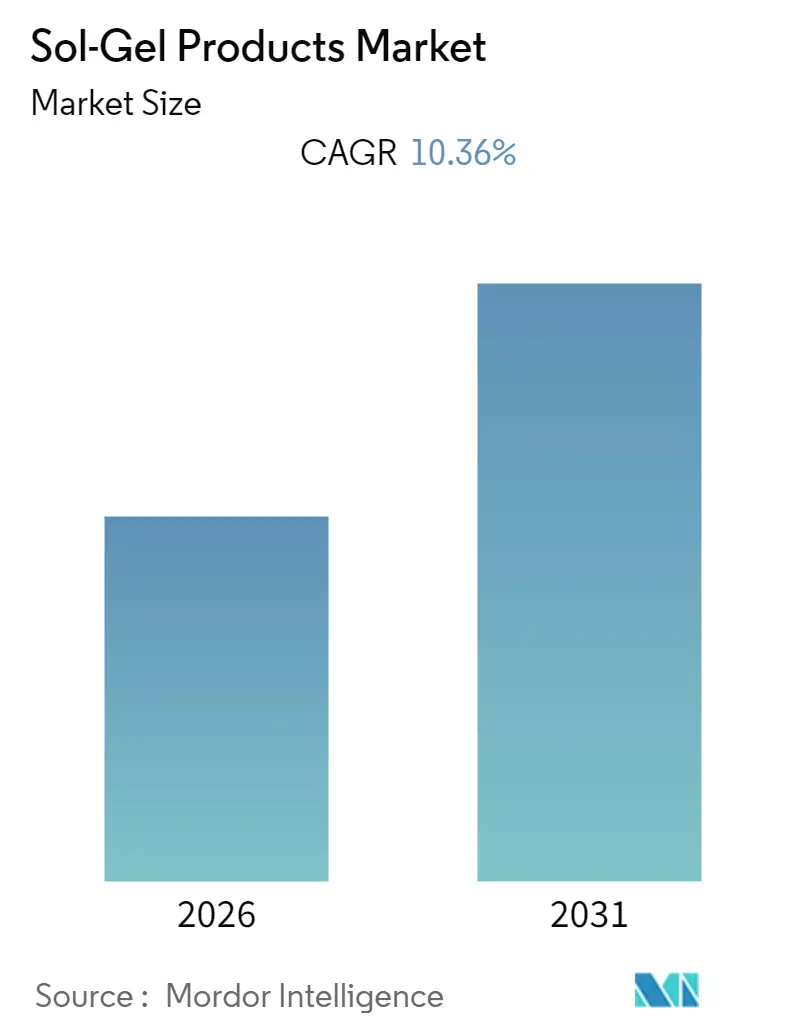
The Sol-Gel Products Market size is expected to register a CAGR of 10.36% during the forecast period (2026-2031).
- Another major driving factors of the market studied is the growing demand from Biomedical Industry
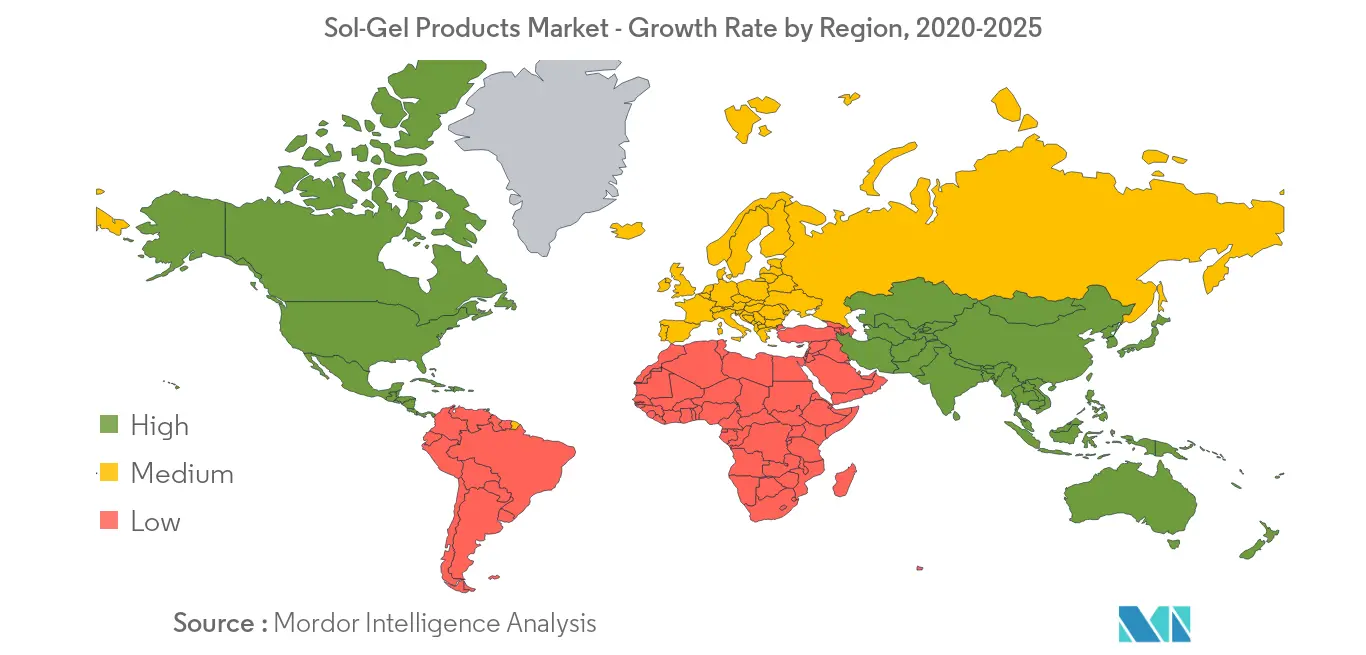
- North America accounts for the highest market share and is expected to dominate the sol-gel products market during the forecast period.
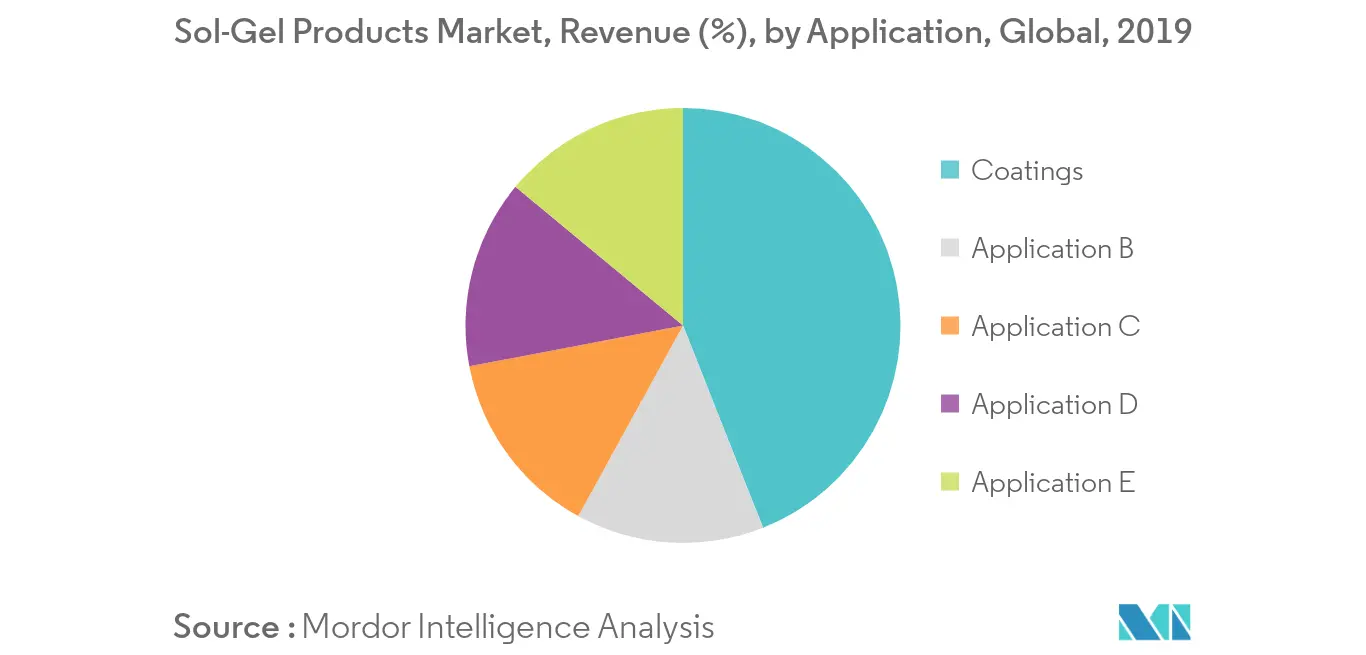
- Among the applications, sol-gel coatings application is expected to dominate the market studied during the forecast period.
Note: Market size and forecast figures in this report are generated using Mordor Intelligence’s proprietary estimation framework, updated with the latest available data and insights as of 2026.
Global Sol-Gel Products Market Trends and Insights
Sol-gel Coating Application to Dominate the Market
- Coatings deposition represents the oldest and largest commercial application of sol-gel technology.
- Silica based sol-gel coatings represents huge potential to be implemented in optical devices, like optical sensors and active coatings.
- The sol-gel process offers various advantages for the development of coatings owing to their relatively low temperatures involved.
- The ever-increasing demand coupled with the advancement in the technology in automotive and aerospace industry is likely to increase the demand for sol-gel coatings.
- Hence, owing to the above-mentioned factors, the sol-gel coatings application is likely to dominate the forecast period during the forecast period.
North America to Dominate the Market
- North America accounts for the largest market share in the global sol-gel products market currently with the major demand coming from the united states.
- In the United States, the growing demand for sol-gel coatings from the aerospace industry is driving the demand for sol-gel products.
- Additionally, The increasing focus on the miniaturization of electronic devices and strong growth in the biomedical sector is likely to drive the demand for sol-gel products in the region.
- Hence, owing to the above-mentioned factors,North America is likely to dominate the market studied during the forecast period.
Competitive Landscape
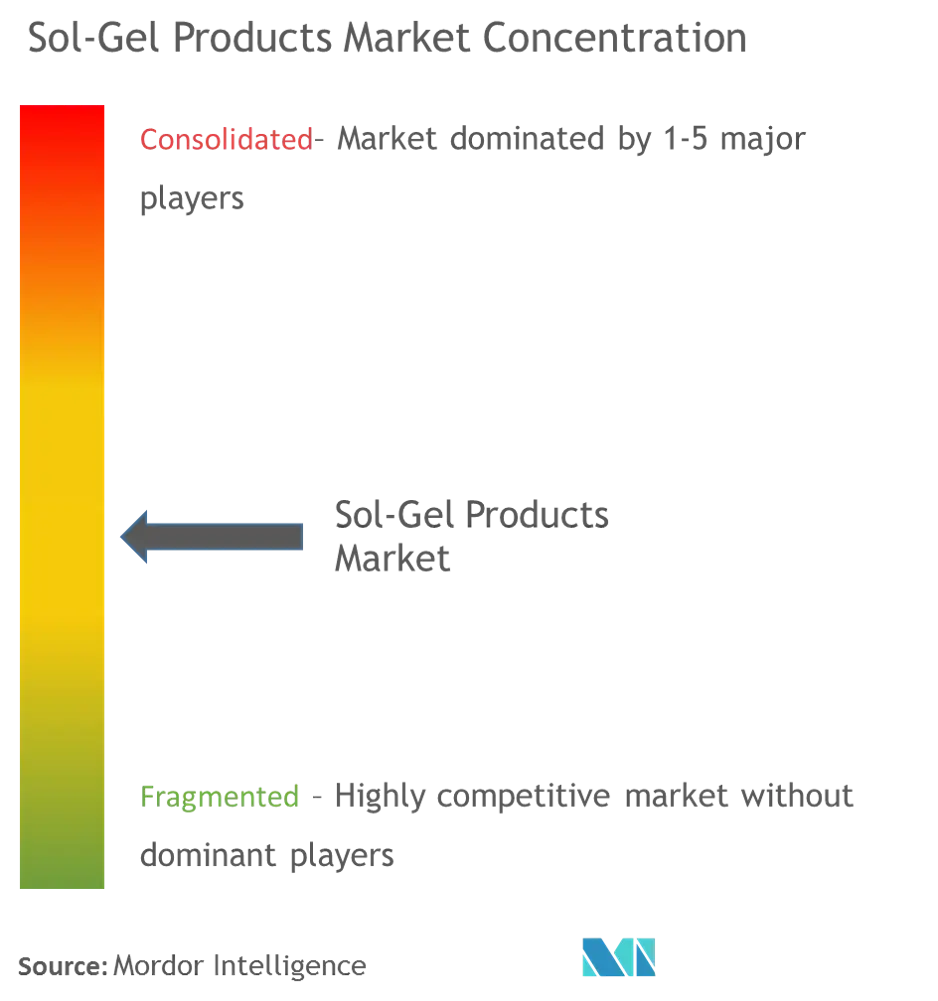
The global sol-gel products market is moderately fragmented as the market share is divided between many players. Key players in the market include 3M, SCHOTT AG, Nanovations Pvt Ltd., CMR Coatings GmbH, and SOCOMORE, among others.
Sol-Gel Products Industry Leaders
-
3M
-
SCHOTT AG
-
Nanovations Pty Ltd.
-
CMR Coatings GmbH
-
SOCOMORE
- *Disclaimer: Major Players sorted in no particular order
Market Opportunities and Future Outlook
Opportunities for sol-gel products remain concentrated in coatings, where customers are seeking thin, high-performance layers deposited at relatively low processing temperatures, supporting adoption across automotive, aerospace, electronics, and biomedical end users. In aerospace surface treatment, sol-gel systems are used as alternatives to chromated pre-treatments, and SOCOMORE positions its SOCOGEL technology as qualified with major OEM requirements, including Airbus (AIMS 04-04-053) and Boeing, which supports broader conversion programs for primers, adhesion promotion, and corrosion-related surface prep.
Research progress is also pushing use cases beyond traditional coatings by improving manufacturability, sustainability, and functional performance. Peer-reviewed 2026 work highlights rapid, more eco-efficient routes that reduce solvent hazards and VOC emissions (reported reductions of 70-90%), while also shortening processing times from hours to minutes. Other studies show sol-gel compatibility with additive manufacturing, including DLP 3D printing of transparent Nd3+-doped silica-phosphate laser glasses. In biomedical and energy-management, sol-gel coatings are being engineered for improved implant corrosion resistance and bioactivity, and low-emissivity xerogel coatings have been discussed as a way to cut building energy consumption (reported at 20-30%), reinforcing product-development pipelines tied to regulated medical devices and energy-efficient infrastructure.
Recent Industry Developments
- July 2026: 3M and Microsoft announced a strategic partnership focused on advancing AI data center infrastructure and enterprise transformation, including deployment of 3M Expanded Beam Optical (EBO) technology within Microsoft Azure environments. The announcement expands 3M's presence in high-performance connectivity and infrastructure applications where specialty materials and coatings are used to protect performance and reliability at scale.
- March 2026: 3M announced it will create a leading fire and safety business by acquiring Madison Fire & Rescue and combining it with Scott Safety. While not specific to sol-gel products, the transaction reflects portfolio actions at a key listed participant in the report, with potential implications for how capital and R&D resources are allocated across 3M's materials and protective-technology platforms.
- January 2026: SCHOTT Pharma launched EVERIC lyo and amber vials with a hydrophobic inner coating aimed at lyophilized, light-sensitive antibody-drug conjugates (ADCs), aligned with light transmission requirements across the EU, the United States, and Japan. The introduction underscores ongoing innovation in specialty coated glass packaging for biopharma, which is a downstream area that aligns with sol-gel coating value propositions around barrier performance and surface functionality.
Research Methodology Framework and Report Scope
Market Definition and Coverage
The sol-gel products market is defined as revenues generated from sol-gel derived materials and products used in industrial and advanced material applications, where a sol to gel chemical process is the core manufacturing route, and sales are counted at the point of product supply.
Scope exclusions: We exclude downstream finished assemblies where sol-gel is only a minor treatment step, and the sold item is priced mainly as a complete device or structure.
Segmentation Overview
- Application
- Coatings
- Catalysts
- Piezoelectric Devices
- High-Strength Ceramics
- Others
- End-User Industry
- Automotive
- Electronics
- Aerospace
- Biomedical
- Others
- Geography
- Asia-Pacific
- China
- India
- Japan
- South Korea
- ASEAN Countries
- Rest of Asia-Pacific
- North America
- United States
- Canada
- Mexico
- Europe
- Germany
- United Kingdom
- France
- Italy
- Rest of Europe
- South America
- Brazil
- Argentina
- Rest of South America
- Middle-East & Africa
- Saudi Arabia
- South Africa
- Rest of Middle-East & Africa
- Asia-Pacific
Data Sources, Market Sizing, and Validation
Desk Research
Desk work started with mapping where sol-gel derived products are used and what drives adoption in coatings, ceramics, catalysts, and functional materials. We referenced public sources such as the US Geological Survey, the International Trade Centre trade statistics portal, the World Bank indicators, the OECD industry datasets, and the US Patent and Trademark Office for patent activity, which helped set context on materials supply and innovation direction.
After that, secondary reading was used to shape assumptions and check reasonableness, including annual reports and investor presentations, technical papers from peer reviewed journals, and updates shared by industry associations and reputable press. A limited set of paid subscriptions was also used for company financials and intelligence, patent databases, and import and export shipment-level checks where product identification was feasible. These sources are illustrative rather than exhaustive, and many other references were also used for data collection, validation, and clarification.
Primary Interviews and Surveys
Primary research was used to turn desk hypotheses into usable inputs, especially around typical selling price ranges, adoption timing by end use, and the portion of demand served by sol-gel routes versus other chemistries. We spoke with a mix of manufacturers, distributors, formulators, and end user technical buyers across the main consuming regions, so assumptions on volumes, substitution, and margin structure could be stress tested before finalizing the model.
Distribution of primary research fieldwork respondents
| Company type | Respondent position | Region |
|---|---|---|
| Top tier: 38% | CXOs: 15% | APAC: 47% |
| Mid tier: 44% | Functional/Unit leaders: 31% | EMEA: 31% |
| Smaller Players: 18% | Managers: 54% | Americas: 22% |
Market-Sizing & Forecasting
Our sizing logic begins with a top-down demand pool build using end-use activity levels and conversion factors that are realistic for sol-gel adoption, and then it is checked against selective bottom-up approximations to keep the totals anchored. Where data was thin, supplier and channel checks were used to bound the estimate by taking sampled average selling prices and pairing them with implied volumes for key application clusters.
Key inputs used in the model include industrial coatings output trends, electronics manufacturing indicators, automotive and aerospace build rates, biomedical device usage signals, and patent filing intensity for sol-gel related formulations and materials. These variables are linked to demand because sol-gel uptake tends to rise when high performance coatings and functional surfaces are specified, and when advanced ceramics and catalyst use expands in industrial settings.
Forecasting was done using multivariate regression, where the market is linked to the above demand indicators, and then adjusted through scenario analysis to reflect expert views on adoption pace and pricing normalization. Gaps in product-level data were handled by applying conservative penetration ranges and using interview based adjustment factors by region and by major end use, so the final forecast stays repeatable and explainable.
Data Validation & Update Cycle
Validation is done through repeated cross checks, where the modeled totals are compared with independent signals such as trade movement patterns, materials supply constraints, and reported capacity expansions, and mismatches are investigated before sign off. Outliers are reviewed by another analyst, and when the variance is material, follow up calls are triggered to re-check the specific assumption that caused the gap.
The report is refreshed annually, and interim updates are made when major events occur, such as large capacity additions, regulation driven shifts in coatings demand, or sharp moves in input costs that can change pricing. Right before delivery, a final pass is completed so clients receive the most current view that matches the latest available public data and the most recent expert feedback.
Mordor Intelligence's Sol Gel Products Market Size Compared Against Other Published Estimates
Published market sizes for sol-gel products often vary because groups do not count the same product set, and they also use different base years and currency handling. Differences also show up when some estimates lean on broad materials markets and apply high penetration rates without checking how much is actually produced through sol-gel routes.
Key gap drivers in this market usually come from whether adjacent categories like aerogels, general silica and metal oxides, and broad nanoparticles are counted as sol-gel products by default, plus whether pricing is treated as a single blended average or separated by application types like coatings, catalysts, and functional ceramics. Another spread factor is refresh cadence, since capacity announcements and end-use cycles can quickly change the near-term run rate in electronics, automotive, and aerospace.
Benchmark comparison
| Source | Market Size | Gaps in Research Methodology |
|---|---|---|
| Mordor Intelligence | USD 6.20 B (2025) | |
| Industry Publisher A | USD 15.30 B (2023) | This estimate appears to include adjacent materials revenues such as aerogels, general silica and metal oxides, and broad nanoparticles, which expands the counted value beyond sol-gel derived products sold into defined applications. |
| Research Portal B | USD 6.20 B (2025) | The public snapshot provides limited detail on how application-level pricing is normalized and how overlap between materials categories and finished products is removed, which can shift totals even when the headline year matches. |
The spread mainly comes from what is treated as a sol-gel product and how pricing is averaged across end uses, and then from how often assumptions are refreshed when demand indicators move. By counting revenue only when the sol-gel route is central to the supplied product and by re-checking application level ASP ranges during annual updates, the model stays closer to real buying patterns, a scope filter applied by Mordor Intelligence.
Key Questions Answered in the Report
What is the current Sol-Gel Products Market size?
The Sol-Gel Products Market is projected to register a CAGR of 10.36% during the forecast period (2026-2031)
Who are the key players in Sol-Gel Products Market?
3M, SCHOTT AG, Nanovations Pty Ltd., CMR Coatings GmbH and SOCOMORE are the major companies operating in the Sol-Gel Products Market.
Which is the fastest growing region in Sol-Gel Products Market?
Asia Pacific is estimated to grow at the highest CAGR over the forecast period (2026-2031).
Which region has the biggest share in Sol-Gel Products Market?
In 2025, the North America accounts for the largest market share in Sol-Gel Products Market.
What years does this Sol-Gel Products Market cover?
The report covers the Sol-Gel Products Market historical market size for years: 2019, 2020, 2021, 2022, 2023 and 2024. The report also forecasts the Sol-Gel Products Market size for years: 2026, 2027, 2028, 2029, 2030 and 2031.