
Smart Faucets Market Size and Share
Market Overview
| Study Period | 2021 - 2032 |
|---|---|
| Market Size (2027) | USD 4.62 Billion |
| Market Size (2032) | USD 6.94 Billion |
| Growth Rate (2027 - 2032) | 8.46 % |
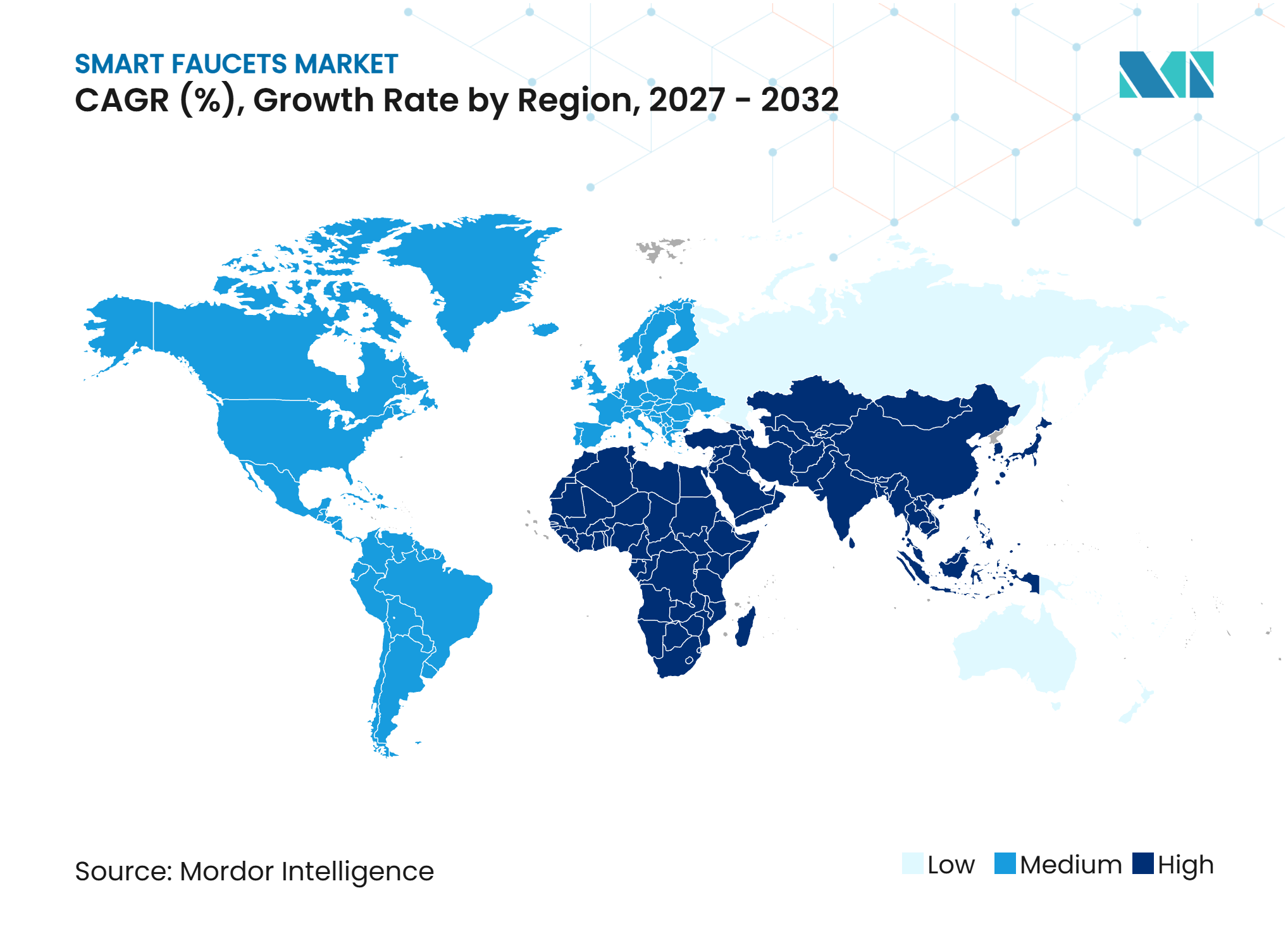
| Fastest Growing Market | Asia-Pacific |
| Largest Market | Asia-Pacific |
| Market Concentration | Medium |
Major Players *Disclaimer: Major Players sorted in no particular order Image © Mordor Intelligence. Reuse requires attribution under CC BY 4.0. | |
Smart Faucets Market Analysis by Mordor Intelligence
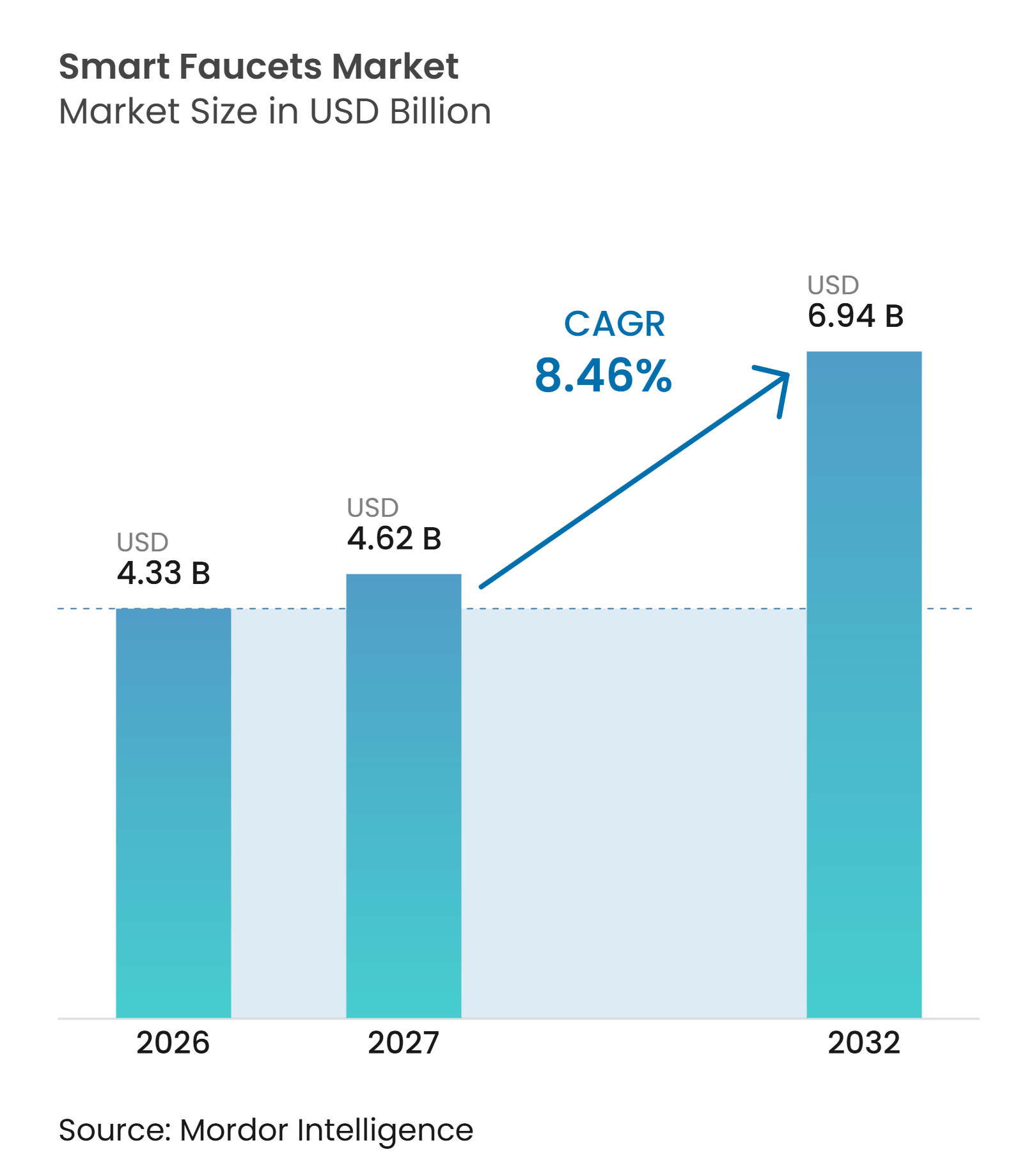
The smart faucets market size is expected to grow from USD 4.33 billion in 2026 to USD 4.62 billion in 2027 and is forecast to reach USD 6.94 billion by 2032 at a 8.46% CAGR over 2027-2032. The smart faucets market is moving beyond a fixture-only purchase toward water management, hygiene, and maintenance applications in commercial and residential buildings. Replacement and renovation projects accounted for 60% of demand in 2026, which gives suppliers exposure to maintenance budgets as well as construction cycles. Water efficiency rules, hygiene requirements, and building certification programs are reinforcing demand for automatic shut-off and monitored water use. Commercial buyers are also favoring products that can connect with building management systems and support maintenance decisions. These conditions create opportunities for suppliers that combine reliable hardware, low water use, and service support.
Key Report Takeaways
- By material, brass held a 44.9% share of the market in 2026, while engineering plastics and polymer composites are forecast to grow at a 10.1% CAGR through 2032.
- By installation type, deck-mount configurations held a 59.7% share of the market in 2026, while other installations are forecast to grow at a 10.3% CAGR through 2032.
- By construction/project type, replacement, renovation, and retrofit projects held a 60% share of the market in 2026 and are forecast to grow at a 9.5% CAGR through 2032.
- By application, bathroom sink faucets held a 62.8% share of the market in 2026, while kitchen sink faucets are forecast to grow at a 9.7% CAGR through 2032.
- By end user, residential users held a 56.9% share of the market in 2026, while the commercial segment is forecast to grow at a 10.2% CAGR through 2032.
- By distribution channel, B2C and retail held a 63.6% share of the market in 2026, while B2B and direct sales are forecast to grow at a 9.6% CAGR through 2032.
- By geography, Asia-Pacific held a 35% share of the market in 2026 and is forecast to grow at a 9.9% CAGR through 2032.
Note: Market numbers in this report are based on Mordor Intelligence's proprietary estimation framework, which combines nine months of actuals with Q4 projections for base year 2026.
Market Trends and Insights
Drivers Impact Analysis of Smart Faucets Market*
| Driver | (~) % Impact on CAGR Forecast | Geographic Relevance | Impact Timeline |
|---|---|---|---|
| Hygiene-Led Replacement of High-Contact Fixtures | +1.8% | Global, with concentration in North America, Europe, Japan, and Southeast Asia | Short term (≤ 2 years) |
| Water Conservation and Automatic Shut-Off Requirements | +1.6% | Global, with emphasis in China, India, Australia, the Middle East and Africa, and the western United States | Medium term (2-4 years) |
| Smart-Home and Building-Management-System Integration | +1.4% | North America, Western Europe, China, South Korea, and the United Arab Emirates | Medium term (2-4 years) |
| Sensor Reliability Improvements and Lower Power Consumption | +0.8% | Global, with the largest effect in high-traffic commercial settings | Short term (≤ 2 years) |
| Hospitality, Healthcare, and High-Traffic Facility Modernization | +0.9% | Global, including GCC hospitality projects and Southeast Asian commercial construction | Medium term (2-4 years) |
| Specification of Touchless Fixtures in Premium and Green Buildings | +0.7% | North America and Europe, with early adoption in South Korea, Singapore, and the United Arab Emirates | Long term (≥ 4 years) |
| Source: Mordor Intelligence | |||
Hygiene-Led Replacement of High-Contact Fixtures
The smart and touchless faucets market benefits from replacement programs that treat contact reduction as part of facility hygiene management. Chicago Faucets describes its HyTronic product range for healthcare settings with non-aerating laminar outlets, ASSE 1070-certified thermostatic mixing valves, and Bluetooth-enabled monitoring[1]. These features support infection prevention and water safety practices in patient areas. Hospitals, foodservice locations, schools, and transit facilities can include such upgrades in planned maintenance work instead of relying on reactive purchases. This approach can sustain purchases when discretionary interior projects slow. Hygiene requirements also make touch-free fixtures more relevant in spaces with frequent user turnover.
Water Conservation and Automatic Shut-Off Requirements
Automatic shut-off and controlled flow rates support water conservation in the smart and touchless faucets market. The U.S. Environmental Protection Agency states that WaterSense-labeled bathroom sink faucets use at least 20% less water than the federal standard of 2.2 gallons per minute[2]. Sloan expanded its BASYS line with a 0.35 gallons-per-minute option in January 2025, designed to support water efficiency requirements in commercial facilities. China’s water conservation regulation directs public buildings to use water-saving fixtures, strengthening the role of institutional procurement in the country[3]. Water monitoring can also help building occupants recognize consumption that is otherwise difficult to observe. According to the GROHE Water Insights 2025, 87% of surveyed European respondents considered water efficiency important, while 79% underestimated their daily water use.
Connected Buildings, Reliable Sensors, and Efficient Power Use
The smart and touchless faucets market is gaining from sensor improvements and stronger links with building management systems. Zurn Elkay received a U.S. patent for its plumbSMART platform in May 2025, which centralizes monitoring and control of water devices across commercial and campus sites. Product reliability matters because earlier false activations created maintenance concerns in reflective or brightly lit settings. TOTO introduced its ESCUA system in June 2025 with microwave sensing and expanded compatible touchless faucet design choices[4]. Connected controls can provide remote configuration, alerts, hygiene flush scheduling, and maintenance records. These capabilities favor suppliers that can meet interoperability and cybersecurity requirements in commercial projects.
Facility Modernization and Green Building Specifications
Hospitals, hotels, airports, stadiums, and education facilities are creating a larger base of specification-led demand for the smart and touchless faucets market. These buyers can assess water use, hygiene, and maintenance across a property rather than evaluate a faucet only by its upfront price. LEED v4.1 includes indoor water-use reduction requirements that can strengthen interest in efficient fixture specifications. Sloan’s education-focused platform, introduced in September 2025, highlights sensor-activated products and water management tools for schools and universities. Premium and green buildings also create demand for products that demonstrate water performance and operational visibility. The result is a longer procurement process, but one that can support broader product and service contracts.
Restraints Impact Analysis of Smart Faucets Market*
| Restraint | (~) % Impact on CAGR Forecast | Geographic Relevance | Impact Timeline |
|---|---|---|---|
| Higher Purchase, Installation, and Maintenance Costs | -1.4% | Global, especially South Asia, Southeast Asia, Latin America, and Sub-Saharan Africa | Short term (≤ 2 years) |
| Retrofit Complexity and Skilled-Plumber Shortages | -0.8% | Western Europe, North America, and emerging areas in Asia-Pacific | Medium term (2-4 years) |
| False Activations and Sensor Performance Under Variable Site Conditions | -0.5% | Global, with greater exposure to highly reflective or variable-light locations | Short term (≤ 2 years) |
| Battery Logistics, Electronic Waste, and Connectivity Dependence | -0.3% | Global, with added exposure in the European Union, Singapore, and California | Long term (≥ 4 years) |
| Source: Mordor Intelligence | |||
Cost, Retrofit Complexity, and Installer Availability
Higher equipment and installation costs remain a barrier for the smart and touchless faucets market, particularly in price-sensitive public and residential projects. A retrofit can require power-source selection, sink-specific sensor calibration, countertop adjustments, and network configuration. These tasks require skills that are not always available among general plumbing contractors. Aging building stock can add further issues such as unsuitable pipe materials, irregular countertop cutouts, and limited electrical access. Chubu Electric Power and Komoro City began a March 2025 pilot that uses an electricity smart-meter communications network for remote water-valve operation, showing how infrastructure operators are exploring remote management approaches. Suppliers that simplify installation and field servicing will be better placed to reduce project delays and control labor requirements.
Performance, Battery, and Connectivity Obligations
Sensor performance can still vary with sink geometry, surface reflectivity, ambient light, and local maintenance practices. These risks make buyers cautious when they have experienced false activations or unreliable installations in the past. Battery-operated products also create replacement, waste-handling, and maintenance requirements that do not apply to manual fixtures. Connectivity adds value for monitoring, but it can introduce network dependence and data-management responsibilities. The European Union’s Ecodesign for Sustainable Products Regulation provides a framework for digital product information requirements, which can raise the compliance workload for manufacturers serving the region. Product designs that use less power, support serviceability, and document component information can help reduce these concerns.
*Our forecasts treat driver/restraint impacts as directional, not additive. The impact forecasts reflect baseline growth, mix effects, and variable interactions.
Smart Faucets Market Segment Analysis
By Material:
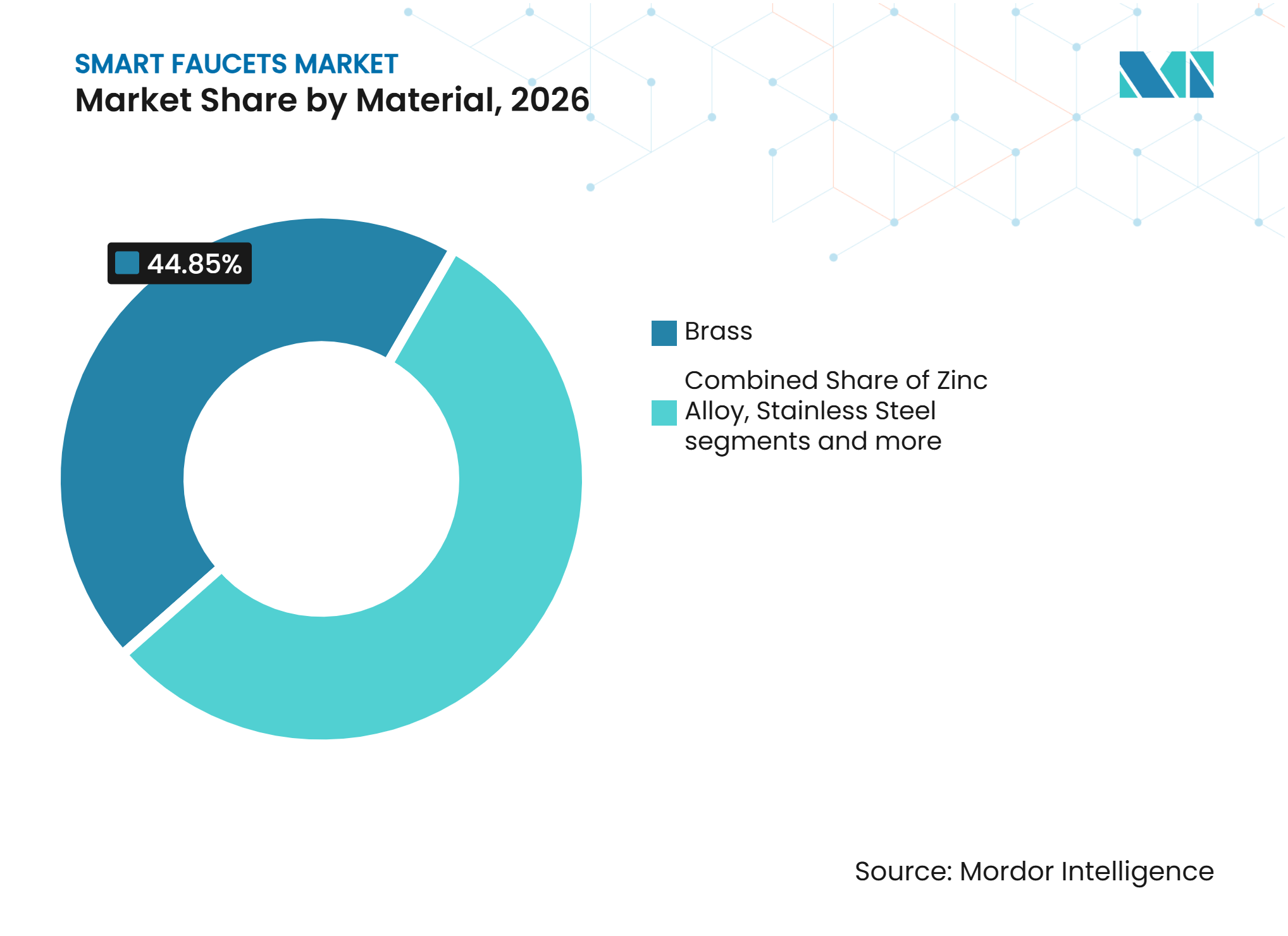
Brass Retains Scale While Polymers Gain GroundBrass held 44.9% of the smart and touchless faucets market share in 2026, supported by corrosion resistance, machinability, established plumbing-code acceptance, and mature supply chains. The material remains common in faucet bodies used in both new construction and replacement work. Its broad installed base also supports recurring orders from familiar manufacturing and distribution networks. Lead restrictions and drinking-water requirements are creating pressure to reduce brass use in suitable components. The European Drinking Water Directive sets requirements intended to protect drinking water quality, including controls relevant to materials in contact with water. This encourages suppliers to assess alternative material choices without compromising reliability or code compliance.
Engineering plastics and polymer composites are forecast to expand at a 10.1% CAGR through 2032 in the smart and touchless faucets industry. EMS Group states that its drinking-water-certified Grivory FWA and Grilamid FWA materials can be used in applications that seek to reduce dependence on brass. Syensqo announced in October 2025 that Uniwell uses AvaSpire PAEK for flexible plumbing connection hoses supplied for GROHE faucet systems. The development shows that polymer use is moving beyond small internal components into selected plumbing assemblies. Stainless steel and zinc alloy retain roles where appearance, hygiene requirements, or difficult operating conditions are more important than the lowest material cost.



By Installation Type:
Deck-Mount Designs Lead While Integrated Systems ExpandDeck-mount configurations held a 59.7% share of the market in 2026, reflecting compatibility with a broad range of sinks and countertops. This format supports both new installations and retrofit work because it can avoid major wall modifications. Commercial product lines from major suppliers commonly use deck-mount designs for restroom applications. Wall-mount products retain a role in premium residential and hospitality projects where concealed plumbing is preferred. Their use remains more limited because installation depends on in-wall rough plumbing and skilled labor. The smart and touchless faucets market therefore continues to favor installation formats that reduce disruption in existing buildings.
Other installations are forecast to grow at a 10.3% CAGR through 2032. This category includes integrated sink systems, panel-mounted products, and other modular approaches used in high-traffic settings. Sloan’s education materials illustrate the importance of coordinated restroom solutions that bring together water efficiency, hygiene, and durable design. Facility managers can reduce the number of separate equipment relationships when faucets, sinks, and related fixtures are designed as one system. This supports suppliers that offer standardized components and simpler maintenance procedures. Integrated products also fit projects where vandal resistance and consistent cleaning practices are important.
By Construction/Project Type:
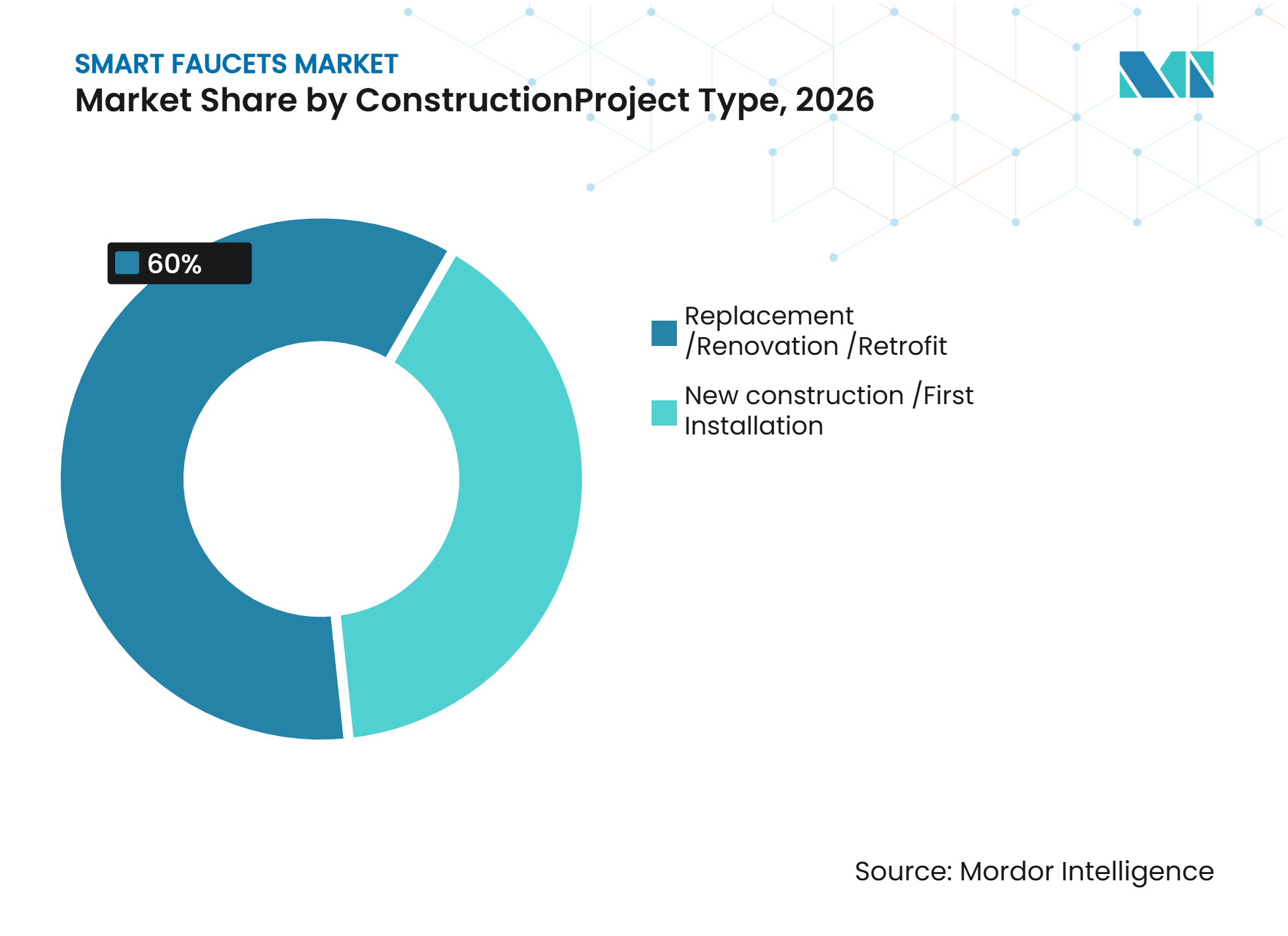
Renovation Sustains the Core Demand BaseReplacement, renovation, and retrofit projects accounted for 60% of the smart and touchless faucets market size in 2026 and are forecast to grow at a 9.5% CAGR through 2032. This pattern reduces dependence on new construction cycles. Demand comes from hygiene upgrades, water-efficiency work, and residential design renovation. Facility operators can schedule faucet replacements as part of ongoing building maintenance. Chicago Faucets’ healthcare resources position touchless products within water safety, infection prevention, and scald-protection planning. The segment benefits when these needs are included in recurring capital maintenance budgets.
New construction remains strategically important because a specification made at the design stage can guide long-term fixture procurement. LEED v4.1 addresses indoor water use and encourages project teams to document plumbing fixture performance. WaterSense labeling also provides a recognized benchmark for efficient bathroom sink faucets in the United States. These requirements can create demand that is less dependent on individual product preference. Suppliers need to support architects and engineers with performance documentation. The smart and touchless faucets industry can therefore gain from early engagement in green-building and institutional design specifications.

By Application:
Bathroom Faucets Hold Volume and Kitchens Add Digital DemandBathroom sink faucets held a 62.8% share of the market in 2026, driven by their use across residential buildings, hotels, healthcare sites, and commercial restrooms. Each large property can contain many bathroom handwashing points, which supports high unit volumes. Healthcare and foodservice settings also have hygiene requirements that support touch-free operation. Automatic shut-off can limit unnecessary flow in frequently used restrooms. Bathroom products are well suited to standardized commercial rollouts. Buyers in this segment generally prioritize reliability, easy maintenance, and flow control.
Kitchen sink faucets are forecast to grow at a 9.7% CAGR through 2032. LIXIL’s 2025 Navish catalog demonstrates the continued availability of touchless kitchen products in Japan. In connected homes, kitchen products can be linked with filtration, usage monitoring, and other home-management functions. Foodservice and hospital kitchens can also value hands-free operation where hygiene workflows are important. Other applications, including laboratory, utility, and outdoor faucets, remain smaller but serve specific requirements such as controlled temperature and sanitary operation. Product suppliers must adapt sensor range, spout design, and durability to the physical demands of each setting.
By End User:
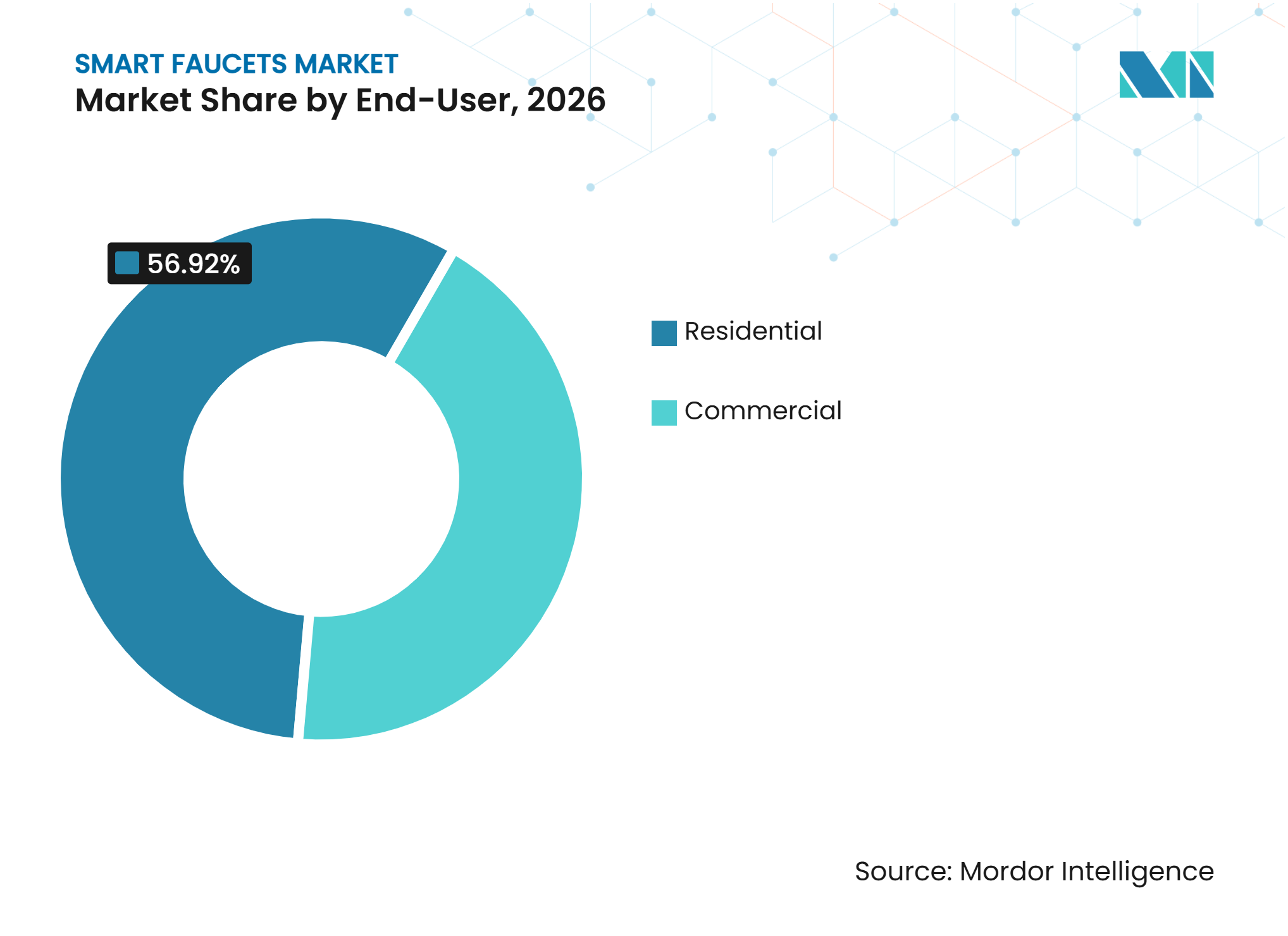
Commercial Facilities Set the Faster Growth PaceResidential users held a 56.9% share of the market in 2026, supported by construction activity in Asia-Pacific and smart-home renovations in North America. Consumers are more likely to select touchless products when they can see hygiene, convenience, and water-use benefits. Retail availability helps established brands reach homeowners undertaking kitchen or bathroom upgrades. Adoption can grow as commercial installations make the technology more familiar to users. Price remains a central consideration for the mid-market residential buyer. Suppliers that balance design, reliability, and accessible pricing can broaden their residential reach.
Commercial use is forecast to expand at a 10.2% CAGR through 2032. Airports, offices, stadiums, hotels, hospitals, and foodservice sites have high traffic and stronger water-accountability requirements. These properties can examine water use and maintenance at portfolio scale, which makes connected products more relevant. Commercial specifications often cascade from highly regulated settings into offices, schools, and entertainment venues. Zurn’s patented plumbSMART platform shows how suppliers are building water-device monitoring around large facilities. The smart and touchless faucets market can gain where companies provide both hardware and ongoing management support.
By Distribution Channel:
Retail Holds Volume While Direct Sales Serve Systems ProjectsB2C and retail channels held a 63.6% share of the market in 2026, covering home-improvement stores, specialist showrooms, e-commerce platforms, and local hardware outlets. This channel benefits from the large number of residential purchasers. Recognized brands can use retail displays and digital content to explain sensor features and installation needs. Online channels can broaden selection and improve access in markets with limited showroom coverage. Retail buyers, however, may need clearer information on power sources, compatible sinks, and service requirements. The smart and touchless faucets market continues to depend on simple product education at the point of purchase.
B2B and direct sales are forecast to grow at a 9.6% CAGR through 2032. This route serves commercial specifications, original equipment manufacturing contracts, and institutional tenders. Direct engagement becomes more valuable when a project includes building management integration, commissioning, and maintenance support. Suppliers can differentiate through remote monitoring, service-level agreements, and technical documentation. Zurn’s platform strategy illustrates the role of centralized management in commercial water-device decisions. Direct channels are likely to gain value as customers purchase complete water-management solutions rather than individual fixtures.
Geography Analysis
Asia-Pacific
Asia-Pacific held 35% of smart and touchless faucets market share in 2026 and is forecast to grow at a 9.9% CAGR through 2032. China’s national water conservation regulation requires water-saving fixtures in public buildings and supports wider adoption of efficient products. This creates an institutional route to demand alongside private housing purchases. Japan remains an important product-development center, as shown by TOTO’s 2025 ESCUA launch with microwave sensing and automatic lighting functions. India adds demand through urban infrastructure and growing interest in smart-home products. The region combines high installation volumes with a broad range of price points and building standards. Suppliers need products that suit commercial projects, urban apartments, and local service capabilities.
Europe
Europe is shaped by water-management regulation, renovation activity, and demand for premium sanitary products. The European Commission’s 2025 Water Resilience Strategy identifies better water management as a priority, including action relevant to the built environment. The Energy Performance of Buildings Directive provides a wider policy setting for building upgrades. Hansgrohe partnered with Hydraloop in February 2025 to introduce a greywater recycling solution for hotels, public buildings, and sustainability-focused construction projects. This points to a shift from individual water-saving fixtures toward building-level reuse systems. The smart and touchless faucets market is supported where manufacturers can demonstrate performance, water efficiency, and compatibility with broader water infrastructure.
North America, Middle East and Africa, and South America
North America remains a mature commercial market, where WaterSense, LEED v4.1, and WELL-related project requirements support efficient fixture specifications. The United States Department of Energy proposed rescinding enhanced faucet conservation standards in May 2025, but this did not remove WaterSense or private building-certification requirements. In the Middle East and Africa, hospitality and infrastructure projects in the Gulf create demand for premium products in hotels, airports, and offices. Benkiser introduced its Isla touchless faucet at BIG 5 Dubai in November 2025, signaling attention to this commercial segment. South America offers a more selective opportunity through hospitality and commercial projects, while cost sensitivity and infrastructure limits constrain wider household adoption. Across these regions, suppliers need localized installation support and products that balance specification performance with total project cost.
Competitive Landscape
Market Concentration
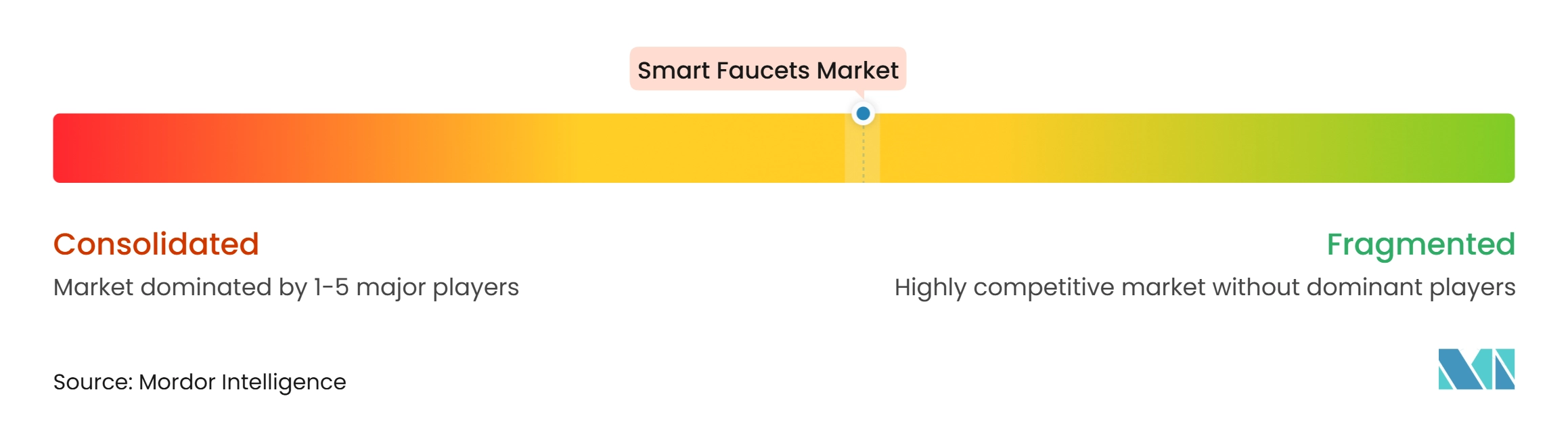
The smart and touchless faucets market remains moderately concentrated globally, although several suppliers have strong positions in specific commercial and residential applications. Large suppliers compete through product reliability, distribution, water efficiency, and the ability to meet formal project specifications. Regional producers can remain competitive where they offer lower prices, local service, or products adapted to domestic standards. This structure leaves room for both established sanitaryware companies and specialized sensor suppliers. No single company has pricing authority across all product categories or regions.
Sloan and Zurn Elkay are using connected water management to move beyond the sale of individual fixtures. Zurn received a U.S. patent in May 2025 for plumbSMART, which supports centralized monitoring and remote control of water devices. Sloan added a 0.35 gallons-per-minute BASYS configuration in January 2025 for commercial water-efficiency applications. These actions respond to commercial customers seeking efficiency, maintenance visibility, and coordinated facility controls. They also make technical support and software capability more important in supplier selection. The smart and touchless faucets market increasingly rewards companies that can support the full life of a building system.
European and Japanese companies are also pursuing product and system differentiation. Hansgrohe’s February 2025 partnership with Hydraloop linked water-use reduction with greywater reuse for selected building types. TOTO’s June 2025 ESCUA release expanded touchless design options and introduced microwave-sensor automatic lighting. Syensqo’s October 2025 announcement on PAEK plumbing hoses for GROHE systems showed how material innovation can support lead-risk reduction in selected components. These examples show competition across connectivity, water systems, sensing, and materials rather than only faucet styling.
Smart Faucets Industry Leaders
-
Kohler Co.
-
LIXIL Corporation
-
TOTO Ltd.
-
Moen Incorporated
-
Delta Faucet Company
- *Disclaimer: Major Players sorted in no particular order
Smart Faucets Market Companies Covered in this Report
- Kohler Co.
- LIXIL Corporation
- TOTO Ltd.
- Moen Incorporated
- Sloan Valve Company
- Hansgrohe SE
- Roca Sanitario, S.A.
- Jaquar Group
- Geberit International AG
- Oras Ltd.
- PRESTO Group
- GESSI S.p.A.
- Zurn Elkay Water Solutions
- VitrA
- Franke Group
- CERA Sanitaryware Limited
- JOMOO Kitchen & Bath Co., Ltd.
- Advanced Modern Technologies Corporation (AMTC)
- Pfister
- Kraus USA
Recent Industry Developments in Smart Faucets Market
- October 2026: Kohler Co. was granted US Patent 12,768,153 for a camera-based faucet control system. A camera and processor identify the object under the spout (hands, cup, toothbrush, pot) and adjust flow rate, temperature and duration to suit it. A ranging sensor can also stop flow once a container reaches a fill level.
- October 2026: Delta Faucet Company (Masco) introduced the Noreau Kitchen Collection. It combines Touch2O with Touchless Technology, VoiceIQ voice-activated metered dispensing and a TempSense LED water-temperature indicator.
- November 2025: Benkiser premiered its Isla touchless sensor faucet at BIG 5 Dubai, offering individually selectable premium finishes and configurable spout heights for hotels, airports, office buildings, and high-end gastronomy.
- October 2025: Syensqo announced that Uniwell Rohrsysteme is using AvaSpire PAEK to manufacture flexible plumbing connection hoses for GROHE faucet systems.
Global Smart Faucets Market Report Scope
Segmentation Overview
| Zinc Alloy |
| Stainless Steel |
| Brass |
| Engineering plastics / polymer composites |
| Other Materials |
| Deck-Mount |
| Wall-Mount |
| Other Installations |
| Kitchen Sink Faucets |
| Bathroom Sink Faucets |
| Other Applications |
| New construction / first installation |
| Replacement / renovation / retrofit |
| Residential |
| Commercial |
| B2C / Retail | Multi-Brand Stores/Home-improvement retailers |
| Specialist plumbing and kitchen/bath showrooms (including Exclusive Brand Outlets (EBOs)) | |
| Online / E-Commerce | |
| Local Hardware Stores / Unorganized Retail | |
| B2B / Direct Sales |
| North America | Canada |
| United States | |
| Mexico | |
| South America | Brazil |
| Peru | |
| Chile | |
| Argentina | |
| Rest of South America | |
| Europe | United Kingdom |
| Germany | |
| France | |
| Spain | |
| Italy | |
| Benelux | |
| Nordics | |
| Rest of Europe | |
| Asia-Pacific | India |
| China | |
| Japan | |
| Australia | |
| South Korea | |
| Southeast Asia | |
| Rest of Asia-Pacific | |
| Middle East and Africa | United Arab Emirates |
| Saudi Arabia | |
| South Africa | |
| Nigeria | |
| Rest of Middle East and Africa |
| By Material | Zinc Alloy | |
| Stainless Steel | ||
| Brass | ||
| Engineering plastics / polymer composites | ||
| Other Materials | ||
| By Installation Type | Deck-Mount | |
| Wall-Mount | ||
| Other Installations | ||
| By Application | Kitchen Sink Faucets | |
| Bathroom Sink Faucets | ||
| Other Applications | ||
| By Construction/Project Type | New construction / first installation | |
| Replacement / renovation / retrofit | ||
| By End-User | Residential | |
| Commercial | ||
| By Distribution Channel | B2C / Retail | Multi-Brand Stores/Home-improvement retailers |
| Specialist plumbing and kitchen/bath showrooms (including Exclusive Brand Outlets (EBOs)) | ||
| Online / E-Commerce | ||
| Local Hardware Stores / Unorganized Retail | ||
| B2B / Direct Sales | ||
| By Geography | North America | Canada |
| United States | ||
| Mexico | ||
| South America | Brazil | |
| Peru | ||
| Chile | ||
| Argentina | ||
| Rest of South America | ||
| Europe | United Kingdom | |
| Germany | ||
| France | ||
| Spain | ||
| Italy | ||
| Benelux | ||
| Nordics | ||
| Rest of Europe | ||
| Asia-Pacific | India | |
| China | ||
| Japan | ||
| Australia | ||
| South Korea | ||
| Southeast Asia | ||
| Rest of Asia-Pacific | ||
| Middle East and Africa | United Arab Emirates | |
| Saudi Arabia | ||
| South Africa | ||
| Nigeria | ||
| Rest of Middle East and Africa | ||
Key Questions Answered in the Report
What is the projected size of the smart and touchless faucets market by 2032?
The smart and touchless faucets market is projected to reach USD 6.94 billion by 2032, growing at a CAGR of 8.5%.
Which material leads demand for smart and touchless faucets?
In the smart and touchless faucets market, brass led demand with a 44.9% share in 2026, while engineering plastics and polymer composites are forecast to grow at a 10.1% CAGR through 2032.
Why are touchless faucets used in commercial buildings?
The smart and touchless faucets market serves commercial sites that need hygiene, water efficiency, maintenance visibility, and building management functions.
Which application has the largest demand for touchless faucets?
In the smart and touchless faucets market, bathroom sink faucets held 62.8% of demand in 2026 because they are widely used in homes, hotels, healthcare facilities, and commercial restrooms.
Which region is expanding fastest for smart and touchless faucets?
In the smart and touchless faucets market, Asia-Pacific held 35% of demand in 2026 and is forecast to grow at a 9.9% CAGR through 2032.