
Smart Bathroom Market Size and Share
Market Overview
| Study Period | 2021 - 2032 |
|---|---|
| Market Size (2027) | USD 13.71 Billion |
| Market Size (2032) | USD 27.41 Billion |
| Growth Rate (2027 - 2032) | 14.86 % |
| Fastest Growing Market | Asia-Pacific |
| Largest Market | North America |
| Market Concentration | Low |
Major Players *Disclaimer: Major Players sorted in no particular order Image © Mordor Intelligence. Reuse requires attribution under CC BY 4.0. | |
Smart Bathroom Market Analysis by Mordor Intelligence
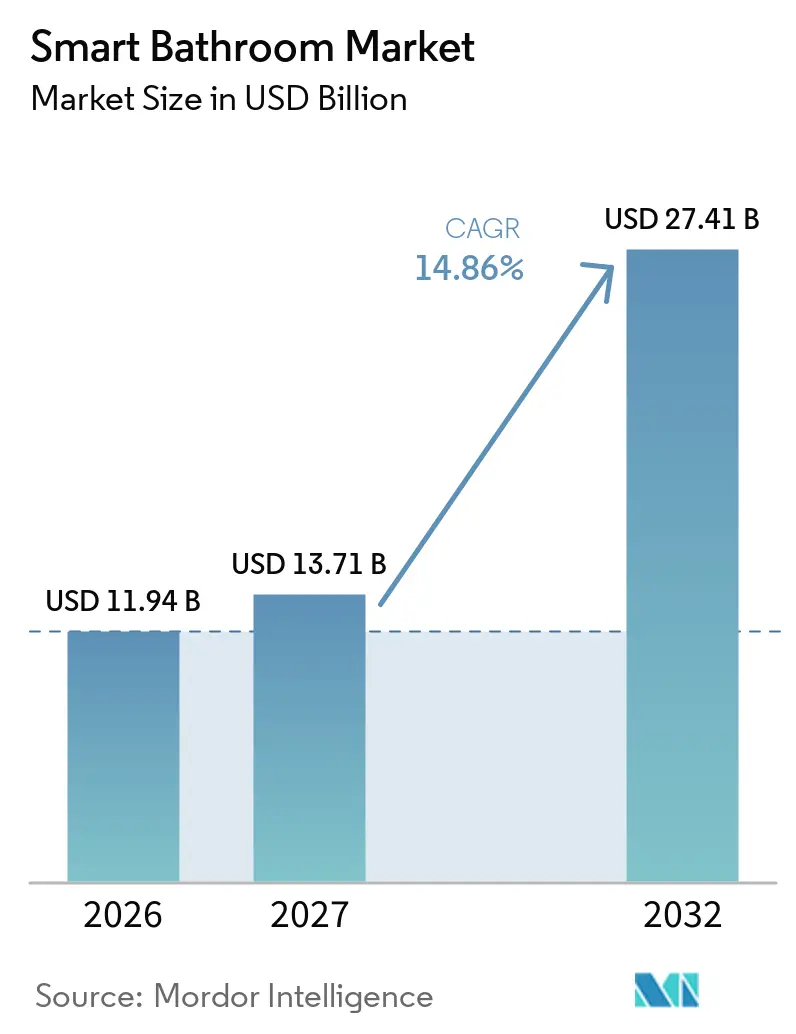
The smart bathroom market size is expected to increase from USD 11.94 billion in 2026 to USD 13.71 billion in 2027 and reach USD 27.41 billion by 2032, growing at a CAGR of 14.86% over 2027-2032. Connected fixtures are becoming practical renovation purchases as buyers seek hygiene, convenience, water control, and wellness features. Interoperable smart-home systems are making bathroom devices part of a wider household upgrade rather than isolated fixtures. Manufacturers are focusing on retrofit-ready products, digital sales, and premium health features to reach existing homes and commercial properties. Regulation also favors products that can manage water and energy use more precisely. The smart bathroom market still faces high purchase costs and consumer concerns about the handling of personal data.
Key Report Takeaways
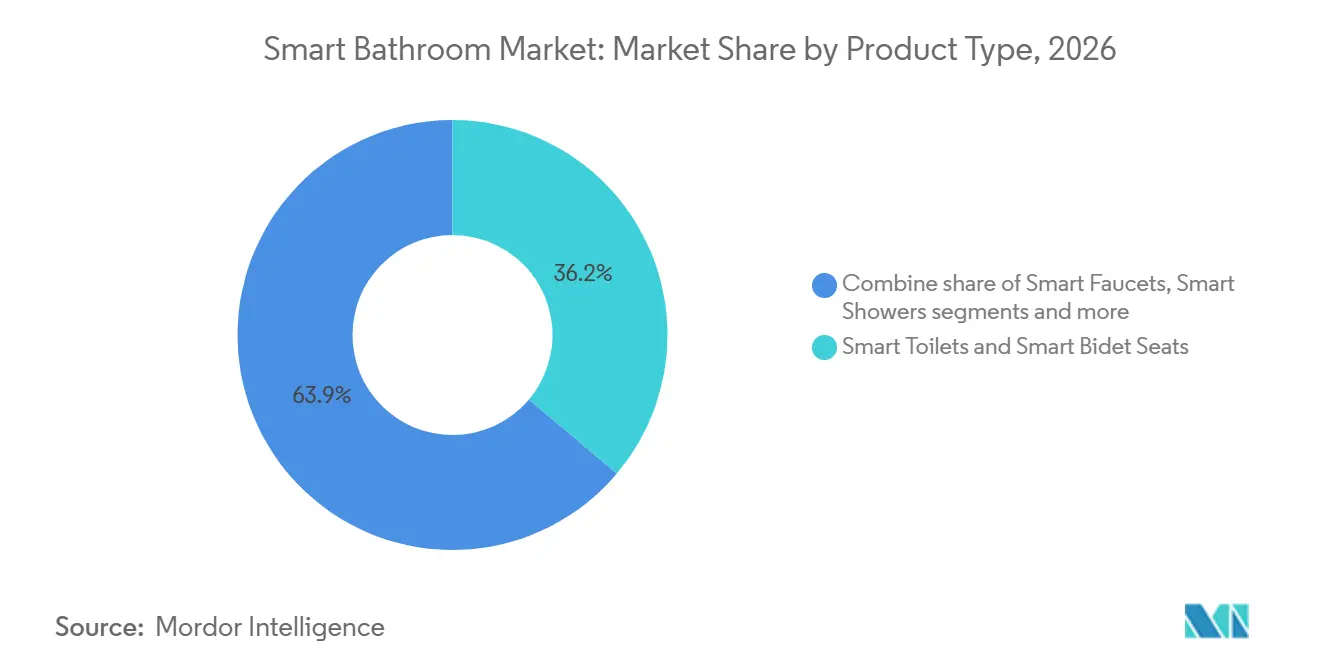
- By product type, Smart Toilets and Smart Bidet Seats held 36.15% of the smart bathroom market share in 2026, while Smart Faucets are projected to grow at a 16.64% CAGR through 2032.
- By construction type, Replacement and Retrofit accounted for 57.55% of the smart bathroom market share in 2026 and is forecast to advance at a 15.93% CAGR through 2032.
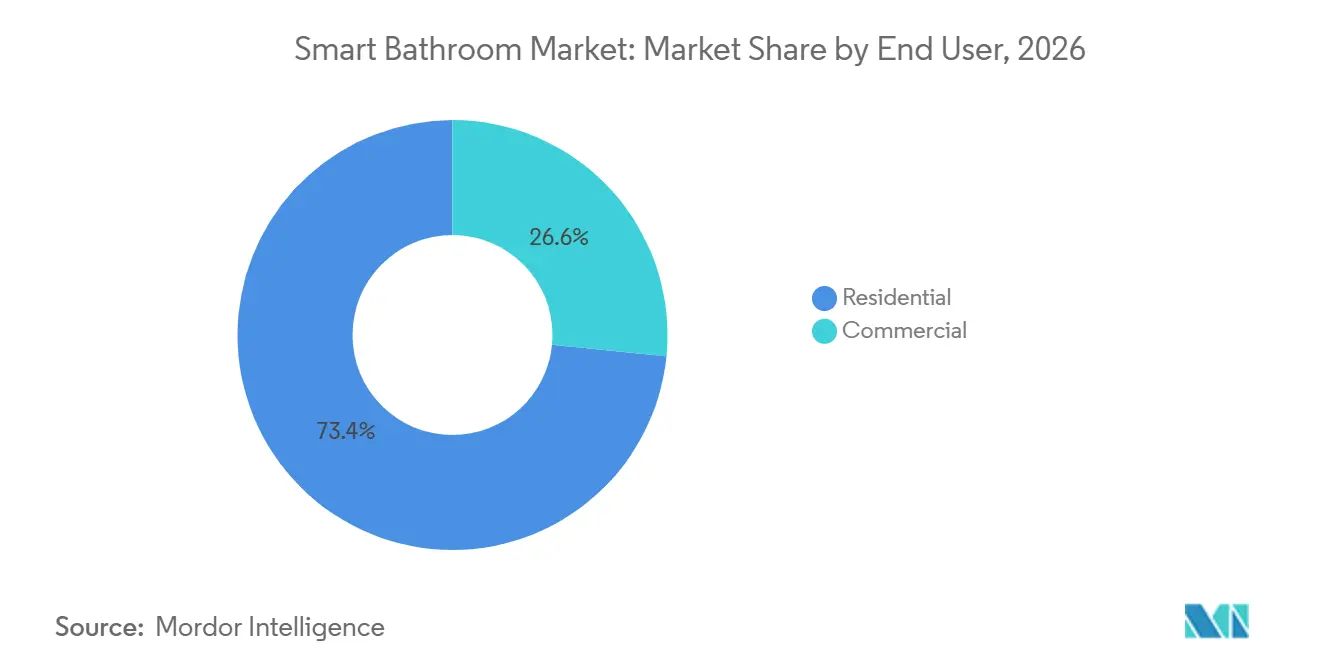
- By end user, Residential held 73.43% revenue share in 2026, and is projected to grow at the fastest CAGR of 15.58% during 2027–2032
- By distribution channel, B2C/Retail held a 76.57% revenue share in 2026 and is projected to grow at the fastest CAGR of 16.85% during 2027–2032.
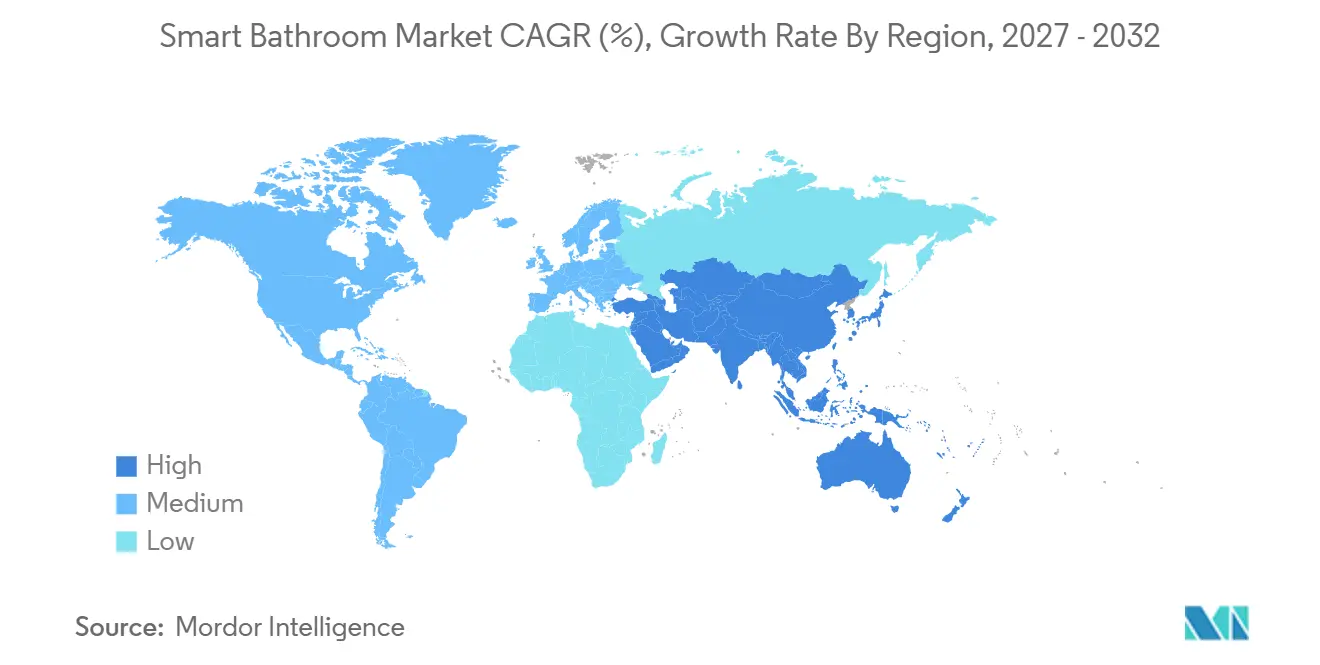
- By geography, North America held a 28.54% revenue share in 2026, while Asia-Pacific is forecast to grow at a 16.46% CAGR through 2032.
Note: Market numbers in this report are based on Mordor Intelligence's proprietary estimation framework, which combines nine months of actuals with Q4 projections for base year 2026.
Market Trends and Insights
Drivers Impact Analysis of Smart Bathroom Market*
| Driver | (~) % Impact on CAGR Forecast | Geographic Relevance | Impact Timeline |
|---|---|---|---|
| Smart-Home and IoT Ecosystem Adoption | +3.50% | Global | Medium term (2-4 years) |
| Hygiene-Led Shift Toward Touchless Fixtures | +2.80% | Global, led by North America and Asia-Pacific | Short term (≤ 2 years) |
| Water and Energy Efficiency Requirements | +2.00% | Global, strongest in the EU, Asia-Pacific, and Australia | Medium term (2-4 years) |
| Aging-in-Place and Accessibility Demand | +2.50% | North America, Europe, Japan | Long term (≥ 4 years) |
| Premium Bathroom Renovation and Wellness Spending | +2.20% | North America, Europe, Asia-Pacific core | Medium term (2-4 years) |
| Hospitality and Commercial Retrofit Activity | +2.00% | Global, led by Middle East and Africa, Europe, Asia-Pacific | Medium term (2-4 years) |
| Source: Mordor Intelligence | |||
Smart-Home and IoT Ecosystem Adoption
The smart bathroom market benefits when fixtures connect with the same systems used for lighting, climate control, and security. This connection makes a bathroom upgrade part of a broader home project and can raise the value placed on compatible devices, particularly where homeowners are already investing in integrated control systems. Kohler integrated Anthem+ showering with the Control4 platform in September 2025, allowing shower controls to work within professional home automation settings. NKBA and CEDIA reported that homeowners completing smart-home projects directed 20% of project budgets, more than USD 41,000 for the average whole-home project, toward smart technology integration[1]. Wider protocol compatibility can reduce buyer uncertainty when smart bathroom market products from several brands are used in one home.
Hygiene-Led Shift Toward Touchless Fixtures
Touchless faucets and automatic flushing are now specified for everyday hygiene rather than only for temporary public-health measures. Consumers who encountered these products in public places increasingly expect similar functions in homes and hospitality settings, supporting broader smart bathroom market demand. Cistermiser installed infrared sensor taps during a GBP 2 million (USD 2.5 million) refurbishment at Radisson RED London Heathrow. The installation reduced flow rates to 1.89 liters per minute and aligned hygiene needs with water-reduction goals. Houzz found that 36% of renovated bathrooms included wellness-oriented features, while 74% of homeowners named hygiene as their leading comfort consideration.
Water and Energy Efficiency Requirements
Efficiency rules increasingly make water and energy performance a product-design requirement in the smart bathroom market, especially for suppliers seeking regulatory acceptance across regions. China added smart toilets to its 2025 water-efficiency labeling catalog under GB 38448-2025, with mandatory labeling scheduled from April 2027[2]. The revised standard lowers per-cycle energy use by 20% and wash-water use by 14% compared with the 2019 standard. Proposed United Kingdom requirements for aerated taps and dual-flush toilets would support fixtures with controlled water delivery. From March 23, 2025, NSW landlords must provide 3-star WELS dual-flush toilets to pass water-usage charges to tenants, supporting replacement activity[3].
Aging-in-Place, Wellness, and Commercial Retrofit Demand
The smart bathroom market is supported by demand for accessible homes, wellness-oriented renovations, and more efficient commercial properties. Houzz found that 68% of homeowners renovating bathrooms considered special needs, while 47% anticipated needs within five years (2025 Houzz Bathroom Trends Study). NAHB reported in June 2025 that 73% of surveyed industry leaders had seen more aging-in-place remodeling requests over the preceding 5 years. NKBA found that 77% of surveyed designers expected hospitality-inspired bath experiences to gain popularity, while 51% expected smart toilet use to rise during the next 3 years. Hotels and other commercial sites can justify upgrades through lower water use, improved guest experience, and easier management of high-traffic bathrooms.
Restraints Impact Analysis of Smart Bathroom Market*
| Restraint | (~) % Impact on CAGR Forecast | Geographic Relevance | Impact Timeline |
|---|---|---|---|
| High Upfront Cost and Long Payback for Premium Systems | -2.50% | Global, acute in South America and MEA | Long term (≥ 4 years) |
| Cybersecurity, Data Privacy, and Connected-Device Trust Concerns | -1.20% | North America, Europe | Medium term (2-4 years) |
| Retrofit Complexity in Legacy Plumbing and Electrical Infrastructure | -0.80% | South America, MEA, South-East Asia | Long term (≥ 4 years) |
| Dependence on Continuous Power, Specialist Service and Imported Electronics | -0.60% | MEA, South-East Asia, South America | Long term (≥ 4 years) |
| Source: Mordor Intelligence | |||
High Upfront Cost, Retrofit Complexity, and Power Dependence
Premium bathroom systems are often assessed against a short renovation budget even when their benefits may emerge over 5 to 10 years. Water savings, health-related functions, and reduced maintenance can therefore be difficult to value at the point of purchase. Hotels.com reported in September 2025 that many hotel guests struggled to operate smart room technology, adding training and interface costs to installation spending. Legacy plumbing, limited electrical capacity, specialist servicing needs, and reliance on imported electronics can further slow smart bathroom market adoption in South America, the Middle East and Africa, and Southeast Asia. JOMOO presented the battery-equipped Z1 Pro in March 2026 with a 15,600 mAh battery and more than 600 hours of standby time, showing how manufacturers are addressing unreliable power and installation barriers. Products that reduce structural work can broaden the addressable retrofit base without requiring deep price cuts.
Cybersecurity, Data Privacy, and Connected-Device Trust Concerns
Health-sensing fixtures raise specific concerns because they can collect information that users regard as highly personal. After a security researcher challenged Kohler’s end-to-end encryption claim, Kohler revised the Dekoda page in December 2025 to cite encryption at rest and in transit. NIST identified connected devices in telehealth smart-home settings as potential routes for compromise and called attention to privacy and cybersecurity risks[4]. Research presented at ASME BIOMED 2025 showed that PIR and LiDAR sensors can support privacy-focused bathroom monitoring without capturing images or waste data. Manufacturers that make data practices understandable and limit unnecessary collection may find it easier to earn trust in the smart bathroom market.
*Our forecasts treat driver/restraint impacts as directional, not additive. The impact forecasts reflect baseline growth, mix effects, and variable interactions.
Smart Bathroom Market Segment Analysis
By Product Type:
Toilets Lead Revenue While Faucets Lead GrowthSmart Toilets and Smart Bidet Seats held 36.15% of the smart bathroom market in 2026, supported by higher selling prices and frequent household use. The smart bathroom market size for Smart Faucets is projected to grow at a 16.64% CAGR through 2032. Smart faucets have lower entry prices and often avoid the structural plumbing changes required by more complex products. Touchless operation also makes them suitable for homes, offices, and hospitality properties that prioritize hygiene. Kohler Health launched Dekoda in October 2025 at USD 599, introducing a sensor that attaches to existing toilet bowls and monitors hydration, gut health, and blood detection.
Gyerim Bass launched the AI Healthcare Bidet KBI-600SAI in March 2026 with stool analysis validated on more than 7,000 clinical data points. Smart showers are also gaining commercial acceptance where water savings can be measured across many rooms. Hansgrohe and voco used EcoSmart shower systems at a Brussels property, where the installation saved up to 40% of water per use and recovered 1.2 million liters of graywater each year. Smart mirrors, bathtubs, soap dispensers, and hand dryers can add connected features without extensive plumbing changes. TOTO CONNECT PUBLIC added congestion monitoring, facility navigation, and multilingual cleaning requests, extending connected restroom management to end users.



By Construction Type:
Replacement and Retrofit Support the Largest OpportunityReplacement and Retrofit represented 57.55% of smart bathroom market revenue in 2026 and is projected to expand at a 15.93% CAGR through 2032. The segment share reflects the scale of existing housing stock compared with new construction pipelines. Many buyers can upgrade a single fixture without rebuilding an entire bathroom, which lowers the practical barrier to adoption. China has an estimated 400 million households with aging sanitary ware.
Domestic smart toilet sales in China reached 12.41 million units in 2025, with replacement activity forming the volume base. Geberit AquaClean Mera can be installed in hotel rooms within hours without a full bathroom shutdown. JOMOO designed its Z1 Pro with an embedded battery to reduce dependence on fixed electrical outlets. New construction remains important because builders can specify connected suites before occupancy. Kohler is using this route in premium residential projects in India, where early specification can support later upgrades.
By End User:
Residential Demand Provides the Value BaseResidential users held 73.43% of revenue in 2026 and are forecast to grow at a 15.58% CAGR through 2032. The smart bathroom industry relies on household renovation cycles in developed economies and premium new-home demand in emerging economies. The National Kitchen and Bath Association found that 51% of bath professionals expect smart toilets to grow in popularity during the next 3 years. The same report found that 72% expect bathroom footprints to increase to accommodate wellness features. These preferences support spending on connected fixtures that deliver convenience and comfort.
Hotels and restaurants are early commercial adopters because differentiated guest experiences can support higher-quality specifications. Healthcare facilities are considering touchless fixtures and health-monitoring products where infection control and patient support are important. Offices and commercial buildings focus more on high-traffic faucets and soap dispensers. Senior living properties are another potential demand source because fall detection and hydration monitoring can address resident-care needs. The smart bathroom industry can therefore serve varied commercial requirements without relying on one institutional buyer group.

By Distribution Channel:
Digital Tools Change the Purchase JourneyB2C/Retail held 76.57% of the smart bathroom market in 2026, while online-driven B2C/Retail is projected to grow at a 16.85% CAGR through 2032. The smart bathroom industry is gaining from digital tools that help buyers understand products before a showroom visit. Online marketplaces, visualization tools, and installation videos can make a complex fixture easier to assess. Daelim Bath reported 82% online sales growth through its official mall in 2025, while AI bidet sales grew 129% on its digital channels. These results show that online research and purchase are becoming more relevant for premium connected fixtures.
The United States Census Bureau reported 5.3% e-commerce growth in the second quarter of 2025, compared with 3.9% for total retail. B2B and direct sales remain necessary for commercial installations that require project pricing and in-person support. Kohler operates through 828 dealers in 83 Indian cities, alongside online channels and experience centers. Manufacturers are therefore maintaining physical networks while building online routes. This blended approach serves both project-based buyers and consumers who begin their research online.
Geography Analysis
North America held 28.54% of global revenue in 2026, giving it the largest regional smart bathroom market position. The United States benefits from mature smart-home adoption, strong purchasing power, and a USD 228 billion kitchen and bath industry (NKBA). Research by Houzz found that 68% of United States bathroom renovators considered special needs during their projects. It also found that 1 in 6 renovated bathrooms included a wet room and that 36% included wellness features. The United States Department of Energy proposed rescinding faucet energy-conservation standards in May 2025, although WaterSense and product standards continue to guide development.
Asia-Pacific is projected to record a 16.46% CAGR through 2032, making it the fastest-growing region in the smart bathroom market. China and Japan provide manufacturing strength, while India, South Korea, Vietnam, and Southeast Asia add premiumization opportunities. China recorded 12.41 million smart toilets sold in 2025 and 14.42 million units produced, equal to 73% of global output, while domestic penetration was 12.3% compared with more than 80% in Japan. Kohler announced an INR 800 crore (USD 93 million) investment in India in January 2026. China’s GB 38448-2025 standard, effective from April 2027, may favor certified producers with stronger research and development capabilities.
Europe has a mature premium base in Germany, the United Kingdom, the Nordics, and BENELUX, where Geberit, Hansgrohe, GROHE, and Villeroy & Boch have institutional specification relationships. Hansgrohe introduced LavaPura Element, its first shower toilet for Europe, in March 2025, expanding competition in shower toilets. GROHE presented Aqua Intelligence, Purefoam, and heat-recovery shower products at ISH 2025, addressing water quality, wellness, and efficiency. The Middle East and Africa and South America remain earlier-stage opportunities, with premium hospitality providing an initial route to the smart bathroom market.
Competitive Landscape
Market Concentration
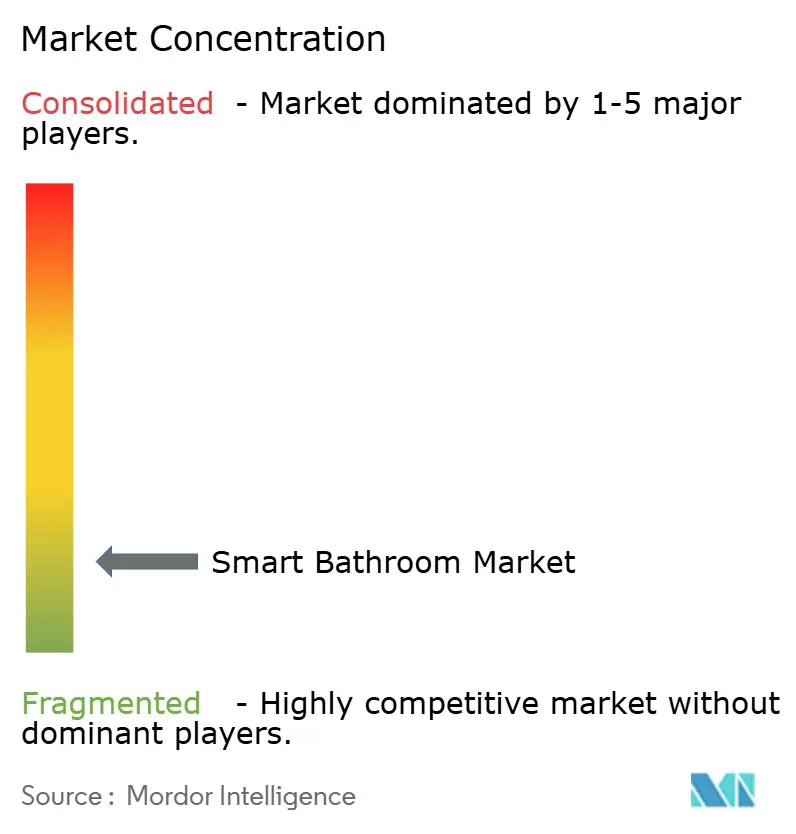
The smart bathroom market is fragmented. Kohler, TOTO, LIXIL, Hansgrohe, Geberit, Roca, and Villeroy & Boch compete in the premium tier through technology, design, and specification relationships. The broader mid-market remains fragmented, especially among producers in China’s Chaozhou and Guangdong clusters, where companies are moving from volume-led manufacturing toward more distinctive branded offerings. China’s certification requirements may raise compliance costs and favor producers that can meet technical standards. This creates room for global brands in premium projects and for domestic producers that can build trusted brands through consistent product performance, after-sales support, and stronger distribution relationships.
Health-monitoring products and lower-priced connected fixtures remain open areas of competition within the smart bathroom market. Kohler launched Dekoda in October 2025 as an optical sensor for existing toilets, moving health data into a consumer bathroom product. TOTO expanded its connected-public-restroom platform with real-time congestion and cleaning features in July 2025. LIXIL partnered with American Bath Group in April 2025 and licensed American Standard, DXV, and Eljer bathing brands, allowing LIXIL to focus more closely on connected toilets and fittings. Companies are also competing through low-power sensing, water-quality monitoring, battery-backed products, and related intellectual property, which can improve product reliability in buildings with different utility conditions and help create more practical options for retrofit projects.
GROHE launched Aqua Intelligence at ISH 2025 with Purefoam, a heat-recovery shower, and filtered shower functions under one platform. Hansgrohe introduced the Neovis faucet line in March 2026 with CoolStart, EcoSmart at 5 liters per minute, and AirPower features. These launches show that leading companies are extending efficiency and convenience features across different price points, from commercial settings to household renovations, rather than limiting connected features to flagship products. Their strategies combine product innovation, retail access, commercial specification, and connected-service functions, which shape the smart bathroom market beyond single-product competition and help suppliers defend their relevance across both renovation and new-build projects.
Smart Bathroom Industry Leaders
-
Kohler Co.
-
TOTO LTD.
-
LIXIL Corporation
-
Roca Sanitario, SA
-
Geberit AG
- *Disclaimer: Major Players sorted in no particular order
Smart Bathroom Market Companies Covered in this Report
- Kohler Co.
- TOTO LTD.
- LIXIL Corporation
- Geberit AG
- Duravit AG
- Villeroy & Boch AG
- MASCO Corporation
- Moen Incorporated
- Hansgrohe SE
- Delta Faucet Company
- Jaquar Group
- Cera Sanitaryware Limited
- Sloan Valve Company
- Bradley Corporation
- Roca Sanitario, SA
- Eczacıbaşı Building Products Industry and Trade Inc.
- JOMOO Kitchen and Bath Co.
- HUIDA Sanitary Ware Co. Ltd.
- Brondell Inc.
Recent Industry Developments in Smart Bathroom Market
- March 2026: Hansgrohe SE introduced the Neovis washbasin faucet line featuring CoolStart, EcoSmart (5L/min), and AirPower technologies, extending smart water efficiency to accessible price points across family and commercial bathroom applications.
- January 2026: Kohler announced an INR 800 crore (USD 93 million) three-year India investment covering Gujarat plant expansion, engineering team growth, and new Experience Centre openings, elevating India as a priority strategic market.
- October 2025: Kohler Co. launched Kohler Health and its first product, Dekoda, a USD 599 optical sensor that attaches to existing toilet bowls to monitor hydration, gut health, and blood detection via machine-learning, establishing a new health-data product category in the smart bathroom market.
- September 2025: Kohler integrated Anthem+ smart showering with Control4's professional automation platform, enabling bathroom water delivery within whole-home automation scenes, a milestone for smart bathroom interoperability with premium home control ecosystems.
Global Smart Bathroom Market Report Scope
Segmentation Overview
| Smart Toilets and Smart Bidet Seats |
| Smart Faucets |
| Smart Showers |
| Smart Bathroom Mirrors |
| Smart Bathtubs |
| Smart Soap Dispensers |
| Smart Hand Dryers |
| Others (Smart Water Leak Controllers, Ventilation, Heated Towel Rails) |
| New Construction |
| Replacement and Retrofit |
| Residential | |
| Commercial | Hotels and Restaurants |
| Healthcare Facilities | |
| Offices and Commercial Buildings | |
| Others |
| B2C / Retail | Home Centers/DIY Showrooms |
| Specialty Showrooms and Dealers | |
| Wholesale and Trade Channels | |
| Online Stores and Direct-to-Consumer | |
| Other Distribution Channels | |
| B2B / Direct Sales |
| North America | Canada |
| United States | |
| Mexico | |
| South America | Brazil |
| Peru | |
| Chile | |
| Argentina | |
| Rest of South America | |
| Europe | United Kingdom |
| Germany | |
| France | |
| Spain | |
| Italy | |
| BENELUX (Belgium, Netherlands, Luxembourg) | |
| NORDICS (Denmark, Finland, Iceland, Norway, Sweden) | |
| Rest of Europe | |
| Asia-Pacific | India |
| China | |
| Japan | |
| Australia | |
| South Korea | |
| South-East Asia | |
| Rest of Asia-Pacific | |
| Middle East & Africa | United Arab Emirates |
| Saudi Arabia | |
| South Africa | |
| Nigeria | |
| Rest of Middle East & Africa |
| By Product Type | Smart Toilets and Smart Bidet Seats | |
| Smart Faucets | ||
| Smart Showers | ||
| Smart Bathroom Mirrors | ||
| Smart Bathtubs | ||
| Smart Soap Dispensers | ||
| Smart Hand Dryers | ||
| Others (Smart Water Leak Controllers, Ventilation, Heated Towel Rails) | ||
| By Construction Type | New Construction | |
| Replacement and Retrofit | ||
| By End User | Residential | |
| Commercial | Hotels and Restaurants | |
| Healthcare Facilities | ||
| Offices and Commercial Buildings | ||
| Others | ||
| By Distribution Channel | B2C / Retail | Home Centers/DIY Showrooms |
| Specialty Showrooms and Dealers | ||
| Wholesale and Trade Channels | ||
| Online Stores and Direct-to-Consumer | ||
| Other Distribution Channels | ||
| B2B / Direct Sales | ||
| By Geography | North America | Canada |
| United States | ||
| Mexico | ||
| South America | Brazil | |
| Peru | ||
| Chile | ||
| Argentina | ||
| Rest of South America | ||
| Europe | United Kingdom | |
| Germany | ||
| France | ||
| Spain | ||
| Italy | ||
| BENELUX (Belgium, Netherlands, Luxembourg) | ||
| NORDICS (Denmark, Finland, Iceland, Norway, Sweden) | ||
| Rest of Europe | ||
| Asia-Pacific | India | |
| China | ||
| Japan | ||
| Australia | ||
| South Korea | ||
| South-East Asia | ||
| Rest of Asia-Pacific | ||
| Middle East & Africa | United Arab Emirates | |
| Saudi Arabia | ||
| South Africa | ||
| Nigeria | ||
| Rest of Middle East & Africa | ||
Key Questions Answered in the Report
What is the projected value of the smart bathroom sector by 2032?
It is forecast to reach USD 23.86 billion by 2032, growing at a 14.86% CAGR from 2027-2032.
Which smart bathroom products have the largest revenue position?
Smart Toilets and Smart Bidet Seats lead product revenue with a 36.15% share in 2026.
Which product category is growing fastest through 2032?
Smart Faucets are projected to grow at a 16.64% CAGR, supported by touchless demand and simpler retrofit options.
Why is replacement and retrofit important for smart bathroom suppliers?
Replacement and Retrofit held 57.55% of revenue in 2026 and is forecast to grow at a 15.9% CAGR through 2032.
Which region is expected to grow fastest?
Asia-Pacific is forecast to expand at a 16.46% CAGR through 2032, supported by China’s production scale and regional premiumization.