
Bathtub Market Size and Share
Market Overview
| Study Period | 2021 - 2031 |
|---|---|
| Market Size (2026) | USD 13.82 Billion |
| Market Size (2031) | USD 17.42 Billion |
| Growth Rate (2026 - 2031) | 4.73 % |
| Fastest Growing Market | Asia-Pacific |
| Largest Market | North America |
| Market Concentration | Medium |
Major Players *Disclaimer: Major Players sorted in no particular order Image © Mordor Intelligence. Reuse requires attribution under CC BY 4.0. | |
Bathtub Market Analysis by Mordor Intelligence
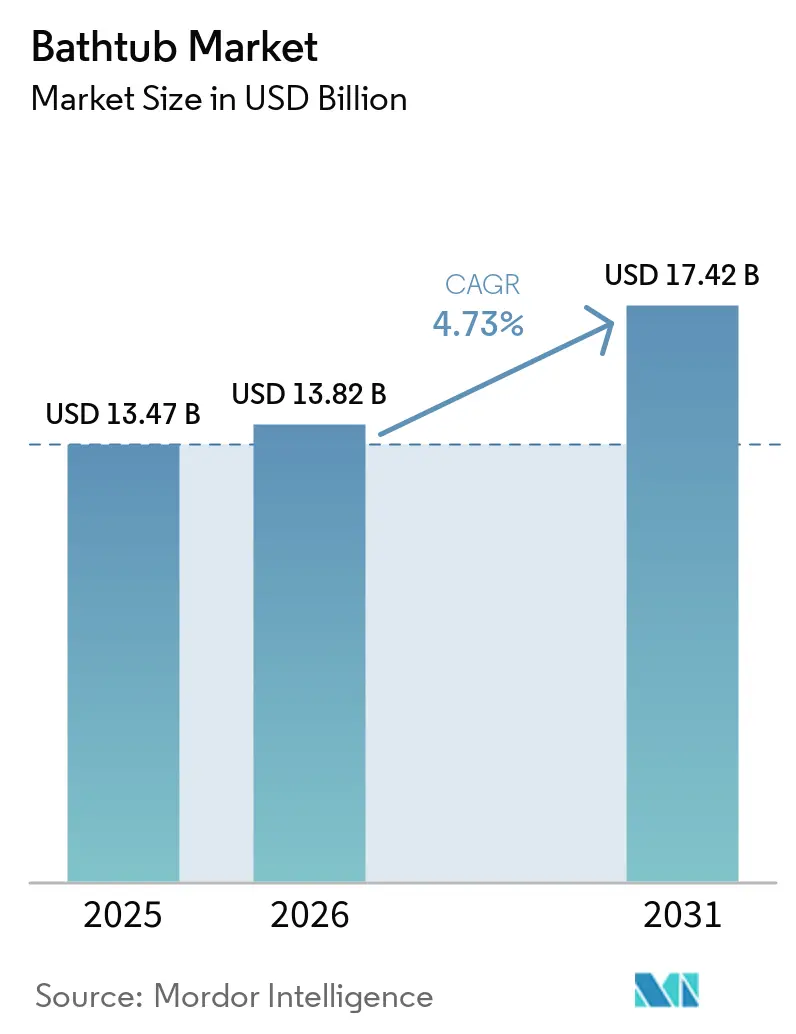
The global bathtub market size is projected to expand from USD 13.47 billion in 2025 to USD 13.82 billion in 2026 and is forecast to reach USD 17.42 billion by 2031, registering a CAGR of 4.73% between 2026 and 2031. Replacement demand across established housing markets remains a key contributor to the global bathtub market, supported by aging residential infrastructure and ongoing bathroom renovation activity. Renovation projects increasingly incorporate higher-value bathtub formats, including freestanding, soaking, hydrotherapy, and accessible models, as homeowners prioritize comfort, functionality, and design differentiation. The growing integration of wellness-oriented features into residential bathrooms further supports demand for products that enhance relaxation and therapeutic bathing experiences. Beyond residential applications, procurement across hospitality, spa, healthcare, and senior living facilities provides an additional source of market demand. However, high installation costs and the increasing preference for spacious, walk-in showers continue to constrain adoption, particularly in space-limited housing and cost-sensitive renovation projects. Premium bathtub categories remain comparatively differentiated through their design appeal, specialized features, and alignment with wellness-focused bathroom upgrades.
Key Report Takeaways
- By product type, alcove bathtubs accounted for 41.25% of the bathtub market in 2025, while freestanding bathtubs are projected to register a CAGR of 6.15% through 2031.
- By material, acrylic accounted for 43.56% of the market in 2025, while solid surface and stone resin are projected to register a CAGR of 6.47% through 2031.
- By end-user, residential users accounted for 71.53% of demand in 2025, while commercial users are projected to register a CAGR of 5.87% through 2031.
- By distribution channel, B2C and retail accounted for 76.36% of demand in 2025 and are projected to register a CAGR of 5.41% through 2031.
- By geography, North America accounted for 33.46% of demand in 2025, while Asia-Pacific is projected to register a CAGR of 6.20% through 2031.
Note: Market size and forecast figures in this report are generated using Mordor Intelligence’s proprietary estimation framework, updated with the latest available data and insights as of January 2026.
Market Trends and Insights
Drivers Impact Analysis of Bathtub Market*
| Driver | (~) % Impact on CAGR Forecast | Geographic Relevance | Impact Timeline |
|---|---|---|---|
| Bathroom Remodeling and Replacement Cycles | +1.3% | North America and Europe | Short term (≤ 2 years) |
| Wellness-Oriented Bathing and Home-Spa Demand | +1.0% | Global | Medium term (2-4 years) |
| Space-Efficient Alcove Adoption in Urban Housing | +0.5% | Asia-Pacific core, with spillover to South America | Medium term (2-4 years) |
| Hospitality and Premium Multifamily Construction | +0.6% | Middle East, Asia-Pacific, and North America | Medium term (2-4 years) |
| Aging-in-Place and Accessible Bathing Demand | +0.5% | North America and Europe | Medium term (2-4 years) |
| Smart Bathing and Personalized Hydrotherapy Features | +0.3% | Global, with early gains in North America and Japan | Long term (≥ 4 years) |
| Source: Mordor Intelligence | |||
Bathroom Remodeling and Replacement Cycles Drive Baseline Demand
Home improvement remains a durable source of demand for the bathtub market in mature economies. Harvard Joint Center for Housing Studies projected homeowner remodeling spending at USD 524 billion in early 2026, supported by permit activity and single-family home sales[1]. Bathroom fixture replacement is supported by the age of housing stock and renovation cycles that often include tile, plumbing, and fixture upgrades. The National Kitchen & Bath Association reported that United States residential kitchen and bath spending was expected to reach USD 235 billion in 2025. High-value bathroom projects above USD 60,000 were expected to account for 22% of activity, supporting specification of premium bathtub formats[2].
Wellness-Oriented Bathing and Home-Spa Demand Reshape the Product Mix
Wellness-led bathroom design shifts demand toward products that provide a longer soaking or hydrotherapy experience. The National Kitchen & Bath Association reported that 70% of designers saw rising requests for soaking tubs linked to physical recovery. The same report found that 72% of designers identified steam and chromotherapy integration in baths and showers[3]. These preferences support freestanding, whirlpool, and soaking models, which can be positioned around comfort and recovery rather than routine cleansing. The bathtub market also benefits when a primary bathroom is designed as a separate personal space rather than a utility room. This change favors design-led products with deeper basins, integrated controls, and distinctive material finishes.
Hospitality and Premium Multifamily Construction Expand Commercial Specification
Commercial projects support the bathtub market where the bathroom contributes directly to guest experience and property positioning. Luxury and upper-upscale hotels often specify freestanding, soaking, or hydrotherapy formats at a higher rate than economy properties. This gives manufacturers access to projects with longer planning periods and larger specification values. Premium multifamily developments also use bathroom fixtures to differentiate units in competitive urban locations. In Saudi Arabia, destination hospitality projects linked to Vision 2030 have created demand for high-specification sanitary ware and bathtub products. The Rosewood AMAALA project named Geberit, LAUFEN, Duravit, and Kaldewei among its fixture suppliers.
Aging-in-Place and Accessible Bathing Demand Opens a Structural Sub-Market
Accessible products expand the bathtub market beyond discretionary design upgrades. Walk-in models use low-threshold entry, grab bars, rapid drainage, and hydrotherapy options to support household safety and comfort. The U.S. Census Bureau reported that the population aged 65 and older reached 61.2 million in 2024, and the older population continues to grow[4]. Aging-in-place renovations can therefore favor accessible products in owner-occupied homes. Healthcare and senior-living facilities can also specify walk-in formats when updating older bathroom infrastructure. This demand is especially relevant in North America and Europe, where renovation spending and older homeowner cohorts are significant.
Restraints Impact Analysis of Bathtub Market*
| Restraint | (~) % Impact on CAGR Forecast | Geographic Relevance | Impact Timeline |
|---|---|---|---|
| High Installation, Plumbing, and Structural Modification Costs | -0.4% | North America and Europe | Medium term (2-4 years) |
| Bulky-Product Logistics and Freight Exposure | -0.2% | Global, most acute in export markets | Medium term (2-4 years) |
| Substitution by Larger Showers and Space-Saving Alternatives | -0.3% | Europe, with spillover to urban Asia-Pacific | Long term (≥ 4 years) |
| Long Fill, Drain, and Cleaning Cycles in Accessible and Smart Models | -0.1% | North America | Medium term (2-4 years) |
| Source: Mordor Intelligence | |||
High Installation and Structural Modification Costs Compress Entry-Segment Conversion
Installation costs remain a constraint for entry and mid-price bathtub purchases. Replacement projects can require plumbing changes, subfloor reinforcement, and tile or surround work in addition to the cost of the tub. These additions can raise the total project cost by USD 1,000 to USD 5,000 or more in typical residential settings. The remodeling sector also continues to face skilled labor constraints, which can increase project costs and delay installations. Walk-in tubs can carry a greater installation burden because of specialized door seals, drainage systems, and structural support. The bathtub market is therefore more exposed in lower-income households, where installation cost can outweigh the value of product upgrades.
Shower Substitution Is the Most Durable Structural Risk to Volume
Larger walk-in showers and wet rooms compete directly with standard bathtub formats in new construction and renovations. This is most evident in compact urban bathrooms, where a shower can provide more usable floor area. In the United States, 53% of designers reported removing bathtubs to create space for larger showers, according to the National Kitchen & Bath Association. Premium freestanding, soaking, and hydrotherapy products face less direct substitution because they meet a separate desire for relaxation and visual design. The restraint is therefore concentrated in conventional alcove and builder-grade products. Manufacturers can reduce exposure by improving the wellness, accessibility, and design value of the bathtub market offering.
*Our forecasts treat driver/restraint impacts as directional, not additive. The impact forecasts reflect baseline growth, mix effects, and variable interactions.
Bathtub Market Segment Analysis
By Product Type:
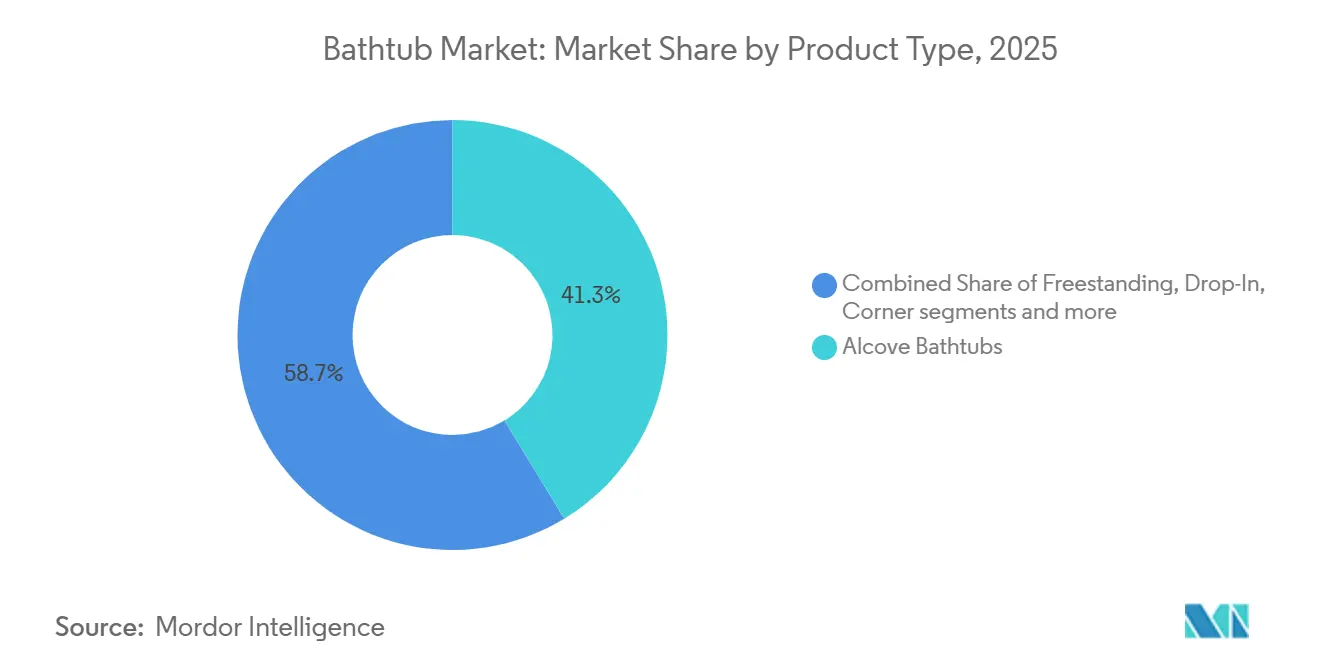
Alcove Leads Replacement Demand, While Freestanding Shapes the Premium TierAlcove bathtubs held 41.25% of the bathtub market share in 2025, supported by their fit with common three-wall bathroom layouts. They remain a practical choice for replacement projects across North America and Europe. Their installation footprint suits family bathrooms, rental homes, and cost-sensitive renovation work. Drop-in tubs serve buyers who want an integrated tile surround and a finished built-in appearance. Corner models provide an option for apartment layouts where diagonal placement improves use of limited floor space.
Freestanding bathtubs are forecast to grow at a 6.15% CAGR through 2031, the fastest rate among product types. Their growth is tied to wellness-oriented redesigns and premium hospitality specifications. Soaking depth, sculptural form, and placement flexibility make these models prominent in design-led bathrooms. Walk-in tubs meet functional accessibility needs through lower entry thresholds and safety features. Whirlpool tubs are also being repositioned as therapeutic products through hydrotherapy, chromotherapy, and controlled temperature functions.

By Material:
Acrylic Leads Volume, While Solid Surface and Stone Resin Build ValueAcrylic represented 43.56% of the bathtub market share in 2025, making it the leading material category. Its thermoformability supports curved shapes and slim rims used in freestanding models. Acrylic also remains cost-competitive for mass-market and mid-range production. Reinforced composite backing and improved polymer formulations help address durability concerns. Fiberglass continues to serve builder-grade alcove installations where lower weight and low initial cost are important.
Solid surface and stone resin are forecast to grow at a 6.47% CAGR through 2031, reflecting demand for premium finishes and heat retention. The bathtub industry uses these materials to offer weight, texture, and customized color options that differ from standard acrylic. Their use in premium residences and hospitality projects broadens commercial demand. Cast iron retains demand where acoustic dampening, heat retention, and perceived permanence matter. Porcelain-enameled steel and cultured marble remain relevant in value-oriented replacement and integrated surround applications.
By End-User:
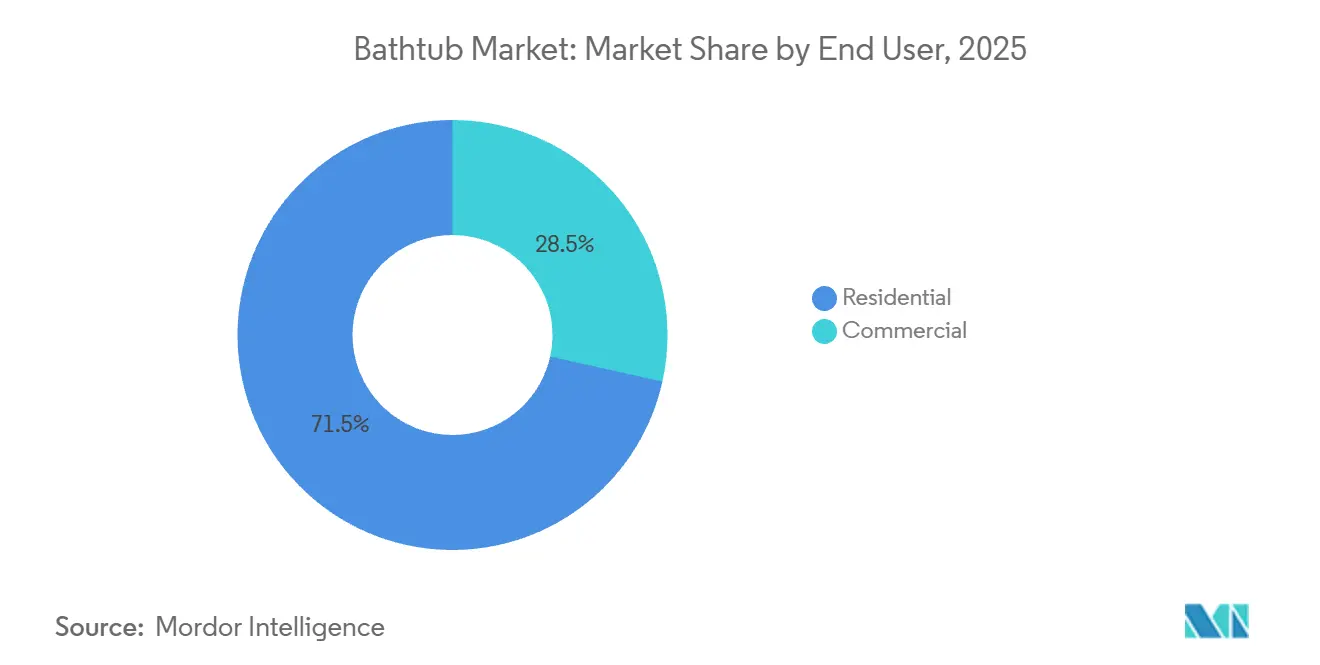
Residential Retains Volume, While Commercial Use Expands FasterResidential users accounted for 71.53% of demand in 2025, making the home renovation channel the core of the bathtub market. Aging housing stock and bathroom replacement cycles sustain this base. Owner-occupied households are more likely to select freestanding, soaking, and walk-in formats during full renovations. Rental and investor-owned properties commonly prioritize durable alcove products with lower installation complexity. Household preferences for accessible bathing also support residential demand in older homeowner groups.
Commercial demand is forecast to grow at a 5.87% CAGR through 2031, supported by hotels, spas, healthcare facilities, and senior living properties. Hotels and resorts use premium bathroom fixtures as part of room design and service positioning. Spas and wellness centers specify soaking, hydrotherapy, and contrast-bathing equipment. Healthcare and senior-living facilities are updating legacy bathrooms with formats that reduce entry barriers. Gyms and other commercial facilities add smaller volumes as recovery-focused bathing becomes more widely offered.
By Distribution Channel:
B2C and Retail Remain Central, While Digital Research Changes Purchase PathsB2C and retail channels held 76.36% of demand in 2025, covering home improvement stores, specialty bath retailers, showrooms, and online retailers. The channel gives consumers access to visual comparison, design advice, and installation referrals. Physical stores remain useful for inspecting finishes, scale, and comfort before purchase. Specialty retailers also support specification decisions for premium and accessible products. B2B and direct channels serve contractors, hotels, healthcare buyers, and other project-based customers with customized requirements.
The B2C and retail channel is forecast to grow at a 5.41% CAGR through 2031. Online research increasingly shapes the choice of model before a consumer visits a showroom. Manufacturers with detailed product visuals, technical drawings, and room-planning tools can influence this process earlier. Digital content is particularly important for large fixtures because customers need confidence in fit, finish, and installation requirements. The bathtub market can benefit when online discovery is connected to a local showroom or installation network.
Geography Analysis
North America Bathtub Market
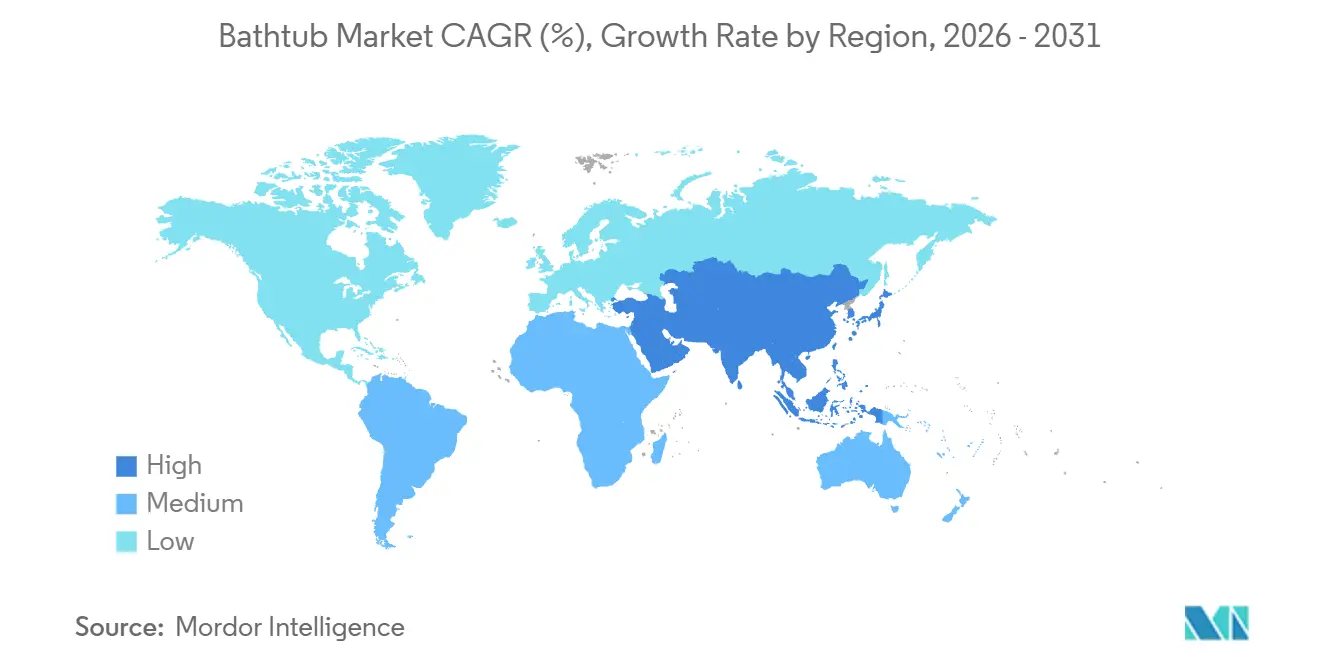
North America held 33.46% of the bathtub market share in 2025, supported by renovation spending and a large installed base of aging homes. The United States provides the largest share of regional demand because bathroom remodeling and replacement activity are well established. The National Kitchen & Bath Association projected United States residential kitchen and bath spending of USD 235 billion in 2025. Higher-value renovations support freestanding, soaking, and accessible products. Canada follows similar replacement patterns, especially in urban and suburban owner-occupied homes.
APAC Bathtub Market
Asia-Pacific is forecast to grow at a 6.2% CAGR through 2031, the fastest regional rate in the bathtub market. Urban housing investment and rising consumer interest in modern bathroom products support the regional outlook. India is emerging as a market for premium bathroom renovation, including products from global brands. Japan, South Korea, Thailand, Vietnam, and Indonesia support regional demand through renovation activity, design-sensitive upgrades, and growing household income.
EMEA and South America Bathtub Market
Europe combines renovation-led demand in mature economies with recovery potential in Spain, Poland, and the Benelux region. Shower substitution remains a clear constraint in compact new-build bathrooms, while existing-home modernization supports bathtub replacement. The Middle East and Africa region is important for high-specification hospitality projects, particularly in Saudi Arabia and the United Arab Emirates. Dubai’s 2025 Green Building Regulations require water-efficient fittings in new residential and hospitality projects. Brazil leads South America, while Chile and Peru provide more stable premium renovation demand, and African adoption remains concentrated in higher-income housing.
Competitive Landscape
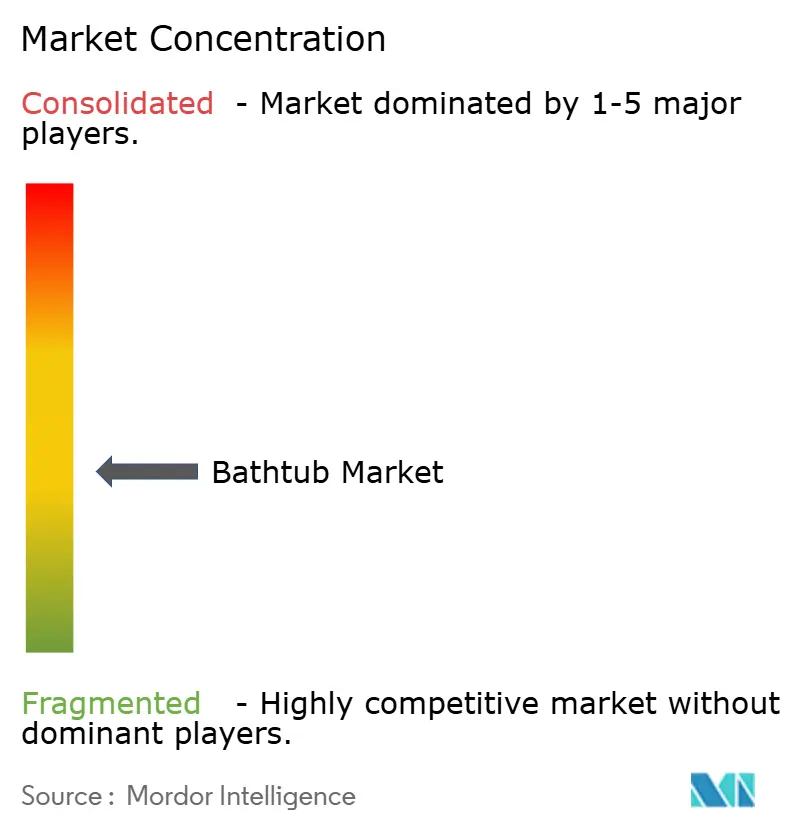
The global bathtub market is fragmented, with international manufacturers competing alongside regional specialists. Kohler, TOTO, LIXIL, and Roca have broad portfolios across product types, price points, and geographies. Kaldewei, Duravit, and Villeroy & Boch are strongly positioned in premium European specification channels. MTI Baths, Aquatic, Hydro Systems, and American Bath Group serve the North American mid-to-premium residential space. Jacuzzi retains strong consumer recognition in hydrotherapy products.
Product differentiation centers on material innovation, wellness features, and recognized design partnerships. Solid-surface composites, mineral cast, and stone resin allow manufacturers to serve customers looking for a premium tactile finish. Hydrotherapy jets, chromotherapy, and digital water controls provide functional differentiation beyond appearance. Kohler introduced the Ice Bath by Kohler x Remedy Place at KBIS 2025, extending its portfolio into recovery-focused bathing. Duravit’s product work with Antonio Citterio and Patricia Urquiola shows how established brands use design partnerships to strengthen premium specification appeal.
Opportunities are concentrated where accessibility and wellness functions overlap, particularly in walk-in tubs with therapeutic features. Mainstream brands and accessibility specialists currently serve different parts of this demand, leaving space for broader product propositions. Online purchase and installation coordination is another area where a clear, accessible customer offer is still developing. Manufacturers also need to manage bulky-product logistics, freight exposure, and installation support to preserve customer conversion.
Bathtub Industry Leaders
-
Kohler Co.
-
TOTO LTD.
-
LIXIL Corporation
-
Roca Sanitario, S.A.
-
Jacuzzi Brands LLC
- *Disclaimer: Major Players sorted in no particular order
Bathtub Market Companies Covered in this Report
- Kohler Co.
- TOTO LTD.
- LIXIL Corporation
- Roca Sanitario, S.A.
- Jacuzzi Brands LLC
- Duravit AG
- Villeroy & Boch AG
- Geberit International AG
- American Bath Group
- RAK Ceramics PJSC
- Masco Corporation
- American Standard
- MTI Baths, Inc.
- MAAX Bath Inc.
- Aquatic
- Hydro Systems, Inc.
- Victoria + Albert Baths
- Kaldewei GmbH & Co. KG
- OVE Decors ULC
- Porcelanosa Grupo AIE
Recent Industry Developments in Bathtub Market
- December 2025: Villeroy & Boch and KASCHKASCH released the Antao freestanding bathtub. Crafted from Quaryl® mineral composite, the Antao collection features an asymmetric organic silhouette, SilentFlow integrated filling, and a warm-touch surface in colorways including Morning Green and Stone White. The release targets the ultra-premium residential and boutique hospitality segments, where material differentiation and tactile quality are key criteria.
- July 2025: Hydro Systems launched the Anson freestanding tub with integrated hydrotherapy. The Metro Collection model pairs Charleston-townhouse-inspired aesthetics with Cold Plunge, Hydro Indulge, and Thermal Air hydrotherapy options, constructed from HydroLuxe™ composite. The launch signals Hydro Systems' strategic intent to compete directly in the premium wellness-tub segment alongside Kohler and Jacuzzi at the intersection of design and therapeutic bathing.
- May 2025: Duravit introduced Balcoon collection by Patricia Urquiola. The full bathroom range, including acrylic bathtubs with ergonomic oval raised edges and integral rear panels, is positioned at premium-to-mid-range price points for residential and hospitality settings. The collection integrates Minus Flow and Fresh Start water-saving tap technologies, aligning with sustainability purchasing criteria increasingly applied by hotel procurement teams.
Global Bathtub Market Report Scope
Segmentation Overview
| Freestanding Bathtubs |
| Alcove Bathtubs |
| Drop-In Bathtubs |
| Corner Bathtubs |
| Walk-In Bathtubs |
| Whirlpool Bathtubs |
| Other Product Types |
| Acrylic |
| Fiberglass |
| Cast Iron |
| Porcelain-Enameled Steel |
| Solid Surface and Stone Resin |
| Cultured Marble |
| Ceramic and Other Materials |
| Residential | |
| Commercial | Hotels and Resorts |
| Spas and Wellness Centers | |
| Healthcare and Senior Living | |
| Gyms and Other Commercial Facilities |
| B2C/Retail | Big-Box & Home-Improvement Stores |
| Specialty Retail Stores | |
| Online | |
| Other Distribution Channels | |
| B2B/Direct From Manufacturers |
| North America | Canada |
| United States | |
| Mexico | |
| South America | Brazil |
| Peru | |
| Chile | |
| Argentina | |
| Rest of South America | |
| Europe | United Kingdom |
| Germany | |
| France | |
| Spain | |
| Italy | |
| BENELUX (Belgium, Netherlands, Luxembourg) | |
| NORDICS (Denmark, Finland, Iceland, Norway, Sweden) | |
| Rest of Europe | |
| Asia-Pacific | India |
| China | |
| Japan | |
| Australia | |
| South Korea | |
| South-East Asia | |
| Rest of Asia-Pacific | |
| Middle East & Africa | United Arab Emirates |
| Saudi Arabia | |
| South Africa | |
| Nigeria | |
| Rest of Middle East & Africa |
| By Product Type | Freestanding Bathtubs | |
| Alcove Bathtubs | ||
| Drop-In Bathtubs | ||
| Corner Bathtubs | ||
| Walk-In Bathtubs | ||
| Whirlpool Bathtubs | ||
| Other Product Types | ||
| By Material | Acrylic | |
| Fiberglass | ||
| Cast Iron | ||
| Porcelain-Enameled Steel | ||
| Solid Surface and Stone Resin | ||
| Cultured Marble | ||
| Ceramic and Other Materials | ||
| By End User | Residential | |
| Commercial | Hotels and Resorts | |
| Spas and Wellness Centers | ||
| Healthcare and Senior Living | ||
| Gyms and Other Commercial Facilities | ||
| By Distribution Channel | B2C/Retail | Big-Box & Home-Improvement Stores |
| Specialty Retail Stores | ||
| Online | ||
| Other Distribution Channels | ||
| B2B/Direct From Manufacturers | ||
| By Geography | North America | Canada |
| United States | ||
| Mexico | ||
| South America | Brazil | |
| Peru | ||
| Chile | ||
| Argentina | ||
| Rest of South America | ||
| Europe | United Kingdom | |
| Germany | ||
| France | ||
| Spain | ||
| Italy | ||
| BENELUX (Belgium, Netherlands, Luxembourg) | ||
| NORDICS (Denmark, Finland, Iceland, Norway, Sweden) | ||
| Rest of Europe | ||
| Asia-Pacific | India | |
| China | ||
| Japan | ||
| Australia | ||
| South Korea | ||
| South-East Asia | ||
| Rest of Asia-Pacific | ||
| Middle East & Africa | United Arab Emirates | |
| Saudi Arabia | ||
| South Africa | ||
| Nigeria | ||
| Rest of Middle East & Africa | ||
Key Questions Answered in the Report
What is the projected value of the global bathtub sector by 2031?
The global bathtub market is projected to reach USD 17.42 billion by 2031, growing at a 4.73% CAGR from 2026. The outlook reflects replacement needs in established homes, higher spending on premium bathroom upgrades, and commercial specifications from hotels, spas, healthcare facilities, and senior living properties.
Which bathtub product type is growing the fastest?
Freestanding bathtubs are forecast to grow at a 6.15% CAGR through 2031. Their appeal comes from wellness-oriented renovation, deeper soaking use, premium hospitality specification, and the ability to act as a visible design feature in a primary bathroom. Alcove tubs remain the leading product by share.
Which material leads bathtub demand?
Acrylic led demand with a 43.56% share in 2025 because it supports varied shapes and remains cost-competitive. Reinforced backing and improved polymer formulations help extend its suitability across mass-market and mid-range products. Solid surface and stone resin are the fastest-growing material category.
Why are walk-in bathtubs gaining attention?
Walk-in tubs support aging-in-place renovations through low-entry access, grab bars, rapid drainage, and therapeutic features. They can serve households, healthcare facilities, and senior-living properties. Their value is linked to safety, comfort, and the desire to remain in a familiar home.
Which region has the largest bathtub demand?
North America led demand with a 33.46% share in 2025, supported by established renovation and replacement activity. Its demand includes premium soaking products and accessible formats. Asia-Pacific is expected to post the fastest regional growth through 2031 as urban households adopt more modern bathroom fixtures.