
North America Smart Bathroom Market Size and Share
Market Overview
| Study Period | 2021 - 2032 |
|---|---|
| Forecast Data Period | 2027 - 2032 |
| Base Year Market Size (2026) | USD 3.26 Billion |
| Market Size (2027) | USD 3.56 Billion |
| Market Size (2032) | USD 5.53 Billion |
| Growth Rate (2027 - 2032) | 9.21 % |
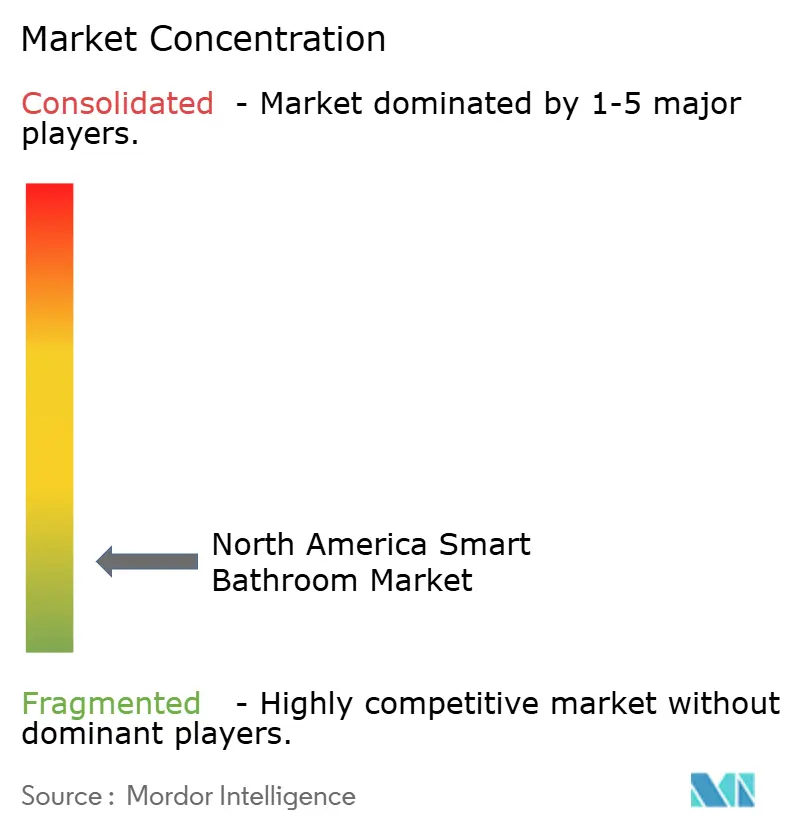
| Market Concentration | Low |
Major Players *Disclaimer: Major Players sorted in no particular order Image © Mordor Intelligence. Reuse requires attribution under CC BY 4.0. | |
North America Smart Bathroom Market Analysis by Mordor Intelligence
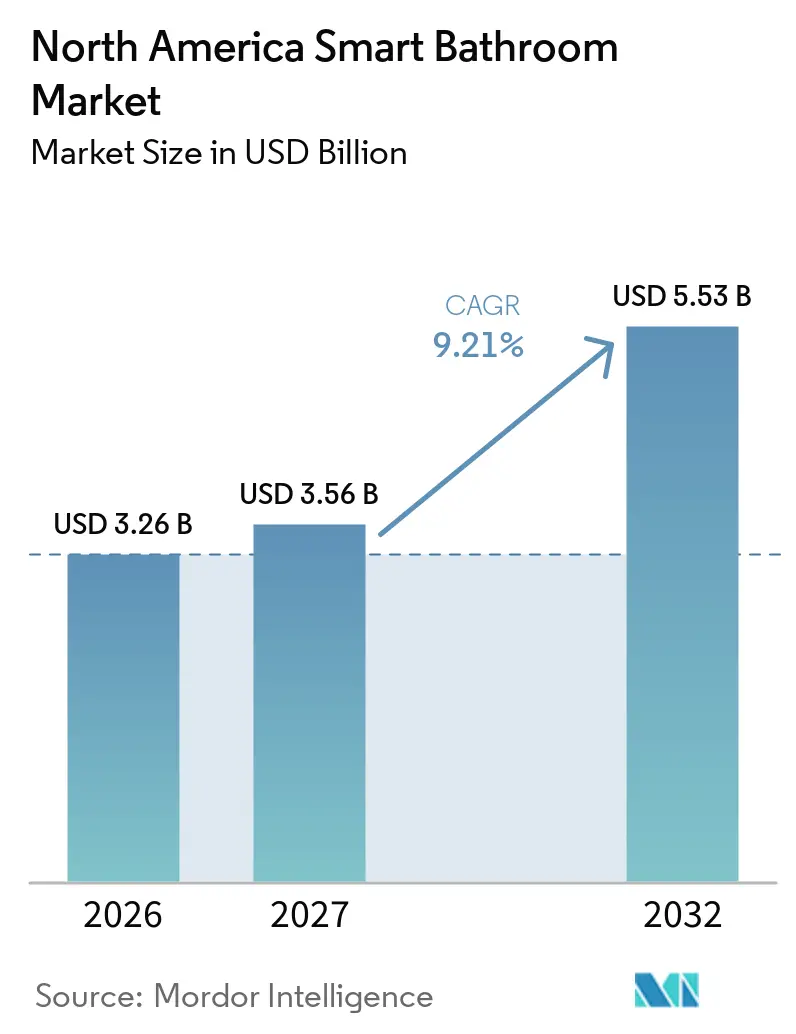
The North America smart bathroom market size was valued at USD 3.26 billion in 2026, is estimated at USD 3.56 billion in 2027, and is forecast to reach USD 5.53 billion by 2032, growing at a 9.21% CAGR during 2027–2032. Bathroom remodeling is the central source of demand because connected products are most often selected when homeowners replace fixtures or redesign the entire room. Larger renovation budgets also make it easier for households to combine smart toilets, showers, faucets, lighting, and water controls in one project. Suppliers in the North America smart bathroom market are linking fixtures to broader smart-home platforms and adding health, hygiene, and water-use functions. The opportunity remains concentrated in premium renovations and commercial projects because installation costs, electrical work, and plumbing compatibility still limit wider adoption. Privacy and cybersecurity requirements will matter more as health-enabled bathroom devices collect more personal information.
Key Report Takeaways
- By product type, smart toilets and smart bidet seats held 29.7% of the North America smart bathroom market share in 2026, while smart faucets are forecast to grow at an 11.5% CAGR through 2032.
- By construction type, replacement and retrofit accounted for 61.7% of the North America smart bathroom market share in 2026 and is projected to expand at an 11.7% CAGR through 2032.
- By end user, residential held a 62.7% revenue share in 2026, while commercial is forecast to record a 10.6% CAGR through 2032.
- By distribution channel, B2C/Retail held 70.8% revenue share in 2026 and is forecast to grow at a 12.9% CAGR through 2032.
- By geography, the United States held a 79.6% revenue share in 2026, while Canada is forecast to grow at a 10.8% CAGR through 2032.
Note: Market numbers in this report are based on Mordor Intelligence's proprietary estimation framework, which combines nine months of actuals with Q4 projections for base year 2026.
Market Trends and Insights
Drivers Impact Analysis of North America Smart Bathroom Market*
| Driver | (~) % Impact on CAGR Forecast | Geographic Relevance | Impact Timeline |
|---|---|---|---|
| Rising Residential Bathroom Remodeling | +2.50% | United States (primary); Canada (secondary) | Short term (≤ 2 years) |
| Smart-Home Ecosystem Integration | +2.00% | North America (United States-led, Canada expanding) | Medium term (2-4 years) |
| Demand for Touchless Hygiene and Personalized Comfort | +1.30% | United States urban metros; nationwide commercial | Short term (≤ 2 years) |
| Water-Efficiency and Utility-Cost Reduction Requirements | +1.00% | United States Western states; national compliance baseline | Medium term (2-4 years) |
| Hospitality, Healthcare and Institutional Bathroom Modernization | +0.80% | United States and Canada commercial hubs; Mexico hospitality corridors | Medium term (2-4 years) |
| Sensor-Based Retrofit Systems for Legacy Bathrooms | +0.70% | Nationwide, Northeast and Midwest older housing stock | Long term (≥ 4 years) |
| Source: Mordor Intelligence | |||
Rising Residential Bathroom Remodeling
Bathroom remodeling is the most immediate demand driver for the North America smart bathroom market. Houzz reports large (100+ sq ft) primary baths rising from USD 25,000 to 30,000 median and USD 70,000 to 75,000 at the high end. Smaller baths moved from USD 17,000 to 18,000. The same study found that 89% of renovating homeowners used at least 1 professional, an increase of 5 percentage points from the prior year. Professional involvement supports adoption because many connected fixtures require plumbing, electrical work, or both. The National Kitchen & Bath Association expects professional-led kitchen and bath renovation spending to grow 4.4% in 2026, compared with 0.6% for do-it-yourself spending. Bathrooms of 100 square feet or more had median project budgets of USD 30,000, creating room for several connected fixtures in the same renovation.
Smart-Home Ecosystem Integration
Bathroom products are increasingly joining connected-home systems rather than operating as stand-alone devices. Kohler integrated its Anthem+ smart showering system with Control4 in September 2025, allowing users to manage shower presets through a wider home automation interface. The system can manage up to 12 outlets, dual temperature zones, steam, ice-shower functions, and SoundTile speaker controls. This type of integration makes connected shower products more relevant to households that already use automated lighting, climate, or security controls. Interoperability can also make multi-product purchases more practical because consumers do not need to manage separate applications for each fixture. The North America smart bathroom market therefore benefits when manufacturers support common home automation environments and clear installation pathways.
Water-Efficiency and Utility-Cost Reduction Requirements
Water and energy management is becoming an important purchasing reason for connected bathroom products. TOTO introduced the WASHLET S5 at KBIS 2025 with instantaneous water heating that reduces energy consumption by 38% compared with prior models. Zurn Elkay received United States Patent No. 12301661 for its plumbSMART platform in June 2025, which supports remote monitoring and control across faucets, flush valves, bottle fillers, and backflow preventers. These functions help commercial facilities schedule line flushing, monitor usage, and identify maintenance needs. The United States Department of Energy proposed rescinding enhanced water-use standards for faucets in May 2025, which introduced uncertainty for some water-efficiency product planning[1]. State-level utility costs and drought conditions, especially in Western markets, continue to support water monitoring and leak detection across the North America smart bathroom market.
Sensor-Based Retrofit Systems for Legacy Bathrooms
Older housing and commercial buildings create demand for products that can be installed with limited disruption. Sloan launched the FLITE-DEC Integrated Sink System in October 2025, combining a faucet, soap dispenser, hand dryer, and basin in 1 IAPMO-certified unit. The unit is engineered to withstand 150 lbs of downward force and can provide up to 10,600 touchless hand washes per soap fill. Geberit also updated its Duofix installation element in 2025 to simplify in-wall WC mounting for retrofit work. Retrofit projects can still require both a licensed plumber and a licensed electrician when a fixture needs a dedicated low-voltage circuit. Products that work with existing plumbing and avoid major wall work can address a larger share of the North America smart bathroom market.
Restraints Impact Analysis of North America Smart Bathroom Market*
| Restraint | (~) % Impact on CAGR Forecast | Geographic Relevance | Impact Timeline |
|---|---|---|---|
| High Product, Installation and Electrical-Work Costs | -1.50% | Nationwide (most acute in mid-income residential) | Short term (≤ 2 years) |
| Plumbing Compatibility and Retrofit Complexity | -0.80% | Northeast and Midwest older housing stock | Medium term (2-4 years) |
| Maintenance, Cleaning and Service-Coverage Concerns | -0.50% | Suburban and rural markets with limited service networks | Long term (≥ 4 years) |
| Cybersecurity, Privacy and Interoperability Risks | -0.50% | Urban high-income residential; healthcare settings | Medium term (2-4 years) |
| Source: Mordor Intelligence | |||
High Product, Installation, and Electrical-Work Costs
Product and installation costs remain the clearest barrier to household adoption in the North American smart bathroom market. Connected bidet seats retail from USD 500 to USD 2,000, while a Kohler Anthem+ smart shower system adds USD 5,000 or more in hardware before installation. Plumbing and electrical labor can add USD 500 to USD 1,500 per fixture in many United States metropolitan areas. Older homes may also need pressure-balance valve upgrades before smart shower controls can be fitted, while concealed valve boxes can require partial removal of finished tile walls. Service coverage, cleaning requirements, and replacement-part access can add to ownership concerns in suburban and rural locations. Lower-cost sensor sleeves and Wi-Fi-enabled valve actuators could broaden adoption if they work with existing plumbing and do not require dedicated electrical work.
Cybersecurity, Privacy, and Interoperability Risks
Connected bathroom products can collect highly sensitive information, including daily routines, biometric signals, and health-related indicators. Kohler launched Dekoda in October 2025 as a toilet-mounted optical sensor that analyzes gut health, hydration, and blood detection through the Kohler Health app. A 2025 systematic review found that smart-home IoT devices lack uniform security standards and that inference attacks can derive sensitive behavior from encrypted traffic metadata[2]. This gap makes vendor assessment harder for healthcare buyers with patient privacy obligations. Manufacturers that explain data handling clearly and offer reliable interoperability can reduce a barrier that is likely to become more important as health-focused products expand.
*Our forecasts treat driver/restraint impacts as directional, not additive. The impact forecasts reflect baseline growth, mix effects, and variable interactions.
North America Smart Bathroom Market Segment Analysis
By Product Type:
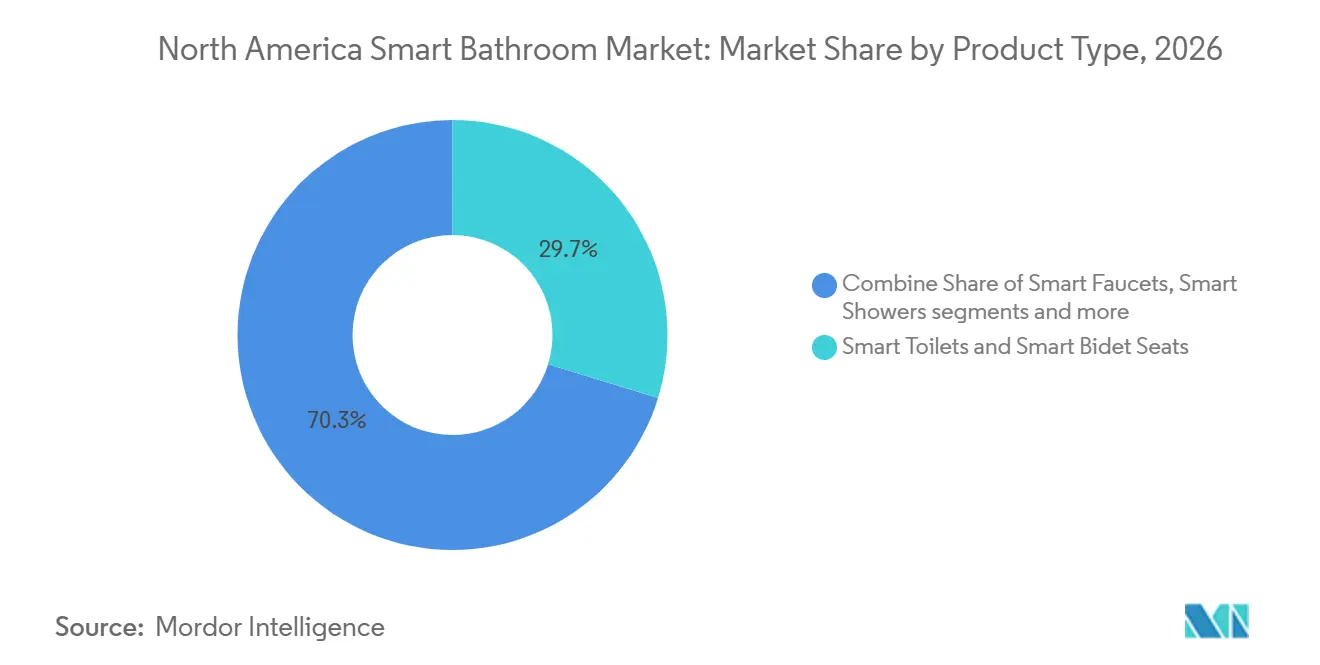
Health and Hygiene Features Strengthen the Smart Toilet CategorySmart toilets and smart bidet seats held 29.7% of segment revenue in 2026. Their lead reflects growing interest in bidet functions, touch-free operation, self-cleaning features, and health-oriented product concepts. Kohler launched Dekoda at USD 599 in October 2025, positioning the toilet as a source of data on gut health, hydration, and blood detection. TOTO introduced the WASHLET S5 at KBIS 2025 with instantaneous heating, a self-cleaning wand, and an Environmental Product Declaration. Entry-level bidet seats can expand volume, while fully integrated toilet suites support higher revenue per unit. This range allows suppliers to serve first-time buyers as well as households purchasing premium renovation packages.
Smart faucets are forecast to grow at an 11.5% CAGR through 2032, the fastest rate among product types. Touchless control remains relevant in commercial restrooms because it supports hygiene management and reduces contact with shared surfaces. Voice and app-based controls can also appeal in homes when they work within a broader connected-home environment. TOTO introduced the MIST SPA Shower in 2025 with ultrafine bubble technology that provides 63% more cleansing power at 1.75 GPM. Smart mirrors, bathtubs, soap dispensers, hand dryers, leak controllers, ventilation products, and heated towel rails extend connectivity across the room. The North America smart bathroom market gains value when suppliers offer related fixtures that can be selected together in one project.

By Construction Type:
Replacement and Retrofit Create the Largest Demand BaseReplacement and retrofit accounted for 61.7% of the North America smart bathroom market size in 2026 and are projected to grow at an 11.7% CAGR through 2032. Existing homes and facilities offer a broad base for upgrades because their bathrooms were built before connected controls were common. Houzz found that 89% of homeowners completing bathroom renovations in 2025 engaged at least 1 professional. Professional installation helps address the technical requirements of smart showers, faucets, toilets, and ventilation equipment. It also supports higher-value purchases when several fixtures are selected during the same renovation. Retrofit-oriented suppliers can benefit when their products reduce the need for wall demolition, complex rewiring, or major plumbing changes.
New construction accounted for 38.3% of revenue in 2026. Builders use connected bathroom packages in luxury condominiums and premium single-family homes to differentiate units before sale. Smart products can also meet practical accessibility needs in aging-in-place projects. The NKBA reported that 32% of design professionals viewed aging-in-place features as mainstream in 2026, while 48% considered them an emerging trend. Sensor-operated faucets, motion-triggered lighting, and voice-controlled showers can make daily use easier for people with limited mobility. New-build demand will remain important, but it does not match the larger installed base available to the replacement and retrofit segment.
By End User:
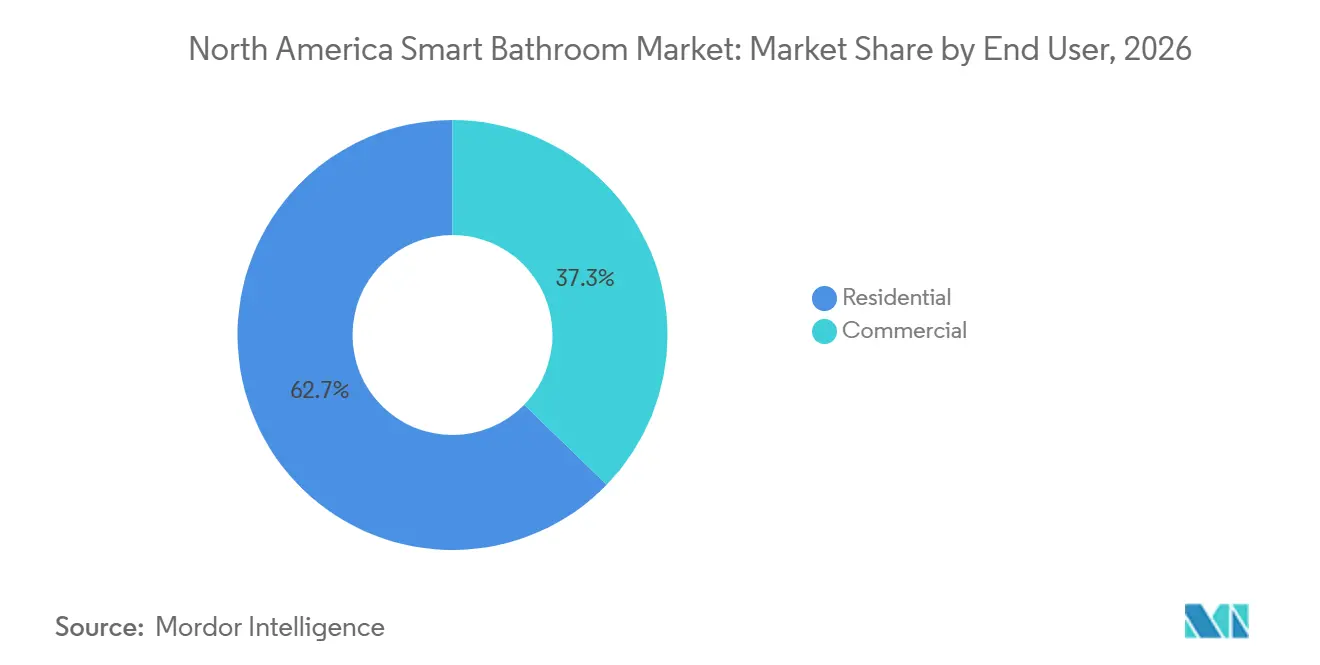
Residential Demand Leads While Commercial Buyers Seek Operational BenefitsResidential users held 62.7% of revenue in 2026. This segment is supported by home renovation activity, household familiarity with connected devices, and interest in comfort, hygiene, and accessibility. The NKBA found that 77% of design professionals expect hospitality-inspired technology to become mainstream in residential bathrooms. Adults aged 65 and older can provide additional demand for voice-operated, sensor-based, and motion-activated products that reduce physical effort and fall risk. Larger primary bathroom projects also support multi-product purchases, which can include connected showers, toilets, mirrors, and water controls. Residential growth will remain sensitive to installation expense because smart suites compete with other home improvement priorities.
Commercial demand is forecast to grow at a 10.6% CAGR through 2032. Hotels, restaurants, healthcare facilities, offices, and commercial buildings value touchless operation, centralized monitoring, and water-use reporting. Sloan, a global manufacturer of commercial plumbing systems, has expanded its SC Argus Pro offering. This update to the company’s smart restroom management platform introduces enhanced portal and dashboard features, along with expanded product connectivity. The platform supports remote monitoring of water consumption, filter status, and hygiene metrics across facility portfolios. Healthcare buyers focus on infection control and patient privacy, while hospitality operators use in-suite technology to improve guest experience. Office and commercial property managers add demand within the North America smart bathroom market as they seek facility-management and sustainability reporting tools.
By Distribution Channel:
B2C/Retail Benefits From Digital Product DiscoveryB2C/Retail held 70.8% of distribution revenue in 2026 and is forecast to expand at a 12.9% CAGR through 2032. Online stores and direct-to-consumer platforms help buyers compare product functions, review installation requirements, and visualize bathroom layouts before purchase. Digital tools can be useful for products that are difficult to demonstrate in standard retail displays, including smart showers, connected mirrors, and app-controlled fixtures. Home centers and do-it-yourself showrooms remain important for sensor retrofit kits, aerator upgrades, and entry-level bidet seats. Specialty showrooms retain a role in premium purchases where buyers want an in-person product demonstration. A clear digital journey can help manufacturers reach customers before they enter a trade showroom or contact an installer.
B2B/Direct Sales remains important for commercial specifications and multi-unit projects. Architects, plumbing engineers, contractors, and facility managers influence product selection in healthcare, hospitality, offices, and residential developments. GROHE SPA’s United States debut in November 2025 highlighted growing interest in premium, design-led bathroom solutions in the North American market, reinforcing opportunities for luxury bathroom brands. Wholesale and trade channels continue to serve volume builders and commercial contractors that prioritize supply reliability and lead times. Channel strategies that combine consumer education with installer relationships are likely to be more effective than approaches that rely on either path alone.
Geography Analysis
The United States held 79.6% of the North America smart bathroom market share in 2026. Its position reflects a large home improvement base and strong demand for premium bathroom renovation products. Median spending on primary bathroom renovations reached USD 15,000 with a top 10% starting at USD 45,000 comes from the 2024 Houzz Bathroom study. California, Texas, Florida, and New York contribute strongly because they combine active renovation activity with higher household incomes. California also supports water-monitoring and leak-detection purchases through its water-cost conditions and drought exposure.
Canada is forecast to grow at a 10.8% CAGR through 2032, the fastest rate in the region. Cold-climate homes create demand for pre-heated shower systems, sensor-operated ventilation, and whole-home leak detection that can help prevent freeze damage. Canadian plumbing requirements under the CSA B45 series create an additional compliance step for United States-made fixtures. This gives brands with established local distribution and compliant product ranges an advantage. Ontario, British Columbia, and Quebec are key demand areas because they combine renovation activity with condominium development. Toronto and Vancouver developers use connected bathroom packages as a presale feature in some premium projects.
Mexico accounted for the smallest regional revenue share in 2026. Luxury resorts in Riviera Maya, Cancún, and Los Cabos specify smart showers, touchless faucets, and sensor-operated soap dispensers in renovations and new villa developments. These products support a technology-led guest experience in high-value hospitality properties. Residential adoption remains early because household purchasing power and home automation infrastructure vary widely. Mexico City, Guadalajara, and Monterrey offer the strongest urban settings for connected-home product adoption. The North America smart bathroom market therefore has a more targeted opportunity in Mexico, centered on hospitality and higher-income urban projects.
Competitive Landscape
The North America smart bathroom market is fragmented. Kohler, TOTO, LIXIL, GROHE, American Standard, and Masco’s Delta Faucet set much of the product direction, while specialist companies address specific product categories or customer groups. Kohler launched Kohler Health and Dekoda in October 2025, bringing a USD 599 toilet-mounted optical sensor into the company’s bathroom portfolio. Kohler Health’s Dekoda uses validated machine-learning algorithms trained and refined on more than 1.2 million data points to deliver hydration, gut-health, and blood-presence insights through the Kohler Health app[3]. This move places health services alongside hardware as a potential source of customer value. TOTO continues to compete through hygiene, efficiency, and premium wellness features.
LIXIL strengthened its premium North American position when GROHE SPA made its United States debut at the World Architecture Festival in Miami in November 2025. The brand targeted architects and designers who specify hospitality and luxury residential projects. Zurn Elkay competes in commercial settings through centralized water management rather than household fixture design alone. Its fully patented plumbSMART platform supports remote monitoring and control across multi-site commercial operations. Sloan has also expanded its SC Argus Pro platform to include additional faucets and bottle fillers[4]. These offerings shift competition toward management tools that help facilities track water, hygiene, and maintenance activity.
Specialist brands such as Brondell and BioBidet by Bemis serve first-time bidet buyers through direct-to-consumer channels at lower price points. Their role broadens consumer familiarity with bidet products while creating competition for premium toilet suppliers. Delta Faucet is a relevant smart faucet competitor because it offers Touch2O, VoiceIQ, and MotionSense products through national home centers, specialty retailers, and online channels. Phyn Technologies also addresses connected water monitoring and leak detection in luxury new construction and high-end retrofits. The largest unmet need remains modular retrofit equipment that does not require electrical work or extensive plumbing changes. The North America smart bathroom market also has room for a unified institutional platform that combines water, occupancy, hygiene, and maintenance data.
North America Smart Bathroom Industry Leaders
-
Kohler Co.
-
TOTO LTD.
-
Moen Incorporated
-
LIXIL Corporation
-
Masco Corporation
- *Disclaimer: Major Players sorted in no particular order
North America Smart Bathroom Market Companies Covered in this Report
- Kohler Co.
- TOTO LTD.
- Moen Incorporated
- LIXIL Corporation
- Masco Corporation
- Roca Sanitario, SA
- Duravit AG
- Villeroy & Boch AG
- Geberit AG
- Sloan Valve Company
- Bradley Corporation
- Jacuzzi Brands LLC
- Brondell, Inc.
- BioBidet by Bemis Manufacturing Company
- MAAX Bath Inc.
- Niagara Conservation Corporation
- Speakman Company
- Zurn Elkay Water Solutions
- Symmons Industries, Inc.
- WaterHawk
- Moen Incorporated
Recent Industry Developments in North America Smart Bathroom Market
- April 2026: Sloan Valve expanded its SC Argus Pro smart restroom management platform to integrate DropSpot Bottle Fillers and additional battery-powered and above-deck faucet models, enabling unified remote monitoring of water consumption, filter status, and hygiene metrics across commercial facility portfolios with ESG-reporting functionality.
- October 2025: Sloan unveiled the FLITE-DEC Integrated Sink System, an IAPMO-certified commercial unit combining a touchless faucet, soap dispenser, hand dryer, and customizable basin in 1 module engineered to withstand 150 lbs of downward force, delivering up to 10,600 touchless hand washes per soap fill for high-traffic hospitality and transportation facilities.
- October 2025: Kohler Co. launched Kohler Health and debuted Dekoda, a USD 599 toilet-mounted optical sensor using machine-learning algorithms validated on more than 1.2 million data points to analyze gut health, hydration, and blood detection, with results transmitted to the Kohler Health app. Dekoda represents Kohler's entry into subscription-eligible digital health services from the bathroom.
- September 2025: Kohler Co. announced the integration of its Anthem+ smart showering system, managing up to 12 outlets with dual temperature zones, steam, ice-shower function, and SoundTile speaker control, with Control4's whole-home automation platform, enabling voice-command and app-driven shower presets within unified daily routines.
North America Smart Bathroom Market Report Scope
Segmentation Overview
| Smart Toilets and Smart Bidet Seats |
| Smart Faucets |
| Smart Showers |
| Smart Bathroom Mirrors |
| Smart Bathtubs |
| Smart Soap Dispensers |
| Smart Hand Dryers |
| Others (Smart Water Leak Controllers, Ventilation, Heated Towel Rails) |
| New Construction |
| Replacement and Retrofit |
| Residential | |
| Commercial | Hotels and Restaurants |
| Healthcare Facilities | |
| Offices and Commercial Buildings | |
| Others |
| B2C / Retail | Home Centers/DIY Showrooms |
| Specialty Showrooms and Dealers | |
| Wholesale and Trade Channels | |
| Online Stores and Direct-to-Consumer | |
| Other Distribution Channels | |
| B2B / Direct Sales |
| United States |
| Canada |
| Mexico |
| By Product Type | Smart Toilets and Smart Bidet Seats | |
| Smart Faucets | ||
| Smart Showers | ||
| Smart Bathroom Mirrors | ||
| Smart Bathtubs | ||
| Smart Soap Dispensers | ||
| Smart Hand Dryers | ||
| Others (Smart Water Leak Controllers, Ventilation, Heated Towel Rails) | ||
| By Construction Type | New Construction | |
| Replacement and Retrofit | ||
| By End User | Residential | |
| Commercial | Hotels and Restaurants | |
| Healthcare Facilities | ||
| Offices and Commercial Buildings | ||
| Others | ||
| By Distribution Channel | B2C / Retail | Home Centers/DIY Showrooms |
| Specialty Showrooms and Dealers | ||
| Wholesale and Trade Channels | ||
| Online Stores and Direct-to-Consumer | ||
| Other Distribution Channels | ||
| B2B / Direct Sales | ||
| By Country | United States | |
| Canada | ||
| Mexico | ||
Key Questions Answered in the Report
What is the projected value of the North America smart bathroom market by 2032?
The North America smart bathroom market is projected to reach USD 5.1 billion by 2032, growing at a 9.2% CAGR from 2027.
Which product category leads smart bathroom sales in North America?
Smart toilets and smart bidet seats lead with 29.7% revenue share in 2026, supported by hygiene, comfort, and health-related features.
Which smart bathroom product is expected to grow the fastest?
Smart faucets are forecast to grow at an 11.5% CAGR through 2032, driven by touchless controls and connected-home integration.
Why are replacement and retrofit projects important for smart bathroom adoption?
Replacement and retrofit held 61.7% of revenue in 2026 because many existing homes and facilities need connected products that can work with older bathroom infrastructure.
Which country has the largest share of regional smart bathroom demand?
The United States held 79.6% of regional revenue in 2026, supported by a large home renovation base and premium product demand.