
Europe Smart Bathroom Market Size and Share
Market Overview
| Study Period | 2021 - 2032 |
|---|---|
| Forecast Data Period | 2027 - 2032 |
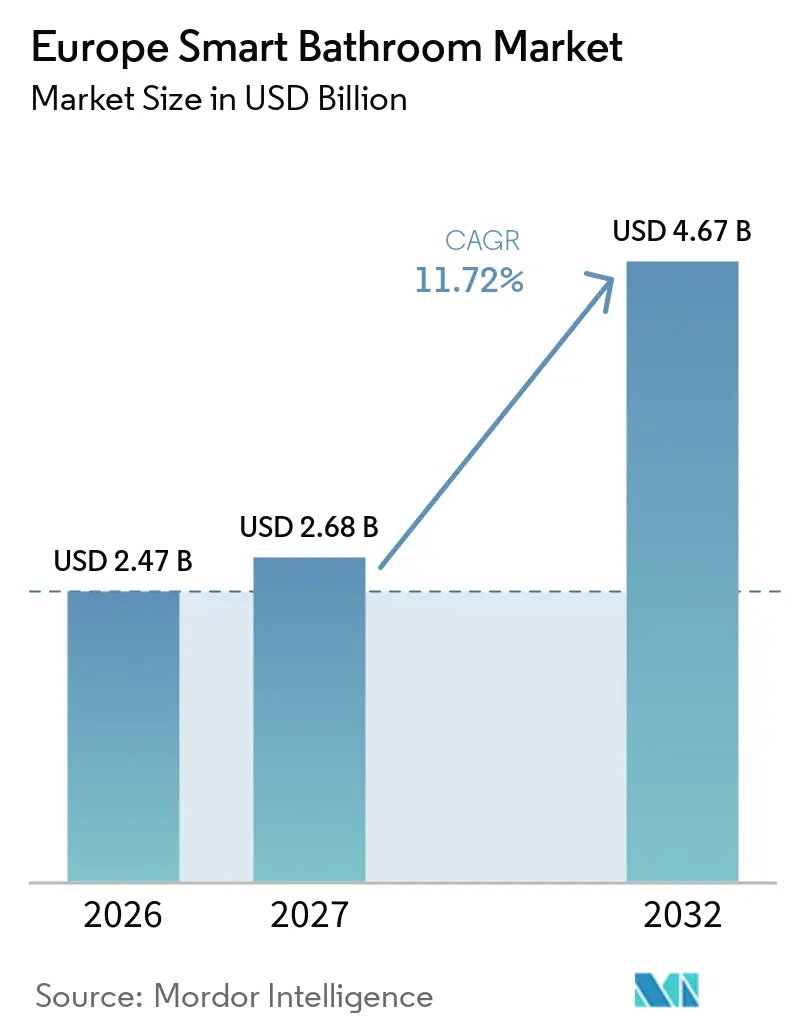
| Base Year Market Size (2026) | USD 2.47 Billion |
| Market Size (2027) | USD 2.68 Billion |
| Market Size (2032) | USD 4.67 Billion |
| Growth Rate (2027 - 2032) | 11.72 % |
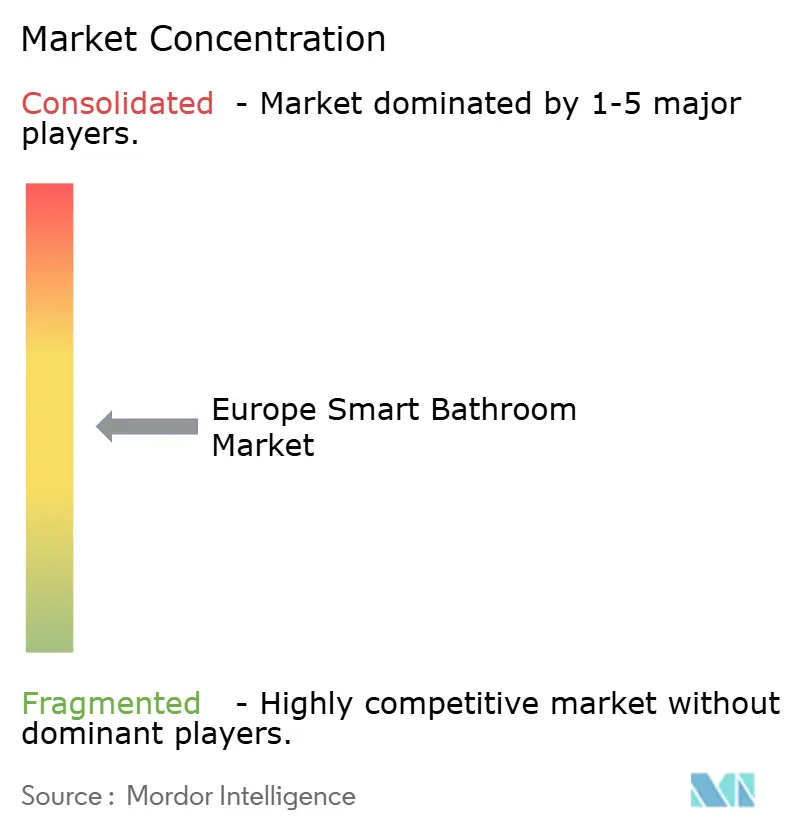
| Market Concentration | Medium |
Major Players *Disclaimer: Major Players sorted in no particular order Image © Mordor Intelligence. Reuse requires attribution under CC BY 4.0. | |
Europe Smart Bathroom Market Analysis by Mordor Intelligence
The Europe smart bathroom market size is projected to expand from USD 2.47 billion in 2026 to USD 2.68 billion in 2027 and USD 4.67 billion by 2032, registering a CAGR of 11.72% between 2027 and 2032. The Europe smart bathroom market is moving from stand-alone fixtures toward products that work within connected-home systems. Water-efficiency rules, older populations, and renovation activity are supporting demand across residential and commercial properties. The European Commission seeks a 10% improvement in water efficiency by 2030, while the Energy Performance of Buildings Directive sets minimum performance standards for the least efficient nonresidential buildings[1]. These requirements place water management and accessibility closer to the center of bathroom specifications. Established manufacturers hold an advantage where installation capability, privacy protection, and product compatibility shape purchasing decisions.
Key Report Takeaways
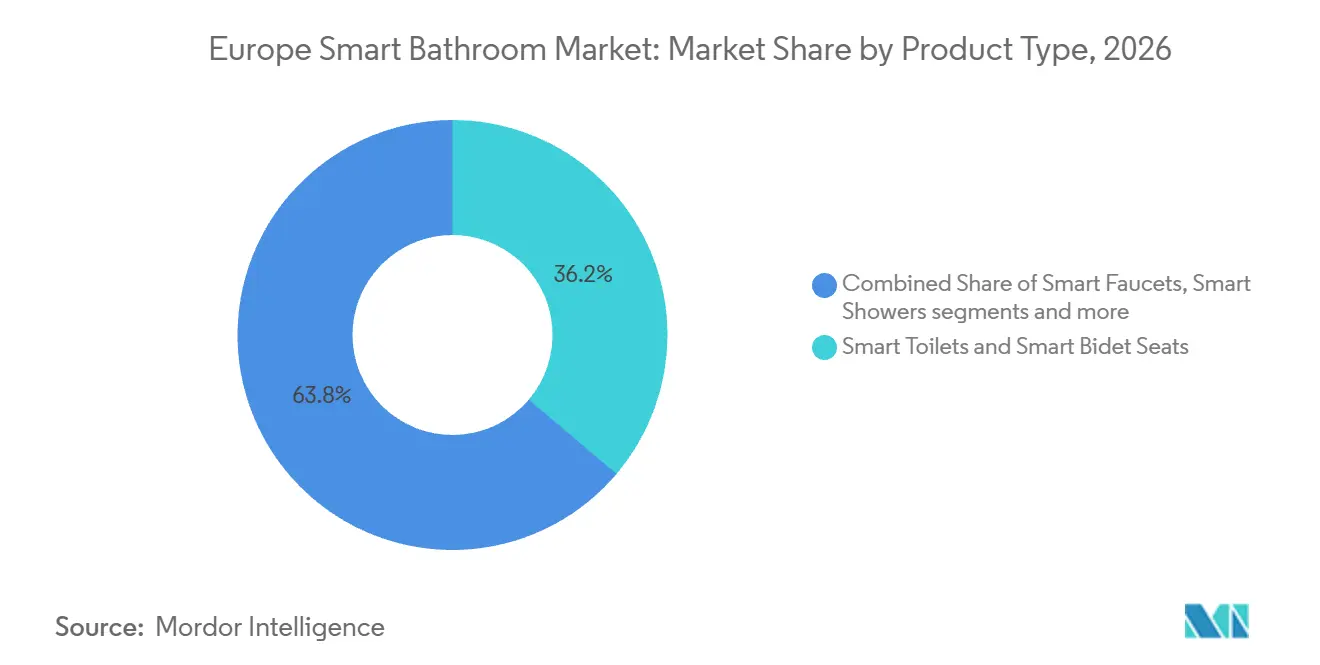
- By product type, smart toilets and smart bidet seats held a 36.2% share in 2026, while smart faucets are projected to grow at the fastest CAGR of 12.9% through 2032.
- By construction type, replacement and retrofit held a 64.0% share in 2026 and are projected to grow at the fastest CAGR of 12.3% through 2032.
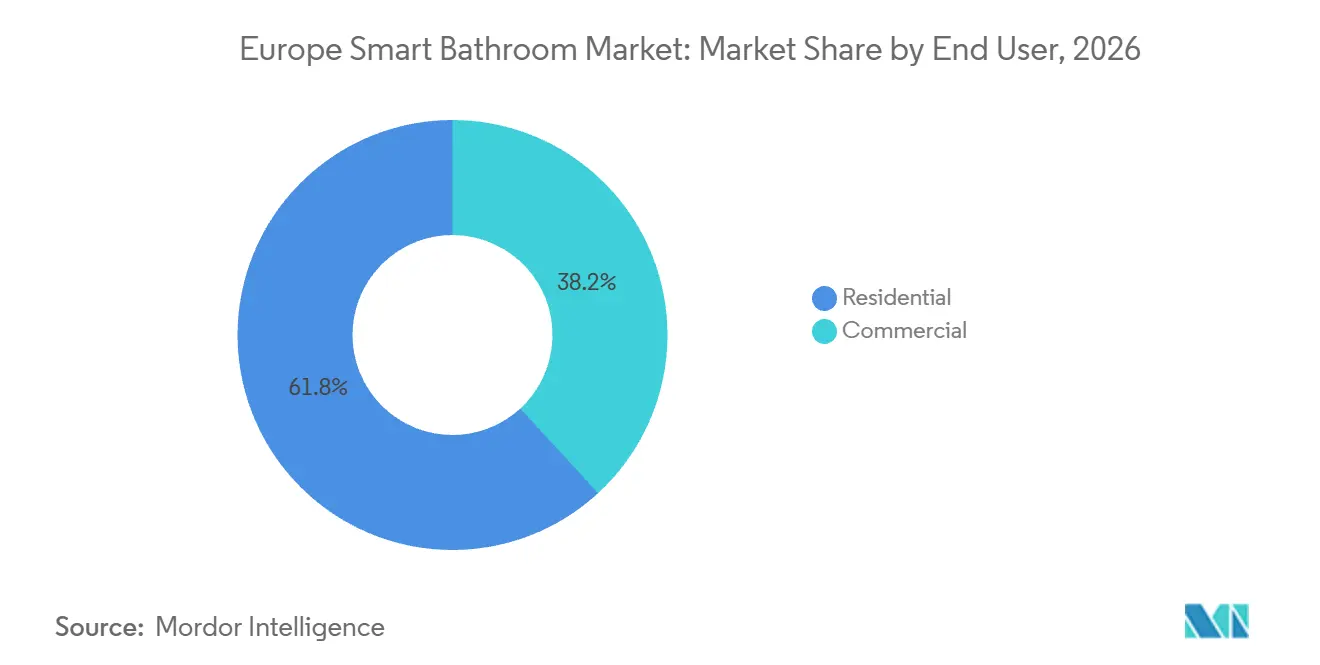
- By end user, residential accounted for a 61.8% share in 2026, while commercial is projected to grow at the fastest CAGR of 12.2% through 2032.
- By distribution channel, B2C and retail held a 78.0% share in 2026, while B2B and direct sales are projected to grow at the fastest CAGR of 12.5% through 2032.
- By geography, Germany held a 23.2% share in 2026, while the United Kingdom is projected to grow at the fastest CAGR of 12.6% through 2032.
Note: Market numbers in this report are based on Mordor Intelligence's proprietary estimation framework, which combines nine months of actuals with Q4 projections for base year 2026.
Market Trends and Insights
Drivers Impact Analysis of Europe Smart Bathroom Market*
| Driver | (~) % Impact on CAGR Forecast | Geographic Relevance | Impact Timeline |
|---|---|---|---|
| Water Stress Mitigation and Water Efficiency Regulation | +2.7% | EU-wide, with stronger compliance pressure in Southern Europe and spillover into Western Europe | Short term (≤ 2 years) |
| Mature Smart Home Adoption and Connected Living Ecosystems | +2.5% | Netherlands, Nordics, and the United Kingdom | Medium term (2-4 years) |
| Long Cycle Bathroom Renovation and Premium Fixture Specification | +2.0% | Germany, the United Kingdom, BENELUX, and France | Medium term (2-4 years) |
| Commercial Hygiene and Hospitality Modernization | +1.5% | France, Spain, Italy, and the United Kingdom | Short term (≤ 2 years) |
| Aging Population and Accessible Bathroom Demand | +1.2% | Italy, Germany, Greece, and the wider EU | Long term (≥ 4 years) |
| Retrofit Shower Toilet and Seat Based Upgrades | +0.9% | United Kingdom, DACH, Netherlands, and Belgium | Short term (≤ 2 years) |
| Source: Mordor Intelligence | |||
Water Stress Mitigation and Water Efficiency Regulation
Water-efficiency requirements are translating public policy into product-level purchasing requirements across the Europe smart bathroom market. The Unified Water Label Association has more than 20,000 registered products and over 160 industry partners, which gives manufacturers a widely recognized route to demonstrate fixture efficiency[2]. The European Environment Agency has identified water savings as central to a more water-resilient Europe[3]. GROHE found that 87% of more than 20,000 European respondents value household water efficiency, yet 79% underestimate their own daily consumption. Connected faucets, showers, and toilets can make household consumption more visible while helping users change settings. This makes certified and low-flow products more relevant to specifications for both public procurement and private renovation.
Mature Smart Home Adoption and Connected Living Ecosystems
The Europe smart bathroom market benefits from households already using connected devices and understanding their day-to-day value. In 2024, 70.9% of EU residents used internet-connected devices, including 94.8% in the Netherlands, 90.6% in Ireland, and 87% in Denmark[4]. Smart home appliance adoption reached 12.8% across the EU, leaving room for the connected fixture category to grow within existing home systems. Homes with established connectivity can reduce the practical barrier to adding a connected bathroom device. They also make users more familiar with controls, alerts, and remote management. Manufacturers that make products easy to integrate can be better positioned as connected living becomes more common.
Long Cycle Bathroom Renovation and Premium Fixture Specification
The Europe smart bathroom market is supported by bathroom replacement cycles that commonly extend over many years. The European Commission's Renovation Wave aims to renovate 35 million buildings by 2030. The updated buildings framework also requires member states to develop National Building Renovation Plans. Renovation passports can help owners sequence improvements as part of a longer building plan. A full bathroom project creates an opportunity to replace conventional fixtures with more efficient and accessible equipment. This shifts demand toward products that can show clear water, energy, and installation benefits.
Commercial Hygiene and Hospitality Modernization
Hotels, healthcare operators, and offices provide an additional route to demand in the Europe smart bathroom market. Cistermiser reported that its touchless installation at Radisson RED London Heathrow achieved flow rates as low as 1.89 liters per minute, compared with typical manual tap use of 6 to 8 liters per minute. Hotel Schweizerhof Luzern completed a CHF 12 million renovation of 101 rooms in 2025, including shower-drainage equipment designed to reduce water-heating energy by up to 60%. The German sanitary sector has also emphasized accessibility needs, noting that more than 5 million people in Germany need care and 1 in 4 bathrooms does not meet accessibility requirements. Operators can assess water costs, hygiene, accessibility, and room quality together when planning a renovation. This supports dedicated commercial product lines and closer relationships with installers.
Restraints Impact Analysis of Europe Smart Bathroom Market*
| Restraint | (~) % Impact on CAGR Forecast | Geographic Relevance | Impact Timeline |
|---|---|---|---|
| High Product and Installation Cost | -1.5% | EU-wide, with higher pressure in Eastern Europe | Short term (≤ 2 years) |
| Older Building Plumbing and Electrical Compatibility | -0.8% | Southern and Eastern Europe | Medium term (2-4 years) |
| GDPR Health Data Privacy and Cybersecurity Requirements | -0.5% | EU-wide | Short term (≤ 2 years) |
| Fragmented National Codes and Interoperability Barriers | -0.4% | Cross-border European launches and multi-country programs | Medium term (2-4 years) |
| Source: Mordor Intelligence | |||
High Product and Installation Cost
Product and installation costs can limit adoption in the Europe smart bathroom market, especially where renovation budgets are constrained. Smart fixtures can carry a premium over conventional alternatives, while more complex projects require both a plumber and an electrician. That combination can add scheduling issues and separate call-out costs for mid-market buyers. GROHE found that 28% of Europeans who did not plan to adopt water-saving solutions cited perceived high cost as the main barrier, ahead of lack of information at 25%. The price hurdle is stronger when homeowners must first address wider plumbing or electrical work. Suppliers that offer straightforward retrofit options and clear operating-cost benefits can reduce this barrier.
Older Building Plumbing and Electrical Compatibility
Older building infrastructure can delay connected-bathroom upgrades even when property owners want more efficient fixtures. Many Southern and Eastern European buildings have older pipework, lower water pressure, or wiring that is unsuitable for powered equipment. Industry participants at ISH 2025 noted that smart bathrooms require sanitary and electrical expertise, while older homes may lack the network coverage and cable routes that connected fixtures assume. Remediation work can increase the total cost and extend project timelines. Property transactions and wider renovation plans can bring these limits to light before fixture selection begins. Products that work with existing connections and minimize wall disruption are more suited to this installed base.
*Our forecasts treat driver/restraint impacts as directional, not additive. The impact forecasts reflect baseline growth, mix effects, and variable interactions.
Europe Smart Bathroom Market Segment Analysis
By Product Type:
Toilets Lead the Category While Faucets Set the Growth PaceSmart toilets and smart bidet seats commanded 36.2% of the Europe smart bathroom market share in 2026. Their position reflects established bidet use in Southern Europe and the wider adoption of shower-toilet hygiene features. Hansgrohe introduced LavaPura Element for Europe in March 2025 with UV disinfection for the shower bar, a motion-sensor lid, and an antibacterial ceramic glaze. These functions address hygiene, ease of use, and premium bathroom renovation needs. The category has a clear role in projects where users seek both comfort and accessible controls.
Smart faucets are projected to grow at a 12.9% CAGR through 2032, the fastest rate among product types in the Europe smart bathroom market. Touchless and sensor-controlled models are relevant to hygiene-sensitive commercial settings and water-management requirements. Smart showers remain suited to premium installations because digital controls can support temperature consistency and water-use management. Smart mirrors, soap dispensers, and hand dryers serve narrower commercial and premium residential uses. Their adoption depends on whether customers see a practical benefit from connected controls rather than a feature with limited daily value.

By Construction Type:
Retrofit Defines Current Demand and Forecast GrowthReplacement and retrofit accounted for 64% of Europe smart bathroom market size in 2026 and is expected to expand at a 12.3% CAGR through 2032. This combined leadership shows that demand is tied more closely to the existing building stock than to new construction. The Renovation Wave has placed greater policy attention on upgrading existing buildings. Bathroom projects can become part of these broader improvements when owners replace water-consuming fittings. Retrofit demand favors products that fit within existing layouts and can be installed with limited disruption.
New construction accounted for 36% of the Europe smart bathroom market in 2026. It gives developers a better opportunity to incorporate electrical, network, and water-management requirements during design. Even so, the renovation opportunity is broader because existing buildings contain most of the region's bathroom stock. Hansgrohe launched the Activera Q and S Select shower range with VarioFix brackets that reuse existing drill holes, a feature intended to simplify retrofit installation. This type of product engineering matters where installers need to avoid additional tile and wall work. The Europe smart bathroom industry therefore depends on making advanced products suitable for ordinary replacement projects.
By End User:
Residential Provides Value While Commercial Supports Faster GrowthResidential users held 61.8% of the Europe smart bathroom market share in 2026. Homeowner renovation is supported by an aging population and wider awareness of products encountered in hotels and other public spaces. On January 1, 2025, the EU had 99 million residents aged 65 years or older, equal to 22% of the population. Sensor-based functions, easier controls, and accessible layouts can be relevant to this demographic. The residential segment remains important because a broad base of household projects can support steady fixture replacement.
Commercial end users are expected to grow at a 12.2% CAGR through 2032. Hotels, restaurants, healthcare facilities, and offices follow different procurement needs, but each can assess durability, hygiene, and operating costs. German accessibility needs point to a renovation opportunity in care homes and assisted-living properties. Commercial purchasers can also procure fixtures and installation as coordinated projects. This gives suppliers an incentive to provide installation support, warranties, and products designed for high-use settings.
By Distribution Channel:
Retail Holds the Largest Position While Direct Sales Gains MomentumB2C and retail channels represented a 78% share in the Europe smart bathroom market in 2026. Home centers, specialist showrooms, wholesalers, and online stores all contribute to consumer access. Showrooms remain useful because users can test bidet functions and digital shower controls before buying. Retail also supports smaller-scale household upgrades where a buyer makes the selection directly. The channel will remain significant while residential renovation provides the largest end-user base.
B2B and direct sales are forecast to grow at a 12.5% CAGR through 2032. Hotel chains and healthcare networks can use direct agreements to coordinate volumes, installation, and warranty coverage. Hansgrohe renovated 79 rooms at the Van der Valk Hotel Waterloo with AXOR and EcoSmart systems designed to reduce water use by 40%. Such examples show why an operator may prefer a direct relationship for larger projects. Direct sales can also strengthen service relationships after installation. This channel is positioned to capture projects where technical support is as important as the fixture itself.
Geography Analysis
Germany accounted for 23.2% of the European smart bathroom market size in 2026. Its role as a major sanitaryware manufacturing base reinforces demand for efficient, high-quality products. Geberit invested CHF 86 million in research and development during 2025, leading to 18 patent applications and continued product development in its bathroom portfolio. Villeroy & Boch increased Bathroom and Wellness revenue by 2.3% to EUR 1,124.5 million in 2025 despite difficult construction conditions.
The United Kingdom is projected to grow at a 12.6% CAGR through 2032, the highest country rate in the Europe smart bathroom market. The outlook reflects retrofit demand, hotel refurbishment, and growing interest in accessible bathroom configurations. France's bathroom sector declined 3.3% to EUR 2,098 million in 2025, though high-value washlet toilets and concealed faucets remained among the growing categories. This shows that premium product demand can remain resilient even when the wider category is under pressure. Roca Group invested EUR 126 million in 2025 in product connectivity, digitalization, and robotic production.
BENELUX benefits from high levels of connected-device use, including the Netherlands' 94.8% rate. The Nordics have strong interest in touchless technology and water-saving solutions. Oras describes touchless faucets as a well-established technology in Northern countries. Vitas Group acquired Flow Loop in 2025, adding shower technology that reports water savings of up to 80% and energy reductions of 70%. Poland, Czechia, Hungary, and the Baltics have longer adoption timelines, but broader building-renovation policy can support future demand.
Competitive Landscape
The European smart bathroom market is moderately concentrated, although several firms hold strong positions in individual product areas. Geberit, GROHE under LIXIL, Hansgrohe, Villeroy & Boch, and TOTO have established brands, manufacturing capability, and established distribution relationships. These strengths matter because architects, installers, and buyers often prefer proven systems for water, electrical, and hygiene-sensitive installations. Companies also benefit when their products are familiar to installers and fit established specification practices. The competitive setting favors firms that combine efficient fixtures, reliable installation support, and clear product documentation.
Established companies continue to use product development to strengthen their position in the European smart bathroom market. Hansgrohe introduced LavaPura Element in 2025, bringing shower-toilet features such as UV disinfection and a sensor-operated lid to its European range. In 2026, the company launched Neovis faucets with CoolStart and EcoSmart functions, alongside Activera showers with retrofit-focused VarioFix brackets. Roca Group expanded through the acquisitions of Antonio Lupi Design and Phoenix Industries while investing in connectivity and production capability. These actions show a focus on premium products, efficient fixtures, and wider portfolio coverage.
Data privacy, cybersecurity, and interoperability can influence competitive positioning as connected functions become more common. Smaller suppliers may find it harder to support product security, software updates, and technical compliance across several countries. Larger manufacturers are better placed to combine these responsibilities with installer training and service coverage. The Europe smart bathroom market retains room for specialists in accessibility, water recirculation, and retrofit-friendly products, provided they can meet the technical and service requirements of larger buyers.
Europe Smart Bathroom Industry Leaders
-
Geberit AG
-
TOTO LTD.
-
LIXIL Corporation
-
Roca Sanitario, S.A.
-
Duravit AG
- *Disclaimer: Major Players sorted in no particular order
Europe Smart Bathroom Market Companies Covered in this Report
- Geberit AG
- TOTO LTD.
- LIXIL Corporation
- Roca Sanitario, S.A.
- Duravit AG
- Villeroy & Boch AG
- Hansgrohe SE
- Kohler Co.
- Dornbracht AG & Co. KG
- Aqualisa Products Limited
- TECE GmbH
- VitrA (Eczacıbaşı Building Products)
- Ideal Standard International S.A.
- LAUFEN
- Noken (PORCELANOSA Group)
- Oras Group
- HEWI GmbH
- Gessi S.p.A.
- Jacuzzi Brands LLC
- Uspa Europe S.r.l.
Recent Industry Developments in Europe Smart Bathroom Market
- April 2026: Hansgrohe SE launched the Neovis faucet line with CoolStart energy-saving technology, with cold water as the default in the center position, and EcoSmart flow limitation to 5 liters per minute, 60% below conventional fittings. The simultaneous Activera Q and S Select shower launch added VarioFix variable wall brackets specifically engineered to reuse existing drill holes for retrofit installation
- March 2026: Geberit AG disclosed planned 2026 launches of the CleanLine30 slim shower channel, with a 10% higher discharge rate than its predecessor, and the CleanFloor30 floor-level shower surface, products directly aligned with accessible and barrier-free bathroom design requirements.
- March 2025: Hansgrohe SE launched LavaPura Element, its first shower toilet for the European market, featuring automatic UV disinfection of the shower bar after each use, a motion-sensor-activated lid, and a 2-in-1 antibacterial ceramic glaze, directly addressing the premium shower-toilet segment's acceleration.
- March 2025: GROHE premiered Everstream, with up to 75% water and 70% energy savings versus conventional showers, the Rapido heat recovery system, with up to 48% CO₂ reduction per shower cycle, and the Purefoam foam-shower concept at ISH 2025, reinforcing the brand's emphasis on quantified sustainability performance.
Europe Smart Bathroom Market Report Scope
Segmentation Overview
| Smart Toilets and Smart Bidet Seats |
| Smart Faucets |
| Smart Showers |
| Smart Bathroom Mirrors |
| Smart Bathtubs |
| Smart Soap Dispensers |
| Smart Hand Dryers |
| Others (Smart Water Leak Controllers, Ventilation, Heated Towel Rails) |
| New Construction |
| Replacement and Retrofit |
| Residential | |
| Commercial | Hotels and Restaurants |
| Healthcare Facilities | |
| Offices and Commercial Buildings | |
| Others |
| B2C / Retail | Home Centers/DIY Showrooms |
| Specialty Showrooms and Dealers | |
| Wholesale and Trade Channels | |
| Online Stores and Direct-to-Consumer | |
| Other Distribution Channels | |
| B2B /Direct Sales |
| United Kingdom |
| Germany |
| France |
| Spain |
| Italy |
| BENELUX (Belgium, Netherlands, Luxembourg) |
| NORDICS (Denmark, Finland, Iceland, Norway, Sweden) |
| Rest of Europe |
| By Product Type | Smart Toilets and Smart Bidet Seats | |
| Smart Faucets | ||
| Smart Showers | ||
| Smart Bathroom Mirrors | ||
| Smart Bathtubs | ||
| Smart Soap Dispensers | ||
| Smart Hand Dryers | ||
| Others (Smart Water Leak Controllers, Ventilation, Heated Towel Rails) | ||
| By Construction Type | New Construction | |
| Replacement and Retrofit | ||
| By End User | Residential | |
| Commercial | Hotels and Restaurants | |
| Healthcare Facilities | ||
| Offices and Commercial Buildings | ||
| Others | ||
| By Distribution Channel | B2C / Retail | Home Centers/DIY Showrooms |
| Specialty Showrooms and Dealers | ||
| Wholesale and Trade Channels | ||
| Online Stores and Direct-to-Consumer | ||
| Other Distribution Channels | ||
| B2B /Direct Sales | ||
| By Country | United Kingdom | |
| Germany | ||
| France | ||
| Spain | ||
| Italy | ||
| BENELUX (Belgium, Netherlands, Luxembourg) | ||
| NORDICS (Denmark, Finland, Iceland, Norway, Sweden) | ||
| Rest of Europe | ||
Key Questions Answered in the Report
What is the projected value of the Europe smart bathroom market by 2032?
The Europe smart bathroom market is forecast to reach USD 4.67 billion by 2032, growing at a 11.7% CAGR from 2027.
Which product category leads European smart bathroom sales?
Smart toilets and smart bidet seats lead with a 36.2% share in 2026, while smart faucets have the fastest projected growth at 12.9% CAGR through 2032.
Why are retrofit projects important for connected bathroom products?
Replacement and retrofit work held a 64% share in 2026 and is projected to grow at 12.3% CAGR, supported by building-renovation programs and the need to upgrade existing fixtures.
Which end users are expected to adopt smart bathroom equipment fastest?
Commercial users are forecast to grow at 12.2% CAGR through 2032, supported by hotel, healthcare, and office renovation needs.
Which European country has the fastest outlook for smart bathroom adoption?
The United Kingdom has the highest projected country CAGR at 12.6% through 2032, supported by retrofit activity and demand for accessible bathroom configurations.