
Sludge Treatment and Handling Equipment Market Size and Share
Market Overview
| Study Period | 2021 - 2031 |
|---|---|
| Market Size (2026) | USD 7.57 Billion |
| Market Size (2031) | USD 9.73 Billion |
| Growth Rate (2026 - 2031) | 5.14 % |
| Fastest Growing Market | Asia-Pacific |
| Largest Market | Asia-Pacific |
| Market Concentration | Medium |
Major Players *Disclaimer: Major Players sorted in no particular order Image © Mordor Intelligence. Reuse requires attribution under CC BY 4.0. | |
Sludge Treatment and Handling Equipment Market Analysis by Mordor Intelligence
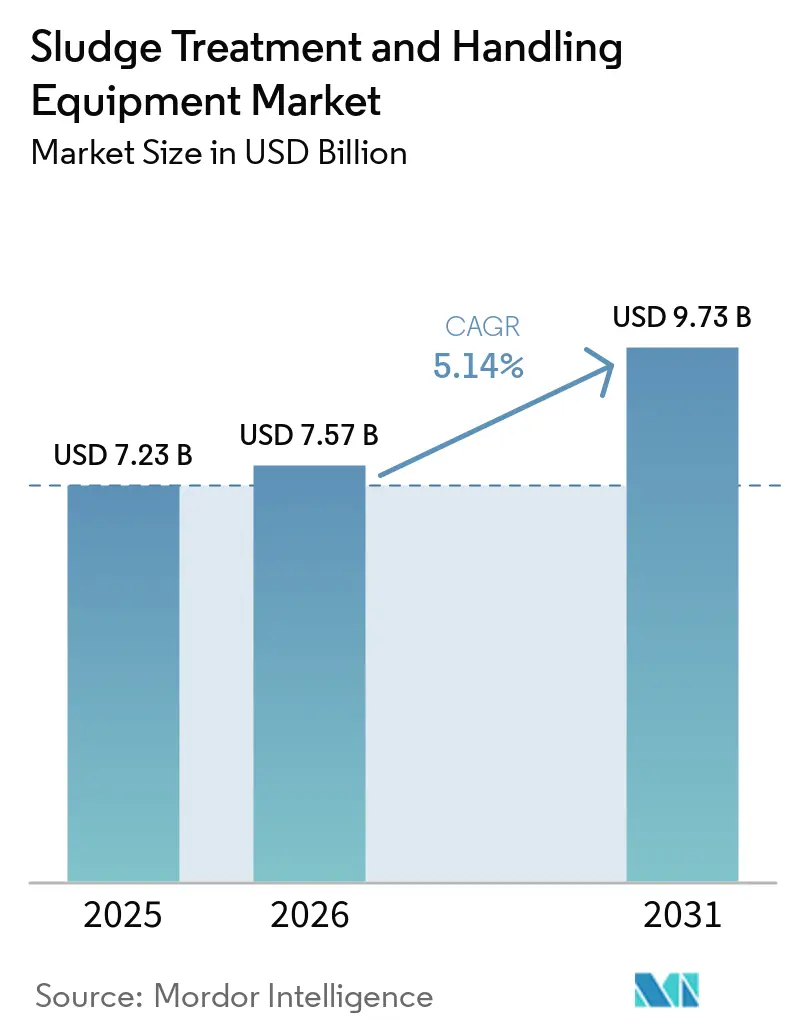
The Sludge Treatment and Handling Equipment Market size was valued at USD 7.23 billion in 2025 and is estimated to grow from USD 7.57 billion in 2026 to reach USD 9.73 billion by 2031, at a CAGR of 5.14% during the forecast period (2026-2031). The sludge treatment and handling equipment market is influenced by stricter wastewater discharge regulations, rising disposal costs, and equipment replacement requirements at aging treatment facilities. Municipal utilities represent a procurement source, supported by public capital programs for wastewater system modernization. Industrial operators are investing in on-site conditioning and dewatering equipment to manage the costs and risks associated with third-party disposal. Urban wastewater generation and industrial output are increasing treatment capacity requirements, while per- and polyfluoroalkyl substances (PFAS) management is contributing to demand for thermal treatment and related equipment. Suppliers offer integrated process lines, automation solutions, and partnerships that combine dewatering, thermal treatment, and resource recovery capabilities.
Key Report Takeaways
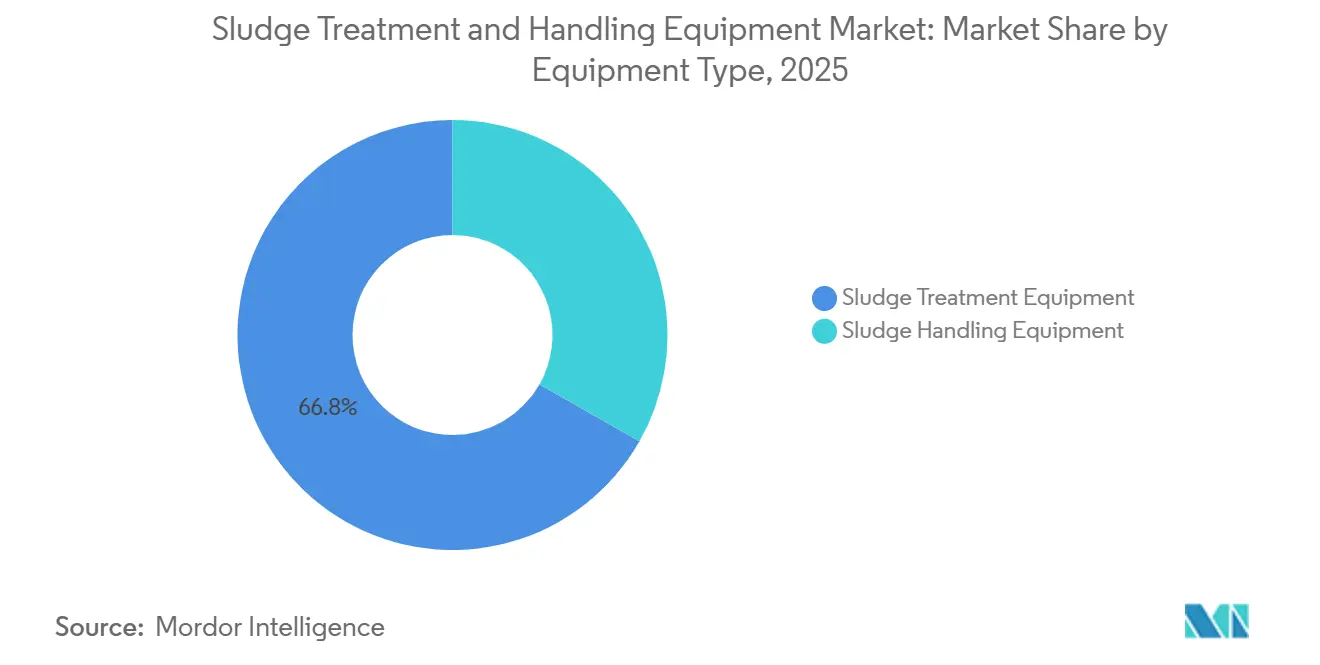
- By equipment type, sludge treatment equipment held 66.78% of global revenue in 2025, while sludge handling equipment is forecast to grow at a 5.46% CAGR through 2031.
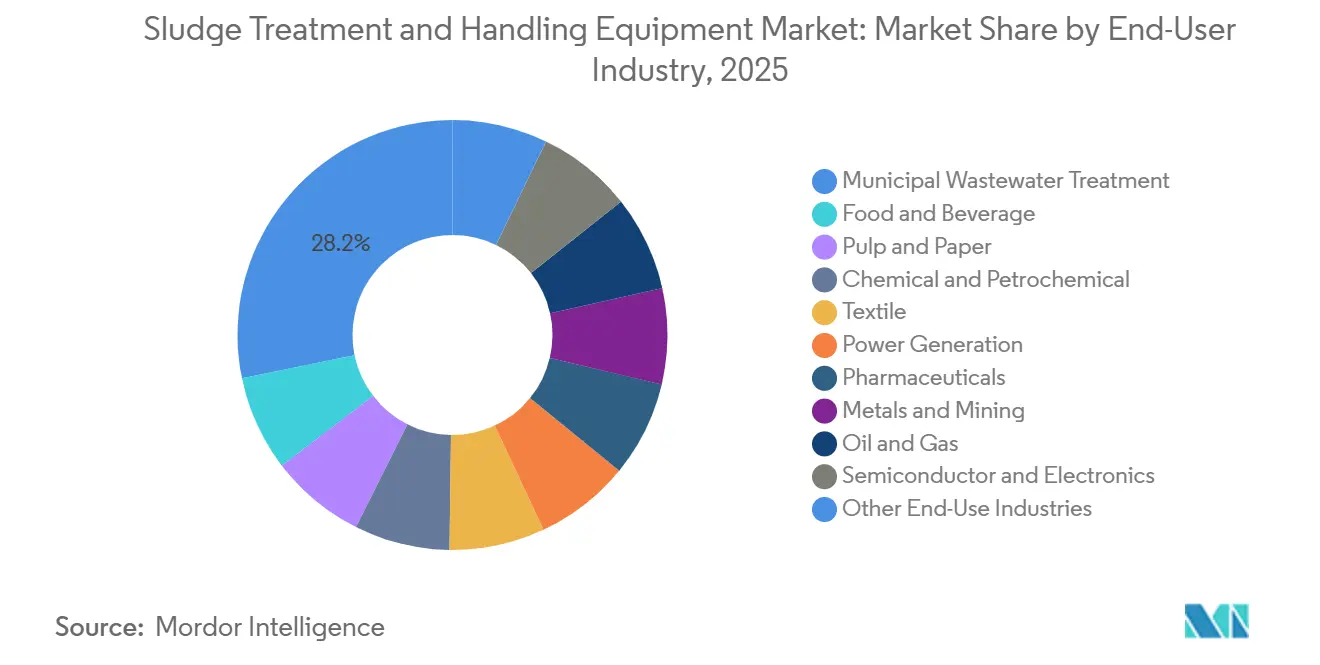
- By end-user industry, municipal wastewater treatment accounted for 28.23% of global revenue in 2025, while chemical and petrochemical industries are forecast to expand at a 6.12% CAGR through 2031.
- By geography, Asia-Pacific accounted for 38.17% of global revenue in 2025 and is forecast to advance at a 5.83% CAGR through 2031.
Note: Market size and forecast figures in this report are generated using Mordor Intelligence’s proprietary estimation framework, updated with the latest available data and insights as of January 2026.
Global Sludge Treatment and Handling Equipment Market Trends and Insights
Drivers Impact Analysis*
| Drivers | (~) % Impact on CAGR Forecast | Geographic Relevance | Impact Timeline |
|---|---|---|---|
| Stricter Wastewater Discharge and Biosolids Compliance | +1.3% | Global, strongest in North America and Europe | Short term (≤ 2 years) |
| Rising Wastewater Volumes from Urbanization and Industrialization | +1.1% | APAC core, spillover to the Middle East and Africa (MEA), and South America | Long term (≥ 4 years) |
| Sludge Volume Reduction and Disposal-Cost Avoidance | +0.8% | Global | Medium term (2-4 years) |
| Circular-Economy Demand for Biogas, Nutrients, and Reusable Biosolids | +0.7% | Europe, Japan, Australia, and growing in APAC | Medium term (2-4 years) |
| Per- and Polyfluoroalkyl Substances (PFAS)-Driven Pretreatment and Destruction Requirements | +0.5% | North America and Europe | Short term (≤ 2 years) |
| Source: Mordor Intelligence | |||
Stricter Wastewater Discharge and Biosolids Compliance Intensifies Equipment Procurement
Regulatory requirements remain a key driver of demand for the sludge treatment and handling equipment market. In July 2026, the U.S. Environmental Protection Agency (EPA) issued draft guidance on reducing risks associated with perfluorooctanoic acid (PFOA) and perfluorooctane sulfonic acid (PFOS) in biosolids and requested public feedback through its public docket. The guidance recommends precautions for land application near waterways and in areas with elevated public exposure risks, increasing the focus on treatment options for affected utilities. In Europe, the revised Urban Wastewater Treatment Directive sets policy direction by establishing stricter treatment requirements and resource recovery provisions. These requirements prompt utilities to assess aging dewatering and stabilization assets and enhance sampling, conditioning, conveyance, emissions control, and final-disposal documentation throughout the treatment chain. The sludge treatment and handling equipment market is supported by operators' need for equipment that addresses contaminants while ensuring reliable material handling and documentation.
Rising Wastewater Volumes from Urbanization and Industrialization Generate Structural Demand
Urbanization and industrial expansion increase the quantity and complexity of wastewater requiring treatment. This trend creates demand for thickening, conditioning, dewatering, pumping, and conveyance systems across the sludge treatment and handling equipment market. Municipal wastewater treatment projects often require high-throughput equipment, as population growth increases wastewater flows in systems that may already face deferred upgrades. Industrial facilities create an additional source of demand because their sludge characteristics can differ significantly from municipal feedstocks in solids content and chemical composition. By June 2026, the Asian Development Bank's Citywide Inclusive Sanitation Project had awarded eight of its 11 sewer-construction packages, with contracts totaling USD 138.5 million and civil works targeted for completion by the end of 2029. These projects generate demand across the process chain, including intake, thickening, dewatering, transfer, storage, and final-cake treatment, rather than supporting a single equipment purchase. As new wastewater infrastructure becomes operational, operators require treatment equipment that can accommodate increasing wastewater flows while aligning with local operating and maintenance conditions.
Circular-Economy Demand for Biogas, Nutrients, and Reusable Biosolids Reshapes Equipment Mix
The sludge treatment and handling equipment market is also influenced by initiatives to recover energy and nutrients from materials previously treated solely as waste. A four-year municipal plant study in Germany found that thermal pressure hydrolysis increased methane production by 18% and improved digestate dewaterability by 14%, while struvite recovery exceeded 80% of phosphorus input. The study also found that recovered struvite met relevant German fertilizer declaration thresholds, supporting full-scale resource recovery. These projects require equipment beyond conventional presses, including digesters, thermal hydrolysis units, crystallizers, and dewatering systems designed for treated sludge. In May 2025, Veolia received a USD 34 million contract to install MemGas biogas-to-biomethane technology at San Francisco's Southeast Water Pollution Control Plant, with an expected annual renewable energy output of 68 GWh[1]. Project economics depend on each operator's ability to integrate digestion, dewatering, recovery, product handling, and compliance management into an operating plan that can be maintained throughout the asset's life. This trend supports integrated process configurations in the sludge treatment and handling equipment market, enabling utilities to align disposal management with energy and nutrient recovery.
PFAS-Driven Pretreatment and Destruction Requirements Create Specialized Upgrade Cycle
PFAS contamination creates specialized equipment requirements in addition to conventional sludge-processing needs. Research published in 2025 found that a pyrolysis system combined with a thermal oxidizer operating at 900°C to 1,000°C removed 99.4% of PFAS molar mass from dewatered biosolids. The research also examined thermal destruction pathways that require controlled operating conditions and appropriate emissions management. These findings may lead utilities serving catchments with legacy industrial discharges to consider thermal treatment in their capital plans. At WEFTEC 2026, Alfa Laval and AquaGreen are presenting a treatment chain that combines Ashbrook Simon-Hartley dewatering systems with HECLA-integrated drying and pyrolysis technology for the destruction of per- and polyfluoroalkyl substances (PFAS), biochar production, and phosphorus recovery. The sludge treatment and handling equipment market is supported by this requirement, as suppliers can integrate dewatering systems with thermal treatment technologies and process controls. However, these projects require greater capital investment, energy consumption, emissions management capabilities, and technical expertise than conventional installations.
Restraints Impact Analysis*
| Restraints | (~) % Impact on CAGR Forecast | Geographic Relevance | Impact Timeline |
|---|---|---|---|
| High Capital, Energy, Maintenance, and Skilled-Labor Costs | -0.8% | Global, pronounced in developing markets | Long term (≥ 4 years) |
| Variable Sludge Rheology and Feed-Quality Uncertainty | -0.5% | Global, strongest at mixed-input treatment plants | Medium term (2-4 years) |
| PFAS Liability and Restrictions on Beneficial Biosolids Reuse | -0.5% | North America and Europe | Medium term (2-4 years) |
| Source: Mordor Intelligence | |||
High Capital, Energy, Maintenance, and Skilled-Labor Costs Compress Procurement Pace
Advanced sludge treatment systems may require thickening, conditioning, digestion, dewatering, and thermal treatment within a single project. This scope increases capital requirements and can extend procurement cycles, as major installations also require civil works and process integration. Centrifuges, thermal dryers, and fluidized-bed incinerators consume significant amounts of energy, making operating costs highly sensitive to electricity prices. Smaller utilities and facilities may face challenges in securing skilled personnel to operate automated equipment and maintain control systems. In addition, PFAS-related restrictions may eliminate lower-cost reuse options and increase the cost burden on municipalities that lack dedicated destruction capacity. These constraints can delay replacement decisions in the sludge treatment and handling equipment market, particularly where project budgets are limited.
Variable Sludge Rheology and Feed-Quality Uncertainty Introduce Operational and Commercial Risk
Sludge properties in the sludge treatment and handling equipment market vary based on solids content, viscosity, seasonal flows, upstream catchments, and industrial inputs. Equipment selected for a specific design condition may perform less effectively when feed characteristics fall outside the expected range. This variability can result in centrate turbidity exceedances, belt filter blinding, or screw press torque trips, reducing throughput. The risk is higher at large facilities that receive both municipal and industrial wastewater, where operating conditions can change frequently. Flottweg's FW400 HTS decanter, introduced in 2026, features a modular FlexConcept design that allows adjustments to bowl speed and torque range without replacing the entire machine[2]. Although such designs can reduce operational risk, retrofitting them into legacy plants may require additional integration work and delay project completion.
*Our forecasts treat driver/restraint impacts as directional, not additive. The impact forecasts reflect baseline growth, mix effects, and variable interactions.
Segment Analysis
By Equipment Type: Process Complexity Lifts Value Beyond Dewatering
Sludge treatment equipment accounted for 66.78% of the sludge treatment and handling equipment market share in 2025, reflecting the multiple process steps required to achieve compliant treatment. Dewatering equipment, including belt filter presses, centrifuges, and screw presses, has the largest installed base within this category. Thermal treatment systems, such as dryers and thermal hydrolysis units, are gaining importance as utilities prepare for stricter biosolids quality requirements and resource recovery programs. Thickening equipment, including gravity thickeners, dissolved-air flotation units, and centrifugal thickeners, prepares feedstock for subsequent treatment processes. Conditioning equipment, such as polymer dosing and mixing systems, can reduce downstream dewatering costs by improving flocculation and increasing cake dryness.
Sludge handling equipment is the fastest-growing equipment segment, with the sludge treatment and handling equipment market projected to expand at a 5.46% CAGR from 2026 to 2031. Pumping and conveying systems support operations in large, multi-train plants, where sludge must move consistently between process stages while remaining contained. Plant designers increasingly specify enclosed conveyance and odor-control systems, as odor complaints can delay permit issuance in densely populated areas. Storage and loading equipment is gaining adoption at plants that add lime stabilization or composting operations. Biofilters, chemical scrubbers, and thermal oxidizers are becoming more common in new tenders, while ISO 11647 and ISO 5667-13 influence sludge characterization, sampling, and quality documentation in regulated environments.

By End-User Industry: Industrial Channels Outpace Municipal Baseline
Municipal wastewater treatment accounted for 28.23% of the sludge treatment and handling equipment market share in 2025, making it the largest end-user segment. Population-driven increases in sludge quantities and public capital programs support municipal procurement across regions. Utilities in the sludge treatment and handling equipment market commonly prefer standardized, high-throughput dewatering and pumping equipment with predictable service intervals. This preference creates recurring opportunities for equipment suppliers to perform maintenance and replacements over long asset lifecycles. Food and beverage facilities represent the second-largest industrial channel, as organic sludge quantities increase with food production capacity. Pulp and paper facilities require dewatering equipment for fibrous effluent, while textile plants require pretreatment systems for mixed chemical and biological sludge.
Chemical and petrochemical applications are the fastest-growing end-user categories, with the sludge treatment and handling equipment market size for this segment projected to grow at a 6.12% CAGR from 2026 to 2031. Refineries and chemical plants generate oily and heavy-metal-bearing sludge, which many jurisdictions classify as hazardous waste. These facilities often require on-site mass reduction because disposal management is closely linked to permit conditions and operating costs. New petrochemical capacity in China, India, and the Middle East is increasing the need to incorporate sludge management into project designs from the outset. Power generation, pharmaceuticals, metals and mining, oil and gas, and semiconductor and electronics facilities also require specialized systems because their waste streams may require contamination-controlled handling or process-specific dewatering.
Geography Analysis
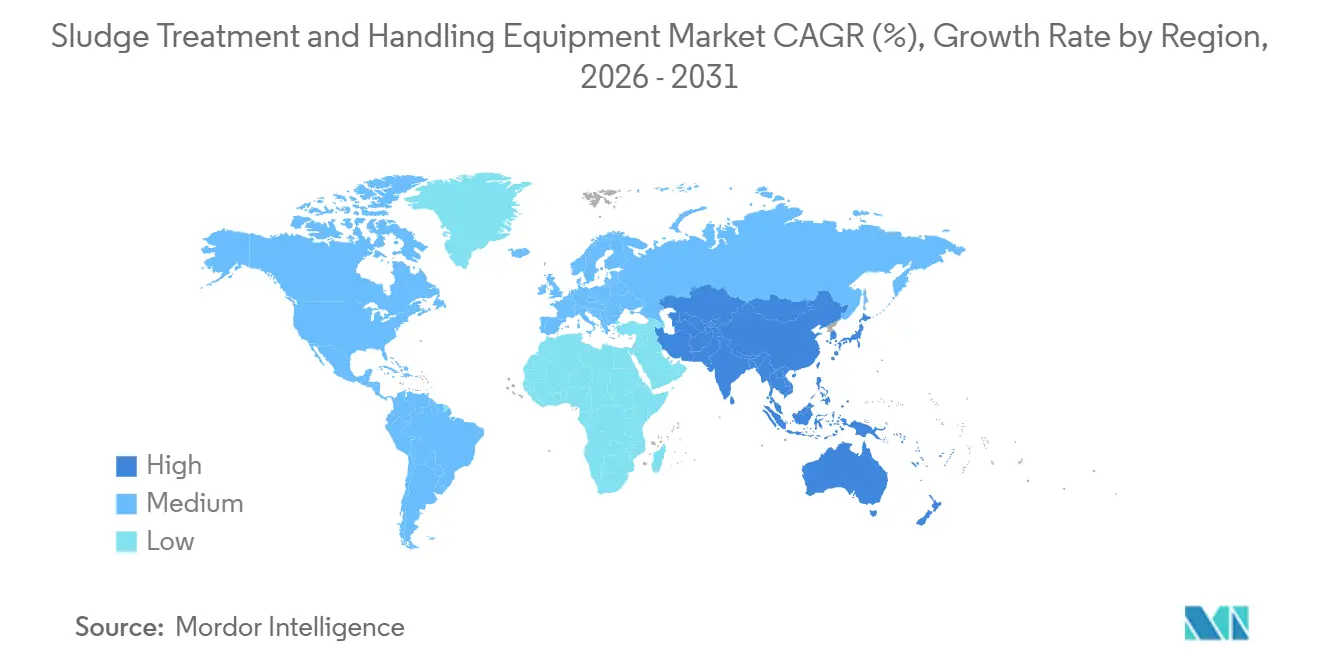
Asia-Pacific accounted for 38.17% of global revenue in 2025 and is forecast to grow at a CAGR of 5.83% through 2031. The region has municipal infrastructure requirements and expanding industrial wastewater treatment needs. China is a key procurement market for sludge treatment and handling equipment, as treatment capacity additions and circular economy priorities drive demand for dewatering, drying, incineration, and flue-gas treatment equipment. India is generating demand by expanding sewage treatment in smaller cities and implementing wastewater projects with public and private participation. Japan and South Korea are technology-intensive markets where advanced systems for digestion, thermal treatment, and phosphorus recovery support municipal upgrades.
North America and Europe account for a smaller share of the sludge treatment and handling equipment market. In the United States, EPA guidance issued in July 2026 has increased attention on biosolids management in catchments exposed to PFOA and PFOS risks. This supports interest in pyrolysis and incineration options as utilities seek to manage disposal-pathway risks. In Norway, Veolia announced a EUR 28.5 million wastewater treatment upgrade at Fuglevik in January 2026, including struvite phosphorus recovery, biogas-to-energy capture, and nitrogen removal.
South America, the Middle East, and Africa are emerging demand areas in the sludge treatment and handling equipment market, where infrastructure gaps and industrial activity influence procurement. Brazil plays a key role in South America, and HUBER SE supplied 85 machines for the Barueri wastewater treatment plant expansion near São Paulo, where capacity is planned to increase from 16 m³/s to 22.5 m³/s by 2027. Argentina, Colombia, and Chile offer additional opportunities through sewage coverage initiatives and industrial wastewater facilities serving the mining and food processing sectors. In the Middle East and Africa, petrochemical projects and municipal infrastructure gaps create demand for advanced treatment, particularly for refinery sludge with high solids content and oily characteristics. Local integrators and equipment suppliers can benefit when project financing supports treatment upgrades and dependable after-sales service.
Competitive Landscape
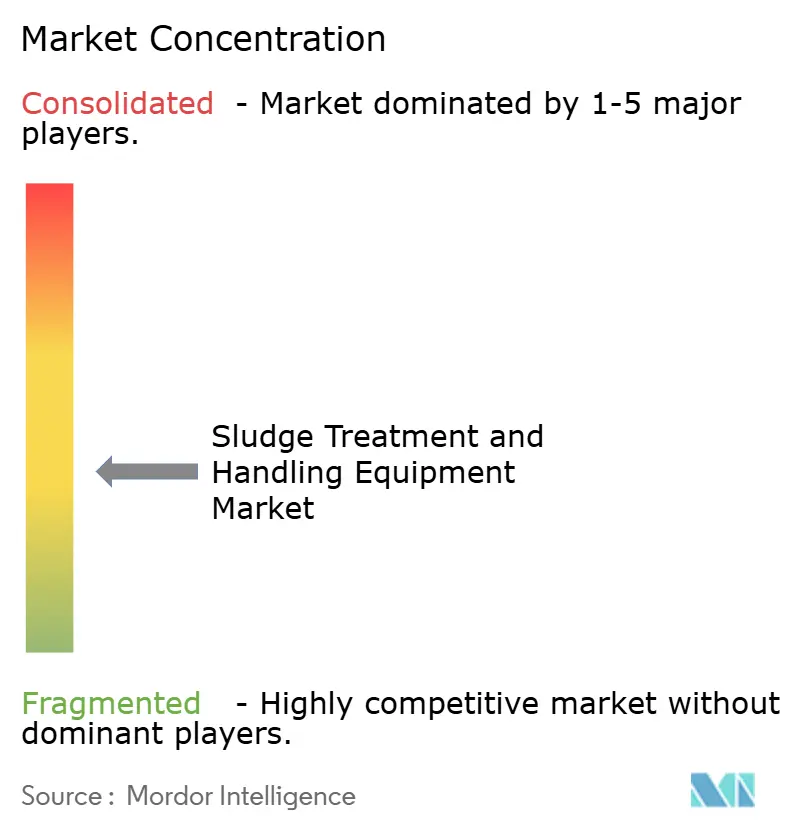
The sludge treatment and handling equipment market is moderately fragmented. European suppliers, including ANDRITZ, Alfa Laval (through Ashbrook Simon-Hartley), GEA Group, HUBER SE, and Flottweg SE, compete based on equipment performance, process engineering, and aftermarket service capabilities. Their portfolios include thickening, dewatering, handling, drying, and thermal treatment, enabling them to serve large municipal upgrade projects through integrated solutions. Kanadevia Corporation, Mitsubishi Kakoki Kaisha, and Kurita Water Industries operate in Japan and South Korea and expand their presence through regional partnerships and technology transfer. Veolia and SUEZ use their concession management operations to offer design-build-operate contracts, which differ from those of equipment-focused suppliers.
Technology integration is increasingly relevant in the sludge treatment and handling equipment market. In August 2025, GEA acquired the Flocmix brand to integrate centrate turbidity sensing with AI-based decanter control through its OptiPartner Intellicant platform. The acquisition supports the use of real-time process data and automated adjustments in decanter systems. In May 2025, Veolia acquired CDPQ's 30% stake in Water Technologies and Solutions for USD 1.75 billion, increasing its ownership of water technology capabilities. In September 2026, Alfa Laval and AquaGreen expanded their collaboration on integrated dewatering, drying, and pyrolysis systems for PFAS destruction, biochar production, and phosphorus recovery.
Suppliers focus on specialized applications where treatment performance and verified results influence procurement decisions beyond basic equipment capacity. Thermal destruction systems for per- and polyfluoroalkyl substances (PFAS) are a key application area, as specialized providers can partner with established dewatering vendors rather than compete across the full process line. Modular and containerized treatment units may be suitable for decentralized industrial sites without conventional in-ground infrastructure. Biosolids quality standards and emissions verification methods can also influence vendor selection when customers require documented commissioning results. The sludge treatment and handling equipment industry includes global suppliers with broad process portfolios and regional providers that compete on cost, local service, and proximity to delivery.
Sludge Treatment and Handling Equipment Industry Leaders
-
ALFA LAVAL
-
ANDRITZ
-
Veolia
-
HUBER SE
-
Xylem
- *Disclaimer: Major Players sorted in no particular order
Recent Industry Developments
- September 2026: Alfa Laval and AquaGreen expanded their collaboration at WEFTEC 2026 in New Orleans, presenting an integrated biosolids treatment chain combining Alfa Laval’s Ashbrook Simon-Hartley dewatering systems with AquaGreen’s HECLA Integrated Drying and Pyrolysis (IDP) technology.
- January 2026: SUEZ secured a contract to supply 16 Dehydris Twist fully enclosed sludge-dewatering units for Hong Kong’s Sha Tin Cavern Sewage Treatment Works, Asia’s largest sewage treatment plant built in underground caverns. The compact design reduces the footprint by 25% compared with conventional alternatives, addressing space constraints in the cavern environment.
Global Sludge Treatment and Handling Equipment Market Report Scope
Sludge treatment and handling equipment includes industrial machinery and systems used to process residual semi-solid waste, or sludge, generated during municipal and industrial wastewater treatment. These systems support sludge thickening, digestion, dewatering, drying, storage, and handling to facilitate treatment, disposal, or reuse.
The sludge treatment and handling equipment market is segmented by equipment type, end-user industry, and geography. By equipment type, the market is segmented into sludge treatment equipment and sludge handling equipment. By end-user industry, the market is segmented into municipal wastewater treatment, food and beverage, pulp and paper, chemical and petrochemical, textile, power generation, pharmaceuticals, metals and mining, oil and gas, semiconductor and electronics, and other end-use industries. The report also covers the market size and forecasts for sludge treatment and handling equipment in 15 countries across major regions. The market sizes and forecasts are provided in terms of value (USD).
| Sludge Treatment Equipment | Thickening Equipment |
| Conditioning Equipment | |
| Stabilization Equipment | |
| Dewatering Equipment | |
| Drying and Thermal Treatment Equipment | |
| Sludge Handling Equipment | Pumping and Conveying Systems |
| Storage and Loading Equipment | |
| Odor and Air Control Equipment | |
| Other Sludge Handling Equipment |
| Municipal Wastewater Treatment |
| Food and Beverage |
| Pulp and Paper |
| Chemical and Petrochemical |
| Textile |
| Power Generation |
| Pharmaceuticals |
| Metals and Mining |
| Oil and Gas |
| Semiconductor and Electronics |
| Other End-Use Industries |
| Asia-Pacific | China |
| India | |
| Japan | |
| South Korea | |
| ASEAN Countries | |
| Rest of Asia-Pacific | |
| North America | United States |
| Canada | |
| Mexico | |
| Europe | Germany |
| United Kingdom | |
| France | |
| Italy | |
| NORDIC Countries | |
| Rest of Europe | |
| South America | Brazil |
| Argentina | |
| Rest of South America | |
| Middle East and Africa | Saudi Arabia |
| South Africa | |
| Rest of Middle East and Africa |
| By Equipment Type | Sludge Treatment Equipment | Thickening Equipment |
| Conditioning Equipment | ||
| Stabilization Equipment | ||
| Dewatering Equipment | ||
| Drying and Thermal Treatment Equipment | ||
| Sludge Handling Equipment | Pumping and Conveying Systems | |
| Storage and Loading Equipment | ||
| Odor and Air Control Equipment | ||
| Other Sludge Handling Equipment | ||
| By End-User Industry | Municipal Wastewater Treatment | |
| Food and Beverage | ||
| Pulp and Paper | ||
| Chemical and Petrochemical | ||
| Textile | ||
| Power Generation | ||
| Pharmaceuticals | ||
| Metals and Mining | ||
| Oil and Gas | ||
| Semiconductor and Electronics | ||
| Other End-Use Industries | ||
| By Geography | Asia-Pacific | China |
| India | ||
| Japan | ||
| South Korea | ||
| ASEAN Countries | ||
| Rest of Asia-Pacific | ||
| North America | United States | |
| Canada | ||
| Mexico | ||
| Europe | Germany | |
| United Kingdom | ||
| France | ||
| Italy | ||
| NORDIC Countries | ||
| Rest of Europe | ||
| South America | Brazil | |
| Argentina | ||
| Rest of South America | ||
| Middle East and Africa | Saudi Arabia | |
| South Africa | ||
| Rest of Middle East and Africa | ||
Key Questions Answered in the Report
What is current market size of Sludge Treatment and Handling Equipment Market?
The Sludge Treatment and Handling Equipment Market size was valued at USD 7.23 billion in 2025 and is estimated to grow from USD 7.57 billion in 2026 to reach USD 9.73 billion by 2031, at a CAGR of 5.14% during the forecast period (2026-2031).
Which equipment category leads demand?
Sludge treatment equipment led with a 66.78% share in 2025. It includes equipment used for thickening, conditioning, stabilization, dewatering, and thermal treatment.
Which end user is expanding fastest?
Chemical and petrochemical applications are forecast to grow at a 6.12% CAGR through 2031 because hazardous and oily sludge needs specialized on-site treatment.
Which region has the strongest outlook?
Asia-Pacific held a 38.17% share in 2025 and is forecast to grow at a 5.83% CAGR through 2031, supported by municipal and industrial wastewater investment.