
Ski Apparel Market Size and Share
Market Overview
| Study Period | 2022 - 2032 |
|---|---|
| Market Size (2027) | USD 5.14 Billion |
| Market Size (2032) | USD 6.57 Billion |
| Growth Rate (2027 - 2032) | 5.03 % |
| Fastest Growing Market | Asia-Pacific |
| Largest Market | Europe |
| Market Concentration | Low |
Major Players *Disclaimer: Major Players sorted in no particular order Image © Mordor Intelligence. Reuse requires attribution under CC BY 4.0. | |
Ski Apparel Market Analysis by Mordor Intelligence
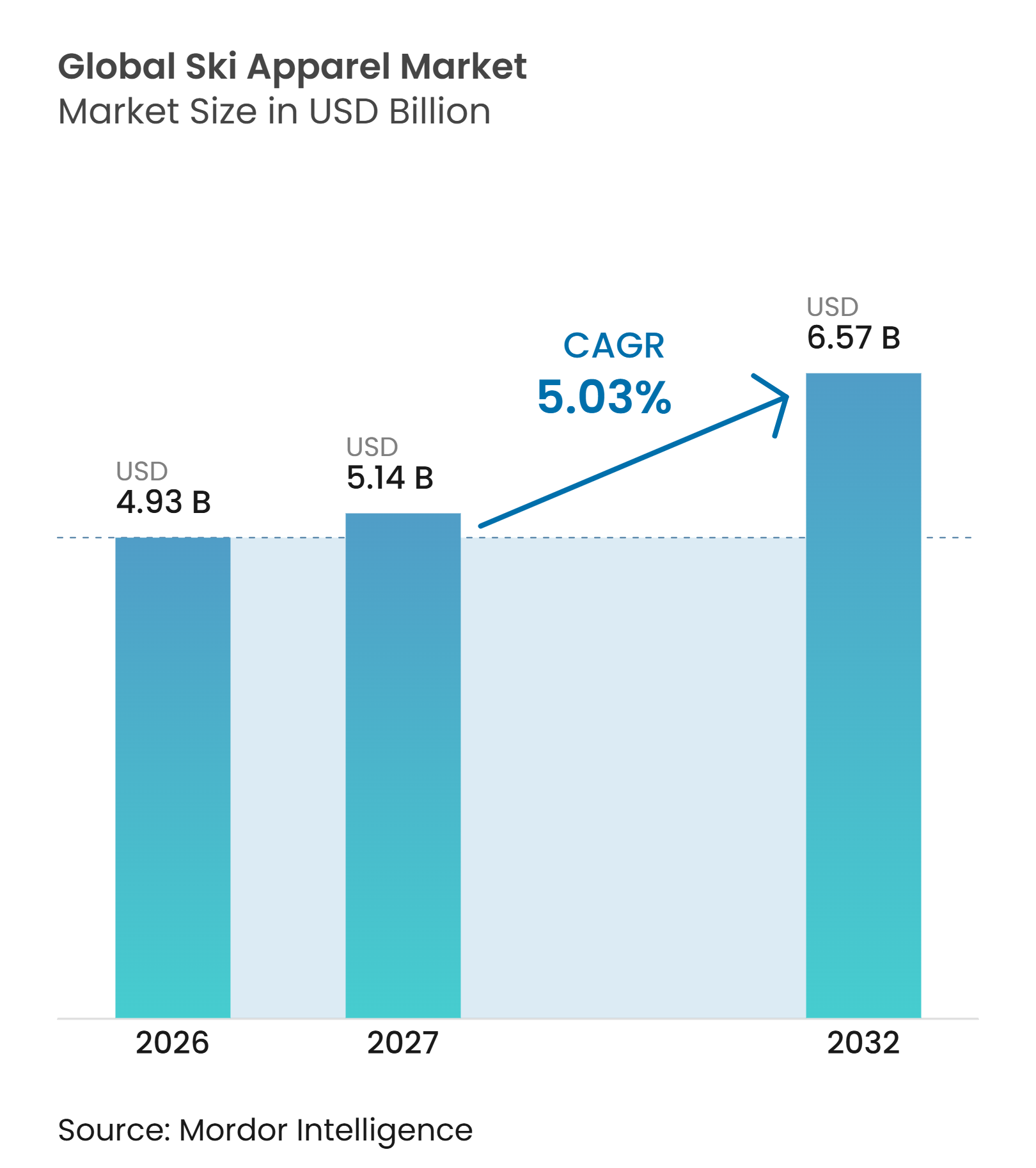
The Global Ski Apparel Market size was valued at USD 4.93 billion in 2026 and is estimated to grow from USD 5.14 billion in 2027 to reach USD 6.57 billion by 2032, at a CAGR of 5.03% during the forecast period (2027-2032). Participation is broadening in established snow destinations and in Asian locations that are adding indoor and outdoor capacity. Demand is also moving toward higher-value garments that combine weather protection, warmth, and a design suitable for use away from the slopes. Direct sales channels give brands more contact with consumers and help them adapt products and pricing more quickly. Climate volatility and changing Per- and polyfluoroalkyl substances (PFAS) rules create costs and inventory risks, which make material innovation and a wider seasonal product offer important competitive responses. The ski apparel market remains fragmented, leaving room for specialized brands that can serve women, premium buyers, and occasional participants through rental-linked models.
Key Report Takeaways
-
By product type, jackets held 45.32% of the ski apparel market share in 2026, while base layers are forecast to expand at a 6.21% CAGR through 2032.
-
By end-user, men held 48.10% of the ski apparel market share in 2026, while women are forecast to expand at a 6.35% CAGR through 2032.
-
By category, mass apparel held 64.32% share in 2026, while premium apparel is forecast to expand at a 6.78% CAGR through 2032.
-
By distribution channel, offline retail stores held 75.67% share in 2026, while online retail stores are forecast to expand at a 6.89% CAGR through 2032.
-
By geography, Europe held 34.20% share in 2026, while Asia-Pacific is forecast to expand at a 6.39% CAGR through 2032.
Note: Market numbers in this report are based on Mordor Intelligence's proprietary estimation framework, which combines nine months of actuals with Q4 projections for base year 2026.
Market Trends and Insights
Drivers Impact Analysis of Ski Apparel Market*
| Driver | (~) % Impact on CAGR Forecast | Geographic Relevance | Impact Timeline |
|---|---|---|---|
| Growth in ski tourism and winter sports participation | +1.1% | Global, with concentrated gains in Europe and Asia-Pacific | Short term (≤ 2 years) |
| Premiumization of technical outerwear | +1.0% | Europe, North America, and emerging Asia-Pacific markets | Medium term (2-4 years) |
| Waterproof breathable and insulation innovation | +0.9% | Global | Medium term (2-4 years) |
| Omnichannel and direct to consumer Expansion | +0.8% | North America and Europe, expanding to Asia-Pacific | Medium term (2-4 years) |
| Cross season wearability of ski technical apparel | +0.6% | Global, strongest in Europe and North America | Long term (≥ 4 years) |
| Rental led access for infrequent skiers | +0.5% | European resort areas, expanding to Asia-Pacific | Short term (≤ 2 years) |
| Source: Mordor Intelligence | |||
Growth In Ski Tourism And Winter Sports Participation
The ski apparel market benefits from a wider base of people taking part in snow sports, particularly where participation is becoming a repeat leisure habit rather than a one-time holiday activity. Snowsports Industries America reported 32 million United States participants in the 2025/26 season, the highest level in 6 seasons[1]. Those consumers can become buyers over many seasons as their equipment, fit, warmth, and style needs change with experience and spending capacity. China also had 13.6 million individual skiers in the 2024/25 season, which supports demand for entry and mid-priced clothing, although this earlier data should be treated as context rather than a current measure. The ski apparel market can benefit when brands design for both ski and snowboard culture instead of treating the audiences as completely separate.
Premiumization Of Technical Outerwear
The ski apparel market is seeing demand move toward performance garments with clear technical and design value, rather than products that compete only on a basic winter clothing offer. Amer Sports reported USD 2.9 billion in Technical Apparel revenue in fiscal 2025, up 30.1% from the prior year. The company ended the year with 288 direct-to-consumer stores, compared with 223 stores a year earlier. Premium buyers increasingly look for PFAS-free membranes, sustainable insulation, reliable fit, and garments that can be worn during travel and in everyday winter settings. This favors brands that can explain on-slope performance, material choices, durability, and intended use in a simple way. It puts pressure on undifferentiated mid-priced products, which compete with both accessible retailers and premium specialists.
Waterproof Breathable And Insulation Innovation
Material performance is becoming a more visible point of competition in the ski apparel market, as buyers compare weather protection and comfort more closely across premium products. Arc'teryx introduced GORE-TEX Pro ePE in the Beta AR jacket during 2025 as part of its move toward fluorine-free technology. Patagonia launched its PowSlayer Freeride Kit with GORE-TEX Pro ePE in October 2025, combining shell, mid-layer, transition, and base-layer pieces. These launches make waterproofing, breathability, warmth, weight, and lower chemical use part of the product story rather than a back-office compliance issue. Brands that postpone the transition risk appearing behind the technical standard set by leading products, even before formal rules become the immediate sales issue.
Omnichannel And Direct To Consumer Expansion
Direct sales give ski clothing brands an opportunity to understand demand without waiting for wholesale orders, which are usually committed before the next season begins. Halfdays has built its women-focused business around a direct relationship with consumers and expects sales above USD 30 million in 2026. The online channel gives brands room to test product colors, fits, and limited launches before they make broader commitments. Physical stores still matter because shoppers often want to check warmth, fit, movement, and layering before purchasing outerwear. The strongest approach combines digital information and direct service with the credibility of specialist retail.
Restraints Impact Analysis of Ski Apparel Market*
| Restraint | (~) % Impact on CAGR Forecast | Geographic Relevance | Impact Timeline |
|---|---|---|---|
| Climate variability and shorter snow seasons | -1.5% | Global, most acute in mid-elevation European and North American resorts | Long term (≥ 4 years) |
| High product cost and low annual utilization | -0.9% | Global, most restrictive in Asia-Pacific emerging markets and mass segments | Medium term (2-4 years) |
| PFAS and chemical compliance cost burden | -0.8% | European Union, United States, Canada, and global supply chains | Short term (≤ 2 years) |
| Winter season inventory and markdown risk | -0.7% | Global, most acute for Northern Hemisphere brands with compressed selling windows | Short term (≤ 2 years) |
| Source: Mordor Intelligence | |||
Climate Variability And Shorter Snow Seasons
Unpredictable snow conditions limit the number of days that consumers use ski clothing and make annual demand harder for brands and retailers to anticipate. United States skier visits fell to 53 million in the 2025/26 season from 61.6 million in 2024/25, with large losses in the Rocky Mountain region[2]. The risk is especially material for businesses that earn most of their revenue during a short winter period and must order seasonal inventory well in advance. Brands can reduce this exposure through spring, fall, trail, and urban products that use similar technical credibility. That approach does not remove weather risk, but it gives the business more selling periods and a wider reason for consumers to buy. It also makes inventory planning less dependent on a single regional snowfall pattern.
High Product Cost And Low Annual Utilization
High purchase prices can hold back ownership among consumers who ski infrequently, particularly when the purchase competes with the cost of travel, lift access, and equipment. The cost is particularly relevant for families because children can outgrow clothing before a second or third season. Rental is often a practical choice for these consumers, even if it reduces immediate apparel sales and shifts the first interaction away from a branded store. The constraint is strongest where participation is still emerging and buyers have not formed a long-term habit or a clear preference for a specific brand. It also raises the risk of late-season markdowns when weather conditions disrupt planned trips and reduce store traffic. Brands that pair durable products with rental partners, repair services, or later purchase offers can remain connected with these consumers rather than losing them entirely.
*Our forecasts treat driver/restraint impacts as directional, not additive. The impact forecasts reflect baseline growth, mix effects, and variable interactions.
Ski Apparel Market Segment Analysis
By Product Type:
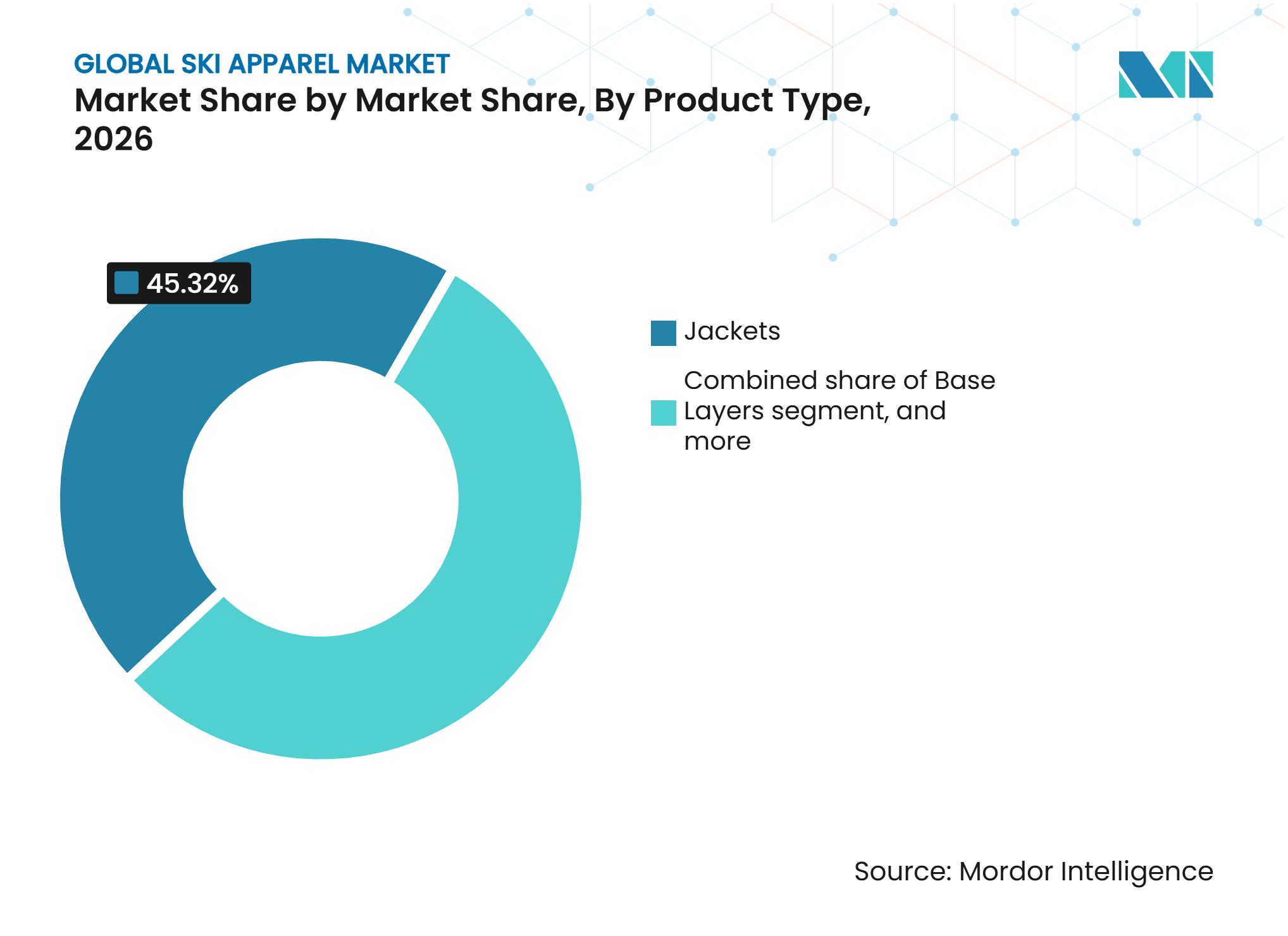
Jackets Remain The Highest Value Purchase While Base Layers Broaden Their UseJackets held 45.32% of the product segment in 2026, making them the leading product type. Consumers place a high value on the waterproofing, insulation, and technical details found in an outer shell. This supports replacement and upgrade buying, particularly among premium shoppers. Pants and bottoms remain important because buyers often purchase them with a new jacket. One-piece suits serve competitive racers, young skiers, and several European resort markets. Accessories offer lower entry prices and frequent replacement needs, which can make them easier for new brands to enter.
Base layers are forecast to grow at a 6.21% CAGR through 2032, the fastest product growth rate in the ski apparel industry. Their appeal is moving beyond thermal performance on the mountain. Brands including Eivy and Rojo have used looser cuts and streetwear-inspired styling for the 2025/26 winter collections. This expands their relevance to travel, daily winter wear, and other outdoor activity. The change can spread demand across more months of the year. It also gives consumers a lower-cost way to enter the ski apparel market before buying a full outerwear set.



By End User:
Women Gain Through Dedicated Product DevelopmentMen held 48.10% of the ski apparel market size in 2026, reflecting established participation patterns in mature destinations. Older male skiers remain important purchasers in premium and luxury price tiers. Their spending supports demand for jackets that can exceed USD 1,000 at retail. Children’s apparel faces a different set of buying conditions. Growth-related replacement needs make purchasing less attractive for some families. Rental use can therefore be higher in this part of the category.
Women are forecast to grow at a 6.35% CAGR through 2032, the highest rate by end-user. Dedicated brands have shown that product fit, style, and technical performance can be addressed together. Halfdays raised USD 10 million in 2025 and announced a European launch with a Zurich headquarters and a GORE-TEX collection in 2026. This model responds to women who want functional clothing without relying on a smaller version of a generalist product. The category also benefits when its garments are useful for travel and daily winter wear.
By Category:
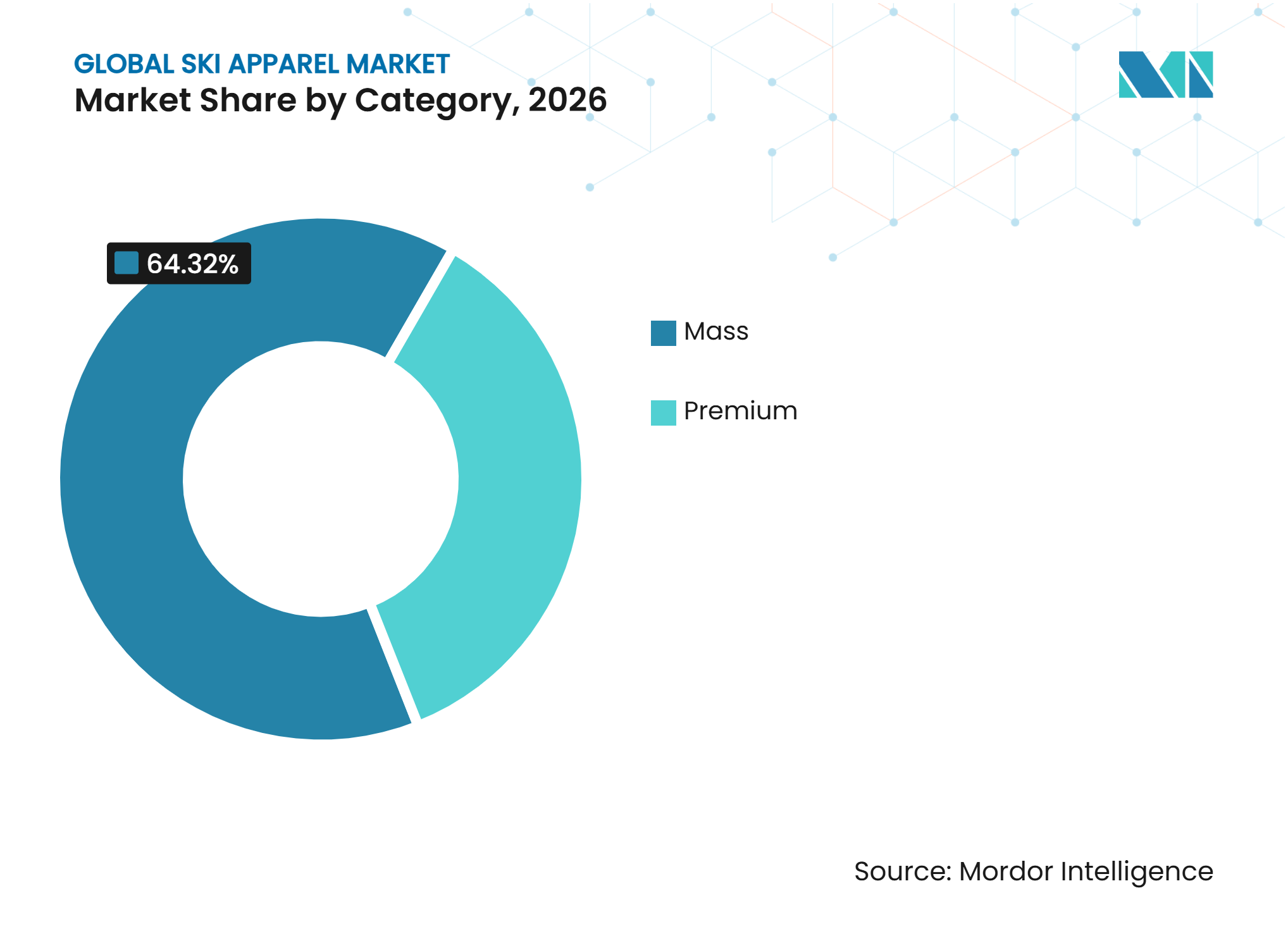
Accessible Volume And Premium Performance Create Different Competitive NeedsMass apparel held 64.32% share in 2026, showing the importance of accessible price points, resort clothing, and replacement purchases. This segment serves the widest group of recreational skiers. It is also exposed to poor snow conditions because consumers can delay a nonessential upgrade. Private-label resort products and fast-fashion-adjacent lines add to the competitive pressure. Brand loyalty is often weaker at this end of the price range.
Premium apparel is forecast to grow at a 6.78% CAGR through 2032. Technical brands compete through membrane performance, insulation, durability, and simpler chemical claims. Luxury-oriented brands compete through design, heritage, and garments that work in urban settings. The two positions can overlap when a product offers credible mountain performance and a strong everyday appearance. The bluesign framework is also relevant because it excludes PFAS-treated articles from approval from January 2026.

By Distribution Channel:
Online Growth Complements Specialist Store ExpertiseOffline retail stores held 75.67% share in 2026. Buyers often want to touch the fabric, assess mobility, and test fit before purchasing technical outerwear. This is particularly important for garments priced above USD 400. Resort stores also benefit from purchases made close to the point of use. Specialist staff can explain layering, waterproofing, and warmth in ways that support conversion. As a result, physical retail is likely to remain structurally important even as online sales increase.
Online retail stores are forecast to grow at a 6.89% CAGR through 2032. Digital channels allow brands to offer a broader range of styles, gather consumer feedback, and launch limited products directly. They are especially useful for brands that have invested in customer data and repeat engagement. Flexible returns and virtual fitting tools can reduce some of the barriers to online purchase. Direct e-commerce also allows a company to decide how products are presented across different countries. The ski apparel market benefits most when online tools support the expertise and service that shoppers still seek in stores.
Geography Analysis
Europe
Europe held 34.20% of the ski apparel market share in 2026, supported by dense Alpine infrastructure and high spending per ski visit. France recorded 56.1 million skier days in the 2025/26 season, ahead of Austria’s 53.7 million and the United States’ 52.6 million [2]. High-frequency visits support replacement and upgrade cycles across both accessible and premium clothing. France’s Law No. 2025-188, effective from January 2026, restricts PFAS-containing ski textiles, adding a material compliance requirement for brands serving the country. Denmark also introduced additional PFAS restrictions in July 2026, which increases the need for supply-chain control. European buyers are also an important audience for garments that move between resort use, travel, and urban winter wear. The region remains a testing ground for products that combine technical function with broader lifestyle relevance.
Asia-Pacific
Asia-Pacific is forecast to expand at a 6.39% CAGR through 2032, the fastest regional rate in the ski apparel market. China’s operating base included 748 ski areas and 66 indoor facilities that met International Ski and Snowboard Federation standards during the 2025/26 period. Indoor skiing can reduce the weather dependency that shapes many outdoor markets. It can also create recurring apparel needs throughout the year. Japan’s ski regions benefited from international travel during the 2024/25 winter period, supporting demand for both equipment and clothing. Growth in South Korea, Australia, and outbound travel from Seoul adds to the regional consumer base. Brands need products that suit newer participants as well as travelers who buy for trips to Japan and New Zealand. Lightweight products for indoor skiing and practical entry-level clothing are relevant openings in this geography.
North America, South America, Middle East And Africa
North America remains an important volume region despite weather variation across the United States. Vermont reached 13.3 million skier visits in the 2025/26 season, its highest level since 2014/15[3]. South America benefits from Chilean and Argentine high-altitude resorts that attract local customers and Northern Hemisphere travelers during the off-season. Growing affluence in Brazil can widen the base of potential buyers for those destinations. The Middle East and Africa segment remains small but is developing through indoor ski facilities and planned mountain leisure infrastructure. Dubai’s indoor ski venue has helped familiarize consumers with technical snow clothing in a climate where outdoor skiing is not available. These mixed geographies give brands an opportunity to balance seasonal demand by serving travel, indoor skiing, and resort activity across different hemispheres.
Competitive Landscape
Market Concentration

The ski apparel market has a fragmented competitive structure. The North Face, Arc'teryx, Columbia, Patagonia, Helly Hansen, and Decathlon cover different price points and geographic markets. Bogner, KJUS, Rossignol, and Fusalp have stronger positions in premium and luxury ski clothing. Competitive success increasingly depends on direct sales, material transition, and products that work outside the core winter season. Companies that lack a clear position in at least 2 of these areas risk weaker retail visibility. Scale remains helpful, but it does not guarantee relevance with consumers who want a focused product proposition.
The North Face announced an 8-year partnership with United States Ski and Snowboard in May 2026 as Official Performance Apparel Partner for all 11 disciplines through 2034. The company launched a 55-piece United States Ski and Snowboard collection in November 2026, linking competition outerwear with consumer lifestyle products. Rossignol has added a rental connection through Lizee, which lets the company reach low-frequency participants. These actions show different ways to strengthen credibility, customer access, and repeat contact.
Smaller brands are changing how ski clothing brands build awareness. Halfdays uses a women-focused, direct model and has expanded into Europe with a technical GORE-TEX collection. Picture Organic Clothing uses certified sustainable materials to appeal to environmentally conscious buyers. White-space opportunities remain in women’s entry-level technical clothing for first-time Asia-Pacific skiers. Indoor-ski garments may also need lighter and more flexible product formats than outdoor resort clothing. Rental-integrated collections can build familiarity among consumers who are not yet ready to buy. The competitive field therefore favors a clear audience, a credible product claim, and a path to stay visible after the first trip.
Ski Apparel Industry Leaders
-
Columbia Sportswear Company
-
Patagonia, Inc.
-
Burton Snowboards, Inc.
-
Helly Hansen AS
-
VF Corporation
- *Disclaimer: Major Players sorted in no particular order
Ski Apparel Market Companies Covered in this Report
- VF Corporation
- Columbia Sportswear Company
- Patagonia, Inc.
- Burton Snowboards, Inc.
- Helly Hansen AS
- Decathlon S.A.
- Amer Sports Corporation
- Arc'teryx Equipment Inc.
- Spyder Active Sports, Inc.
- Rossignol Group SAS
- Moncler S.p.A.
- Bogner
- KJUS AG
- Descente Ltd.
- GOLDWIN INC.
- Phenix Co., Ltd.
- Mammut Sports Group AG
- Peak Performance AB
- Picture Organic Clothing SAS
- Fusalp SAS
- Lafuma S.A.S.
- Schöffel Sportbekleidung GmbH
Recent Industry Developments in Ski Apparel Market
- November 2026: The North Face launched its United States Ski & Snowboard partnership collection, with 55 pieces spanning competition outerwear to lifestyle apparel. The launch follows the brand's 8-year appointment as Official Performance Apparel Partner of United States Ski & Snowboard.
- November 2026: Atomic introduced its 2026/27 ski apparel collection, featuring Revent 3L Jackets and Bib Pants with three-layer weatherproof construction, ventilation zones and articulated designs, strengthening its technical outerwear portfolio.
- October 2026: KJUS launched its Fall/Winter 2026/27 ski collection, incorporating premium technical shells, insulated jackets and graphene-lined apparel, with an expanded junior range targeting performance, thermal comfort and functional versatility.
- July 2026: Oakley introduced its FW26 Snow Apparel Collection, featuring insulated jackets, GORE-TEX outerwear and technical ski pants, combining weather protection and performance functionality with contemporary lifestyle-inspired designs.
Global Ski Apparel Market Report Scope
Ski apparel refers to specialized clothing designed to provide thermal insulation, weather protection, moisture management, comfort, and mobility during skiing and other snow-based activities. These products are manufactured using technical fabrics and materials that offer water resistance, windproofing, breathability, and insulation to withstand cold weather conditions. The Ski Apparel Market is segmented by product type, end-user, category, distribution channel, and geography. Based on product type, the market is segmented into jackets, pants and bottoms, one-piece suits, base layers, and accessories. Based on end-user, the market is segmented into men, women, and children/kids. Based on category, the market is segmented into mass and premium. Based on distribution channel, the market is segmented into offline retail stores and online retail stores. Based on geography, the market is segmented into North America, Europe, Asia-Pacific, South America, Middle East, and Africa. For each segment, the market sizing and forecasts are provided in terms of value (USD).
Segmentation Overview
| Jackets |
| Pants and Bottoms |
| One-Piece Suits |
| Base Layers |
| Accessories |
| Men |
| Women |
| Children/Kids |
| Mass |
| Premium |
| Offline Retail Stores |
| Online Retail Stores |
| North America | United States |
| Canada | |
| Mexico | |
| Rest of North America | |
| Europe | Germany |
| United Kingdom | |
| France | |
| Italy | |
| Spain | |
| Switzerland | |
| Netherlands | |
| Rest of Europe | |
| Asia-Pacific | China |
| Japan | |
| India | |
| South Korea | |
| Australia | |
| Rest of Asia-Pacific | |
| South America | Brazil |
| Argentina | |
| Chile | |
| Rest of South America | |
| Middle East and Africa | Saudi Arabia |
| South Africa | |
| Turkey | |
| Rest of Middle East and Africa |
| By Product Type | Jackets | |
| Pants and Bottoms | ||
| One-Piece Suits | ||
| Base Layers | ||
| Accessories | ||
| By End-user | Men | |
| Women | ||
| Children/Kids | ||
| By Category | Mass | |
| Premium | ||
| By Distribution Channel | Offline Retail Stores | |
| Online Retail Stores | ||
| By Geography | North America | United States |
| Canada | ||
| Mexico | ||
| Rest of North America | ||
| Europe | Germany | |
| United Kingdom | ||
| France | ||
| Italy | ||
| Spain | ||
| Switzerland | ||
| Netherlands | ||
| Rest of Europe | ||
| Asia-Pacific | China | |
| Japan | ||
| India | ||
| South Korea | ||
| Australia | ||
| Rest of Asia-Pacific | ||
| South America | Brazil | |
| Argentina | ||
| Chile | ||
| Rest of South America | ||
| Middle East and Africa | Saudi Arabia | |
| South Africa | ||
| Turkey | ||
| Rest of Middle East and Africa | ||
Key Questions Answered in the Report
What is the projected value of ski apparel sales by 2032?
The Ski Apparel Market is projected to reach USD 6.57 billion by 2032, growing at a 5.03% CAGR from 2027.A
Which ski clothing product category leads sales?
Jackets lead product sales with a 45.32% share in 2026 because buyers value weather protection, insulation, and technical features.
Which customer group is growing fastest in ski clothing?
Women’s apparel is projected to grow at a 6.35% CAGR through 2032, supported by dedicated product development and direct-to-consumer brands.
Why are premium ski garments gaining demand?
Premium apparel is expected to grow at a 6.78% CAGR through 2032 as consumers seek stronger performance, PFAS-free materials, and garments useful beyond ski trips.