
Shearography Inspection Systems Market Size and Share
Market Overview
| Study Period | 2020 - 2031 |
|---|---|
| Market Size (2026) | USD 111.62 Million |
| Market Size (2031) | USD 171.63 Million |
| Growth Rate (2026 - 2031) | 8.99 % |
| Fastest Growing Market | Asia-Pacific |
| Largest Market | North America |
| Market Concentration | Medium |
Major Players *Disclaimer: Major Players sorted in no particular order Image © Mordor Intelligence. Reuse requires attribution under CC BY 4.0. | |
Shearography Inspection Systems Market Analysis by Mordor Intelligence
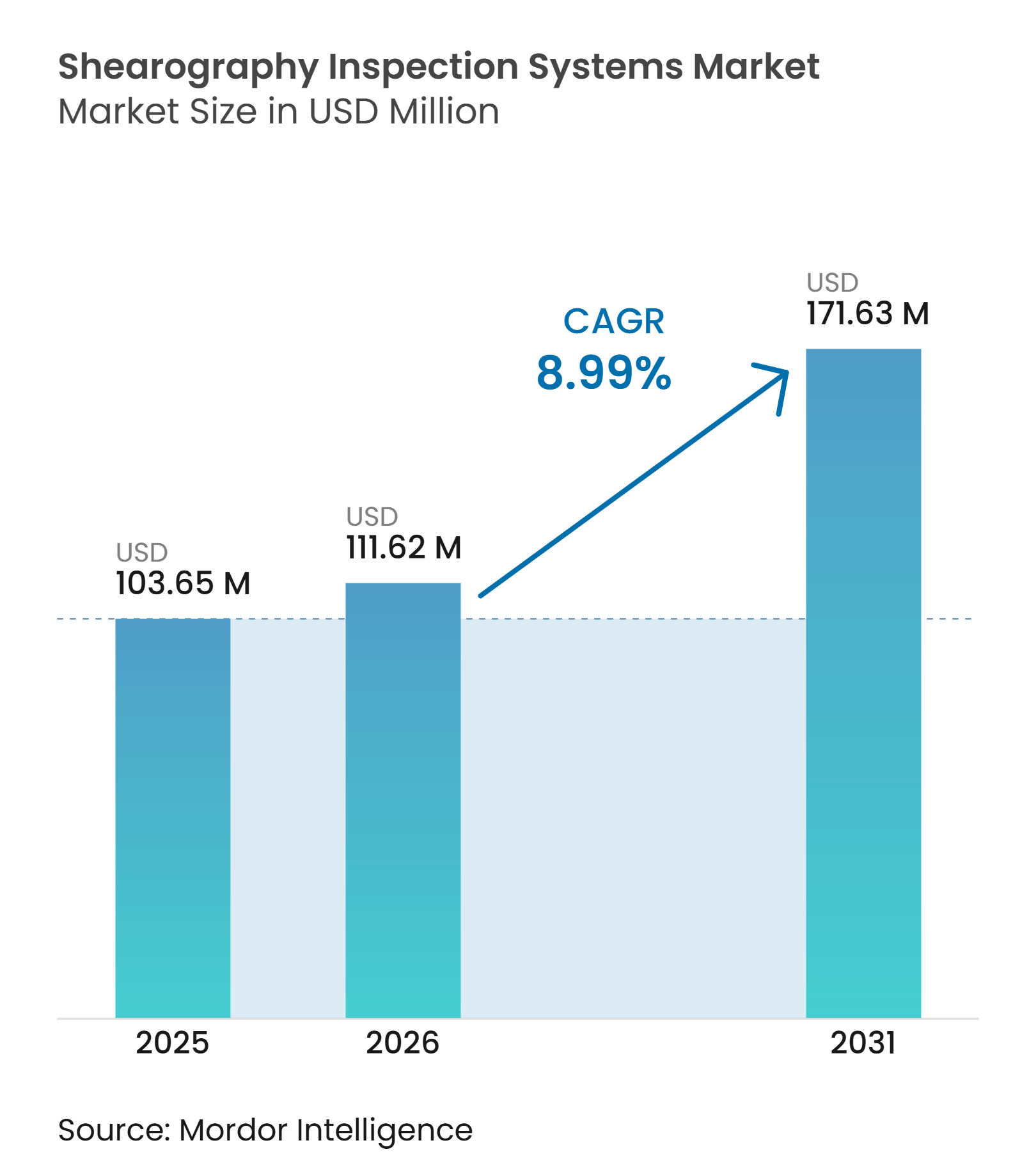
The shearography inspection systems market size was valued at USD 103.65 million in 2025 and USD 111.62 million in 2025, and is projected to reach USD 171.63 million by 2031, registering a CAGR of 8.99% during 2026-2031. The shearography inspection systems market serves aerospace, wind energy, tire production, and aviation maintenance through non-destructive inspection of composite structures. The method identifies subsurface defects by measuring surface deformation under controlled loading. Its full-field coverage supports faster inspection of large composite parts than point-by-point ultrasonic scanning in many production settings. ASTM E2657 and ISO 12718 qualification requirements place shearography in aerospace quality plans and support recurring system replacement needs. Composite-intensive aircraft programs, renewable energy assets, and automated tire retreading operations also support demand.
Key Report Takeaways
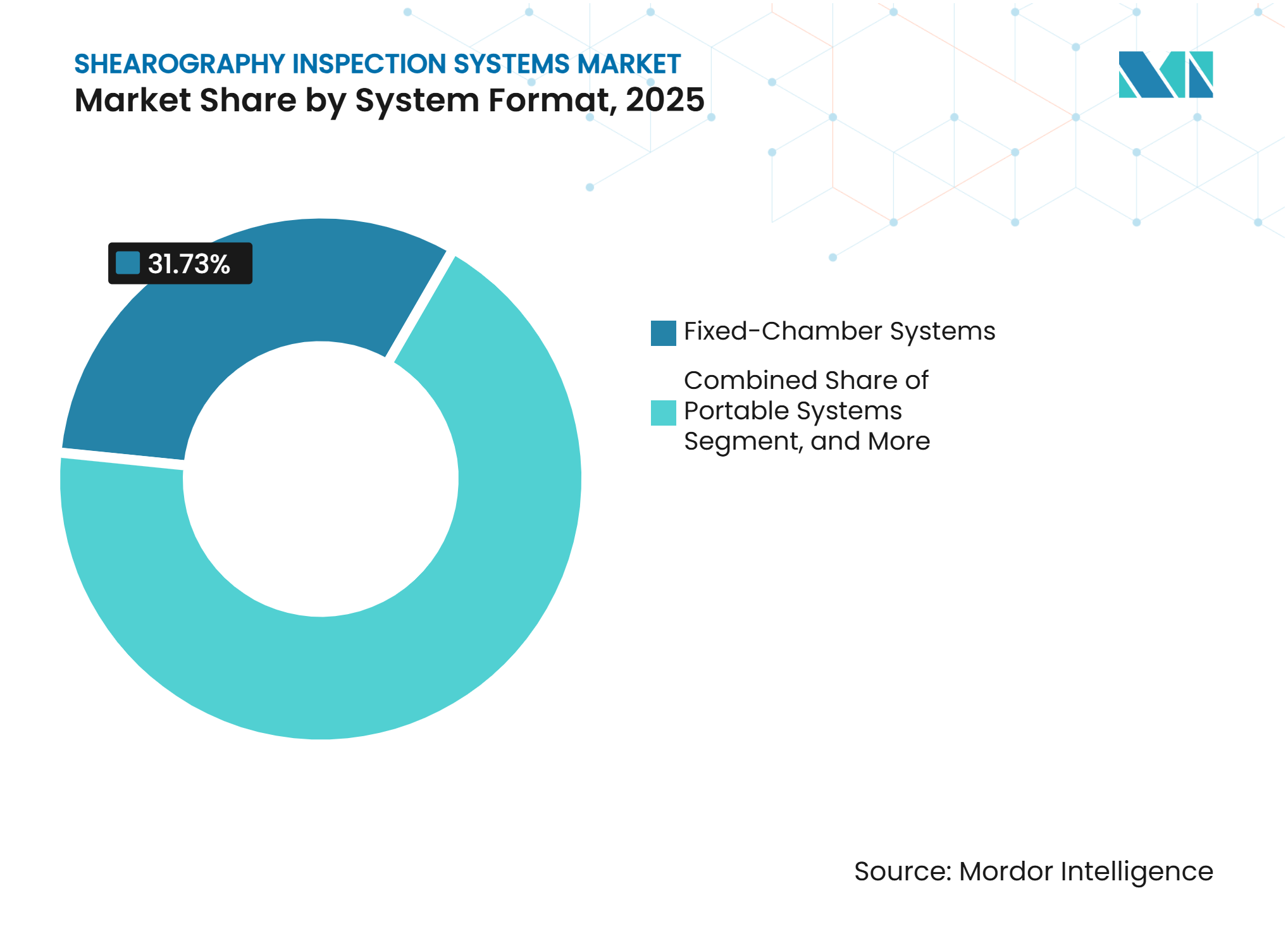
- By system format, fixed-chamber systems held 31.73% of the shearography inspection systems market share in 2025, while robot-mounted systems are projected to expand at a 10.09% CAGR through 2031.
- By loading or excitation method, vacuum excitation held 43.87% share in 2025, while thermal loading is expected to expand at a 9.98% CAGR through 2031.
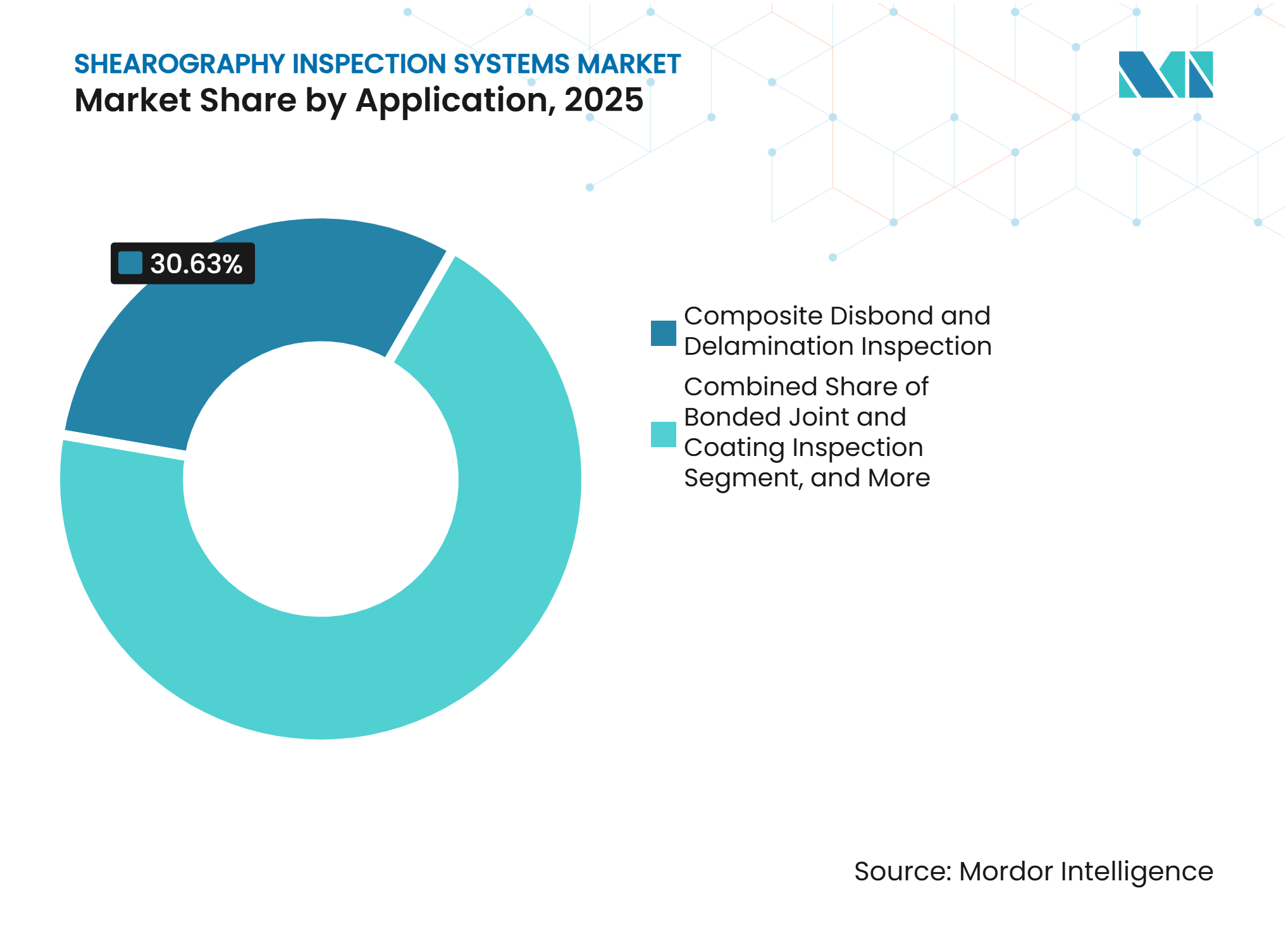
- By application, composite disbond and delamination inspection accounted for 30.63% share in 2025, while impact-damage and repair inspection is projected to expand at a 10.37% CAGR through 2031.
- By end-user industry, aerospace and defense held 38.47% share in 2025, while energy and power is projected to expand at a 10.51% CAGR through 2031.
- By geography, North America held 32.73% share in 2025, while Asia-Pacific is projected to expand at a 9.96% CAGR through 2031.
Note: Market size and forecast figures in this report are generated using Mordor Intelligence’s proprietary estimation framework, updated with the latest available data and insights as of January 2026.
Market Trends and Insights
Drivers Impact Analysis of Shearography Inspection Systems Market*
| Driver | (~) % Impact on CAGR Forecast | Geographic Relevance | Impact Timeline |
|---|---|---|---|
| Expansion of Composite Structures in Safety-Critical Platforms | +2.3% | Global, with concentration in North America and Europe | Long term (≥ 4 years) |
| Faster Full-Field Inspection for High-Rate Production | +1.7% | North America and Europe, with growing Asia-Pacific contribution | Medium term (2-4 years) |
| Rising In-Service Inspection of Wind Turbine Blades | +1.4% | Asia-Pacific, Europe, and North America | Long term (≥ 4 years) |
| Growth of Tire Quality Control and Retreading Automation | +1.1% | Europe and Asia-Pacific, with North America as a secondary market | Medium term (2-4 years) |
| Digital Phase-Shifting and Edge Analytics Adoption | +0.9% | Global, with early gains in Germany, the United States, and China | Short term (≤ 2 years) |
| Qualification for Kissing-Bond and Core-Defect Detection | +0.7% | North America and Europe, followed by global adoption | Medium term (2-4 years) |
| Source: Mordor Intelligence | |||
Expansion of Composite Structures in Safety-Critical Platforms
Aerospace, defense, and advanced air mobility programs are increasing their use of carbon fiber-reinforced polymer structures. Aerospace and defense accounted for 60.8% of global CFRP revenue in 2025, while the segment recorded 13.6% volume expansion that year. The Boeing 787 and Airbus A350 each use composites for more than 50% of structural weight. These structures require full-field inspection to support production rates that can exceed the capacity of sequential ultrasonic scanning. Airbus plans to reach 75 narrowbody aircraft per month, while Boeing is restoring 737 MAX output to 42 aircraft per month. ASTM E2533 and ASTM E2581 link shearography to aerospace process specifications and support recurring procurement by established users.
Faster Full-Field Inspection for High-Rate Production
Aircraft composite production requires inspection methods that keep pace with automated manufacturing. Shearography provides large-area phase maps in near real time and can reduce the delay associated with sequential C-scan inspection. ECNDT 2026 research showed that spatial phase-shifting shearography can achieve video-rate measurements under industrial conditions. This capability supports inspection between automated layup and curing stages. Early defect feedback can prevent downstream assembly costs from defective parts. US Patent 12360057, granted in July 2025, describes a laser shearography end effector that can be exchanged with repair tools on an industrial robot.
Rising In-Service Inspection of Wind Turbine Blades
Global wind capacity additions reached 169,014 MW in 2025, bringing cumulative capacity to 1,346,866 MW.[1] The World Wind Energy Association expects cumulative capacity to exceed 1,500,000 MW in 2026. Wind turbine blades commonly measure 60-100 meters and have design lives of 20-25 years. Blade-related failures accounted for 18% of turbine downtime in a 2026 review, underscoring the need for regular structural inspections. Shearography can identify delamination, disbond, and impact damage across large composite blade sections without contact. China added 130,258 MW of wind capacity in 2025, creating a future need for scalable inspection systems as those assets enter routine service cycles.
Growth of Tire Quality Control and Retreading Automation
Shearography is used for full inspection of retreaded truck and aircraft tires because it can identify casing disbonds, belt-edge separation, and internal voids. A 2025 scientific study described machine-learning support for shearographic tire inspection. Michelin North America launched TreadVision in March 2026 to classify Casing Integrity Analysis results in real time. The platform brings automated classification into retreading quality-control workflows. AI-assisted interpretation may also improve the economic case for full inspection in new-tire production. ITALMATIC S.p.A. and MESNAC Co., Ltd. provide tire testing equipment with cycle times as short as 60 seconds per tire, allowing use on high-capacity lines.
Restraints Impact Analysis of Shearography Inspection Systems Market*
| Restraint | (~) % Impact on CAGR Forecast | Geographic Relevance | Impact Timeline |
|---|---|---|---|
| Dependence on Defect-Inducing Load Conditions | -1.8% | Global | Long term (≥ 4 years) |
| Limited Suitability for Thick or Mechanically Insensitive Structures | -1.3% | Global, with greater exposure in heavy industry and energy | Long term (≥ 4 years) |
| Skilled Operator and Procedure Qualification Requirements | -1.0% | Global, with greater exposure in Asia-Pacific and Middle East and Africa | Medium term (2-4 years) |
| Surface Reflectivity and Environmental Stability Constraints | -0.7% | Global, with higher exposure in field inspection | Short term (≤ 2 years) |
| Source: Mordor Intelligence | |||
Dependence on Defect-Inducing Load Conditions
Shearography relies on vacuum, thermal, vibrational, or mechanical loading to generate a measurable deformation pattern. A defect can remain undetected when its geometry, depth, or material stiffness does not create sufficient differential strain. Kissing bonds are difficult because the surfaces are in contact, but may lack adhesive strength. ASTM E2657 recognizes the application, although field reproducibility remains subject to standardization work. A 2025 study found that fiber noise during thermal loading can reduce reliability for sub-millimeter composite defects and require multi-frame processing. Users with varied structures often combine shearography with ultrasonic or thermographic methods, thereby increasing inspection system costs.
Limited Suitability for Thick or Mechanically Insensitive Structures
The shearography inspection systems market faces limitations with thick or structurally stiff components because surface deformation weakens as defect depth increases. Heavy-gauge metals, thick-walled pressure vessels, and reinforced concrete can produce signals below practical detection thresholds. This constraint excludes the method from the wider non-destructive testing opportunity. Hybrid composite-metal aircraft structures and offshore wind components may not provide an accessible inspection area in line with their total composite volume. Fraunhofer and TU Dresden reported that combined active thermography and digital shearography improved detection probability by up to 20% for complex CFRP structures. The added sensors also raise integration needs and can increase the cost of a complete inspection system.
*Our forecasts treat driver/restraint impacts as directional, not additive. The impact forecasts reflect baseline growth, mix effects, and variable interactions.
Shearography Inspection Systems Market Segment Analysis
By System Format:
Fixed-Chamber Systems Lead While Robotics ExpandsFixed-chamber systems held 31.73% of the shearography inspection systems market share in 2025. Their lead reflects longstanding use in aircraft component facilities, where controlled vacuum conditions support repeatable phase-map capture across large panels. The LTI-9000 vacuum chamber has been used to non-destructively test composite components for NASA's Gateway Power and Propulsion Element. Fixed systems suit production environments that prioritize consistent inspection conditions. Portable units continue to see demand in aviation maintenance and field inspection. Benchtop configurations serve smaller facilities and research settings.
Robot-mounted systems are projected to expand at a 10.09% CAGR through 2031 within the shearography inspection systems market. The format supports automated inspection in aerospace composites and wind-blade fabrication, where work was previously completed manually or with portable systems. US Patent 12360057 describes a robot-mounted laser shearography tool that can be exchanged with repair equipment. Gantry-mounted and in-line systems are used on continuous manufacturing lines with automated part movement. Dantec Dynamics designed its FlawExplorer sensor for robotic-arm integration with programmable logic controller interfaces. These configurations place inspection within the manufacturing sequence rather than after batch completion.



By Loading Method:
Vacuum Leads While Thermal Loading AdvancesVacuum excitation held 43.87% of the shearography inspection systems market share in 2025. It is established in aircraft composite inspection because a partial vacuum can create repeatable deformation in thin laminates and honeycomb panels. Vacuum systems are compatible with controlled production and maintenance workflows. Dantec Dynamics markets FlawHunter as a portable vacuum-loaded system with an integrated pump and an option for thermal excitation. This design supports single-operator aviation maintenance use. The method remains important where consistent loading is required for acceptance inspection.
Thermal loading is projected to expand at a 9.98% CAGR through 2031. It supports inspection of large, curved structures, including wind turbine blades and fuselage panels, where uniform vacuum or mechanical loading can be difficult to achieve. A 2025 Applied Optics study reported a single-frame analysis time of 0.36 seconds and 97% detection accuracy for internal defects at least 2 mm in diameter. Vibration loading remains relevant for dynamic mode-shape measurement and strain analysis. Electromagnetic loading targets metallic bonds and welds, including resistance spot weld monitoring. Mechanical loading is used mainly in laboratory and calibration environments.
By Application:
Disbond Detection Leads While Repair Inspection Gains MomentumComposite disbond and delamination inspection accounted for 30.63% of the shearography inspection systems market size in 2025. The application is central to the acceptance inspection of primary aerostructures. ASTM E2581 specifies shearography procedures for polymer matrix composites, sandwich core materials, and filament-wound pressure vessels used in aerospace applications. Honeycomb and sandwich-structure inspection can use much of the same fixed-chamber and vacuum-loading infrastructure. Bonded-joint and coating inspection similarly benefits from that installed base. This limits the need for separate capital equipment when users add inspection tasks.
Impact-damage and repair inspection is projected to expand at a 10.37% CAGR through 2031. Commercial aviation maintenance requires documentation of the damage boundary and the completed repair before the aircraft is returned to service. SAE AIR7491 provides training guidance for reliable inspection of solid laminate composite structures. Each repair can require inspection before and after work, which supports demand beyond new aircraft production. Tire and retread inspection is a mature application in Europe and the Asia-Pacific. Strain, deformation, and vibration measurement remain relevant to structural testing and finite-element model validation.

By End-User Industry:
Aerospace and Defense Leads While Energy and Power Sets the PaceAerospace and defense held 38.47% of the shearography inspection systems market share in 2025. The sector requires full-field composite inspection for primary structures during manufacturing and in-service maintenance. Program quality plans create procurement demand that is less discretionary than general capital spending. Aviation maintenance, repair, and overhaul has distinct demand drivers, including repair events, fleet age, and aircraft utilization. This provides support during periods when aircraft production rates are lower. Automotive and transportation users apply shearography to new-tire quality control and composite body-panel inspection.
Energy and power are projected to expand at a 10.51% CAGR through 2031. The 169,014 MW of wind capacity installed in 2025 increases the future base of blades that require structural inspection. SAE research published in January 2026 examined defect-depth characterization through thermally and pneumatically induced shearography for automotive components. Tire retreading, marine and shipbuilding, and industrial manufacturing are smaller established user groups. Marine composite hull inspection remains under development because thick-walled glass-reinforced plastic hulls can exceed practical depth sensitivity. Some shipyards, therefore, do not qualify the method for those applications.
Geography Analysis
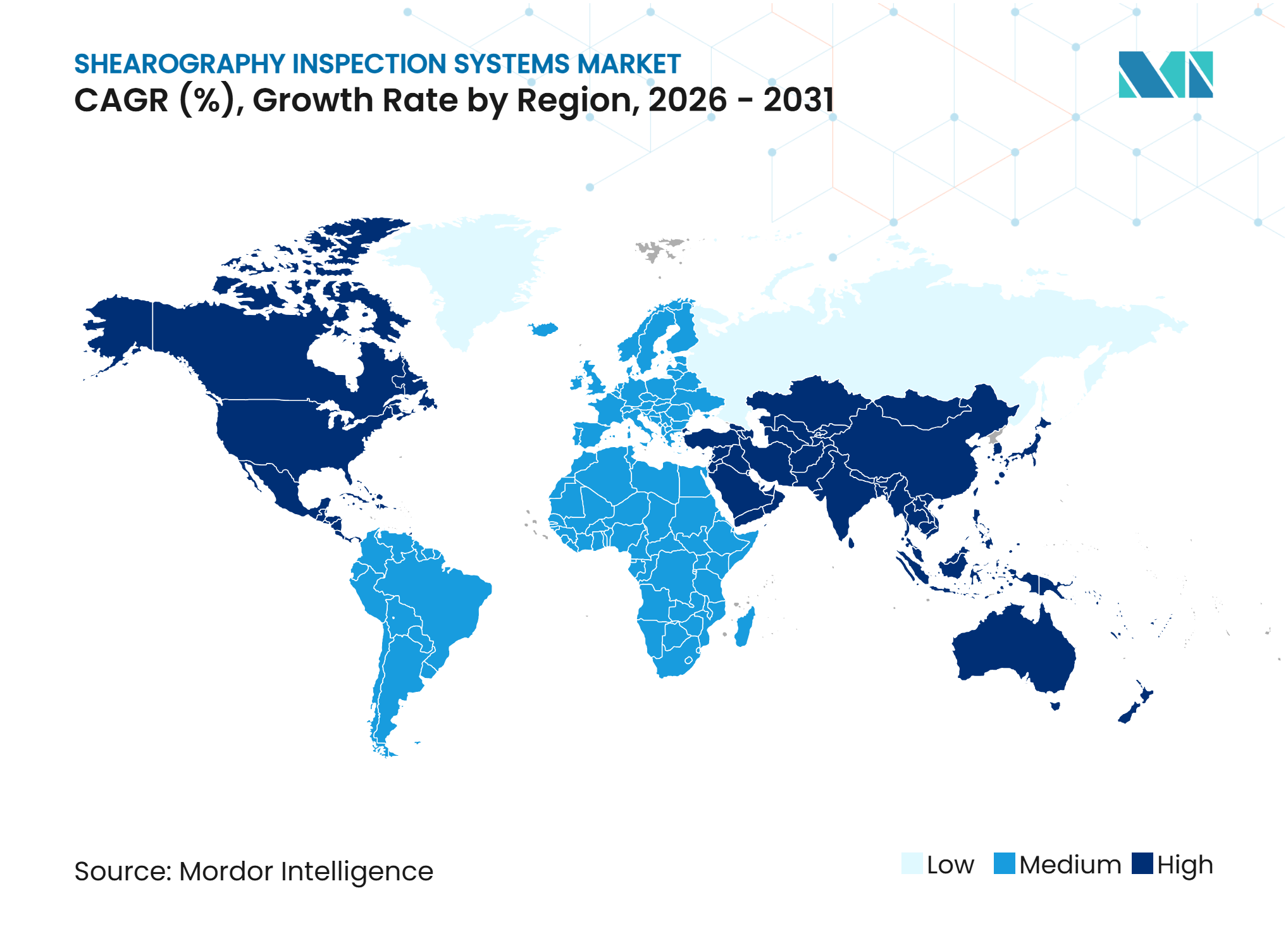
North America held 32.73% of the shearography inspection systems market share in 2025. US aerospace supply chains support equipment purchases for composite-intensive programs, including the Boeing 787 and Lockheed Martin F-35. These programs create structured demand for fixed-chamber and gantry-mounted systems among supplier tiers. FAA Advisory Circular AC 120-93B supports portable-system demand for composite repair inspection within aviation maintenance facilities. Hexcel announced a USD 320 million expansion at its Salt Lake City CFRP facility in February 2025. The investment supports Boeing 787 MAX 10, Airbus A320neo XLR, and commercial space programs.
Canada contributes through aerospace maintenance clusters in Montreal and Toronto. Mexico is gaining relevance as composite component assembly moves to lower-cost locations within North American supply chains. Europe has specialist manufacturers including Dantec Dynamics A/S, isi-sys GmbH, and Steinbichler Optotechnik GmbH. Airbus sites in Hamburg, Toulouse, and Bremen maintain fixed and robotic systems for primary-structure certification of the A350 and A220. Germany, Denmark, France, and Spain have wind fleets that require in-service blade inspection. EASA Part-145 requirements and EN 4179 certification favor traceable systems operated by qualified personnel.[2]
Asia-Pacific is projected to expand at a 9.96% CAGR through 2031. China installed 130,258 MW in 2025, representing 77% of global wind additions and creating a future inspection requirement as the fleet enters regular service. India has more than 325 suppliers providing parts and services to Boeing, supporting future composite component inspection needs. South Korea and Japan add demand through automotive composites and established aviation maintenance operations. Brazil's Embraer supply chain supports South America. Saudi Arabia's aviation maintenance investment represents the clearest near-term opportunity in the Middle East and Africa, while other regional markets remain in their early stages.
Competitive Landscape
Market Concentration
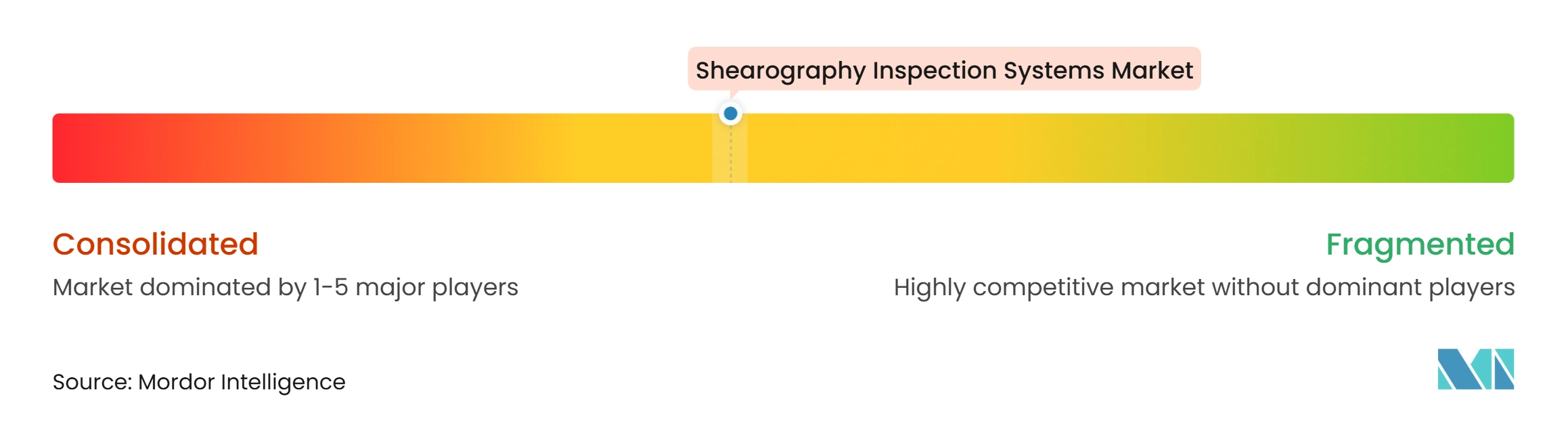
The shearography inspection systems market is moderately concentrated in hardware, with specialist manufacturers accounting for most of the market revenue. Laser Technology, Inc., Dantec Dynamics A/S, isi-sys GmbH, ITALMATIC S.p.A., and Steinbichler Optotechnik GmbH are key specialists. Their offerings address aerospace composites, tire inspection, research metrology, and related applications. Competition centers on inspection performance and fit with specific operating environments. Software capabilities have become an important point of differentiation. Vendors are adding AI-assisted defect classification, automated phase unwrapping, and robotic path programming to their systems.
TENTA VISION GmbH presented a spatial phase-shifting system with AI-based inline measurement at ECNDT 2026. The example shows how laboratory methods are moving into commercial hardware and software packages. Dantec Dynamics designed FlawExplorer for automation with robotic arms and programmable logic controllers. Michelin introduced TreadVision in March 2026, featuring automated classification of shearography results for tire retreading. These moves focus on faster interpretation and integration with existing production workflows. The shearography inspection systems industry also depends on qualified users because the inspection result must be traceable and repeatable.
ESAB completed its acquisition of Eddyfi Technologies in June 2026, expanding its inspection and monitoring portfolio.[3] The transaction brings advanced instrumentation, sensing, robotics, and monitoring capabilities into a larger industrial platform. Hexagon announced an agreement in April 2026 to acquire Waygate Technologies from Baker Hughes, subject to regulatory approvals. These transactions can expand distribution reach across adjacent inspection methods. Field inspection of offshore wind foundations, composite ship hulls, and civil infrastructure remains less developed. No supplier has established a fully automated, production-ready shearography system for those locations without precision positioning infrastructure.
Shearography Inspection Systems Industry Leaders
-
Laser Technology, Inc.
-
Dantec Dynamics A/S
-
ITALMATIC S.p.A.
-
isi-sys GmbH
-
Carl Zeiss AG
- *Disclaimer: Major Players sorted in no particular order
Shearography Inspection Systems Market Companies Covered in this Report
- Laser Technology, Inc.
- Dantec Dynamics A/S
- isi-sys GmbH
- Steinbichler Optotechnik GmbH
- ITALMATIC S.p.A.
- SDS Systemtechnik GmbH
- MESNAC Co., Ltd.
- image HoloLab
- TENTA VISION GmbH
- DEKRA SE
- Smithers Group Inc.
- Sonatest Ltd.
- Optonor AS
- JenaWave GmbH
- OptoMet GmbH
- Eddyfi Technologies
- Waygate Technologies GmbH
- TÜV SÜD AG
- Applus+
- Bureau Veritas SA
Recent Industry Developments in Shearography Inspection Systems Market
- June 2026: ESAB Corporation completed its acquisition of Eddyfi Technologies, a global provider of advanced NDT instrumentation, sensing, robotics, and monitoring technologies headquartered in Québec, Canada. The deal brought Eddyfi's more than 1,000 employees and customer base across more than 110 countries into ESAB's portfolio, extending its strategy from fabrication into inspection and monitoring across aerospace, defense, nuclear power, and oil and gas.
- April 2026: Hexagon AB signed a definitive agreement to acquire Waygate Technologies GmbH from Baker Hughes for USD 1.45 billion in cash. The transaction is expected to close in the second half of 2026, subject to regulatory approvals. Waygate generated USD 630 million in revenue in FY2025 across radiography, remote visual inspection, and ultrasonic testing platforms serving aerospace, automotive, and energy sectors globally.
- March 2026: Michelin North America launched TreadVision by Michelin Retread Technologies at the Technology and Maintenance Council Annual Meeting in Greenville, South Carolina. The platform integrates Vision AI automated classification of Casing Integrity Analysis, shearography, results in real time, representing the first documented large-scale commercial deployment of generative AI for production shearography quality control in tire retreading.
- February 2026: ESAB Corporation announced its definitive agreement to acquire Eddyfi Technologies for USD 1.45 billion, citing Eddyfi's expected USD 270 million in revenue and USD 80 million in adjusted EBITDA for 2026, with USD 100 million achievable including annualized run-rate synergies. The transaction closed in June 2026.
Global Shearography Inspection Systems Market Report Scope
The Shearography Inspection Systems Market comprises the global market for inspection systems that use shearography, an optical interferometric, non-destructive testing (NDT) technique, to detect and characterize surface or subsurface defects, strain concentrations, deformation, and structural anomalies in components and materials. These systems typically measure changes in an object’s surface deformation under an applied load, enabling the identification of defects such as disbonds, delaminations, impact damage, debonding, and other structural discontinuities.
The Shearography Inspection Systems Market Report is Segmented by System Format (Portable Systems, Benchtop Systems, Fixed-Chamber Systems, Gantry-Mounted Systems, Robot-Mounted Systems, and In-Line Integrated Systems), Loading Method (Vacuum Loading, Thermal Loading, Vibration / Dynamic Loading, Mechanical Loading, and Electromagnetic Loading), Application (Composite Disbond and Delamination Inspection, Honeycomb and Sandwich-Structure Inspection, Bonded Joint and Coating Inspection, Impact-Damage and Repair Inspection, Tire and Retread Inspection, Strain, Deformation, and Vibration Measurement, and Other Applications), End-User Industry (Aerospace and Defense, Aviation MRO, Tire and Retreading, Energy and Power, Automotive and Transportation, Marine and Shipbuilding, Industrial Manufacturing, and Other End-User Industries), and Geography (North America, South America, Europe, Asia-Pacific, and Middle East and Africa). The Market Forecasts are Provided in Terms of Value (USD).
Segmentation Overview
| Portable Systems |
| Benchtop Systems |
| Fixed-Chamber Systems |
| Gantry-Mounted Systems |
| Robot-Mounted Systems |
| In-Line Integrated Systems |
| Vacuum Loading |
| Thermal Loading |
| Vibration / Dynamic Loading |
| Mechanical Loading |
| Electromagnetic Loading |
| Composite Disbond and Delamination Inspection |
| Honeycomb and Sandwich-Structure Inspection |
| Bonded Joint and Coating Inspection |
| Impact-Damage and Repair Inspection |
| Tire and Retread Inspection |
| Strain, Deformation, and Vibration Measurement |
| Other Applications |
| Aerospace and Defense |
| Aviation MRO |
| Tire and Retreading |
| Energy and Power |
| Automotive and Transportation |
| Marine and Shipbuilding |
| Industrial Manufacturing |
| Other End-User Industries |
| North America | United States | |
| Canada | ||
| Mexico | ||
| South America | Brazil | |
| Argentina | ||
| Rest of South America | ||
| Europe | Germany | |
| United Kingdom | ||
| France | ||
| Italy | ||
| Spain | ||
| Rest of Europe | ||
| Asia-Pacific | China | |
| Japan | ||
| India | ||
| South Korea | ||
| ASEAN | ||
| Rest of Asia-Pacific | ||
| Middle East and Africa | Middle East | Saudi Arabia |
| United Arab Emirates | ||
| Turkey | ||
| Rest of the Middle East | ||
| Africa | South Africa | |
| Nigeria | ||
| Rest of Africa | ||
| By System Format | Portable Systems | ||
| Benchtop Systems | |||
| Fixed-Chamber Systems | |||
| Gantry-Mounted Systems | |||
| Robot-Mounted Systems | |||
| In-Line Integrated Systems | |||
| By Loading or Excitation Method | Vacuum Loading | ||
| Thermal Loading | |||
| Vibration / Dynamic Loading | |||
| Mechanical Loading | |||
| Electromagnetic Loading | |||
| By Application | Composite Disbond and Delamination Inspection | ||
| Honeycomb and Sandwich-Structure Inspection | |||
| Bonded Joint and Coating Inspection | |||
| Impact-Damage and Repair Inspection | |||
| Tire and Retread Inspection | |||
| Strain, Deformation, and Vibration Measurement | |||
| Other Applications | |||
| By End-User Industry | Aerospace and Defense | ||
| Aviation MRO | |||
| Tire and Retreading | |||
| Energy and Power | |||
| Automotive and Transportation | |||
| Marine and Shipbuilding | |||
| Industrial Manufacturing | |||
| Other End-User Industries | |||
| By Geography | North America | United States | |
| Canada | |||
| Mexico | |||
| South America | Brazil | ||
| Argentina | |||
| Rest of South America | |||
| Europe | Germany | ||
| United Kingdom | |||
| France | |||
| Italy | |||
| Spain | |||
| Rest of Europe | |||
| Asia-Pacific | China | ||
| Japan | |||
| India | |||
| South Korea | |||
| ASEAN | |||
| Rest of Asia-Pacific | |||
| Middle East and Africa | Middle East | Saudi Arabia | |
| United Arab Emirates | |||
| Turkey | |||
| Rest of the Middle East | |||
| Africa | South Africa | ||
| Nigeria | |||
| Rest of Africa | |||
Key Questions Answered in the Report
What is the shearography inspection systems market size?
The shearography inspection systems market was valued at USD 103.65 million in 2025 and is projected to reach USD 171.63 million by 2031, with an 8.99% CAGR during 2026-2031.
What is driving demand for shearography inspection systems?
Demand is supported by composite aircraft structures, wind turbine blade inspection, high-rate production needs, and automated tire retreading.
Which system format has the largest share?
Fixed-chamber systems held the largest share at 31.73% in 2025 because they support repeatable inspection in controlled aerospace production environments.
Which loading method is expanding the fastest?
Thermal loading is projected to expand at a 9.98% CAGR through 2031 because it suits large curved composite surfaces.
Which end-user sector is projected to expand the fastest?
Energy and power is projected to expand at a 10.51% CAGR through 2031, supported by the increasing installed base of wind turbine blades.
Which region leads demand for shearography systems?
North America held 32.73% share in 2025, while Asia-Pacific is projected to expand at a 9.96% CAGR through 2031.