
Semolina Market Size and Share
Market Overview
| Study Period | 2027 - 2032 |
|---|---|
| Market Size (2027) | USD 2.89 Billion |
| Market Size (2032) | USD 3.27 Billion |
| Growth Rate (2027 - 2032) | 2.50 % |
| Fastest Growing Market | Asia-Pacific |
| Largest Market | North America |
| Market Concentration | Medium |
Major Players *Disclaimer: Major Players sorted in no particular order Image © Mordor Intelligence. Reuse requires attribution under CC BY 4.0. | |
Semolina Market Analysis by Mordor Intelligence
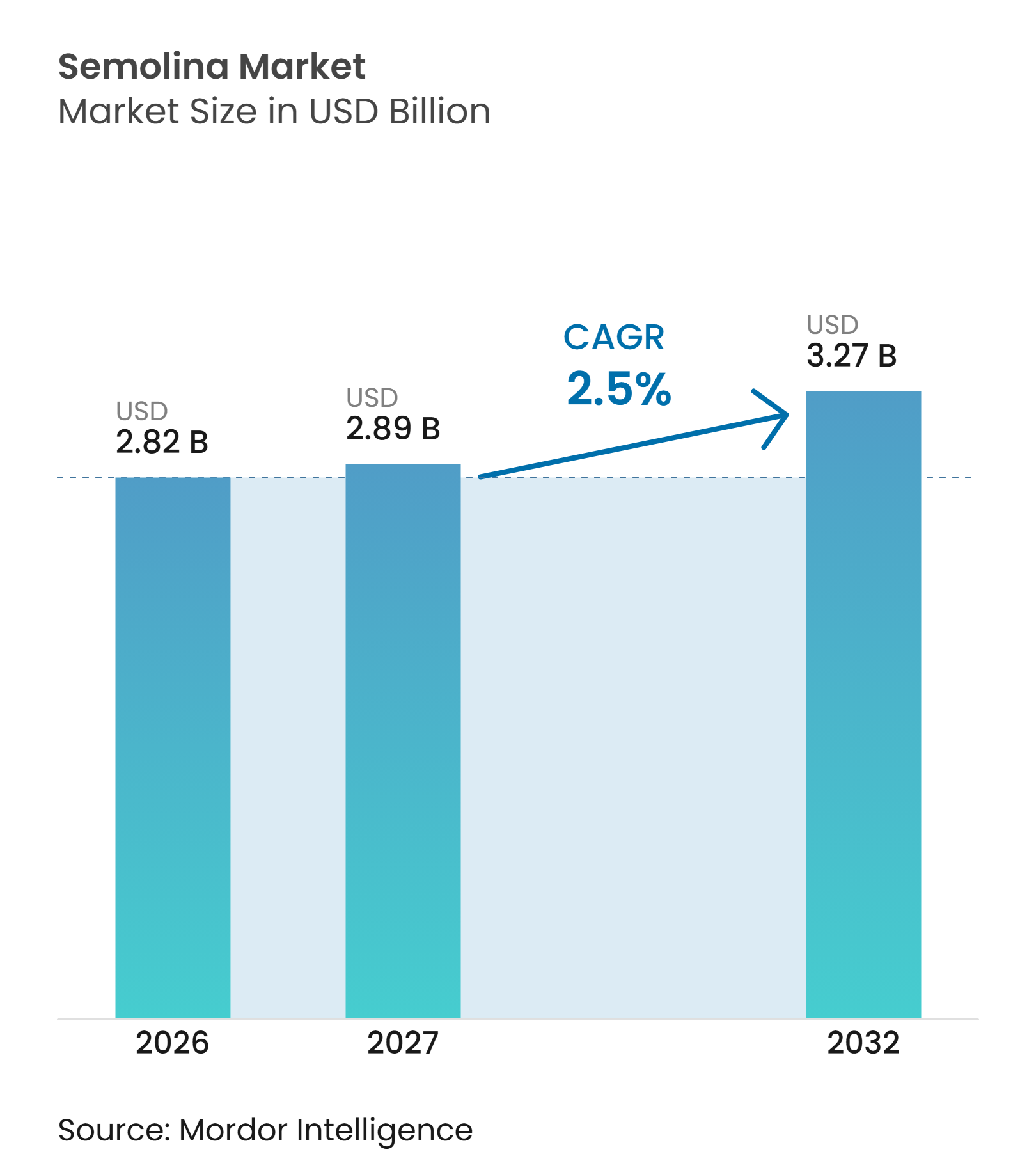
The semolina market size is estimated at USD 2.82 billion in 2026 and is projected to grow from USD 2.89 billion in 2027 to USD 3.27 billion by 2032, at a CAGR of 2.50% during the forecast period (2027–2032). Rising demand for pasta and other durum wheat-based products, growing consumption of convenience foods and ready-to-cook products, and increasing use of semolina in bakery and confectionery applications are supporting market growth. The expansion of the global pasta manufacturing industry and the use of semolina in traditional foods and regional cuisines are further contributing to demand. Technological advancements in wheat milling and semolina processing are also supporting improvements in product quality and processing efficiency. By product grade, coarse semolina is estimated to hold the largest market share, while fine semolina is expected to record the fastest growth. Pasta and noodles are projected to remain the largest application segment, whereas snacks and ready-to-eat foods are expected to grow at the fastest rate. North America is estimated to remain the largest regional market, while Asia-Pacific is expected to record the fastest growth, supported by increasing demand for semolina-based food products.
Key Report Takeaways
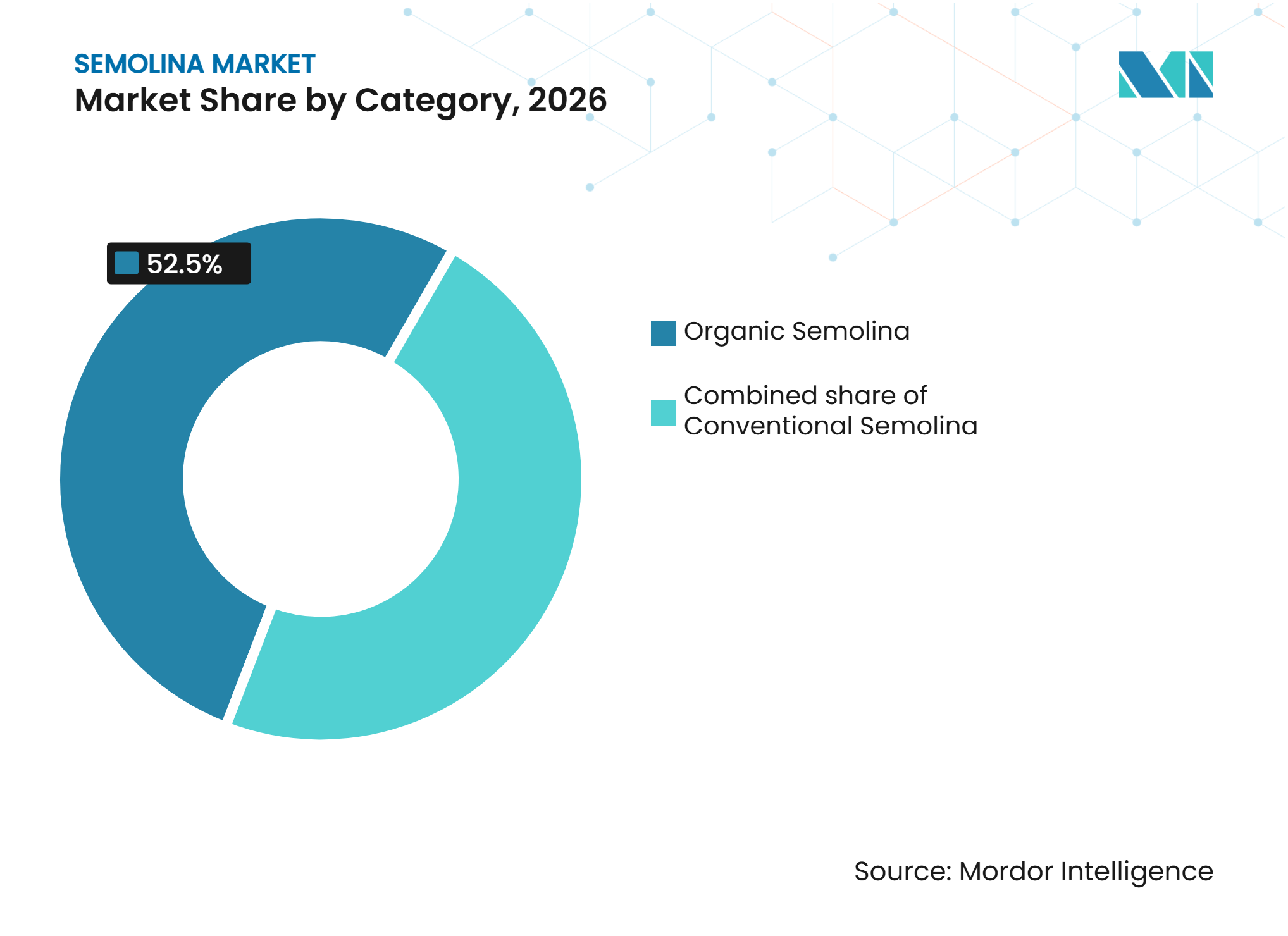
- By category, organic semolina accounted for an estimated 52.50% share of the semolina market in 2026 and is projected to grow at a CAGR of 3.42% during 2027–2032.
- By product grade, coarse semolina held an estimated 42.43% share in 2026, while fine semolina is forecast to grow at a CAGR of 3.27% through 2032.
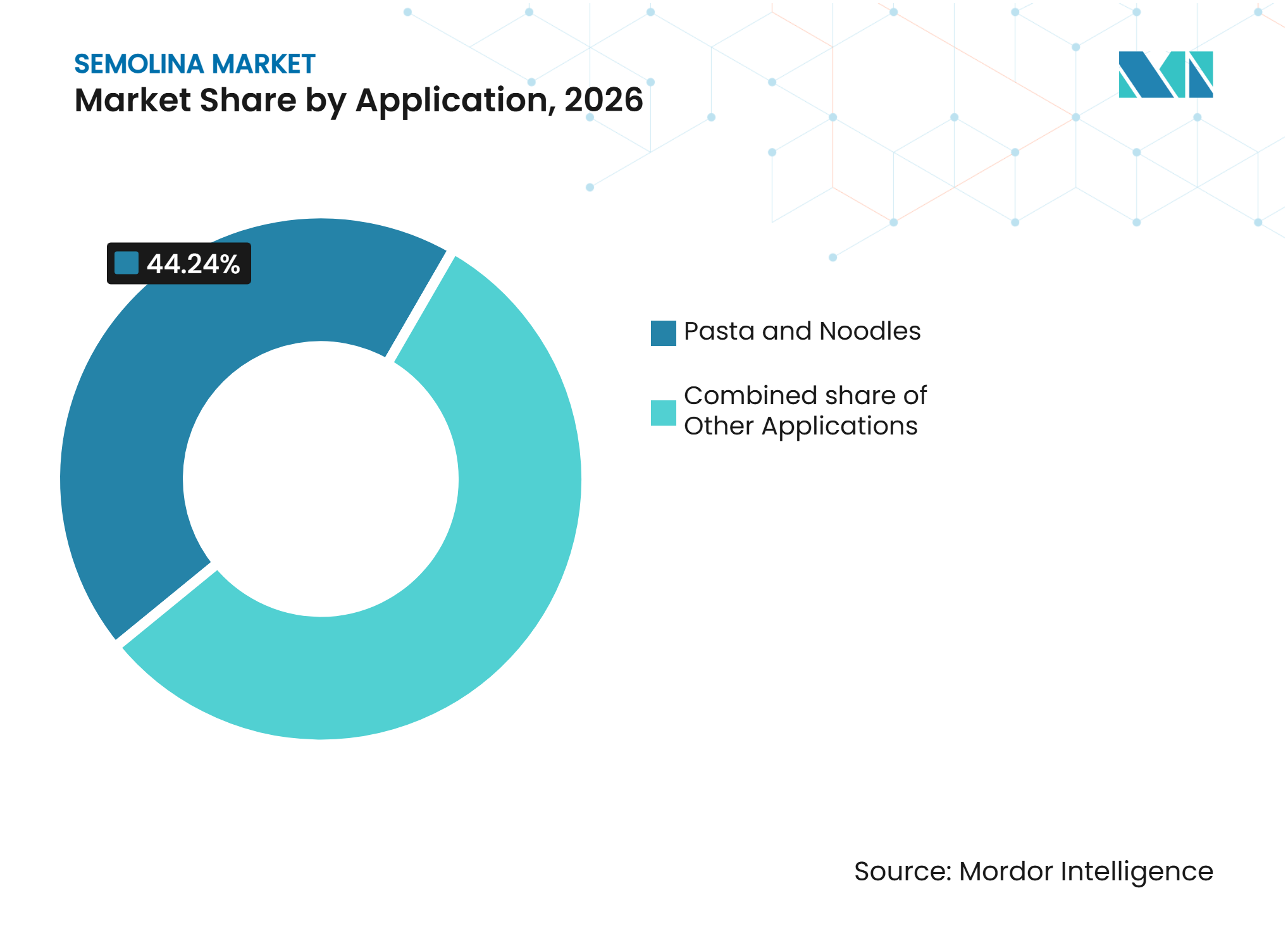
- By application, pasta and noodles accounted for an estimated 44.24% share in 2026, while snacks and ready-to-eat foods are projected to record the fastest growth, at a CAGR of 3.68% during 2027–2032.
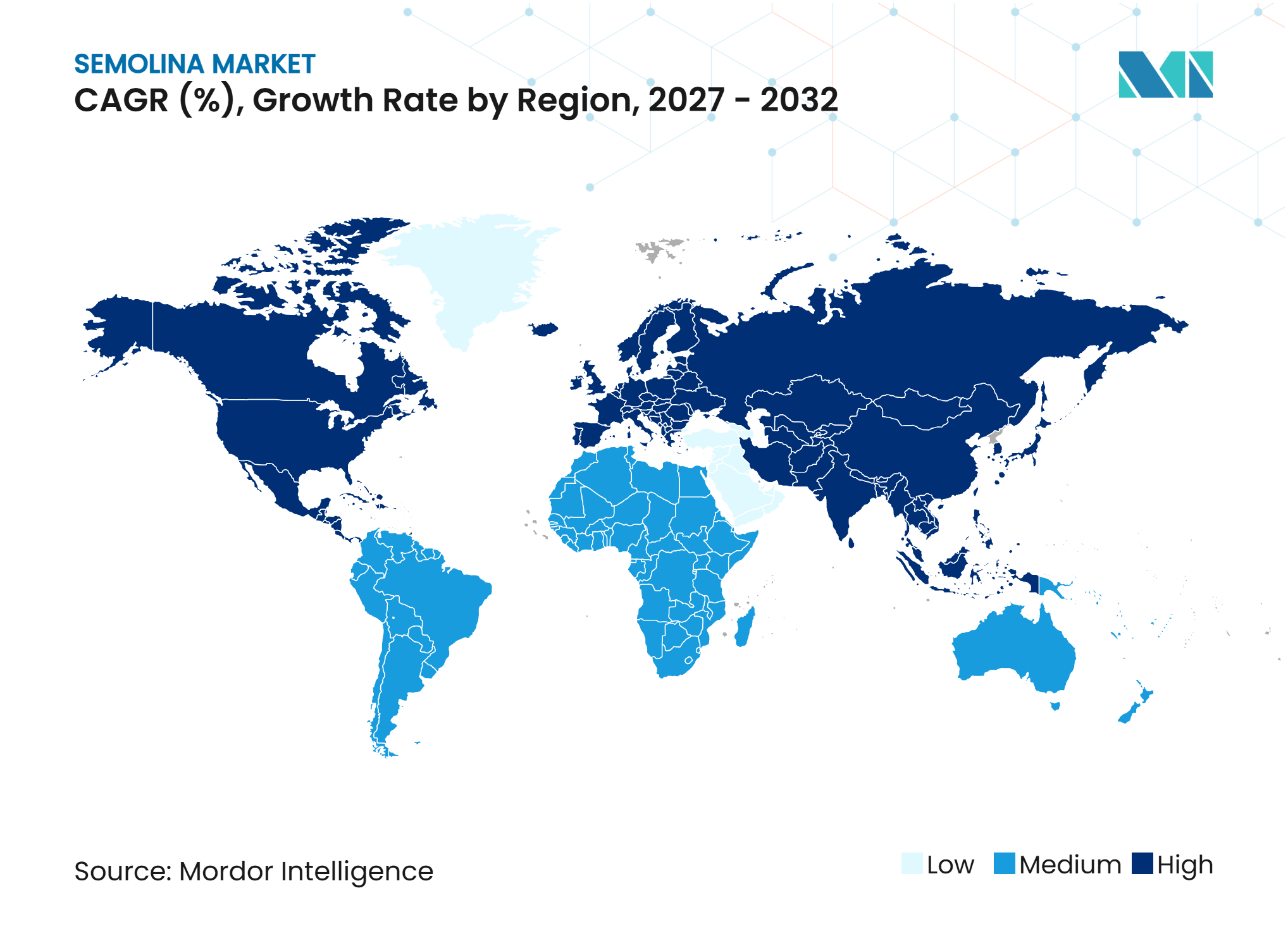
- By geography, North America held an estimated 36.77% share in 2026, while Asia-Pacific is projected to record the fastest growth, at a CAGR of 3.32% through 2032.
Note: Market numbers in this report are based on Mordor Intelligence's proprietary estimation framework, which combines nine months of actuals with Q4 projections for base year 2026.
Market Trends and Insights
Drivers Impact Analysis of Semolina Market*
| Driver | (~) % Impact on CAGR Forecast | Geographic Relevance | Impact Timeline |
|---|---|---|---|
| Rising demand for pasta and other durum wheat-based products | +0.9% | Global, particularly Europe and North America, where pasta consumption and established durum wheat processing industries support semolina demand | Medium term (2–4 years) |
| Growing consumption of convenience foods and ready-to-cook products | +0.8% | Global, particularly North America, Europe and urban markets across Asia-Pacific, supported by demand for convenient meal options | Short term (Less than 2 years) |
| Increasing demand for semolina in bakery and confectionery applications | +0.7% | Global, particularly Europe and Asia-Pacific, where semolina is used in regional bakery products and processed food formulations | Medium term (2–4 years) |
| Expansion of the global pasta manufacturing industry | +0.6% | Global, particularly Europe, North America and Asia-Pacific, supported by pasta production capacity and demand for wheat-based food products | Long term (More than 4 years) |
| Growing use of semolina in traditional foods and regional cuisines | +0.5% | Global, particularly North Africa, the Middle East, Europe and South Asia, where semolina is used in couscous and traditional food preparations | Medium term (2–4 years) |
| Technological advancements in wheat milling and semolina processing | +0.4% | Global, particularly Europe and North America, where established milling industries are adopting processing and quality-control improvements | Long term (More than 4 years) |
| Source: Mordor Intelligence | |||
Rising Demand for Pasta and Other Durum Wheat-Based Products
Growing demand for pasta and other durum wheat-based products is supporting semolina consumption, as semolina is the principal raw material used in the manufacture of many pasta varieties. The expansion of pasta production and consumption across established markets is sustaining demand from food manufacturers. In 2024, European Union countries produced 6.0 million tonnes of pasta, with Italy accounting for 69% of total output, highlighting the scale of the region's pasta manufacturing industry.[1] Semolina's suitability for pasta production, along with its use in products such as couscous, macaroni and spaghetti, supports its position as an important ingredient across the durum wheat value chain.[2]
Growing Consumption of Convenience Foods and Ready-to-Cook Products
Growing consumption of convenience foods and ready-to-cook products is supporting demand for semolina-based foods, particularly packaged and easy-to-prepare products. Semolina is used in a range of convenient food preparations, including pasta, breakfast foods and instant or quick-cooking meal options. In India, changing household preferences, urbanisation and increased demand for packaged staple foods have supported interest in branded and packaged sooji, which offers consistent quality, hygiene and convenience compared with loose, locally milled products.[3] The wider availability of packaged semolina through traditional retail, supermarkets and online grocery platforms is also improving consumer access and supporting its use in everyday food preparation.
Increasing Demand for Semolina in Bakery and Confectionery Applications
Increasing use of semolina in bakery and confectionery applications is contributing to demand beyond its traditional role in pasta manufacturing. Semolina can be incorporated into bread, baguettes, biscuits, gnocchi and other baked products, where it contributes to product texture, colour and flavour. The American Society of Baking notes that durum wheat semolina is used in high-quality pasta and bakery products, including baguettes and batards, and can provide a distinctive flavour and crumb structure in baked goods.[4] In India, semolina is also used as a raw material in traditional sweets and other food preparations, broadening its application across bakery, confectionery and regional food categories.
Expansion of the Global Pasta Manufacturing Industry
Expansion of the global pasta manufacturing industry is supporting demand for semolina as food processors increase production to serve domestic and international markets. Durum wheat semolina is widely used in the production of pasta varieties such as macaroni, spaghetti and vermicelli, making pasta manufacturers an important customer group for semolina millers. In 2024, EU pasta production reached 6.0 million tonnes, while exports totalled 2.9 million tonnes, demonstrating the scale of manufacturing and cross-border trade in this product category. The continued presence of large-scale pasta producers and integrated durum wheat processing facilities supports demand for consistent supplies of food-grade semolina.
Growing Use of Semolina in Traditional Foods and Regional Cuisines
Growing use of semolina in traditional foods and regional cuisines is supporting consumption across households and foodservice applications. Semolina is used in a variety of regional preparations, including upma, halwa, traditional sweets and other dishes, particularly in South Asian cuisines. It is also an important ingredient in couscous and several traditional foods across North Africa and the Middle East. In India, CSIR–Central Food Technological Research Institute identifies semolina, commonly known as sooji or rava, as a basic raw material for traditional products such as upma and sweets. Its versatility across savoury and sweet preparations helps maintain demand beyond industrial pasta and bakery applications.
Restraints Impact Analysis of Semolina Market*
| Restraint | (~) % Impact on CAGR Forecast | Geographic Relevance | Impact Timeline |
|---|---|---|---|
| Price volatility and climate-related risks in durum wheat production | −0.9% | Global, particularly Canada, the United States, Europe and North Africa, where durum wheat production is exposed to drought, heat stress and variable weather conditions | Long term (More than 4 years) |
| Competition from alternative grains and flour-based ingredients | −0.6% | Global, particularly Asia-Pacific, Europe and North America, where rice, maize, millet and other cereal-based ingredients compete across food applications | Medium term (2–4 years) |
| Dependence on durum wheat supply and regional sourcing constraints | −0.7% | Global, particularly importing markets in North Africa, the Middle East and Asia-Pacific, which depend on durum wheat supplies from major exporting countries such as Canada and Europe | Medium term (2–4 years) |
| Quality variations and storage challenges in semolina production | −0.4% | Global, particularly regions with high temperatures, humidity and extended grain-storage requirements, including parts of Asia-Pacific, Africa and the Middle East | Short term (Less than 2 years) |
| Source: Mordor Intelligence | |||
Price Volatility and Climate-Related Risks in Durum Wheat Production
Price volatility and climate-related risks in durum wheat production can affect semolina manufacturers by increasing raw material procurement costs and creating uncertainty in grain availability. Durum wheat cultivation is particularly exposed to drought and heat stress, which can reduce crop yields and affect grain quality. A 2024 review published in Resources, Environment and Sustainability identifies drought and heat stress as the primary yield-limiting factors for durum wheat, while highlighting the potential for climate change to alter production patterns across regions. These risks are relevant to major durum-producing regions, including Canada, Europe and North Africa. Changes in production volumes and export availability can also influence international durum wheat prices, increasing cost pressures for semolina millers and downstream food manufacturers.
Competition from Alternative Grains and Flour-Based Ingredients
Competition from alternative grains and flour-based ingredients can constrain semolina demand in food applications where manufacturers have flexibility in raw material selection. Rice, maize and millet flours are used in several food categories, including bakery products, noodles, snacks and breakfast preparations, providing alternatives to wheat-based ingredients in selected formulations. India's Agricultural and Processed Food Products Export Development Authority (APEDA) identifies rice flour, maize flour and other cereal flours as established milled-product categories, reflecting the availability of alternative cereal-based ingredients in the food supply chain. The Government of India also highlights the use of millet flour in products such as biscuits, cakes, pasta and noodles, demonstrating its potential application across categories that may also use semolina or other wheat-based ingredients. Wider availability of these alternatives may limit semolina adoption in selected applications, particularly where manufacturers prioritise ingredient cost, product formulation flexibility or specific nutritional characteristics.
*Our forecasts treat driver/restraint impacts as directional, not additive. The impact forecasts reflect baseline growth, mix effects, and variable interactions.
Semolina Market Segment Analysis
By Category:
Organic Semolina Leads While Conventional Semolina Serves Mainstream DemandIn 2026, organic semolina accounted for an estimated 52.50% of the semolina market, making it the leading category. Its position reflects growing consumer interest in organically produced food ingredients and products made using certified agricultural inputs. Meanwhile, organic semolina is projected to record the fastest growth, at an estimated CAGR of 3.42% through 2032. Demand is supported by interest in organic food products and greater attention to ingredient sourcing and production standards.
Conventional semolina remains relevant across household consumption and large-scale food manufacturing, supported by established wheat supply chains and its use in pasta, bakery products and traditional foods. Across categories, manufacturers need to balance product quality, sourcing requirements, certification standards and affordability to serve different consumer groups.



By Product Grade:
Coarse Semolina Leads While Fine Semolina Expands FasterIn 2026, coarse semolina accounted for an estimated 42.43% of the semolina market, making it the leading product grade. Its position reflects its established use in pasta manufacturing, where particle size and processing characteristics influence dough formation and finished-product quality. Meanwhile, fine semolina is projected to record the fastest growth, at an estimated CAGR of 3.27% through 2032. Its finer particle structure supports its use in selected bakery, confectionery and food preparation applications.
Medium semolina remains relevant across food applications requiring intermediate particle characteristics, while coarse semolina continues to serve pasta manufacturers. Across product grades, manufacturers need to maintain consistent particle size, moisture levels and processing characteristics to meet different application requirements.
By Application:
Pasta and Noodles Lead While Snacks and Ready-to-Eat Foods Expand FasterIn 2026, pasta and noodles accounted for an estimated 44.24% of the semolina market, making them the leading application. Its position reflects the established use of durum wheat semolina in products such as spaghetti, macaroni and other pasta varieties. Meanwhile, snacks and ready-to-eat foods are projected to record the fastest growth, at an estimated CAGR of 3.68% through 2032. These applications offer opportunities for semolina incorporation in convenient and processed food products, supported by demand for ready-to-consume food options.
Bakery and confectionery products remain relevant through the use of semolina in breads, biscuits and traditional sweets. Couscous and traditional food products, breakfast cereals and porridge, and other applications provide additional consumption avenues. Across applications, manufacturers need to balance texture, processing performance, product quality and suitability for different food formulations.

Geography Analysis
North America Semolina Market
North America accounted for an estimated 36.77% of the semolina market in 2026, making it the largest regional market. The region has an established wheat milling industry and durum wheat processing infrastructure, supporting semolina availability for pasta manufacturers and food processors. The United States and Canada are important markets, with established pasta manufacturing industries and demand for wheat-based food products. Semolina is widely used in pasta, bakery products and other processed food applications, creating opportunities for millers and ingredient suppliers. These market characteristics support demand for consistent-quality semolina across industrial and retail applications.
Asia-Pacific Semolina Market
Asia-Pacific is projected to be the fastest-growing regional market, with an estimated CAGR of 3.32% over 2027–2032. Growth opportunities are supported by rising consumption of processed wheat-based foods, expanding food manufacturing activities and the continued use of semolina in traditional regional cuisines. Markets such as India, China, Japan, South Korea and Australia contribute to regional demand through pasta, bakery products, snacks and other food applications. India also has an established household market for semolina, commonly known as sooji or rava, which is used in preparations such as upma and halwa. However, market development varies across countries according to dietary preferences, purchasing power and the maturity of food processing industries.
Europe Semolina Market
Europe represents an established market for semolina, supported by its strong pasta manufacturing industry, durum wheat processing capabilities and established consumption of wheat-based foods. Countries such as Italy, France, Germany and Spain contribute to regional demand through pasta production, bakery applications and traditional food preparations. Italy is particularly important because of its established pasta production industry and the use of durum wheat semolina in products such as spaghetti, macaroni and other pasta varieties. The region's developed food processing infrastructure and established consumer demand create opportunities for semolina millers and ingredient suppliers. However, market conditions vary across countries according to durum wheat availability, production costs and consumption patterns.
Competitive Landscape
Market Concentration

The Semolina Market includes multinational agribusiness companies, wheat millers, grain processors, pasta manufacturers, and regional milling businesses competing through product quality, durum wheat sourcing, milling capabilities, processing efficiency, product consistency, and distribution reach. Companies participate at different stages of the value chain, including grain procurement, wheat cleaning and milling, semolina processing, packaging, and the supply of ingredients to food manufacturers. Large companies such as Archer Daniels Midland Company, Bunge Global SA, Cargill, Incorporated, and Ardent Mills LLC benefit from established grain procurement networks, processing infrastructure, and broad customer relationships. Regional millers such as GoodMills Group, Molino Casillo, The Mennel Milling Company, and North Dakota Mill and Elevator Association strengthen competition through local sourcing, specialized milling capabilities, and established regional distribution networks.
Competitive strategies in the Semolina Market focus on strengthening wheat sourcing networks, expanding milling capacity, improving product consistency, and supplying different semolina grades for food-processing applications. Companies such as Ardent Mills, ADM, and Cargill participate in grain processing and flour milling, supplying wheat-based ingredients to food manufacturers and other industrial customers. Specialist milling companies, including Molino Casillo and GoodMills Group, focus on wheat milling and semolina products for applications such as pasta and other food preparations. These approaches help suppliers serve customers with different requirements for coarse, medium, and fine semolina, as well as specific processing and end-use applications.
Sourcing and distribution remain important competitive considerations. Companies with established procurement relationships across durum wheat-producing regions can strengthen access to suitable raw materials, while milling technology and quality-control processes help maintain product consistency. Large integrated grain businesses benefit from their procurement, storage, processing, and logistics capabilities, while regional millers compete through local market knowledge and customer relationships. At the downstream level, companies such as Barilla G. e R. Fratelli, Ebro Foods, and De Cecco participate in pasta manufacturing, creating demand for semolina as a key production input. However, the presence of diversified agribusiness and food companies in the competitive landscape does not necessarily indicate that all their wheat-processing or food activities are specific to semolina. Durum wheat price volatility, climate-related supply disruptions, quality consistency, and competition from alternative ingredients can affect procurement costs and product availability. These factors make reliable sourcing, milling efficiency, grade differentiation, and distribution reach important areas of competition.
Semolina Industry Leaders
-
Ardent Mills LLC
-
Archer Daniels Midland Company
-
Bunge Global SA
-
Cargill, Incorporated
-
General Mills, Inc.
- *Disclaimer: Major Players sorted in no particular order
Semolina Market Companies Covered in this Report
- Ardent Mills LLC
- Archer Daniels Midland Company
- Bunge Global SA
- Cargill, Incorporated
- General Mills, Inc.
- Grain Craft, Inc.
- The Mennel Milling Company
- Bay State Milling Company
- North Dakota Mill and Elevator Association
- GoodMills Group GmbH
- Molino Casillo S.p.A.
- Barilla G. e R. Fratelli S.p.A.
- Manildra Group
- Nisshin Seifun Group Inc.
- Olam Agri Holdings Limited
- Groupe Limagrain
- ITC Limited
- Ebro Foods, S.A.
- De Cecco S.p.A.
- Pasta Foods Limited
Recent Industry Developments in Semolina Market
- October 2026: Diamond Pasta (Pvt.) Ltd., the manufacturer of Roza and Milan pasta brands, inaugurated Sri Lanka’s first durum semolina flour mill. The facility incorporates Italian machinery and Bühler technology and is intended to strengthen the company’s semolina supply chain, support local pasta manufacturing, and reduce dependence on imported raw materials.
- June 2026: Crown Flour Mill, the wheat-milling business of Olam Agri, unveiled Mama’s Pride Semolina to its marketers and business partners. The launch expanded the company’s branded semolina portfolio in Nigeria, with the product positioned as a smooth, creamy-white and Vitamin A-fortified staple for consumption with local soups and other meals.
- May 2026: Olam Agri’s Crown Flour Mill introduced Mama’s Pride Semolina during customer engagement events held in Lagos on May 12 and 13. The Vitamin A-fortified product features a smooth texture and firm consistency and was developed to address household demand for an everyday semolina product. The launch involved distributors, dealers, and other supply-chain partners.
- January 2026: AGRIMAC commissioned a new semolina production facility with a combined capacity of 600 metric tons per day in Mardin, Türkiye, for Azim Group Holding. The facility is designed to supply semolina to the group’s expanding pasta operations under the Akhan Makarna brand, strengthening the integration of durum wheat processing and downstream pasta manufacturing.
Global Semolina Market Report Scope
For this study, the Semolina Market is defined as the sales value of commercially traded semolina products produced primarily from durum wheat. The market covers organic and conventional semolina and is segmented by product grade into coarse semolina, medium semolina, and fine semolina. By application, the market includes pasta and noodles, bakery and confectionery, couscous and traditional food products, breakfast cereals and porridge, snacks and ready-to-eat foods, and other applications. The market is analyzed across North America, Europe, Asia-Pacific, South America, and the Middle East and Africa. Market sizing and forecasts are presented in value terms (USD) across the defined categories, product grades, applications, and geographies.
Segmentation Overview
| Organic |
| Conventional |
| Please check whether other grades are available, like Bold / Large Particle Semolina or any others |
| Coarse Semolina |
| Medium Semolina |
| Fine Semolina |
| Pasta and Noodles |
| Bakery and Confectionery |
| Couscous and Traditional Food Products |
| Breakfast Cereals and Porridge |
| Snacks and Ready-to-Eat Foods |
| Other Applications |
| North America | United States |
| Canada | |
| Mexico | |
| Rest of North America | |
| Europe | United Kingdom |
| Germany | |
| France | |
| Italy | |
| Spain | |
| Poland | |
| Netherlands | |
| Rest of Europe | |
| Asia-Pacific | China |
| Japan | |
| India | |
| South Korea | |
| Australia | |
| Rest of Asia-Pacific | |
| South America | Brazil |
| Argentina | |
| Colombia | |
| Rest of South America | |
| Middle East and Africa | South Africa |
| Saudi Arabia | |
| United Arab Emirates | |
| Turkey | |
| Rest of Middle East and Africa |
| By Category | Organic | |
| Conventional | ||
| By Product Grade | Please check whether other grades are available, like Bold / Large Particle Semolina or any others | |
| Coarse Semolina | ||
| Medium Semolina | ||
| Fine Semolina | ||
| By Application | Pasta and Noodles | |
| Bakery and Confectionery | ||
| Couscous and Traditional Food Products | ||
| Breakfast Cereals and Porridge | ||
| Snacks and Ready-to-Eat Foods | ||
| Other Applications | ||
| By Geography | North America | United States |
| Canada | ||
| Mexico | ||
| Rest of North America | ||
| Europe | United Kingdom | |
| Germany | ||
| France | ||
| Italy | ||
| Spain | ||
| Poland | ||
| Netherlands | ||
| Rest of Europe | ||
| Asia-Pacific | China | |
| Japan | ||
| India | ||
| South Korea | ||
| Australia | ||
| Rest of Asia-Pacific | ||
| South America | Brazil | |
| Argentina | ||
| Colombia | ||
| Rest of South America | ||
| Middle East and Africa | South Africa | |
| Saudi Arabia | ||
| United Arab Emirates | ||
| Turkey | ||
| Rest of Middle East and Africa | ||
Key Questions Answered in the Report
What is the estimated size of the Semolina Market in 2026?
The Semolina Market is estimated at USD 2.82 billion in 2026.
What is the projected growth rate of the Semolina Market?
The market is projected to grow at a CAGR of 2.50% during 2027–2032.
Which product grade holds the largest share of the Semolina Market?
Coarse semolina is estimated to hold the largest share, accounting for 42.43% in 2026.
Which application segment dominates the Semolina Market?
Pasta and noodles represent the largest application segment, accounting for an estimated 44.24% share in 2026.