
Self-healing Concrete Market Size and Share
Market Overview
| Study Period | 2021 - 2031 |
|---|---|
| Market Size (2026) | USD 132.15 Billion |
| Market Size (2031) | USD 520.83 Billion |
| Growth Rate (2026 - 2031) | 31.56 % |
| Fastest Growing Market | Asia-Pacific |
| Largest Market | Asia-Pacific |
| Market Concentration | Medium |
Major Players *Disclaimer: Major Players sorted in no particular order Image © Mordor Intelligence. Reuse requires attribution under CC BY 4.0. | |
Self-healing Concrete Market Analysis by Mordor Intelligence
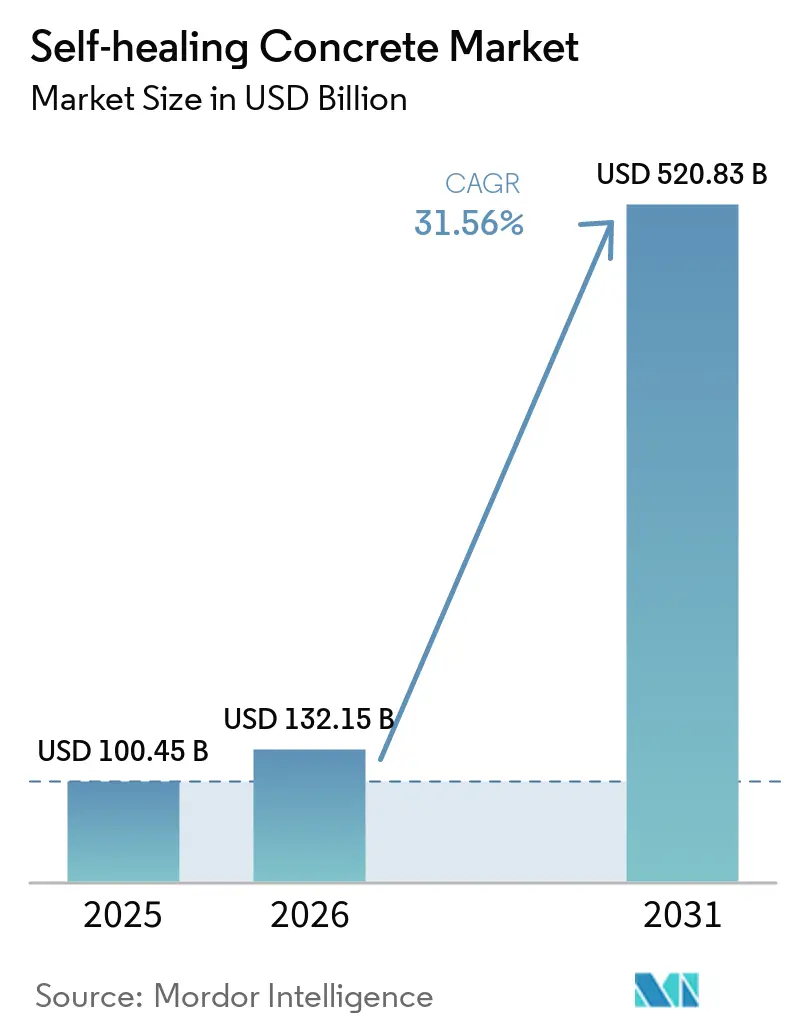
The Self-healing Concrete Market size was valued at USD 100.45 billion in 2025 and is estimated to grow from USD 132.15 billion in 2026 to reach USD 520.83 billion by 2031, at a CAGR of 31.56% during the forecast period (2026-2031). The self-healing concrete market is supported by asset owners seeking to prevent small cracks from developing into corrosion, spalling, water leakage, and costly structural repairs. Civil infrastructure programs provide a durable demand base because bridges, tunnels, roads, water systems, and ports require long service lives and difficult maintenance work. Sustainability requirements also favor materials that reduce replacement needs, while lower-carbon cement and concrete capacity are expanding across the value chain. The self-healing concrete market remains constrained by the premium for bacterial, crystalline, and encapsulated additives, as well as the limited use of common performance standards in building codes. Companies are therefore pairing materials with quality monitoring, local production, field validation, project evidence, and training for site teams to make specifications easier for engineers, public buyers, contractors, and asset managers responsible for long-term performance across major infrastructure projects safely.
Key Report Takeaways
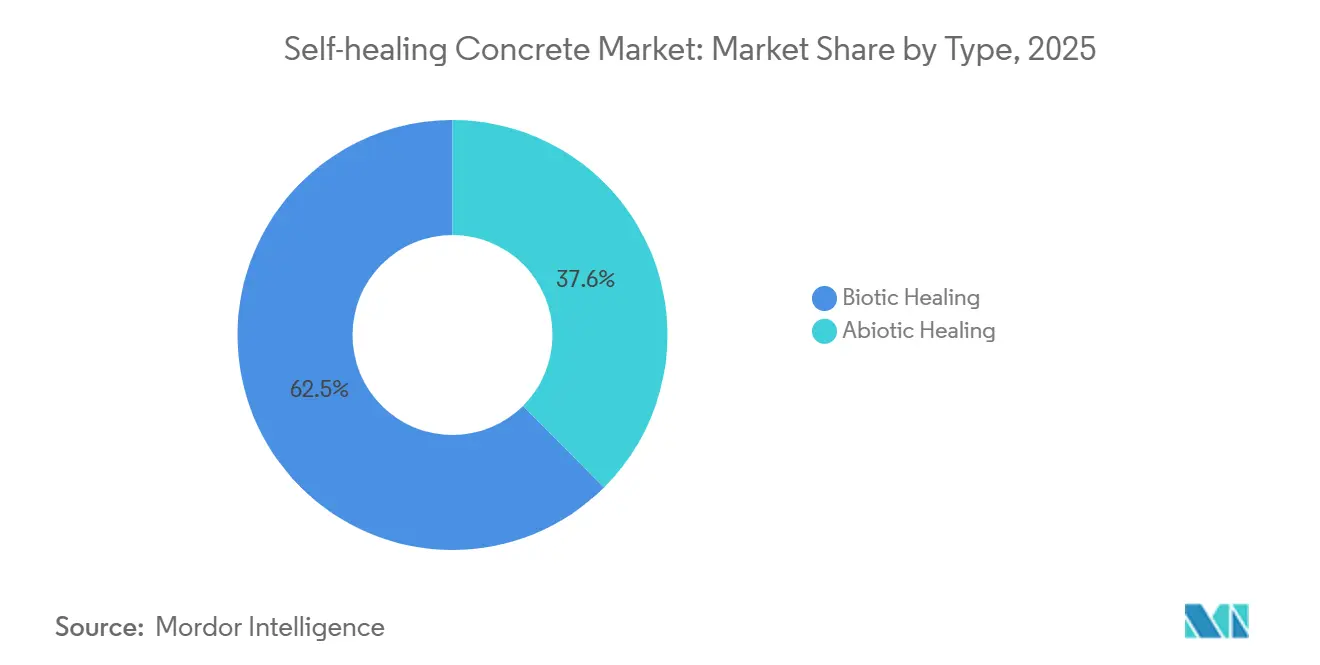
- By type, biotic healing held 62.45% of the self-healing concrete market share in 2025, while abiotic healing is projected to advance at a 32.56% CAGR through 2031.
- By form, capsule-based healing held 45.71% of the self-healing concrete market share in 2025, while vascular healing is projected to advance at a 34.85% CAGR through 2031.
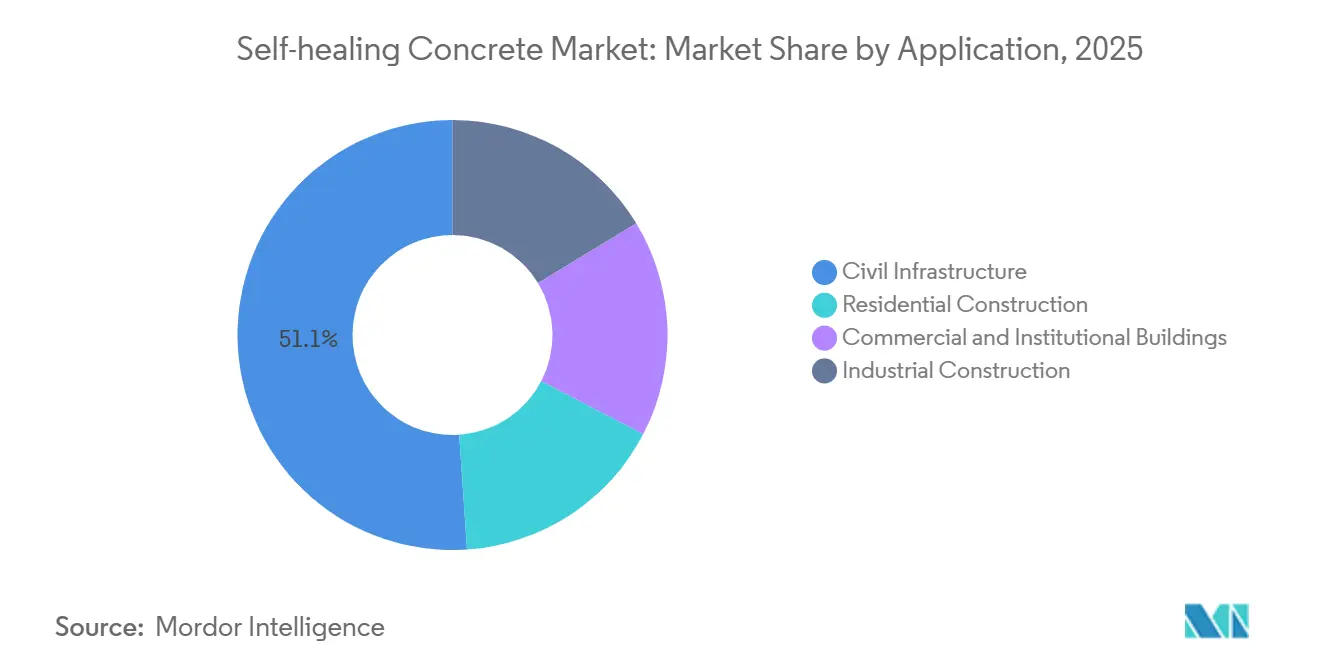
- By application, civil infrastructure held 51.07% of the self-healing concrete market share in 2025, while industrial construction is projected to advance at a 35.38% CAGR through 2031.
- By geography, Asia-Pacific held 43.68% of the self-healing concrete market share in 2025 and is projected to advance at a 34.03% CAGR through 2031.
Note: Market size and forecast figures in this report are generated using Mordor Intelligence’s proprietary estimation framework, updated with the latest available data and insights as of January 2026.
Global Self-healing Concrete Market Trends and Insights
Drivers Impact Analysis*
| Driver | (~) % Impact on CAGR Forecast | Geographic Relevance | Impact Timeline |
|---|---|---|---|
| Aging Infrastructure and Rising Maintenance Costs | +8.5% | Global, concentrated in North America, Europe, and APAC megacities | Short term (≤ 2 years) |
| Sustainability Requirements and Lifecycle Carbon Reduction | +7.2% | Global, with strongest policy pull in EU and East Asia | Medium term (2–4 years) |
| Infrastructure Resilience and Long-Service-Life Requirements | +6.4% | Global, led by APAC megaprojects, Middle East, and North America | Medium term (2–4 years) |
| Smart-City and Predictive-Maintenance Integration | +5.3% | APAC core, spillover to North America and EU | Medium term (2–4 years) |
| Growing Use of Self-Healing Systems in Precast and Modular Construction | +4.1% | North America, Europe, and APAC | Long term (≥ 4 years) |
| Source: Mordor Intelligence | |||
Aging Infrastructure and Rising Maintenance Costs
Deferred maintenance raises costs when minor cracking allows water and chlorides to reach reinforcement, creating repairs that are much more disruptive than early treatment. U.S. state and local governments had accumulated USD 105 billion in deferred roadway maintenance liabilities by 2023. That analysis also found annual roadway depreciation rose from USD 57 billion in 1999 to USD 73 billion in 2023, while real capital investment declined. The self-healing concrete market addresses this problem, where repairs interrupt transport, water supply, port activity, or public access for extended periods. Bridges, tunnels, water-retaining structures, and marine assets have a stronger economic case because inspection and intervention are difficult after the structure enters service. This preference for avoiding maintenance helps explain why owners of long-life public assets are more willing to consider higher material costs than owners of standard buildings.
Sustainability Requirements and Lifecycle Carbon Reduction
Cement and concrete production create a substantial emissions burden, and the Global Cement and Concrete Association has committed the sector to net-zero concrete by 2050. Its roadmap targets a 25% reduction in carbon dioxide per cubic meter of concrete by 2030 from 2020 levels. Self-healing materials do not remove emissions at the mixing stage, but they can reduce the need to replace damaged structural elements during their service life. HOLCIM reported that ECOPact accounted for 31% of ready-mix concrete net sales in 2025, up 5 percentage points from 2024, showing the growing commercial reach of lower-carbon concrete platforms. HOLCIM also reported Science Based Targets initiative validated goals to reduce Scope 1 and Scope 2 emissions per metric ton of cementitious material by 24.95% by 2030 against its 2020 baseline. The self-healing concrete market benefits when procurement teams assess maintenance, repair materials, and replacement work alongside initial construction costs.
Infrastructure Resilience and Long-Service-Life Requirements
Asset owners increasingly require materials that can maintain performance under moisture, salt exposure, vibration, chemical contact, and changing temperatures. The self-healing concrete market is relevant for projects with 75- to 100-year design expectations, where the consequences of premature deterioration extend well beyond a contractor's warranty period. A 2025 peer-reviewed study reported that bacterial concrete improved compressive strength by 25% to 40% and reduced wear by 15% to 25% compared with conventional mixes under its test conditions. The study also confirmed complete crack closure within 21 days under optimal curing conditions. Another 2025 study found bacterial specimens maintained ultrasonic pulse velocities above 4.45 km/s and showed a 15% to 25% reduction in Cantabro loss rates versus control specimens. These results support the use in corridors where mechanical loads and environmental exposure create faster deterioration in conventional concrete.
Smart-City and Predictive-Maintenance Integration
Embedded sensors can provide condition data while healing mechanisms address early-stage cracking, creating a more active maintenance model for public infrastructure. A 2025 scientific paper demonstrated an electromagnetic Internet of Things (IoT) monitoring system for continuous corrosion detection in reinforced concrete. The system reduced inspection frequency and associated costs by more than 40 labor-hours per month in the reported use case. These systems can provide data on crack progression, moisture ingress, and healing-agent use for digital asset models. Japan’s Ministry of Land, Infrastructure, Transport and Tourism recognized Basilisk HA Self-Healing Concrete at the Valuable Excellent performance tier in September 2024, supporting faster consideration for bridges, harbor structures, and mountain tunnels.
Restraints Impact Analysis*
| Restraint | (~) % Impact on CAGR Forecast | Geographic Relevance | Impact Timeline |
|---|---|---|---|
| High Initial Cost Premium Versus Conventional Concrete | -3.8% | Global, highest friction in cost-sensitive emerging markets | Short term (≤ 2 years) |
| Limited Standardization and Slow Building-Code Acceptance | -2.9% | North America & EU, with lagging adoption in South America and MEA | Medium term (2–4 years) |
| Uncertainty About Long-Term Field Performance | -2.1% | Global | Medium term (2–4 years) |
| Source: Mordor Intelligence | |||
High Initial Cost Premium Versus Conventional Concrete
Self-healing concrete carried a 25% to 100% premium over standard concrete, with bacterial and encapsulated-agent variants at the upper end of this range. South Korean deployments remained cost-constrained because bacterial additives and specialty microcapsule inputs had not reached domestic manufacturing scale. Reliance on imported inputs also added logistics costs and limited use in routine construction. The self-healing concrete market, therefore, has greater near-term potential in projects where access, downtime, and repair disruptions create high lifecycle costs. Standard residential and lower-specification commercial projects remain harder to serve because developers often prioritize near-term expenditure. Asset owners using lifecycle cost models typically reach breakeven within 10 to 15 years, which better suits public infrastructure than projects with shorter investment horizons.
Limited Standardization and Slow Building-Code Acceptance
Internationally harmonized benchmarks for healing efficiency, agent longevity, and repeated healing cycles remain limited. Conventional concrete has established standards across strength and durability testing, while self-healing systems face more fragmented testing practices. The International Energy Agency noted that definitions and emissions measurement methods for near-zero cement and concrete remained under development in 2025[1]International Energy Agency, “Cement and Concrete, Breakthrough Agenda Report 2025,” International Energy Agency, iea.org. The same need for interoperable methods affects the adoption of performance claims in the self-healing concrete market. Until engineers can verify claims against widely accepted third-party standards, many will select familiar materials to manage technical and professional risk. Early frameworks developed by RILEM Technical Committee 221-SHC have not yet been adopted consistently in national building codes.
*Our forecasts treat driver/restraint impacts as directional, not additive. The impact forecasts reflect baseline growth, mix effects, and variable interactions.
Segment Analysis
By Type: Biotic Healing Leads, While Abiotic Healing Accelerates
Biotic healing held 62.45% of the self-healing concrete market share in 2025, supported by field deployment of microbially induced calcite precipitation in bridges, tunnels, and water-retaining structures, where crack closure can prevent water and chloride ingress. These systems use bacterial activity to form mineral deposits when moisture and nutrients are available, making their operating principle especially relevant for infrastructure exposed to recurring wet conditions. A 2025 study reported that hybrid Bacillus formulations improved compressive strength by up to 19.57% and split tensile strength by 28.89% at 90 days compared with control specimens, while reducing water absorption by 27%. Aizawa Kosen Concrete has supplied more than 34,000 metric tons of precast products and 5,800 cubic meters of ready-mix self-healing concrete after its mass-production plant began operating in November 2020. This record indicated commercially deployable scale in selected infrastructure settings, though consistent biological handling and local supply remain important considerations for contractors.
Abiotic healing is projected to advance at a 32.56% CAGR through 2031. It includes crystalline admixtures, superabsorbent polymers, and emerging shape-memory compounds that can be integrated into standard ready-mix processes without the biological handling protocols required for bacterial concrete. This compatibility limits workflow changes for contractors and can simplify adoption where batches, quality controls, and supply arrangements are already established for conventional admixtures. Nature Communications published 2026 research on a molecular Velcro polymer additive that delivered autonomous, repeatable crack healing at less than 0.15% weight loading without requiring a discrete healing reservoir. The result addresses the limited number of healing events possible with conventional encapsulation and broadens the potential use of abiotic systems in structures that experience repeated loading and small recurring cracks.


By Form: Capsule-Based Healing Leads, While Vascular Healing Accelerates
Capsule-based healing held 45.71% of the self-healing concrete market share in 2025, helped by its compatibility with familiar concrete mixing equipment, defined dosing practices, and a clear agent-release mechanism that fits established quality-assurance workflows. When a crack damages a capsule, the system releases a prescribed volume of healing agent, allowing engineers to specify additive content per cubic meter with controls like conventional admixture practices. Pilot precast applications in Germany and the Netherlands reported a 40% reduction in maintenance costs over simulated 20-year lifespans, which gave procurement teams a direct basis for lifecycle evaluation. Sika AG introduced a ready-to-use capsule admixture for industrial flooring that achieved 60% crack closure in third-party validation by Dutch TNO, strengthening the available evidence for commercial use. The format remains particularly relevant where users seek an approachable way to introduce self-healing performance without major changes to batching or construction procedures.
Vascular healing is projected to advance at a 34.85% CAGR through 2031. Vascular networks can deliver healing agents repeatedly through an asset’s service life, unlike capsule systems that can be limited to 1 or 2 damage-healing events before their available agent is exhausted. Researchers at Cardiff University developed three-dimensional printed mini-vascular tetrahedral networks with multiple separate reservoirs inside concrete, avoiding the negative-pressure buildup that limited earlier tubular designs. A large-scale TU Delft demonstration in 2025 validated installation in full-scale retaining walls and addressed constructability questions that had previously restricted the technology to laboratory specimens. Intrinsic healing, based on continued cement hydration and carbonation, remains a baseline mechanism in concrete, but it is largely limited to cracks below 150 µm and functions as a performance floor rather than a separate growth driver for the self-healing concrete industry.
By Application: Civil Infrastructure Anchors Demand, Industrial Construction Accelerates
Civil infrastructure held 51.07% of the self-healing concrete market share in 2025, reflecting the long design lives and difficult service conditions facing roads, bridges, tunnels, dams, and water infrastructure. These assets often remain in operation while repair work occurs, so small cracks can create disproportionate problems when water, salts, and other aggressive substances reach reinforcement. Autonomous sealing is consequently more valuable where conventional repairs disrupt transport, public services, or safe access to a site, and where public owners seek longer maintenance cycles. Hazama Ando Hazama established manufacturing protocols for bio-smart concrete using alkaline-resistant AH-strain bacteria and completed a 10-cubic-meter marine pier breakwater trial in March 2026. The work targeted harbor structures where chloride attack and limited repair access can cause persistent maintenance challenges.
Industrial construction is projected to advance at a 35.38% CAGR through 2031. Chemical plants, refineries, pharmaceutical facilities, and power assets expose concrete to thermal cycling, chemical contact, mechanical impact, and vibration that can create microcracks and reduce the useful life of conventional surfaces. The crystalline systems reduced chemical ingress by 60% to 75% compared with conventional concrete, while industrial operators reported 35% to 45% lower maintenance expenditure over 20-year operating cycles after using calcite precipitation technologies. Autonomous sealing can protect continuous-process operations from costly interruptions when cracks allow aggressive substances to reach reinforcement layers or containment surfaces. Residential construction and commercial and institutional buildings drive demand for cost sensitivity and limited self-healing provisions in many building codes, although adoption can expand as additive production scales and specification practices become clearer.

Geography Analysis
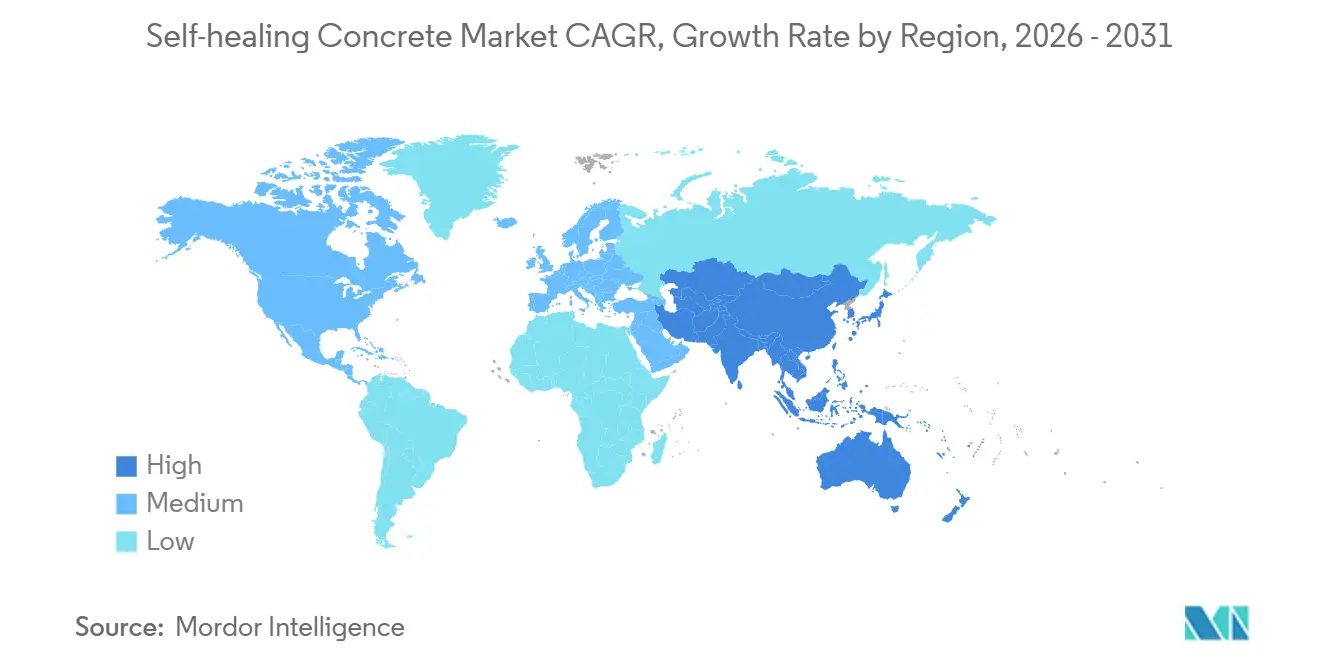
Asia-Pacific held 43.68% of the self-healing concrete market share in 2025 and is projected to advance at a 34.03% CAGR through 2031. The region has a substantial infrastructure pipeline and a growing need for materials that lower inspection needs and avoid disruptive repair work across public assets. China has developed mass-production capabilities for bacterial and crystalline systems, supporting regional supply-chain development for different technology approaches. India has supported demand through national highway expansion, metro rail projects, and smart-city programs that reward lower maintenance needs where routine inspection work faces labor constraints. Japan provides an advanced example of public validation after the Ministry of Land, Infrastructure, Transport, and Tourism recognized Basilisk HA Self-Healing Concrete in its New Technology Information System.
North America has a significant need for durable materials because the United States had USD 105 billion in deferred roadway maintenance liabilities in 2023. Federal infrastructure legislation and state capital maintenance programs are translating this backlog into a stronger procurement setting for long-life construction materials and repair avoidance. Green Basilisk BV entered the North American ready-mix and precast supply chain through Restoration Partners LLC in October 2024, marking the technology’s first large-scale commercial introduction to the Americas. Canada’s Buy Clean Strategy is committed to a 30% reduction in embodied carbon in federal construction beginning in 2025, creating a compliance signal that favors service-life extension.
Europe remains a technically mature area for the self-healing concrete market, with Germany, the Netherlands, and the United Kingdom among established early adopters and experienced precast application markets. The European Union Construction Products Regulation and broader embodied-carbon requirements support materials that extend structural service life and reduce the need for additional construction materials during repairs. The Global Cement and Concrete Association reported that nearly 50% of cement production outside China was covered by decarbonization roadmaps. South America is an early-growth area where Brazil, Argentina, and Chile have demand in large civil infrastructure and industrial projects, while Chile’s seismic conditions strengthen the practical case for resilient concrete. The Middle East and Africa are growing through high-specification coastal and mixed-use developments in Saudi Arabia and South Africa, where chloride-related deterioration can make conventional maintenance approaches commercially difficult.

Competitive Landscape
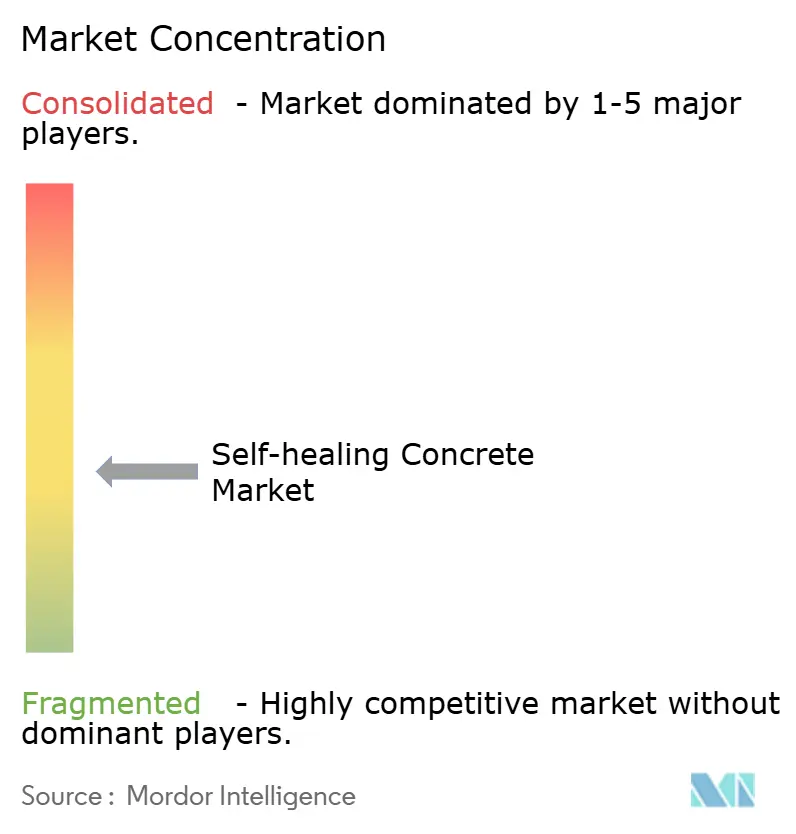
The self-healing concrete market is moderately concentrated, with the top five players including Sika AG, Basilisk, Holcim, Cemex S.A.B. DE C.V., and Xypex Chemical Corporation. Basilisk, Kryton International Inc., Penetron, and Xypex Chemical Corporation focus on bacterial, crystalline, and polymer-based healing mechanisms, while Sika AG, BASF, Heidelberg Materials AG, HOLCIM, and Cemex S.A.B. de C.V. combine these capabilities with broader materials businesses. This structure allows specialists to develop differentiated technologies, while larger suppliers offer distribution relationships, technical-service networks, and established customer access. Sika AG acquired Giatec Scientific Inc. in 2025 to add digital concrete quality and durability optimization capabilities[2]Sika AG, “Sika Business Year 2025 Annual Report,” Sika AG, sika.com.
Industrial containment structures, subsea and marine infrastructure, and precast modular components remain important opportunities in the self-healing concrete market because healing-agent compatibility differs among aggregate systems and curing environments. Patent positions and standards-body participation are likely to matter more as performance benchmarks and specification eligibility develop across regions. Companies that participate in RILEM, the International Organization for Standardization Technical Committee 71, and code-revision processes can better support the technical evidence needed by public buyers and engineers. Smaller participants such as Oscrete, Fescon Oy, and Wacker Chemie AG focus on industrial flooring, precast elements, and polymer-modified crystalline systems, where localized expertise and project evidence can limit confrontation with large-scale distribution networks.
Leading companies are linking formulation, field performance, monitoring, and lower-carbon product platforms in their commercial strategies. Sika AG announced its Fast Forward program in November 2025, with CHF 120 million to CHF 150 million in targeted investment for digitalization, efficiency, and geographic consolidation. HOLCIM expanded the commercial role of ECOPact, which represented 31% of ready-mix net sales in 2025. Hazama Ando Hazama completed a 10-cubic-meter marine pier breakwater trial using Bio-Smart Concrete in March 2026. These actions show that competition includes production scale, monitoring, public validation, and project-specific deployment, not only the composition of a healing additive.
Self-healing Concrete Industry Leaders
Sika AG
Basilisk
HOLCIM
Cemex S.A.B DE C.V.
Xypex Chemical Corporation
- *Disclaimer: Major Players sorted in no particular order

Recent Industry Developments
- October 2025: DMAT raised USD 4.5 million to accelerate the commercialization of its self-healing concrete technology, which is designed to extend infrastructure service life and reduce emissions. The funding supports the scale-up and market adoption of self-healing concrete for longer-lasting infrastructure applications.
- June 2025: Sika AG partnered with Giatec Scientific Inc. to integrate AI-driven concrete sensors, software, and real-time data analytics into its construction product offerings. The collaboration supports smarter monitoring and maintenance of concrete structures, creating complementary opportunities for self-healing concrete solutions.


Global Self-healing Concrete Market Report Scope
Self-healing concrete is an advanced concrete material designed to autonomously seal or repair cracks that develop during service. It incorporates healing mechanisms that can restore structural integrity, reduce water and chemical ingress, and potentially extend the service life of concrete structures while lowering maintenance requirements.
The Self-healing Concrete Market is segmented by type, form, application, and geography. By type, the market is segmented into biotic healing and abiotic healing. By form, the market is segmented into intrinsic healing, capsule-based healing, and vascular healing. By application, the market is segmented into civil infrastructure, residential construction, commercial and institutional buildings, and industrial construction. The report also covers the market size and forecasts for self-healing concrete in 15 countries across major regions. For each segment, the market sizing and forecasts have been done on the basis of value (USD).
| Biotic Healing |
| Abiotic Healing |
| Intrinsic Healing |
| Capsule-Based Healing |
| Vascular Healing |
| Civil Infrastructure |
| Residential Construction |
| Commercial and Institutional Buildings |
| Industrial Construction |
| Asia-Pacific | China |
| India | |
| Japan | |
| South Korea | |
| ASEAN Countries | |
| Rest of Asia-Pacific | |
| North America | United States |
| Canada | |
| Mexico | |
| Europe | Germany |
| United Kingdom | |
| France | |
| Italy | |
| NORDIC Countries | |
| Rest of Europe | |
| South America | Brazil |
| Argentina | |
| Rest of South America | |
| Middle East and Africa | Saudi Arabia |
| South Africa | |
| Rest of Middle East and Africa |
| By Type | Biotic Healing | |
| Abiotic Healing | ||
| By Form | Intrinsic Healing | |
| Capsule-Based Healing | ||
| Vascular Healing | ||
| By Application | Civil Infrastructure | |
| Residential Construction | ||
| Commercial and Institutional Buildings | ||
| Industrial Construction | ||
| By Geography | Asia-Pacific | China |
| India | ||
| Japan | ||
| South Korea | ||
| ASEAN Countries | ||
| Rest of Asia-Pacific | ||
| North America | United States | |
| Canada | ||
| Mexico | ||
| Europe | Germany | |
| United Kingdom | ||
| France | ||
| Italy | ||
| NORDIC Countries | ||
| Rest of Europe | ||
| South America | Brazil | |
| Argentina | ||
| Rest of South America | ||
| Middle East and Africa | Saudi Arabia | |
| South Africa | ||
| Rest of Middle East and Africa | ||


Key Questions Answered in the Report
What is the size of the self-healing concrete market?
The self-healing concrete market stands at USD 132.15 billion in 2026 and is projected to reach USD 520.83 billion by 2031.
What is driving the adoption of self-healing concrete?
Aging infrastructure, deferred maintenance liabilities, resilience requirements, and lifecycle carbon considerations are supporting adoption where repair work is costly, disruptive, or unsafe.
Which type led the market demand in 2025?
Biotic healing led with a 62.45% share in 2025, because it uses bacterial activity to deposit minerals that close cracks when moisture and nutrients are available.
Which application is expected to grow fastest through 2031?
Industrial construction is projected to advance at a 35.38% CAGR through 2031 because plants and refineries face chemical, thermal, and mechanical degradation that can shorten concrete service life.
Page last updated on:





