
Sebacic Acid Market Size and Share
Market Overview
| Study Period | 2022 - 2032 |
|---|---|
| Market Size (2027) | USD 512.13 Million |
| Market Size (2032) | USD 674.75 Million |
| Growth Rate (2027 - 2032) | 5.67 % |
| Fastest Growing Market | Asia-Pacific |
| Largest Market | Asia-Pacific |
| Market Concentration | Medium |
Major Players *Disclaimer: Major Players sorted in no particular order Image © Mordor Intelligence. Reuse requires attribution under CC BY 4.0. | |
Sebacic Acid Market Analysis by Mordor Intelligence
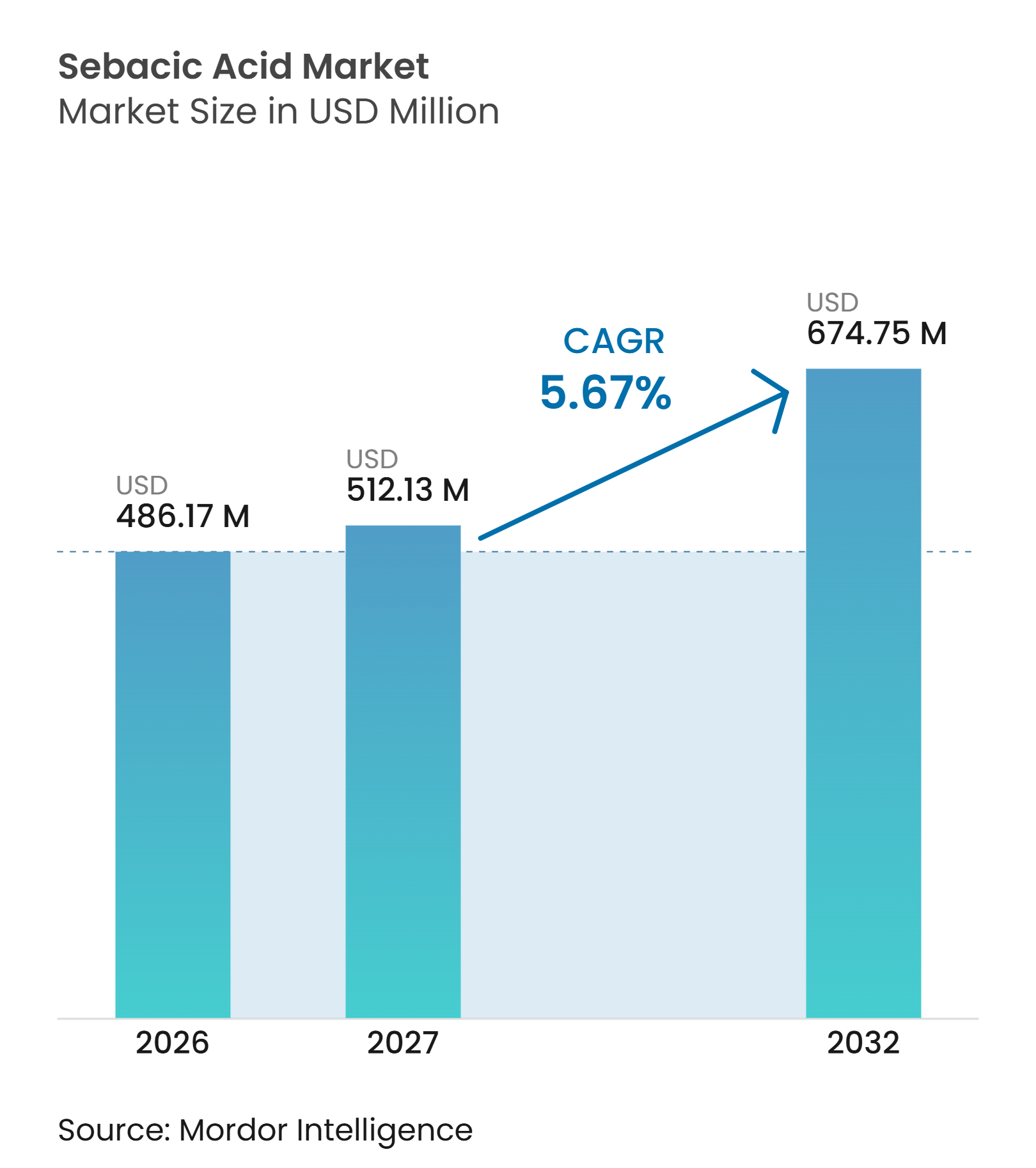
The Sebacic Acid Market size was valued at USD 486.17 million in 2026 and is estimated to grow from USD 512.13 million in 2027 to USD 674.75 million by 2032, at a CAGR of 5.67% during the forecast period (2027-2032). The sebacic acid market is closely linked to castor oil, as commercial production largely relies on alkaline hydrolysis of castor-derived intermediates. This gives the market a renewable-feedstock position while making supply sensitive to crop output and castor oil availability. Demand is supported by bio-based polyamides, specialty plasticizers, and synthetic lubricants that require low-temperature performance. Producers are integrating feedstocks, offering higher-purity grades, and expanding downstream products rather than relying solely on commodity acid sales. The market also faces concentration risk, as China and India remain central to feedstock supply and processing.
Key Report Takeaways
- By source, Castor Oil held 82.56% of the Sebacic Acid Market share in 2026 and is projected to grow at a 6.34% CAGR through 2032.
- By form, Powder held a 35.89% share in the Sebacic Acid Market in 2026, while Granules are projected to grow at a 6.57% CAGR through 2032.
- By application, Plastics and Polymer Manufacturing held a 33.73% share in the Sebacic Acid Market in 2026, while Lubricants and Metalworking Fluids are projected to grow at a 6.89% CAGR through 2032.
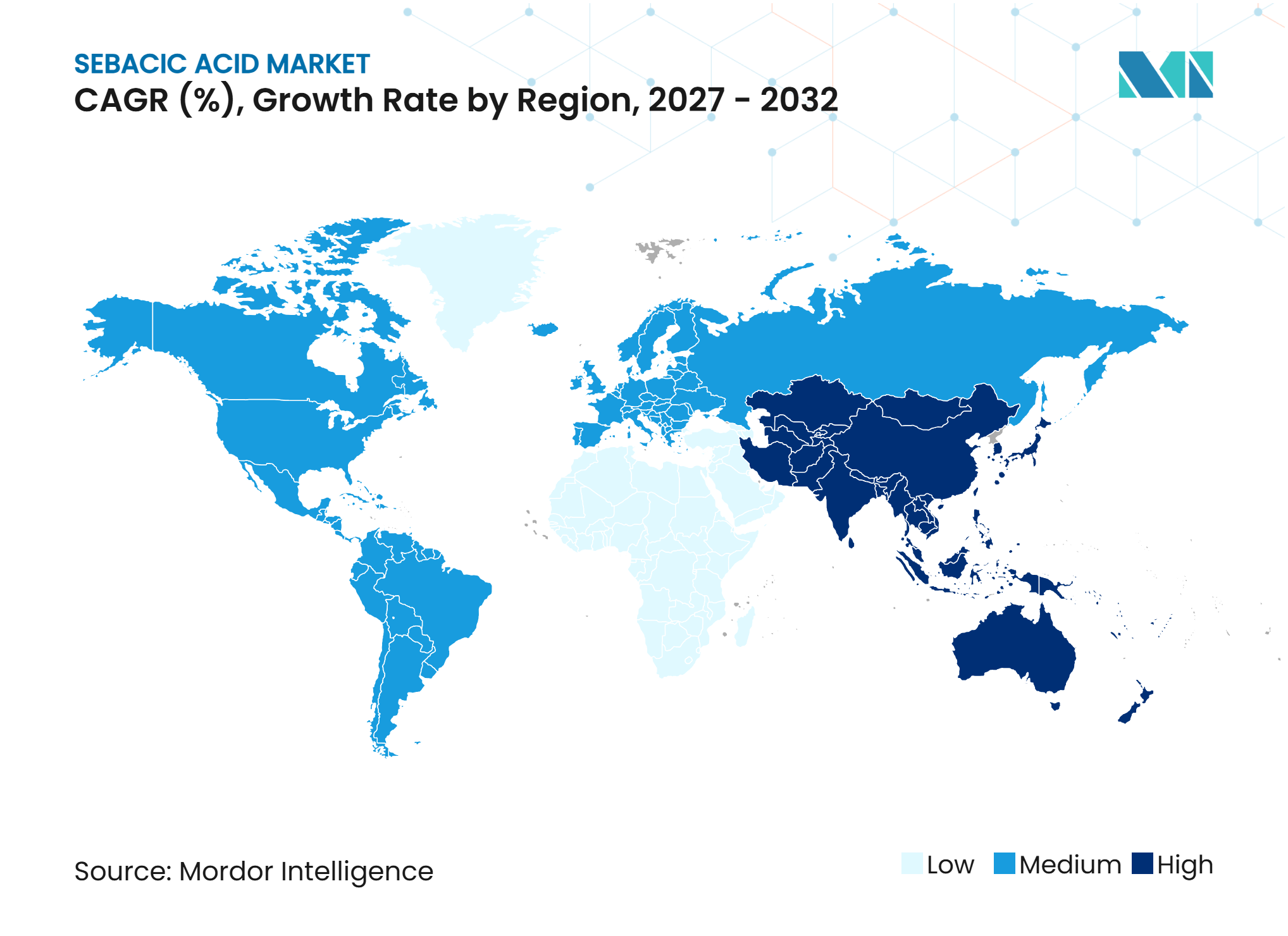
- By geography, Asia-Pacific accounted for 48.11% of the Sebacic Acid Market in 2026 and is projected to grow at a 6.77% CAGR through 2032.
Note: Market numbers in this report are based on Mordor Intelligence's proprietary estimation framework, which combines nine months of actuals with Q4 projections for base year 2026.
Market Trends and Insights
Drivers Impact Analysis of Sebacic Acid Market*
| Drivers | (~) % Impact on CAGR Forecast | Geographic Relevance | Impact Timeline |
|---|---|---|---|
| Bio-Based Polyamide and Engineering Plastic Adoption | +1.7% | Global, strongest in Asia-Pacific and Europe | Long term (≥ 4 years) |
| Phthalate Substitution and Bio-Based Plasticizer Demand | +1.3% | Europe and North America core, spillover to Asia-Pacific | Medium term (2-4 years) |
| Low-Temperature Synthetic Lubricant and Grease Demand | +1.0% | Global, strongest in North America, Europe, and Japan | Medium term (2-4 years) |
| Castor-Oil Integration and Renewable-Carbon Procurement | +0.9% | Asia-Pacific core, including India and China, with spillover to Oman | Long term (≥ 4 years) |
| High-Purity Grade Demand for Automotive, Electronics, and Personal Care | +0.7% | East Asia, Europe, and North America | Medium term (2-4 years) |
| Source: Mordor Intelligence | |||
Bio-Based Polyamide and Engineering Plastic Adoption
Sebacic acid is a difunctional monomer used in nylons 6,10 and 10,10, linking the sebacic acid market to demand for engineering plastics. Arkema reported that its castor-based Rilsan PA11 achieved a product carbon footprint of 1.3 kg CO₂e per kg from January 2025, which the company described as an 80% reduction compared with fossil-based PA12. The company also started a Singapore Rilsan Clear unit in January 2026 and stated that the site tripled global capacity for the transparent polyamide grade. This investment strengthens internal control over castor-based chemistry and reduces dependence on spot purchases of specialty intermediates. In February 2025, Cathay Biotech formed a joint venture with Contemporary Amperex Technology Co., Ltd. (CATL) and Kalai Composites to develop bio-based polyamide composites for battery shells and energy storage boxes. These developments support applications in electric vehicles, 3D printing, and electronics, where material performance and renewable-carbon content are both relevant.
Phthalate Substitution and Bio-Based Plasticizer Demand
The sebacic acid market benefits from the replacement of certain phthalate plasticizers in regulated applications. The European Chemicals Agency (ECHA) identifies 14 phthalates on the REACH Authorization List, for which authorized uses require ongoing regulatory action. A 2025 study in Royal Society Open Science reported that dibutyl sebacate-plasticized polyvinyl chloride (PVC) exhibited 12.78% plasticizer migration over 28 days, along with 350% elongation and a breaking stress of 15.7 MPa[1]. In February 2025, BASF expanded International Sustainability and Carbon Certification (ISCC) PLUS certification to biomass-balanced plasticizer grades produced in Texas and Ontario. The certification adds a traceability element that can influence procurement decisions for plastics and flexible materials. Commission Regulation (EU) 2025/351 also tightened requirements for food-contact plastics in February 2025. These compliance factors support demand for non-phthalate sebacate esters across the sebacic acid market.
Low-Temperature Synthetic Lubricant and Grease Demand
Sebacate esters support the sebacic acid market by providing low-temperature fluidity for demanding lubricant applications. A 2025 study in Industrial Lubrication and Tribology found that di-2-ethoxyethyl sebacate achieved a pour point of -30°C and a high viscosity index. This performance is relevant to aviation lubricants, refrigeration compressor oils, and high-performance automotive fluids. The same technical properties apply to electric-vehicle reduction gearboxes and thermal-management systems, where conventional mineral oils may not meet the required operating conditions. Lubricant formulators also value the biodegradability and thermal stability of ester-based fluids. This creates an application path for sebacic acid distinct from its use in polyamides, and the sebacic acid market therefore benefits from product development in mobility, industrial equipment, and refrigeration.
Castor-Oil Integration and Renewable-Carbon Procurement
Integrated producers can reduce exposure to spot castor oil prices by controlling the conversion of seed to derivatives. Jayant Agro-Organics reported that its castor oil derivatives segment accounted for 47% of the group's turnover in FY2025. The company's integrated processing chain in Vadodara illustrates why access to feedstock, conversion capacity, and downstream outlets can matter more than stand-alone acid production. The National Commodity & Derivatives Exchange (NCDEX) estimated India's 2025-26 castor seed production at 17.86 lakh tons, compared with 15.90 lakh tons in 2024-25. Greater crop availability can ease feedstock pressure, although weather and planting decisions continue to affect the supply outlook. Sebacic Oman operates a 30,000-ton-per-annum (TPA) biorefinery in the Duqm Special Economic Zone, using local castor oil. Such projects expand supply options for the sebacic acid market while maintaining a renewable feedstock base.
Restraints Impact Analysis of Sebacic Acid Market*
| Restraints | (~) % Impact on CAGR Forecast | Geographic Relevance | Impact Timeline |
|---|---|---|---|
| Castor-Oil Crop and Price Volatility | -1.9% | Global, most acute in China and India supply chains | Short term (≤ 2 years) |
| Production Concentration in China and India | -1.3% | Global, heightened in North American and European consuming markets | Long term (≥ 4 years) |
| By-Product and Effluent-Management Complexity | -1.0% | China production clusters and India production clusters | Medium term (2-4 years) |
| Qualification Lead Times for Polymer-Grade Material | -0.8% | Global, highest impact in Europe and Japan for polyamide-grade supply | Medium term (2-4 years) |
| Source: Mordor Intelligence | |||
Castor-Oil Crop and Price Volatility
Castor oil crop conditions directly affect availability and pricing in the Sebacic Acid Market. The International Castor Oil Association reported that India's 2025 castor crop was 20% smaller than in 2024 and that castor oil exports fell 5.8% year over year from January through October 2025. Lower crop output reduces the availability of exports for downstream processors. India is a major source of castor seed and castor oil, and weather variability in key growing areas can affect the supply chain. Formulators may find it difficult to change raw materials quickly because polymer-grade qualification requires repeat testing and customer approval. This makes feedstock volatility more disruptive than a straightforward increase in input costs. The Sebacic Acid Market is therefore exposed to agricultural cycles even when demand from polymers and lubricants remains stable.
Production Concentration in China and India
The Sebacic Acid Market relies heavily on China and India for feedstock conversion and finished material supply. This structure exposes consuming regions to disruptions in logistics, trade policy, and export availability. It also leaves buyers in North America and Europe with limited local alternatives for standard and polymer-grade material. China's GB/T 2092-2024 standard supports consistent industrial specifications, but it does not eliminate the risk of geographic concentration. Cathay Biotech's long-chain diacid product portfolio demonstrates the commercial role of biological production routes, although those routes remain a limited alternative to established castor chemistry. Greater geographic diversity would require comparable access to feedstocks, cost-effective processing, and qualified supply relationships. These conditions take time to establish in the Sebacic Acid Market.
*Our forecasts treat driver/restraint impacts as directional, not additive. The impact forecasts reflect baseline growth, mix effects, and variable interactions.
Sebacic Acid Market Segment Analysis
By Source:
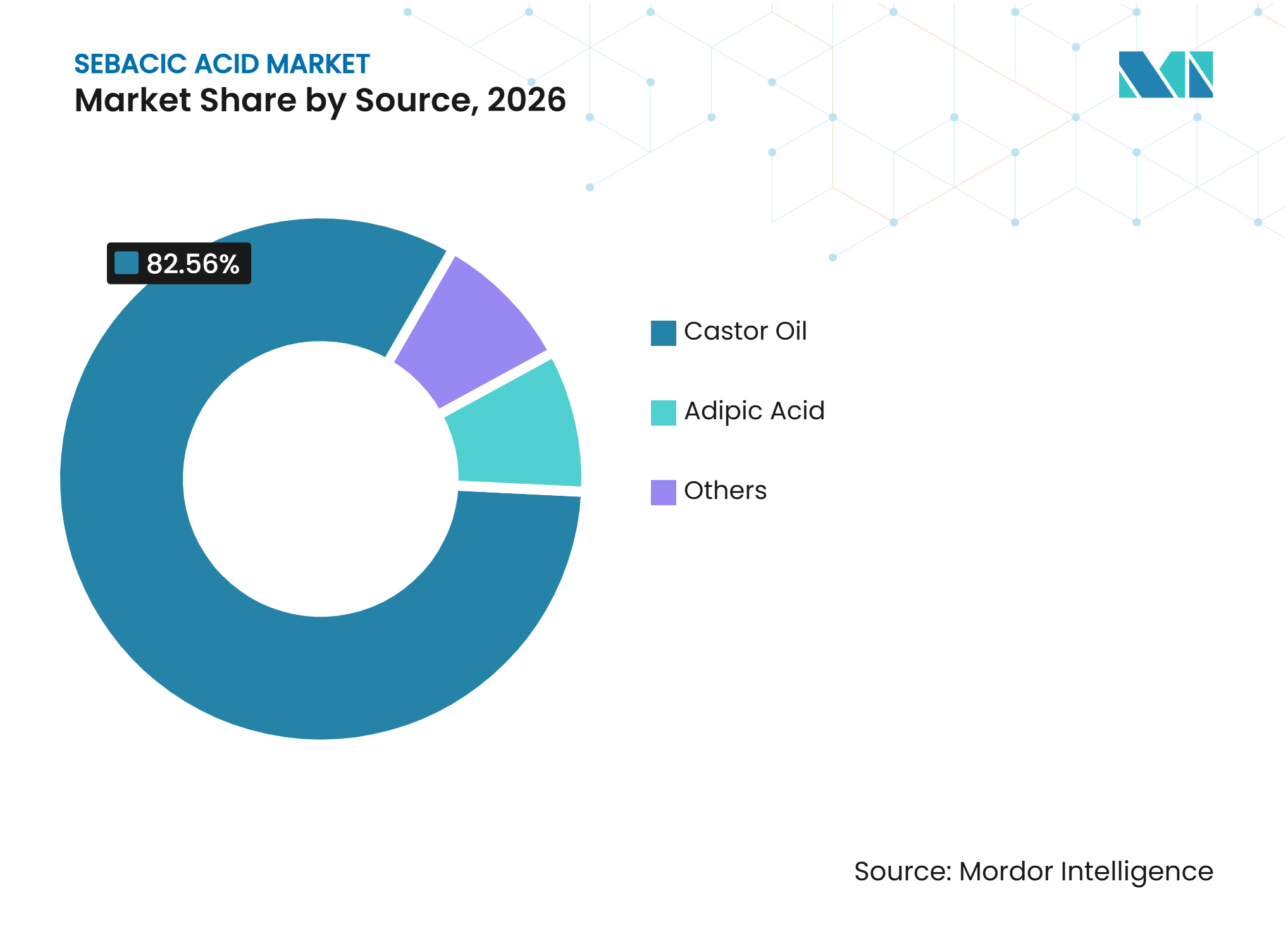
Castor Oil Commands the Bio-Based Value ChainCastor oil held an 82.56% share in the sebacic acid market in 2026 and is projected to expand at a 6.34% CAGR through 2032. Its position reflects the established production route from castor oil derivatives to sebacic acid. India's 2025-26 crop estimate of 17.86 lakh tons indicates stronger feedstock availability compared to the 15.90 lakh tons estimated for 2024-25. Crop conditions and export flows remain important factors for supply. Castor oil-derived material supports a renewable-carbon route for polyamides, plasticizers, and specialty esters.
Adipic acid remains relevant where buyers prioritize established commodity nylon supply chains and cost consistency. Other sources include biological routes aimed at producing long-chain diacids with controlled impurity profiles. Cathay Biotech identifies DC10 sebacic acid as one of its long-chain diacid products. China's GB/T 2092-2024 standard provides a framework for industrial sebacic acid grades from different production routes. The sebacic acid market remains anchored in castor oil, while alternative routes offer limited options for select high-grade customers.



By Form:
Processing Formats Signal Downstream SophisticationPowder held a 35.89% share of the sebacic acid market in 2026, reflecting its established use in polymer and plasticizer manufacturing. It remains suitable for facilities designed around conventional conveying, blending, and dosing methods. Granules are projected to grow at a 6.57% CAGR through 2032, driven by their suitability for automated dosing and cleaner handling. Investment in continuous processing equipment supports demand for granules. Lower dust generation and better flow behavior can reduce handling challenges in downstream plants.
Flakes retain a role where existing equipment and handling practices remain in place. Processors that require tighter control over particle size and material flow are more likely to evaluate powder or granules. This is relevant in automotive, electronics, and specialty polymer production, where consistent raw material properties affect operations. Suppliers that add granulation capacity can offer more application-specific products, while powder remains the leading format by share.
By Application:
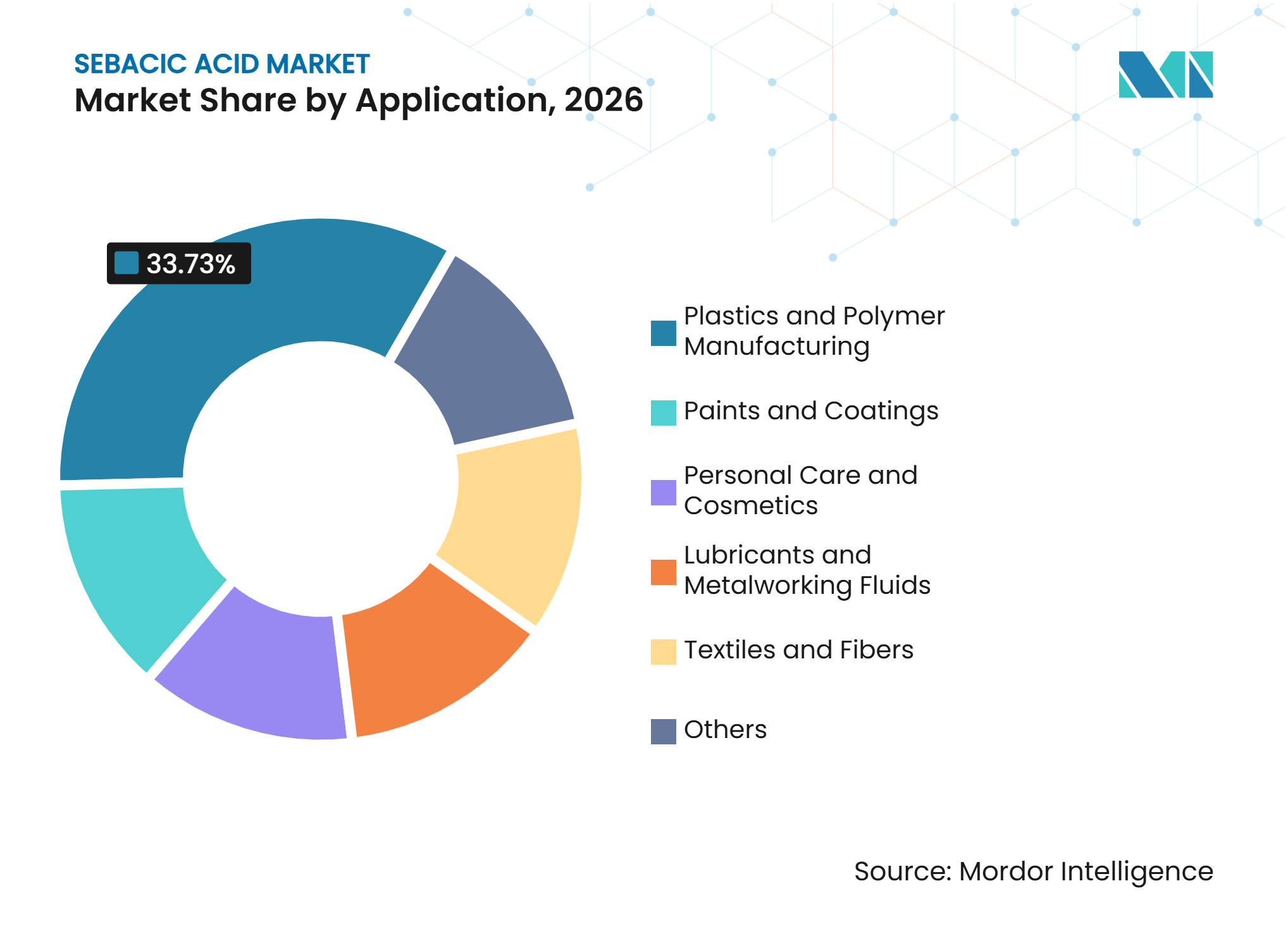
Polymer Demand Anchors While Lubricants Sprint AheadPlastics and polymer manufacturing accounted for 33.73% of the sebacic acid market in 2026. The segment uses sebacic acid to produce nylon 6,10, nylon 10,10, and related materials for automotive, electronics, and additive manufacturing applications. Arkema reported a lower carbon footprint for its castor-based Rilsan PA11 than for fossil-based PA12, underscoring the relevance of renewable feedstocks in high-performance polyamides. Polyamide applications require lightweight, durable, and thermally stable materials. The segment combines large material quantities with demanding product specifications.
Lubricants and metalworking fluids are projected to grow at a 6.89% CAGR through 2032. Sebacate esters are used in synthetic fluids for aviation, refrigeration, and automotive systems due to their low-temperature fluidity. Personal care and cosmetics add demand for plant-based copolymer ingredients, including sebacic acid-containing products offered by Inolex. Textiles, fibers, paints, and coatings provide additional specialized outlets. The range of applications supports demand across several end uses in the sebacic acid market.

Geography Analysis
Asia-Pacific
Asia-Pacific held 48.11% of the sebacic acid market share in 2026 and is forecast to grow at a 6.77% CAGR through 2032. The region benefits from the availability of castor feedstock, chemical processing capacity, and demand for polymers, lubricants, and electronics. India's 2025-26 castor crop was estimated at 17.86 lakh tons, supporting raw material availability for downstream conversion. China's GB/T 2092-2024 standard has been in effect since February 2025 and serves as an industrial quality reference. Cathay Biotech's 2025 joint venture with CATL and Kalai Composites links the development of bio-based polyamide to energy storage applications. Japan and South Korea generate demand for high-purity material used in electronics and specialty lubricants.
North America
North America is an import-dependent market with demand from lubricant manufacturers, automotive polymer processors, and personal care formulators. Wincom supplies Wintrol sebacic acid for metalworking fluids, hydraulic fluids, and engine coolants. Sebacic acid is listed as an active substance on the US Toxic Substances Control Act (TSCA) Inventory, supporting continuity for established commercial use. Import reliance exposes North American buyers to freight, trade, and source-country supply conditions.
Supply Diversification and Regional Market Momentum
Europe has demand from automotive and specialty polymer applications that require traceable, high-purity material. REACH compliance is a major factor for substances and plasticizer alternatives used in the region. The European Commission's 2025 Bioeconomy Strategy supports bio-based solutions and procurement. In the Middle East and Africa, Sebacic Oman's 30,000-ton-per-annum (TPA) biorefinery in Duqm offers a supply option outside the core China-India corridor. South America has potential in automotive assembly and specialty lubricant demand.
Competitive Landscape
Market Concentration
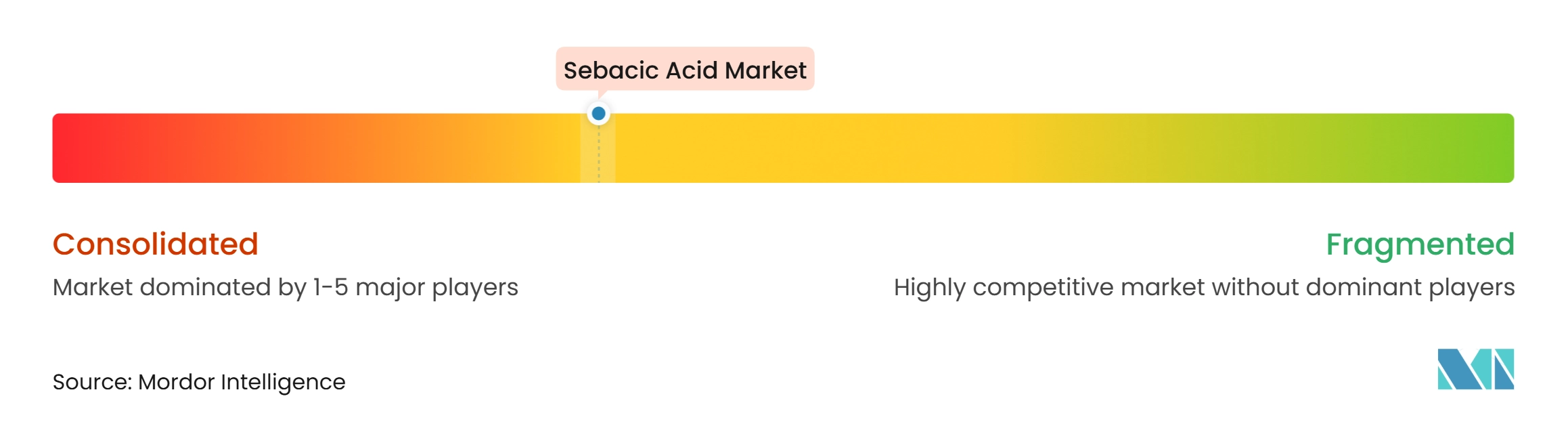
The sebacic acid market is moderately consolidated. Large producers compete on cost, access to feedstocks, process reliability, and compliance with industrial specifications. China's GB/T 2092-2024 standard strengthened the reference framework for industrial-grade material in February 2025. Cathay Biotech, Hokoku, and Inolex differentiate through biological production, specialized material grades, and personal care formulations.
Arkema started a new Rilsan Clear transparent polyamide unit in Singapore in January 2026, tripling global capacity for the material. This expanded its downstream position in castor-based polyamides. Cathay Biotech's February 2025 venture with CATL and Kalai Composites targets bio-based polyamide composites for battery shells and energy-storage boxes. BASF expanded International Sustainability and Carbon Certification (ISCC) PLUS certification for biomass-balanced plasticizer grades in North America in February 2025. These developments place chain-of-custody certification and downstream application development alongside production capacity as competitive factors.
Competitive opportunities are strongest where customers require high purity, dependable traceability, or proprietary downstream formulations. Pharmaceutical- and cosmetic-grade materials require tight controls over purity and trace contaminants. Polymer supplier qualification processes also create value for consistent material quality. Integrated castor processors can coordinate supply when feedstock markets tighten. Sebacic Oman's Duqm operation is one example of local feedstock access supporting a new geographic production base[2].
Sebacic Acid Industry Leaders
-
Arkema
-
Hengshui Jinghua Chemical Co., Ltd.
-
Shandong Siqiang Chemical Group Co., Ltd.
-
JAYANT AGRO-ORGANICS LIMITED
-
Sebacic Oman S.A.O.C.
- *Disclaimer: Major Players sorted in no particular order
Sebacic Acid Market Companies Covered in this Report
- Arkema
- BASF
- Cathay Biotech Inc.
- Hengshui Jinghua Chemical Co., Ltd.
- Hokoku Corporation
- Inolex, Inc.
- JAYANT AGRO-ORGANICS LIMITED
- Jiangsu Zhongzheng Biochemical Co., Ltd.
- Sebacic Oman S.A.O.C.
- Shandong Siqiang Chemical Group Co., Ltd.
- Shandong Tianxing Biotechnology Co., Ltd.
- Shanxi Zhengang Chemical Co., Ltd.
- Shipra Agrichem Private Limited
- Tongliao Xinghe Biotechnology Co., Ltd.
- Wilmar International Ltd
- Wincom Inc.
Recent Industry Developments in Sebacic Acid Market
- January 2026: Arkema started up its new Rilsan Clear transparent polyamide unit at the Singapore Jurong Island platform, tripling its global production capacity for this Polyamide 11 (PA11)-derived transparent polymer, which is produced from sebacic acid. This expansion marked the first Asian production capacity for the grade, targeting customers in optics, eyewear, medical equipment, and consumer electronics across the region.
- May 2025: Sinopec Lubricants (China Petrochemical Lubrication Company) issued a public tender for 448 tons of 99.5% purity sebacic acid for lubricant manufacturing. This confirmed direct sebacic acid procurement by one of China's largest lubricant producers and established a price benchmark for high-purity sebacic acid in the domestic market.
Global Sebacic Acid Market Report Scope
Sebacic acid is a naturally occurring dicarboxylic acid. It is a white, flaky or powdered solid derived from castor oil. The acid consists of a 10-carbon chain with carboxylic acid groups at both ends, giving it properties that make it useful across a range of industrial and chemical applications. It is produced primarily through the alkaline hydrolysis of castor oil, a process that breaks down ricinoleic acid, castor oil's main fatty acid, into sebacic acid and other byproducts.
The sebacic acid market is segmented by source, form, application, and geography. By source, the market is segmented into castor oil, adipic acid, and others. By form, the market is segmented into flakes, powder, and granules. By application, the market is segmented into personal care and cosmetics, lubricants and metalworking fluids, textiles and fibers, plastics and polymer manufacturing, paints and coatings, and others. The report also covers market sizes and forecasts for sebacic acid across 15 countries in major regions. The market sizes and forecasts are provided in terms of value (USD).
Segmentation Overview
| Castor Oil |
| Adipic Acid |
| Others |
| Flakes |
| Powder |
| Granules |
| Personal Care and Cosmetics |
| Lubricants and Metalworking Fluids |
| Textiles and Fibers |
| Plastics and Polymer Manufacturing |
| Paints and Coatings |
| Others |
| Asia-Pacific | China |
| India | |
| Japan | |
| South Korea | |
| ASEAN Countries | |
| Rest of Asia-Pacific | |
| North America | United States |
| Canada | |
| Mexico | |
| Europe | Germany |
| United Kingdom | |
| France | |
| Italy | |
| NORDIC Countries | |
| Rest of Europe | |
| South America | Brazil |
| Argentina | |
| Rest of South America | |
| Middle East and Africa | Saudi Arabia |
| South Africa | |
| Rest of Middle East and Africa |
| By Source | Castor Oil | |
| Adipic Acid | ||
| Others | ||
| By Form | Flakes | |
| Powder | ||
| Granules | ||
| By Application | Personal Care and Cosmetics | |
| Lubricants and Metalworking Fluids | ||
| Textiles and Fibers | ||
| Plastics and Polymer Manufacturing | ||
| Paints and Coatings | ||
| Others | ||
| By Geography | Asia-Pacific | China |
| India | ||
| Japan | ||
| South Korea | ||
| ASEAN Countries | ||
| Rest of Asia-Pacific | ||
| North America | United States | |
| Canada | ||
| Mexico | ||
| Europe | Germany | |
| United Kingdom | ||
| France | ||
| Italy | ||
| NORDIC Countries | ||
| Rest of Europe | ||
| South America | Brazil | |
| Argentina | ||
| Rest of South America | ||
| Middle East and Africa | Saudi Arabia | |
| South Africa | ||
| Rest of Middle East and Africa | ||
Key Questions Answered in the Report
What is current market size of Sebacic Acid Market?
The Sebacic Acid Market size was valued at USD 486.17 million in 2026 and is estimated to grow from USD 512.13 million in 2027 to USD 674.75 million by 2032, at a CAGR of 5.67% during the forecast period (2027-2032).
Which end use is forecast to grow the fastest?
Lubricants and Metalworking Fluids is projected to grow at a 6.89% CAGR through 2032. Sebacate esters are used in specialized synthetic fluids for aviation, refrigeration, and automotive systems because they offer low-temperature fluidity and thermal stability.
Which region leads demand and supply for sebacic acid?
Asia-Pacific held a 48.11% share in 2026 and is forecast to grow at a 6.77% CAGR through 2032. The region combines India’s castor feedstock position, China’s processing capacity, and demand from polymers, electronics, and specialty lubricant applications.
What risks affect sebacic acid supply?
Castor crop variability, feedstock prices, production concentration, effluent management, and polymer-grade qualification requirements can affect supply continuity. Customers may need repeat trials and approvals before changing suppliers because purity, color, ash content, and batch consistency affect polymer performance.