
Saudi Arabia Wire and Cable Market Size and Share
Market Overview
| Study Period | 2020 - 2031 |
|---|---|
| Forecast Data Period | 2026 - 2031 |
| Base Year Market Size (2025) | USD 1.98 Billion |
| Market Size (2026) | USD 2.07 Billion |
| Market Size (2031) | USD 2.53 Billion |
| Growth Rate (2026 - 2031) | 4.10 % |
| Market Concentration | Medium |
Major Players *Disclaimer: Major Players sorted in no particular order Image © Mordor Intelligence. Reuse requires attribution under CC BY 4.0. | |
Saudi Arabia Wire and Cable Market Analysis by Mordor Intelligence
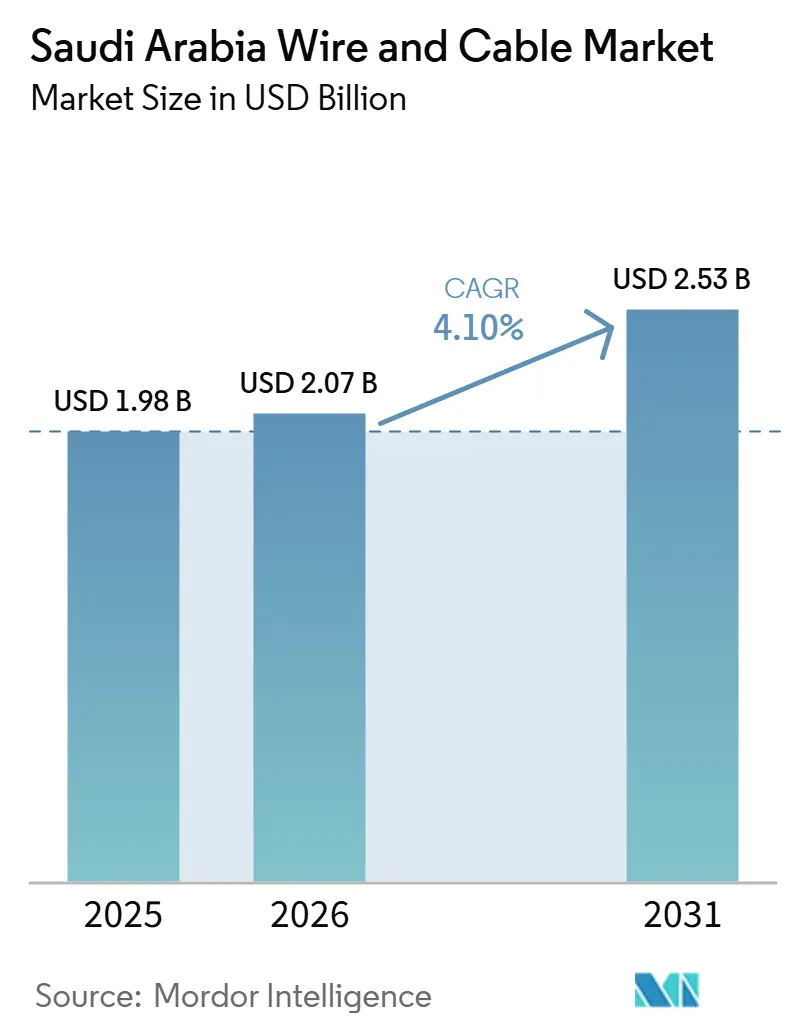
The Saudi Arabia wire and cable market size was valued at USD 1.98 billion in 2025 and is estimated to grow from USD 2.07 billion in 2026 to reach USD 2.53 billion by 2031, at a CAGR of 4.10% during the forecast period (2026-2031). The forecast reflects a move from project planning toward full-scale material deployment across construction and infrastructure programs. Vision 2030 projects are creating requirements for building wire, distribution systems, and high-capacity power connections. Grid investment, renewable interconnection, and digital infrastructure are supporting both power and communications applications. Local manufacturers benefit from local-content qualification, established delivery networks, and familiarity with utility procurement, while international suppliers remain important in specialized applications. Copper, aluminum, and polymer costs remain a key constraint because they can affect manufacturer margins, contractor purchasing schedules, and project delivery timing.
Key Report Takeaways
- By voltage, low-voltage cables accounted for 45.72% of revenue share in the Saudi Arabia wire and cable market in 2025, while medium-voltage cables are projected to expand at a 5.99% CAGR through 2031.
- By cable type, power cables held 68.14% of revenue share in the Saudi Arabia wire and cable market in 2025, while fiber-optic cables are projected to expand at a 5.74% CAGR through 2031.
- By conductor material, copper held 56.85% of revenue share in the Saudi Arabia wire and cable market in 2025, while optical glass/polymer conductors are projected to expand at a 7.14% CAGR through 2031.
- By installation, underground cables accounted for 54.63% of revenue share in the Saudi Arabia wire and cable market in 2025, while submarine cables are projected to expand at an 11.18% CAGR through 2031.
- By end-user vertical, power infrastructure (utilities and renewables) held 25.84% of revenue share in the Saudi Arabia wire and cable market in 2025, while telecommunications and data centers are projected to expand at a 7.15% CAGR through 2031.
- By insulation, insulated cables accounted for 89.36% of revenue share in the Saudi Arabia wire and cable market in 2025 and are projected to expand at a 6.70% CAGR through 2031.
Note: Market size and forecast figures in this report are generated using Mordor Intelligence’s proprietary estimation framework, updated with the latest available data and insights as of January 2026.
Saudi Arabia Wire and Cable Market Trends and Insights
Drivers Impact Analysis*
| Driver | (~) % Impact on CAGR Forecast | Geographic Relevance | Impact Timeline |
|---|---|---|---|
| Vision 2030 Giga-Projects and Urban Infrastructure Build-Out | +1.0% | National, with highest intensity in Riyadh, the northwestern coastal corridor, including NEOM and the Red Sea Project, and Jeddah | Short term (≤ 2 years) |
| Grid Modernization and Transmission Network Expansion | +0.8% | National, with priority in the Central, Western, and Southern regions | Medium term (2-4 years) |
| Renewable Energy and Storage Interconnection | +0.6% | Northwestern Saudi Arabia, including NEOM and Yanbu, and the Southern Region, including Jazan and Khamis Mushait | Medium term (2-4 years) |
| 5G, Fiber Broadband and Data Center Expansion | +0.4% | National, with early gains in Riyadh, Jeddah, and NEOM smart-city zones | Short term (≤ 2 years) |
| Railway, Metro and Airport Electrification | +0.2% | National, with project-specific activity in Riyadh, Jeddah, and the Haramain corridor | Medium term (2-4 years) |
| Saudi-Made Qualification and Local Content Procurement | +0.1% | National, with Jubail, Yanbu, and Riyadh industrial estates benefiting most | Long term (≥ 4 years) |
| Source: Mordor Intelligence | |||
Vision 2030 Giga-Projects and Urban Infrastructure Build-Out
The execution phase of Saudi Arabia’s giga-project portfolio is a major near-term driver of demand for the Saudi Arabia wire and cable market. Contract awards increased as project activity moved from planning into construction and material deployment. Residential, hospitality, commercial, cultural, and public infrastructure projects require large volumes of low-voltage building wire and distribution cables. Utility infrastructure that connects these developments to the national grid also requires medium-voltage, high-voltage, and extra-high-voltage systems. The concentration of projects in Riyadh, Jeddah, and the northwestern coast supports demand across urban, coastal, and remote installation environments. Project owners can require specifications that vary by site and operating conditions, making qualification more difficult for smaller suppliers and favoring manufacturers that can meet specialized technical and delivery requirements.
Grid Modernization and Transmission Network Expansion
Saudi Energy’s transmission network reached 104,634 circular km in 2025, up 5% from the prior year, while its fiber-optic network reached 104,417 km, up 9%. The parallel expansion of power and communications networks reflects the use of fiber along transmission corridors for smart-grid operations. Saudi Energy added 55 transmission substations during 2025 and invested SAR 88.2 billion (USD 23.5 billion) in grid expansion, battery storage, and smart-grid upgrades. The Saudi Arabia wire and cable market benefits when substations, transmission corridors, and system upgrades require connections across several voltage levels. The planned expansion of the transmission system to 160,000 km by 2030 points to sustained demand for medium-voltage and high-voltage cable systems.[1]U.S. Commercial Service, “Saudi Arabia Power,” Country Commercial Guide, trade.gov Urban grid upgrades also support underground routes where visual, safety, and land-use requirements limit overhead infrastructure, increasing the importance of approved systems that meet utility standards.
Renewable Energy and Storage Interconnection
Grid-connected renewable capacity reached 12.3 GW by the end of 2025, underscoring the need for cables connecting generation assets, substations, and distant load centers. Renewable sites can be located far from large demand centers, which increases the need for transmission and collector systems. The Saudi Arabia wire and cable market also receives demand from storage projects that need medium-voltage control cables, power cables, and grid connection equipment. Saudi Energy commissioned 8 GWh of battery storage across Bisha, Jazan, Khamis Mushait, and Najran during 2025. A further 14 GWh of battery capacity is under development for commissioning in 2026-2027, extending cable demand from central generation into distributed storage connections. Renewable and storage projects also require systems that can operate reliably over long distances and in high-temperature environments.
5G, Fiber Broadband and Data Center Expansion
The Saudi Arabia wire and cable market is also supported by demand for high-fiber-count optical cables, plenum-rated structured cabling, and low-smoke, zero-halogen products. These products serve different requirements than traditional electricity transmission and distribution projects. stc Group’s network exceeded 10,800 5G sites and 3.75 million fiber-to-the-home connections in 2025. The company also launched a five-year framework agreement with Ericsson to expand 5G Standalone and Massive MIMO deployment. Center3 committed USD 13 billion toward 1 GW of total data-center capacity by 2030, beginning with 300 MW of hyperscaler-ready capacity by 2027.[2]stc Group, “Annual Report 2025,” stc Group, stc.com A January 2026 joint venture with HUMAIN targeted up to 1 GW of AI workload capacity, supporting fiber backhaul and specialized internal cabling requirements.
Restraints Impact Analysis*
| Restraint | (~) % Impact on CAGR Forecast | Geographic Relevance | Impact Timeline |
|---|---|---|---|
| Copper, Aluminum and Polymer Price Volatility | -0.5% | Global supply chain, with direct exposure across Saudi cable procurement | Short term (≤ 2 years) |
| Qualification and Approval Lead Times for High-Specification Cables | -0.3% | National, most acute for extra-high-voltage and submarine cable categories | Medium term (2-4 years) |
| Extreme Heat, UV Exposure and Thermal Derating Requirements | -0.2% | National, with greater intensity in southern and desert-edge zones | Long term (≥ 4 years) |
| Fragmented Project-Specification Practices and Contractor-Driven Substitution | -0.1% | National, concentrated in private developer projects outside Saudi Energy’s standardized procurement | Short term (≤ 2 years) |
| Source: Mordor Intelligence | |||
Copper, Aluminum and Polymer Price Volatility
Raw materials, including copper, aluminum, and polymer compounds, accounted for 70% to 85% of cable production costs. This makes changes in commodity prices important to manufacturers, contractors, and project owners. Copper reached an intraday high of USD 14,527.50 per tonne in January 2026, placing pressure on cable manufacturers and project contractors. LSEG projected refined copper production growth of 2.2% for 2026, below its earlier 2.8% projection.[3]London Stock Exchange Group, “Aluminium and Copper, A Rally Fuelled by Structural Strains and Political Uncertainty,” LSEG, lseg.com The Saudi Arabia wire and cable market may face longer procurement cycles when contractors operate under fixed-price agreements, while aluminum market disruptions can erode the cost advantage that supports substitution in lower-voltage applications. These pressures can erode margins, delay material purchases, and complicate procurement timing.
Qualification and Approval Lead Times for High-Specification Cables
Saudi cable suppliers must complete type testing and project-owner prequalification before bidding for medium-voltage and higher-voltage cable tenders. The Saudi Electricity Company is particularly important in this process because its specifications shape a large share of utility procurement. Custom orders for extra-high-voltage, HVDC submarine, and fire-resistant halogen-free cables can require 10-16 weeks of qualification and testing. Standard low-voltage and medium-voltage cable orders typically take 4-8 weeks, giving local suppliers a stronger position in established product lines. The Saudi Arabia wire and cable market remains dependent on imported supply for many high-value categories because domestic qualification is still developing. Riyadh Cables completed type testing for a 1×2,500 mm², 400 kV extra-high-voltage cable system at its ISO 17025-accredited laboratories in 2026.
*Our forecasts treat driver/restraint impacts as directional, not additive. The impact forecasts reflect baseline growth, mix effects, and variable interactions.
Segment Analysis
By Voltage: Low-Voltage Demand Supports a Growing Medium-Voltage Requirement
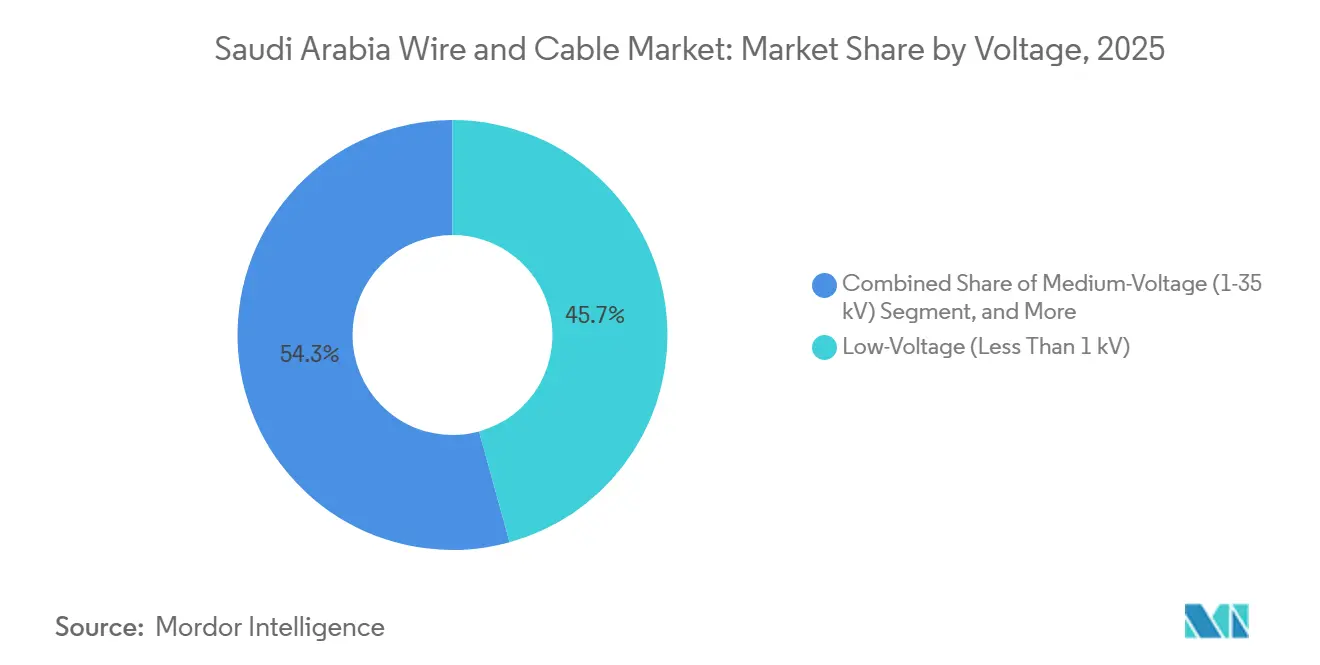
Low-voltage cables held 45.72% of the Saudi Arabia wire and cable market share in 2025. Residential construction, commercial fit-outs, and industrial distribution circuits create high-volume demand for building wire and flexible harnesses. Housing programs, including ROSHN developments, continue to support this broad demand base. Contractors use these products across internal building networks, service connections, and local distribution systems. Medium-voltage cables are projected to expand at a 5.99% CAGR from 2026 to 2031 as project utility networks require higher-capacity interconnection.
Renewable facilities, industrial parks, and giga-project utility systems support the need for medium-voltage products. High-voltage and extra-high-voltage cables remain central to transmission expansion and renewable integration. Saudi Energy had 24 substations and 4,327 km of transmission lines under construction to connect 34.4 GW of renewable capacity by 2027. Cross-linked polyethylene, or XLPE, insulation is required for underground applications under Saudi Energy’s distribution materials specification 11-SDMS-01. The Saudi Arabia wire and cable market, therefore, retains a large low-voltage base while higher-voltage applications gain importance.



By Cable Type: Power Cables Lead While Fiber-Optic Cables Gain Momentum
Power cables accounted for 68.14% of the Saudi Arabia wire and cable market size in 2025. Electricity delivery infrastructure remains the largest source of demand due to grid projects, independent power connections, and utility requirements for giga-projects. Transmission, distribution, and project utility systems use power cables at several voltage levels. This base is supported by continued utility investment and construction activity across the Kingdom. Fiber-optic cables are projected to expand at a 5.74% CAGR from 2026 to 2031 as fiber-to-the-home, 5G backhaul, and data-center connections expand.
stc Group’s SilkLink initiative involved a USD 800 million contract signed in February 2026 for 4,500 km of terrestrial fiber across Syria. The project showed the regional importance of diversified long-haul fiber routes and alternative connectivity paths. Within Saudi Arabia, this planning can increase demand for terrestrial backhaul and associated optical infrastructure. Signal and control cables remain relevant for oil and gas automation and industrial manufacturing, while coaxial and data cables continue to support broadcast and legacy telecommunications uses. Bahra Electric signed an agreement with Prysmian in 2025 to manufacture optical ground wire, or OPGW, at its Saudi facility, expanding domestic capability in a specialized fiber-related product category.
By Conductor Material: Copper Retains Its Lead as Optical Materials Advance
Copper held 56.85% of the Saudi Arabia wire and cable market share by conductor material in 2025. Its position reflects high conductivity, established utility qualification practices, and long-standing industrial specifications. It is used widely where project owners prioritize performance and established technical standards. Aluminum balances the demand for metallic conductors and offers lower weight for suitable designs. Optical glass and polymer conductors are projected to expand at a 7.14% CAGR from 2026 to 2031.
Fiber infrastructure for smart grids, data centers, and subsea connectivity supports the faster pace of optical materials. Aluminum has cost and weight benefits in overhead distribution and long-span applications. Copper and aluminum pricing can shape manufacturer margins and project specification choices. Copper traded above USD 11,400 per tonne on the London Metal Exchange in 2025, encouraging manufacturers to expand aluminum-compatible product lines. The Saudi Arabia wire and cable market combines established demand for metallic conductors with growing requirements for fiber infrastructure.
By Installation: Underground Systems Hold the Largest Base While Submarine Cables Grow Faster
Underground installations accounted for 54.63% of the Saudi Arabia wire and cable market size in 2025. This position reflects infrastructure policy and the need to protect networks from ultraviolet exposure and high temperatures. Buried networks also meet urban design requirements in dense development corridors. They are particularly important where land-use, visual, and safety requirements restrict overhead infrastructure. Submarine cables are projected to expand at an 11.18% CAGR from 2026 to 2031.
Overhead systems remain relevant in rural distribution and long-span transmission routes where burial costs are high. Submarine growth is linked to Red Sea fiber routes and power requirements for coastal and island developments. The Egypt-Saudi interconnection adds a cross-border power connection requirement. Underground replacement programs continue alongside the construction of entirely new infrastructure. The Saudi Arabia wire and cable market requires different technical designs, logistics, and approvals for overhead, buried, and subsea installations.
By End-User Vertical: Power Infrastructure Leads and Digital Infrastructure Expands
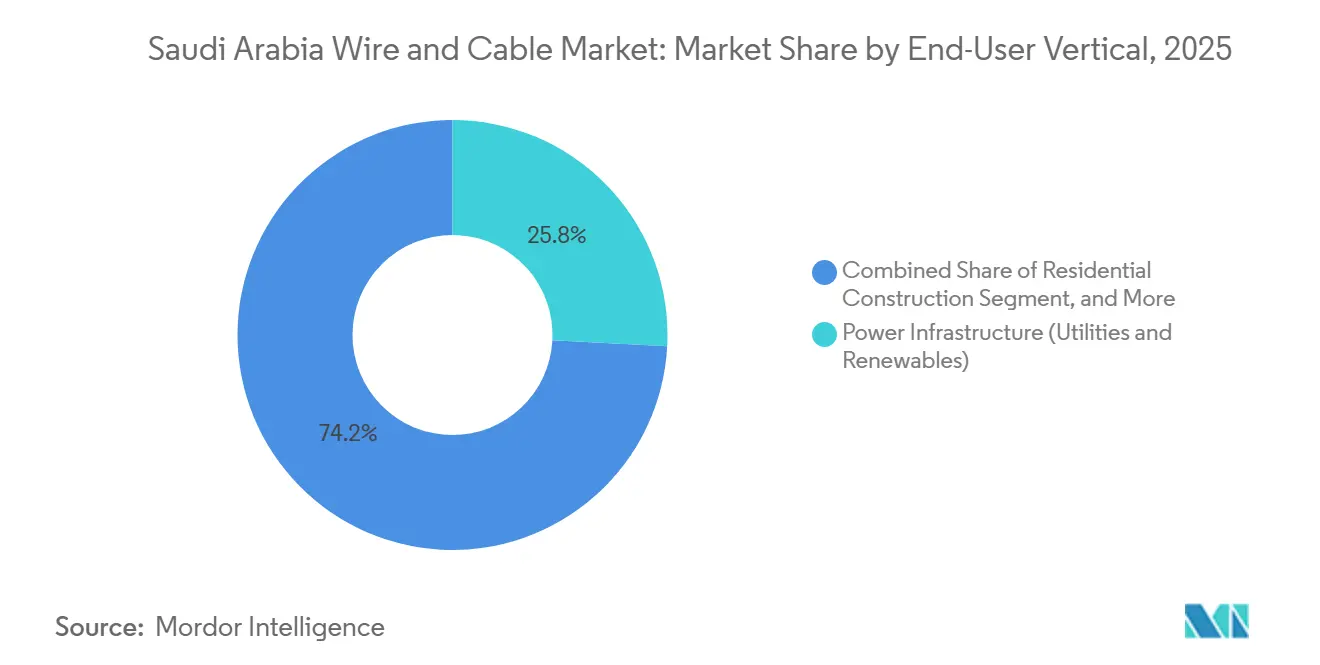
Power infrastructure, utilities, and renewables held 25.84% of the market in 2025. Saudi Energy is the largest individual buyer because it funds transmission expansion, substations, storage systems, and renewable connections. Its SAR 88.2 billion (USD 23.5 billion) capital investment in 2025 supported these activities. Utility procurement creates demand for transmission, distribution, control, and supporting communications systems. Telecommunications and data centers are projected to expand at a 7.15% CAGR from 2026 to 2031.
Fiber deployment, data center investment, and AI infrastructure support faster growth in telecommunications and data centers. Oil, gas, and petrochemicals remain important because of Saudi Aramco’s production and industrial activity in the Eastern Province. Saudi Aramco signed USD 9 billion in iktva agreements and memoranda of understanding at its 2025 forum, including in the electrical and instrumentation categories. Residential and commercial construction demand consistent low-voltage wiring, while industrial manufacturing requires power, control, and instrumentation cables. Automotive and mobility applications are beginning to add demand through charging infrastructure and vehicle assembly.
By Insulation: Insulated Cables Hold a Strong Position and Continue to Expand
Insulated cables accounted for 89.36% of the market in 2025. This reflects a preference for insulated conductors in nearly all applications, except cost-sensitive overhead distribution. Non-insulated products, mainly bare aluminum conductors, remain relevant for rural grids and long-distance overhead sections. Their role is declining as underground cable use increases and grid modernization replaces older overhead infrastructure. Insulated cables are projected to expand at a 6.70% CAGR from 2026 to 2031.
Higher-specification XLPE-insulated, low-smoke, zero-halogen, and halogen-free fire-resistant cables support this growth. Saudi Energy requires XLPE insulation for underground power cables in accordance with IEC 60502-1. This has made XLPE the standard choice for new underground procurement. Data-center and telecommunications projects also require insulation designed for fire safety and enclosed spaces. The Saudi Arabian wire and cable market is moving toward products that meet higher safety and performance standards.
Geography Analysis
The Central and Northern Region, led by Riyadh, accounted for the largest share of cable procurement in the Saudi Arabia wire and cable market. Government capital programs, Saudi Energy grid operations, and urban construction support demand in the region. New Murabba, King Salman Park, and Qiddiya add requirements across building, utility, and transport applications. Riyadh’s urban development also increases demand for underground power and communications systems. The region remains the principal location for project delivery and supplier activity.
The Eastern Province is the second major demand center, with Dammam, Jubail, and Ras Al Khair serving oil, gas, petrochemical, and industrial customers. Its cable requirements include high-temperature, flame-retardant, and hazardous-area-compatible products. Saudi Aramco’s local-content program supports the domestic supply chain serving these applications. The Western Region, from Jeddah through Makkah and Madinah to the northwestern coast, is the fastest-evolving area. Port logistics, commercial construction, tourism projects, and Red Sea fiber connectivity broaden its demand base.
NEOM, the Red Sea Project, and AMAALA require power and communications infrastructure for coastal development. ENOWA planned 3 HVDC corridors with a combined capacity of up to 9 GW, which would require high-specification cable systems when commissioned. The Southern Region has a smaller but growing demand base across Jazan, Khamis Mushait, Abha, and Najran. Battery storage commissioned in Bisha, Jazan, Khamis Mushait, and Najran in 2025 increased medium-voltage network requirements. Regional economic city programs are also extending distribution-level procurement into Qassim, Ha’il, and Tabuk. This expansion supports broader geographic demand across the Saudi Arabia wire and cable market.
Competitive Landscape
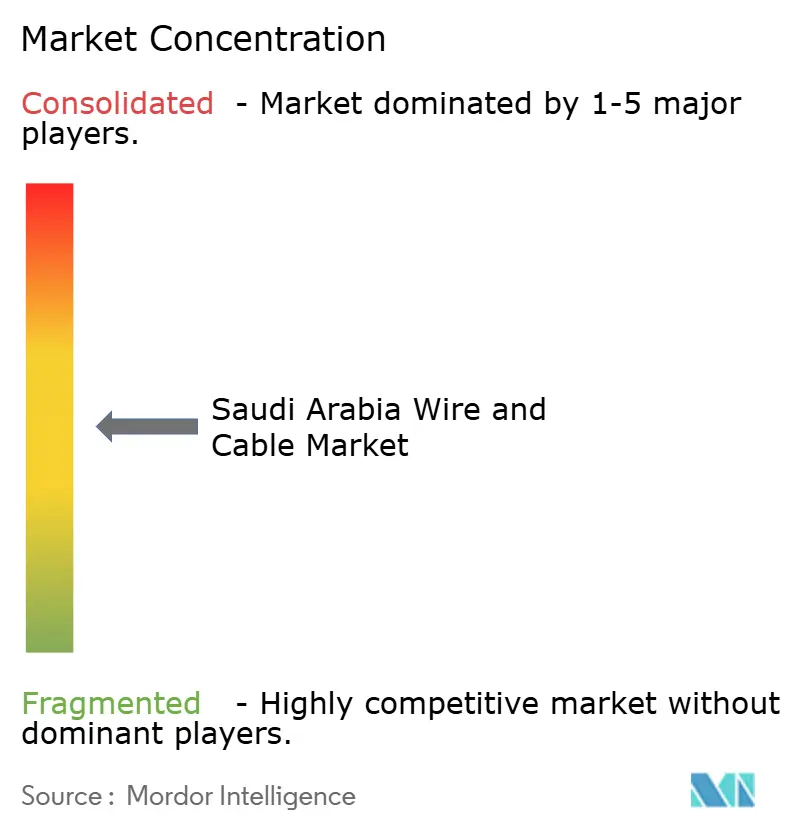
The Saudi Arabia wire and cable market is moderately concentrated in domestic low-voltage and medium-voltage manufacturing. Riyadh Cables Group, Bahra Electric, Saudi Cable Company, Jeddah Cables Company, and Alfanar form the core domestic supplier group. These companies compete on local-content qualification, delivery performance, utility prequalification, and local production capability. International companies remain important in categories where local capacity or qualification is limited.
Nexans, Prysmian, and NKT are active in extra-high-voltage and submarine cable categories. These applications require specialized production, testing, and operating records. Riyadh Cables completed domestic type testing of its 1×2,500 mm², 400 kV extra-high-voltage cable system in 2026, which strengthened its position in future extra-high-voltage tenders. Bahra Electric’s 2025 agreement with Prysmian to manufacture OPGW expanded its specialized product capability. These moves show how domestic manufacturers are building capacity in products previously supplied mainly from outside the Kingdom.
Elsewedy Electric combines local manufacturing with turnkey engineering, procurement, and construction delivery. The company invested more than USD 300 million in Saudi Arabia over the 2 years preceding early 2026 and held a project backlog exceeding USD 5 billion at that point. Its approach allows it to participate in both manufacturing and infrastructure delivery. Smaller suppliers, including Masarat United Cables Company and National Cables Industry, compete in residential and light-commercial projects. Remote monitoring and sensor-integrated cable systems are becoming additional points of differentiation for major projects.
Saudi Arabia Wire and Cable Industry Leaders
Riyadh Cables Group Company
Saudi Cable Company
Bahra Electric (Bahra Advanced Cable Manufacture Company Ltd.)
Jeddah Cables Company
Middle East Specialized Cables Company (MESC)
- *Disclaimer: Major Players sorted in no particular order

Recent Industry Developments
- May 2026: Riyadh Cables Group announced the successful completion of type testing for its 1×2500 mm² 400 kV extra-high-voltage cable system at its ISO 17025-accredited laboratories, making it the first GCC-based manufacturer to validate this voltage class domestically and improving its competitive position for future EHV cable tenders in Saudi Arabia and the broader region.
- April 2026: Riyadh Cables Group secured a 12-month supply contract valued at SAR 450 million (USD 120 million) with Mohammed Al Ojaimi Contracting Establishment, covering power transmission cables for key generation and infrastructure projects across Saudi Arabia. Financial impact on results is expected to begin in Q4 2026.


Saudi Arabia Wire and Cable Market Report Scope
The Saudi Arabia wire and cable market revenue is generated through the sale of low-, medium-, and high-voltage wires and cables, including power, fiber-optic, signal and control, and coaxial/data cables with copper, aluminum, or optical glass/polymer conductors, along with associated value-added products and installation-specific solutions for overhead, underground, and submarine network deployments.
The Saudi Arabia wire and cable market report is segmented by voltage (extra- and high-voltage (greater than 35 kV), medium-voltage (1-35 kV), and low-voltage (less than 1 kV)), cable type (power cable, fiber-optic cable, signal and control cable, and coaxial and data cable), conductor material (copper, aluminum, and optical glass/polymer), installation (overhead, underground, and submarine), end-user vertical (residential construction, commercial construction, power infrastructure (utilities and renewables), telecommunications and data centers, oil and gas and petrochemicals, automotive and mobility, and industrial manufacturing), and insulation (insulated and non-insulated). The market forecasts are provided in terms of value (USD).
| Extra- and High-Voltage (Greater Than 35 kV) |
| Medium-Voltage (1-35 kV) |
| Low-Voltage (Less Than 1 kV) |
| Power Cable |
| Fiber-Optic Cable |
| Signal and Control Cable |
| Coaxial and Data Cable |
| Copper |
| Aluminum |
| Optical Glass/Polymer |
| Overhead |
| Underground |
| Submarine |
| Residential Construction |
| Commercial Construction |
| Power Infrastructure (Utilities and Renewables) |
| Telecommunications and Data Centers |
| Oil and Gas and Petrochemicals |
| Automotive and Mobility |
| Industrial Manufacturing |
| Insulated |
| Non-Insulated |
| By Voltage | Extra- and High-Voltage (Greater Than 35 kV) |
| Medium-Voltage (1-35 kV) | |
| Low-Voltage (Less Than 1 kV) | |
| By Cable Type | Power Cable |
| Fiber-Optic Cable | |
| Signal and Control Cable | |
| Coaxial and Data Cable | |
| By Conductor Material | Copper |
| Aluminum | |
| Optical Glass/Polymer | |
| By Installation | Overhead |
| Underground | |
| Submarine | |
| By End-User Vertical | Residential Construction |
| Commercial Construction | |
| Power Infrastructure (Utilities and Renewables) | |
| Telecommunications and Data Centers | |
| Oil and Gas and Petrochemicals | |
| Automotive and Mobility | |
| Industrial Manufacturing | |
| By Insulation | Insulated |
| Non-Insulated |


Key Questions Answered in the Report
What is the size of the Saudi Arabia wire and cable market?
The Saudi Arabia wire and cable market was valued at USD 1.98 billion in 2025 and is estimated to reach USD 2.53 billion by 2031 at a 4.10% CAGR.
Which voltage category held the largest share in 2025?
Low-voltage cables held 45.72% of the market in 2025, supported by residential, commercial, and industrial distribution requirements.
Which cable type is expected to grow fastest through 2031?
Fiber-optic cables are projected to expand at a 5.74% CAGR through 2031, supported by fiber, 5G, and data-center investment.
Why are underground cable systems important in Saudi Arabia?
Underground systems held 54.63% of the market in 2025 because urban projects need protected, visually integrated networks that can withstand demanding conditions.
What is driving demand from utilities and renewables?
Power infrastructure, utilities and renewables, held 25.84% of the market in 2025, supported by transmission expansion, substations, storage, and renewable connections.
Which insulation category leads demand?
Insulated cables held 89.36% of the market in 2025 and are projected to expand at a 6.70% CAGR through 2031.
Page last updated on:


 Your data is secure and never sold or shared.


