
Saudi Arabia Less-than Truckload (LTL) Market Size and Share
Market Overview
| Study Period | 2021 - 2032 |
|---|---|
| Forecast Data Period | 2027 - 2032 |
| Base Year Market Size (2026) | USD 2.67 Billion |
| Market Size (2027) | USD 2.87 Billion |
| Market Size (2032) | USD 3.85 Billion |
| Growth Rate (2027 - 2032) | 6.00 % |
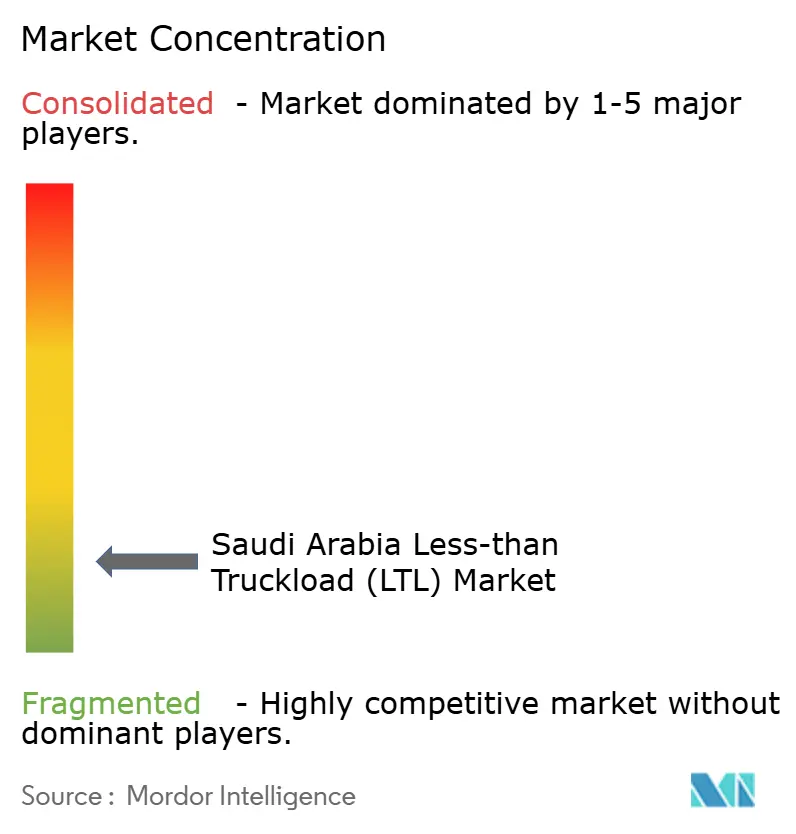
| Market Concentration | Low |
Major Players *Disclaimer: Major Players sorted in no particular order Image © Mordor Intelligence. Reuse requires attribution under CC BY 4.0. | |
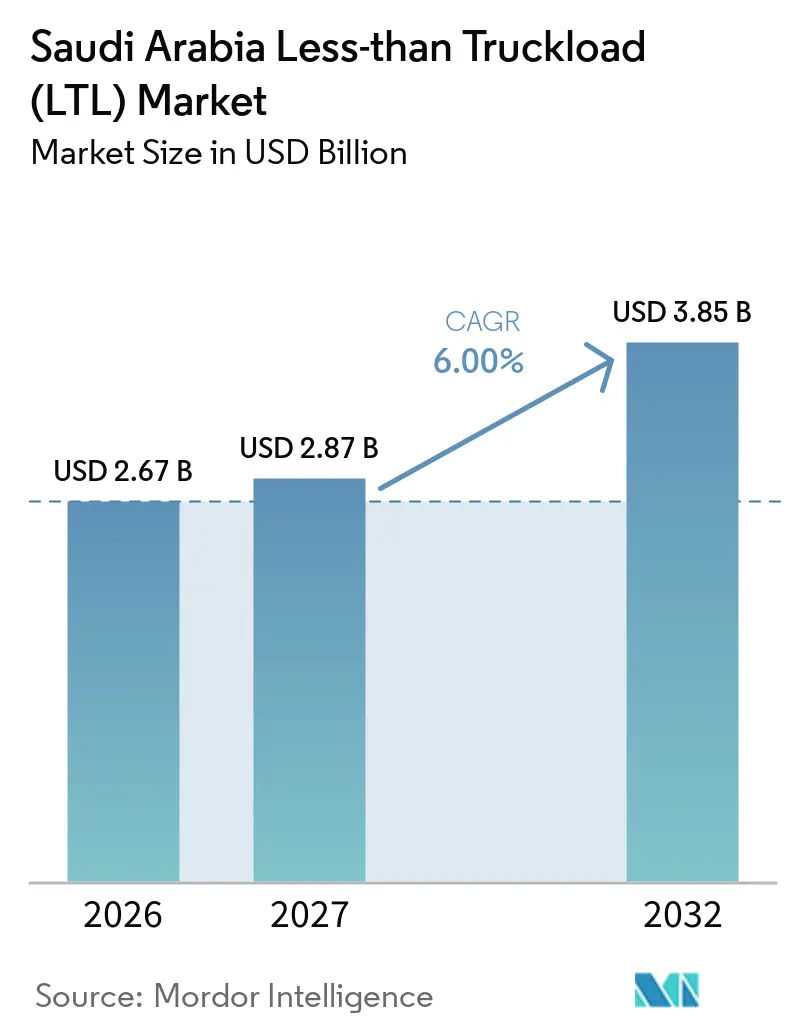
Saudi Arabia Less-than Truckload (LTL) Market Analysis by Mordor Intelligence
The Saudi Arabia less-than truckload (LTL) market size is valued at USD 2.67 billion in 2026. It is estimated to grow from USD 2.87 billion in 2027 to reach USD 3.85 billion by 2032, at a CAGR of 6.00% during the forecast period (2027-2032).
Growth is supported by frequent small consignments from e-commerce, investment in freight infrastructure under Vision 2030, and diversification of the non-oil economy. Manufacturing excluding oil refining contributed 11.1% of Saudi Arabia's GDP at current prices in 2025, while wholesale and retail trade, restaurants, and hotels accounted for 12.3%. These activities support demand for regular distribution and consolidated freight movements. Road transport remains important for connecting production sites, ports, distribution centers, and end customers. Infrastructure development and digital scheduling can improve vehicle utilization and delivery coordination, although driver availability, compliance costs, and low freight density on some routes remain operational constraints. Carriers with reliable national coverage, efficient consolidation, and specialized handling capabilities are positioned to compete as demand develops.
Key Report Takeaways
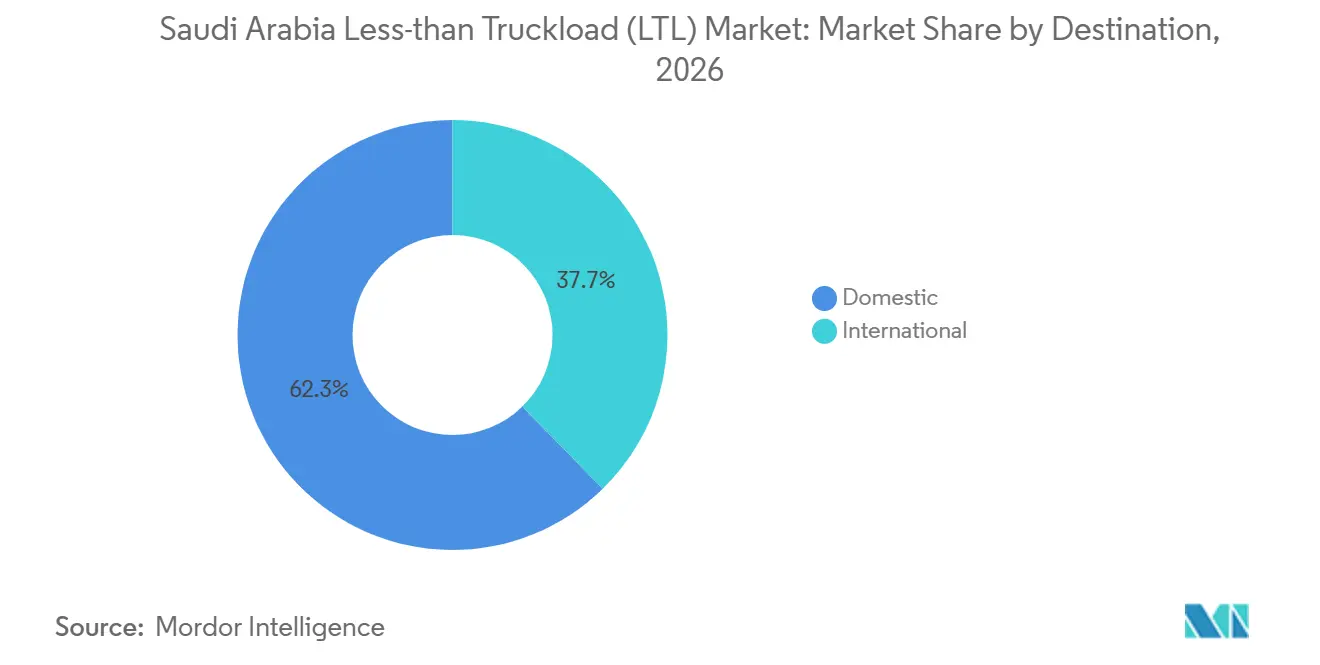
- By destination, domestic shipments account for 62.35% of the Saudi Arabia less-than truckload (LTL) market size in 2026, while international shipments are projected to register a CAGR of 7.87% through 2032.
- By temperature control, dry freight accounts for 88.46% of the Saudi Arabia less-than truckload (LTL) market share in 2026, while reefer freight is projected to register a CAGR of 6.98% through 2032.
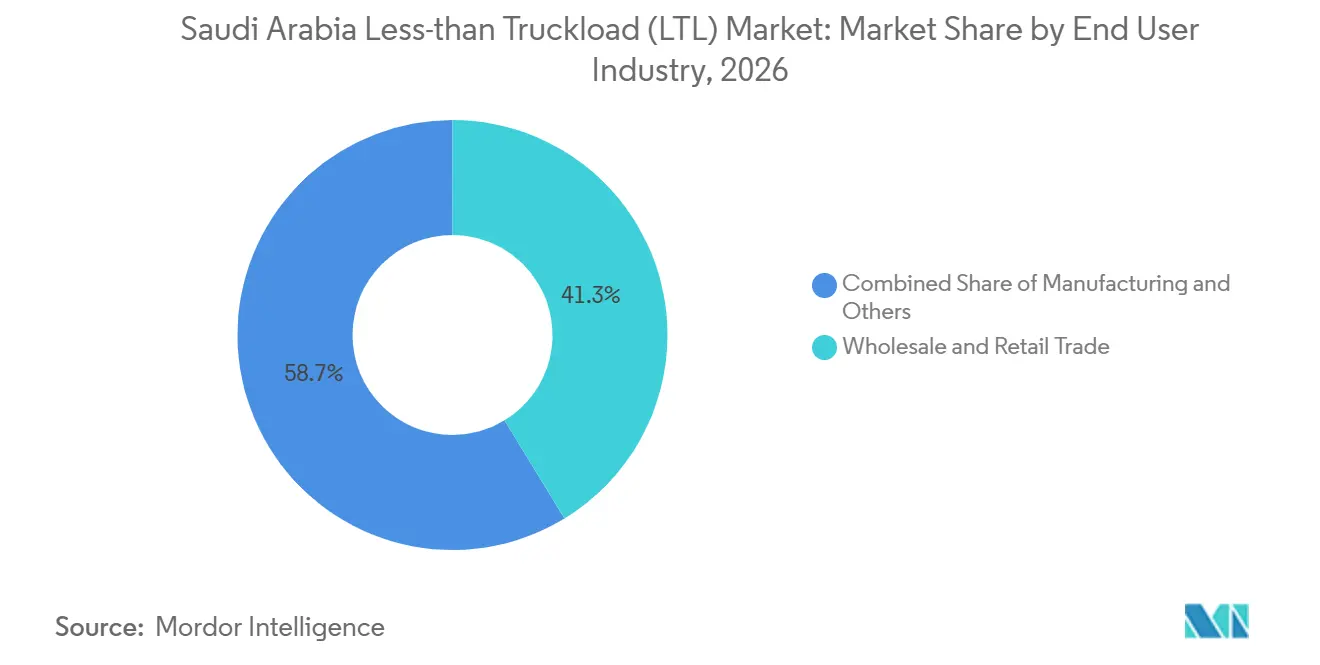
- By end-user industry, wholesale and retail trade accounts for 41.28% of the Saudi Arabia less-than truckload (LTL) market share in 2026, while manufacturing is projected to register a CAGR of 8.24% through 2032.
- By region, the Central region, comprising Riyadh, Al-Qassim, and Hail, accounts for 36.96% of the Saudi Arabia less-than truckload (LTL) market size in 2026. The Southern region, comprising Asir, Jazan, and Najran, is projected to register a CAGR of 8.39% through 2032.
Note: Market numbers in this report are based on Mordor Intelligence's proprietary estimation framework, which combines nine months of actuals with Q4 projections for base year 2026.
Saudi Arabia Less-than Truckload (LTL) Market Trends and Insights
Drivers Impact Analysis*
| Driver | (~) % Impact on CAGR Forecast | Geographic Relevance | Impact Timeline |
|---|---|---|---|
| E-Commerce Fragmentation Increasing LTL Shipment Frequency | +1.4% | National, with concentration in Riyadh, Jeddah, and Dammam | Short term (≤ 2 years) |
| Vision 2030 Projects Expanding LTL Freight Demand | +1.2% | National, with early gains in Central and Western regions | Long term (≥ 4 years) |
| Manufacturing and Retail Growth Increasing Consolidation Demand | +1.0% | Central (Riyadh) and Eastern (Dammam/Jubail industrial zones) | Medium term (2–4 years) |
| Digital Freight Matching Improving LTL Asset Utilization | +0.9% | National, with platform adoption led by Riyadh and Jeddah hubs | Short term (≤ 2 years) |
| Temperature-Sensitive Distribution Expanding Specialized LTL Demand | +0.6% | National; critical in Jeddah port gateway and Central cold storage clusters | Medium term (2–4 years) |
| Micro-Hub Networks Strengthening Scheduled Line-Haul Efficiency | +0.5% | National; concentrated in urban freight corridors linking Riyadh, Jeddah, and Dammam | Medium term (2–4 years) |
| Source: Mordor Intelligence | |||
E-Commerce Fragmentation Increasing LTL Shipment Frequency
The Saudi Arabia LTL market benefits from the volume and diversity of shipments generated by e-commerce and retail distribution. The Transport General Authority reported more than 57 million parcel shipments and postal parcels in the fourth quarter of 2025, reflecting the scale of activity in the wider delivery sector[1]. Larger consignments that are not economical to move as full truckloads can be consolidated with shipments from other businesses, supporting demand for scheduled LTL services. Carriers that connect distribution centers, retail outlets, and regional delivery points can serve this demand through shared trailer capacity. Reliable collection schedules, shipment visibility, and predictable delivery windows are important differentiators as shippers seek to balance service quality and transport costs.
Vision 2030 Projects Expanding LTL Freight Demand
Vision 2030 infrastructure and diversification initiatives support the development of freight networks across Saudi Arabia. The expansion of logistics zones and investment in industrial and transport infrastructure can create new origins, destinations, and consolidation opportunities for LTL operators. In November 2025, DHL Supply Chain announced a EUR 130 million (USD 152.92 million) investment in a regional logistics and distribution hub at Riyadh's Special Integrated Logistics Zone. The planned facility covers 78,000 m² of land and includes 53,000 m² of warehouse space, with a 26-year lease arrangement. The development is intended to serve industries including technology, retail and consumer goods, automotive, energy, and e-commerce. Such facilities can increase demand for distribution services between logistics hubs and business customers as they become operational.
Manufacturing and Retail Growth Increasing Consolidation Demand
Manufacturing and retail distribution generate recurring freight movements between suppliers, production sites, distribution centers, and end customers. GASTAT reported that manufacturing activities excluding oil refining contributed 11.1% of Saudi Arabia's GDP at current prices in 2025, while wholesale and retail trade, restaurants, and hotels contributed 12.3%. These sectors require the movement of components, finished products, consumer goods, and store replenishment shipments. Many consignments do not fill a complete truck, making consolidation useful when delivery schedules and handling requirements are compatible. As manufacturers and retailers serve customers across multiple cities, LTL carriers can combine shipments across established freight corridors. Efficient terminal operations and dependable delivery schedules remain important for controlling costs and meeting customer requirements.
Digital Freight Matching, Specialized Distribution, and Micro-Hub Networks
Digital freight matching can help LTL operators coordinate shipments from different customers, improve vehicle utilization, and plan collection and delivery schedules. These systems are most effective when carriers have reliable shipment data, sufficient route density, and operational processes that support consolidation. Specialized distribution can also create opportunities in sectors that require additional handling, including pharmaceuticals, healthcare products, and temperature-sensitive goods. In October 2025, AJEX Logistics Services opened a 3,000 m² GMP-GxP-compliant logistics depot in Riyadh to support life sciences distribution. Urban consolidation points and partner networks may help carriers connect major freight hubs with secondary cities, provided that shipment density supports the cost of operating these facilities.
Restraints Impact Analysis*
| Restraint | (~) % Impact on CAGR Forecast | Geographic Relevance | Impact Timeline |
|---|---|---|---|
| Driver Shortages and Saudization Limiting Capacity Availability | -0.8% | National; acute in Central and Eastern regions during peak periods | Short term (≤ 2 years) |
| Low-Density Deliveries Weakening Peripheral Route Economics | -0.5% | Northern (Al-Jouf, Arar) and Southern (Najran) border regions | Long term (≥ 4 years) |
| Diesel and Compliance Costs Increasing LTL Expenses | -0.4% | National; heaviest burden on smaller carriers and cross-border routes | Medium term (2–4 years) |
| Fragmented Visibility Reducing Small-Carrier Network Efficiency | -0.3% | National, disproportionate impact on carriers outside Riyadh–Jeddah–Dammam triangle | Medium term (2–4 years) |
| Source: Mordor Intelligence | |||
Driver Shortages, Saudization, and Compliance Costs Limiting Capacity
Labor availability, training requirements, and regulatory compliance can constrain capacity in the Saudi Arabia LTL market. Operators must maintain qualified drivers and meet applicable employment, vehicle, and transport requirements while preserving competitive service costs. In November 2025, the Human Resources Development Fund reported that its partnerships with the transport and logistics sector had supported the employment of 74,000 Saudi nationals between 2020 and the first half of 2025[2]. The programmes involved more than SAR 500 million (USD 133.23 million) in support and included job-linked training initiatives. Smaller carriers may have less capacity than large operators to absorb recruitment, training, and fleet-compliance costs. Efficient route planning and workforce development can help mitigate these pressures, although the effects will vary by operator and location.
Low-Density Routes and Fragmented Small-Carrier Visibility
Low shipment density can weaken the economics of scheduled LTL services outside major commercial and industrial centers. Carriers operating routes across sparsely populated areas may have fewer opportunities to combine shipments, which can increase the cost per consignment or require longer delivery windows. This challenge can be more pronounced on routes serving smaller markets in the Northern and Southern regions, although conditions vary by corridor and customer base. Fragmented capacity among smaller operators can also make it harder for shippers to compare service availability and coordinate shipments across different carriers. Digital booking, partner networks, and shared consolidation points can improve access to capacity, but their effectiveness depends on reliable information, consistent service standards, and sufficient shipment volumes.
*Our forecasts treat driver/restraint impacts as directional, not additive. The impact forecasts reflect baseline growth, mix effects, and variable interactions.
Segment Analysis
By Destination: Domestic Networks Anchor Revenue, Cross-Border Routes Gain Momentum
Domestic shipments account for 62.35% of the Saudi Arabia less-than truckload (LTL) market size in 2026. Demand is supported by consumer goods distribution, retail replenishment, and manufacturing supply chains that move shipments between production facilities, warehouses, and end customers. Riyadh, Jeddah, and Dammam are important commercial and logistics centers, while secondary cities require connections to the main freight network. Consolidation allows carriers to combine smaller shipments moving along compatible routes, reducing the need for individual shippers to book full truckloads. Reliable documentation, collection planning, and cross-dock coordination can support efficient domestic services. Operators seeking national coverage need to balance the high shipment density of major corridors with the operating costs of serving less-dense locations.
International shipments are projected to register at a CAGR of 7.87% through 2032. Cross-border demand can be supported by regional trade, business supply chains, and consignments moving between Saudi Arabia and neighbouring markets. Shipments moving through land borders may require coordination of customs documentation, vehicle compliance, and delivery schedules across different jurisdictions. These requirements can favor operators with established cross-border processes and dependable partner networks. However, the growth outlook does not establish that capacity constraints or elevated freight rates apply across all international routes. LTL providers that can consolidate compatible shipments and manage border formalities efficiently may be positioned to capture additional demand as regional trade develops.

By Temperature Control: Dry Dominates, Reefer Adds Specialized Capacity
Dry freight accounts for 88.46% of the Saudi Arabia less-than truckload (LTL) market share in 2026. Ambient consumer goods, retail merchandise, packaged products, and many industrial supplies can be transported using standard equipment, giving carriers a broad base of potential shipments. Dry freight networks can consolidate compatible consignments across established routes without the additional equipment and monitoring requirements associated with temperature-controlled transport. However, operating efficiency still depends on shipment density, handling requirements, vehicle utilization, and reliable delivery schedules. Competition in this category can place pressure on margins, making route planning and terminal productivity important to carrier performance.
Reefer freight is projected to register at a CAGR of 6.98% through 2032. Food distribution, pharmaceutical logistics, and other temperature-sensitive supply chains can require specialized vehicles, monitoring systems, and handling procedures. In October 2025, AJEX opened a 3,000 m² GMP-GxP-compliant depot in Riyadh, adding specialized life sciences logistics capacity[3]. The facility includes separate temperature-controlled chambers and is designed to support regulated product handling. Reefer operators must manage equipment costs, temperature control, product-specific requirements, and the risk of running vehicles without compatible return loads.
By End-User Industry: Wholesale and Retail Trade Leads, Manufacturing Grows Faster
Wholesale and retail trade accounts for 41.28% of the Saudi Arabia less-than truckload (LTL) market size in 2026, making it the largest end-user segment. Retailers, wholesalers, and distribution centers generate recurring movements of consumer goods and store replenishment shipments. These flows often involve multiple destinations and shipment sizes that are suitable for consolidation. The broader sector provides an important economic base for distribution demand, although its GDP contribution is not a direct measure of LTL freight volumes. Delivery reliability, handling accuracy, and schedule adherence remain important for retailers managing stock availability across multiple locations.
Manufacturing is projected to register a CAGR of 8.24% through 2032. Manufacturing supply chains can generate inbound movements of components and materials, as well as outbound shipments of finished products. These shipments may require a combination of local distribution, intercity transport, and connections between industrial zones and major commercial hubs. Industrial centers such as Jubail and Yanbu are relevant to the wider freight network because of their industrial and port-related activities. LTL carriers can serve manufacturers by providing scheduled collections, consolidated outbound distribution, shipment visibility, and handling services suited to the customer's products.
Geography Analysis
The Central region accounts for 36.96% of the Saudi Arabia less-than truckload (LTL) market size in 2026. It remains an important consolidation point for freight moving between major commercial and industrial centers. Riyadh connects national distribution networks with retail, manufacturing, and logistics customers. In November 2025, DHL Supply Chain signed a 26-year land lease arrangement at the Special Integrated Logistics Zone in Riyadh for a planned EUR 130 million (USD 152.92 million) regional logistics and distribution hub[4]. The project is designed to provide 53,000 m² of warehouse space on a 78,000 m² site and to serve sectors including retail, technology, automotive, energy, and e-commerce. The Eastern region complements this network through industrial and port-related freight activity around Dammam and Jubail. The movement of shipments between Central and Eastern markets creates opportunities for LTL operators that can consolidate compatible freight and maintain dependable schedules.
The Western region supports freight flows associated with Jeddah's maritime gateway, retail distribution, and service requirements linked to Makkah and Medina. Port-related cargo can generate onward movements to warehouses, distribution centers, and customers across the Kingdom, including consignments that do not require a full truckload. The region also serves food, beverage, pharmaceutical, and hospitality supply chains. NEOM and other developments in the wider northwest may create additional logistics demand as projects progress. Still, the effect on LTL volumes depends on actual activity and the resulting freight requirements. Carriers serving the Western region need to coordinate port collections, urban deliveries, and intercity transport while accounting for variations in shipment size and customer delivery windows.
The Southern region is projected to register a CAGR of 8.39% through 2032. Agricultural distribution, industrial development around Jazan, and regional trade can support demand for freight services. The Eastern region continues to draw on industrial and downstream distribution requirements, while the Northern region has a more dispersed customer base and potentially lower freight density on some routes. These differences favour region-specific operating models rather than a uniform national approach. Shared capacity, partner networks, and digital shipment coordination can help extend service coverage, provided that the volume and timing of consignments support commercially viable schedules.
Competitive Landscape
The Saudi Arabia LTL market is fragmented and includes international logistics groups, regional operators, and domestic transport providers. Competition depends on geographic coverage, terminal and warehouse access, cross-border capabilities, service reliability, and the ability to consolidate compatible shipments. Larger international operators can draw on broader logistics networks and integrated services, while domestic providers may benefit from local customer relationships and knowledge of regional operating conditions.
In February 2026, DSV announced the integration go-live of its Schenker operations in Saudi Arabia. The combined organization covers air and sea, contract logistics, and road services. The company reported a Saudi network comprising 29 facilities and more than 1,150 logistics specialists. This integration may strengthen the company's ability to coordinate services across modes and logistics functions. In May 2025, Kuehne+Nagel announced that it had become the first company to receive an Authorized Economic Operator licence for Customs Brokerage in Saudi Arabia. The certification supports customs processes and can be relevant to international freight services, including shipments requiring border clearance.
Domestic providers and specialist operators compete through local coverage, service flexibility, and sector-specific capabilities. In August 2025, DHL eCommerce completed its acquisition of a minority stake in AJEX Logistics Services. At the time of the announcement, AJEX reported more than 60 facilities and 1,200 vehicles, with DHL eCommerce gaining management board representation and an option to increase its stake in the future. The partnership was presented as a way to combine AJEX's regional network with DHL's international e-commerce capabilities. In October 2025, AJEX also opened a GMP-GxP-compliant depot in Riyadh for life sciences logistics. In October 2025, SAL completed the final land agreement for its planned logistics zone at Falcon City, north of Riyadh. The project covers approximately 1.57 million m², with planned investment of about SAR 4.1 billion (USD 1.09 billion) and revenue generation expected from 2028 as development progresses. The project is intended to integrate warehousing, storage, and multimodal connectivity.
Saudi Arabia Less-than Truckload (LTL) Industry Leaders
-
CEVA Almajdouie Logistics
-
Wared Logistics
-
SMSA Express Transportation Company Ltd
-
DSV A/S (including DB Schenker)
-
DHL Group
- *Disclaimer: Major Players sorted in no particular order
Recent Industry Developments
- October 2026: Port of NEOM and CEVA Almajdouie Logistics signed a memorandum of understanding. The companies agreed to explore integrated logistics solutions across an emerging multimodal corridor linking Europe, Egypt, Saudi Arabia, the GCC, and Iraq. The planned collaboration combines Port of NEOM's Red Sea location with CEVA Almajdouie Logistics' transport, customs brokerage, warehousing, and cross-border capabilities.
- November 2025: DHL Supply Chain signed a 26-year land lease agreement at Riyadh's Special Integrated Logistics Zone. The company announced a EUR 130 million (USD 152.92 million) investment in a planned regional logistics and distribution hub. The site covers 78,000 m² of land, including 53,000 m² of warehouse space, and is intended to serve multiple industries. The project adds to the logistics infrastructure planned for Riyadh, although its effect on LTL capacity will depend on commissioning and operational use.
- August 2025: DHL eCommerce completed its minority investment in AJEX Logistics Services. The transaction gave DHL eCommerce representation on AJEX's management board and an option to increase its stake to a majority position in the future. At the time of the announcement, AJEX reported more than 60 facilities and 1,200 vehicles. The partnership combines AJEX's regional and domestic parcel network with DHL eCommerce's international e-commerce capabilities.
- July 2025: ADQ completed its acquisition of approximately 63% of Aramex. The transaction brought Aramex into ADQ's portfolio and may support its broader regional logistics strategy. Its implications for Saudi Arabia's LTL market depend on the services and investments that are subsequently deployed in the Kingdom.
Saudi Arabia Less-than Truckload (LTL) Market Report Scope
| Domestic |
| International |
| Dry |
| Reefer |
| Agriculture, Fishing, and Forestry |
| Construction |
| Manufacturing |
| Oil and Gas, Mining and Quarrying |
| Wholesale and Retail Trade |
| Others |
| Central (Riyadh, Al-Qassim, and Hail) |
| Eastern (Ash-Sharqiyah) |
| Western (Al-Bahah, Makkah, Medina, and Tabuk) |
| Northern (Al-Jouf and Arar) |
| Southern (Asir, Jazan, and Najran) |
| By Destination | Domestic |
| International | |
| By Temperature Control | Dry |
| Reefer | |
| By End-User Industry | Agriculture, Fishing, and Forestry |
| Construction | |
| Manufacturing | |
| Oil and Gas, Mining and Quarrying | |
| Wholesale and Retail Trade | |
| Others | |
| By Region | Central (Riyadh, Al-Qassim, and Hail) |
| Eastern (Ash-Sharqiyah) | |
| Western (Al-Bahah, Makkah, Medina, and Tabuk) | |
| Northern (Al-Jouf and Arar) | |
| Southern (Asir, Jazan, and Najran) |
Key Questions Answered in the Report
What is the forecast for less-than truckload freight in Saudi Arabia?
The Saudi Arabia LTL market is projected to increase from USD 2.87 billion in 2027 to USD 3.85 billion by 2032, registering a CAGR of 6.00%.
Which shipment destination leads Saudi Arabia's LTL market?
Domestic shipments are leading with a 62.35% share in 2026, supported by consumer goods distribution, retail replenishment, and manufacturing supply chains.
What is driving cross-border LTL growth in Saudi Arabia?
International shipments are projected to register a CAGR of 7.87% through 2032, supported by regional trade and demand for cross-border distribution.
Which temperature-control category is growing fastest?
Reefer freight is projected to register a CAGR of 6.98% through 2032, supported by demand for specialized food and pharmaceutical logistics.
Which customer sector is expanding fastest for shared truck freight?
Manufacturing is projected to register a CAGR of 8.24% through 2032 as production and distribution supply chains generate demand for freight services.
Which Saudi region has the strongest growth outlook for LTL services?
The Southern region, comprising Asir, Jazan, and Najran, is projected to register at a CAGR of 8.39% through 2032.